ANTHRAX
Dr Ashish Tanwer
Teaching Associate
V. C.C, C.V.A.S Bikaner
Synonyms:- Splenic Fever, Wool sorter’s disease
From the Greek word anthrakos for coal
• Caused by spores
• Primarily a disease of domesticated & wild animals
– Herbivores such as sheep, cows, horses, goats
• Natural reservoir is soil
– Does not depend on an animal reservoir making it
hard to eradicate
– Cannot be regularly cultivated from soils where there
is an absence of endemic anthrax
– Occurs sporadically throughout US
– South Dakota, Arkansas, Texas, Louisiana, Mississippi,
California recognized endemic areas
ANTHRAX
General Characteristics of Bacillus
~ 60 species; Gram-positive or Gram-variable bacilli
• Large (0.5 x 1.2 to 2.5 x 10 um)
• Most are saprophytic contaminants or normal flora
• Bacillus anthracis is most important member
 Produce endospores
 Aerobic or facultatively anaerobic
 Bacillus spp. are ubiquitous
• Soil, water, and airborne dust
• Thermophilic (< 75°C) and psychrophilic (>5-8°C)
• Can flourish at extremes of acidity & alkalinity (pH 2 to
10)
A Closer Look at Anthrax
• Anthrax is a disease of cattle, goats, and sheep caused by a
bacterium, Bacillus anthracis. It is rare for humans to be infected.
Most infections that do occur are localized to small cuts in the
skin whose edges turn black (hence the name “anthracis”,after
anthracite coal). The disease is deadly for humans because B.
anthracis produces lethal Toxins.
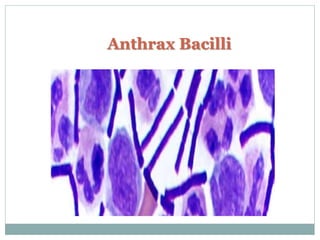
Anthrax Bacilli
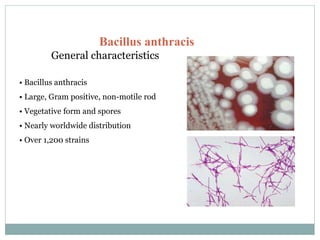
Bacillus anthracis
General characteristics
• Bacillus anthracis
• Large, Gram positive, non-motile rod
• Vegetative form and spores
• Nearly worldwide distribution
• Over 1,200 strains
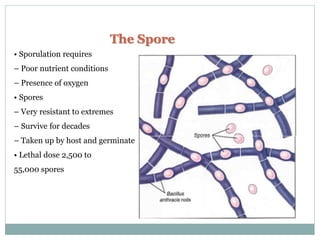
The Spore
• Sporulation requires
– Poor nutrient conditions
– Presence of oxygen
• Spores
– Very resistant to extremes
– Survive for decades
– Taken up by host and germinate
• Lethal dose 2,500 to
55,000 spores
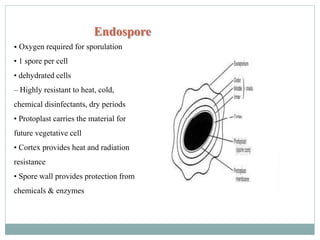
Endospore
• Oxygen required for sporulation
• 1 spore per cell
• dehydrated cells
– Highly resistant to heat, cold,
chemical disinfectants, dry periods
• Protoplast carries the material for
future vegetative cell
• Cortex provides heat and radiation
resistance
• Spore wall provides protection from
chemicals & enzymes
Mechanism of Infection
• Anthrax spores enter body
• Germinate & multiple in lymph nodes
• PA, EF, LF excreted from bacteria
• PA binds to TEM8.
• EF and/or LF binds
• Complex internalized by endocytosis
• Acidification of endosome
• LF or EF crosses into cytosol
via PA mediated ion conductive
channels
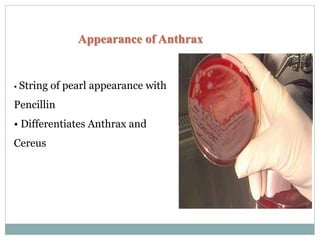
Appearance of Anthrax
• String of pearl appearance with
Pencillin
• Differentiates Anthrax and
Cereus
Antibiotics
• Pencillin
• Erythrocin
• Tetracycline
• Chloramphenicol
• Occasional strains
resistant to penicillin
are encountered
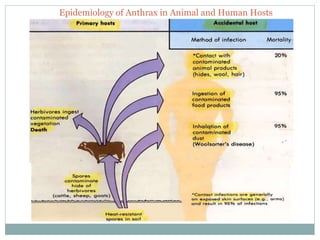
Epidemiology of Anthrax in Animal and Human Hosts
Three forms of Anthrax
• Cutaneous anthrax
– Skin
– Most common
– Spores enter to skin through small lesions
• Inhalation anthrax
– Spores are inhaled
• Gastrointestinal (GI) anthrax
– Spores are ingested
– Oral-pharyngeal and abdominal
Pathogenesis
• Anthrax spores enter body
• Germinate & multiple in lymph nodes
• PA, EF, LF excreted from bacteria
• PA binds to TEM8.
• PA nicked by protease furin
– 20-kDa segment off leaving 63-kDa peptide
– Heptamer forms
• EF and/or LF binds
• Complex internalized by endocytosis
• Acidification of endosome
• LF or EF crosses into cytosol via PA mediated ion-conductive
channels
• LF cleaves MAPKK 1 & 2
• EF stimulates cAMP
Diagnosis
History: Sudden changes in climate and sudden death.
Symptoms: Sudden death and bleeding from natural opening .
Postmortem finding : oozing of dark- tarry coloured blood from
natural opening, enlargement of spleen i.e. Splenomegaly.
Microscopic examination of blood smear
Isolation and identification of organism
Treatment
Treatment is effective ,if giving in the initial stage of the disease
1. Amoxycillin@ 10-20 mg/kg or penicillin @10,000-20,000 units/kg IM or
Oxytetracycline @10mg/kg IM or IV for 5-7 days
2. Supportive treatment with antipyretics, antihistamine, corticosteroids and
fluid therapy.
Prevention and Controls
1. General measures
•Identification and isolation of affected animals
•Movements of animals from infected area to clean area should be stopped
•Deep burial of dead animals
•Destroy contaminated fodder by burning
•Thorough disinfection of cattle shed by using 10% caustic soda or formaline
or 5% phenyl
2. Vaccination
Anthrax spores vaccine @1ml sub cut every year before onset of monsoon in
area where anthrax outbreak are common
The immunity develops in 2 to 3 week and remains for 1 year.
Never conduct post-mortem of the animal suspected to be died of anthrax
Thank you

Anthrax in ruminants vpm

  • 1.
    ANTHRAX Dr Ashish Tanwer TeachingAssociate V. C.C, C.V.A.S Bikaner
  • 2.
    Synonyms:- Splenic Fever,Wool sorter’s disease From the Greek word anthrakos for coal • Caused by spores • Primarily a disease of domesticated & wild animals – Herbivores such as sheep, cows, horses, goats • Natural reservoir is soil – Does not depend on an animal reservoir making it hard to eradicate – Cannot be regularly cultivated from soils where there is an absence of endemic anthrax – Occurs sporadically throughout US – South Dakota, Arkansas, Texas, Louisiana, Mississippi, California recognized endemic areas ANTHRAX
  • 3.
    General Characteristics ofBacillus ~ 60 species; Gram-positive or Gram-variable bacilli • Large (0.5 x 1.2 to 2.5 x 10 um) • Most are saprophytic contaminants or normal flora • Bacillus anthracis is most important member  Produce endospores  Aerobic or facultatively anaerobic  Bacillus spp. are ubiquitous • Soil, water, and airborne dust • Thermophilic (< 75°C) and psychrophilic (>5-8°C) • Can flourish at extremes of acidity & alkalinity (pH 2 to 10)
  • 4.
    A Closer Lookat Anthrax • Anthrax is a disease of cattle, goats, and sheep caused by a bacterium, Bacillus anthracis. It is rare for humans to be infected. Most infections that do occur are localized to small cuts in the skin whose edges turn black (hence the name “anthracis”,after anthracite coal). The disease is deadly for humans because B. anthracis produces lethal Toxins.
  • 5.
  • 6.
    Bacillus anthracis General characteristics •Bacillus anthracis • Large, Gram positive, non-motile rod • Vegetative form and spores • Nearly worldwide distribution • Over 1,200 strains
  • 7.
    The Spore • Sporulationrequires – Poor nutrient conditions – Presence of oxygen • Spores – Very resistant to extremes – Survive for decades – Taken up by host and germinate • Lethal dose 2,500 to 55,000 spores
  • 8.
    Endospore • Oxygen requiredfor sporulation • 1 spore per cell • dehydrated cells – Highly resistant to heat, cold, chemical disinfectants, dry periods • Protoplast carries the material for future vegetative cell • Cortex provides heat and radiation resistance • Spore wall provides protection from chemicals & enzymes
  • 9.
    Mechanism of Infection •Anthrax spores enter body • Germinate & multiple in lymph nodes • PA, EF, LF excreted from bacteria • PA binds to TEM8. • EF and/or LF binds • Complex internalized by endocytosis • Acidification of endosome • LF or EF crosses into cytosol via PA mediated ion conductive channels
  • 10.
    Appearance of Anthrax •String of pearl appearance with Pencillin • Differentiates Anthrax and Cereus
  • 11.
    Antibiotics • Pencillin • Erythrocin •Tetracycline • Chloramphenicol • Occasional strains resistant to penicillin are encountered
  • 12.
    Epidemiology of Anthraxin Animal and Human Hosts
  • 13.
    Three forms ofAnthrax • Cutaneous anthrax – Skin – Most common – Spores enter to skin through small lesions • Inhalation anthrax – Spores are inhaled • Gastrointestinal (GI) anthrax – Spores are ingested – Oral-pharyngeal and abdominal
  • 14.
    Pathogenesis • Anthrax sporesenter body • Germinate & multiple in lymph nodes • PA, EF, LF excreted from bacteria • PA binds to TEM8. • PA nicked by protease furin – 20-kDa segment off leaving 63-kDa peptide – Heptamer forms • EF and/or LF binds • Complex internalized by endocytosis • Acidification of endosome • LF or EF crosses into cytosol via PA mediated ion-conductive channels • LF cleaves MAPKK 1 & 2 • EF stimulates cAMP
  • 15.
    Diagnosis History: Sudden changesin climate and sudden death. Symptoms: Sudden death and bleeding from natural opening . Postmortem finding : oozing of dark- tarry coloured blood from natural opening, enlargement of spleen i.e. Splenomegaly. Microscopic examination of blood smear Isolation and identification of organism
  • 16.
    Treatment Treatment is effective,if giving in the initial stage of the disease 1. Amoxycillin@ 10-20 mg/kg or penicillin @10,000-20,000 units/kg IM or Oxytetracycline @10mg/kg IM or IV for 5-7 days 2. Supportive treatment with antipyretics, antihistamine, corticosteroids and fluid therapy.
  • 17.
    Prevention and Controls 1.General measures •Identification and isolation of affected animals •Movements of animals from infected area to clean area should be stopped •Deep burial of dead animals •Destroy contaminated fodder by burning •Thorough disinfection of cattle shed by using 10% caustic soda or formaline or 5% phenyl 2. Vaccination Anthrax spores vaccine @1ml sub cut every year before onset of monsoon in area where anthrax outbreak are common The immunity develops in 2 to 3 week and remains for 1 year. Never conduct post-mortem of the animal suspected to be died of anthrax
  • 18.