Pregnancy
toxemia
SUSAN SCHOENIAN
Sheep & Goat Specialist Emeritus
University of Maryland Extension
sschoen@umd.edu | sheepandgoat.com
sheep101.info | wormx.info
Facebook @ MDSmallRuminant
Pregnancy
toxemia
• Very well-known disease.
• One of the most common diseases of
sheep (#7 NAHMS 2021)
• A metabolic disease that occurs in late
gestation (last 6 weeks).
• Most common metabolic disorder in
pregnant ewes.
• Usually caused by mismanagement
(nutrition) during gestation.
Other names for
pregnancy toxemia
• Twin lamb disease
• Pregnancy disease
• Gestational toxemia
• Lambing sickness
• Lambing paralysis
• Ketosis
• Hypoglycemia
Hyperketonemia
• Fatty liver syndrome
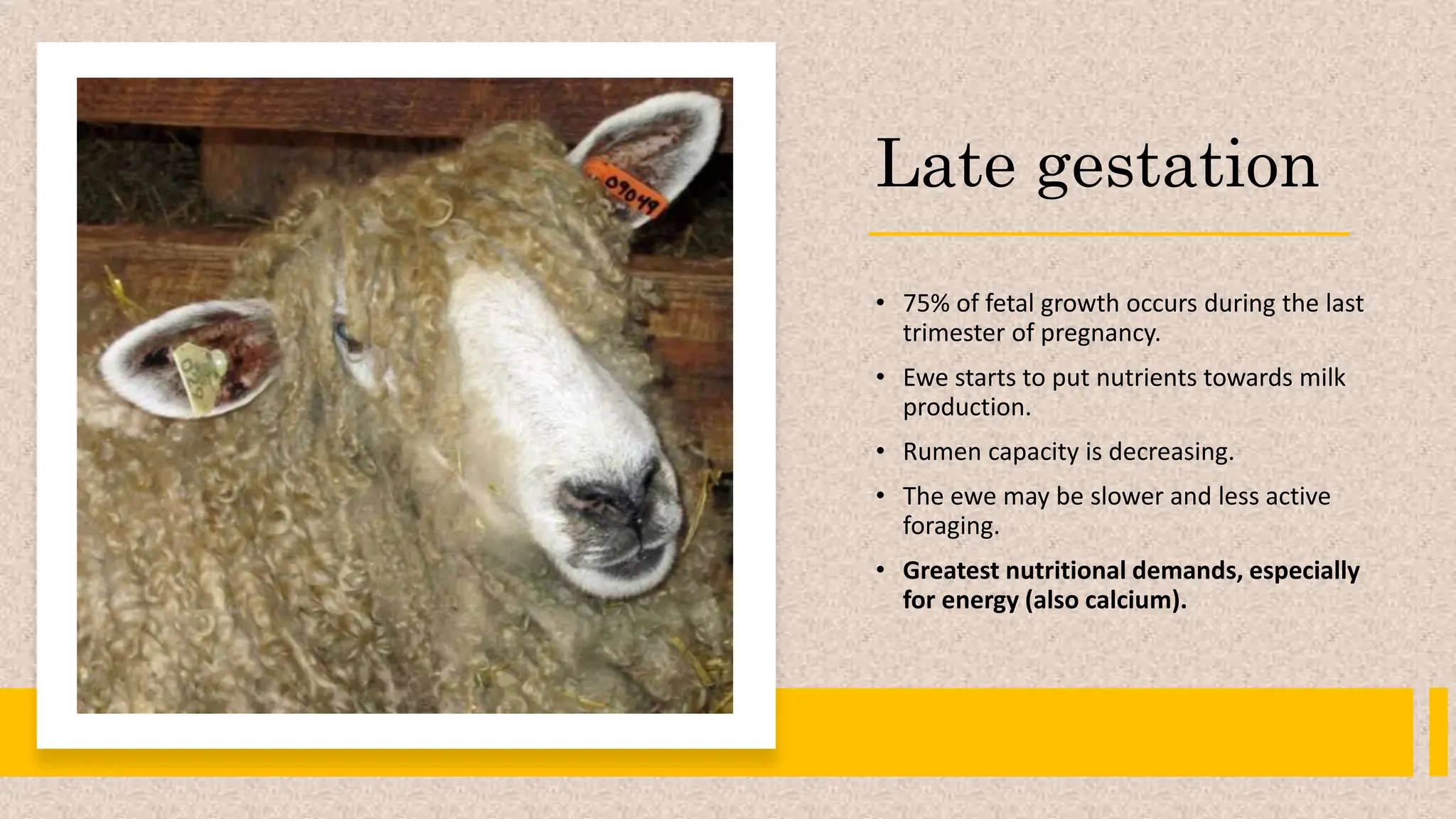
Late gestation
• 75% of fetal growth occurs during the last
trimester of pregnancy.
• Ewe starts to put nutrients towards milk
production.
• Rumen capacity is decreasing.
• The ewe may be slower and less active
foraging.
• Greatest nutritional demands, especially
for energy (also calcium).
What causes
pregnancy
toxemia?
• Negative energy balance resulting from
increased energy demands for rapid
fetal growth during late gestation.
• Insufficient nutrition during late
pregnancy.
• Inadequate intake of energy.
• Decreased rumen capacity due to fetal
growth.
• Rumen capacity can also be decreased
by large intra-abdominal fat deposits.
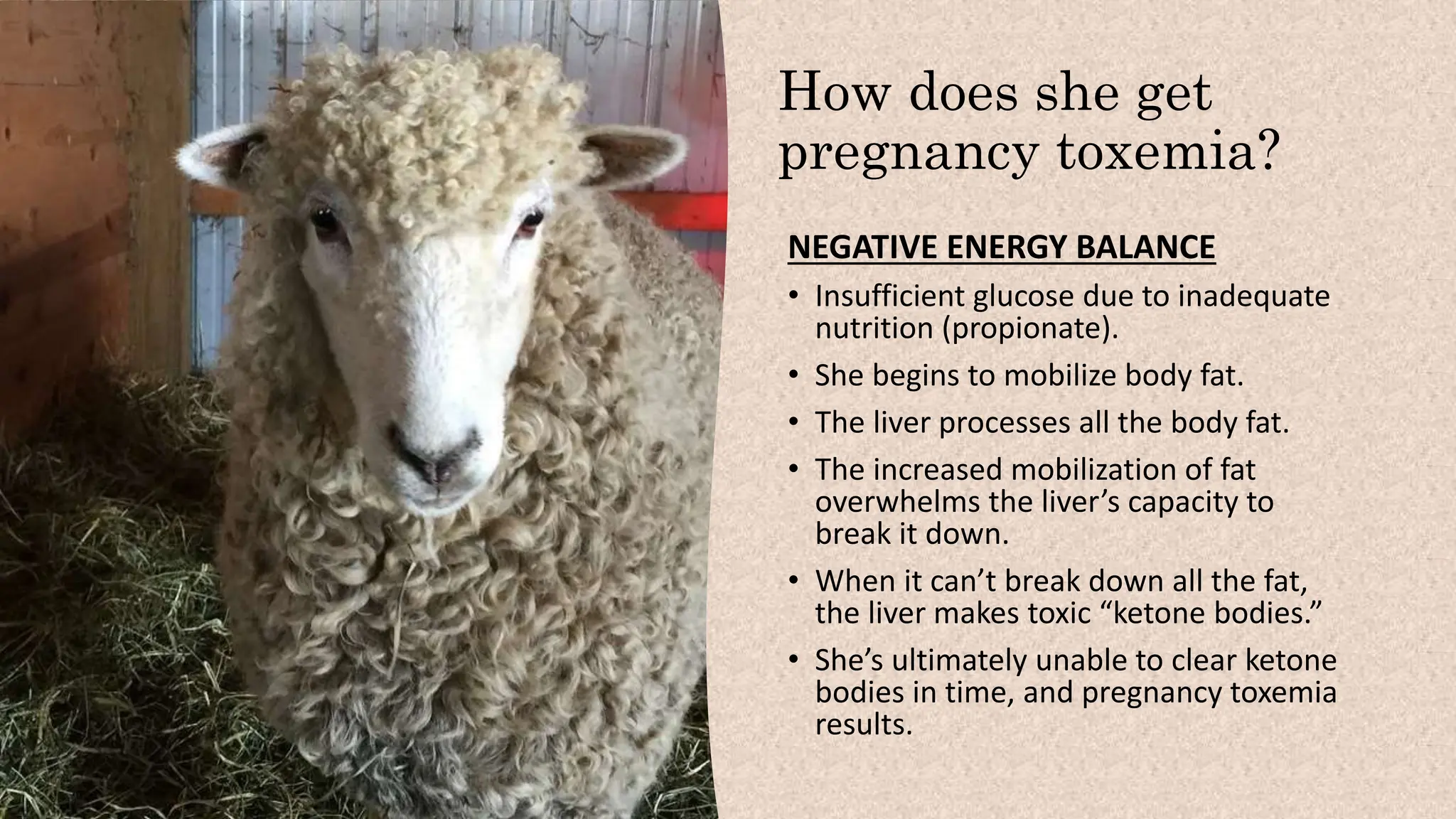
How does she get
pregnancy toxemia?
NEGATIVE ENERGY BALANCE
• Insufficient glucose due to inadequate
nutrition (propionate).
• She begins to mobilize body fat.
• The liver processes all the body fat.
• The increased mobilization of fat
overwhelms the liver’s capacity to
break it down.
• When it can’t break down all the fat,
the liver makes toxic “ketone bodies.”
• She’s ultimately unable to clear ketone
bodies in time, and pregnancy toxemia
results.
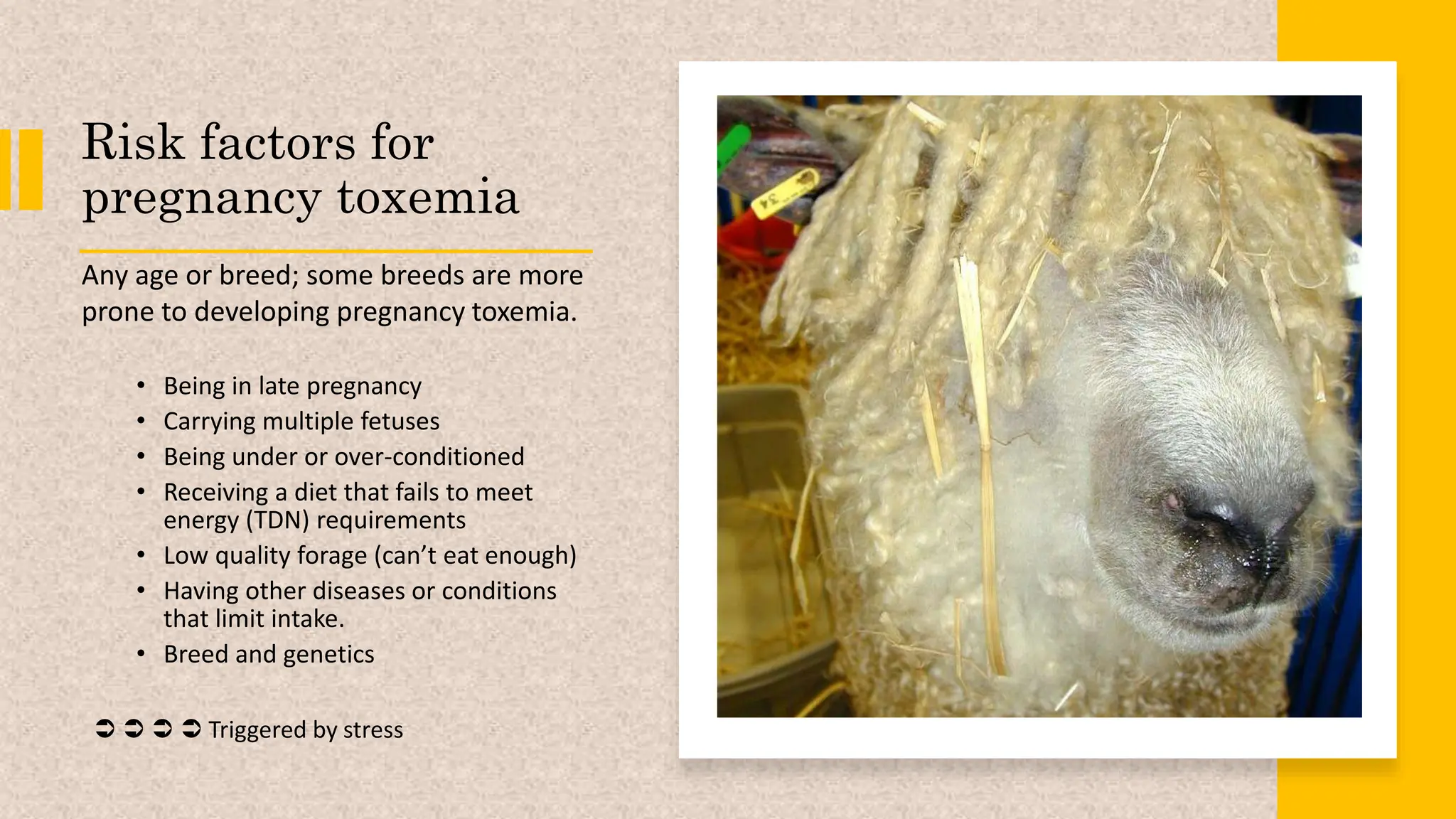
Risk factors for
pregnancy toxemia
Any age or breed; some breeds are more
prone to developing pregnancy toxemia.
• Being in late pregnancy
• Carrying multiple fetuses
• Being under or over-conditioned
• Receiving a diet that fails to meet
energy (TDN) requirements
• Low quality forage (can’t eat enough)
• Having other diseases or conditions
that limit intake.
• Breed and genetics
    Triggered by stress
What is
Stress?
• A change in diet
• Change in feeding time
• Weather changes/extremes
• Moving to new pens
• Changing of pen mates
• Transportation
• Handling
• Dogs
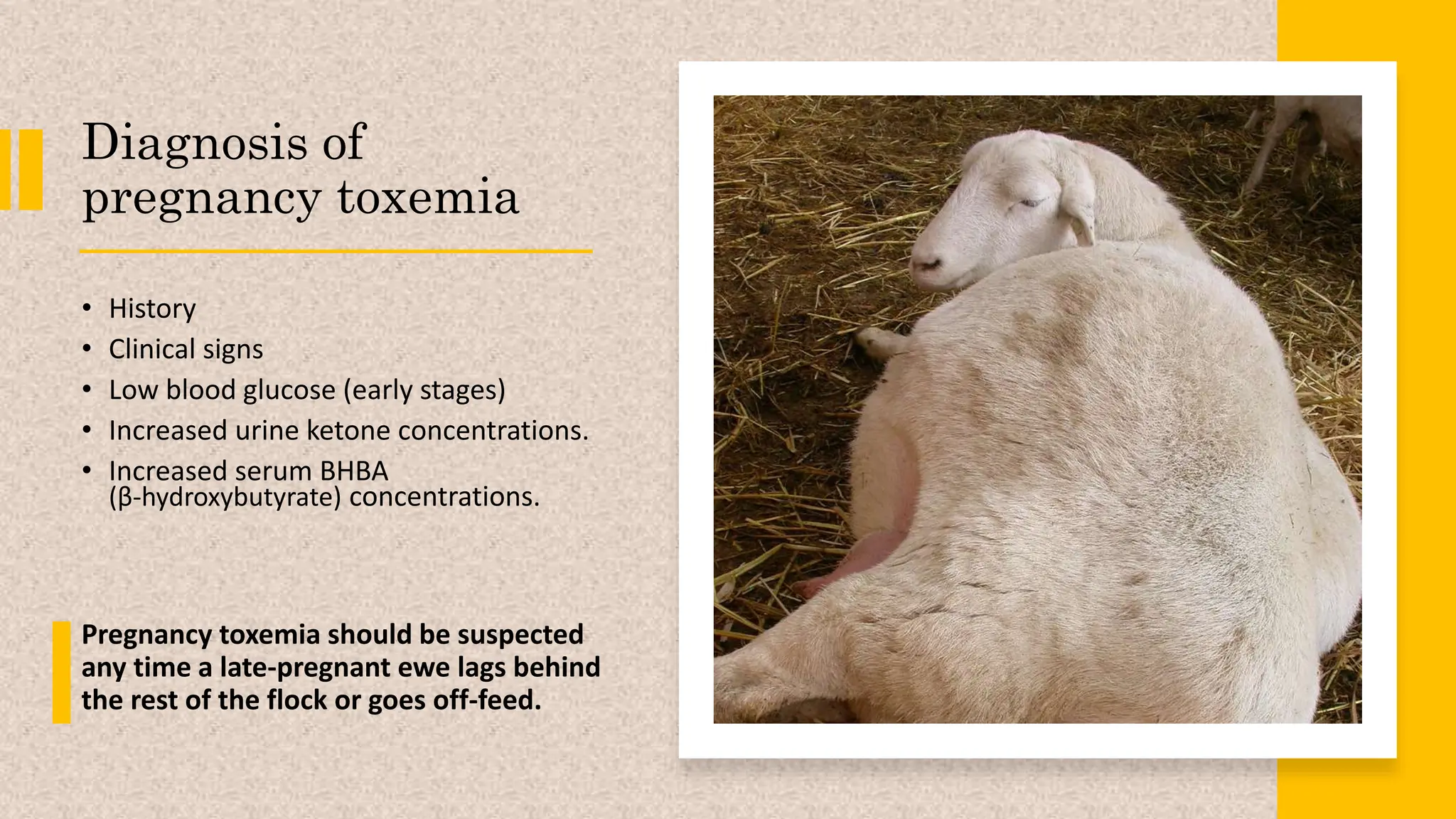
Diagnosis of
pregnancy toxemia
• History
• Clinical signs
• Low blood glucose (early stages)
• Increased urine ketone concentrations.
• Increased serum BHBA
(β-hydroxybutyrate) concentrations.
Pregnancy toxemia should be suspected
any time a late-pregnant ewe lags behind
the rest of the flock or goes off-feed.
Signs of
pregnancy toxemia
Symptoms can be different.
• Lags behind, separation from flock
• Anorexia (off-feed)
• Depression, head down
• Nervous system signs: tremors and blindness
• Teeth grinding (pain)
• Recumbency -> death 
What else can it be?
Some differential diagnoses
Pregnancy toxemia
• Low blood sugar.
• Ketones in breath, blood, and
urine.
• Caused by inadequate energy
intake in late pregnancy.
• Only seen in late pregnancy
• Slow disease course (many
days)
• Separation from other sheep.
• Low blood calcium
• Caused by sudden increase in
calcium demand.
• Usually occurs late pregnancy but
can occur after (dairy females).
• Moderate disease course
(< 1 day).
• Characteristic pose.
• Low blood magnesium
• Caused by low magnesium or
salt intake
• Usually seen during lactation
• Rapid disease course (hours)
• Twitchy gait
Hypomagnesemia
“grass staggers”
Milk fever
Hypocalcemia
More common
~20% of ewes that have pregnancy toxemia also have milk fever.
Treatment
options
• Individual penning of affected ewes with access to palatable and
energy-dense feeds.
• Oral administration of energy products
• Subcutaneous (SQ) injection of glucose products
• Intravenous (IV) administration of glucose
• Induction of parturition or abortion (+ birthing assistance)
• Caesarian section to remove lambs.
• Euthanasia when ewe is too far gone.
Still
eating
Quick sources of energy to
treat early stages of
pregnancy toxemia
• Propylene glycol
60 ml every 6-12 hours
• Glycerol
• Corn syrup
• Molasses
• Apple Cider Vinegar
• Homemade sugar solutions
table sugar + water
yogurt + water
~$40 now
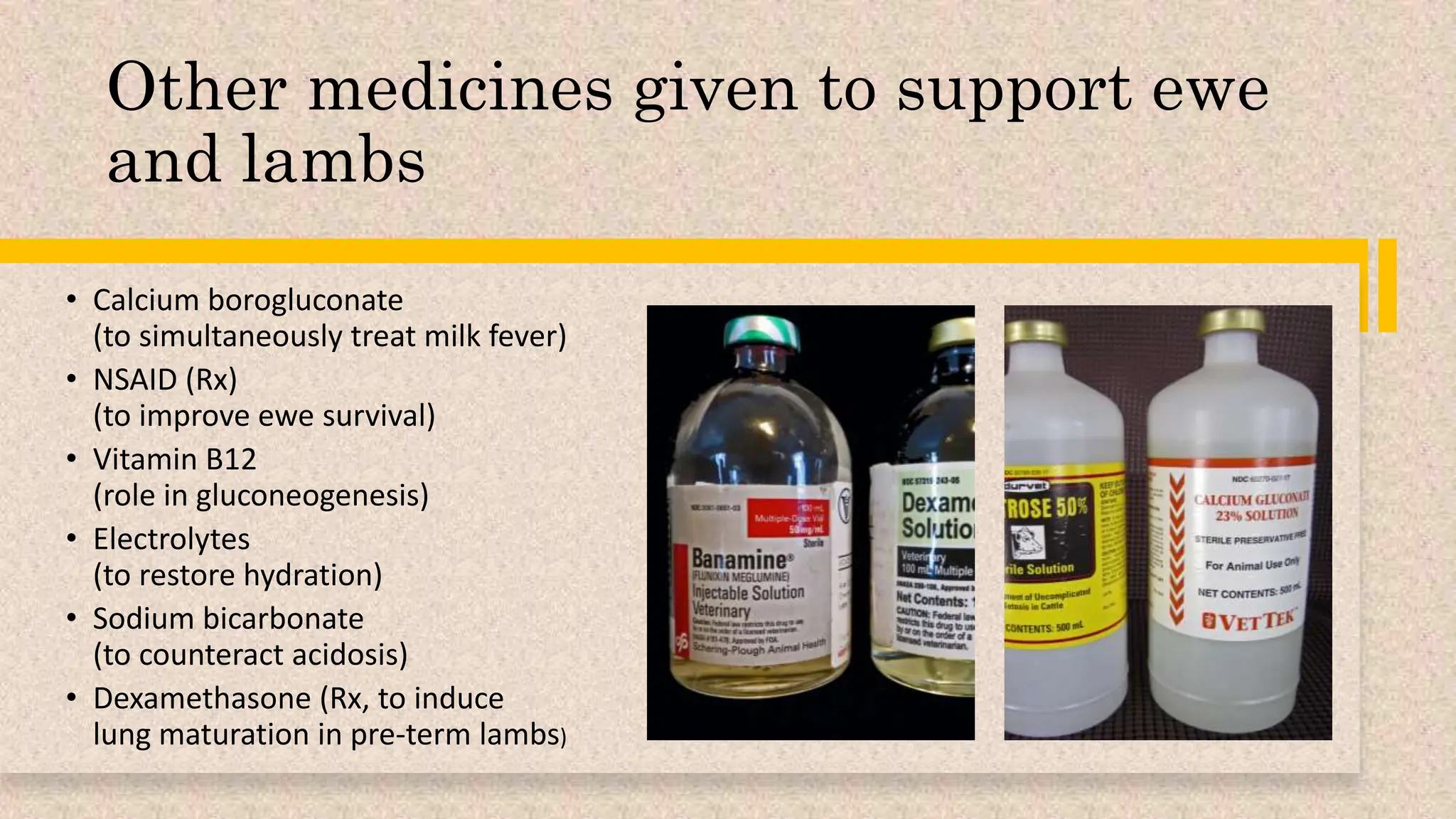
Other medicines given to support ewe
and lambs
• Calcium borogluconate
(to simultaneously treat milk fever)
• NSAID (Rx)
(to improve ewe survival)
• Vitamin B12
(role in gluconeogenesis)
• Electrolytes
(to restore hydration)
• Sodium bicarbonate
(to counteract acidosis)
• Dexamethasone (Rx, to induce
lung maturation in pre-term lambs)
Treatment of
pregnancy
toxemia
• Identify early signs of disease
• Treatment is much more
successful if it is initiated early.
• Up to 90% ewes will die if left
untreated
• If caesarian section (Vx) is done
more than five days before the
ewe’s due date, then lamb
survival is likely to be very low.
Pregnancy
toxemia is
usually a flock
problem.
• Need to evaluate your nutritional program to make sure ewes are getting
enough energy in their diet.
• If necessary, divide ewes into groups based on BCS, fetal number, and expected
lambing dates – and feed accordingly.
• If ewes are strictly grass-fed, special emphasis should be place on feeding high
quality roughage to ewes in late gestation.
• Aim for body condition score of 3 to 3.5 (at least 2.5) at the time of lambing.
 Balance rations to make sure pregnant ewes are getting proper nutrition.
Balancing
rations for
pregnant ewes
What you need to know
• Age and weight of ewes
• Stage of gestation (early, mid, late)
• Fetal number (1, 2, 3 or more).
• Nutritive value of feeds
“book” values are usually adequate
for grain, but not for forages or by-
product feeds.
• How much feed your ewes are
consuming (how much you feed
minus how much they are
WASTING!)
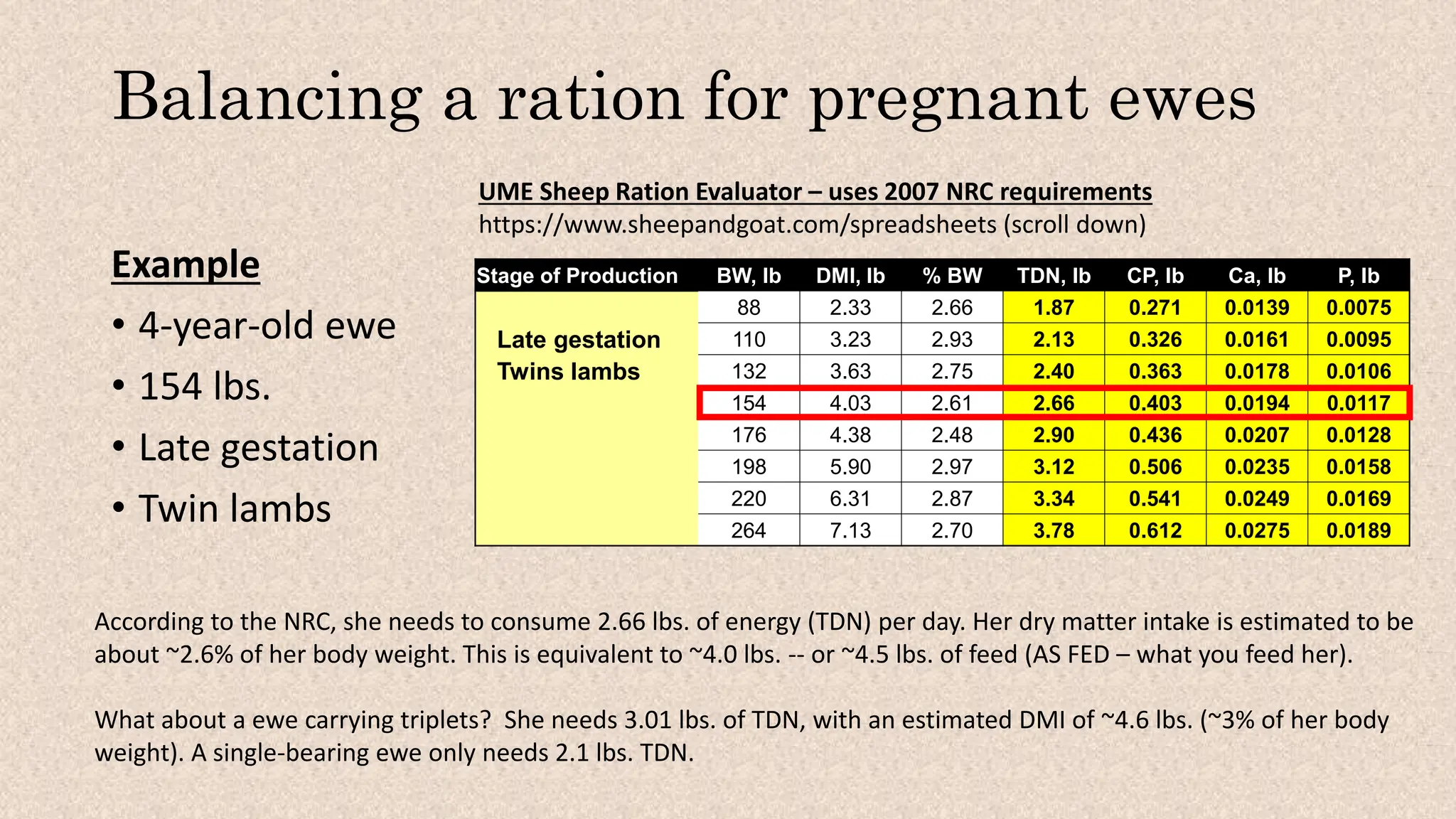
Balancing a ration for pregnant ewes
Example
• 4-year-old ewe
• 154 lbs.
• Late gestation
• Twin lambs
Stage of Production BW, lb DMI, lb % BW TDN, lb CP, lb Ca, lb P, lb
88 2.33 2.66 1.87 0.271 0.0139 0.0075
Late gestation 110 3.23 2.93 2.13 0.326 0.0161 0.0095
Twins lambs 132 3.63 2.75 2.40 0.363 0.0178 0.0106
154 4.03 2.61 2.66 0.403 0.0194 0.0117
176 4.38 2.48 2.90 0.436 0.0207 0.0128
198 5.90 2.97 3.12 0.506 0.0235 0.0158
220 6.31 2.87 3.34 0.541 0.0249 0.0169
264 7.13 2.70 3.78 0.612 0.0275 0.0189
According to the NRC, she needs to consume 2.66 lbs. of energy (TDN) per day. Her dry matter intake is estimated to be
about ~2.6% of her body weight. This is equivalent to ~4.0 lbs. -- or ~4.5 lbs. of feed (AS FED – what you feed her).
What about a ewe carrying triplets? She needs 3.01 lbs. of TDN, with an estimated DMI of ~4.6 lbs. (~3% of her body
weight). A single-bearing ewe only needs 2.1 lbs. TDN.
UME Sheep Ration Evaluator – uses 2007 NRC requirements
https://www.sheepandgoat.com/spreadsheets (scroll down)
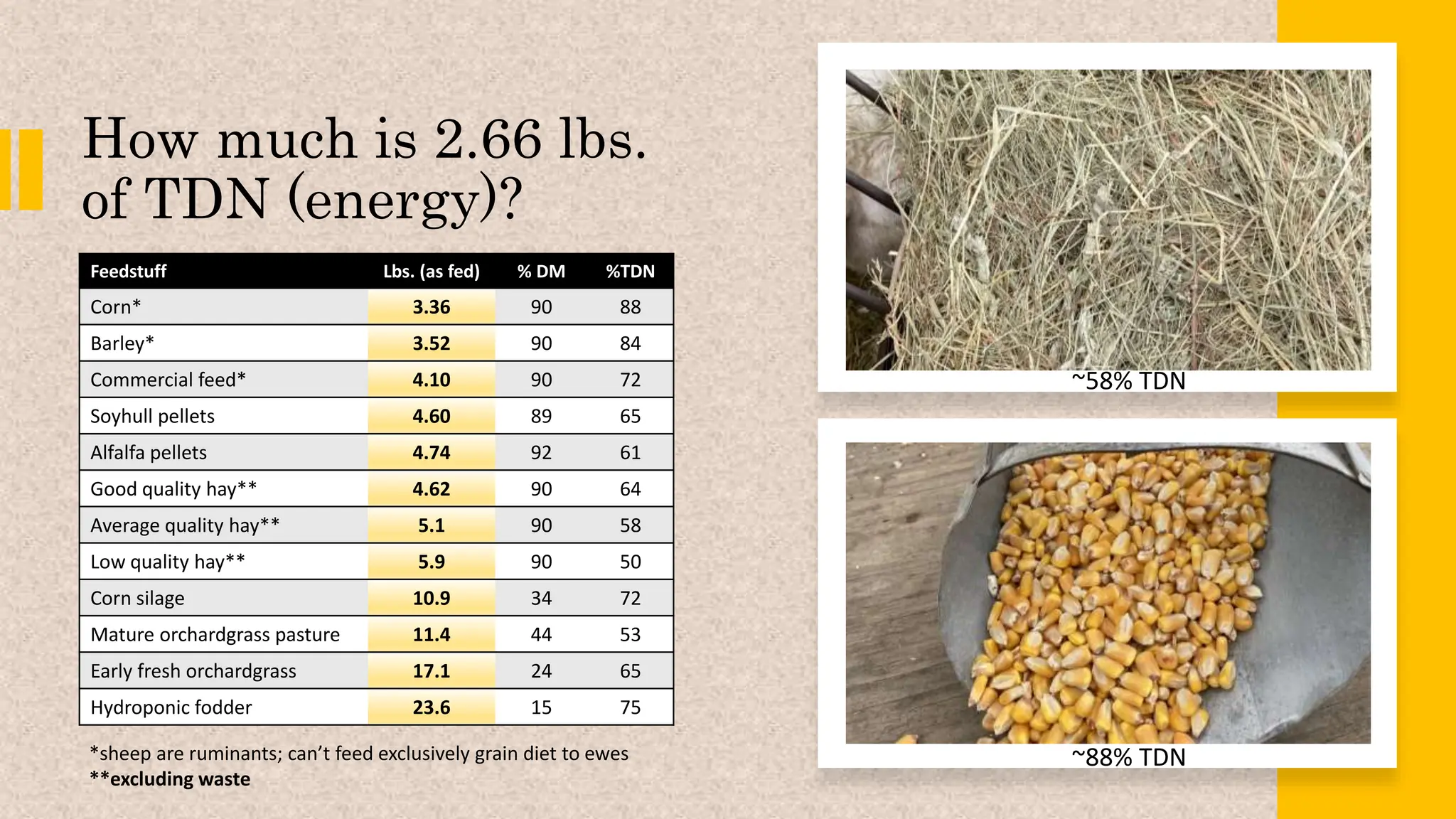
How much is 2.66 lbs.
of TDN (energy)?
*sheep are ruminants; can’t feed exclusively grain diet to ewes
**excluding waste
Feedstuff Lbs. (as fed) % DM %TDN
Corn* 3.36 90 88
Barley* 3.52 90 84
Commercial feed* 4.10 90 72
Soyhull pellets 4.60 89 65
Alfalfa pellets 4.74 92 61
Good quality hay** 4.62 90 64
Average quality hay** 5.1 90 58
Low quality hay** 5.9 90 50
Corn silage 10.9 34 72
Mature orchardgrass pasture 11.4 44 53
Early fresh orchardgrass 17.1 24 65
Hydroponic fodder 23.6 15 75
~88% TDN
~58% TDN
Good nutrition relies on
accurate appraisal of forage.
1. Species
Legume hays are typically higher in protein, calcium,
and other minerals and vitamins than grass hays. Not
necessarily energy.
2. Stage of maturity
Biggest factor affecting quality (grass or legume)
3. Leafiness - leaf to stem ratio
Most of the nutrients are found in the leaves.
4. Color
While you like a bright green color, color can be
deceiving.
5. Softness
Sheep prefer soft hay.
6. Odor and condition
Mold or dust - sheep may refuse to eat.
7. Foreign material
Weeds and foreign objects can affect quality and safety.
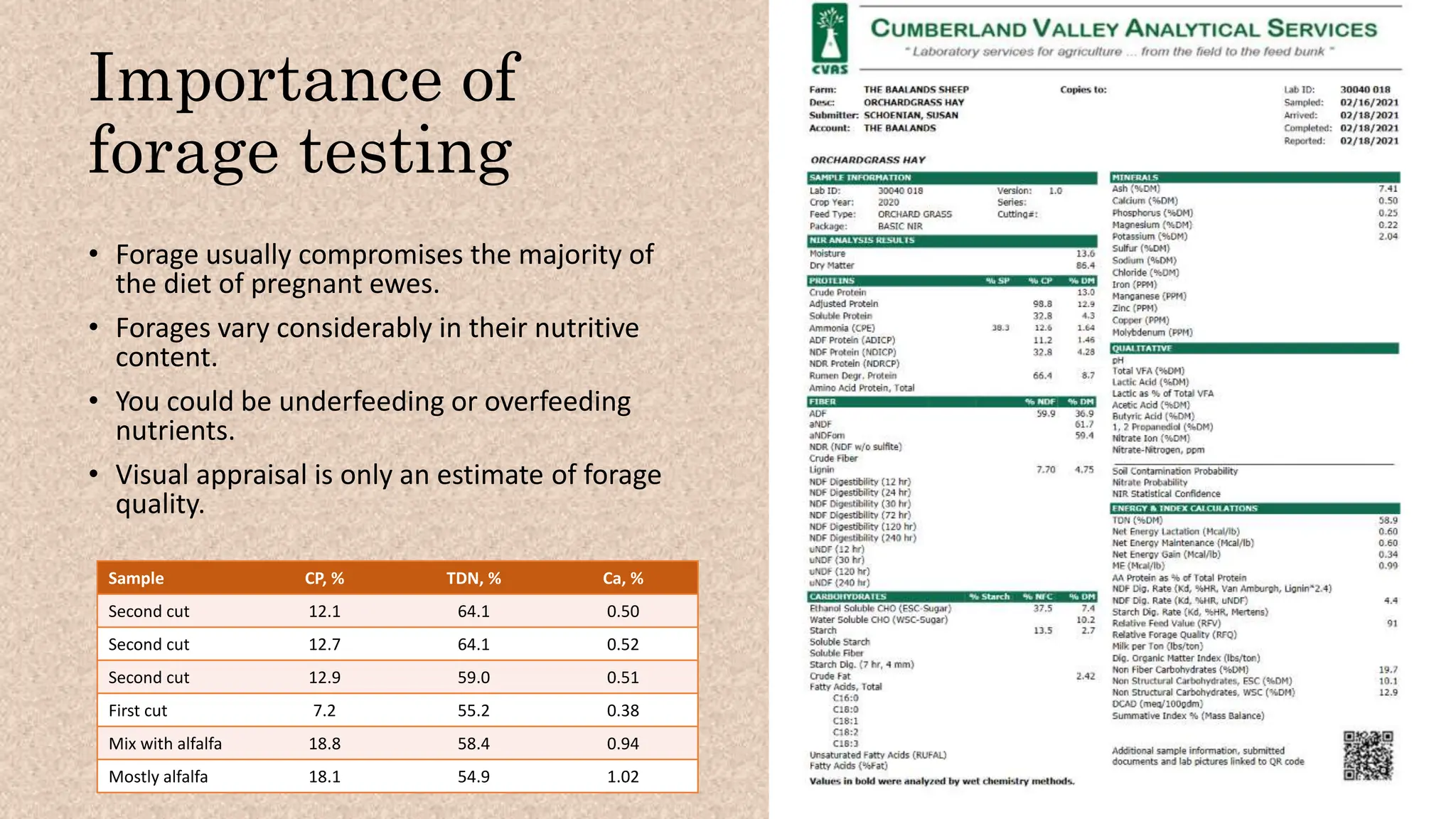
Importance of
forage testing
• Forage usually compromises the majority of
the diet of pregnant ewes.
• Forages vary considerably in their nutritive
content.
• You could be underfeeding or overfeeding
nutrients.
• Visual appraisal is only an estimate of forage
quality.
Sample CP, % TDN, % Ca, %
Second cut 12.1 64.1 0.50
Second cut 12.7 64.1 0.52
Second cut 12.9 59.0 0.51
First cut 7.2 55.2 0.38
Mix with alfalfa 18.8 58.4 0.94
Mostly alfalfa 18.1 54.9 1.02
Let’s go back to our
4-year-old, 180-lb.
ewe pregnant with
twins.
What should you feed
her?
Strictly grass hay (4 lbs./day)
Not enough of anything
4 lbs. hay + 2 lbs. of pellets
Too much grain = too much energy and protein
A balanced ration
0.75 lb. corn + 4 lbs. of mixed hay (75% orchardgrass 25% alfalfa)
Okay, so you’re not going
to balance rations for
your ewes…
Then, estimate forage quality and feed:
Free choice hay + ½ to 1 lb. of grain
• Gradual introduce and increase amount
of grain in diet.
• May need more grain if hay quality is
poor (stemmy, a lot of waste).
• More grain for prolific ewes
(lots of triplets expected)
• Add protein to grain ration if hay is
deficient (grass, stemmy, mature).
• Add calcium to grain diet if hay is
deficient (not part legume).
• Free choice minerals don’t ensure
adequate intake.
Prevention of
pregnancy toxemia
• Adequate energy in diet during last 4-6
weeks of pregnancy.
• Good quality hay with some grain
(energy) supplementation
• Adequate feeder space for hay and grain
• Feed yearlings and mature females
separately.
• Avoid abrupt feed changes
• Avoid stressors
• Monitor and control parasitism and other
diseases.
Thank you.
Comments?
Questions?
SUSAN SCHOENIAN
Sheep & Goat Specialist Emeritus
University of Maryland Extension
sschoen@umd.edu
www.sheepandgoat.com
www.sheep101.info (/201)
www.wormx.info
Facebook @ MDSmallRuminant
Flickr @ /baalands

Pregnancy Toxemia in sheep

  • 1.
    Pregnancy toxemia SUSAN SCHOENIAN Sheep &Goat Specialist Emeritus University of Maryland Extension sschoen@umd.edu | sheepandgoat.com sheep101.info | wormx.info Facebook @ MDSmallRuminant
  • 2.
    Pregnancy toxemia • Very well-knowndisease. • One of the most common diseases of sheep (#7 NAHMS 2021) • A metabolic disease that occurs in late gestation (last 6 weeks). • Most common metabolic disorder in pregnant ewes. • Usually caused by mismanagement (nutrition) during gestation.
  • 3.
    Other names for pregnancytoxemia • Twin lamb disease • Pregnancy disease • Gestational toxemia • Lambing sickness • Lambing paralysis • Ketosis • Hypoglycemia Hyperketonemia • Fatty liver syndrome
  • 4.
    Late gestation • 75%of fetal growth occurs during the last trimester of pregnancy. • Ewe starts to put nutrients towards milk production. • Rumen capacity is decreasing. • The ewe may be slower and less active foraging. • Greatest nutritional demands, especially for energy (also calcium).
  • 5.
    What causes pregnancy toxemia? • Negativeenergy balance resulting from increased energy demands for rapid fetal growth during late gestation. • Insufficient nutrition during late pregnancy. • Inadequate intake of energy. • Decreased rumen capacity due to fetal growth. • Rumen capacity can also be decreased by large intra-abdominal fat deposits.
  • 6.
    How does sheget pregnancy toxemia? NEGATIVE ENERGY BALANCE • Insufficient glucose due to inadequate nutrition (propionate). • She begins to mobilize body fat. • The liver processes all the body fat. • The increased mobilization of fat overwhelms the liver’s capacity to break it down. • When it can’t break down all the fat, the liver makes toxic “ketone bodies.” • She’s ultimately unable to clear ketone bodies in time, and pregnancy toxemia results.
  • 7.
    Risk factors for pregnancytoxemia Any age or breed; some breeds are more prone to developing pregnancy toxemia. • Being in late pregnancy • Carrying multiple fetuses • Being under or over-conditioned • Receiving a diet that fails to meet energy (TDN) requirements • Low quality forage (can’t eat enough) • Having other diseases or conditions that limit intake. • Breed and genetics     Triggered by stress
  • 8.
    What is Stress? • Achange in diet • Change in feeding time • Weather changes/extremes • Moving to new pens • Changing of pen mates • Transportation • Handling • Dogs
  • 9.
    Diagnosis of pregnancy toxemia •History • Clinical signs • Low blood glucose (early stages) • Increased urine ketone concentrations. • Increased serum BHBA (β-hydroxybutyrate) concentrations. Pregnancy toxemia should be suspected any time a late-pregnant ewe lags behind the rest of the flock or goes off-feed.
  • 10.
    Signs of pregnancy toxemia Symptomscan be different. • Lags behind, separation from flock • Anorexia (off-feed) • Depression, head down • Nervous system signs: tremors and blindness • Teeth grinding (pain) • Recumbency -> death 
  • 11.
    What else canit be? Some differential diagnoses Pregnancy toxemia • Low blood sugar. • Ketones in breath, blood, and urine. • Caused by inadequate energy intake in late pregnancy. • Only seen in late pregnancy • Slow disease course (many days) • Separation from other sheep. • Low blood calcium • Caused by sudden increase in calcium demand. • Usually occurs late pregnancy but can occur after (dairy females). • Moderate disease course (< 1 day). • Characteristic pose. • Low blood magnesium • Caused by low magnesium or salt intake • Usually seen during lactation • Rapid disease course (hours) • Twitchy gait Hypomagnesemia “grass staggers” Milk fever Hypocalcemia More common ~20% of ewes that have pregnancy toxemia also have milk fever.
  • 12.
    Treatment options • Individual penningof affected ewes with access to palatable and energy-dense feeds. • Oral administration of energy products • Subcutaneous (SQ) injection of glucose products • Intravenous (IV) administration of glucose • Induction of parturition or abortion (+ birthing assistance) • Caesarian section to remove lambs. • Euthanasia when ewe is too far gone. Still eating
  • 13.
    Quick sources ofenergy to treat early stages of pregnancy toxemia • Propylene glycol 60 ml every 6-12 hours • Glycerol • Corn syrup • Molasses • Apple Cider Vinegar • Homemade sugar solutions table sugar + water yogurt + water ~$40 now
  • 14.
    Other medicines givento support ewe and lambs • Calcium borogluconate (to simultaneously treat milk fever) • NSAID (Rx) (to improve ewe survival) • Vitamin B12 (role in gluconeogenesis) • Electrolytes (to restore hydration) • Sodium bicarbonate (to counteract acidosis) • Dexamethasone (Rx, to induce lung maturation in pre-term lambs)
  • 15.
    Treatment of pregnancy toxemia • Identifyearly signs of disease • Treatment is much more successful if it is initiated early. • Up to 90% ewes will die if left untreated • If caesarian section (Vx) is done more than five days before the ewe’s due date, then lamb survival is likely to be very low.
  • 16.
    Pregnancy toxemia is usually aflock problem. • Need to evaluate your nutritional program to make sure ewes are getting enough energy in their diet. • If necessary, divide ewes into groups based on BCS, fetal number, and expected lambing dates – and feed accordingly. • If ewes are strictly grass-fed, special emphasis should be place on feeding high quality roughage to ewes in late gestation. • Aim for body condition score of 3 to 3.5 (at least 2.5) at the time of lambing.  Balance rations to make sure pregnant ewes are getting proper nutrition.
  • 17.
    Balancing rations for pregnant ewes Whatyou need to know • Age and weight of ewes • Stage of gestation (early, mid, late) • Fetal number (1, 2, 3 or more). • Nutritive value of feeds “book” values are usually adequate for grain, but not for forages or by- product feeds. • How much feed your ewes are consuming (how much you feed minus how much they are WASTING!)
  • 18.
    Balancing a rationfor pregnant ewes Example • 4-year-old ewe • 154 lbs. • Late gestation • Twin lambs Stage of Production BW, lb DMI, lb % BW TDN, lb CP, lb Ca, lb P, lb 88 2.33 2.66 1.87 0.271 0.0139 0.0075 Late gestation 110 3.23 2.93 2.13 0.326 0.0161 0.0095 Twins lambs 132 3.63 2.75 2.40 0.363 0.0178 0.0106 154 4.03 2.61 2.66 0.403 0.0194 0.0117 176 4.38 2.48 2.90 0.436 0.0207 0.0128 198 5.90 2.97 3.12 0.506 0.0235 0.0158 220 6.31 2.87 3.34 0.541 0.0249 0.0169 264 7.13 2.70 3.78 0.612 0.0275 0.0189 According to the NRC, she needs to consume 2.66 lbs. of energy (TDN) per day. Her dry matter intake is estimated to be about ~2.6% of her body weight. This is equivalent to ~4.0 lbs. -- or ~4.5 lbs. of feed (AS FED – what you feed her). What about a ewe carrying triplets? She needs 3.01 lbs. of TDN, with an estimated DMI of ~4.6 lbs. (~3% of her body weight). A single-bearing ewe only needs 2.1 lbs. TDN. UME Sheep Ration Evaluator – uses 2007 NRC requirements https://www.sheepandgoat.com/spreadsheets (scroll down)
  • 19.
    How much is2.66 lbs. of TDN (energy)? *sheep are ruminants; can’t feed exclusively grain diet to ewes **excluding waste Feedstuff Lbs. (as fed) % DM %TDN Corn* 3.36 90 88 Barley* 3.52 90 84 Commercial feed* 4.10 90 72 Soyhull pellets 4.60 89 65 Alfalfa pellets 4.74 92 61 Good quality hay** 4.62 90 64 Average quality hay** 5.1 90 58 Low quality hay** 5.9 90 50 Corn silage 10.9 34 72 Mature orchardgrass pasture 11.4 44 53 Early fresh orchardgrass 17.1 24 65 Hydroponic fodder 23.6 15 75 ~88% TDN ~58% TDN
  • 20.
    Good nutrition relieson accurate appraisal of forage. 1. Species Legume hays are typically higher in protein, calcium, and other minerals and vitamins than grass hays. Not necessarily energy. 2. Stage of maturity Biggest factor affecting quality (grass or legume) 3. Leafiness - leaf to stem ratio Most of the nutrients are found in the leaves. 4. Color While you like a bright green color, color can be deceiving. 5. Softness Sheep prefer soft hay. 6. Odor and condition Mold or dust - sheep may refuse to eat. 7. Foreign material Weeds and foreign objects can affect quality and safety.
  • 21.
    Importance of forage testing •Forage usually compromises the majority of the diet of pregnant ewes. • Forages vary considerably in their nutritive content. • You could be underfeeding or overfeeding nutrients. • Visual appraisal is only an estimate of forage quality. Sample CP, % TDN, % Ca, % Second cut 12.1 64.1 0.50 Second cut 12.7 64.1 0.52 Second cut 12.9 59.0 0.51 First cut 7.2 55.2 0.38 Mix with alfalfa 18.8 58.4 0.94 Mostly alfalfa 18.1 54.9 1.02
  • 22.
    Let’s go backto our 4-year-old, 180-lb. ewe pregnant with twins. What should you feed her?
  • 23.
    Strictly grass hay(4 lbs./day) Not enough of anything
  • 24.
    4 lbs. hay+ 2 lbs. of pellets Too much grain = too much energy and protein
  • 25.
    A balanced ration 0.75lb. corn + 4 lbs. of mixed hay (75% orchardgrass 25% alfalfa)
  • 26.
    Okay, so you’renot going to balance rations for your ewes… Then, estimate forage quality and feed: Free choice hay + ½ to 1 lb. of grain • Gradual introduce and increase amount of grain in diet. • May need more grain if hay quality is poor (stemmy, a lot of waste). • More grain for prolific ewes (lots of triplets expected) • Add protein to grain ration if hay is deficient (grass, stemmy, mature). • Add calcium to grain diet if hay is deficient (not part legume). • Free choice minerals don’t ensure adequate intake.
  • 27.
    Prevention of pregnancy toxemia •Adequate energy in diet during last 4-6 weeks of pregnancy. • Good quality hay with some grain (energy) supplementation • Adequate feeder space for hay and grain • Feed yearlings and mature females separately. • Avoid abrupt feed changes • Avoid stressors • Monitor and control parasitism and other diseases.
  • 28.
    Thank you. Comments? Questions? SUSAN SCHOENIAN Sheep& Goat Specialist Emeritus University of Maryland Extension sschoen@umd.edu www.sheepandgoat.com www.sheep101.info (/201) www.wormx.info Facebook @ MDSmallRuminant Flickr @ /baalands