Name:- FASIH UR REHMAN
Reg#:- 2k12-av-77
Class:- 4th PROF DVM
Topic:- ANTHRAX
Subject:- MED-406
Presented to:- DR. RIAZ LAGHARI
A Zoonotic Disease
ANTHRAX
Overview
 Definition
 About Disease
 Causative Agent
 Transmission
 Clinical Findings
 Diagnosis
 Treatment
 Vaccination
Definition
Anthrax is originated from Greek word
Anthrox means coal. Other names for this
disease are spleenic fever, wool sorter's
disease. Locally it is called as golle or sut.
It is an acute, contagious and septicemia
disease. Highly fatal and affecting a wide
range of mammalian species including
human beings.
About Disease
Before the availability of an effective vaccine,
anthrax was one of the most important causes
of death in livestock throughout the world. The
results of national epidemiological survey of
important diseases of livestock in Pakistan has
indicated that anthrax is one of the leading
causes of death among sheep, goat, cattle in
hilly and desert areas.
Causative Agent
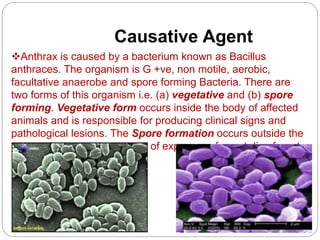
Anthrax is caused by a bacterium known as Bacillus
anthraces. The organism is G +ve, non motile, aerobic,
facultative anaerobe and spore forming Bacteria. There are
two forms of this organism i.e. (a) vegetative and (b) spore
forming. Vegetative form occurs inside the body of affected
animals and is responsible for producing clinical signs and
pathological lesions. The Spore formation occurs outside the
body of host and is the result of exposure of vegetative form to
oxygen.
Transmission
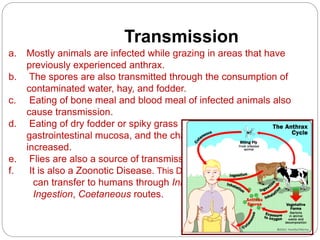
a. Mostly animals are infected while grazing in areas that have
previously experienced anthrax.
b. The spores are also transmitted through the consumption of
contaminated water, hay, and fodder.
c. Eating of bone meal and blood meal of infected animals also
cause transmission.
d. Eating of dry fodder or spiky grass produces lesions in
gastrointestinal mucosa, and the chances of infection are
increased.
e. Flies are also a source of transmission.
f. It is also a Zoonotic Disease. This Disease
can transfer to humans through Inhalation,
Ingestion, Coetaneous routes.
Clinical Findings
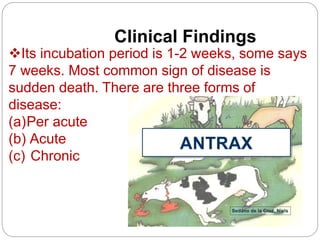
Its incubation period is 1-2 weeks, some says
7 weeks. Most common sign of disease is
sudden death. There are three forms of
disease:
(a)Per acute
(b) Acute
(c) Chronic
Clinical Findings (Continue)
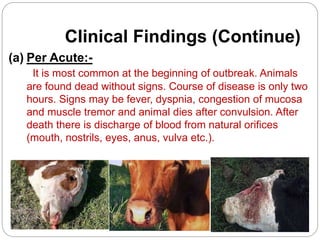
(a) Per Acute:-
It is most common at the beginning of outbreak. Animals
are found dead without signs. Course of disease is only two
hours. Signs may be fever, dyspnia, congestion of mucosa
and muscle tremor and animal dies after convulsion. After
death there is discharge of blood from natural orifices
(mouth, nostrils, eyes, anus, vulva etc.).
Clinical Findings (Continue)
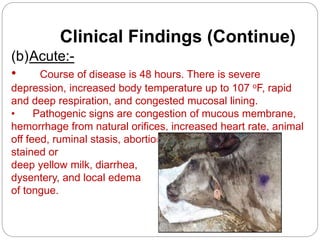
(b)Acute:-
• Course of disease is 48 hours. There is severe
depression, increased body temperature up to 107 oF, rapid
and deep respiration, and congested mucosal lining.
• Pathogenic signs are congestion of mucous membrane,
hemorrhage from natural orifices, increased heart rate, animal
off feed, ruminal stasis, abortion in pregnant cows, blood
stained or
deep yellow milk, diarrhea,
dysentery, and local edema
of tongue.
Clinical Findings (Continue)
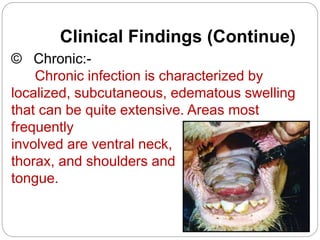
© Chronic:-
Chronic infection is characterized by
localized, subcutaneous, edematous swelling
that can be quite extensive. Areas most
frequently
involved are ventral neck,
thorax, and shoulders and
tongue.
Diagnosis
It is based on the history of the occurrence of disease in
an area, clinical signs, and necropsy findings. Sudden
death in an animal without prior symptoms should lead to
suspicion of anthrax and bloody fluid exuding from the
nose and mouth or anus of living or dead animal is
particularly suggestive of anthrax.
 Postmortem is not allowed in case of anthrax. To
prepare blood smear, blood is obtained from ear by giving
incision. Blood film should be dried and fixed by heat or
immersion for one minute in absolute methanol and
stained with polychrome methylene blue. Then it is
washed after thirty seconds into hypochlorite solution.
After drying the slide, it is examined under microscope for
Treatment
Because this disease is rapid in onset and with large mortality
rate (90%), this is insufficient to initiate treatment before death. If
anthrax is suspected, segregation of animal should be done. Early
supportive and antimicrobial therapy is useful and Bacillus
anthraces is highly susceptible to a wide range of antibiotics
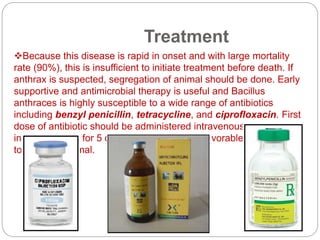
including benzyl penicillin, tetracycline, and ciprofloxacin. First
dose of antibiotic should be administered intravenously and then
intramuscularly for 5 days. Prognosis is not favorable and no time
to treat the animal.
Vaccination
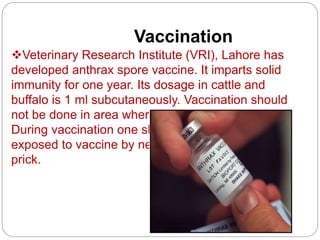
Veterinary Research Institute (VRI), Lahore has
developed anthrax spore vaccine. It imparts solid
immunity for one year. Its dosage in cattle and
buffalo is 1 ml subcutaneously. Vaccination should
not be done in area where disease does not occur.
During vaccination one should not be
exposed to vaccine by needle
prick.
Anthrax presentation med 406

Anthrax presentation med 406

  • 2.
    Name:- FASIH URREHMAN Reg#:- 2k12-av-77 Class:- 4th PROF DVM Topic:- ANTHRAX Subject:- MED-406 Presented to:- DR. RIAZ LAGHARI
  • 3.
  • 4.
    Overview  Definition  AboutDisease  Causative Agent  Transmission  Clinical Findings  Diagnosis  Treatment  Vaccination
  • 5.
    Definition Anthrax is originatedfrom Greek word Anthrox means coal. Other names for this disease are spleenic fever, wool sorter's disease. Locally it is called as golle or sut. It is an acute, contagious and septicemia disease. Highly fatal and affecting a wide range of mammalian species including human beings.
  • 6.
    About Disease Before theavailability of an effective vaccine, anthrax was one of the most important causes of death in livestock throughout the world. The results of national epidemiological survey of important diseases of livestock in Pakistan has indicated that anthrax is one of the leading causes of death among sheep, goat, cattle in hilly and desert areas.
  • 7.
    Causative Agent Anthrax iscaused by a bacterium known as Bacillus anthraces. The organism is G +ve, non motile, aerobic, facultative anaerobe and spore forming Bacteria. There are two forms of this organism i.e. (a) vegetative and (b) spore forming. Vegetative form occurs inside the body of affected animals and is responsible for producing clinical signs and pathological lesions. The Spore formation occurs outside the body of host and is the result of exposure of vegetative form to oxygen.
  • 8.
    Transmission a. Mostly animalsare infected while grazing in areas that have previously experienced anthrax. b. The spores are also transmitted through the consumption of contaminated water, hay, and fodder. c. Eating of bone meal and blood meal of infected animals also cause transmission. d. Eating of dry fodder or spiky grass produces lesions in gastrointestinal mucosa, and the chances of infection are increased. e. Flies are also a source of transmission. f. It is also a Zoonotic Disease. This Disease can transfer to humans through Inhalation, Ingestion, Coetaneous routes.
  • 9.
    Clinical Findings Its incubationperiod is 1-2 weeks, some says 7 weeks. Most common sign of disease is sudden death. There are three forms of disease: (a)Per acute (b) Acute (c) Chronic
  • 10.
    Clinical Findings (Continue) (a)Per Acute:- It is most common at the beginning of outbreak. Animals are found dead without signs. Course of disease is only two hours. Signs may be fever, dyspnia, congestion of mucosa and muscle tremor and animal dies after convulsion. After death there is discharge of blood from natural orifices (mouth, nostrils, eyes, anus, vulva etc.).
  • 11.
    Clinical Findings (Continue) (b)Acute:- •Course of disease is 48 hours. There is severe depression, increased body temperature up to 107 oF, rapid and deep respiration, and congested mucosal lining. • Pathogenic signs are congestion of mucous membrane, hemorrhage from natural orifices, increased heart rate, animal off feed, ruminal stasis, abortion in pregnant cows, blood stained or deep yellow milk, diarrhea, dysentery, and local edema of tongue.
  • 12.
    Clinical Findings (Continue) ©Chronic:- Chronic infection is characterized by localized, subcutaneous, edematous swelling that can be quite extensive. Areas most frequently involved are ventral neck, thorax, and shoulders and tongue.
  • 13.
    Diagnosis It is basedon the history of the occurrence of disease in an area, clinical signs, and necropsy findings. Sudden death in an animal without prior symptoms should lead to suspicion of anthrax and bloody fluid exuding from the nose and mouth or anus of living or dead animal is particularly suggestive of anthrax.  Postmortem is not allowed in case of anthrax. To prepare blood smear, blood is obtained from ear by giving incision. Blood film should be dried and fixed by heat or immersion for one minute in absolute methanol and stained with polychrome methylene blue. Then it is washed after thirty seconds into hypochlorite solution. After drying the slide, it is examined under microscope for
  • 14.
    Treatment Because this diseaseis rapid in onset and with large mortality rate (90%), this is insufficient to initiate treatment before death. If anthrax is suspected, segregation of animal should be done. Early supportive and antimicrobial therapy is useful and Bacillus anthraces is highly susceptible to a wide range of antibiotics including benzyl penicillin, tetracycline, and ciprofloxacin. First dose of antibiotic should be administered intravenously and then intramuscularly for 5 days. Prognosis is not favorable and no time to treat the animal.
  • 15.
    Vaccination Veterinary Research Institute(VRI), Lahore has developed anthrax spore vaccine. It imparts solid immunity for one year. Its dosage in cattle and buffalo is 1 ml subcutaneously. Vaccination should not be done in area where disease does not occur. During vaccination one should not be exposed to vaccine by needle prick.