Dr Ashish Tanwer
Teaching Associate
V. C.C, C.V.A.S
MALIGNANT CATARRHAL
FEVER
Synonyms :
• Bovine malignant
catarrh
•Malignant head catarrh
•Catarrhal fever
•Epitheliosis
Introduction :
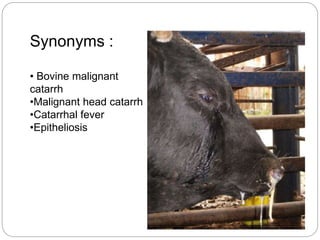
• Malignant catarrhal fever (MCF) is almost
invariably fatal disease of cattle characterized by
catarrhal inflammation of the nasal and oral mucosa,
keratoconjunctivitis, encephalitis, rapid dehydration
and generalized enlargement of lymphnodes.
• The disease is usually sporadic in nature.
• The disease is world-wide distribution and
prevalent in both temperate and tropical zones. •
This disease is caused by ovine herpes virus -1 and
alcelaphine herpes virus- 2 which are belonging to
the family Herpesviridae.
•
•The disease is primarily a disease of cattle and
buffalo. Inapparent infection has been noted in
sheep and goat. Now the disease is increasingly
encountered in deer.
• This disease is transmitted through wildbeast.
The wildbeast develop viraemia which may
persist up to 3 months and during that time they
remain highly infective for cattle of all ages.
• Cattle acquire the infection through sub clinically
affected sheep. The sheep are the indicator host
and wild rabbits are the reservoir host for MCF.
CLINICAL SIGNS :
• Incubation period of the disease ranges from 2-8 weeks. As
a whole the following four clinical findings have been outlined
but it is not a rigid one and all the manifestations may follow
in a case.
1. Peracute form :- High rise of temperature, dyspnoea and
diarrhoea but with out any head and eye lesions
2. Head and eye form:- Clinical course of around 9 days
characterized by nervous syndrome like paralysis and
convulsion prior to death
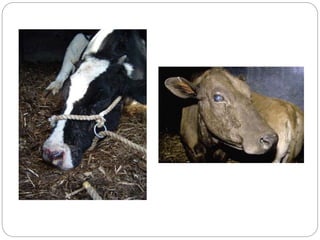
•The disease as a whole is characterized by :-
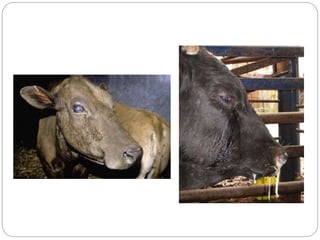
o Dullness, depression, anorexia and high rise of
temperature ranging from 105-108ºF. This is
followed by ocular and nasal discharge.
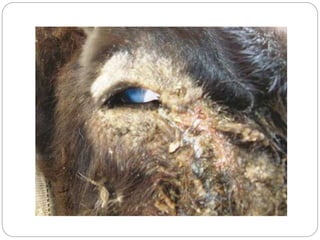
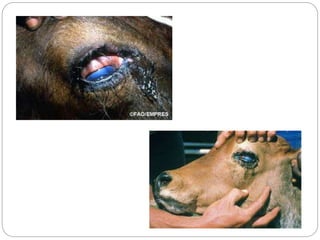
o Discharges are initially mucoid in nature which
soon become mucoprulent, stingy and contain blood
flecks. There is acceleration of pulse and respiratory
rate. Signs of dysponea may be evident.
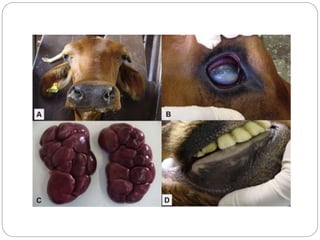
o There is oedema of the eyelids leading to
panopthalmitis
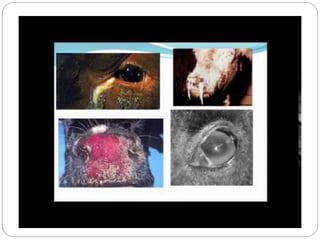
o Changes in the epithelium of mouth cavity
comprising of congestive changes, precisely on
the gum, beneath the tongue, hard palate and oral
papillae. Erosive and ultimate necrotic changes
may follow in the oral mucosa giving rise to
offensive odour from the mouth.
o Ocular lesions– Photophobia and meiosis,
corneal opacity, blindness
o Cutaneous lesions (congestion, petechiation,
bluish discolouration and thickening) localized or
generalized prominent on the muzzle, skin of the
hoof, scrotum, base of the horn and teat.
Diagnosis:-
• Based on clinical signs
• No reliable serological or immunological
tests
• Materials to be collected- Lesions on the
oral, nasal, ocular lesions, enlarged LN
DIAGNOSIS, PREVENTION AND CONTROL
Differential diagnosis
• Rinderpest
• Mucosal disease
• Infectious bovine rhinotracheitis
Prevention and control
• Inactivated or live vaccines with suitable
adjuvants induce antibodies against MCFV.
• In the absence of a vaccine, the only effective
strategy is to limit contact between MCF
susceptible species and the natural hosts of the
virus.
• Sheep has been considered as a spreader of
field outbreaks. Therefore, rigid separation of
cattle from sheep is suggested.
• The feed used by ewes and lambs should not be
provided to cattle. • Avoid contact between
reservoir host (wildebeest and wild rabbits) and
cattle.
Thanks

Malignant catarrhal fever

  • 1.
    Dr Ashish Tanwer TeachingAssociate V. C.C, C.V.A.S MALIGNANT CATARRHAL FEVER
  • 2.
    Synonyms : • Bovinemalignant catarrh •Malignant head catarrh •Catarrhal fever •Epitheliosis
  • 3.
    Introduction : • Malignantcatarrhal fever (MCF) is almost invariably fatal disease of cattle characterized by catarrhal inflammation of the nasal and oral mucosa, keratoconjunctivitis, encephalitis, rapid dehydration and generalized enlargement of lymphnodes. • The disease is usually sporadic in nature. • The disease is world-wide distribution and prevalent in both temperate and tropical zones. • This disease is caused by ovine herpes virus -1 and alcelaphine herpes virus- 2 which are belonging to the family Herpesviridae. •
  • 4.
    •The disease isprimarily a disease of cattle and buffalo. Inapparent infection has been noted in sheep and goat. Now the disease is increasingly encountered in deer. • This disease is transmitted through wildbeast. The wildbeast develop viraemia which may persist up to 3 months and during that time they remain highly infective for cattle of all ages. • Cattle acquire the infection through sub clinically affected sheep. The sheep are the indicator host and wild rabbits are the reservoir host for MCF.
  • 7.
    CLINICAL SIGNS : •Incubation period of the disease ranges from 2-8 weeks. As a whole the following four clinical findings have been outlined but it is not a rigid one and all the manifestations may follow in a case. 1. Peracute form :- High rise of temperature, dyspnoea and diarrhoea but with out any head and eye lesions 2. Head and eye form:- Clinical course of around 9 days characterized by nervous syndrome like paralysis and convulsion prior to death
  • 9.
    •The disease asa whole is characterized by :- o Dullness, depression, anorexia and high rise of temperature ranging from 105-108ºF. This is followed by ocular and nasal discharge. o Discharges are initially mucoid in nature which soon become mucoprulent, stingy and contain blood flecks. There is acceleration of pulse and respiratory rate. Signs of dysponea may be evident. o There is oedema of the eyelids leading to panopthalmitis
  • 11.
    o Changes inthe epithelium of mouth cavity comprising of congestive changes, precisely on the gum, beneath the tongue, hard palate and oral papillae. Erosive and ultimate necrotic changes may follow in the oral mucosa giving rise to offensive odour from the mouth. o Ocular lesions– Photophobia and meiosis, corneal opacity, blindness o Cutaneous lesions (congestion, petechiation, bluish discolouration and thickening) localized or generalized prominent on the muzzle, skin of the hoof, scrotum, base of the horn and teat.
  • 12.
    Diagnosis:- • Based onclinical signs • No reliable serological or immunological tests • Materials to be collected- Lesions on the oral, nasal, ocular lesions, enlarged LN DIAGNOSIS, PREVENTION AND CONTROL Differential diagnosis • Rinderpest • Mucosal disease • Infectious bovine rhinotracheitis
  • 14.
    Prevention and control •Inactivated or live vaccines with suitable adjuvants induce antibodies against MCFV. • In the absence of a vaccine, the only effective strategy is to limit contact between MCF susceptible species and the natural hosts of the virus. • Sheep has been considered as a spreader of field outbreaks. Therefore, rigid separation of cattle from sheep is suggested. • The feed used by ewes and lambs should not be provided to cattle. • Avoid contact between reservoir host (wildebeest and wild rabbits) and cattle.
  • 16.