Enzymology
• Biocatalyst
• Usually proteins except ribozyme (RNA particles with catalytic activity
)
• With out being changed themselves
Enzyme activity
Unit of enzyme activity • Amount causing transformation of 1 um of
substrate /min at 25 *C
• Expressed as mole of substrate utilised or mole of
product formed
Specific activity • No of protein units /mg of protein
• Measure of enzyme purity
• Higher the enzyme purity  higher the specific
activity
Turn over number • Number of substrate molecules transformed per
unit time by a single enzyme molecule (when
enzyme concentration alone is limiting factor)
• Highest turnover  catalase (fastest enzyme)
followed by carbonic anhydrase
• Lowest turnover  lysozyme (slowest enzyme)
Some enzymes are produced as proenzymes
• Inactive precursors  zymogens or proenzymes
• Proelastase
• Pepsinogen
Co enzyme
• organic molecule required by
enzyme
Co factor
• Inorganic molecule required by
enzyme
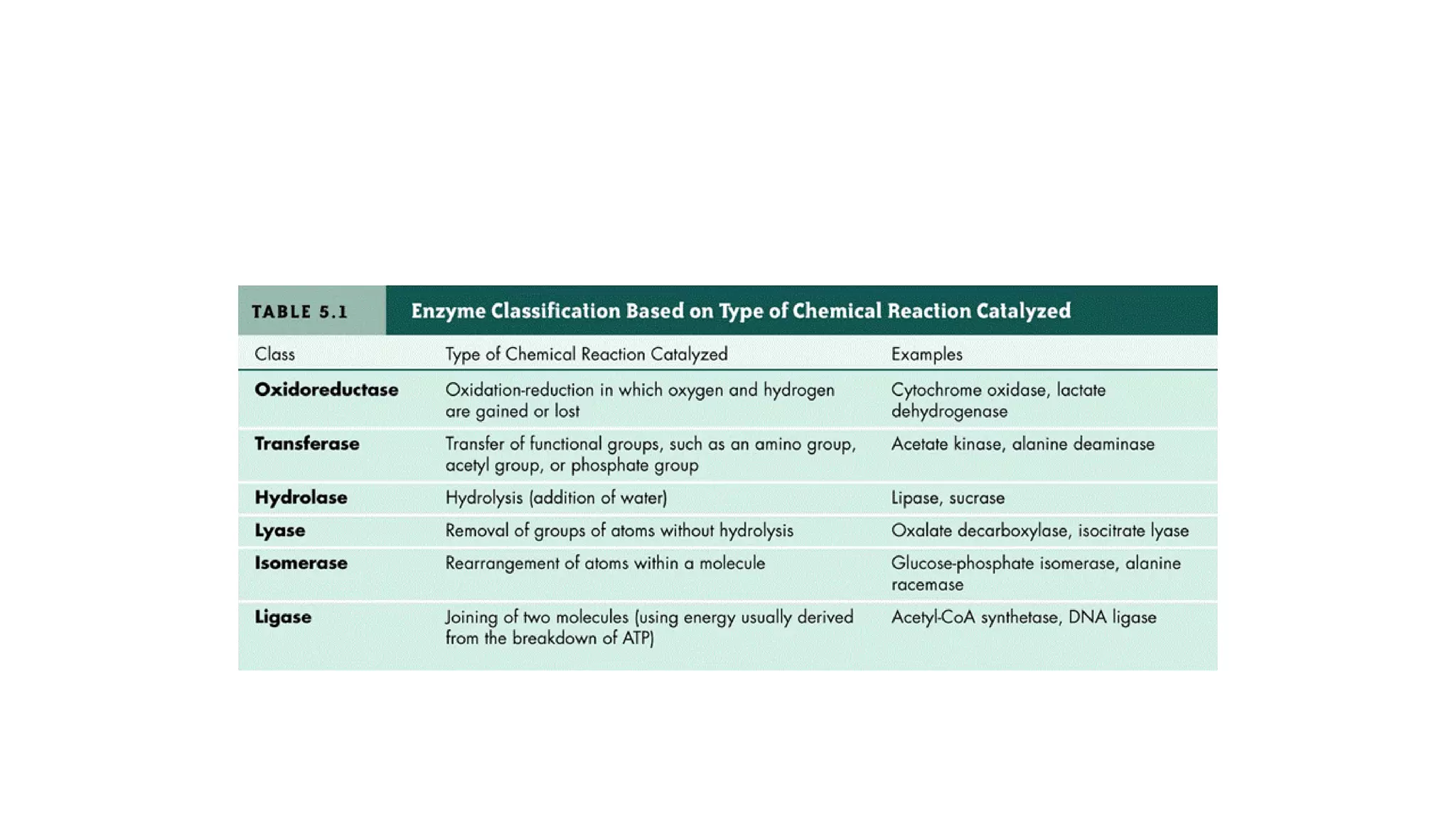
Nomenclature of enzyme
• EC stands for enzyme commission, and
• the first digit stands for the class name (transferase),
• the second digit stands for the subclass
• 3rd digit sub sub class
• 4th digit  individual enzyme
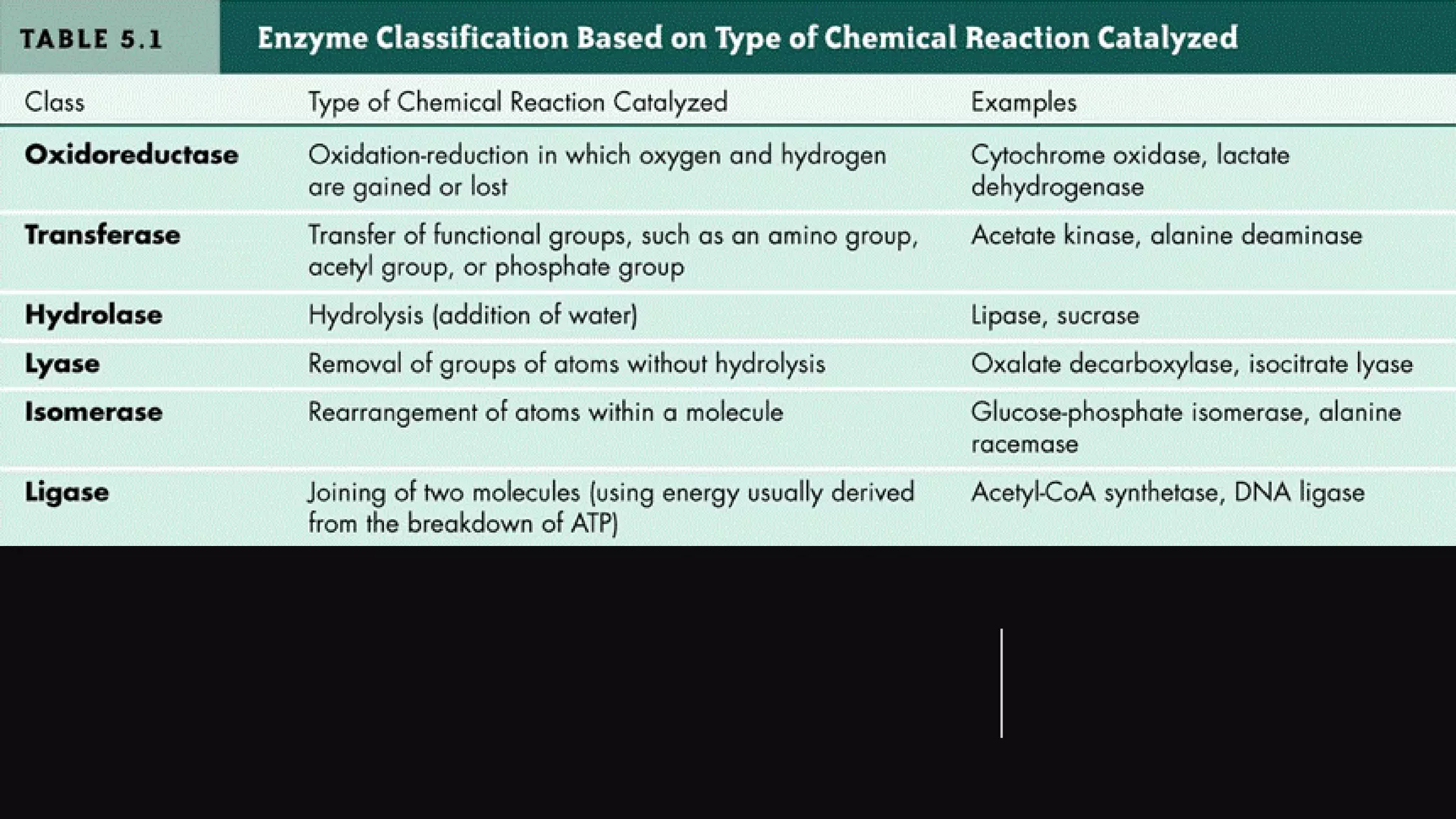
Isomerases
• Decarboxylases
• Aldolases
Ligases
• Synthetase
• Carboxylases
• Ligases
Co enzymes
• Water soluble vitamins
• Can function either as co substrate or prosthetic group
Sulfite oxidase
Molybdenum
• Xanthine oxidase
• Sulfite oxidase
Mechanism of enzyme action
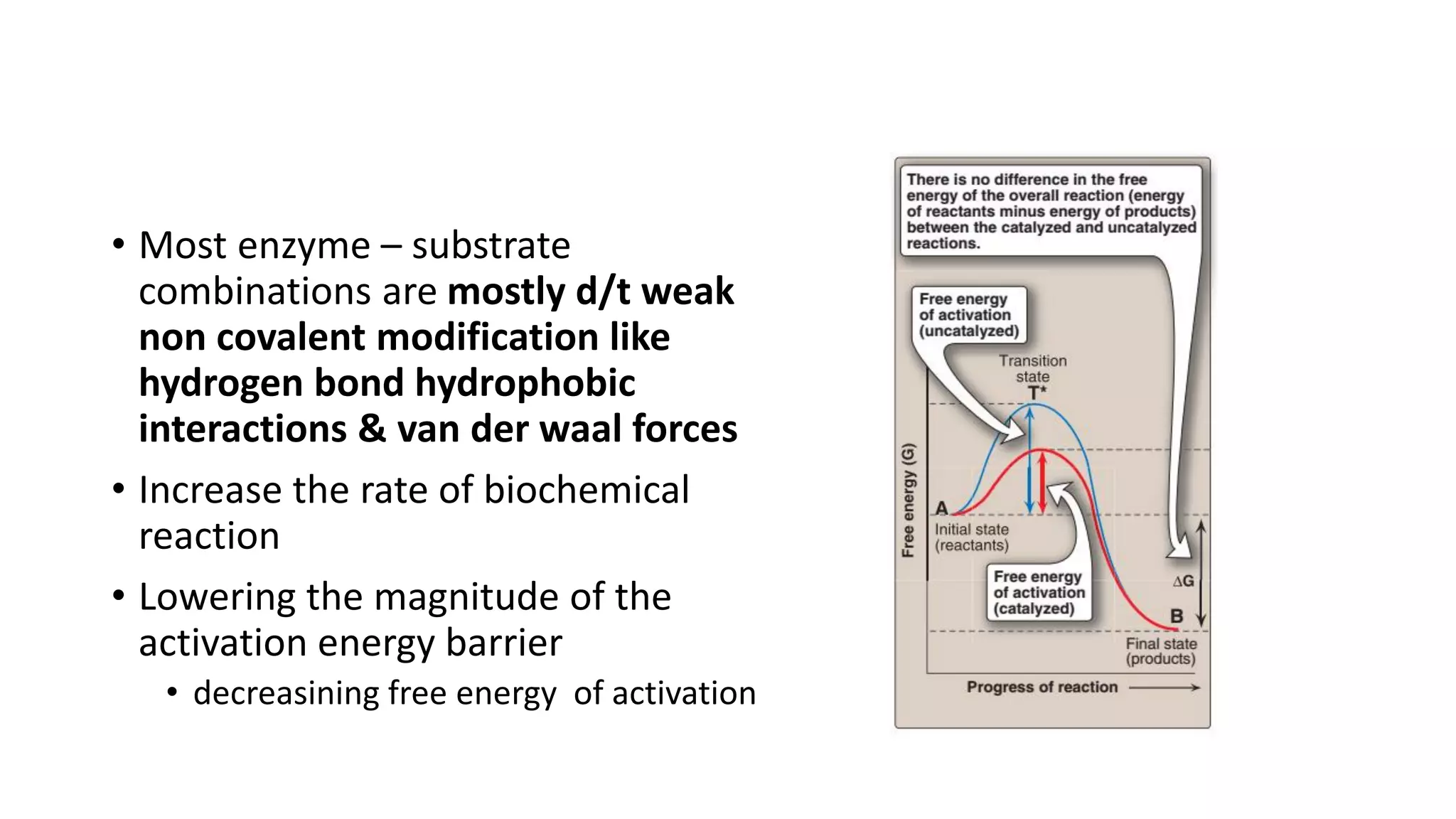
• Most enzyme – substrate
combinations are mostly d/t weak
non covalent modification like
hydrogen bond hydrophobic
interactions & van der waal forces
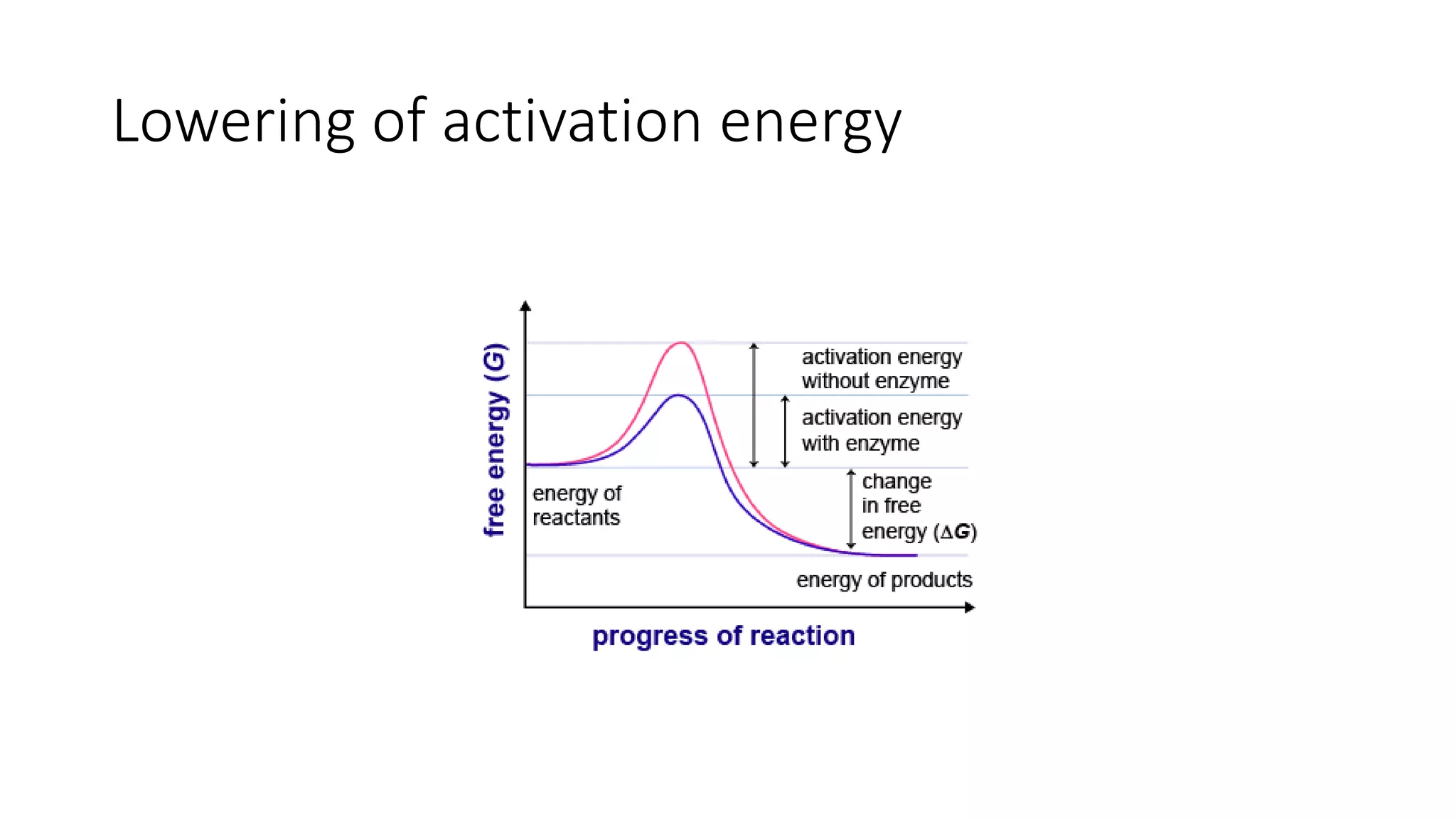
• Increase the rate of biochemical
reaction
• Lowering the magnitude of the
activation energy barrier
• decreasining free energy of activation
Lowering of activation energy
Michaelis menten theory
Enzyme combines with a substrate to form a transient enzyme
substrate complex
Which break in to enzyme products
Temperature & enzyme activity
Rate of enzyme activity increases with increase in temperature d/t
increase in kinetic energy
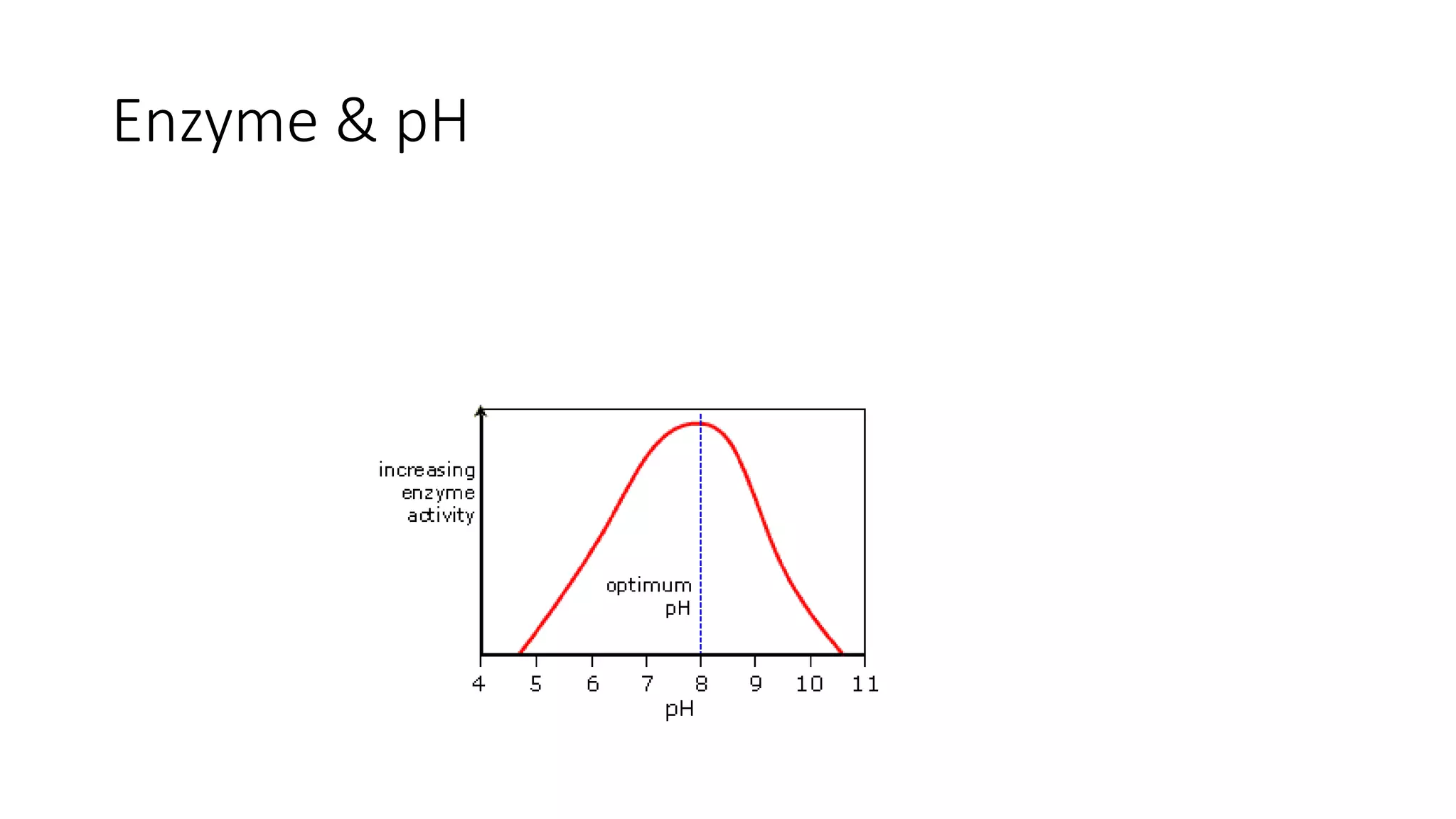
Enzyme & pH
• Rate of reaction
increases directly with
increase in enzyme
cncentration
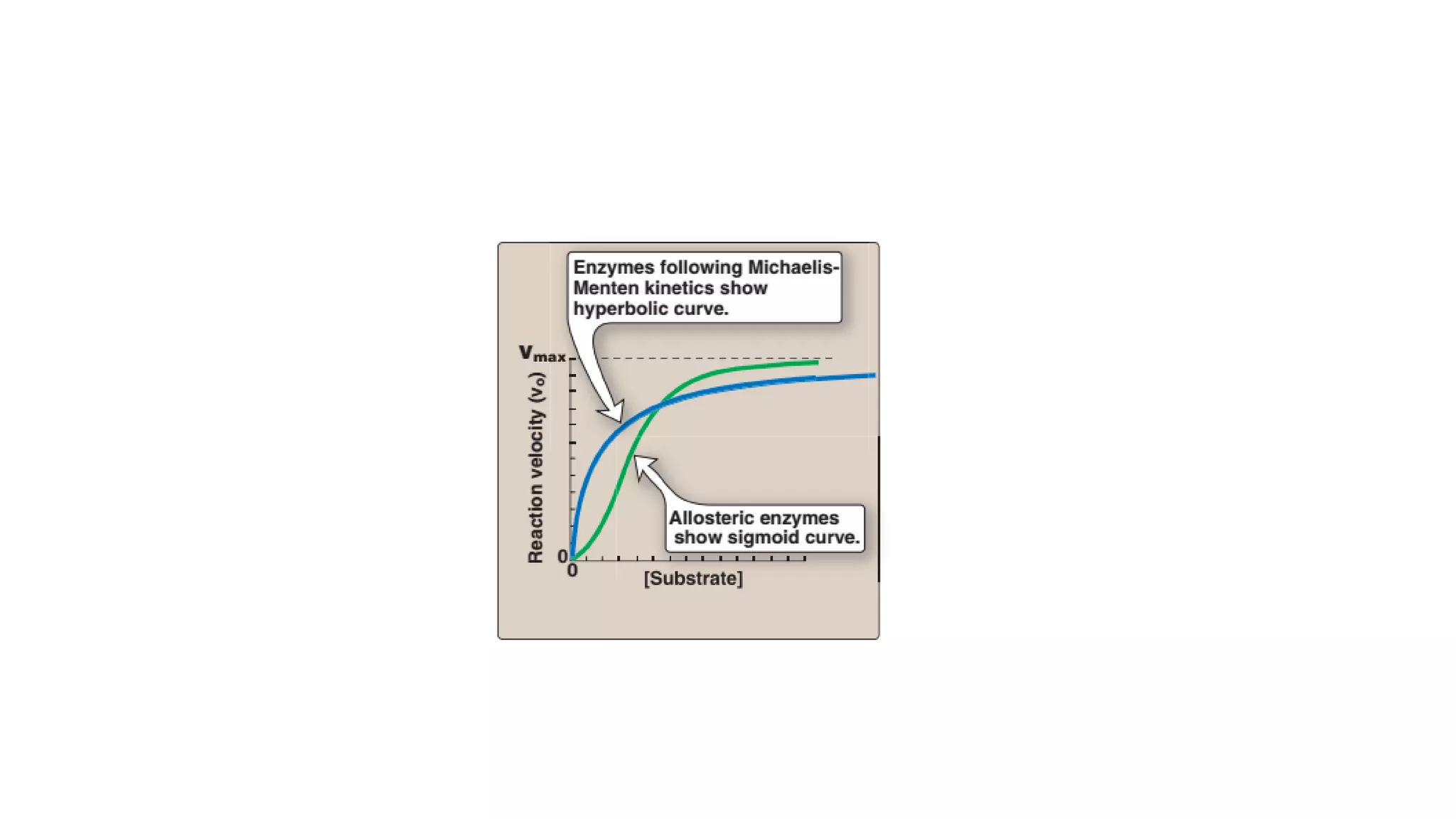
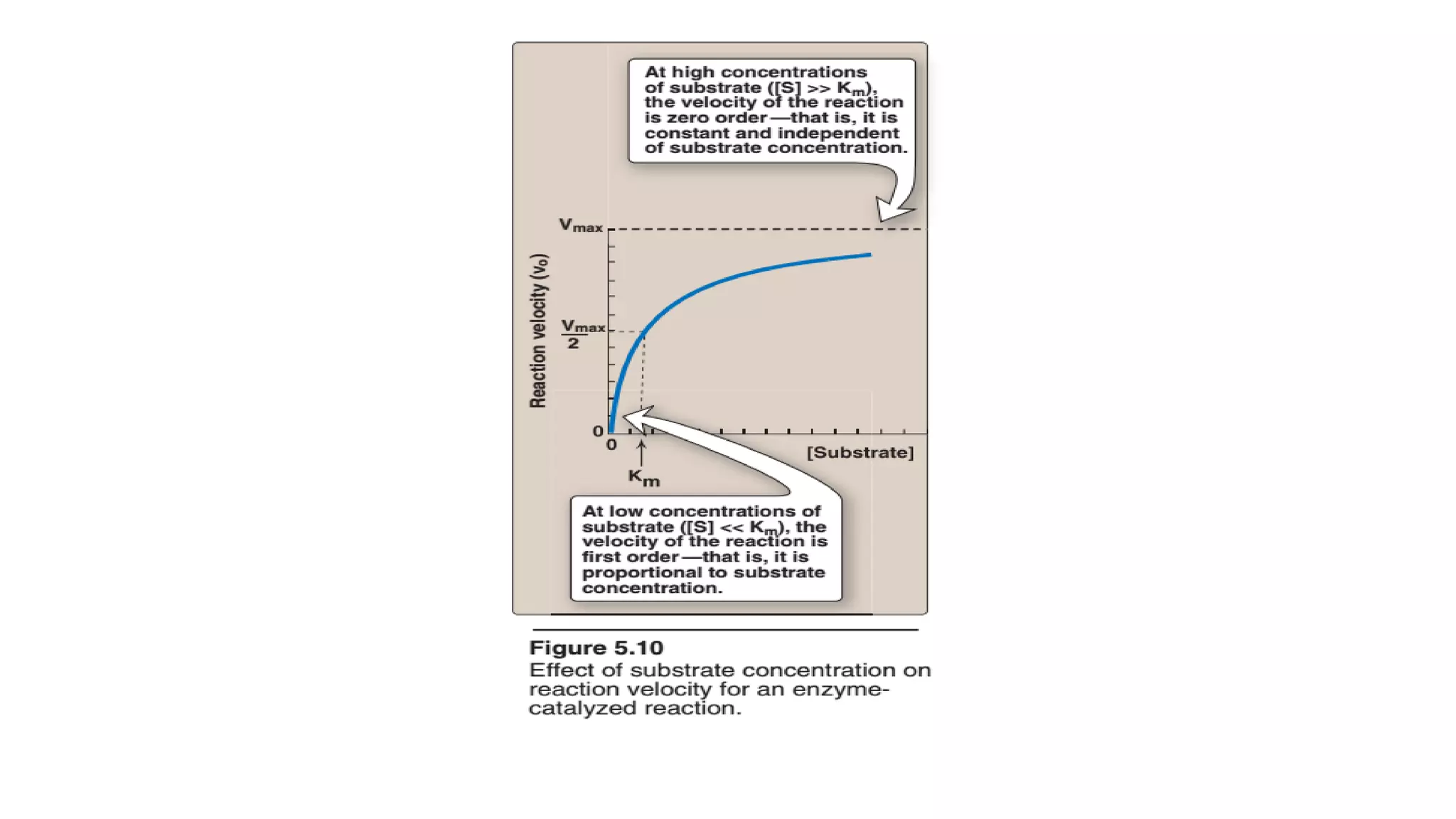
Hyperbolic curve is obtained
Michaelis menten equation
• Reaction velocity varies with substrate
concentration
• V0initial velocity
• Vmax  maximum velocity
• Km michaelis menten constant
• [S] substrate concentration
Km (michaelis menten constant)
• Substrate concentration at which reaction rate is half maximum
• Constant for each enzyme
• Reflects binding affinity of the enzyme for its substrate
• High enzyme substrate affinity implies a low Km value
• Low affinity implies high Km
• Natural substrate has lowest km
• key enzyme has highest km
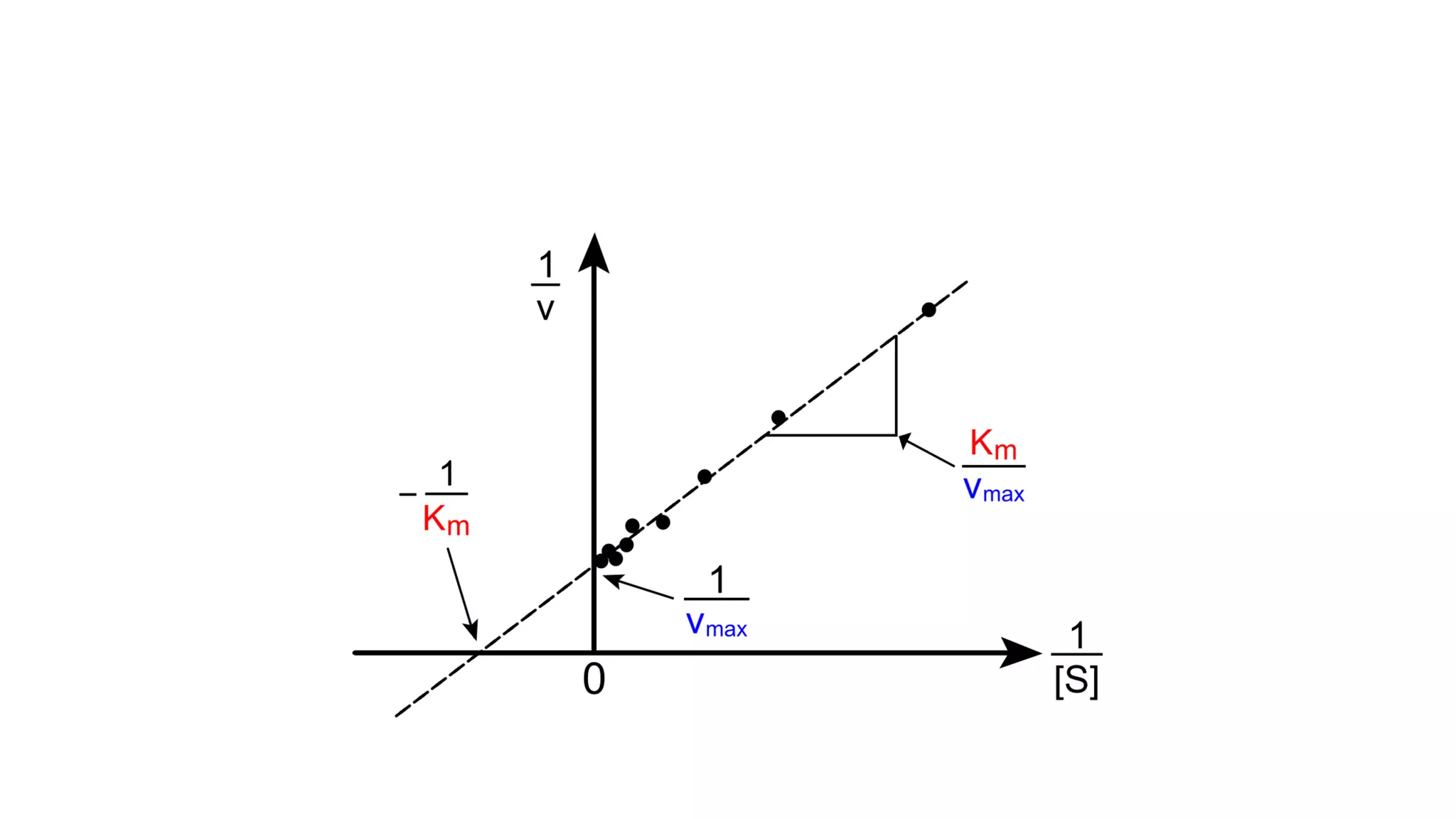
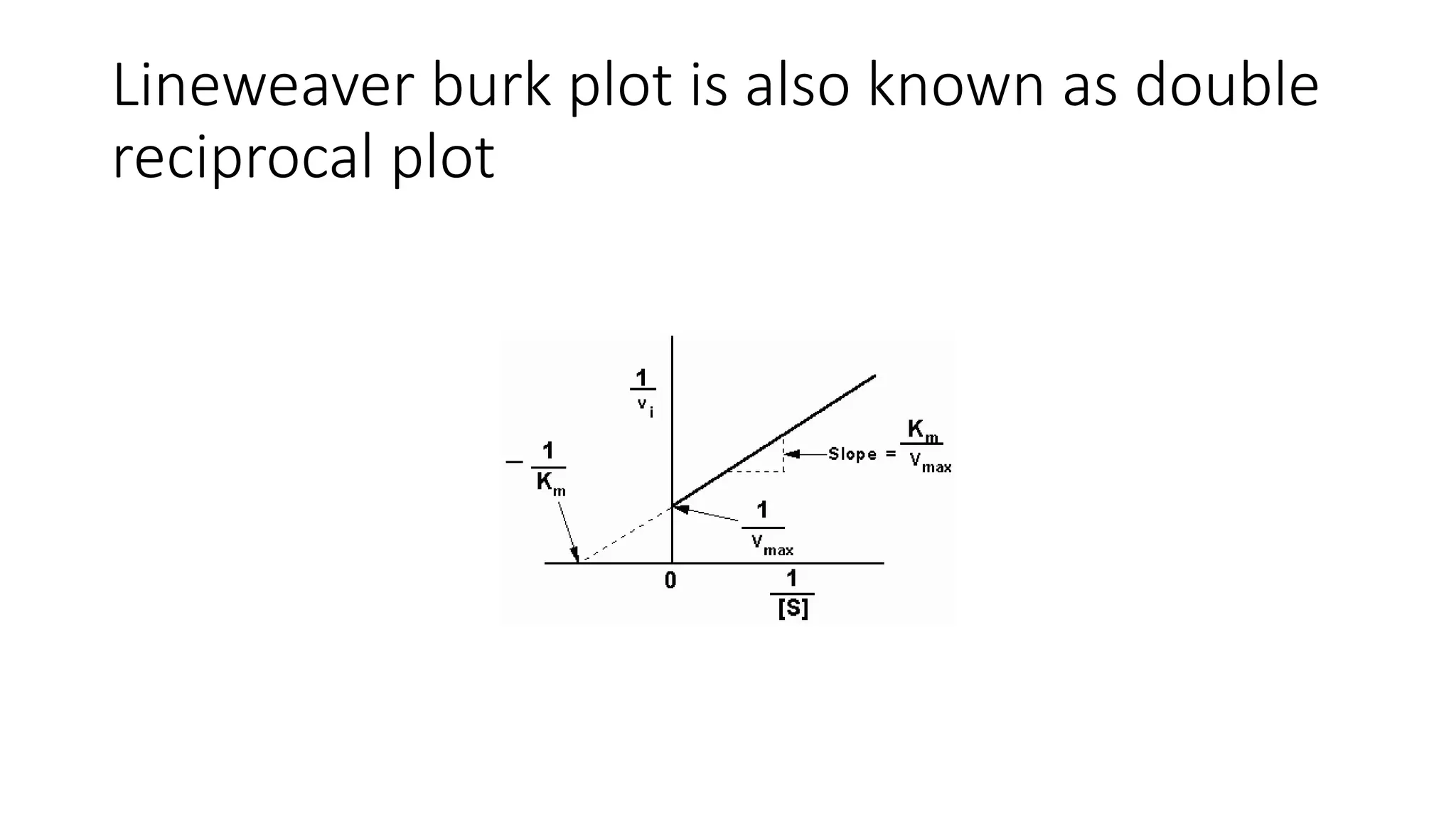
Lineweaver burk plot
Lineweaver burk plot is also known as double
reciprocal plot
Fischers lock and key theory
Koshlands induced fit theory
Enzyme inhibition
Enzyme inhibition
• Competitive inhibition
• Noncompetitive inhibition
• Suicide inhibition
• Allosteric inhibition
• Feedback inhibition
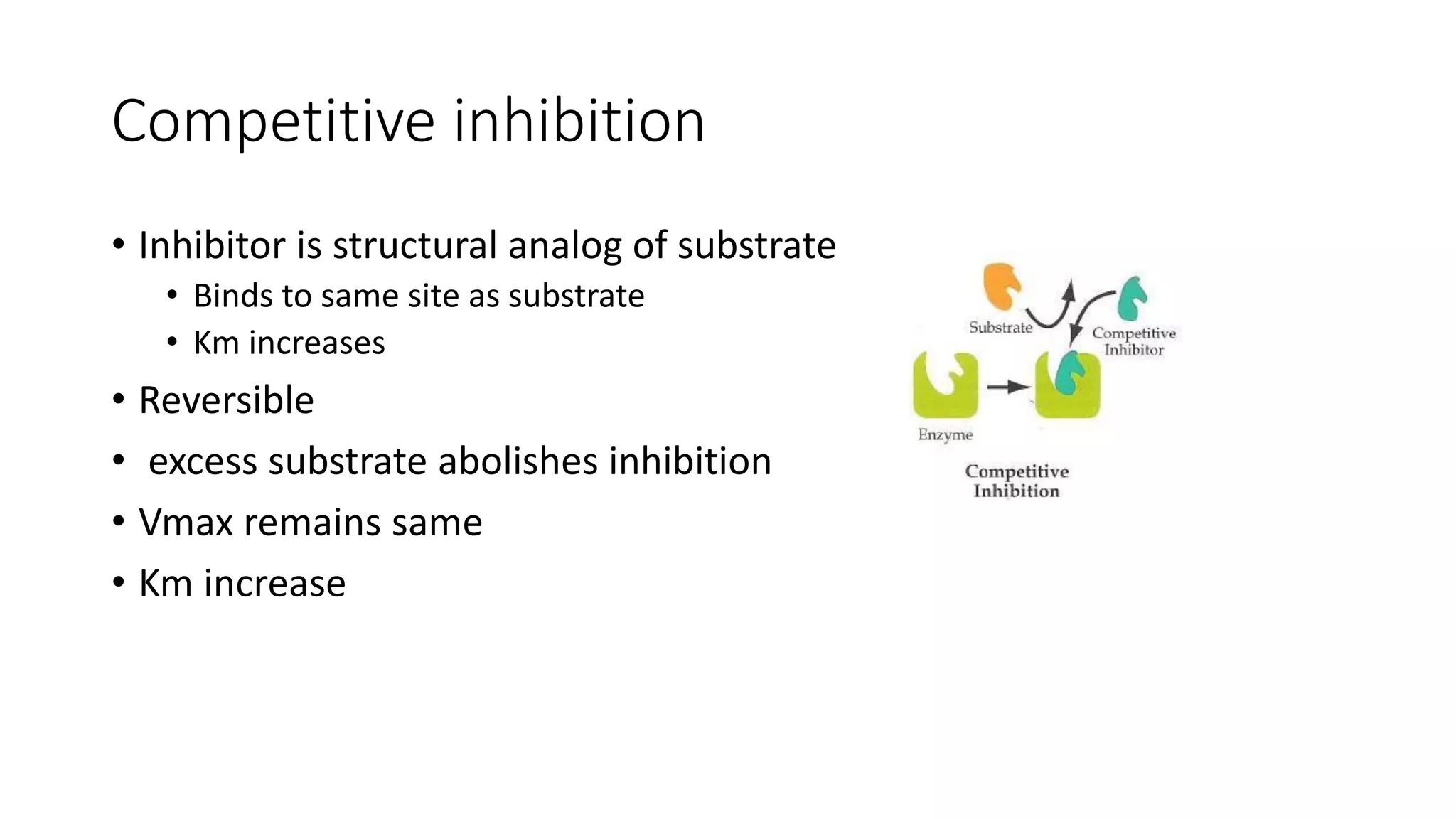
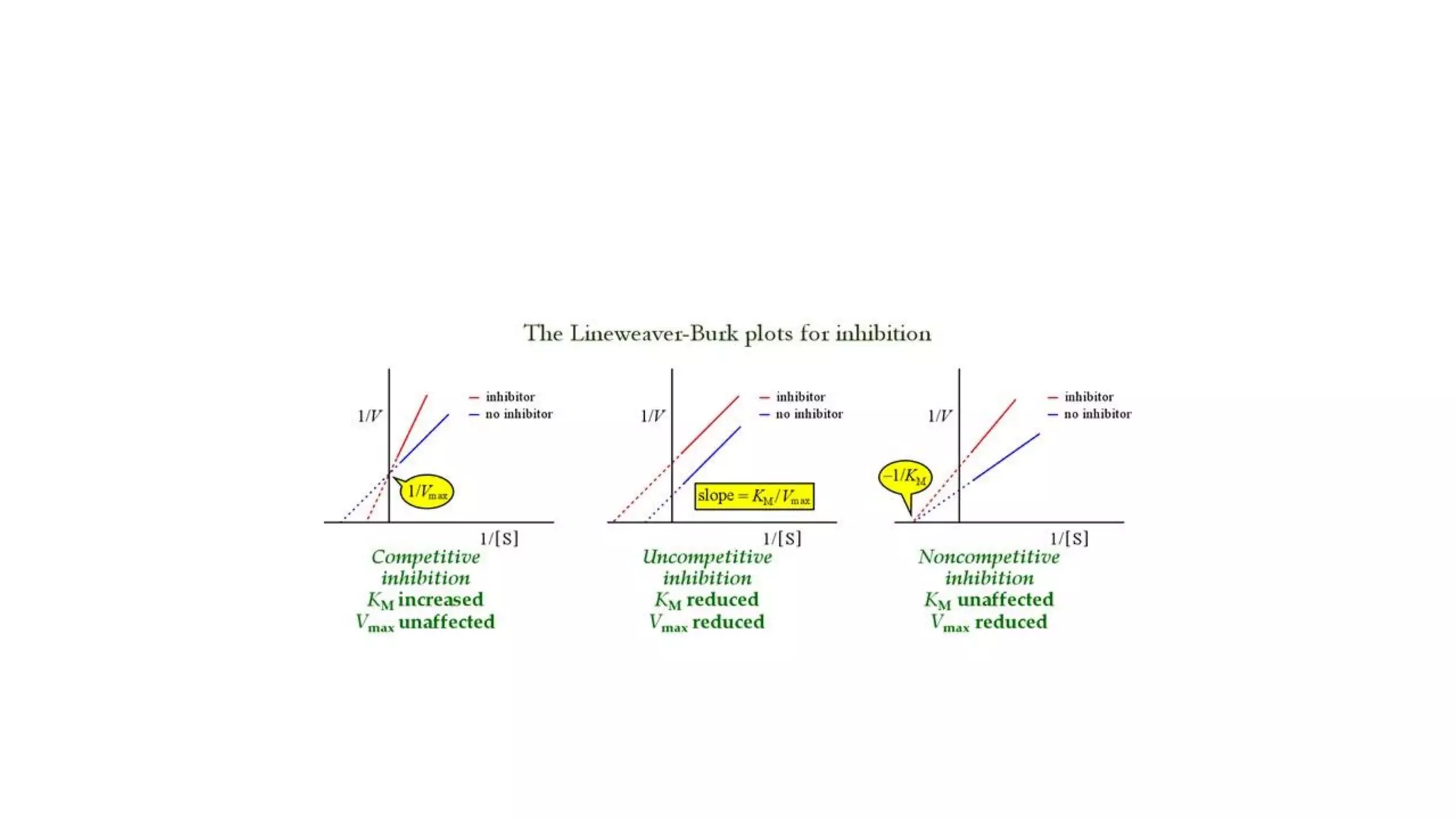
Competitive inhibition
• Inhibitor is structural analog of substrate
• Binds to same site as substrate
• Km increases
• Reversible
• excess substrate abolishes inhibition
• Vmax remains same
• Km increase
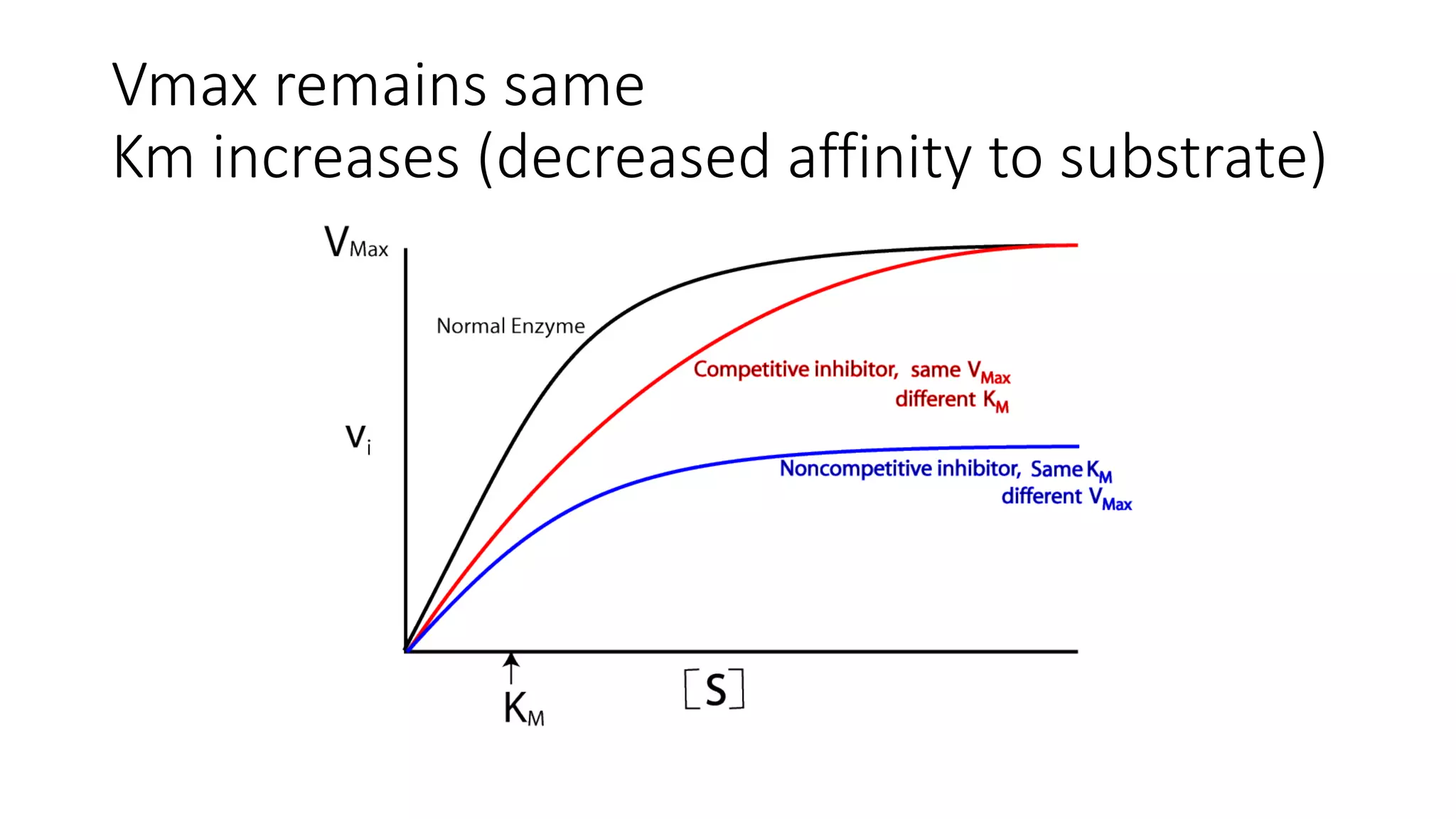
Vmax remains same
Km increases (decreased affinity to substrate)
• Competitive inhibition
• Eg
• Statin on HMG coA reductase
• MTX on DHFR
• Dicumarol in vitamin K epoxide
• Succinate dehydrogenase by malonate
• Effect on Vmax:
• The effect of a competitive inhibitor is reversed by increasing [S]. At a
sufficiently high substrate concentration, the reaction velocity reaches the
Vmax observed in the absence of inhibitor .
• Effect on Km:
• A competitive inhibitor increases the apparent Km for a given substrate. This
means that, in the presence of a competitive inhibitor, more substrate is
needed to achieve 1⁄2Vmax.
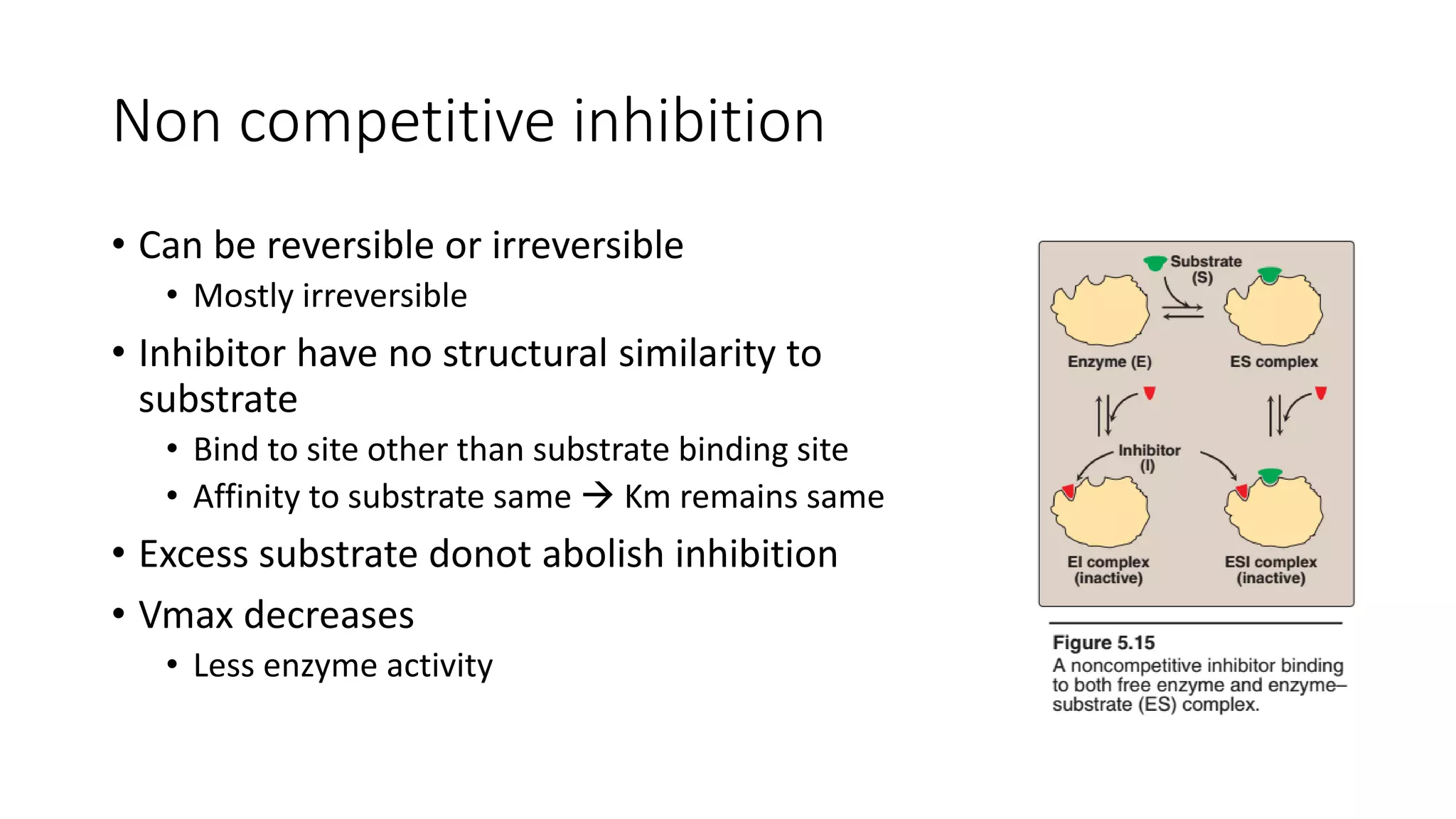
Non competitive inhibition
• Can be reversible or irreversible
• Mostly irreversible
• Inhibitor have no structural similarity to
substrate
• Bind to site other than substrate binding site
• Affinity to substrate same  Km remains same
• Excess substrate donot abolish inhibition
• Vmax decreases
• Less enzyme activity
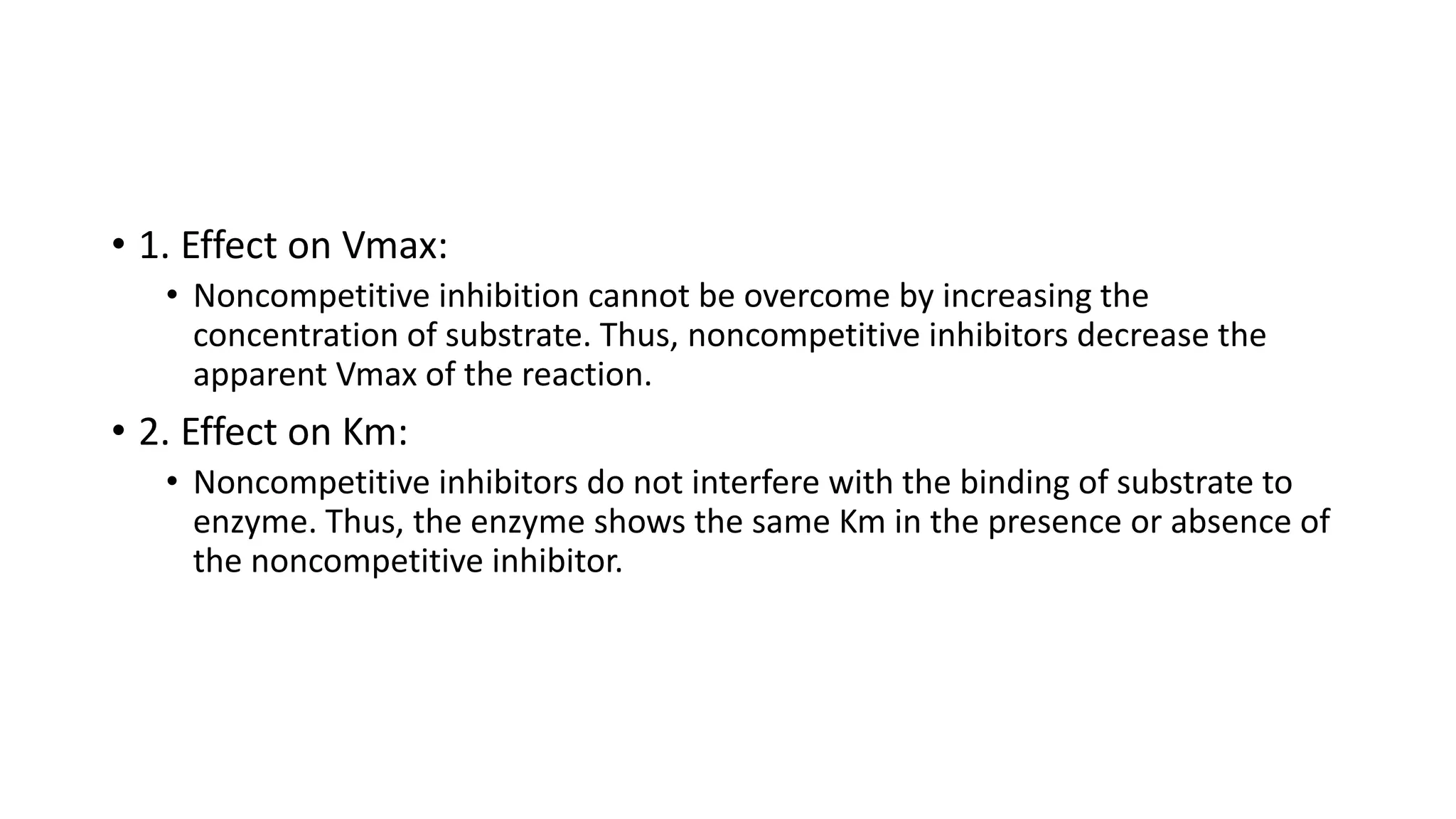
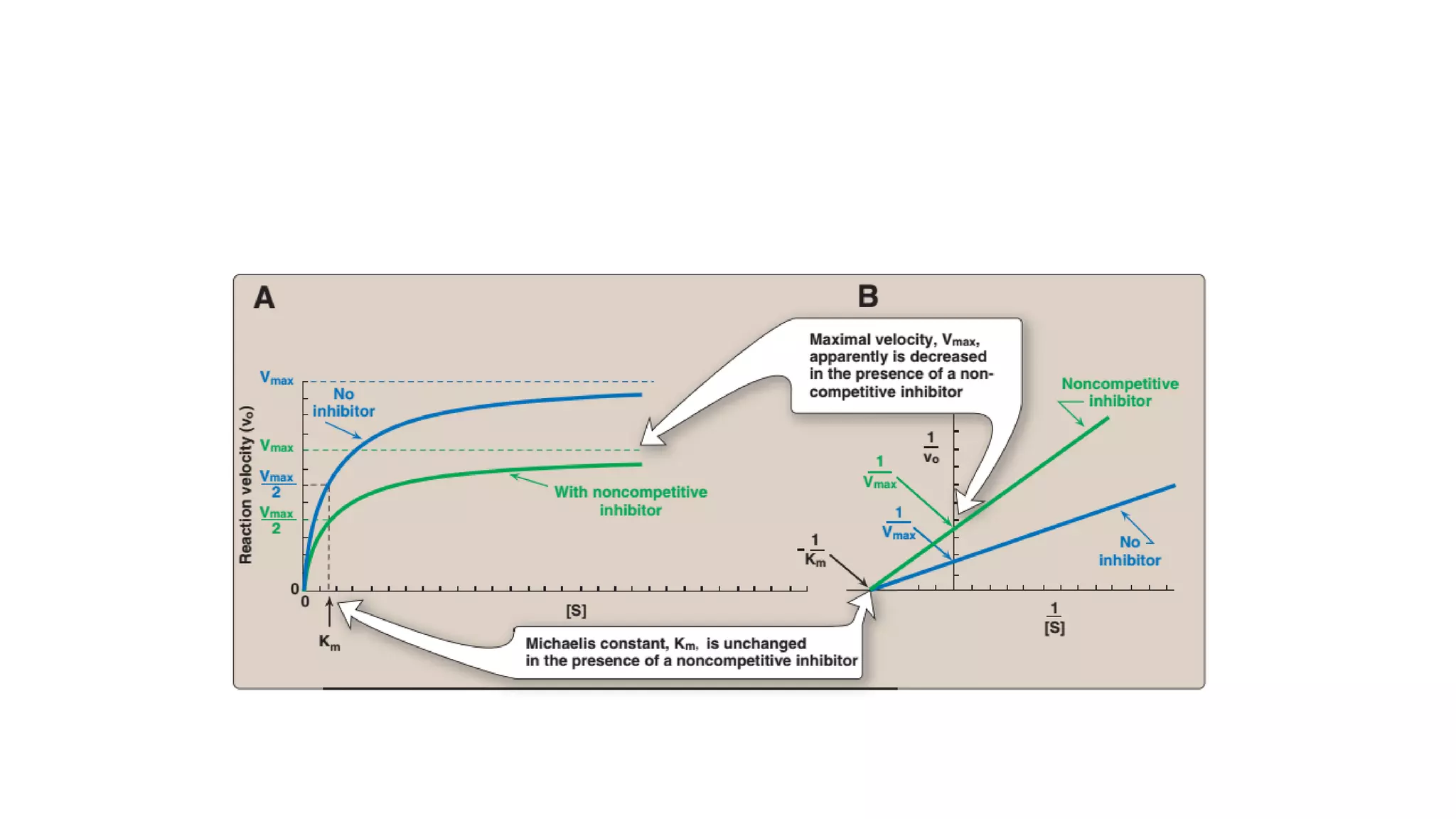
• 1. Effect on Vmax:
• Noncompetitive inhibition cannot be overcome by increasing the
concentration of substrate. Thus, noncompetitive inhibitors decrease the
apparent Vmax of the reaction.
• 2. Effect on Km:
• Noncompetitive inhibitors do not interfere with the binding of substrate to
enzyme. Thus, the enzyme shows the same Km in the presence or absence of
the noncompetitive inhibitor.
Non competitive inhibition
• Cyanide on cytochrome oxidase
Vmax remains same
Km increases (decreased affinity to substrate)
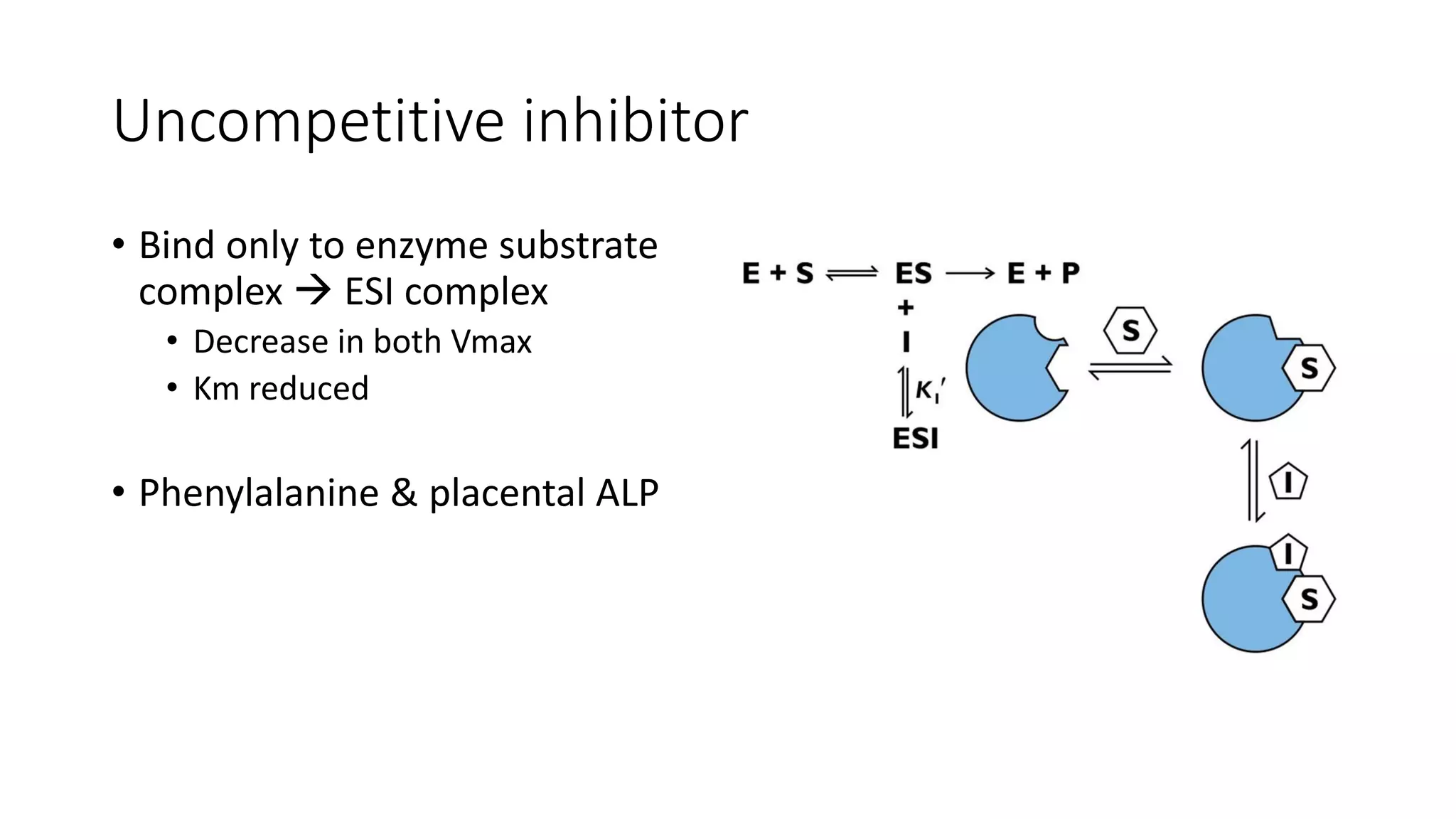
Uncompetitive inhibitor
• Bind only to enzyme substrate
complex  ESI complex
• Decrease in both Vmax
• Km reduced
• Phenylalanine & placental ALP
Suicide inhibition
• Mechanism based inactivation
• Inhibitors are unreactive until they are converted by enzyme in to
active product
• Which in turn inhibits the enzyme
• Eg aspirin COX
• Allopurinol xanthine oxidase
Suicide inhibition by aspirin
Feed back inhibition
• End product inhibition
Regulation of enzymes
• Regulation of enzyme quality
• Allosteric regulation
• Covalent modification
• Regualtion of enzyme quality
• Control of enzyme synthesis  induction & repression
• Control of enzyme degradation
Allosteric regulation
• Allosteric enzymes have a separate site where a modifier binds other
site for binding of substrates
• Can be
• Allosteric activator
• Allosteric inhibitor
• Allosteric enzymes have a quarternary structure & made up of sub
units
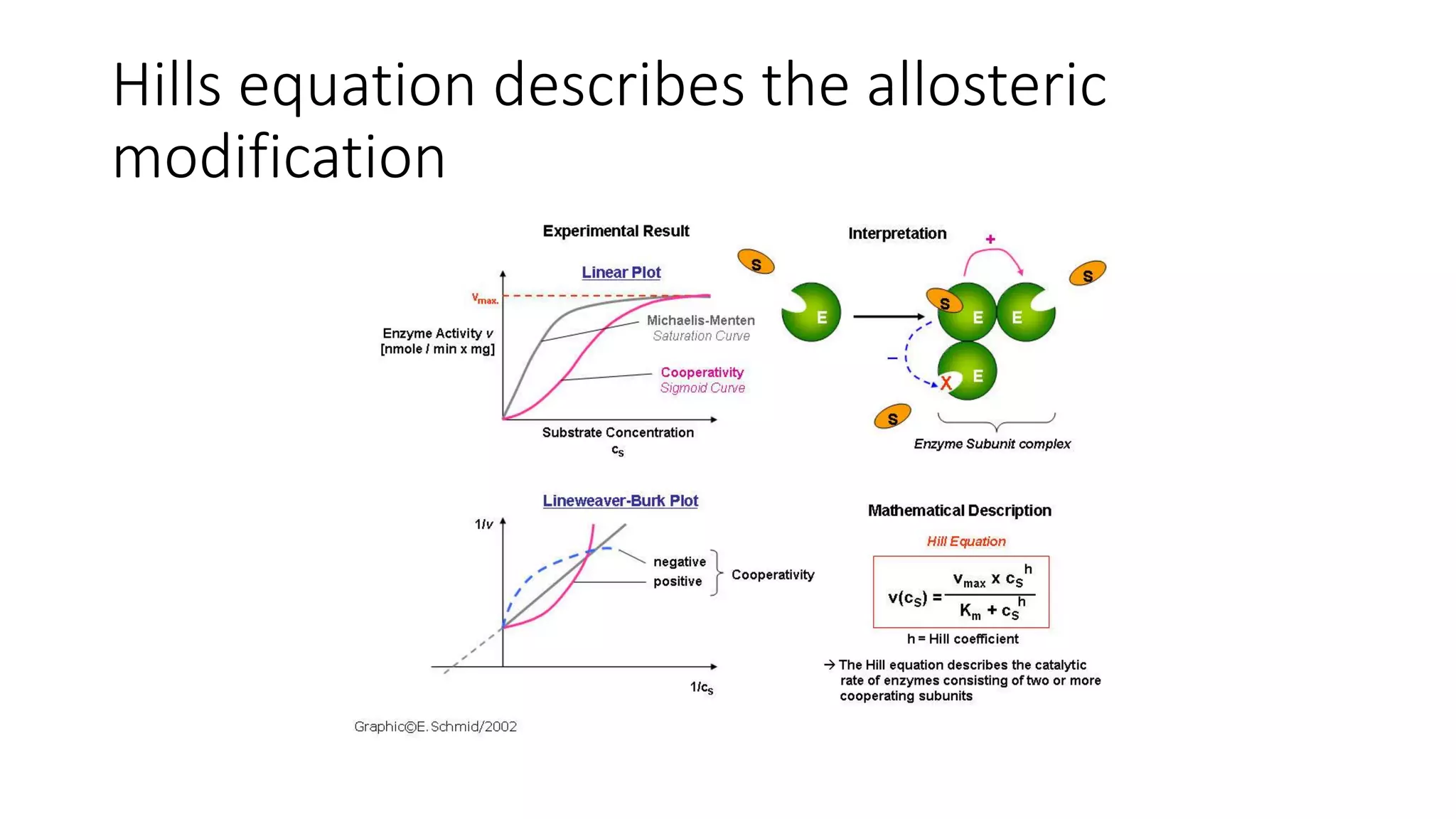
Cooperative binding  sigmoid shaped curve
Hills equation describes the allosteric
modification
Covalent modification
• Reversible
• Phosphorylation /dephophorylation
• Methylation
• Adenylation
• Acetylation
• Irreversible
• Partial proteolysis /zymogen activation
Phosphorylation  most common covalent
modification
Enzymes active in phosphorylated
state
• Glycogen phosphorylase
• Key enzymes of gluconeogenesis
Enzymes active in dephosphorylated
sate
• Glycogen synthase
• Enzymes of glycolysis
Caspaces
• Catalase
• Highest turn over
• Fastest acting enzyme
• Serine Proteases
• They are enzymes with a serine residue at the active site and most of the
proteolytic enzymes belong to this group, e.g. trypsin, chymotrypsin, clotting
factors
Clinical enzymology
• Nonfunctional plasma enzymes
• Cell derived enzymes
• Released in to plasma by autolysis (necrosis) or increased permeability of cells
• Functional enzyme in plasma
• Clotting factors in plasma
Enzymes in Heart
• CK
• LDH
• AST
CK MB
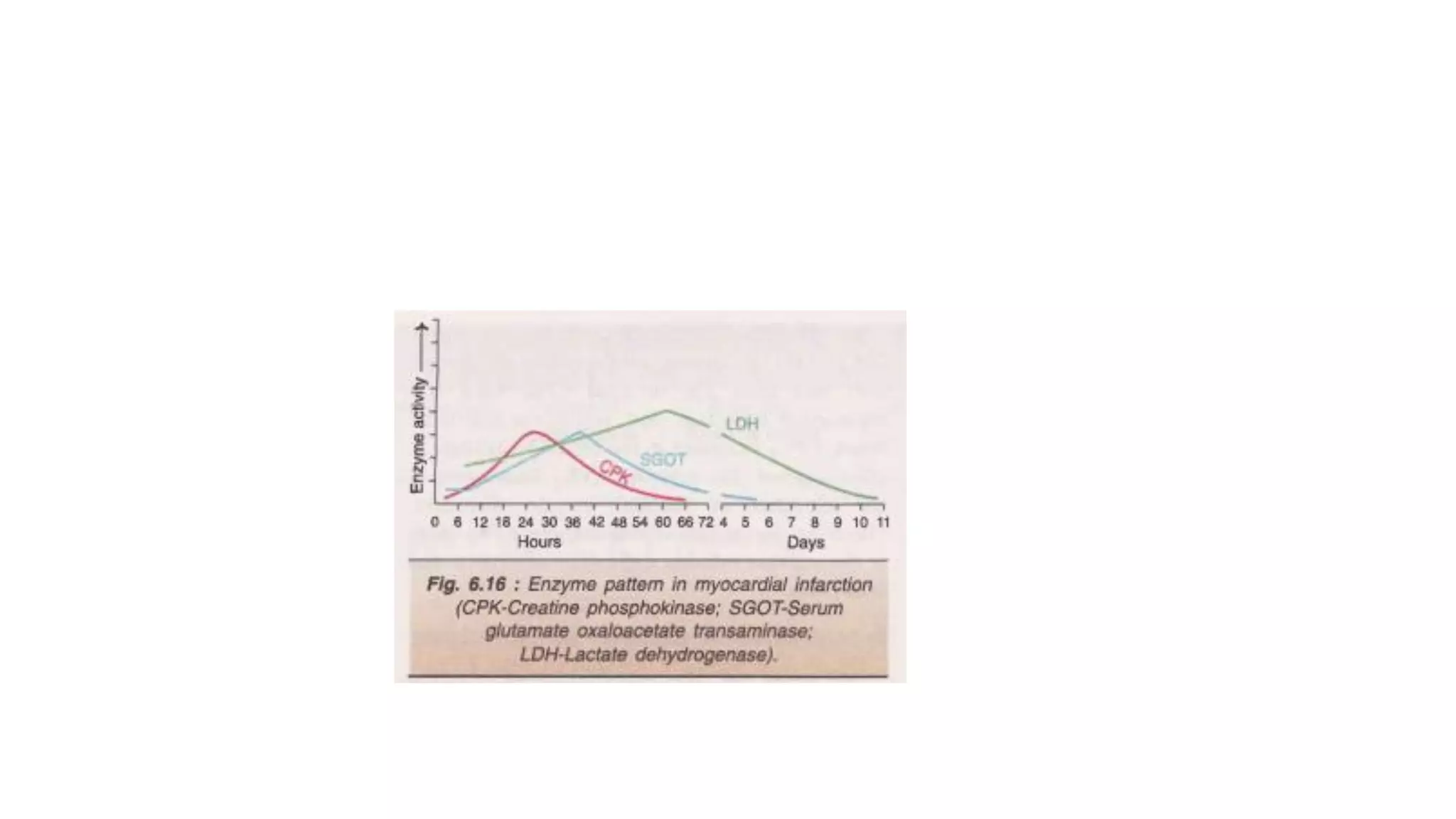
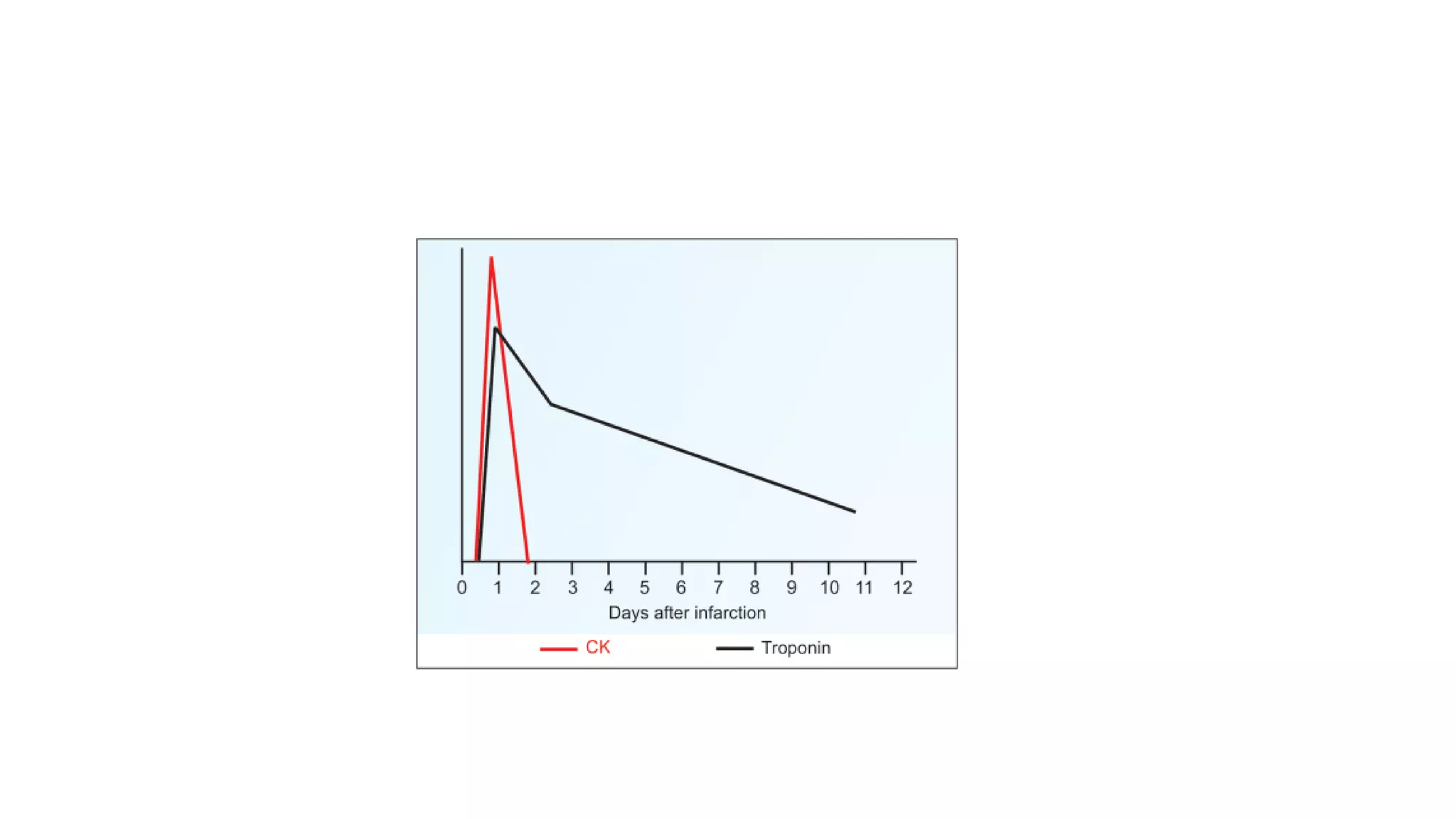
• First enzyme to elevate
• Rises in 3- 8 hrs
• Remain elevated for 3 days
• Early diagnosis of MI
CK is a dimer made up of 2 subunits B & M
subunits
Fetal reversion
• Damaged skeletal muscle may contain more CK-MB owing to
phenomenon of fetal reversion, thus serum CK-MB isoenzyme may
increase in such conditions.
• In c/c muscle disorders
LDH
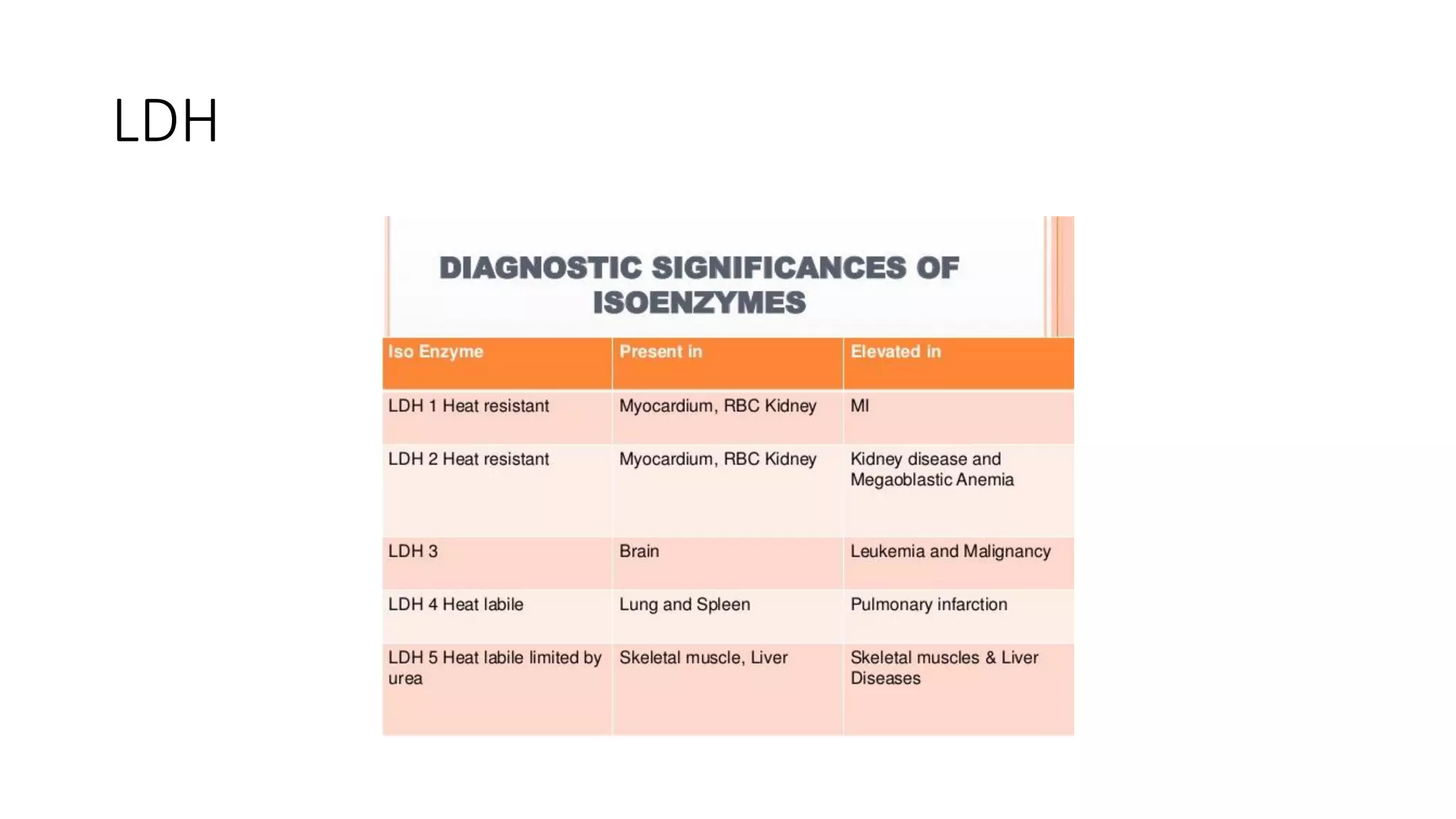
• Tetramer made of H & M subunits
• 5 isoenzymes
• Normally in blood LDH2 > LDH1
• But in MI  LDH 1 > LDH2 } FLIPPED PATTERN
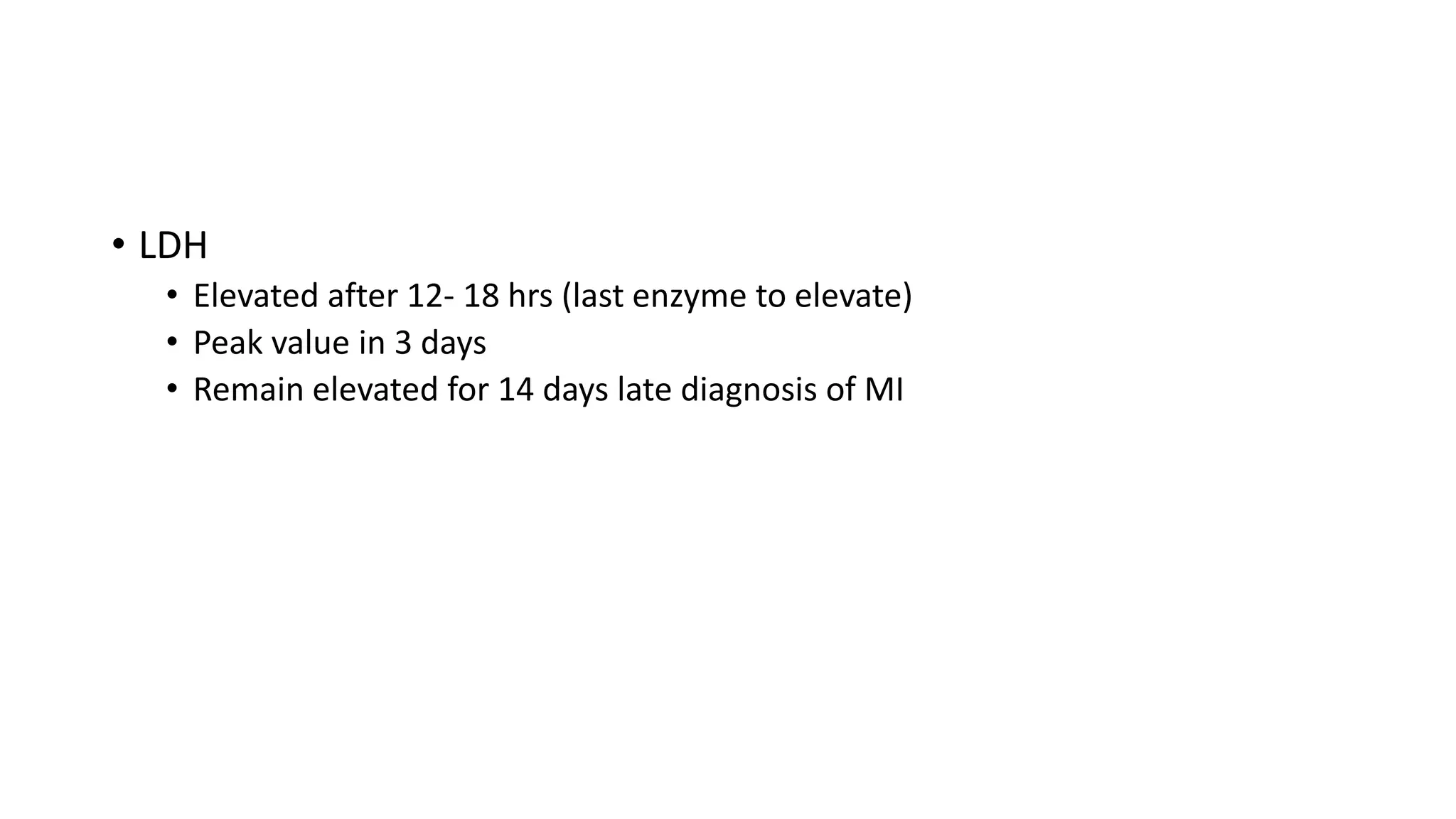
• LDH
• Elevated after 12- 18 hrs (last enzyme to elevate)
• Peak value in 3 days
• Remain elevated for 14 days late diagnosis of MI
LDH
• LDH 2 is elevated in anemia
• LDH may also be elevated in haemolysis
AST
• Elevated in MI & hepatocellular damage
• Non specific
• Elevated after days & lasts for less duration
• Not used in diagnosis
Pro BNP
• The best marker of ventricular dysfunction is pro-BNP.
Ischemia modifed albumin (IMA)
• Myocardial ischemia alters the N-terminus of albumin reducing the
ability of cobalt to bind to albumin.
• Rises with in 6 – 10 minutes
• Low specificity (ischemia in any organ)
• negative value is highly useful, as it rules out the possibility of MI
Myocardial ischemia alters the N-terminus of
albumin reducing the ability of cobalt to bind to
albumin
Myoglobin
• Low specificity
• Troponin I
• is released into the blood within 4 hours after the onset of symptoms of
myocardial ischemia; peaks at 14–24 hours and remains elevated for 3–5 days
postinfarction
• Troponin T (TnT)
• increases within 6 hours of myocardial infarction, peaks at 72 hours and then
remains elevated up to 10–14 days
Troponin
• Skeletal muscle cardiac muscle
• Not in smooth muscle
• Any time marker for MI
H -FABP
• Heart type fatty acid binding protein
• Used as predictor of death or MI @ 1 yr in ACS
• H FABP – ve  low mortality
• H FABP +ve  high mortality
Enzymes in liver disease
• Hepatocellular damge
• ALT
• AST
• Obstructive
• ALP
• Gamma glutamyl transferase
• 5 nucleotidase
AST / ALT
• AST /ALT <1 :viral hepatitis
• AST /ALT 1-2 : cirrhosis
• AST /ALT >2 : alcoholic hepatitis or HCC
Isoenzymes of ALP
• Alpha 1 ALP-
• epithelial cells of biliary canaliculi
• increased in obstructive jaundice
• Alpha 2 heat labile ALP-
• hepatic cells
• Moderate elevation in jaundice
• Alpha 2 heat stable ALP placental
• -not destroyed at 65˚C inhibited by phenylalanine
• Pre beta ALP – bone,heat labile
• Gamma ALP –
• intestinal cells inhibited by phenylalanine
• Elevated in ulcerative colitis
• Leukocyte alkaline phosphatase
• –decreased in CML increase in lymphoma
• ATYPICAL ISOENZYMES
• Regan isoenzyme-heat stable,inhibited by L-phenylalanine
• a/w ca liver lung GIT
• Also increased in smokers
• Nagao isoenzyme- variant of regan inhibited by L-leucine
• In pleural malignancy
5 ‘ nucleotidase
• 2-17 U/L
• Elevated in obstructive ds
GGT (gamma glutamyl transferase )
• Very sensitive for alcoholic liver ds
• Present on membrane surface
Pancreatic ds
• S amylase
• Non specific
• Increased in all cases of a/c abdomen
• Small protein excreted in urine  elevated in renal failure
• S lipase
• Specific
Prostate
• Acid phosphatase
• PSA
Acid phosphatase
• Secreted by prostate cells, RBC, platelets and WBC.
• prostate iso-enzyme is inactivated by tartaric acid
• Erythrocytic form is inhibited by cupric ions
• increased in prostate cancer and highly elevated in bone metastasis of
prostate cancer
• tartrate labile iso-enzyme is elevated.
• This assay is very helpful in follow-up of treatment of prostate cancers.
Tartrate resistant acid phosphatase
• Elevated in osteoclastoma
• Osteodystrophy
• Metabolic bone ds
PROSTATE SPECIFIC ANTIGEN (PSA)
• serine protease
• Normal value is 1–5 mg/L.
• It is very specifc for prostate activity.
• Values above 10 mg/L is indicative of prostate cancer
Anti tranglutaminase activity
• In celiac ds
• Sensitve & specific
Abzyme
• Ab with enzymatic
activity

Enzymology BIOCHEMISTRY REVISION NOTES

  • 1.
  • 2.
    • Biocatalyst • Usuallyproteins except ribozyme (RNA particles with catalytic activity ) • With out being changed themselves
  • 3.
    Enzyme activity Unit ofenzyme activity • Amount causing transformation of 1 um of substrate /min at 25 *C • Expressed as mole of substrate utilised or mole of product formed Specific activity • No of protein units /mg of protein • Measure of enzyme purity • Higher the enzyme purity  higher the specific activity Turn over number • Number of substrate molecules transformed per unit time by a single enzyme molecule (when enzyme concentration alone is limiting factor) • Highest turnover  catalase (fastest enzyme) followed by carbonic anhydrase • Lowest turnover  lysozyme (slowest enzyme)
  • 4.
    Some enzymes areproduced as proenzymes • Inactive precursors  zymogens or proenzymes • Proelastase • Pepsinogen
  • 6.
    Co enzyme • organicmolecule required by enzyme Co factor • Inorganic molecule required by enzyme
  • 13.
    Nomenclature of enzyme •EC stands for enzyme commission, and • the first digit stands for the class name (transferase), • the second digit stands for the subclass • 3rd digit sub sub class • 4th digit  individual enzyme
  • 14.
  • 15.
  • 17.
    Co enzymes • Watersoluble vitamins • Can function either as co substrate or prosthetic group
  • 20.
  • 21.
  • 22.
  • 23.
    • Most enzyme– substrate combinations are mostly d/t weak non covalent modification like hydrogen bond hydrophobic interactions & van der waal forces • Increase the rate of biochemical reaction • Lowering the magnitude of the activation energy barrier • decreasining free energy of activation
  • 24.
  • 25.
    Michaelis menten theory Enzymecombines with a substrate to form a transient enzyme substrate complex Which break in to enzyme products
  • 26.
    Temperature & enzymeactivity Rate of enzyme activity increases with increase in temperature d/t increase in kinetic energy
  • 27.
  • 28.
    • Rate ofreaction increases directly with increase in enzyme cncentration
  • 29.
  • 32.
    Michaelis menten equation •Reaction velocity varies with substrate concentration • V0initial velocity • Vmax  maximum velocity • Km michaelis menten constant • [S] substrate concentration
  • 33.
    Km (michaelis mentenconstant) • Substrate concentration at which reaction rate is half maximum • Constant for each enzyme • Reflects binding affinity of the enzyme for its substrate • High enzyme substrate affinity implies a low Km value • Low affinity implies high Km • Natural substrate has lowest km • key enzyme has highest km
  • 34.
  • 36.
    Lineweaver burk plotis also known as double reciprocal plot
  • 37.
  • 38.
  • 40.
  • 41.
    Enzyme inhibition • Competitiveinhibition • Noncompetitive inhibition • Suicide inhibition • Allosteric inhibition • Feedback inhibition
  • 42.
    Competitive inhibition • Inhibitoris structural analog of substrate • Binds to same site as substrate • Km increases • Reversible • excess substrate abolishes inhibition • Vmax remains same • Km increase
  • 44.
    Vmax remains same Kmincreases (decreased affinity to substrate)
  • 45.
    • Competitive inhibition •Eg • Statin on HMG coA reductase • MTX on DHFR • Dicumarol in vitamin K epoxide • Succinate dehydrogenase by malonate
  • 47.
    • Effect onVmax: • The effect of a competitive inhibitor is reversed by increasing [S]. At a sufficiently high substrate concentration, the reaction velocity reaches the Vmax observed in the absence of inhibitor . • Effect on Km: • A competitive inhibitor increases the apparent Km for a given substrate. This means that, in the presence of a competitive inhibitor, more substrate is needed to achieve 1⁄2Vmax.
  • 48.
    Non competitive inhibition •Can be reversible or irreversible • Mostly irreversible • Inhibitor have no structural similarity to substrate • Bind to site other than substrate binding site • Affinity to substrate same  Km remains same • Excess substrate donot abolish inhibition • Vmax decreases • Less enzyme activity
  • 49.
    • 1. Effecton Vmax: • Noncompetitive inhibition cannot be overcome by increasing the concentration of substrate. Thus, noncompetitive inhibitors decrease the apparent Vmax of the reaction. • 2. Effect on Km: • Noncompetitive inhibitors do not interfere with the binding of substrate to enzyme. Thus, the enzyme shows the same Km in the presence or absence of the noncompetitive inhibitor.
  • 50.
    Non competitive inhibition •Cyanide on cytochrome oxidase
  • 53.
    Vmax remains same Kmincreases (decreased affinity to substrate)
  • 56.
    Uncompetitive inhibitor • Bindonly to enzyme substrate complex  ESI complex • Decrease in both Vmax • Km reduced • Phenylalanine & placental ALP
  • 58.
    Suicide inhibition • Mechanismbased inactivation • Inhibitors are unreactive until they are converted by enzyme in to active product • Which in turn inhibits the enzyme • Eg aspirin COX • Allopurinol xanthine oxidase
  • 59.
  • 60.
    Feed back inhibition •End product inhibition
  • 61.
  • 62.
    • Regulation ofenzyme quality • Allosteric regulation • Covalent modification • Regualtion of enzyme quality • Control of enzyme synthesis  induction & repression • Control of enzyme degradation
  • 63.
    Allosteric regulation • Allostericenzymes have a separate site where a modifier binds other site for binding of substrates • Can be • Allosteric activator • Allosteric inhibitor
  • 66.
    • Allosteric enzymeshave a quarternary structure & made up of sub units
  • 67.
    Cooperative binding sigmoid shaped curve
  • 68.
    Hills equation describesthe allosteric modification
  • 69.
  • 70.
    Covalent modification • Reversible •Phosphorylation /dephophorylation • Methylation • Adenylation • Acetylation • Irreversible • Partial proteolysis /zymogen activation
  • 71.
    Phosphorylation  mostcommon covalent modification Enzymes active in phosphorylated state • Glycogen phosphorylase • Key enzymes of gluconeogenesis Enzymes active in dephosphorylated sate • Glycogen synthase • Enzymes of glycolysis
  • 72.
  • 73.
    • Catalase • Highestturn over • Fastest acting enzyme
  • 74.
    • Serine Proteases •They are enzymes with a serine residue at the active site and most of the proteolytic enzymes belong to this group, e.g. trypsin, chymotrypsin, clotting factors
  • 75.
  • 76.
    • Nonfunctional plasmaenzymes • Cell derived enzymes • Released in to plasma by autolysis (necrosis) or increased permeability of cells
  • 77.
    • Functional enzymein plasma • Clotting factors in plasma
  • 78.
    Enzymes in Heart •CK • LDH • AST
  • 79.
    CK MB • Firstenzyme to elevate • Rises in 3- 8 hrs • Remain elevated for 3 days • Early diagnosis of MI
  • 80.
    CK is adimer made up of 2 subunits B & M subunits
  • 82.
    Fetal reversion • Damagedskeletal muscle may contain more CK-MB owing to phenomenon of fetal reversion, thus serum CK-MB isoenzyme may increase in such conditions. • In c/c muscle disorders
  • 83.
    LDH • Tetramer madeof H & M subunits • 5 isoenzymes • Normally in blood LDH2 > LDH1 • But in MI  LDH 1 > LDH2 } FLIPPED PATTERN
  • 84.
    • LDH • Elevatedafter 12- 18 hrs (last enzyme to elevate) • Peak value in 3 days • Remain elevated for 14 days late diagnosis of MI
  • 85.
  • 86.
    • LDH 2is elevated in anemia
  • 87.
    • LDH mayalso be elevated in haemolysis
  • 88.
    AST • Elevated inMI & hepatocellular damage • Non specific • Elevated after days & lasts for less duration • Not used in diagnosis
  • 90.
    Pro BNP • Thebest marker of ventricular dysfunction is pro-BNP.
  • 91.
    Ischemia modifed albumin(IMA) • Myocardial ischemia alters the N-terminus of albumin reducing the ability of cobalt to bind to albumin. • Rises with in 6 – 10 minutes • Low specificity (ischemia in any organ) • negative value is highly useful, as it rules out the possibility of MI
  • 92.
    Myocardial ischemia altersthe N-terminus of albumin reducing the ability of cobalt to bind to albumin
  • 93.
  • 94.
    • Troponin I •is released into the blood within 4 hours after the onset of symptoms of myocardial ischemia; peaks at 14–24 hours and remains elevated for 3–5 days postinfarction • Troponin T (TnT) • increases within 6 hours of myocardial infarction, peaks at 72 hours and then remains elevated up to 10–14 days
  • 95.
    Troponin • Skeletal musclecardiac muscle • Not in smooth muscle • Any time marker for MI
  • 98.
    H -FABP • Hearttype fatty acid binding protein • Used as predictor of death or MI @ 1 yr in ACS • H FABP – ve  low mortality • H FABP +ve  high mortality
  • 99.
  • 100.
    Enzymes in liverdisease • Hepatocellular damge • ALT • AST • Obstructive • ALP • Gamma glutamyl transferase • 5 nucleotidase
  • 101.
    AST / ALT •AST /ALT <1 :viral hepatitis • AST /ALT 1-2 : cirrhosis • AST /ALT >2 : alcoholic hepatitis or HCC
  • 102.
    Isoenzymes of ALP •Alpha 1 ALP- • epithelial cells of biliary canaliculi • increased in obstructive jaundice • Alpha 2 heat labile ALP- • hepatic cells • Moderate elevation in jaundice • Alpha 2 heat stable ALP placental • -not destroyed at 65˚C inhibited by phenylalanine • Pre beta ALP – bone,heat labile • Gamma ALP – • intestinal cells inhibited by phenylalanine • Elevated in ulcerative colitis • Leukocyte alkaline phosphatase • –decreased in CML increase in lymphoma
  • 103.
    • ATYPICAL ISOENZYMES •Regan isoenzyme-heat stable,inhibited by L-phenylalanine • a/w ca liver lung GIT • Also increased in smokers • Nagao isoenzyme- variant of regan inhibited by L-leucine • In pleural malignancy
  • 104.
    5 ‘ nucleotidase •2-17 U/L • Elevated in obstructive ds
  • 105.
    GGT (gamma glutamyltransferase ) • Very sensitive for alcoholic liver ds • Present on membrane surface
  • 106.
    Pancreatic ds • Samylase • Non specific • Increased in all cases of a/c abdomen • Small protein excreted in urine  elevated in renal failure • S lipase • Specific
  • 107.
  • 108.
    Acid phosphatase • Secretedby prostate cells, RBC, platelets and WBC. • prostate iso-enzyme is inactivated by tartaric acid • Erythrocytic form is inhibited by cupric ions • increased in prostate cancer and highly elevated in bone metastasis of prostate cancer • tartrate labile iso-enzyme is elevated. • This assay is very helpful in follow-up of treatment of prostate cancers. Tartrate resistant acid phosphatase • Elevated in osteoclastoma • Osteodystrophy • Metabolic bone ds
  • 109.
    PROSTATE SPECIFIC ANTIGEN(PSA) • serine protease • Normal value is 1–5 mg/L. • It is very specifc for prostate activity. • Values above 10 mg/L is indicative of prostate cancer
  • 110.
    Anti tranglutaminase activity •In celiac ds • Sensitve & specific
  • 112.
    Abzyme • Ab withenzymatic activity