CONTENTS
•INTRODUCTION
•HISTORY
•CLASSIFICATION
•STRUCTURE
•PROPERTIES
•CONCLUSION
•REFERENCES
2
INTRODUCTION
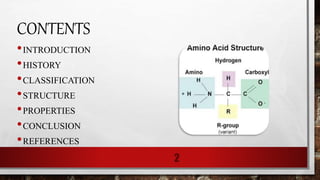
Amino acids are a group of organic compounds containing two functional groups-amino
and carboxyl. The amino group (-NH) is basic while the carboxyl group – (-COOH) is
acidic in nature.
General structure of amino acids
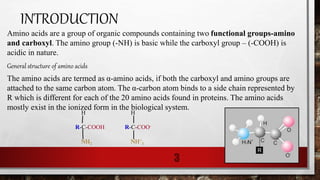
The amino acids are termed as α-amino acids, if both the carboxyl and amino groups are
attached to the same carbon atom. The α-carbon atom binds to a side chain represented by
R which is different for each of the 20 amino acids found in proteins. The amino acids
mostly exist in the ionized form in the biological system.
H
R-C-COO-
NH+
3
H
R-C-COOH
NH2
3
HISTORY
The first amino acid which was discovered is asparagine in 1806. Threonine was
the last amino acid to be found in the year 1938. All the amino acids have trivial or
common name from which they were first isolated. Asparagine was found in
asparagus and glutamine was found in wheat gluten: tyrosine was first isolated
from cheese and glycine(greek glykos means sweet) was so named because of the
sweet taste.
4
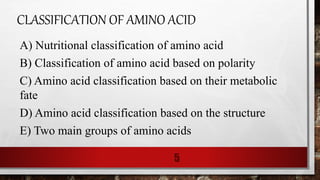
CLASSIFICATION OF AMINO ACID
A) Nutritional classification of amino acid
B) Classification of amino acid based on polarity
C) Amino acid classification based on their metabolic
fate
D) Amino acid classification based on the structure
E) Two main groups of amino acids
5
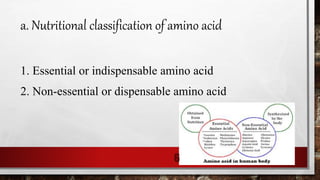
a. Nutritional classification of amino acid
1. Essential or indispensable amino acid
2. Non-essential or dispensable amino acid
6
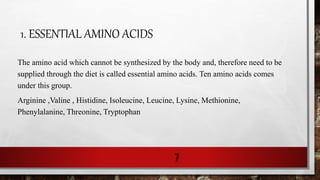
1. ESSENTIAL AMINO ACIDS
The amino acid which cannot be synthesized by the body and, therefore need to be
supplied through the diet is called essential amino acids. Ten amino acids comes
under this group.
Arginine ,Valine , Histidine, Isoleucine, Leucine, Lysine, Methionine,
Phenylalanine, Threonine, Tryptophan
7
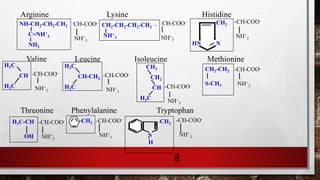
Arginine Lysine Histidine
Valine Leucine Isoleucine Methionine
Threonine Phenylalanine Tryptophan
NH-CH2-CH2-CH2
C=NH+
2
NH2
CH2-CH2-CH2-CH2 -
NH+
3
-CH-COO-
NH+
3
H3C-CH
OH
-CH-COO-
NH+
3
H3C
CH
H3C
H3C
CH-CH2
H3C
CH3
CH2
CH
H3C
-CH-COO-
NH+
3
-CH-COO-
NH+
3
-CH-COO-
NH+
3
CH2-CH2
S-CH3
-CH-COO-
NH+
3
-CH-COO-
NH+
3
-CH2 -CH-COO-
NH+
3
-CH2
N
H
CH2
HN N
-CH-COO-
NH+
3
8
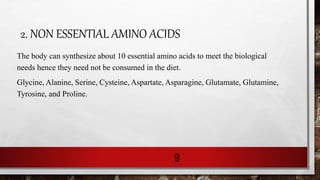
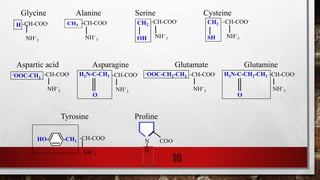
2. NON ESSENTIAL AMINO ACIDS
The body can synthesize about 10 essential amino acids to meet the biological
needs hence they need not be consumed in the diet.
Glycine, Alanine, Serine, Cysteine, Aspartate, Asparagine, Glutamate, Glutamine,
Tyrosine, and Proline.
9
Glycine Alanine Serine Cysteine
Aspartic acid Asparagine Glutamate Glutamine
Tyrosine Proline
N CO
-CH-COO-
NH+
3
H -CH-COO-
NH+
3
-CH-COO-
NH+
3
-CH-COO-
NH+
3
CH2
SH
-CH-COO-
NH+
3
-CH-COO-
NH+
3
-CH-COO-
NH+
3
-CH-COO-
NH+
3
-OOC-CH2
H2N-C-CH2
O
-OOC-CH2-CH2 H2N-C-CH2-CH2
O
-CH-COO-
NH+
3
HO- -CH2
H
10
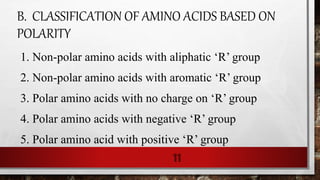
B. CLASSIFICATION OF AMINO ACIDS BASED ON
POLARITY
1. Non-polar amino acids with aliphatic ‘R’ group
2. Non-polar amino acids with aromatic ‘R’ group
3. Polar amino acids with no charge on ‘R’ group
4. Polar amino acids with negative ‘R’ group
5. Polar amino acid with positive ‘R’ group
11
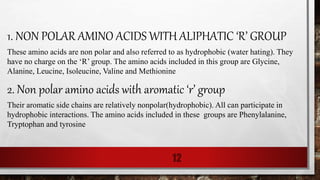
1. NON POLAR AMINO ACIDS WITH ALIPHATIC ‘R’ GROUP
These amino acids are non polar and also referred to as hydrophobic (water hating). They
have no charge on the ‘R’ group. The amino acids included in this group are Glycine,
Alanine, Leucine, Isoleucine, Valine and Methionine
2. Non polar amino acids with aromatic ‘r’ group
Their aromatic side chains are relatively nonpolar(hydrophobic). All can participate in
hydrophobic interactions. The amino acids included in these groups are Phenylalanine,
Tryptophan and tyrosine
12
3. POLAR AMINO ACIDS WITH NO CHARGE ON ‘R’
GROUP
These amino acids carry no charge on ‘R’ group and are soluble in water or more
hydrophilic. They possess group such as hydroxyl, sulfhydryl and amide groups.
They participate in hydrogen bonding of protein structure. The amino acids in this
group are- Proline, Serine, threonine, Cysteine, Glutamine and Asparagine
4. POLAR AMINO ACID WITH NEGATIVE ‘R’ GROUP
The dicarboxylic monoacid. Aspartic acid and Glutamic acid are
included in this group.
13
5. POLAR AMINO ACID WITH POSITIVE ‘R’ GROUP
These amino acids carry positive charge on the ‘R’ group and are dibasic
monocarboxylic acid. They are highly basic in nature. The three amino acid
Lysine, Arginine and Histidine are included in this group.
14
C. AMINO ACID CLASSIFICATION BASED ON
THEIR METABOLIC FATE
1. Glycogenic amino acids
2. Ketogenic amino acids
3. Glycogenic and Ketogenic amino acids
15
1. GLYCOGENIC AMINO ACIDS
These amino acids serve as precursors for the formation of glucose and glycogen. The
amino acids included in this group are Alanine, Aspartate, Glycine, Methionine
2. KETOGENIC AMINO ACIDS
Fat can be synthezied from these amino acids. Two amino acids Leucine and Lysine are
exclusively ketogenic.
16
3. GLYCOGENIC AND KETOGENIC AMINO ACIDS
The four amino acids Isoleuciene, Phenylalanine, Tryptophan, Tyrosine are precursor for
synthesis of glucose as well as fat.
17
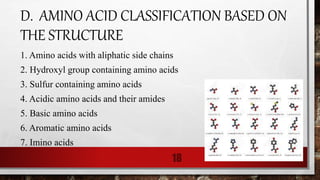
D. AMINO ACID CLASSIFICATION BASED ON
THE STRUCTURE
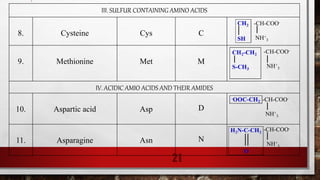
1. Amino acids with aliphatic side chains
2. Hydroxyl group containing amino acids
3. Sulfur containing amino acids
4. Acidic amino acids and their amides
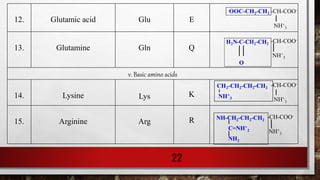
5. Basic amino acids
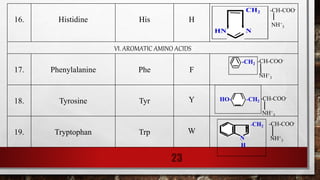
6. Aromatic amino acids
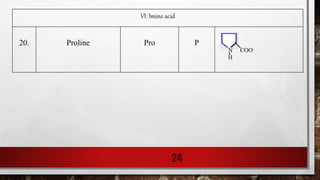
7. Imino acids
18
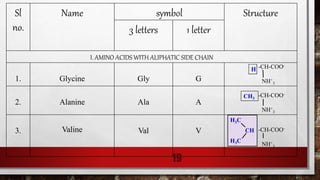
Sl
no.
Name symbol Structure
3 letters 1 letter
I. AMINO ACIDS WITH ALIPHATIC SIDE CHAIN
1. Glycine Gly G
2. Alanine Ala A
3. Valine Val V
-CH-COO-
NH+
3
-CH-COO-
NH+
3
CH3
-CH-COO-
NH+
3
H3C
CH
H3C
19
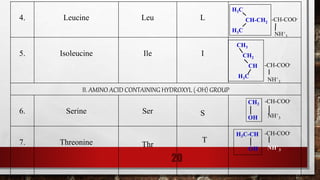
4. Leucine Leu L
5. Isoleucine Ile I
II. AMINO ACID CONTAINING HYDROXYL (-OH) GROUP
6. Serine Ser S
7. Threonine Thr
T
-CH-COO-
NH+
3
-CH-COO-
NH+
3
H3C
CH-CH2
H3C
CH3
CH2
CH
H3C
-CH-COO-
NH+
3
-CH-COO-
NH+
3
20
III. SULFUR CONTAINING AMINO ACIDS
8. Cysteine Cys C
9. Methionine Met M
IV. ACIDIC AMIO ACIDS AND THEIR AMIDES
10. Aspartic acid Asp D
11. Asparagine Asn N
-CH-COO-
NH+
3
-CH-COO-
NH+
3
-CH-COO-
NH+
3
-CH-COO-
NH+
3
21
12. Glutamic acid Glu E
13. Glutamine Gln Q
v. Basic amino acids
14. Lysine Lys K
15. Arginine Arg R
-CH-COO-
NH+
3
-CH-COO-
NH+
3
-CH-COO-
NH+
3
-CH-COO-
NH+
3
NH-CH2-CH2-CH2
C=NH+
2
NH2
22
16. Histidine His H
VI. AROMATIC AMINO ACIDS
17. Phenylalanine Phe F
18. Tyrosine Tyr Y
19. Tryptophan Trp W
-CH-COO-
NH+
3
-CH-COO-
NH+
3
-CH-COO-
NH+
3
-CH-COO-
NH+
3
23
VI. Imino acid
20. Proline Pro P
N COO-
H
24
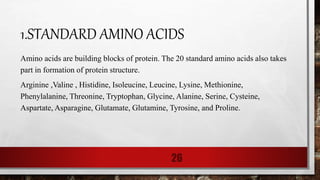
E. Two main groups of amino acids
1. Standard amino acids
2. Non standard amino acids
25
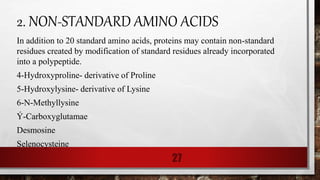
1.STANDARD AMINO ACIDS
Amino acids are building blocks of protein. The 20 standard amino acids also takes
part in formation of protein structure.
Arginine ,Valine , Histidine, Isoleucine, Leucine, Lysine, Methionine,
Phenylalanine, Threonine, Tryptophan, Glycine, Alanine, Serine, Cysteine,
Aspartate, Asparagine, Glutamate, Glutamine, Tyrosine, and Proline.
26
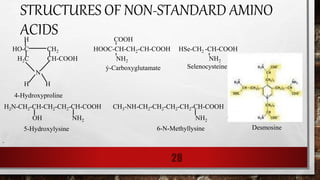
2. NON-STANDARD AMINO ACIDS
In addition to 20 standard amino acids, proteins may contain non-standard
residues created by modification of standard residues already incorporated
into a polypeptide.
4-Hydroxyproline- derivative of Proline
5-Hydroxylysine- derivative of Lysine
6-N-Methyllysine
Ý-Carboxyglutamae
Desmosine
Selenocysteine
27
STRUCTURES OF NON-STANDARD AMINO
ACIDSH COOH
HO-C CH2 HOOC-CH-CH2-CH-COOH HSe-CH2 -CH-COOH
H2C CH-COOH NH2 NH2
N
H H
H2N-CH2-CH-CH2-CH2-CH-COOH CH3-NH-CH2-CH2-CH2-CH2-CH-COOH
OH NH2 NH2
.
4-Hydroxyproline
ý-Carboxyglutamate Selenocysteine
5-Hydroxylysine 6-N-Methyllysine Desmosine
28
PROPERTIES OF AMINO ACIDS
The amino acids differ in their physiochemical properties which determine the
characteristic of protein.
A. Physical properties
B. Chemical properties
29
A. PHYSICAL PROPERTIES
1. Solubility : Most of the amino acids are usually soluble in water and insoluble in
organic solvents.
2. Melting point : Amino acids generally melt at higher temperatures, often above
200°C.
3. Taste : Amino acids may be sweet (Gly, Ala, Val), tasteless (Leu) or bitter (Arg,
Ile), Monosodium glutamate (MSG; ajinomotto) is used as a flavouring agent in
food industry.
30
4. Optical properties: All amino acids except glycine possess optical isomers due
to the presence of asymmentric carbon atom. Some amino acids have a second
assymmentric carbon e.g. isoleucine, threonine.
31
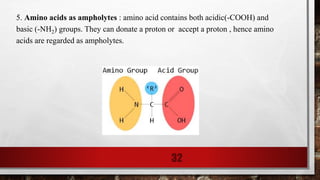
5. Amino acids as ampholytes : amino acid contains both acidic(-COOH) and
basic (-NH2) groups. They can donate a proton or accept a proton , hence amino
acids are regarded as ampholytes.
32
CONT………
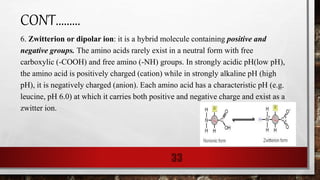
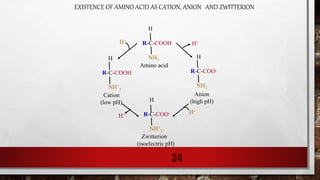
6. Zwitterion or dipolar ion: it is a hybrid molecule containing positive and
negative groups. The amino acids rarely exist in a neutral form with free
carboxylic (-COOH) and free amino (-NH) groups. In strongly acidic pH(low pH),
the amino acid is positively charged (cation) while in strongly alkaline pH (high
pH), it is negatively charged (anion). Each amino acid has a characteristic pH (e.g.
leucine, pH 6.0) at which it carries both positive and negative charge and exist as a
zwitter ion.
33
H
R-C-COO-
NH2
H
R-C-COOH
NH2
H
R-C-COO-
NH+
3
H
R-C-COOH
NH+
3
Amino acid
Anion
(high pH)
Cation
(low pH)
Zwitterion
(isoelectric pH)
H+
H+
H+
H+
EXISTENCE OF AMINO ACID AS CATION, ANION AND ZWITTERION
34
CONT………
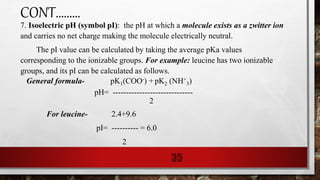
7. Isoelectric pH (symbol pI): the pH at which a molecule exists as a zwitter ion
and carries no net charge making the molecule electrically neutral.
The pI value can be calculated by taking the average pKa values
corresponding to the ionizable groups. For example: leucine has two ionizable
groups, and its pI can be calculated as follows.
General formula- pK1(COO-) + pK2 (NH+
3)
pH= ------------------------------
2
For leucine- 2.4+9.6
pI= ---------- = 6.0
2
35
36
CONT………
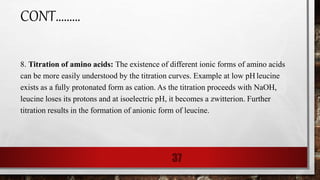
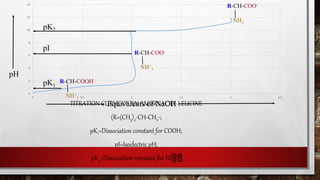
8. Titration of amino acids: The existence of different ionic forms of amino acids
can be more easily understood by the titration curves. Example at low pH leucine
exists as a fully protonated form as cation. As the titration proceeds with NaOH,
leucine loses its protons and at isoelectric pH, it becomes a zwitterion. Further
titration results in the formation of anionic form of leucine.
37
0
2
4
6
8
10
12
14
0 0.5 1 1.5 2 2.5
TITRATION CURVE OF AN AMINO ACID -LEUCINE
(R=(CH3)2-CH-CH2-;
pK1=Dissociation constant for COOH;
pI=Isoelectric pH;
pK2=Dissociation constant for NH3
+).
R-CH-COOH
NH+
3
R-CH-COO-
NH+
3
R-CH-COO-
NH2
pK1
pK2
pI
38
pH
Equivalents of NaOH
B. CHEMICAL PROPERTIES
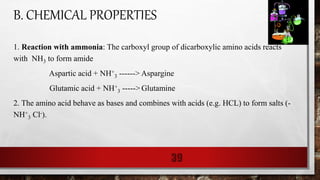
1. Reaction with ammonia: The carboxyl group of dicarboxylic amino acids reacts
with NH3 to form amide
Aspartic acid + NH+
3 ------> Aspargine
Glutamic acid + NH+
3 -----> Glutamine
2. The amino acid behave as bases and combines with acids (e.g. HCL) to form salts (-
NH+
3 Cl-).
39
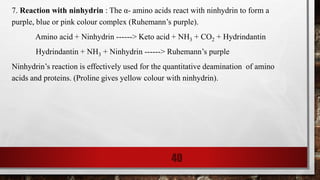
7. Reaction with ninhydrin : The α- amino acids react with ninhydrin to form a
purple, blue or pink colour complex (Ruhemann’s purple).
Amino acid + Ninhydrin ------> Keto acid + NH3 + CO2 + Hydrindantin
Hydrindantin + NH3 + Ninhydrin ------> Ruhemann’s purple
Ninhydrin’s reaction is effectively used for the quantitative deamination of amino
acids and proteins. (Proline gives yellow colour with ninhydrin).
40
41
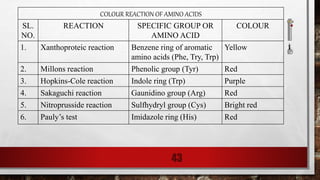
8. Colour reactions of amino acids : Amino acids can be identified by specific colour
reactions.
42
COLOUR REACTION OF AMINO ACIDS
SL.
NO.
REACTION SPECIFIC GROUP OR
AMINO ACID
COLOUR
1. Xanthoproteic reaction Benzene ring of aromatic
amino acids (Phe, Try, Trp)
Yellow
2. Millons reaction Phenolic group (Tyr) Red
3. Hopkins-Cole reaction Indole ring (Trp) Purple
4. Sakaguchi reaction Gaunidino group (Arg) Red
5. Nitroprusside reaction Sulfhydryl group (Cys) Bright red
6. Pauly’s test Imidazole ring (His) Red
43
CONCLUSION
Amino acids are at the basis of all life processes, as they are absolutely essential for
every metabolic process. Among their most important tasks are the optimal
transport and optimal storage of all nutrients (i.e., Water, fat, carbohydrates,
proteins, minerals and vitamins). The majority of diseases such as obesity, high-
cholesterol levels, diabetes, insomnia, erectile dysfunction or arthritis can
essentially be traced back to metabolic disturbances. This also applies to hair loss
and serious cases of wrinkle formation. The positive effects of amino acids on:
Arthritis, Osteoporosis, Cholesterol, Diabetes, Fat-burning, Healthy skin, Hair loss,
Sleep, Mind swings and Performance.
44
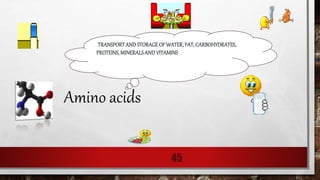
TRANSPORTANDSTORAGEOFWATER,FAT,CARBOHYDRATES,
PROTEINS,MINERALSANDVITAMINS
Amino acids
45
REFERENCES
- DAVID L. NELSON AND MICHAEL M. COX, THIRD EDITION,
LEHNINGER, PRINCIPLES OF BIOCHEMISTRY
- U. SATYANARAYANA AND U. CHAKRAPANI, THIRD EDITION, BIOCHEMISTRY
46
Amino acids