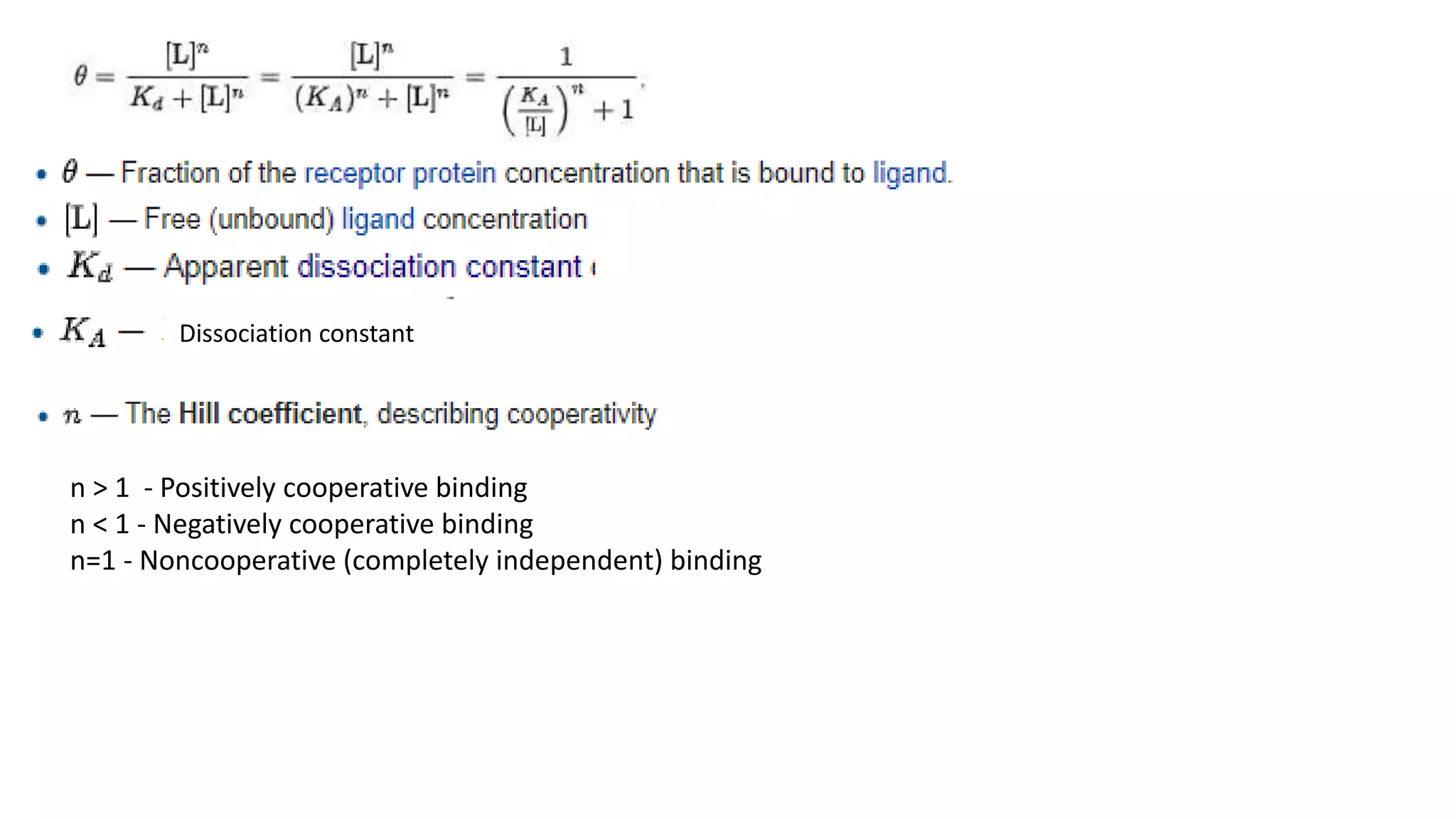
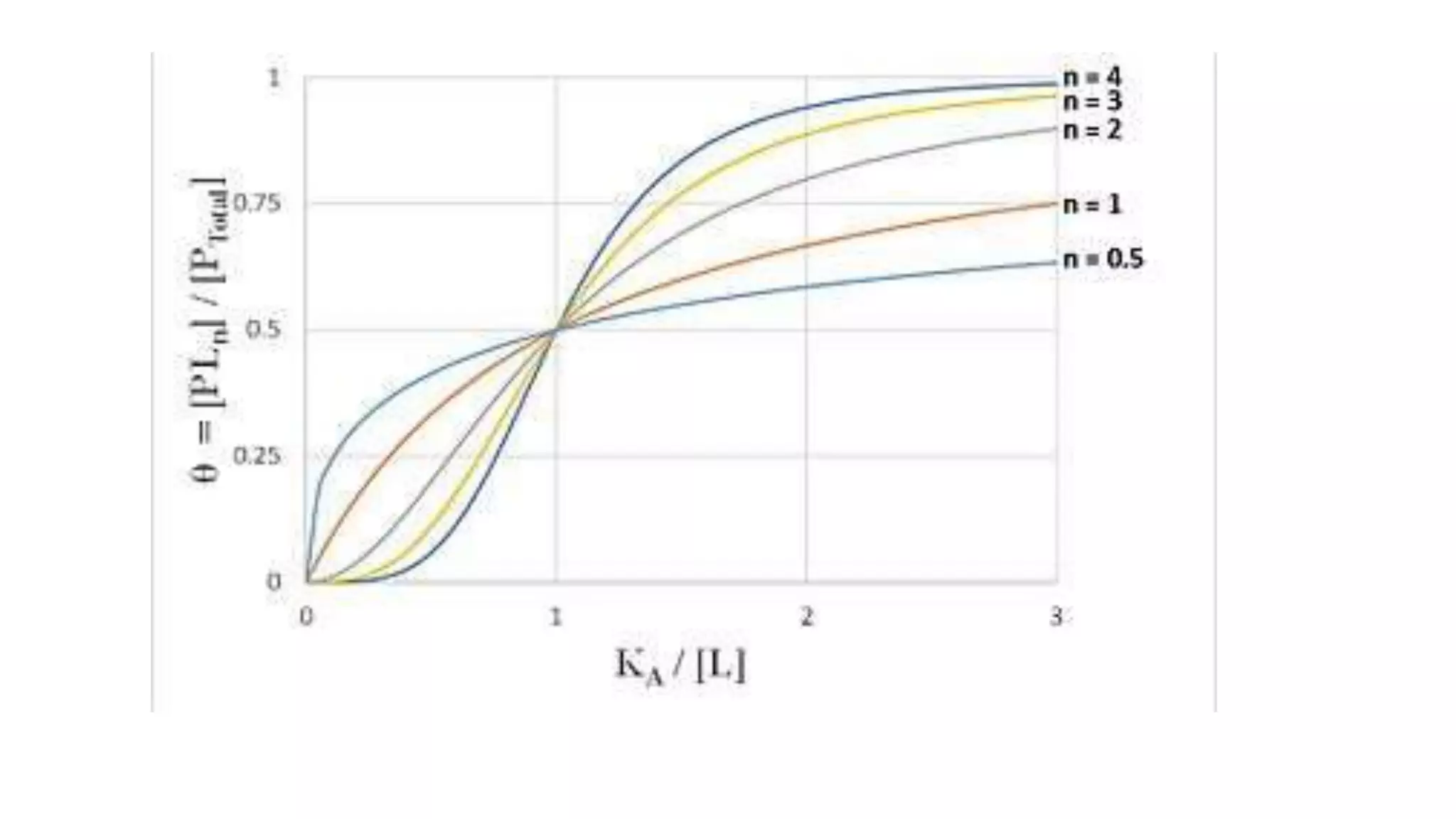
The document discusses the Hill equation, which was formulated by Archibald Hill in 1910 to describe the sigmoidal oxygen binding curve of hemoglobin. The Hill equation can be used to describe the fraction of a macromolecule saturated by a ligand as a function of the ligand's concentration. It is useful for determining the degree of cooperativity between ligand binding sites. A Hill coefficient of n > 1 indicates positively cooperative binding, n < 1 indicates negatively cooperative binding, and n = 1 indicates noncooperative binding.
All simple enzymeswhich follow michaelis menton equation ,
They will exhibit hyperbolic reaction velocity curve
But we have many of enzymes such as regulatory enzymes,
allosteric enzyme in our body
They have got more than one subunit, basically they are reffered
as oligomers (having two or more subunits)
So they oligomers enzyme do not follow michelis menton
equation
Their reaction velocity is not hyperbolic it becomes sigmoidal
3.
So in 1910,Archibald Hill formulated HILL EQUATION to describe
the sigmoidal O2 binding curve of haemoglobin, is used to describe the
fraction of a macromolecule saturated by ligand as a function of the
ligand concentration. The equation is useful for determining the
degree of cooperativity ( a phenomenon in which the shape of one
subunit of an enzyme consisting of several subunits is altered by the
substrate or some other molecule so as to change the shape of a
neighbouring subunit)
of the ligand(s) binding to the enzyme or receptor. The Hill
coefficient provides a way to quantify the degree of interaction
between ligand binding sites.
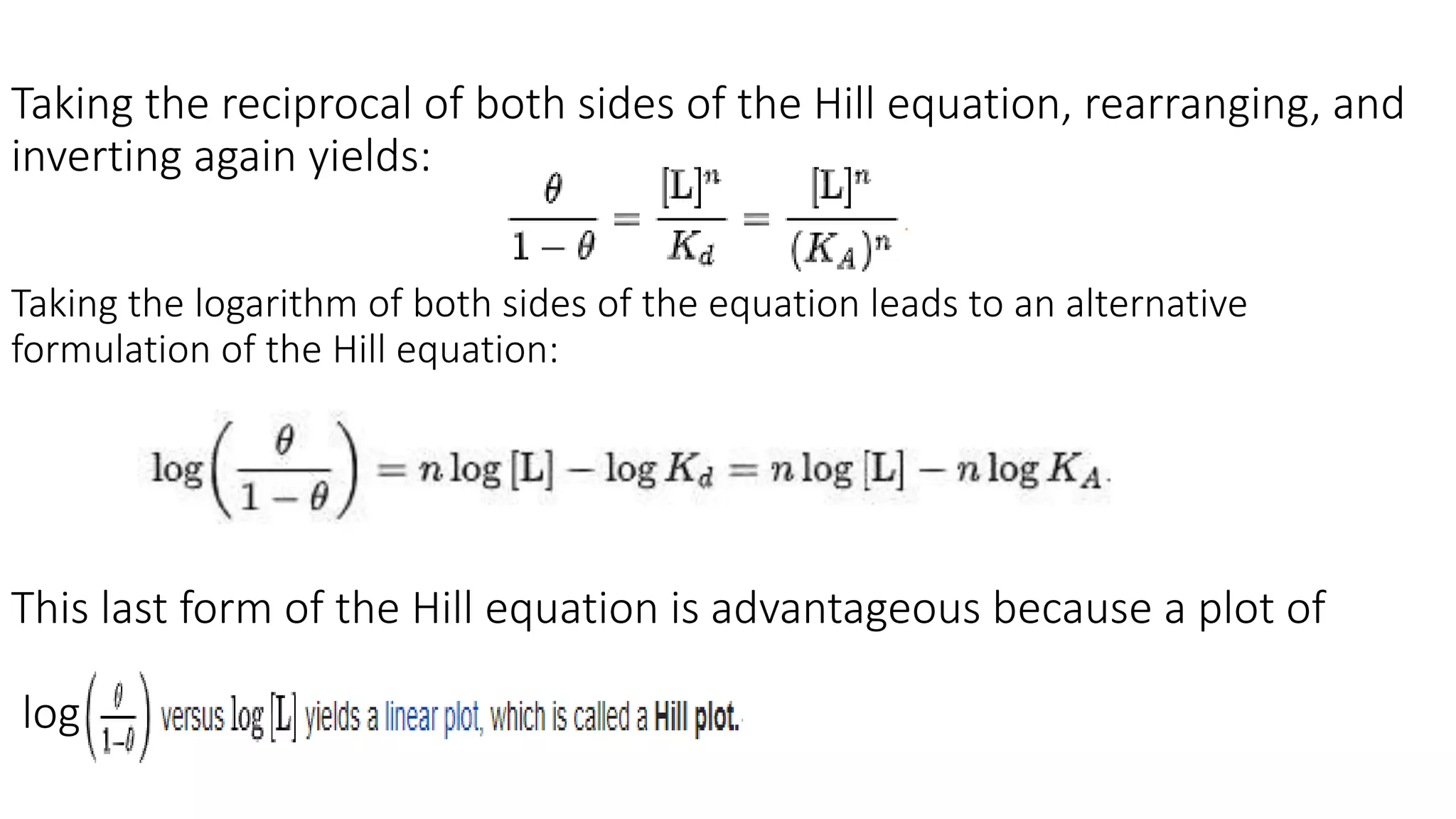
Taking the reciprocalof both sides of the Hill equation, rearranging, and
inverting again yields:
Taking the logarithm of both sides of the equation leads to an alternative
formulation of the Hill equation:
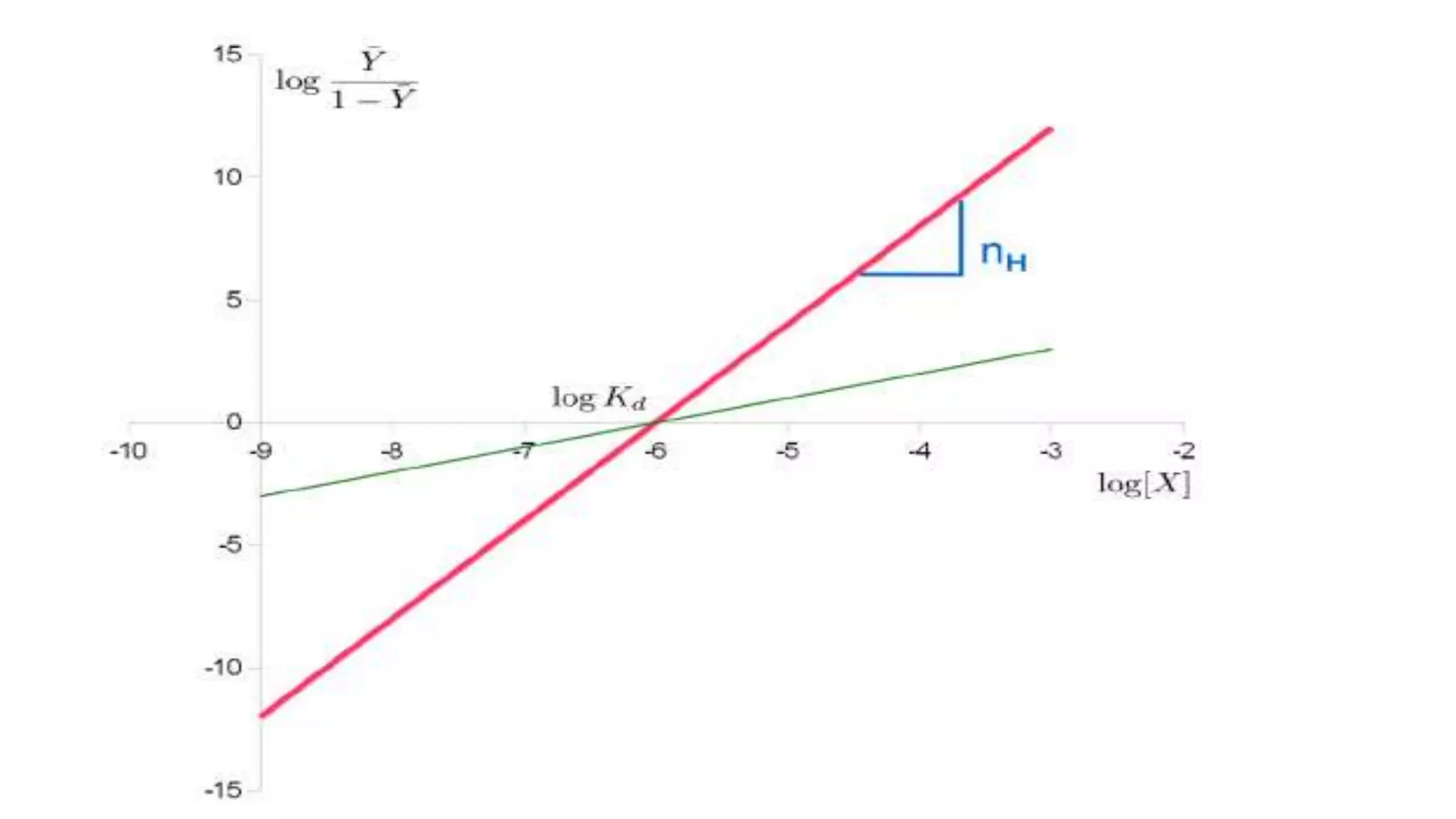
This last form of the Hill equation is advantageous because a plot of
log