Magnesium
• major intracellular divalent cation
• 2ND MOST COMMON INTRACELLULAR CATION (AFTER POTASSSIUM)
• 4TH MOST COMMON CATION IN THE BODY
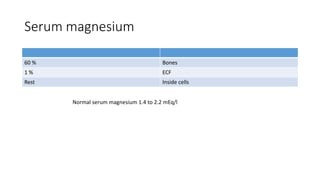
Serum magnesium
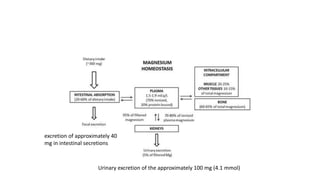
60 % Bones
1 % ECF
Rest Inside cells
Normal serum magnesium 1.4 to 2.2 mEq/l
ROLE OF MAGNESIUM
• Cardiovascular tone
• Neuromuscular junction
• Key complex with ATP and is an important cofactor for a wide range
of enzymes, transporters, and nucleic acids required for normal
cellular function, replication, and energy metabolism
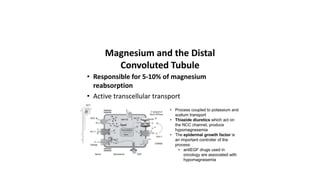
excretion of approximately 40
mg in intestinal secretions
Urinary excretion of the approximately 100 mg (4.1 mmol)
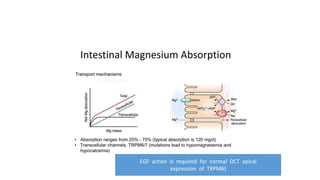
EGF action is required for normal DCT apical
expression of TRPM6)
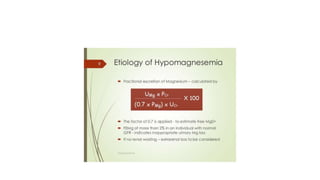
Determinant of serum magnesium
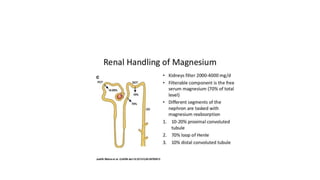
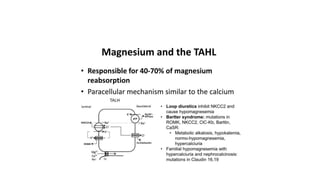
• The main determinant of Mg2+ balance is the serum [Mg2+] itself;
• hypomagnesemia stimulates renal tubular resorption of Mg2+
• hypermagnesemia inhibits this process
• In case of normal RFT Mg2+ will be excreted normally
• Regulation of serum magnesium concentrations is achieved mainly by
control of renal magnesium reabsorption
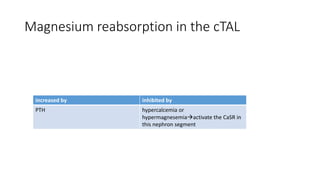
Magnesium reabsorption in the cTAL
increased by inhibited by
PTH hypercalcemia or
hypermagnesemiaactivate the CaSR in
this nephron segment
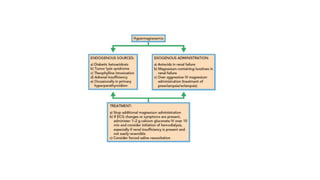
Hypermagnesemia
Serum magnesium > 2.2
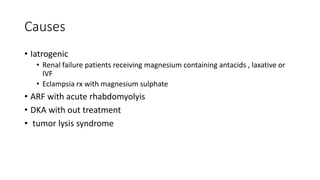
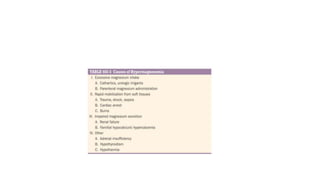
Causes
• Iatrogenic
• Renal failure patients receiving magnesium containing antacids , laxative or
IVF
• Eclampsia rx with magnesium sulphate
• ARF with acute rhabdomyolyis
• DKA with out treatment
• tumor lysis syndrome
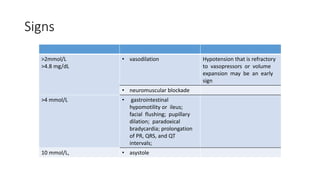
Signs
>2mmol/L
>4.8 mg/dL
• vasodilation Hypotension that is refractory
to vasopressors or volume
expansion may be an early
sign
• neuromuscular blockade
>4 mmol/L • gastrointestinal
hypomotility or ileus;
facial flushing; pupillary
dilation; paradoxical
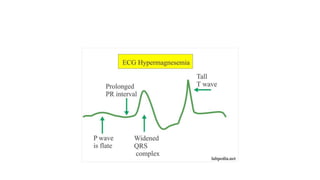
bradycardia; prolongation
of PR, QRS, and QT
intervals;
10 mmol/L, • asystole
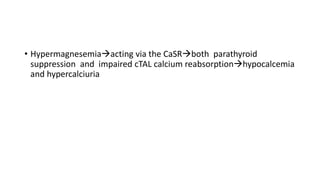
• Hypermagnesemiaacting via the CaSRboth parathyroid
suppression and impaired cTAL calcium reabsorptionhypocalcemia
and hypercalciuria
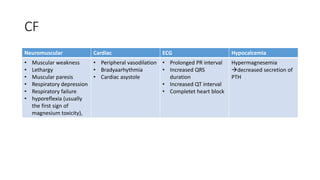
CF
Neuromuscular Cardiac ECG Hypocalcemia
• Muscular weakness
• Lethargy
• Muscular paresis
• Respiratory depression
• Respiratory failure
• hyporeflexia (usually
the first sign of
magnesium toxicity),
• Peripheral vasodilation
• Bradyaarhythmia
• Cardiac asystole
• Prolonged PR interval
• Increased QRS
duration
• Increased QT interval
• Completet heart block
Hypermagnesemia
decreased secretion of
PTH
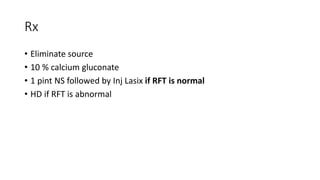
Rx
• Eliminate source
• 10 % calcium gluconate
• 1 pint NS followed by Inj Lasix if RFT is normal
• HD if RFT is abnormal
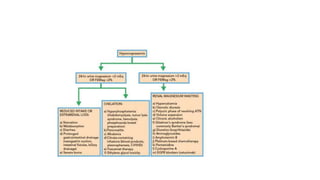
Hypomagnesemia
< 1.3 mEq/L
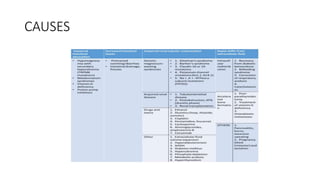
CAUSES
Causes
Increased renal
excretion
Increased GI losses Drugs Poor intake others
increased renal
tubular
flow (as occurs with
osmotic diuresis) as
well as impaired
tubular function (as
seen with resolving
acute tubular
necrosis [ATN], loop
diuretics, and
Bartter’s
and Gitelman’s
syndromes)
• prolonged
diarrhea
• nasogastric
aspiration
• malnutrition, as
is common in
chronic
alcoholics
• malabsorption
syndrome
aminoglycosides,
amphotericin B,
cisplatin,
pentamidine, and
cyclo-
sporine.
• c/c alcoholic • Primary
aldosteronism
• Hypoparathyroidi
sm
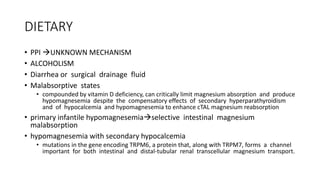
DIETARY
• PPI UNKNOWN MECHANISM
• ALCOHOLISM
• Diarrhea or surgical drainage fluid
• Malabsorptive states
• compounded by vitamin D deficiency, can critically limit magnesium absorption and produce
hypomagnesemia despite the compensatory effects of secondary hyperparathyroidism
and of hypocalcemia and hypomagnesemia to enhance cTAL magnesium reabsorption
• primary infantile hypomagnesemiaselective intestinal magnesium
malabsorption
• hypomagnesemia with secondary hypocalcemia
• mutations in the gene encoding TRPM6, a protein that, along with TRPM7, forms a channel
important for both intestinal and distal-tubular renal transcellular magnesium transport.
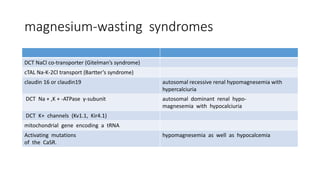
magnesium-wasting syndromes
DCT NaCl co-transporter (Gitelman’s syndrome)
cTAL Na-K-2Cl transport (Bartter’s syndrome)
claudin 16 or claudin19 autosomal recessive renal hypomagnesemia with
hypercalciuria
DCT Na + ,K + -ATPase γ-subunit autosomal dominant renal hypo-
magnesemia with hypocalciuria
DCT K+ channels (Kv1.1, Kir4.1)
mitochondrial gene encoding a tRNA
Activating mutations
of the CaSR.
hypomagnesemia as well as hypocalcemia
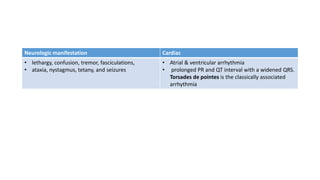
Neurologic manifestation Cardiac
• lethargy, confusion, tremor, fasciculations,
• ataxia, nystagmus, tetany, and seizures
• Atrial & ventricular arrhythmia
• prolonged PR and QT interval with a widened QRS.
Torsades de pointes is the classically associated
arrhythmia
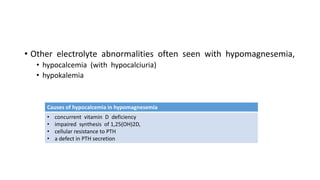
• Other electrolyte abnormalities often seen with hypomagnesemia,
• hypocalcemia (with hypocalciuria)
• hypokalemia
Causes of hypocalcemia in hypomagnesemia
• concurrent vitamin D deficiency
• impaired synthesis of 1,25(OH)2D,
• cellular resistance to PTH
• a defect in PTH secretion
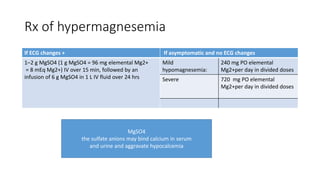
Rx of hypermagnesemia
If ECG changes + If asymptomatic and no ECG changes
1–2 g MgSO4 (1 g MgSO4 = 96 mg elemental Mg2+
= 8 mEq Mg2+) IV over 15 min, followed by an
infusion of 6 g MgSO4 in 1 L IV fluid over 24 hrs
Mild
hypomagnesemia:
240 mg PO elemental
Mg2+per day in divided doses
Severe 720 mg PO elemental
Mg2+per day in divided doses
MgSO4
the sulfate anions may bind calcium in serum
and urine and aggravate hypocalcemia
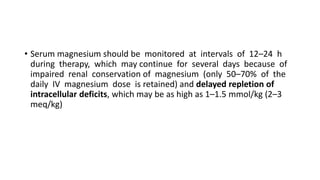
• Serum magnesium should be monitored at intervals of 12–24 h
during therapy, which may continue for several days because of
impaired renal conservation of magnesium (only 50–70% of the
daily IV magnesium dose is retained) and delayed repletion of
intracellular deficits, which may be as high as 1–1.5 mmol/kg (2–3
meq/kg)
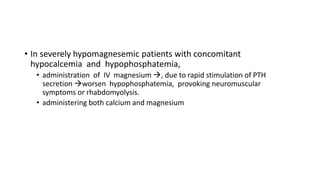
• In severely hypomagnesemic patients with concomitant
hypocalcemia and hypophosphatemia,
• administration of IV magnesium , due to rapid stimulation of PTH
secretion worsen hypophosphatemia, provoking neuromuscular
symptoms or rhabdomyolysis.
• administering both calcium and magnesium
Magnesium
• Normal serum magnesium = 1.4 to 2.2 mEq/l
• Important role in neuromuscular function
• Maintenance of cardiovascular tone
• Approximately 60% of body magnesium is stored in bone, and most of
the remainder is found in cells. Only 1% is in the ECF
• Magnesium is required for PTH secretion and for PTH action
• Serum Ca and Serum Mg level always go parallel in the body.
• The notable exceptions
• CRF (Hypocalcemia and Hypermagnesemia),
• Gitelman syndome (Normocalcemia and hypomagnesemia)
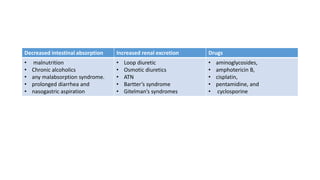
Decreased intestinal absorption Increased renal excretion Drugs
• malnutrition
• Chronic alcoholics
• any malabsorption syndrome.
• prolonged diarrhea and
• nasogastric aspiration
• Loop diuretic
• Osmotic diuretics
• ATN
• Bartter’s syndrome
• Gitelman’s syndromes
• aminoglycosides,
• amphotericin B,
• cisplatin,
• pentamidine, and
• cyclosporine
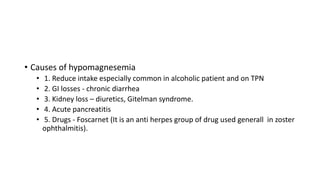
• Causes of hypomagnesemia
• 1. Reduce intake especially common in alcoholic patient and on TPN
• 2. GI losses - chronic diarrhea
• 3. Kidney loss – diuretics, Gitelman syndrome.
• 4. Acute pancreatitis
• 5. Drugs - Foscarnet (It is an anti herpes group of drug used generall in zoster
ophthalmitis).
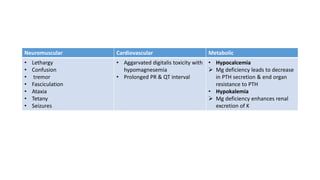
Neuromuscular Cardiovascular Metabolic
• Lethargy
• Confusion
• tremor
• Fasciculation
• Ataxia
• Tetany
• Seizures
• Aggarvated digitalis toxicity with
hypomagnesemia
• Prolonged PR & QT interval
• Hypocalcemia
 Mg deficiency leads to decrease
in PTH secretion & end organ
resistance to PTH
• Hypokalemia
 Mg deficiency enhances renal
excretion of K
Rx
• Magnesium supplement
Hypermagnesemia
Causes
• ARF with rhabdomyolysis
• CRF
• Addison disease
• Magnesium containing drugs.
• Hemolysis
CF
• Occur due to vasodilatation and neuromuscular blockage.
• There is paradoxical Bradycardia, Hypotension, Altered sensorium,
respiratory depression
• Treatment:
• 1. Injection calcium gluconate for heart
• 2. Diuretics (Frusemide)
• 3. Dialysis
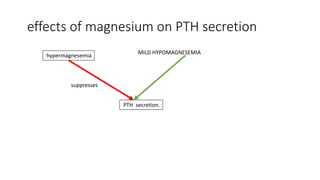
effects of magnesium on PTH secretion
hypermagnesemia
suppresses
PTH secretion.
MILD HYPOMAGNESEMIA
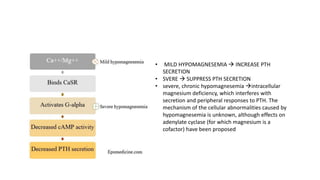
• MILD HYPOMAGNESEMIA  INCREASE PTH
SECRETION
• SVERE  SUPPRESS PTH SECRETION
• severe, chronic hypomagnesemia intracellular
magnesium deficiency, which interferes with
secretion and peripheral responses to PTH. The
mechanism of the cellular abnormalities caused by
hypomagnesemia is unknown, although effects on
adenylate cyclase (for which magnesium is a
cofactor) have been proposed
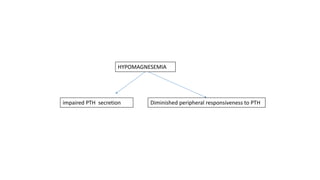
HYPOMAGNESEMIA
Diminished peripheral responsiveness to PTHimpaired PTH secretion

Magnesium metabolism

  • 1.
  • 2.
    • major intracellulardivalent cation • 2ND MOST COMMON INTRACELLULAR CATION (AFTER POTASSSIUM) • 4TH MOST COMMON CATION IN THE BODY
  • 3.
    Serum magnesium 60 %Bones 1 % ECF Rest Inside cells Normal serum magnesium 1.4 to 2.2 mEq/l
  • 4.
    ROLE OF MAGNESIUM •Cardiovascular tone • Neuromuscular junction • Key complex with ATP and is an important cofactor for a wide range of enzymes, transporters, and nucleic acids required for normal cellular function, replication, and energy metabolism
  • 5.
    excretion of approximately40 mg in intestinal secretions Urinary excretion of the approximately 100 mg (4.1 mmol)
  • 6.
    EGF action isrequired for normal DCT apical expression of TRPM6)
  • 7.
    Determinant of serummagnesium • The main determinant of Mg2+ balance is the serum [Mg2+] itself; • hypomagnesemia stimulates renal tubular resorption of Mg2+ • hypermagnesemia inhibits this process • In case of normal RFT Mg2+ will be excreted normally
  • 8.
    • Regulation ofserum magnesium concentrations is achieved mainly by control of renal magnesium reabsorption
  • 11.
    Magnesium reabsorption inthe cTAL increased by inhibited by PTH hypercalcemia or hypermagnesemiaactivate the CaSR in this nephron segment
  • 13.
  • 14.
    Causes • Iatrogenic • Renalfailure patients receiving magnesium containing antacids , laxative or IVF • Eclampsia rx with magnesium sulphate • ARF with acute rhabdomyolyis • DKA with out treatment • tumor lysis syndrome
  • 16.
    Signs >2mmol/L >4.8 mg/dL • vasodilationHypotension that is refractory to vasopressors or volume expansion may be an early sign • neuromuscular blockade >4 mmol/L • gastrointestinal hypomotility or ileus; facial flushing; pupillary dilation; paradoxical bradycardia; prolongation of PR, QRS, and QT intervals; 10 mmol/L, • asystole
  • 17.
    • Hypermagnesemiaacting viathe CaSRboth parathyroid suppression and impaired cTAL calcium reabsorptionhypocalcemia and hypercalciuria
  • 18.
    CF Neuromuscular Cardiac ECGHypocalcemia • Muscular weakness • Lethargy • Muscular paresis • Respiratory depression • Respiratory failure • hyporeflexia (usually the first sign of magnesium toxicity), • Peripheral vasodilation • Bradyaarhythmia • Cardiac asystole • Prolonged PR interval • Increased QRS duration • Increased QT interval • Completet heart block Hypermagnesemia decreased secretion of PTH
  • 19.
    Rx • Eliminate source •10 % calcium gluconate • 1 pint NS followed by Inj Lasix if RFT is normal • HD if RFT is abnormal
  • 21.
  • 22.
  • 23.
    Causes Increased renal excretion Increased GIlosses Drugs Poor intake others increased renal tubular flow (as occurs with osmotic diuresis) as well as impaired tubular function (as seen with resolving acute tubular necrosis [ATN], loop diuretics, and Bartter’s and Gitelman’s syndromes) • prolonged diarrhea • nasogastric aspiration • malnutrition, as is common in chronic alcoholics • malabsorption syndrome aminoglycosides, amphotericin B, cisplatin, pentamidine, and cyclo- sporine. • c/c alcoholic • Primary aldosteronism • Hypoparathyroidi sm
  • 24.
    DIETARY • PPI UNKNOWNMECHANISM • ALCOHOLISM • Diarrhea or surgical drainage fluid • Malabsorptive states • compounded by vitamin D deficiency, can critically limit magnesium absorption and produce hypomagnesemia despite the compensatory effects of secondary hyperparathyroidism and of hypocalcemia and hypomagnesemia to enhance cTAL magnesium reabsorption • primary infantile hypomagnesemiaselective intestinal magnesium malabsorption • hypomagnesemia with secondary hypocalcemia • mutations in the gene encoding TRPM6, a protein that, along with TRPM7, forms a channel important for both intestinal and distal-tubular renal transcellular magnesium transport.
  • 25.
    magnesium-wasting syndromes DCT NaClco-transporter (Gitelman’s syndrome) cTAL Na-K-2Cl transport (Bartter’s syndrome) claudin 16 or claudin19 autosomal recessive renal hypomagnesemia with hypercalciuria DCT Na + ,K + -ATPase γ-subunit autosomal dominant renal hypo- magnesemia with hypocalciuria DCT K+ channels (Kv1.1, Kir4.1) mitochondrial gene encoding a tRNA Activating mutations of the CaSR. hypomagnesemia as well as hypocalcemia
  • 26.
    Neurologic manifestation Cardiac •lethargy, confusion, tremor, fasciculations, • ataxia, nystagmus, tetany, and seizures • Atrial & ventricular arrhythmia • prolonged PR and QT interval with a widened QRS. Torsades de pointes is the classically associated arrhythmia
  • 27.
    • Other electrolyteabnormalities often seen with hypomagnesemia, • hypocalcemia (with hypocalciuria) • hypokalemia Causes of hypocalcemia in hypomagnesemia • concurrent vitamin D deficiency • impaired synthesis of 1,25(OH)2D, • cellular resistance to PTH • a defect in PTH secretion
  • 30.
    Rx of hypermagnesemia IfECG changes + If asymptomatic and no ECG changes 1–2 g MgSO4 (1 g MgSO4 = 96 mg elemental Mg2+ = 8 mEq Mg2+) IV over 15 min, followed by an infusion of 6 g MgSO4 in 1 L IV fluid over 24 hrs Mild hypomagnesemia: 240 mg PO elemental Mg2+per day in divided doses Severe 720 mg PO elemental Mg2+per day in divided doses MgSO4 the sulfate anions may bind calcium in serum and urine and aggravate hypocalcemia
  • 31.
    • Serum magnesiumshould be monitored at intervals of 12–24 h during therapy, which may continue for several days because of impaired renal conservation of magnesium (only 50–70% of the daily IV magnesium dose is retained) and delayed repletion of intracellular deficits, which may be as high as 1–1.5 mmol/kg (2–3 meq/kg)
  • 32.
    • In severelyhypomagnesemic patients with concomitant hypocalcemia and hypophosphatemia, • administration of IV magnesium , due to rapid stimulation of PTH secretion worsen hypophosphatemia, provoking neuromuscular symptoms or rhabdomyolysis. • administering both calcium and magnesium
  • 33.
  • 34.
    • Normal serummagnesium = 1.4 to 2.2 mEq/l • Important role in neuromuscular function • Maintenance of cardiovascular tone • Approximately 60% of body magnesium is stored in bone, and most of the remainder is found in cells. Only 1% is in the ECF
  • 35.
    • Magnesium isrequired for PTH secretion and for PTH action
  • 36.
    • Serum Caand Serum Mg level always go parallel in the body. • The notable exceptions • CRF (Hypocalcemia and Hypermagnesemia), • Gitelman syndome (Normocalcemia and hypomagnesemia)
  • 37.
    Decreased intestinal absorptionIncreased renal excretion Drugs • malnutrition • Chronic alcoholics • any malabsorption syndrome. • prolonged diarrhea and • nasogastric aspiration • Loop diuretic • Osmotic diuretics • ATN • Bartter’s syndrome • Gitelman’s syndromes • aminoglycosides, • amphotericin B, • cisplatin, • pentamidine, and • cyclosporine
  • 38.
    • Causes ofhypomagnesemia • 1. Reduce intake especially common in alcoholic patient and on TPN • 2. GI losses - chronic diarrhea • 3. Kidney loss – diuretics, Gitelman syndrome. • 4. Acute pancreatitis • 5. Drugs - Foscarnet (It is an anti herpes group of drug used generall in zoster ophthalmitis).
  • 39.
    Neuromuscular Cardiovascular Metabolic •Lethargy • Confusion • tremor • Fasciculation • Ataxia • Tetany • Seizures • Aggarvated digitalis toxicity with hypomagnesemia • Prolonged PR & QT interval • Hypocalcemia  Mg deficiency leads to decrease in PTH secretion & end organ resistance to PTH • Hypokalemia  Mg deficiency enhances renal excretion of K
  • 40.
  • 42.
  • 43.
    Causes • ARF withrhabdomyolysis • CRF • Addison disease • Magnesium containing drugs. • Hemolysis
  • 44.
    CF • Occur dueto vasodilatation and neuromuscular blockage. • There is paradoxical Bradycardia, Hypotension, Altered sensorium, respiratory depression
  • 45.
    • Treatment: • 1.Injection calcium gluconate for heart • 2. Diuretics (Frusemide) • 3. Dialysis
  • 47.
    effects of magnesiumon PTH secretion hypermagnesemia suppresses PTH secretion. MILD HYPOMAGNESEMIA
  • 48.
    • MILD HYPOMAGNESEMIA INCREASE PTH SECRETION • SVERE  SUPPRESS PTH SECRETION • severe, chronic hypomagnesemia intracellular magnesium deficiency, which interferes with secretion and peripheral responses to PTH. The mechanism of the cellular abnormalities caused by hypomagnesemia is unknown, although effects on adenylate cyclase (for which magnesium is a cofactor) have been proposed
  • 49.