PLANTAR REFLEX
Plantar response (S1–2)
• MOST IMPORTANT SUPERFICIAL REFLEX
• POLYSYNAPTIC REFLEX
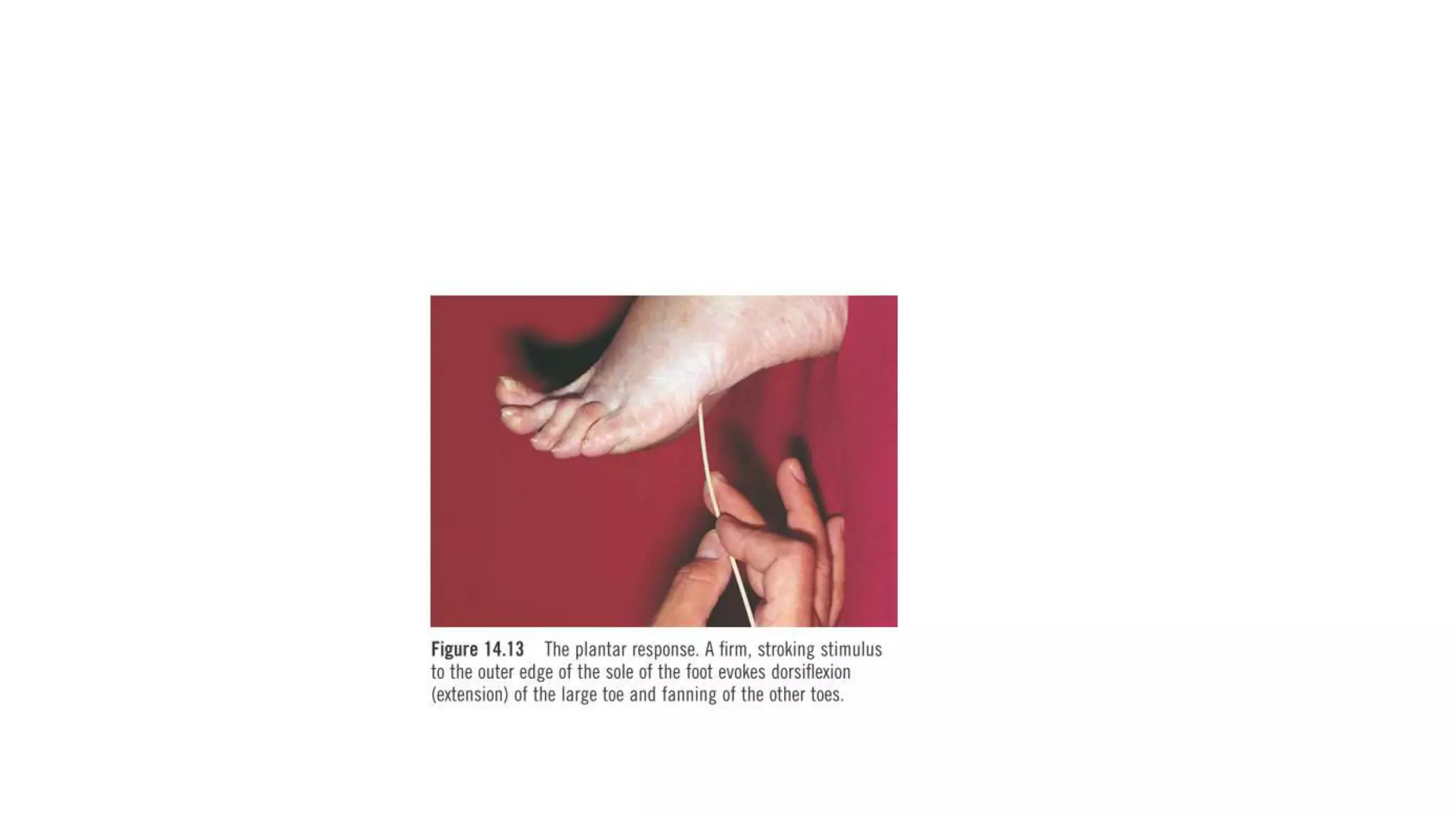
PROCEDURE
• All the leg muscles should be visible and in a relaxed state.
• EXPOSE LEGS UPTO GROIN
• CHECK MOBILITY OF GREAT TOE
• This can be achieved by positioning the patient in a way that the knee is
slightly flexed and the thighis externally rotated.
• The patient should be warned that the sole is going to be scratched and ask
him to tryto let his limb remain as floppy as possible. The toe s should not
be touched at all.
• It is best to advise the patient that the sensation may be slightly
uncomfortable. Patients may experience both a mildly unpleasant
sensation as well as a tickling sensation. The examiner should ensure that
the plantar surface of the foot is free of any lesions before proceeding.
• SLOWLY OVER 6 SECONDS
Equipment
• The Babinski reflex should be elicited by a dull, blunt instrument that
does not cause pain or injury.
• The dull point of a reflex hammer, a tongue depressor, or the edge of a key
are often utilized.
• Sharp objects should be avoided.
PATHOGENESIS OF NORMAL PLANTAR
RESPONSE
• Stimulation of the lateral plantar aspect of the foot (S1 dermatome)
normally leads to plantar flexion of the toes (due to stimulation of the
S1 myotome). The response results from nociceptive fibers in the S1
dermatome detecting the stimulation. Nociceptive input travels up
the tibial and sciatic nerve to the S1 region of the spine and synapse
with anterior horn cells. The motor response which leads to the
plantar flexion is mediated through the S1 root and tibial nerve
NORMAL PLANTAR  FLEXOR PLANTAR
RESPONSE
• GREAT TOE WILL FLEX AT MTP JOINT
• OTHER TOES WILL ADDUCT
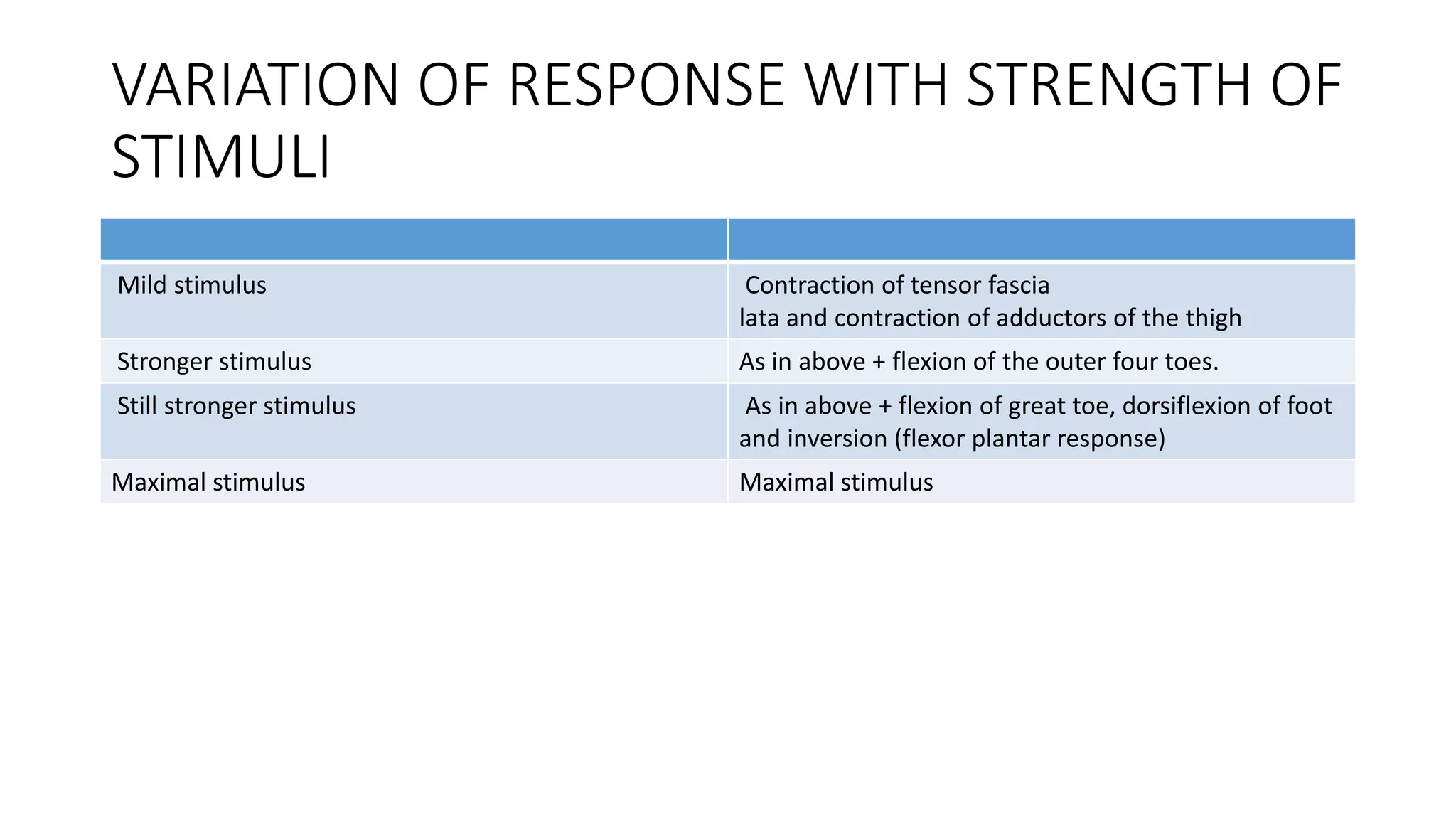
VARIATION OF RESPONSE WITH STRENGTH OF
STIMULI
Mild stimulus Contraction of tensor fascia
lata and contraction of adductors of the thigh
Stronger stimulus As in above + flexion of the outer four toes.
Still stronger stimulus As in above + flexion of great toe, dorsiflexion of foot
and inversion (flexor plantar response)
Maximal stimulus Maximal stimulus
Babinski's sign
• Extensor plantar response
• Dysfunction of corticospinal tract
• Components of babinskis sign
• DORSIFLEXION OF GREAT TOE AT MTP
• FANNING OUT AND EXTENSION OTHER TOES
• DORSIFLEXION OF ANKLE
• FLEXION OF HIP AND KNEE
• CONTRACTION OF TENOR FASCIA LATA
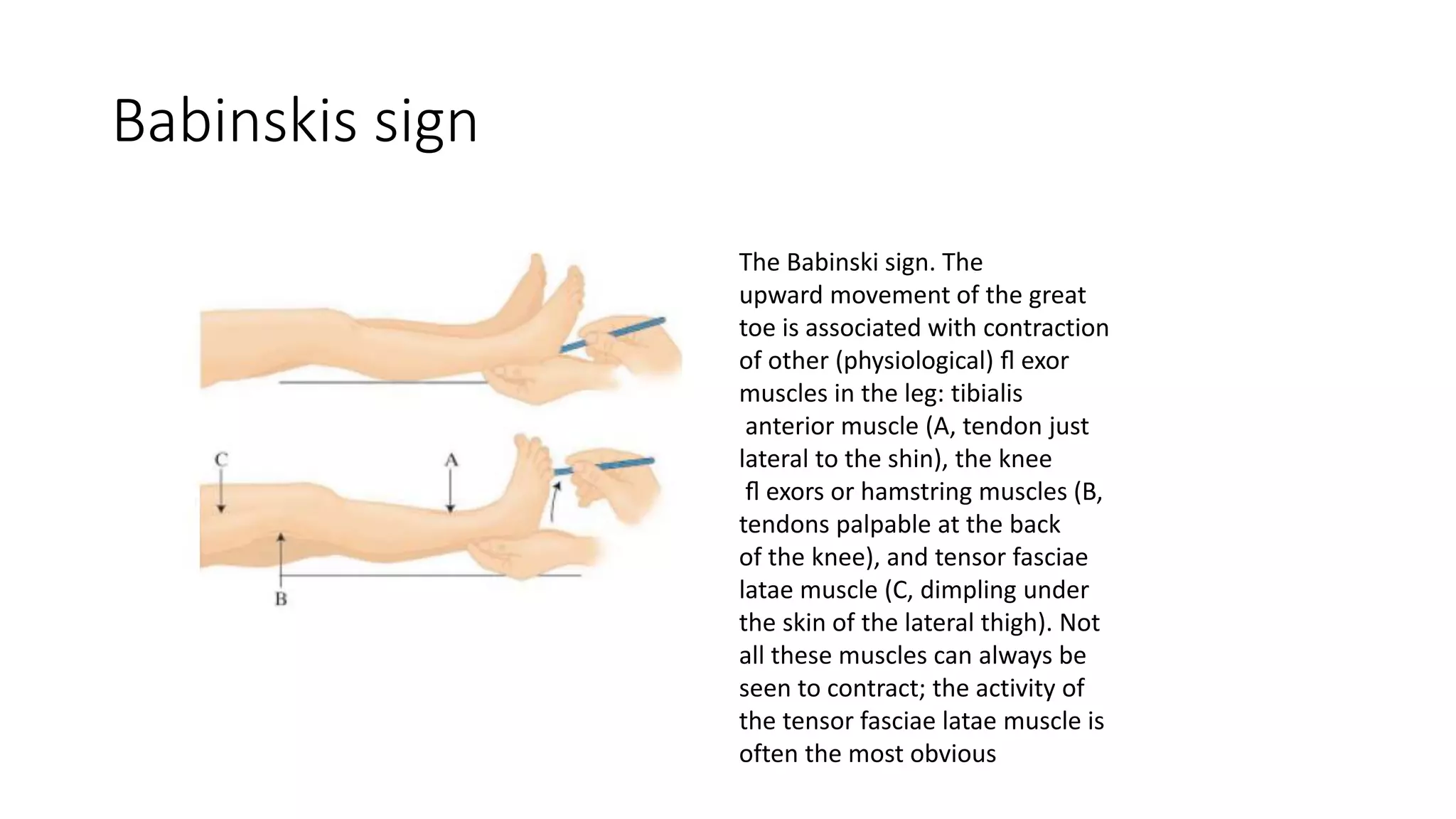
Babinskis sign
The Babinski sign. The
upward movement of the great
toe is associated with contraction
of other (physiological) fl exor
muscles in the leg: tibialis
anterior muscle (A, tendon just
lateral to the shin), the knee
fl exors or hamstring muscles (B,
tendons palpable at the back
of the knee), and tensor fasciae
latae muscle (C, dimpling under
the skin of the lateral thigh). Not
all these muscles can always be
seen to contract; the activity of
the tensor fasciae latae muscle is
often the most obvious
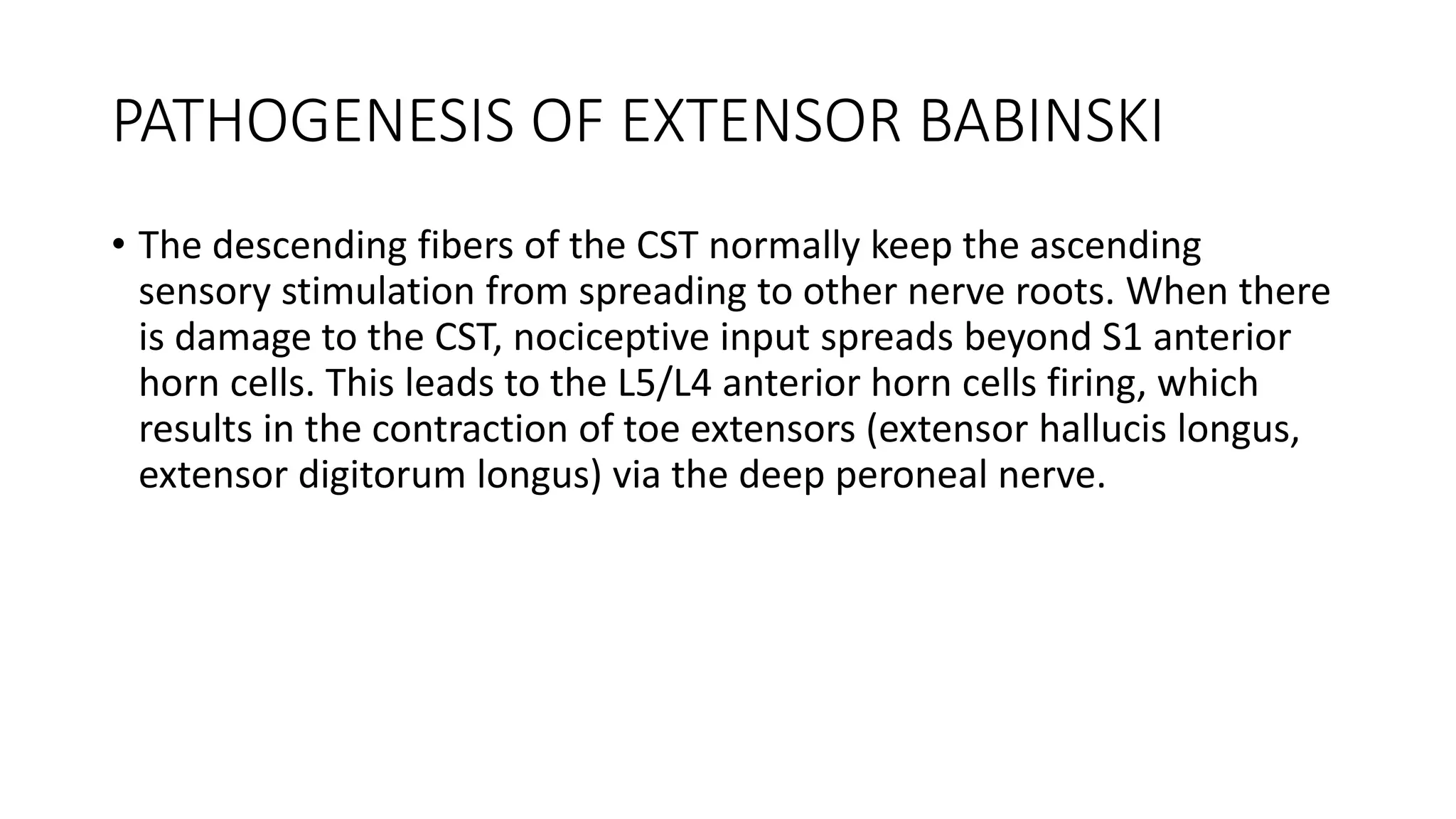
PATHOGENESIS OF EXTENSOR BABINSKI
• The descending fibers of the CST normally keep the ascending
sensory stimulation from spreading to other nerve roots. When there
is damage to the CST, nociceptive input spreads beyond S1 anterior
horn cells. This leads to the L5/L4 anterior horn cells firing, which
results in the contraction of toe extensors (extensor hallucis longus,
extensor digitorum longus) via the deep peroneal nerve.
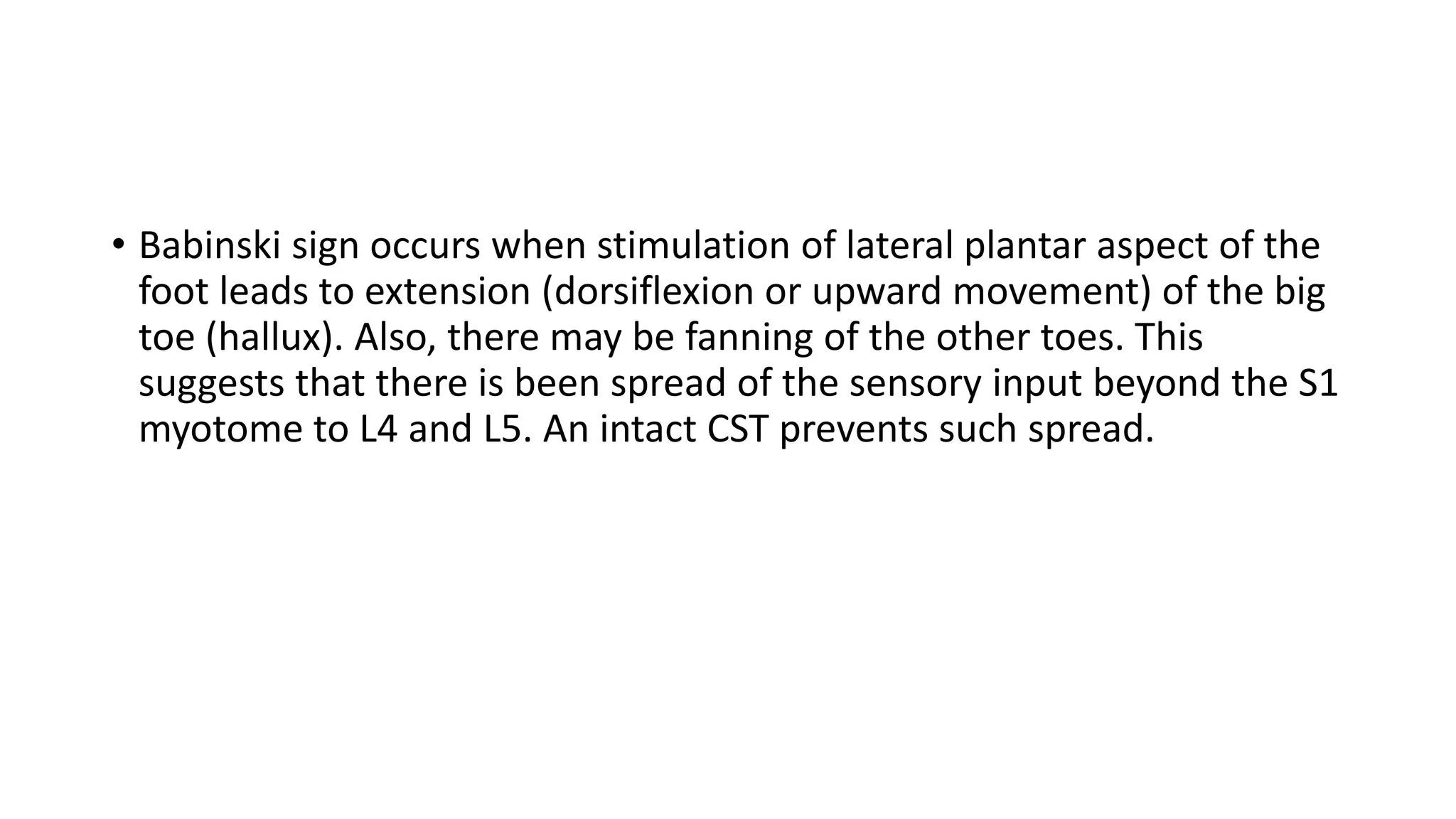
• Babinski sign occurs when stimulation of lateral plantar aspect of the
foot leads to extension (dorsiflexion or upward movement) of the big
toe (hallux). Also, there may be fanning of the other toes. This
suggests that there is been spread of the sensory input beyond the S1
myotome to L4 and L5. An intact CST prevents such spread.
Causes of babinkis sign
• UMN disease
• Infants < 1 year of age
• d/t incomplete myelination
• Comatosed pateints
• Post ictal stage of epilepsy
• Deep sleep
• GA
• ECT ]
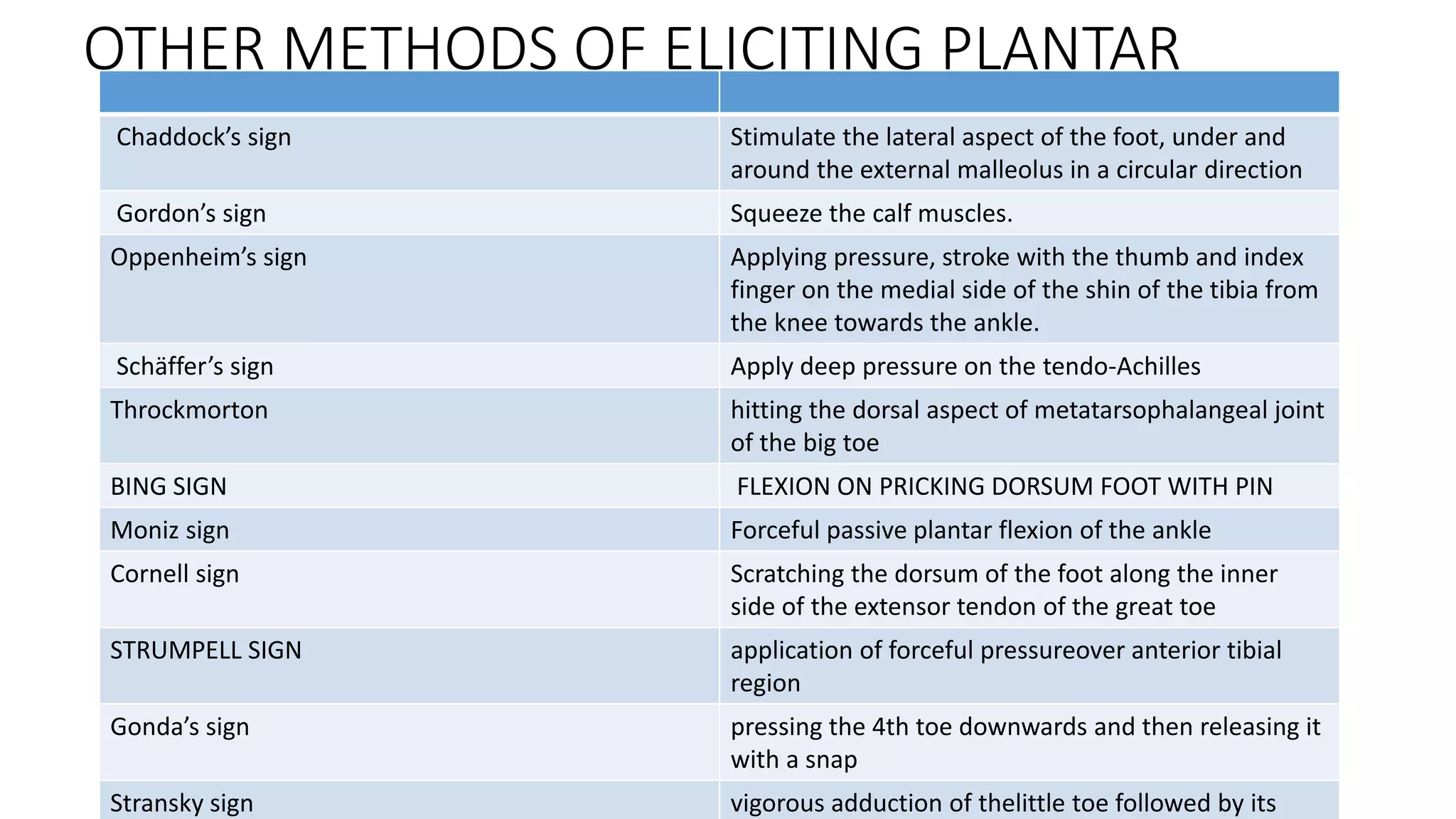
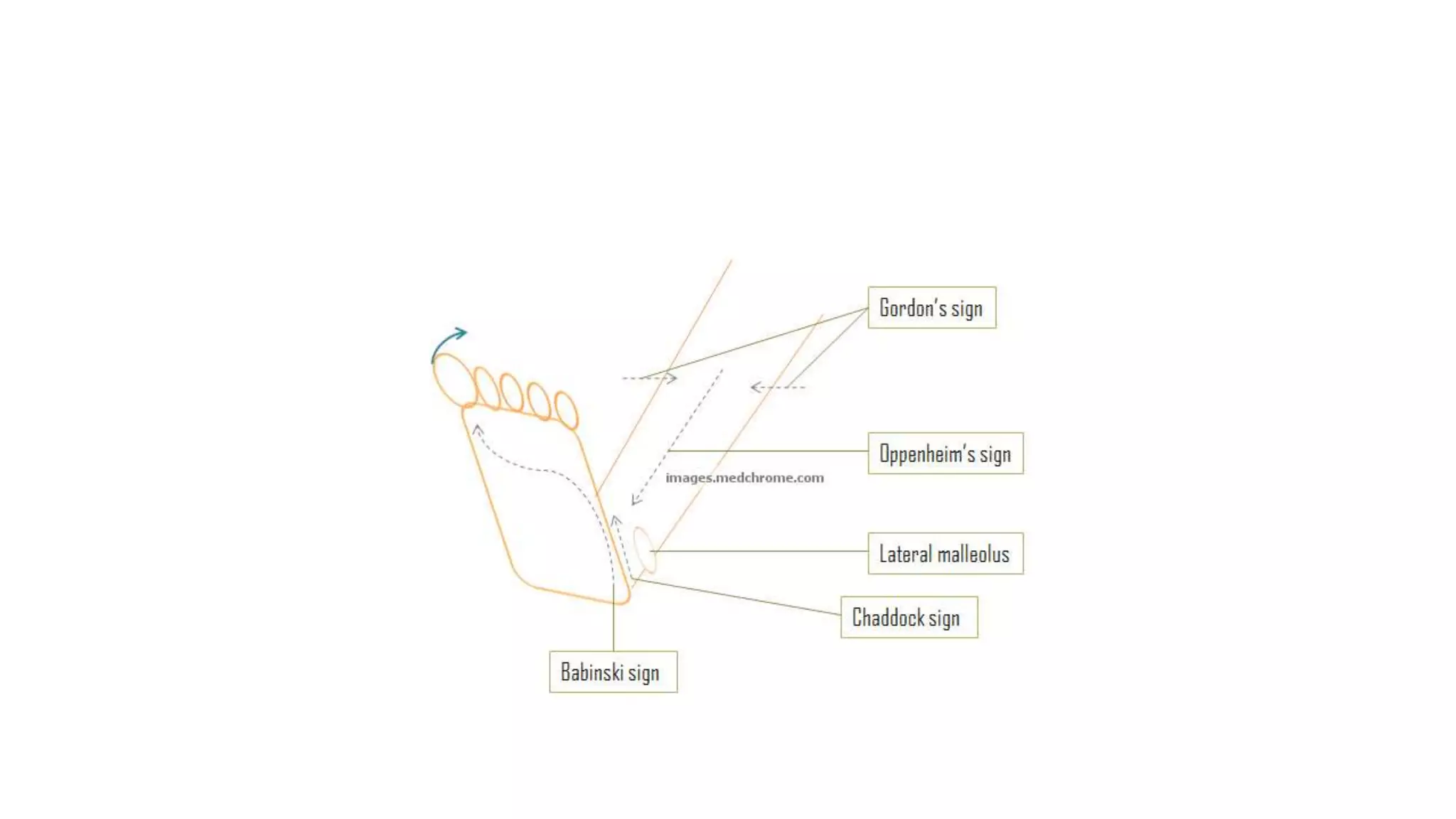
OTHER METHODS OF ELICITING PLANTAR
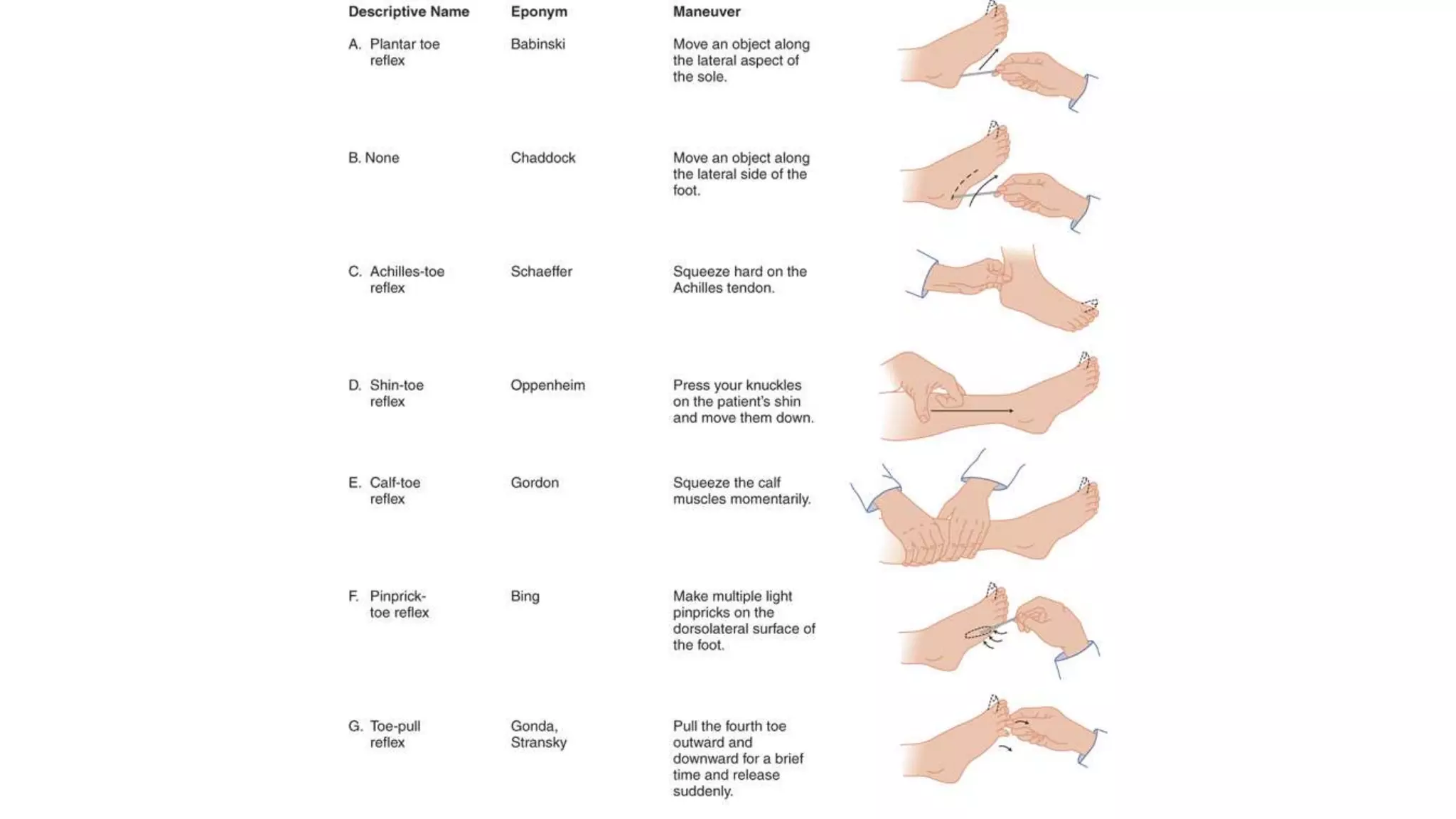
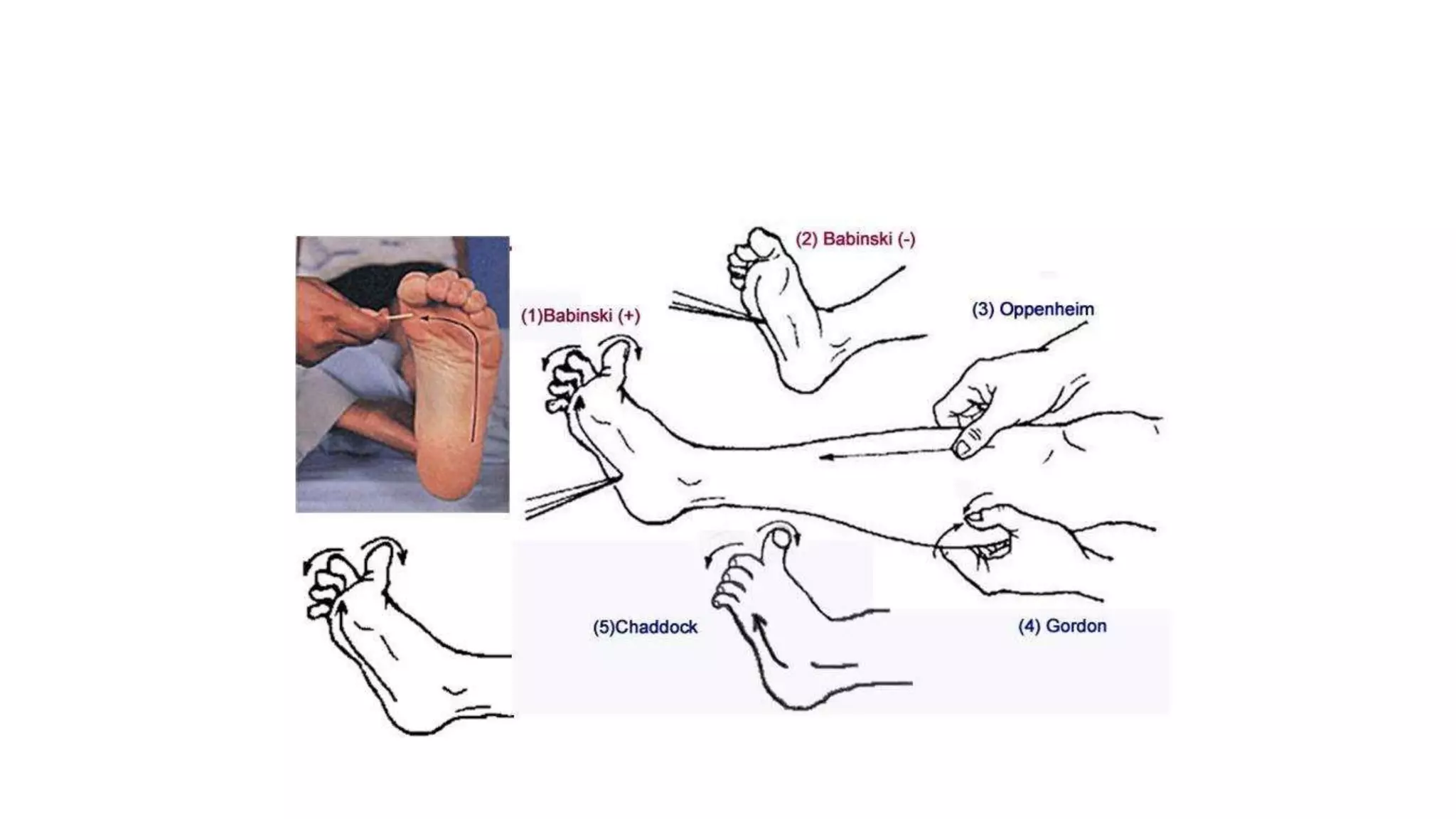
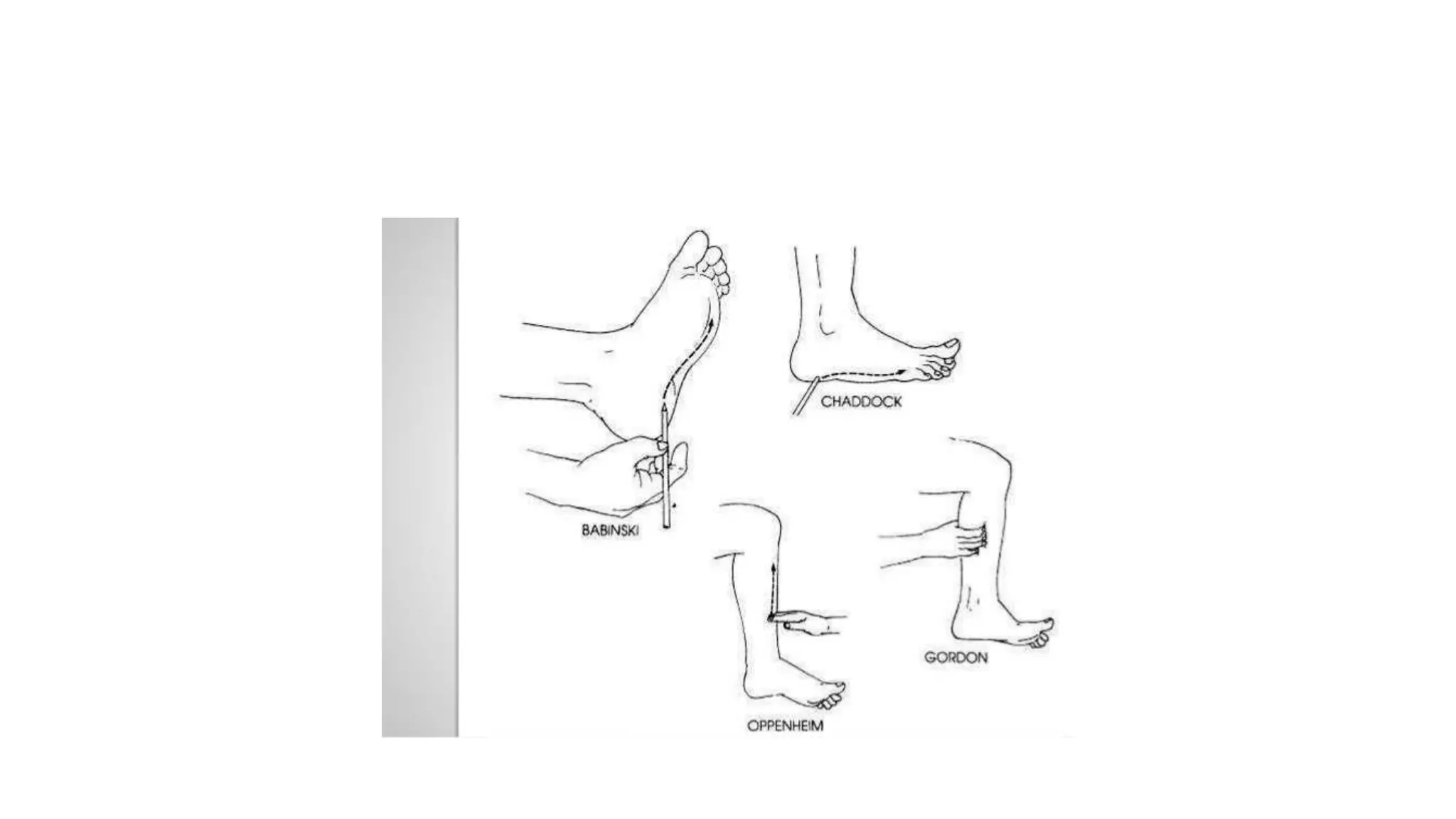
Chaddock’s sign Stimulate the lateral aspect of the foot, under and
around the external malleolus in a circular direction
Gordon’s sign Squeeze the calf muscles.
Oppenheim’s sign Applying pressure, stroke with the thumb and index
finger on the medial side of the shin of the tibia from
the knee towards the ankle.
Schäffer’s sign Apply deep pressure on the tendo-Achilles
Throckmorton hitting the dorsal aspect of metatarsophalangeal joint
of the big toe
BING SIGN FLEXION ON PRICKING DORSUM FOOT WITH PIN
Moniz sign Forceful passive plantar flexion of the ankle
Cornell sign Scratching the dorsum of the foot along the inner
side of the extensor tendon of the great toe
STRUMPELL SIGN application of forceful pressureover anterior tibial
region
Gonda’s sign pressing the 4th toe downwards and then releasing it
with a snap
Stransky sign vigorous adduction of thelittle toe followed by its
withdrawal response
• the patient quickly pulls the foot back away from the stimulus
• In anxious individuals or
• in patients with peripheral sensory neuropathy or
• when an unduly sharp stimulus is given
Absent plantar
• Cold feet
• Anaesthesia of skin
• Fixed great toe
• Paralysis of muscles
Minimal Babinski sign
• Contraction of hamstring muscles and tensor faciae latae
Exaggerated Babinski sign
• It can either be in theform of ‘flexor spasm’ or ‘extensor
spasm’,depending upon the muscles i.e. whether flexorsor extensors,
have excess of tone.
• Flexor spasms
• spinal cord disease,
• bilateral upper motorneuron lesion at a supraspinal level,
• Multiple sclerosis
• subacute combined degeneration of the cord,
• ‘extensor spasm’
• corticospinal tract lesion when the posterior column function is normal.
Crossed extensor response/bilateral
Babinskisign :
• Unilateral stimulation produces bilateral Babinski in patients with
bilateral cerebral disease and spinal cord disease
Pseudo Babinski sign :
• One may encounter this type of response in sensitive individuals,
plantar hyperaesthesia, and choreo-athetosis due to hyperkinesis.
• True Babinski can be clinically distinguished from the false Babinski by
the contraction of hamstring muscles in the former,and failure to
inhibit the extensor response by pressure over the base of the great
toe.
Spontaneous Babinski :
• passive extension of the knee or passive flexion of the hip and the
knee, may produce a positive Babinski sign
• In infants and children following manipulation of the foot
• inpatients with extensive pyramidal tract diseases
Inversion of plantar reflex:
• In selective paralysis of short flexors of toes, plantar response may be
“extensor” due to unopposed action of extensor group of muscles.
Tonic plantar reflex:
• While eliciting the plantar reflex, sometimes, the toes adduct and flex
with persistent plantar flexion of the foot for a couple of minutes.
This sign is indicative of lesion in the ipsilateral or contralateral
prefrontal cortex and extrapyramidal system. This is one of the
release reflexes
Triple flexion response
• The triple flexion response represents profound dysfunction of the
CST, with a spread of the reflex to the L3 and L2 myotomes.
• dorsiflexion of the big toe, the fanning of the other toes,
• dorsiflexion of the foot
• knee flexion.
Reinforcing of plantar response
• Turning head to one side

Plantar reflex

  • 1.
  • 2.
    Plantar response (S1–2) •MOST IMPORTANT SUPERFICIAL REFLEX • POLYSYNAPTIC REFLEX
  • 3.
    PROCEDURE • All theleg muscles should be visible and in a relaxed state. • EXPOSE LEGS UPTO GROIN • CHECK MOBILITY OF GREAT TOE • This can be achieved by positioning the patient in a way that the knee is slightly flexed and the thighis externally rotated. • The patient should be warned that the sole is going to be scratched and ask him to tryto let his limb remain as floppy as possible. The toe s should not be touched at all. • It is best to advise the patient that the sensation may be slightly uncomfortable. Patients may experience both a mildly unpleasant sensation as well as a tickling sensation. The examiner should ensure that the plantar surface of the foot is free of any lesions before proceeding. • SLOWLY OVER 6 SECONDS
  • 4.
    Equipment • The Babinskireflex should be elicited by a dull, blunt instrument that does not cause pain or injury. • The dull point of a reflex hammer, a tongue depressor, or the edge of a key are often utilized. • Sharp objects should be avoided.
  • 5.
    PATHOGENESIS OF NORMALPLANTAR RESPONSE • Stimulation of the lateral plantar aspect of the foot (S1 dermatome) normally leads to plantar flexion of the toes (due to stimulation of the S1 myotome). The response results from nociceptive fibers in the S1 dermatome detecting the stimulation. Nociceptive input travels up the tibial and sciatic nerve to the S1 region of the spine and synapse with anterior horn cells. The motor response which leads to the plantar flexion is mediated through the S1 root and tibial nerve
  • 9.
    NORMAL PLANTAR FLEXOR PLANTAR RESPONSE • GREAT TOE WILL FLEX AT MTP JOINT • OTHER TOES WILL ADDUCT
  • 10.
    VARIATION OF RESPONSEWITH STRENGTH OF STIMULI Mild stimulus Contraction of tensor fascia lata and contraction of adductors of the thigh Stronger stimulus As in above + flexion of the outer four toes. Still stronger stimulus As in above + flexion of great toe, dorsiflexion of foot and inversion (flexor plantar response) Maximal stimulus Maximal stimulus
  • 11.
    Babinski's sign • Extensorplantar response • Dysfunction of corticospinal tract • Components of babinskis sign • DORSIFLEXION OF GREAT TOE AT MTP • FANNING OUT AND EXTENSION OTHER TOES • DORSIFLEXION OF ANKLE • FLEXION OF HIP AND KNEE • CONTRACTION OF TENOR FASCIA LATA
  • 12.
    Babinskis sign The Babinskisign. The upward movement of the great toe is associated with contraction of other (physiological) fl exor muscles in the leg: tibialis anterior muscle (A, tendon just lateral to the shin), the knee fl exors or hamstring muscles (B, tendons palpable at the back of the knee), and tensor fasciae latae muscle (C, dimpling under the skin of the lateral thigh). Not all these muscles can always be seen to contract; the activity of the tensor fasciae latae muscle is often the most obvious
  • 13.
    PATHOGENESIS OF EXTENSORBABINSKI • The descending fibers of the CST normally keep the ascending sensory stimulation from spreading to other nerve roots. When there is damage to the CST, nociceptive input spreads beyond S1 anterior horn cells. This leads to the L5/L4 anterior horn cells firing, which results in the contraction of toe extensors (extensor hallucis longus, extensor digitorum longus) via the deep peroneal nerve.
  • 14.
    • Babinski signoccurs when stimulation of lateral plantar aspect of the foot leads to extension (dorsiflexion or upward movement) of the big toe (hallux). Also, there may be fanning of the other toes. This suggests that there is been spread of the sensory input beyond the S1 myotome to L4 and L5. An intact CST prevents such spread.
  • 15.
    Causes of babinkissign • UMN disease • Infants < 1 year of age • d/t incomplete myelination • Comatosed pateints • Post ictal stage of epilepsy • Deep sleep • GA • ECT ]
  • 16.
    OTHER METHODS OFELICITING PLANTAR Chaddock’s sign Stimulate the lateral aspect of the foot, under and around the external malleolus in a circular direction Gordon’s sign Squeeze the calf muscles. Oppenheim’s sign Applying pressure, stroke with the thumb and index finger on the medial side of the shin of the tibia from the knee towards the ankle. Schäffer’s sign Apply deep pressure on the tendo-Achilles Throckmorton hitting the dorsal aspect of metatarsophalangeal joint of the big toe BING SIGN FLEXION ON PRICKING DORSUM FOOT WITH PIN Moniz sign Forceful passive plantar flexion of the ankle Cornell sign Scratching the dorsum of the foot along the inner side of the extensor tendon of the great toe STRUMPELL SIGN application of forceful pressureover anterior tibial region Gonda’s sign pressing the 4th toe downwards and then releasing it with a snap Stransky sign vigorous adduction of thelittle toe followed by its
  • 22.
    withdrawal response • thepatient quickly pulls the foot back away from the stimulus • In anxious individuals or • in patients with peripheral sensory neuropathy or • when an unduly sharp stimulus is given
  • 23.
    Absent plantar • Coldfeet • Anaesthesia of skin • Fixed great toe • Paralysis of muscles
  • 24.
    Minimal Babinski sign •Contraction of hamstring muscles and tensor faciae latae
  • 25.
    Exaggerated Babinski sign •It can either be in theform of ‘flexor spasm’ or ‘extensor spasm’,depending upon the muscles i.e. whether flexorsor extensors, have excess of tone. • Flexor spasms • spinal cord disease, • bilateral upper motorneuron lesion at a supraspinal level, • Multiple sclerosis • subacute combined degeneration of the cord, • ‘extensor spasm’ • corticospinal tract lesion when the posterior column function is normal.
  • 26.
    Crossed extensor response/bilateral Babinskisign: • Unilateral stimulation produces bilateral Babinski in patients with bilateral cerebral disease and spinal cord disease
  • 27.
    Pseudo Babinski sign: • One may encounter this type of response in sensitive individuals, plantar hyperaesthesia, and choreo-athetosis due to hyperkinesis. • True Babinski can be clinically distinguished from the false Babinski by the contraction of hamstring muscles in the former,and failure to inhibit the extensor response by pressure over the base of the great toe.
  • 28.
    Spontaneous Babinski : •passive extension of the knee or passive flexion of the hip and the knee, may produce a positive Babinski sign • In infants and children following manipulation of the foot • inpatients with extensive pyramidal tract diseases
  • 29.
    Inversion of plantarreflex: • In selective paralysis of short flexors of toes, plantar response may be “extensor” due to unopposed action of extensor group of muscles.
  • 30.
    Tonic plantar reflex: •While eliciting the plantar reflex, sometimes, the toes adduct and flex with persistent plantar flexion of the foot for a couple of minutes. This sign is indicative of lesion in the ipsilateral or contralateral prefrontal cortex and extrapyramidal system. This is one of the release reflexes
  • 31.
    Triple flexion response •The triple flexion response represents profound dysfunction of the CST, with a spread of the reflex to the L3 and L2 myotomes. • dorsiflexion of the big toe, the fanning of the other toes, • dorsiflexion of the foot • knee flexion.
  • 32.
    Reinforcing of plantarresponse • Turning head to one side