Factors affecting enzyme
activity
Namrata Chhabra
M.D.Biochemistry
15-May-20 Namrata Chhabra 1
What are Enzymes ?
• Enzymes are biological catalysts of the chemical reactions.
• They are neither consumed nor permanently altered as a
consequence of their participation in a reaction.
• With the exception of catalytic RNA molecules, or ribozymes, all
enzymes are proteins in nature.
15-May-20 Namrata Chhabra 2
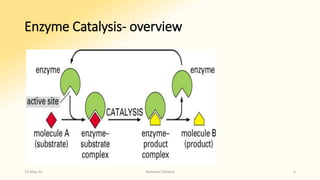
Enzyme catalyzed reaction
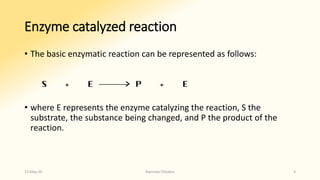
• The basic enzymatic reaction can be represented as follows:
• where E represents the enzyme catalyzing the reaction, S the
substrate, the substance being changed, and P the product of the
reaction.
15-May-20 Namrata Chhabra 3
Enzyme Catalysis- overview
15-May-20 Namrata Chhabra 4
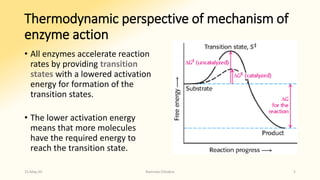
Thermodynamic perspective of mechanism of
enzyme action
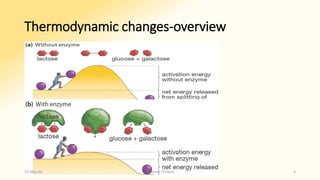
• All enzymes accelerate reaction
rates by providing transition
states with a lowered activation
energy for formation of the
transition states.
• The lower activation energy
means that more molecules
have the required energy to
reach the transition state.
15-May-20 Namrata Chhabra 5
Thermodynamic changes-overview
15-May-20 Namrata Chhabra 6
Enzyme kinetics
• The rate of a chemical reaction is described by the number of
molecules of reactant(s) that are converted into product(s) in a
specified time period.
• International unit – One IU is defined as the activity of the enzyme
which transforms one micro mole of substrate into products per
minute per litre of sample under optimal conditions and at defined
temperature . It is expressed as IU/L
• Katal – catalytic unit – One Katal is defined as the number of moles
of substrate transformed per second per litre of sample. It is
abbreviated as kat or k.
15-May-20 Namrata Chhabra 7
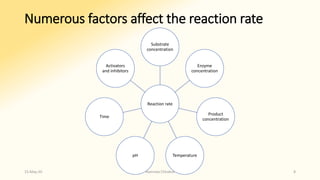
Numerous factors affect the reaction rate
Reaction rate
Substrate
concentration
Enzyme
concentration
Product
concentration
TemperaturepH
Time
Activators
and inhibitors
15-May-20 Namrata Chhabra 8
Effect of substrate concentration
• At lower concentrations, the active sites on most of the enzyme
molecules are not filled because there is not much substrate.
• Higher concentrations cause more collisions between the molecules.
• The rate of reaction increases(First order reaction).
15-May-20 Namrata Chhabra 9
Effect of substrate concentration (contd.)
• The maximum velocity of a reaction is reached when the active sites
are almost continuously filled.
• Increased substrate concentration after this point will not increase
the rate.
• Reaction rate therefore increases as substrate concentration is
increased but it levels off (Zero order reaction)
15-May-20 Namrata Chhabra 10
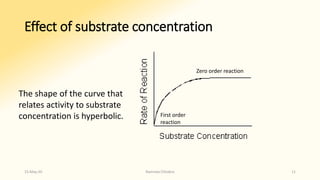
Effect of substrate concentration
The shape of the curve that
relates activity to substrate
concentration is hyperbolic. First order
reaction
Zero order reaction
15-May-20 Namrata Chhabra 11
• At points A or B, increasing
or decreasing [S] therefore
will increase or decrease the
number of ES complexes
with a corresponding change
in vi.
• The rate of reaction is
substrate dependent (First
order reaction).
• At point C essentially all the
enzyme is present as the ES
complex. Since no free
enzyme remains available for
forming ES, further increases
in [S] cannot increase the
rate of the reaction .
• Reaction rate therefore
becomes independent of
substrate concentration
(Zero order reaction).
15-May-20 Namrata Chhabra 12
km and its significance
• Michaelis constant, km is the substrate concentration at which V1 is
half the maximal velocity (Vmax /2) attainable at a particular
concentration of enzyme.
• km thus has the dimensions of substrate concentration.
• It is specific and constant for a given enzyme under defined
conditions of time , temperature and p H
• Km determines the affinity of an enzyme for its substrate, lesser the
Km for is the affinity and vice versa
• Km value helps in determining the true substrate for the enzyme.
15-May-20 Namrata Chhabra 13
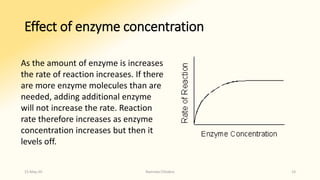
Effect of enzyme concentration
As the amount of enzyme is increases
the rate of reaction increases. If there
are more enzyme molecules than are
needed, adding additional enzyme
will not increase the rate. Reaction
rate therefore increases as enzyme
concentration increases but then it
levels off.
15-May-20 Namrata Chhabra 14
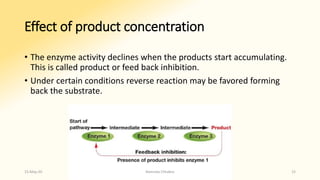
Effect of product concentration
• The enzyme activity declines when the products start accumulating.
This is called product or feed back inhibition.
• Under certain conditions reverse reaction may be favored forming
back the substrate.
15-May-20 Namrata Chhabra 15
Effect of Temperature
• Raising the temperature increases the kinetic energy of molecules.
• Increasing the kinetic energy of molecules also increases their motion
and therefore the frequency with which they collide.
• This combination of more frequent and more highly energetic and
productive collisions increases the reaction rate.
15-May-20 Namrata Chhabra 16
Temperature coefficient
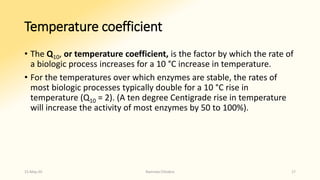
• The Q10, or temperature coefficient, is the factor by which the rate of
a biologic process increases for a 10 °C increase in temperature.
• For the temperatures over which enzymes are stable, the rates of
most biologic processes typically double for a 10 °C rise in
temperature (Q10 = 2). (A ten degree Centigrade rise in temperature
will increase the activity of most enzymes by 50 to 100%).
15-May-20 Namrata Chhabra 17
Effect of Temperature
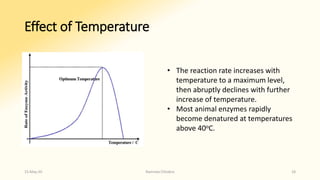
• The reaction rate increases with
temperature to a maximum level,
then abruptly declines with further
increase of temperature.
• Most animal enzymes rapidly
become denatured at temperatures
above 40oC.
15-May-20 Namrata Chhabra 18
Effect of Temperature
• The optimal temperatures of the enzymes in higher organisms rarely
exceed 50 °C.
• Some enzymes lose their activity when frozen.
• Enzymes from thermophilic bacteria found in hot springs are active at
100 °C.
• Changes in the rates of enzyme-catalyzed reactions that accompany a
rise or fall in body temperature constitute a prominent survival
feature for "cold-blooded" life forms such as lizards or fish, whose
body temperatures are dictated by the external environment.
15-May-20 Namrata Chhabra 19
Effect of Hydrogen Ion Concentration (pH)
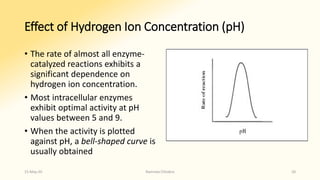
• The rate of almost all enzyme-
catalyzed reactions exhibits a
significant dependence on
hydrogen ion concentration.
• Most intracellular enzymes
exhibit optimal activity at pH
values between 5 and 9.
• When the activity is plotted
against pH, a bell-shaped curve is
usually obtained
15-May-20 Namrata Chhabra 20
Effect of
Hydrogen Ion
Concentration
(pH)
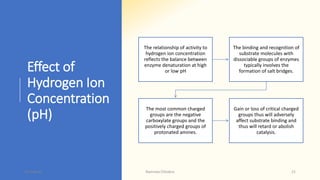
The relationship of activity to
hydrogen ion concentration
reflects the balance between
enzyme denaturation at high
or low pH
The binding and recognition of
substrate molecules with
dissociable groups of enzymes
typically involves the
formation of salt bridges.
The most common charged
groups are the negative
carboxylate groups and the
positively charged groups of
protonated amines.
Gain or loss of critical charged
groups thus will adversely
affect substrate binding and
thus will retard or abolish
catalysis.
15-May-20 Namrata Chhabra 21
Effect of Hydrogen Ion
Concentration (pH)
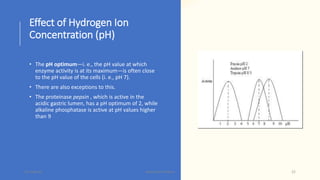
• The pH optimum—i. e., the pH value at which
enzyme activity is at its maximum—is often close
to the pH value of the cells (i. e., pH 7).
• There are also exceptions to this.
• The proteinase pepsin , which is active in the
acidic gastric lumen, has a pH optimum of 2, while
alkaline phosphatase is active at pH values higher
than 9
15-May-20 Namrata Chhabra 22
Effect of
activators and
Coenzymes
• The activity of certain enzymes is greatly
dependent on metal ion activators and
coenzymes.
• Vitamins act as coenzymes in a variety of
reactions.
15-May-20 Namrata Chhabra 23
Effect of modulators and Inhibitors
• The enzyme activity is reduced in the presence of an inhibitor and
• the enzyme activity may be increased in the presence of a positive
modifier.
15-May-20 Namrata Chhabra 24
Effect of Time
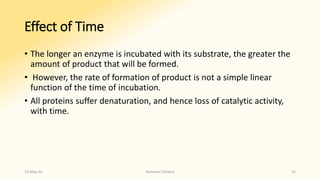
• The longer an enzyme is incubated with its substrate, the greater the
amount of product that will be formed.
• However, the rate of formation of product is not a simple linear
function of the time of incubation.
• All proteins suffer denaturation, and hence loss of catalytic activity,
with time.
15-May-20 Namrata Chhabra 25
Effect of Time
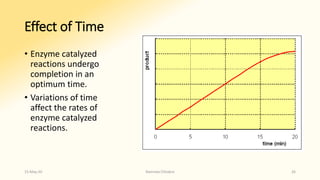
• Enzyme catalyzed
reactions undergo
completion in an
optimum time.
• Variations of time
affect the rates of
enzyme catalyzed
reactions.
15-May-20 Namrata Chhabra 26
Michaelis-Menten Kinetics
• The Michaelis-Menten equation is a quantitative description of the
relationship among the rate of an enzyme- catalyzed reaction [v1],
the concentration of substrate [S] and two constants, Vmax and km
(which are set by the particular equation).
The symbols used in the Michaelis-
Menten equation refer to the reaction
rate [v1], maximum reaction rate (V
max), substrate concentration [S] and
the Michaelis-Menten constant (km).
15-May-20 Namrata Chhabra 27
Michaelis-Menten Kinetics
• The dependence of initial reaction velocity on [S] and Km may be
illustrated by evaluating the Michaelis-Menten equation under three
conditions.
• (1) When [S] is much less than km, the term km + [S] is essentially
equal to km. Replacing Km + [S] with Km reduces equation to
15-May-20 Namrata Chhabra 28
When [S] is
much less
than km
• Since V max and km are both constants, their
ratio is a constant (k).
• In other words, when [S] is considerably below
km, V max is proportionate to k[S].
• The initial reaction velocity therefore is directly
proportionate to [S].
15-May-20 Namrata Chhabra 29
When [S] is much greater than km
• ,the term km + [S] is essentially equal to [S]. Replacing km + [S] with
[S] reduces equation to :
Thus, when [S] greatly exceeds km, the reaction velocity is
maximal (V max) and unaffected by further increases in
substrate concentration.
15-May-20 Namrata Chhabra 30
(3) When [S] = km
• Equation states that when [S] equals km, the initial velocity
is half-maximal.
• Equation also reveals that km can be determined
experimentally from—the substrate concentration at which
the initial velocity is half-maximal.
15-May-20 Namrata Chhabra 31
Linear Form of the Michaelis-Menten Equation
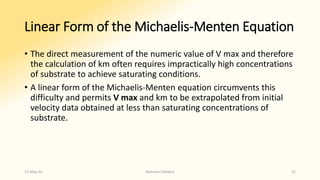
• The direct measurement of the numeric value of V max and therefore
the calculation of km often requires impractically high concentrations
of substrate to achieve saturating conditions.
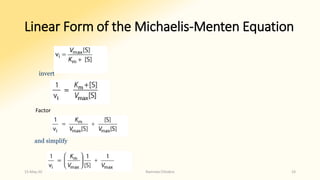
• A linear form of the Michaelis-Menten equation circumvents this
difficulty and permits V max and km to be extrapolated from initial
velocity data obtained at less than saturating concentrations of
substrate.
15-May-20 Namrata Chhabra 32
Linear Form of the Michaelis-Menten Equation
invert
Factor
and simplify
15-May-20 Namrata Chhabra 33
Double reciprocal or Lineweaver-Burk plot
• Equation for a straight line, y = ax + b,
where y = 1/vi and x = 1/[S].
• A plot of 1/vi as y as a function of
1/[S] as x therefore gives a straight
line whose y intercept is 1/ V max and
whose slope is km / V max.
• Such a plot is called a double
reciprocal or Lineweaver-Burk plot
15-May-20 Namrata Chhabra 34
Carry home message
Enzyme is affected by:
❑Substrate concentration
❑Product concentration
❑Enzyme concentration
❑Temperature
❑pH
❑Time and
❑Presence of activators and inhibitors
15-May-20 Namrata Chhabra 35
Thank you
15-May-20 Namrata Chhabra 36

Factors affecting enzyme activity

  • 1.
    Factors affecting enzyme activity NamrataChhabra M.D.Biochemistry 15-May-20 Namrata Chhabra 1
  • 2.
    What are Enzymes? • Enzymes are biological catalysts of the chemical reactions. • They are neither consumed nor permanently altered as a consequence of their participation in a reaction. • With the exception of catalytic RNA molecules, or ribozymes, all enzymes are proteins in nature. 15-May-20 Namrata Chhabra 2
  • 3.
    Enzyme catalyzed reaction •The basic enzymatic reaction can be represented as follows: • where E represents the enzyme catalyzing the reaction, S the substrate, the substance being changed, and P the product of the reaction. 15-May-20 Namrata Chhabra 3
  • 4.
  • 5.
    Thermodynamic perspective ofmechanism of enzyme action • All enzymes accelerate reaction rates by providing transition states with a lowered activation energy for formation of the transition states. • The lower activation energy means that more molecules have the required energy to reach the transition state. 15-May-20 Namrata Chhabra 5
  • 6.
  • 7.
    Enzyme kinetics • Therate of a chemical reaction is described by the number of molecules of reactant(s) that are converted into product(s) in a specified time period. • International unit – One IU is defined as the activity of the enzyme which transforms one micro mole of substrate into products per minute per litre of sample under optimal conditions and at defined temperature . It is expressed as IU/L • Katal – catalytic unit – One Katal is defined as the number of moles of substrate transformed per second per litre of sample. It is abbreviated as kat or k. 15-May-20 Namrata Chhabra 7
  • 8.
    Numerous factors affectthe reaction rate Reaction rate Substrate concentration Enzyme concentration Product concentration TemperaturepH Time Activators and inhibitors 15-May-20 Namrata Chhabra 8
  • 9.
    Effect of substrateconcentration • At lower concentrations, the active sites on most of the enzyme molecules are not filled because there is not much substrate. • Higher concentrations cause more collisions between the molecules. • The rate of reaction increases(First order reaction). 15-May-20 Namrata Chhabra 9
  • 10.
    Effect of substrateconcentration (contd.) • The maximum velocity of a reaction is reached when the active sites are almost continuously filled. • Increased substrate concentration after this point will not increase the rate. • Reaction rate therefore increases as substrate concentration is increased but it levels off (Zero order reaction) 15-May-20 Namrata Chhabra 10
  • 11.
    Effect of substrateconcentration The shape of the curve that relates activity to substrate concentration is hyperbolic. First order reaction Zero order reaction 15-May-20 Namrata Chhabra 11
  • 12.
    • At pointsA or B, increasing or decreasing [S] therefore will increase or decrease the number of ES complexes with a corresponding change in vi. • The rate of reaction is substrate dependent (First order reaction). • At point C essentially all the enzyme is present as the ES complex. Since no free enzyme remains available for forming ES, further increases in [S] cannot increase the rate of the reaction . • Reaction rate therefore becomes independent of substrate concentration (Zero order reaction). 15-May-20 Namrata Chhabra 12
  • 13.
    km and itssignificance • Michaelis constant, km is the substrate concentration at which V1 is half the maximal velocity (Vmax /2) attainable at a particular concentration of enzyme. • km thus has the dimensions of substrate concentration. • It is specific and constant for a given enzyme under defined conditions of time , temperature and p H • Km determines the affinity of an enzyme for its substrate, lesser the Km for is the affinity and vice versa • Km value helps in determining the true substrate for the enzyme. 15-May-20 Namrata Chhabra 13
  • 14.
    Effect of enzymeconcentration As the amount of enzyme is increases the rate of reaction increases. If there are more enzyme molecules than are needed, adding additional enzyme will not increase the rate. Reaction rate therefore increases as enzyme concentration increases but then it levels off. 15-May-20 Namrata Chhabra 14
  • 15.
    Effect of productconcentration • The enzyme activity declines when the products start accumulating. This is called product or feed back inhibition. • Under certain conditions reverse reaction may be favored forming back the substrate. 15-May-20 Namrata Chhabra 15
  • 16.
    Effect of Temperature •Raising the temperature increases the kinetic energy of molecules. • Increasing the kinetic energy of molecules also increases their motion and therefore the frequency with which they collide. • This combination of more frequent and more highly energetic and productive collisions increases the reaction rate. 15-May-20 Namrata Chhabra 16
  • 17.
    Temperature coefficient • TheQ10, or temperature coefficient, is the factor by which the rate of a biologic process increases for a 10 °C increase in temperature. • For the temperatures over which enzymes are stable, the rates of most biologic processes typically double for a 10 °C rise in temperature (Q10 = 2). (A ten degree Centigrade rise in temperature will increase the activity of most enzymes by 50 to 100%). 15-May-20 Namrata Chhabra 17
  • 18.
    Effect of Temperature •The reaction rate increases with temperature to a maximum level, then abruptly declines with further increase of temperature. • Most animal enzymes rapidly become denatured at temperatures above 40oC. 15-May-20 Namrata Chhabra 18
  • 19.
    Effect of Temperature •The optimal temperatures of the enzymes in higher organisms rarely exceed 50 °C. • Some enzymes lose their activity when frozen. • Enzymes from thermophilic bacteria found in hot springs are active at 100 °C. • Changes in the rates of enzyme-catalyzed reactions that accompany a rise or fall in body temperature constitute a prominent survival feature for "cold-blooded" life forms such as lizards or fish, whose body temperatures are dictated by the external environment. 15-May-20 Namrata Chhabra 19
  • 20.
    Effect of HydrogenIon Concentration (pH) • The rate of almost all enzyme- catalyzed reactions exhibits a significant dependence on hydrogen ion concentration. • Most intracellular enzymes exhibit optimal activity at pH values between 5 and 9. • When the activity is plotted against pH, a bell-shaped curve is usually obtained 15-May-20 Namrata Chhabra 20
  • 21.
    Effect of Hydrogen Ion Concentration (pH) Therelationship of activity to hydrogen ion concentration reflects the balance between enzyme denaturation at high or low pH The binding and recognition of substrate molecules with dissociable groups of enzymes typically involves the formation of salt bridges. The most common charged groups are the negative carboxylate groups and the positively charged groups of protonated amines. Gain or loss of critical charged groups thus will adversely affect substrate binding and thus will retard or abolish catalysis. 15-May-20 Namrata Chhabra 21
  • 22.
    Effect of HydrogenIon Concentration (pH) • The pH optimum—i. e., the pH value at which enzyme activity is at its maximum—is often close to the pH value of the cells (i. e., pH 7). • There are also exceptions to this. • The proteinase pepsin , which is active in the acidic gastric lumen, has a pH optimum of 2, while alkaline phosphatase is active at pH values higher than 9 15-May-20 Namrata Chhabra 22
  • 23.
    Effect of activators and Coenzymes •The activity of certain enzymes is greatly dependent on metal ion activators and coenzymes. • Vitamins act as coenzymes in a variety of reactions. 15-May-20 Namrata Chhabra 23
  • 24.
    Effect of modulatorsand Inhibitors • The enzyme activity is reduced in the presence of an inhibitor and • the enzyme activity may be increased in the presence of a positive modifier. 15-May-20 Namrata Chhabra 24
  • 25.
    Effect of Time •The longer an enzyme is incubated with its substrate, the greater the amount of product that will be formed. • However, the rate of formation of product is not a simple linear function of the time of incubation. • All proteins suffer denaturation, and hence loss of catalytic activity, with time. 15-May-20 Namrata Chhabra 25
  • 26.
    Effect of Time •Enzyme catalyzed reactions undergo completion in an optimum time. • Variations of time affect the rates of enzyme catalyzed reactions. 15-May-20 Namrata Chhabra 26
  • 27.
    Michaelis-Menten Kinetics • TheMichaelis-Menten equation is a quantitative description of the relationship among the rate of an enzyme- catalyzed reaction [v1], the concentration of substrate [S] and two constants, Vmax and km (which are set by the particular equation). The symbols used in the Michaelis- Menten equation refer to the reaction rate [v1], maximum reaction rate (V max), substrate concentration [S] and the Michaelis-Menten constant (km). 15-May-20 Namrata Chhabra 27
  • 28.
    Michaelis-Menten Kinetics • Thedependence of initial reaction velocity on [S] and Km may be illustrated by evaluating the Michaelis-Menten equation under three conditions. • (1) When [S] is much less than km, the term km + [S] is essentially equal to km. Replacing Km + [S] with Km reduces equation to 15-May-20 Namrata Chhabra 28
  • 29.
    When [S] is muchless than km • Since V max and km are both constants, their ratio is a constant (k). • In other words, when [S] is considerably below km, V max is proportionate to k[S]. • The initial reaction velocity therefore is directly proportionate to [S]. 15-May-20 Namrata Chhabra 29
  • 30.
    When [S] ismuch greater than km • ,the term km + [S] is essentially equal to [S]. Replacing km + [S] with [S] reduces equation to : Thus, when [S] greatly exceeds km, the reaction velocity is maximal (V max) and unaffected by further increases in substrate concentration. 15-May-20 Namrata Chhabra 30
  • 31.
    (3) When [S]= km • Equation states that when [S] equals km, the initial velocity is half-maximal. • Equation also reveals that km can be determined experimentally from—the substrate concentration at which the initial velocity is half-maximal. 15-May-20 Namrata Chhabra 31
  • 32.
    Linear Form ofthe Michaelis-Menten Equation • The direct measurement of the numeric value of V max and therefore the calculation of km often requires impractically high concentrations of substrate to achieve saturating conditions. • A linear form of the Michaelis-Menten equation circumvents this difficulty and permits V max and km to be extrapolated from initial velocity data obtained at less than saturating concentrations of substrate. 15-May-20 Namrata Chhabra 32
  • 33.
    Linear Form ofthe Michaelis-Menten Equation invert Factor and simplify 15-May-20 Namrata Chhabra 33
  • 34.
    Double reciprocal orLineweaver-Burk plot • Equation for a straight line, y = ax + b, where y = 1/vi and x = 1/[S]. • A plot of 1/vi as y as a function of 1/[S] as x therefore gives a straight line whose y intercept is 1/ V max and whose slope is km / V max. • Such a plot is called a double reciprocal or Lineweaver-Burk plot 15-May-20 Namrata Chhabra 34
  • 35.
    Carry home message Enzymeis affected by: ❑Substrate concentration ❑Product concentration ❑Enzyme concentration ❑Temperature ❑pH ❑Time and ❑Presence of activators and inhibitors 15-May-20 Namrata Chhabra 35
  • 36.