
by: Olla S. BaEissa
1
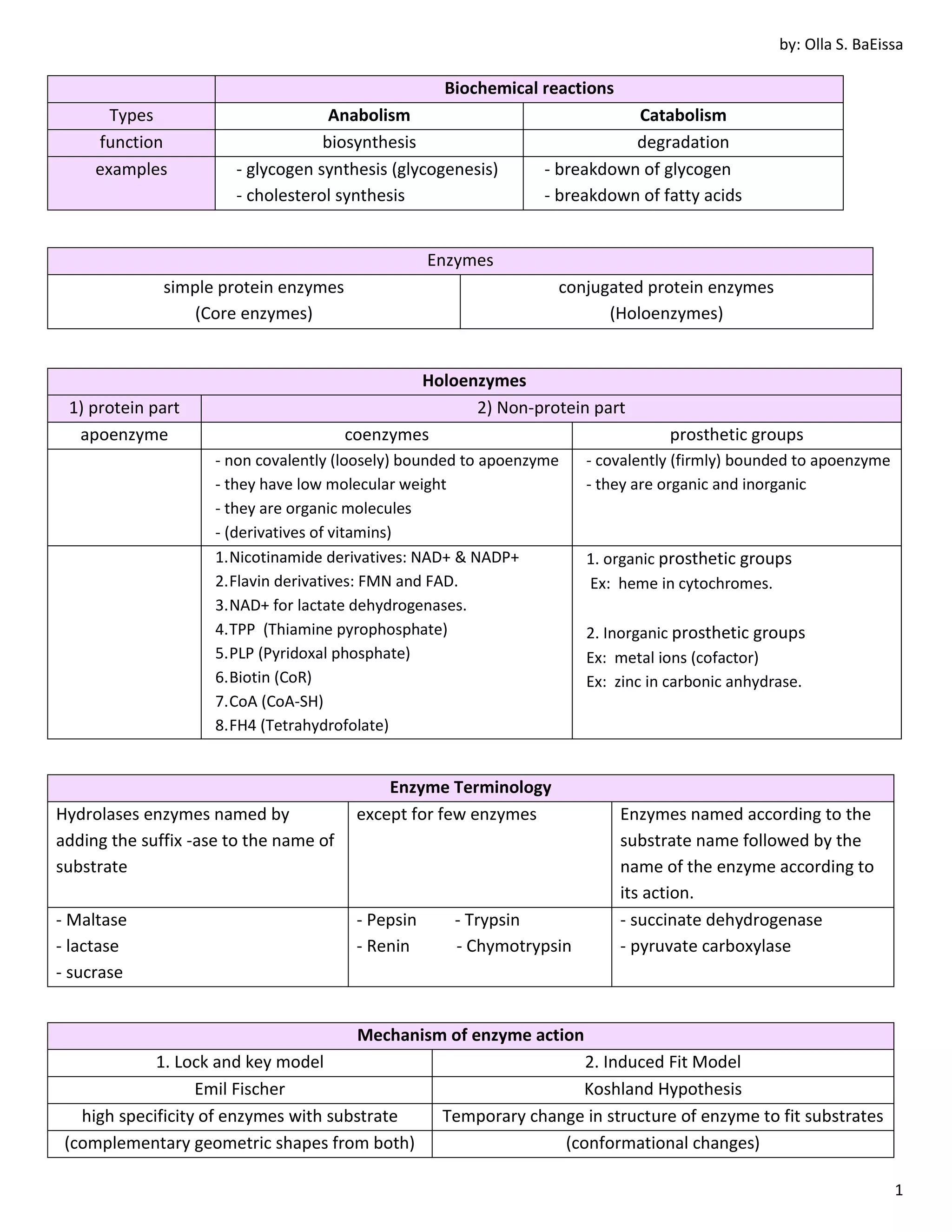
Biochemical reactions
Types Anabolism Catabolism
function biosynthesis degradation
examples - glycogen synthesis (glycogenesis)
- cholesterol synthesis
- breakdown of glycogen
- breakdown of fatty acids
Enzymes
simple protein enzymes
(Core enzymes)
conjugated protein enzymes
(Holoenzymes)
Holoenzymes
1) protein part 2) Non-protein part
apoenzyme coenzymes prosthetic groups
- non covalently (loosely) bounded to apoenzyme
- they have low molecular weight
- they are organic molecules
- (derivatives of vitamins)
- covalently (firmly) bounded to apoenzyme
- they are organic and inorganic
1.Nicotinamide derivatives: NAD+ & NADP+
2.Flavin derivatives: FMN and FAD.
3.NAD+ for lactate dehydrogenases.
4.TPP (Thiamine pyrophosphate)
5.PLP (Pyridoxal phosphate)
6.Biotin (CoR)
7.CoA (CoA-SH)
8.FH4 (Tetrahydrofolate)
1. organic prosthetic groups
Ex: heme in cytochromes.
2. Inorganic prosthetic groups
Ex: metal ions (cofactor)
Ex: zinc in carbonic anhydrase.
Enzyme Terminology
Hydrolases enzymes named by
adding the suffix -ase to the name of
substrate
except for few enzymes Enzymes named according to the
substrate name followed by the
name of the enzyme according to
its action.
- Maltase
- lactase
- sucrase
- Pepsin - Trypsin
- Renin - Chymotrypsin
- succinate dehydrogenase
- pyruvate carboxylase
Mechanism of enzyme action
1. Lock and key model 2. Induced Fit Model
Emil Fischer Koshland Hypothesis
high specificity of enzymes with substrate Temporary change in structure of enzyme to fit substrates
(complementary geometric shapes from both) (conformational changes)
by: Olla S. BaEissa
2
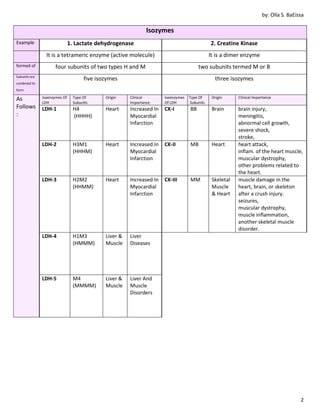
Isozymes
Example 1. Lactate dehydrogenase 2. Creatine Kinase
It is a tetrameric enzyme (active molecule) It is a dimer enzyme
formed of four subunits of two types H and M two subunits termed M or B
Subunits are
combined to
form
five isozymes three isozymes
As
Follows
:
Isoenzymes Of
LDH
Type Of
Subunits
Origin Clinical
Importance
Isoenzymes
Of LDH
Type Of
Subunits
Origin Clinical Importance
LDH-1 H4
(HHHH)
Heart Increased In
Myocardial
Infarction
CK-I BB Brain brain injury,
meningitis,
abnormal cell growth,
severe shock,
stroke,
LDH-2 H3M1
(HHHM)
Heart Increased In
Myocardial
Infarction
CK-II MB Heart heart attack,
inflam. of the heart muscle,
muscular dystrophy,
other problems related to
the heart.
LDH-3 H2M2
(HHMM)
Heart Increased In
Myocardial
Infarction
CK-III MM Skeletal
Muscle
& Heart
muscle damage in the
heart, brain, or skeleton
after a crush injury.
seizures,
muscular dystrophy,
muscle inflammation,
another skeletal muscle
disorder.
LDH-4 H1M3
(HMMM)
Liver &
Muscle
Liver
Diseases
LDH-5 M4
(MMMM)
Liver &
Muscle
Liver And
Muscle
Disorders
by: Olla S. BaEissa
3
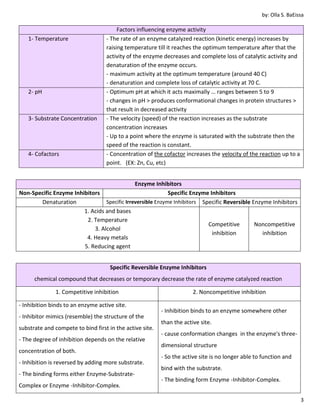
Factors influencing enzyme activity
1- Temperature - The rate of an enzyme catalyzed reaction (kinetic energy) increases by
raising temperature till it reaches the optimum temperature after that the
activity of the enzyme decreases and complete loss of catalytic activity and
denaturation of the enzyme occurs.
- maximum activity at the optimum temperature (around 40 C)
- denaturation and complete loss of catalytic activity at 70 C.
2- pH - Optimum pH at which it acts maximally … ranges between 5 to 9
- changes in pH > produces conformational changes in protein structures >
that result in decreased activity
3- Substrate Concentration - The velocity (speed) of the reaction increases as the substrate
concentration increases
- Up to a point where the enzyme is saturated with the substrate then the
speed of the reaction is constant.
4- Cofactors - Concentration of the cofactor increases the velocity of the reaction up to a
point. (EX: Zn, Cu, etc)
Enzyme Inhibitors
Non-Specific Enzyme Inhibitors Specific Enzyme Inhibitors
Denaturation Specific Irreversible Enzyme Inhibitors Specific Reversible Enzyme Inhibitors
1. Acids and bases
2. Temperature
3. Alcohol
4. Heavy metals
5. Reducing agent
Competitive
inhibition
Noncompetitive
inhibition
Specific Reversible Enzyme Inhibitors
chemical compound that decreases or temporary decrease the rate of enzyme catalyzed reaction
1. Competitive inhibition 2. Noncompetitive inhibition
- Inhibition binds to an enzyme active site.
- Inhibitor mimics (resemble) the structure of the
substrate and compete to bind first in the active site.
- The degree of inhibition depends on the relative
concentration of both.
- Inhibition is reversed by adding more substrate.
- The binding forms either Enzyme-Substrate-
Complex or Enzyme -Inhibitor-Complex.
- Inhibition binds to an enzyme somewhere other
than the active site.
- cause conformation changes in the enzyme's three-
dimensional structure
- So the active site is no longer able to function and
bind with the substrate.
- The binding form Enzyme -Inhibitor-Complex.
by: Olla S. BaEissa
4

Enzymes

  • 1.
    by: Olla S.BaEissa 1 Biochemical reactions Types Anabolism Catabolism function biosynthesis degradation examples - glycogen synthesis (glycogenesis) - cholesterol synthesis - breakdown of glycogen - breakdown of fatty acids Enzymes simple protein enzymes (Core enzymes) conjugated protein enzymes (Holoenzymes) Holoenzymes 1) protein part 2) Non-protein part apoenzyme coenzymes prosthetic groups - non covalently (loosely) bounded to apoenzyme - they have low molecular weight - they are organic molecules - (derivatives of vitamins) - covalently (firmly) bounded to apoenzyme - they are organic and inorganic 1.Nicotinamide derivatives: NAD+ & NADP+ 2.Flavin derivatives: FMN and FAD. 3.NAD+ for lactate dehydrogenases. 4.TPP (Thiamine pyrophosphate) 5.PLP (Pyridoxal phosphate) 6.Biotin (CoR) 7.CoA (CoA-SH) 8.FH4 (Tetrahydrofolate) 1. organic prosthetic groups Ex: heme in cytochromes. 2. Inorganic prosthetic groups Ex: metal ions (cofactor) Ex: zinc in carbonic anhydrase. Enzyme Terminology Hydrolases enzymes named by adding the suffix -ase to the name of substrate except for few enzymes Enzymes named according to the substrate name followed by the name of the enzyme according to its action. - Maltase - lactase - sucrase - Pepsin - Trypsin - Renin - Chymotrypsin - succinate dehydrogenase - pyruvate carboxylase Mechanism of enzyme action 1. Lock and key model 2. Induced Fit Model Emil Fischer Koshland Hypothesis high specificity of enzymes with substrate Temporary change in structure of enzyme to fit substrates (complementary geometric shapes from both) (conformational changes)
  • 2.
    by: Olla S.BaEissa 2 Isozymes Example 1. Lactate dehydrogenase 2. Creatine Kinase It is a tetrameric enzyme (active molecule) It is a dimer enzyme formed of four subunits of two types H and M two subunits termed M or B Subunits are combined to form five isozymes three isozymes As Follows : Isoenzymes Of LDH Type Of Subunits Origin Clinical Importance Isoenzymes Of LDH Type Of Subunits Origin Clinical Importance LDH-1 H4 (HHHH) Heart Increased In Myocardial Infarction CK-I BB Brain brain injury, meningitis, abnormal cell growth, severe shock, stroke, LDH-2 H3M1 (HHHM) Heart Increased In Myocardial Infarction CK-II MB Heart heart attack, inflam. of the heart muscle, muscular dystrophy, other problems related to the heart. LDH-3 H2M2 (HHMM) Heart Increased In Myocardial Infarction CK-III MM Skeletal Muscle & Heart muscle damage in the heart, brain, or skeleton after a crush injury. seizures, muscular dystrophy, muscle inflammation, another skeletal muscle disorder. LDH-4 H1M3 (HMMM) Liver & Muscle Liver Diseases LDH-5 M4 (MMMM) Liver & Muscle Liver And Muscle Disorders
  • 3.
    by: Olla S.BaEissa 3 Factors influencing enzyme activity 1- Temperature - The rate of an enzyme catalyzed reaction (kinetic energy) increases by raising temperature till it reaches the optimum temperature after that the activity of the enzyme decreases and complete loss of catalytic activity and denaturation of the enzyme occurs. - maximum activity at the optimum temperature (around 40 C) - denaturation and complete loss of catalytic activity at 70 C. 2- pH - Optimum pH at which it acts maximally … ranges between 5 to 9 - changes in pH > produces conformational changes in protein structures > that result in decreased activity 3- Substrate Concentration - The velocity (speed) of the reaction increases as the substrate concentration increases - Up to a point where the enzyme is saturated with the substrate then the speed of the reaction is constant. 4- Cofactors - Concentration of the cofactor increases the velocity of the reaction up to a point. (EX: Zn, Cu, etc) Enzyme Inhibitors Non-Specific Enzyme Inhibitors Specific Enzyme Inhibitors Denaturation Specific Irreversible Enzyme Inhibitors Specific Reversible Enzyme Inhibitors 1. Acids and bases 2. Temperature 3. Alcohol 4. Heavy metals 5. Reducing agent Competitive inhibition Noncompetitive inhibition Specific Reversible Enzyme Inhibitors chemical compound that decreases or temporary decrease the rate of enzyme catalyzed reaction 1. Competitive inhibition 2. Noncompetitive inhibition - Inhibition binds to an enzyme active site. - Inhibitor mimics (resemble) the structure of the substrate and compete to bind first in the active site. - The degree of inhibition depends on the relative concentration of both. - Inhibition is reversed by adding more substrate. - The binding forms either Enzyme-Substrate- Complex or Enzyme -Inhibitor-Complex. - Inhibition binds to an enzyme somewhere other than the active site. - cause conformation changes in the enzyme's three- dimensional structure - So the active site is no longer able to function and bind with the substrate. - The binding form Enzyme -Inhibitor-Complex.
  • 4.
    by: Olla S.BaEissa 4