Pathology
Causes of Cell injury
• Hypoxia
• Most common cause of cell injury
• Ischemia  mc cause of hypoxia
• Physical agents
• Chemical agents
• Infections
• Immunological agents
• Genetic cause
• Nutritional imbalance
Hypoxia
• Neurons
• Most susceptible tissue to ischemia
• Irreversible damage with in 3 to 4 minutes
• Myocardial cells
• Irreversible damage with in 20 to 30 minutes
• Fibroblast
• Most resistant to ischemic damage
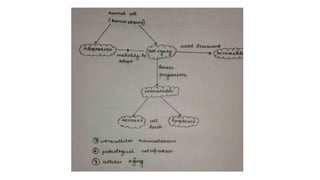
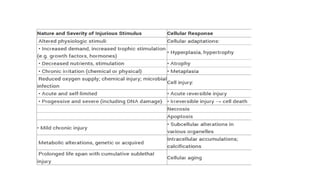
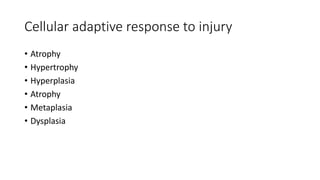
Cellular adaptive response to injury
• Atrophy
• Hypertrophy
• Hyperplasia
• Atrophy
• Metaplasia
• Dysplasia
Hyperplasia
• Increase in number of cells
• Hyperplasia is absent in heart brain & skeletal muscle
• Physiologic
• Compensatory : after hepatectomy
• Hormonal : breast @ puberty
• Antigenic stimulation : lymphoid hyperplasia
• Pathologic
• Mediated by GF cytokines / increased expression of proto-
oncogenesincreased DNA synthesis & cell division
Hypertrophy
• Increase in size of cells in nondividing cells
• d/t induction of genes  increased transcription /GF/vasoactive agents
increased syn of intracellular components
• Increased mechanical demand
• Physiological
• Skeletal muscle
• Pathological
• Increased endocrine stimulation
• Lactating breast
• Hyperplasia & hypertrophy occur together
• in gravid uterus
• Mainly hypertrophy + only some hyperplasia
• In breast during puberta period & pregnancy
Atrophy
• Decrease in cell size & functional ability
• Causes
• Decreased work load/disuse
• Loss of blood / nerve /hormonal stimulation
• Malnutrition
• Ageing
• Pressure
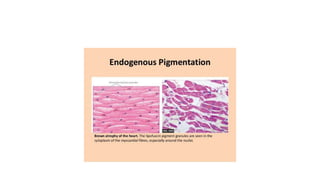
• Small shrunken cells with lipfuchsin granules  brown atrophy
• DECREASED PROTEIN SYNTHEISS
• Increased protein degradation
• In lysosomes
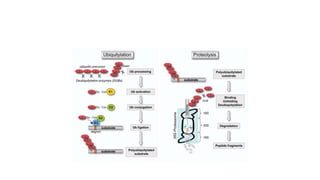
• Ubiquitin –proteasome pathway
• Autophagic vacuoles d/t decreased nutrition
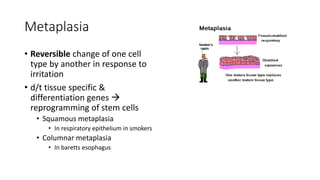
Metaplasia
• Reversible change of one cell
type by another in response to
irritation
• d/t tissue specific &
differentiation genes 
reprogramming of stem cells
• Squamous metaplasia
• In respiratory epithelium in smokers
• Columnar metaplasia
• In baretts esophagus
• Vitamin A deficiency or excess metaplasia
• Deficiency  squamous metaplasia in respiratory epithelium
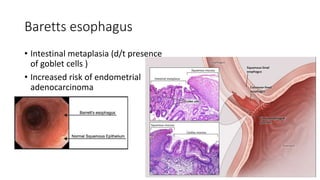
Baretts esophagus
• Intestinal metaplasia (d/t presence
of goblet cells )
• Increased risk of endometrial
adenocarcinoma
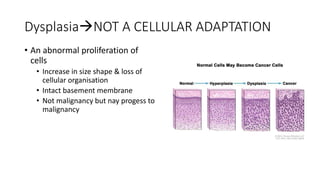
DysplasiaNOT A CELLULAR ADAPTATION
• An abnormal proliferation of
cells
• Increase in size shape & loss of
cellular organisation
• Intact basement membrane
• Not malignancy but nay progess to
malignancy
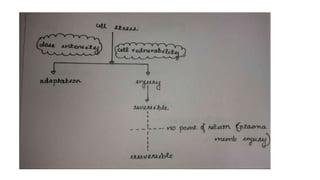
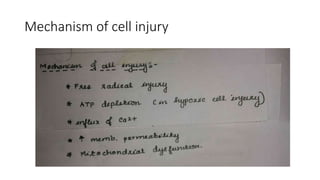
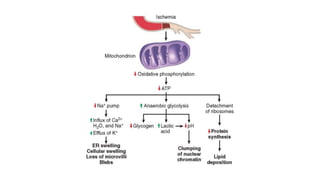
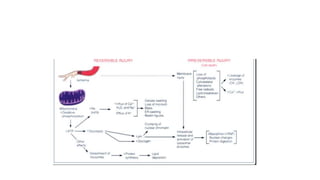
Mechanism of cell injury
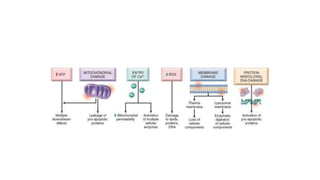
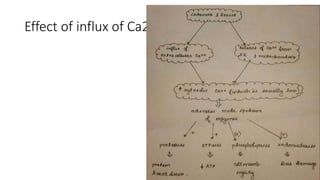
Effect of influx of Ca2+
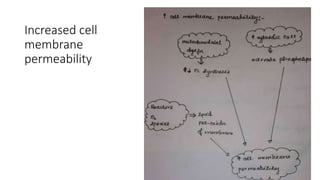
Increased cell
membrane
permeability
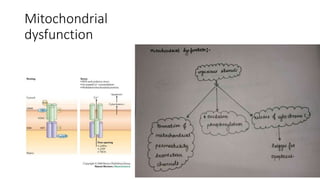
Mitochondrial
dysfunction
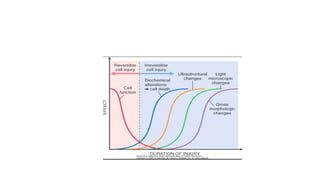
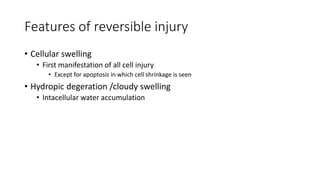
Features of reversible injury
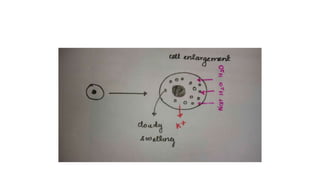
• Cellular swelling
• First manifestation of all cell injury
• Except for apoptosis in which cell shrinkage is seen
• Hydropic degeration /cloudy swelling
• Intacellular water accumulation
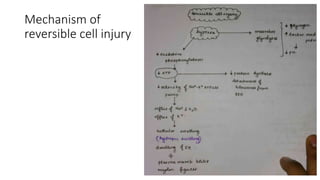
Mechanism of
reversible cell injury
Hypoxia  earliest involvement of mitochondria
 inhibit oxidative phosphorylation
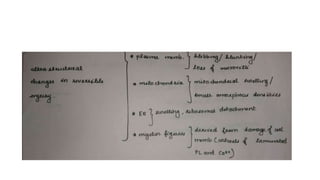
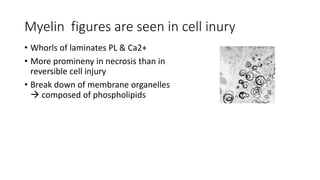
Myelin figures are seen in cell inury
• Whorls of laminates PL & Ca2+
• More promineny in necrosis than in
reversible cell injury
• Break down of membrane organelles
 composed of phospholipids
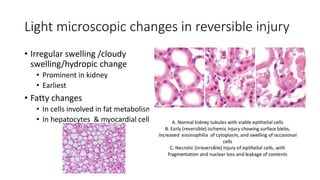
Light microscopic changes in reversible injury
• Irregular swelling /cloudy
swelling/hydropic change
• Prominent in kidney
• Earliest
• Fatty changes
• In cells involved in fat metabolism
• In hepatocytes & myocardial cells
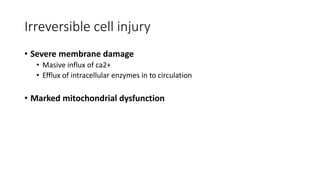
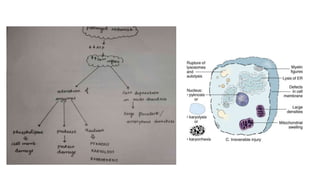
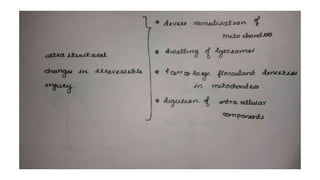
Irreversible cell injury
• Severe membrane damage
• Masive influx of ca2+
• Efflux of intracellular enzymes in to circulation
• Marked mitochondrial dysfunction
• CELLS MOST SENSITIVE TO HYPOXIA  NEURONS
• ESP PYRAMIDAL CELLS IN HIPPOCAMPUS
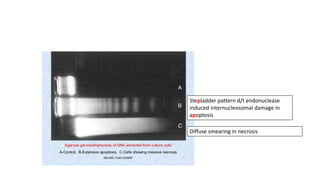
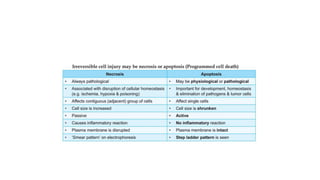
Stepladder pattern d/t endonuclease
induced internucleosomal damage in
apoptosis
Diffuse smearing in necrosis
Cytoplasmic changes in necrosis
• Increased eosinophilia
• d/t protein denaturation
• Glassy appearance d/t loss of glycogen
• Cytoplasm is vacuolated  moth eaten
• D/T ENZYMATIC DIGESTION  VACOULE APPEAR
• Finally calcification
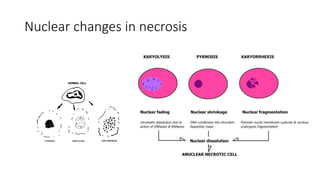
Nuclear changes in necrosis
• Pyknosis
• Nuclear shrinkage
• Chromatin condensation
• Karyorhexis
• Nuclear fragmentation
• Karyolysis
• Decrease basinophilia
• d/t dissolution of chromatin
Types of necrosis
• Coagulative
• Liquefactive
• Caseous
• Fat
• Fibrinoid necrosis
• Gangrenous necrosis
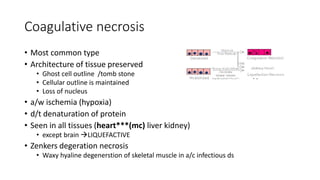
Coagulative necrosis
• Most common type
• Architecture of tissue preserved
• Ghost cell outline /tomb stone
• Cellular outline is maintained
• Loss of nucleus
• a/w ischemia (hypoxia)
• d/t denaturation of protein
• Seen in all tissues (heart***(mc) liver kidney)
• except brain LIQUEFACTIVE
• Zenkers degeration necrosis
• Waxy hyaline degenerstion of skeletal muscle in a/c infectious ds
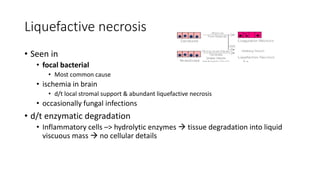
Liquefactive necrosis
• Seen in
• focal bacterial
• Most common cause
• ischemia in brain
• d/t local stromal support & abundant liquefactive necrosis
• occasionally fungal infections
• d/t enzymatic degradation
• Inflammatory cells –> hydrolytic enzymes  tissue degradation into liquid
viscuous mass  no cellular details
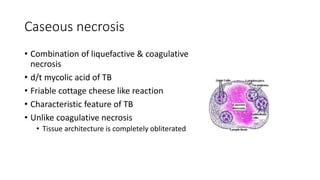
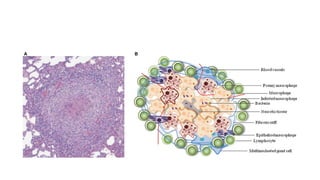
Caseous necrosis
• Combination of liquefactive & coagulative
necrosis
• d/t mycolic acid of TB
• Friable cottage cheese like reaction
• Characteristic feature of TB
• Unlike coagulative necrosis
• Tissue architecture is completely obliterated
• If caseation is absent & lymphoid infiltrate is absent
• In naked granuloma  sarcoidosis
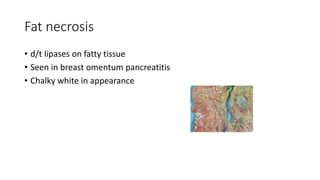
Fat necrosis
• d/t lipases on fatty tissue
• Seen in breast omentum pancreatitis
• Chalky white in appearance
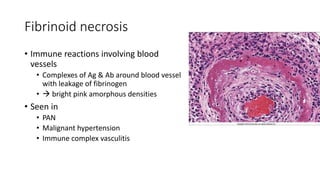
Fibrinoid necrosis
• Immune reactions involving blood
vessels
• Complexes of Ag & Ab around blood vessel
with leakage of fibrinogen
•  bright pink amorphous densities
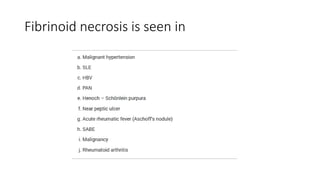
• Seen in
• PAN
• Malignant hypertension
• Immune complex vasculitis
Fibrinoid necrosis is seen in
Gangrenous necrosis
• Dry gangrene
• Microscopic pattern of coagualative
• POVD
• wet gangrene
• Microscopic pattern of liquefactive necrosis
• Superadded putrefaction
• Bowel mouth vulva cervix
• Gas gangrene
• Cl perfringens
• P/S  poikilocytoses(spherocytes)
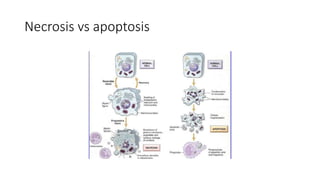
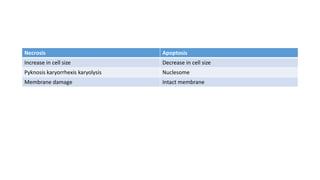
Necrosis vs apoptosis
Necrosis Apoptosis
Increase in cell size Decrease in cell size
Pyknosis karyorrhexis karyolysis Nuclesome
Membrane damage Intact membrane
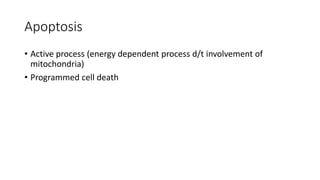
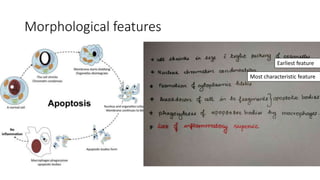
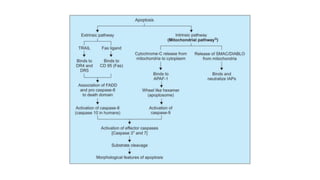
Apoptosis
• Active process (energy dependent process d/t involvement of
mitochondria)
• Programmed cell death
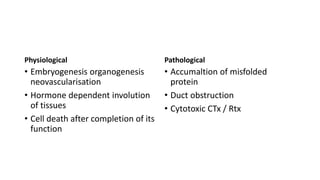
Physiological
• Embryogenesis organogenesis
neovascularisation
• Hormone dependent involution
of tissues
• Cell death after completion of its
function
Pathological
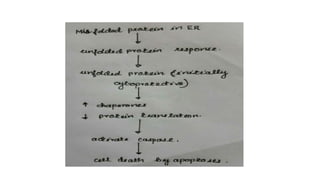
• Accumaltion of misfolded
protein
• Duct obstruction
• Cytotoxic CTx / Rtx
Morphological features
Most characteristic feature
Earliest feature
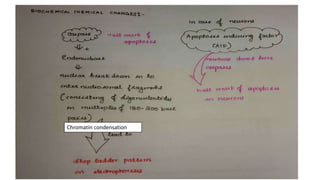
Chromatin condensation
Biochemical features of apoptosis
• Protein cleavage by caspases
• DNA break down by endonuclease
• 50 – 300 kbp size step ladder pattern in agarose gel electrophoresis
Caspases
• Proteases with cysteine group
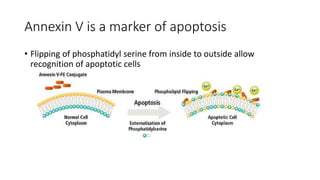
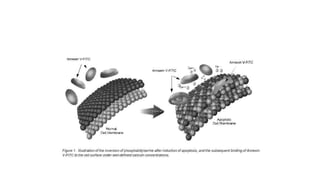
Annexin V is a marker of apoptosis
• Flipping of phosphatidyl serine from inside to outside allow
recognition of apoptotic cells
Regulation of apoptosis
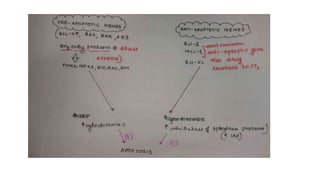
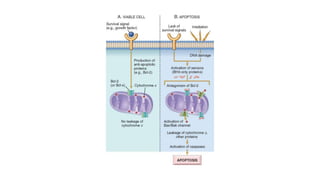
• Bcl-2
• Located on mitochondrial membrane
• Inhibit apoptosis
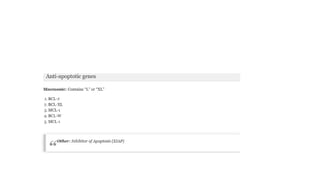
• Bcl – xL  lower apoptosis
• Bak bax bim
• Stimulate apoptosis
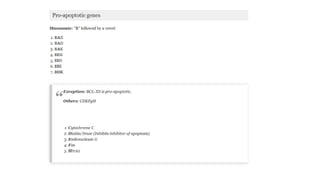
• Bcl – Xs (S- stimulate apoptosis )
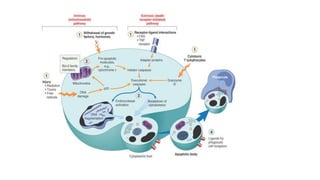
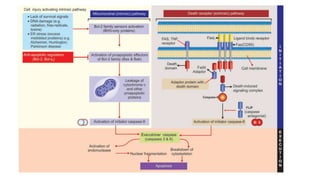
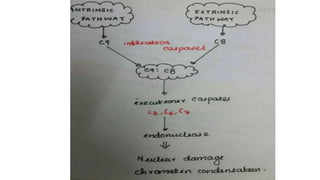
Mechanism of apoptosis
• Initiation
• Activate initiator caspases
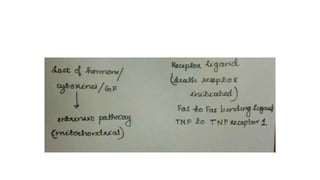
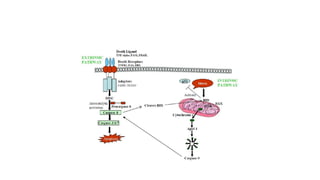
• 2 pathways
• Intrinsic (mitochondrial)
• Extrinsic (death receptor pathway)
• Execution
• Activate caspase 3 *** /6/7 (executioner caspases )
• Glucocorticoids  stimulate apoptosis
• Hence used in Rx of leukemia /lymphoma/myeloma
• Sex steroids inhibit apoptosis
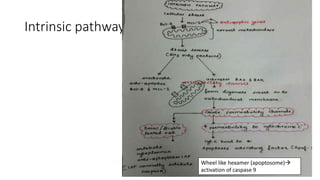
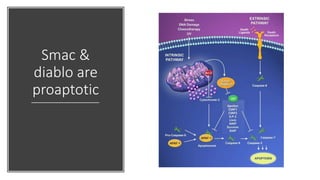
Intrinsic pathway
Wheel like hexamer (apoptosome)
activation of caspase 9
Smac &
diablo are
proaptotic
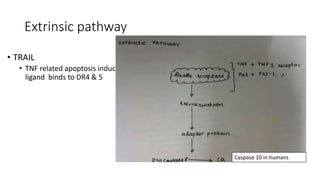
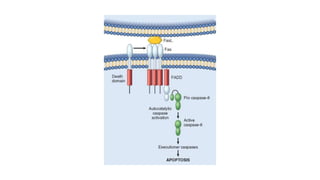
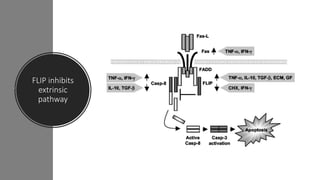
Extrinsic pathway
• TRAIL
• TNF related apoptosis inducing
ligand binds to DR4 & 5
Caspase 10 in humans
FLIP inhibits
extrinsic
pathway
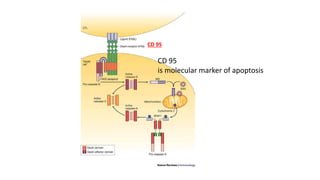
CD 95
CD 95
is molecular marker of apoptosis
Diagnosis of apoptosis
• 1. Chromatin condensation seen by hematoxylin, Feulgen and
acridine orange staining.
• 2.Estimation of cytochrome ‘c’
• 3. Estimation of activated caspase
• Caged flurophores , FRET
• 4. Estimation of Annexin V
• 5. DNA breakdown at specifc sites can be detected by ‘step ladder
pattern’ on gel electrophoresis or
• 6.TUNEL (TdT mediated d-UTP Nick End Labelling) technique.
• Terminal transferase
Necroptosis
• Hybrid of necrosis + apoptosis
• Programmed cell death with out caspase activation
• Cell swelling
• Increased lysosomal permeability
• Cell membrane damage
• Presence of inflammation
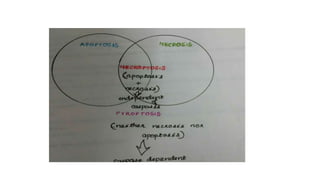
Pyroptosis
• Neither necrosis nor apoptosis
• Caspase dependent (caspase 1 & 11 ) programmed cell death
• Cell swelling
• Cell membrane damage
• Presence of inflammation
• Caspase 1 & caspase 11 involved
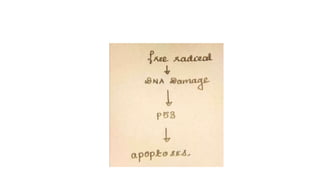
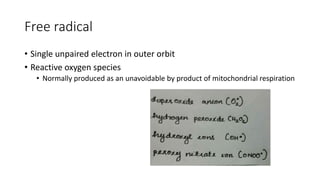
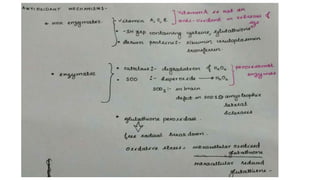
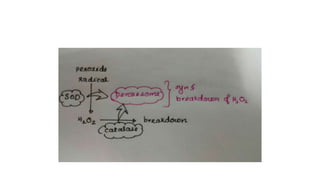
Free radical
• Single unpaired electron in outer orbit
• Reactive oxygen species
• Normally produced as an unavoidable by product of mitochondrial respiration
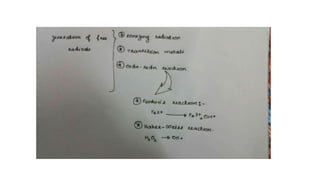
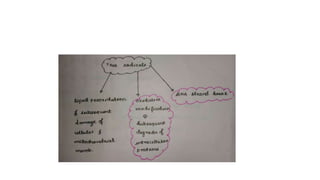
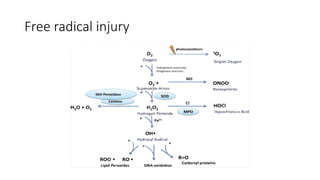
Free radical injury
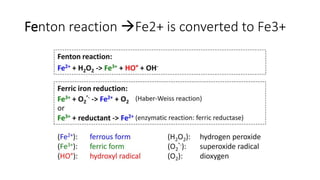
Fenton reaction Fe2+ is converted to Fe3+
Subcellular response to injury
• Autophagocytosis
• Lysosomal digestion of cells own components
• Digest protein CHO except lipids
• Cell eats its own components
• In nutrient deprivation
• In atrophy
• Autophagosome +
• Autophagolysosome+
Deletion of Atg5 increased susceptibility to
tuberculosis
• Atg5 autophagy related genes
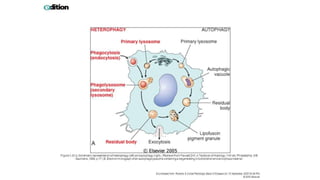
Heterophagy
• Cells ingest substances from outside for intracellular digestion
• Induction of SERhypertrophy of SER
• On phenobarbitone therapy  hypertrophy of SER
Ischemia reperfusion injury
• In cerebral/myocardial ischemia
• Recruitment of WBC  inflammation + generation of free radicals
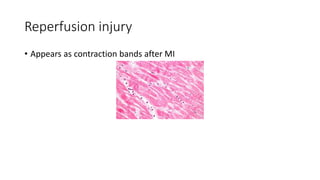
Reperfusion injury
• Appears as contraction bands after MI
Intracellular accumalations
Lipids
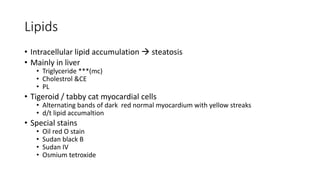
• Intracellular lipid accumulation  steatosis
• Mainly in liver
• Triglyceride ***(mc)
• Cholestrol &CE
• PL
• Tigeroid / tabby cat myocardial cells
• Alternating bands of dark red normal myocardium with yellow streaks
• d/t lipid accumaltion
• Special stains
• Oil red O stain
• Sudan black B
• Sudan IV
• Osmium tetroxide
Proteins
• In proteinuria Protein accumalates in proximal renal tubule
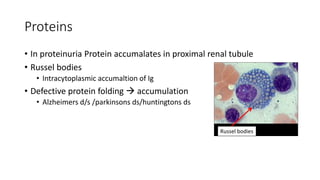
• Russel bodies
• Intracytoplasmic accumaltion of Ig
• Defective protein folding  accumulation
• Alzheimers d/s /parkinsons ds/huntingtons ds
Russel bodies
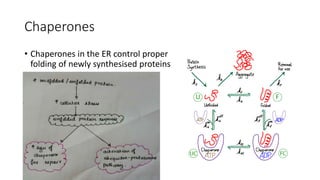
Chaperones
• Chaperones in the ER control proper
folding of newly synthesised proteins
Pigments
• Exogenous
• Tattooing with india ink /cinnbar
• Carbon in lungs
• Endogenous
• Lipofuschin
• Melanin
• Haemosiderin
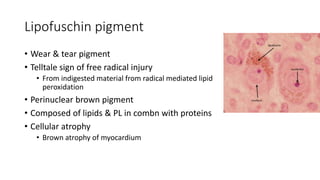
Lipofuschin pigment
• Wear & tear pigment
• Telltale sign of free radical injury
• From indigested material from radical mediated lipid
peroxidation
• Perinuclear brown pigment
• Composed of lipids & PL in combn with proteins
• Cellular atrophy
• Brown atrophy of myocardium
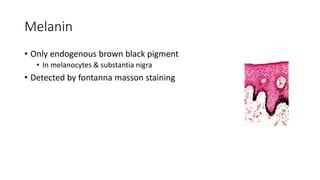
Melanin
• Only endogenous brown black pigment
• In melanocytes & substantia nigra
• Detected by fontanna masson staining
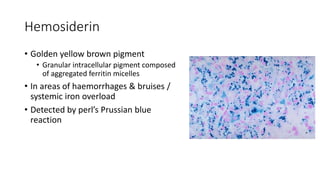
Hemosiderin
• Golden yellow brown pigment
• Granular intracellular pigment composed
of aggregated ferritin micelles
• In areas of haemorrhages & bruises /
systemic iron overload
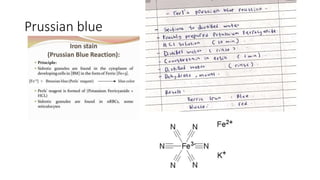
• Detected by perl’s Prussian blue
reaction
Prussian blue
Pathologic calcification
• Abnormal deposition of Ca2+ along with small amounts of mg2+ & fe2+
• Starts
• In mitochondria or microsomal vesicles
• In basement mebrane in kidney
• Stains for Ca2+
• VON – KOSSA (BEST)
• ALIZARIN RED-S
• Calcein stain
• Tetracycline labelling index (best method to detect bone demineralisation)
• 2 types
• Dystrophic
• Metastatic
Dystrophic
• Dead / degenerated tissue
• Serum Ca2+ is normal
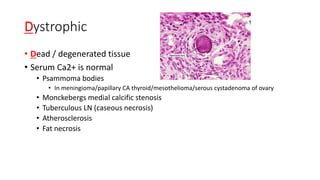
• Psammoma bodies
• In meningioma/papillary CA thyroid/mesothelioma/serous cystadenoma of ovary
• Monckebergs medial calcific stenosis
• Tuberculous LN (caseous necrosis)
• Atherosclerosis
• Fat necrosis
Metastatic
• Raised Ca2+  calcification in normal tissues
• Causes
• Hyperparathyroidism ***
• **Parathyroid adenoma ***
• Vitamin A toxicity
• Vitamin A activates osteoclast  increased bone resorption & hypercalcemia
• Milk alkali syndrome
• Renal failure
• Vitamin D related disorders
• Vitamin D intoxication
• Williams syndrome (idiopathic hypercalcemia of infancy)
• Sarcoidosis
• Saracoid gramuloma synthesise excess 1,25 OH vitamin D3
Metastatic calcification
• Most coomon site
• Lung alveoli
• Systemic arteries & pulmonary V
• Gastric mucosa
• Cornea & conjunctiva
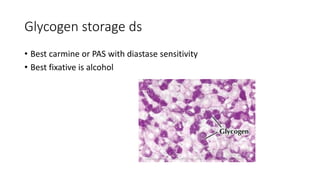
Glycogen storage ds
• Best carmine or PAS with diastase sensitivity
• Best fixative is alcohol
Hyaline change
• Pink homogeneous appearance
• Intracellular
• Mallory alcoholic hyaline
• Russel bodies
• Zenkers degeneration
• Extracellular
• Hyaline memb in newborn
• Corpora amylacea in brain prostate
• Hyaline arteriosclerosis
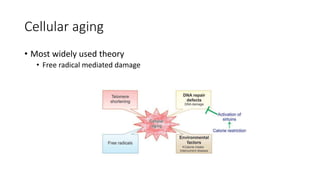
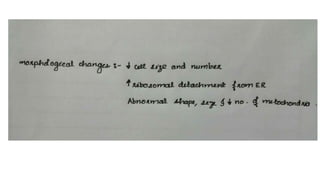
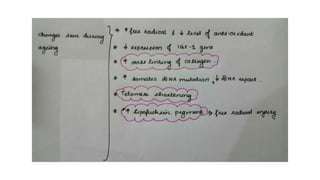
Cellular aging
• Most widely used theory
• Free radical mediated damage
Telomeres
• Short stretches of DNA @ end of chromosomes
• Important in ensuring complete replication of chromosomes & protects
chromosomal ends from fusion & degradation
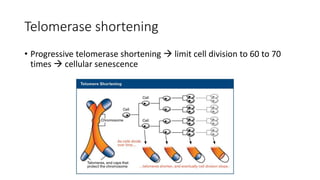
Telomerase shortening
• Progressive telomerase shortening  limit cell division to 60 to 70
times  cellular senescence
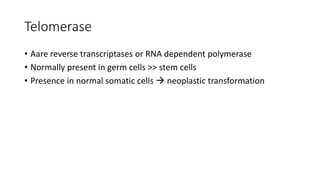
Telomerase
• Aare reverse transcriptases or RNA dependent polymerase
• Normally present in germ cells >> stem cells
• Presence in normal somatic cells  neoplastic transformation
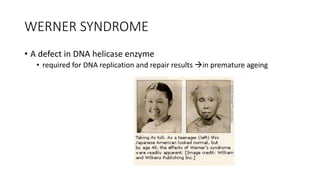
WERNER SYNDROME
• A defect in DNA helicase enzyme
• required for DNA replication and repair results in premature ageing
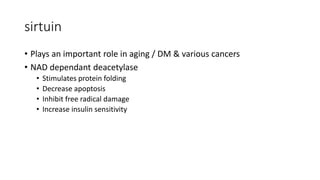
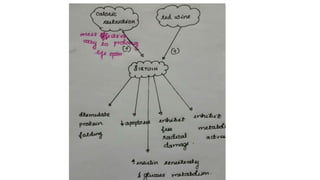
sirtuin
• Plays an important role in aging / DM & various cancers
• NAD dependant deacetylase
• Stimulates protein folding
• Decrease apoptosis
• Inhibit free radical damage
• Increase insulin sensitivity
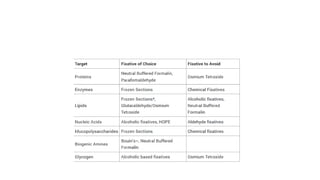
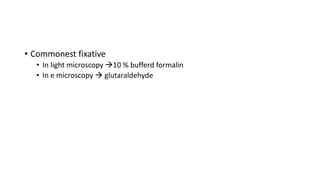
• Commonest fixative
• In light microscopy 10 % bufferd formalin
• In e microscopy  glutaraldehyde
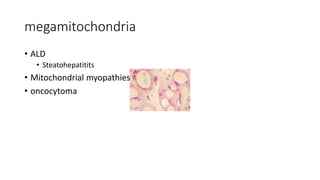
megamitochondria
• ALD
• Steatohepatitits
• Mitochondrial myopathies
• oncocytoma
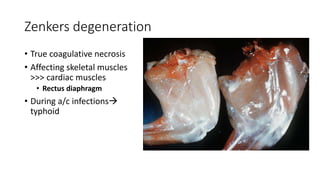
Zenkers degeneration
• True coagulative necrosis
• Affecting skeletal muscles
>>> cardiac muscles
• Rectus diaphragm
• During a/c infections
typhoid
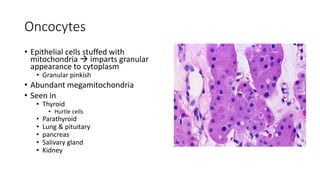
Oncocytes
• Epithelial cells stuffed with
mitochondria  imparts granular
appearance to cytoplasm
• Granular pinkish
• Abundant megamitochondria
• Seen in
• Thyroid
• Hurtle cells
• Parathyroid
• Lung & pituitary
• pancreas
• Salivary gland
• Kidney
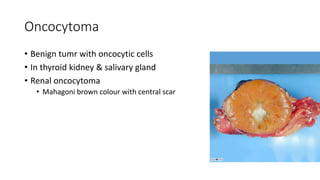
Oncocytoma
• Benign tumr with oncocytic cells
• In thyroid kidney & salivary gland
• Renal oncocytoma
• Mahagoni brown colour with central scar
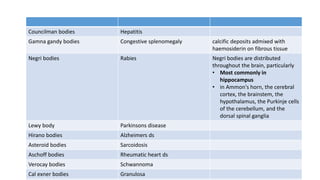
Councilman bodies Hepatitis
Gamna gandy bodies Congestive splenomegaly calcific deposits admixed with
haemosiderin on fibrous tissue
Negri bodies Rabies Negri bodies are distributed
throughout the brain, particularly
• Most commonly in
hippocampus
• in Ammon's horn, the cerebral
cortex, the brainstem, the
hypothalamus, the Purkinje cells
of the cerebellum, and the
dorsal spinal ganglia
Lewy body Parkinsons disease
Hirano bodies Alzheimers ds
Asteroid bodies Sarcoidosis
Aschoff bodies Rheumatic heart ds
Verocay bodies Schwannoma
Cal exner bodies Granulosa
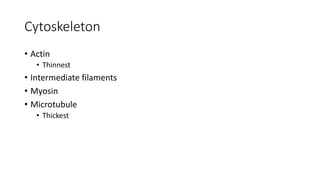
Cytoskeleton
• Actin
• Thinnest
• Intermediate filaments
• Myosin
• Microtubule
• Thickest
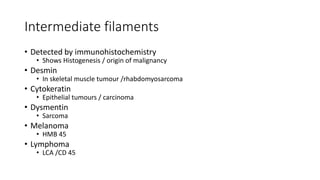
Intermediate filaments
• Detected by immunohistochemistry
• Shows Histogenesis / origin of malignancy
• Desmin
• In skeletal muscle tumour /rhabdomyosarcoma
• Cytokeratin
• Epithelial tumours / carcinoma
• Dysmentin
• Sarcoma
• Melanoma
• HMB 45
• Lymphoma
• LCA /CD 45
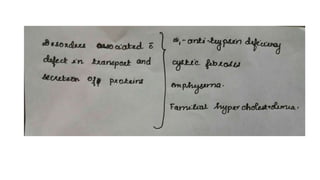
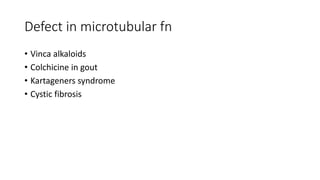
Defect in microtubular fn
• Vinca alkaloids
• Colchicine in gout
• Kartageners syndrome
• Cystic fibrosis
Cytoskeletal abnormalities
Hematology
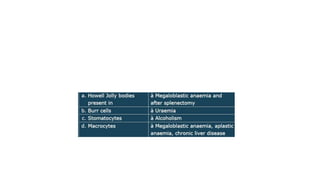
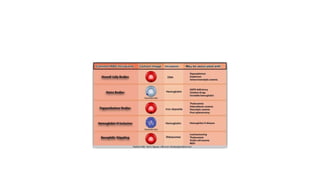
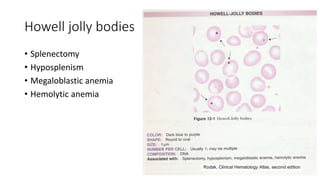
Howell jolly bodies
• Splenectomy
• Hyposplenism
• Megaloblastic anemia
• Hemolytic anemia
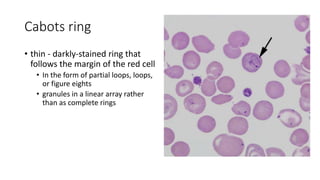
Cabots ring
• thin - darkly-stained ring that
follows the margin of the red cell
• In the form of partial loops, loops,
or figure eights
• granules in a linear array rather
than as complete rings
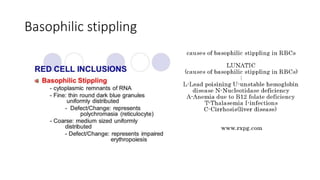
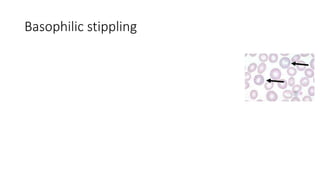
Basophilic stippling
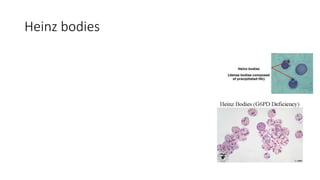
Heinz bodies

Cell injury pathology revision notes

  • 1.
  • 2.
    Causes of Cellinjury • Hypoxia • Most common cause of cell injury • Ischemia  mc cause of hypoxia • Physical agents • Chemical agents • Infections • Immunological agents • Genetic cause • Nutritional imbalance
  • 3.
    Hypoxia • Neurons • Mostsusceptible tissue to ischemia • Irreversible damage with in 3 to 4 minutes • Myocardial cells • Irreversible damage with in 20 to 30 minutes • Fibroblast • Most resistant to ischemic damage
  • 8.
    Cellular adaptive responseto injury • Atrophy • Hypertrophy • Hyperplasia • Atrophy • Metaplasia • Dysplasia
  • 9.
    Hyperplasia • Increase innumber of cells • Hyperplasia is absent in heart brain & skeletal muscle • Physiologic • Compensatory : after hepatectomy • Hormonal : breast @ puberty • Antigenic stimulation : lymphoid hyperplasia • Pathologic • Mediated by GF cytokines / increased expression of proto- oncogenesincreased DNA synthesis & cell division
  • 10.
    Hypertrophy • Increase insize of cells in nondividing cells • d/t induction of genes  increased transcription /GF/vasoactive agents increased syn of intracellular components • Increased mechanical demand • Physiological • Skeletal muscle • Pathological • Increased endocrine stimulation • Lactating breast
  • 11.
    • Hyperplasia &hypertrophy occur together • in gravid uterus • Mainly hypertrophy + only some hyperplasia • In breast during puberta period & pregnancy
  • 12.
    Atrophy • Decrease incell size & functional ability • Causes • Decreased work load/disuse • Loss of blood / nerve /hormonal stimulation • Malnutrition • Ageing • Pressure • Small shrunken cells with lipfuchsin granules  brown atrophy • DECREASED PROTEIN SYNTHEISS • Increased protein degradation • In lysosomes • Ubiquitin –proteasome pathway • Autophagic vacuoles d/t decreased nutrition
  • 14.
    Metaplasia • Reversible changeof one cell type by another in response to irritation • d/t tissue specific & differentiation genes  reprogramming of stem cells • Squamous metaplasia • In respiratory epithelium in smokers • Columnar metaplasia • In baretts esophagus
  • 15.
    • Vitamin Adeficiency or excess metaplasia • Deficiency  squamous metaplasia in respiratory epithelium
  • 16.
    Baretts esophagus • Intestinalmetaplasia (d/t presence of goblet cells ) • Increased risk of endometrial adenocarcinoma
  • 17.
    DysplasiaNOT A CELLULARADAPTATION • An abnormal proliferation of cells • Increase in size shape & loss of cellular organisation • Intact basement membrane • Not malignancy but nay progess to malignancy
  • 19.
  • 22.
  • 23.
  • 24.
  • 26.
    Features of reversibleinjury • Cellular swelling • First manifestation of all cell injury • Except for apoptosis in which cell shrinkage is seen • Hydropic degeration /cloudy swelling • Intacellular water accumulation
  • 29.
  • 31.
    Hypoxia  earliestinvolvement of mitochondria  inhibit oxidative phosphorylation
  • 32.
    Myelin figures areseen in cell inury • Whorls of laminates PL & Ca2+ • More promineny in necrosis than in reversible cell injury • Break down of membrane organelles  composed of phospholipids
  • 33.
    Light microscopic changesin reversible injury • Irregular swelling /cloudy swelling/hydropic change • Prominent in kidney • Earliest • Fatty changes • In cells involved in fat metabolism • In hepatocytes & myocardial cells
  • 34.
    Irreversible cell injury •Severe membrane damage • Masive influx of ca2+ • Efflux of intracellular enzymes in to circulation • Marked mitochondrial dysfunction
  • 38.
    • CELLS MOSTSENSITIVE TO HYPOXIA  NEURONS • ESP PYRAMIDAL CELLS IN HIPPOCAMPUS
  • 39.
    Stepladder pattern d/tendonuclease induced internucleosomal damage in apoptosis Diffuse smearing in necrosis
  • 40.
    Cytoplasmic changes innecrosis • Increased eosinophilia • d/t protein denaturation • Glassy appearance d/t loss of glycogen • Cytoplasm is vacuolated  moth eaten • D/T ENZYMATIC DIGESTION  VACOULE APPEAR • Finally calcification
  • 41.
  • 42.
    Nuclear changes innecrosis • Pyknosis • Nuclear shrinkage • Chromatin condensation • Karyorhexis • Nuclear fragmentation • Karyolysis • Decrease basinophilia • d/t dissolution of chromatin
  • 43.
    Types of necrosis •Coagulative • Liquefactive • Caseous • Fat • Fibrinoid necrosis • Gangrenous necrosis
  • 44.
    Coagulative necrosis • Mostcommon type • Architecture of tissue preserved • Ghost cell outline /tomb stone • Cellular outline is maintained • Loss of nucleus • a/w ischemia (hypoxia) • d/t denaturation of protein • Seen in all tissues (heart***(mc) liver kidney) • except brain LIQUEFACTIVE • Zenkers degeration necrosis • Waxy hyaline degenerstion of skeletal muscle in a/c infectious ds
  • 45.
    Liquefactive necrosis • Seenin • focal bacterial • Most common cause • ischemia in brain • d/t local stromal support & abundant liquefactive necrosis • occasionally fungal infections • d/t enzymatic degradation • Inflammatory cells –> hydrolytic enzymes  tissue degradation into liquid viscuous mass  no cellular details
  • 46.
    Caseous necrosis • Combinationof liquefactive & coagulative necrosis • d/t mycolic acid of TB • Friable cottage cheese like reaction • Characteristic feature of TB • Unlike coagulative necrosis • Tissue architecture is completely obliterated
  • 48.
    • If caseationis absent & lymphoid infiltrate is absent • In naked granuloma  sarcoidosis
  • 49.
    Fat necrosis • d/tlipases on fatty tissue • Seen in breast omentum pancreatitis • Chalky white in appearance
  • 50.
    Fibrinoid necrosis • Immunereactions involving blood vessels • Complexes of Ag & Ab around blood vessel with leakage of fibrinogen •  bright pink amorphous densities • Seen in • PAN • Malignant hypertension • Immune complex vasculitis
  • 51.
  • 52.
    Gangrenous necrosis • Drygangrene • Microscopic pattern of coagualative • POVD • wet gangrene • Microscopic pattern of liquefactive necrosis • Superadded putrefaction • Bowel mouth vulva cervix • Gas gangrene • Cl perfringens • P/S  poikilocytoses(spherocytes)
  • 53.
  • 55.
    Necrosis Apoptosis Increase incell size Decrease in cell size Pyknosis karyorrhexis karyolysis Nuclesome Membrane damage Intact membrane
  • 56.
    Apoptosis • Active process(energy dependent process d/t involvement of mitochondria) • Programmed cell death
  • 57.
    Physiological • Embryogenesis organogenesis neovascularisation •Hormone dependent involution of tissues • Cell death after completion of its function Pathological • Accumaltion of misfolded protein • Duct obstruction • Cytotoxic CTx / Rtx
  • 58.
  • 59.
  • 60.
    Biochemical features ofapoptosis • Protein cleavage by caspases • DNA break down by endonuclease • 50 – 300 kbp size step ladder pattern in agarose gel electrophoresis
  • 61.
  • 62.
    Annexin V isa marker of apoptosis • Flipping of phosphatidyl serine from inside to outside allow recognition of apoptotic cells
  • 64.
    Regulation of apoptosis •Bcl-2 • Located on mitochondrial membrane • Inhibit apoptosis • Bcl – xL  lower apoptosis • Bak bax bim • Stimulate apoptosis • Bcl – Xs (S- stimulate apoptosis )
  • 69.
    Mechanism of apoptosis •Initiation • Activate initiator caspases • 2 pathways • Intrinsic (mitochondrial) • Extrinsic (death receptor pathway) • Execution • Activate caspase 3 *** /6/7 (executioner caspases )
  • 70.
    • Glucocorticoids stimulate apoptosis • Hence used in Rx of leukemia /lymphoma/myeloma • Sex steroids inhibit apoptosis
  • 73.
    Intrinsic pathway Wheel likehexamer (apoptosome) activation of caspase 9
  • 75.
  • 76.
    Extrinsic pathway • TRAIL •TNF related apoptosis inducing ligand binds to DR4 & 5 Caspase 10 in humans
  • 79.
  • 80.
    CD 95 CD 95 ismolecular marker of apoptosis
  • 84.
    Diagnosis of apoptosis •1. Chromatin condensation seen by hematoxylin, Feulgen and acridine orange staining. • 2.Estimation of cytochrome ‘c’ • 3. Estimation of activated caspase • Caged flurophores , FRET • 4. Estimation of Annexin V • 5. DNA breakdown at specifc sites can be detected by ‘step ladder pattern’ on gel electrophoresis or • 6.TUNEL (TdT mediated d-UTP Nick End Labelling) technique. • Terminal transferase
  • 86.
    Necroptosis • Hybrid ofnecrosis + apoptosis • Programmed cell death with out caspase activation • Cell swelling • Increased lysosomal permeability • Cell membrane damage • Presence of inflammation
  • 87.
    Pyroptosis • Neither necrosisnor apoptosis • Caspase dependent (caspase 1 & 11 ) programmed cell death • Cell swelling • Cell membrane damage • Presence of inflammation • Caspase 1 & caspase 11 involved
  • 88.
    Free radical • Singleunpaired electron in outer orbit • Reactive oxygen species • Normally produced as an unavoidable by product of mitochondrial respiration
  • 93.
  • 95.
    Fenton reaction Fe2+is converted to Fe3+
  • 96.
    Subcellular response toinjury • Autophagocytosis • Lysosomal digestion of cells own components • Digest protein CHO except lipids • Cell eats its own components • In nutrient deprivation • In atrophy • Autophagosome + • Autophagolysosome+
  • 97.
    Deletion of Atg5increased susceptibility to tuberculosis • Atg5 autophagy related genes
  • 99.
    Heterophagy • Cells ingestsubstances from outside for intracellular digestion • Induction of SERhypertrophy of SER • On phenobarbitone therapy  hypertrophy of SER
  • 100.
    Ischemia reperfusion injury •In cerebral/myocardial ischemia • Recruitment of WBC  inflammation + generation of free radicals
  • 101.
    Reperfusion injury • Appearsas contraction bands after MI
  • 102.
  • 103.
    Lipids • Intracellular lipidaccumulation  steatosis • Mainly in liver • Triglyceride ***(mc) • Cholestrol &CE • PL • Tigeroid / tabby cat myocardial cells • Alternating bands of dark red normal myocardium with yellow streaks • d/t lipid accumaltion • Special stains • Oil red O stain • Sudan black B • Sudan IV • Osmium tetroxide
  • 104.
    Proteins • In proteinuriaProtein accumalates in proximal renal tubule • Russel bodies • Intracytoplasmic accumaltion of Ig • Defective protein folding  accumulation • Alzheimers d/s /parkinsons ds/huntingtons ds Russel bodies
  • 105.
    Chaperones • Chaperones inthe ER control proper folding of newly synthesised proteins
  • 108.
    Pigments • Exogenous • Tattooingwith india ink /cinnbar • Carbon in lungs • Endogenous • Lipofuschin • Melanin • Haemosiderin
  • 109.
    Lipofuschin pigment • Wear& tear pigment • Telltale sign of free radical injury • From indigested material from radical mediated lipid peroxidation • Perinuclear brown pigment • Composed of lipids & PL in combn with proteins • Cellular atrophy • Brown atrophy of myocardium
  • 111.
    Melanin • Only endogenousbrown black pigment • In melanocytes & substantia nigra • Detected by fontanna masson staining
  • 112.
    Hemosiderin • Golden yellowbrown pigment • Granular intracellular pigment composed of aggregated ferritin micelles • In areas of haemorrhages & bruises / systemic iron overload • Detected by perl’s Prussian blue reaction
  • 113.
  • 114.
    Pathologic calcification • Abnormaldeposition of Ca2+ along with small amounts of mg2+ & fe2+ • Starts • In mitochondria or microsomal vesicles • In basement mebrane in kidney • Stains for Ca2+ • VON – KOSSA (BEST) • ALIZARIN RED-S • Calcein stain • Tetracycline labelling index (best method to detect bone demineralisation) • 2 types • Dystrophic • Metastatic
  • 115.
    Dystrophic • Dead /degenerated tissue • Serum Ca2+ is normal • Psammoma bodies • In meningioma/papillary CA thyroid/mesothelioma/serous cystadenoma of ovary • Monckebergs medial calcific stenosis • Tuberculous LN (caseous necrosis) • Atherosclerosis • Fat necrosis
  • 116.
    Metastatic • Raised Ca2+ calcification in normal tissues • Causes • Hyperparathyroidism *** • **Parathyroid adenoma *** • Vitamin A toxicity • Vitamin A activates osteoclast  increased bone resorption & hypercalcemia • Milk alkali syndrome • Renal failure • Vitamin D related disorders • Vitamin D intoxication • Williams syndrome (idiopathic hypercalcemia of infancy) • Sarcoidosis • Saracoid gramuloma synthesise excess 1,25 OH vitamin D3
  • 117.
    Metastatic calcification • Mostcoomon site • Lung alveoli • Systemic arteries & pulmonary V • Gastric mucosa • Cornea & conjunctiva
  • 118.
    Glycogen storage ds •Best carmine or PAS with diastase sensitivity • Best fixative is alcohol
  • 119.
    Hyaline change • Pinkhomogeneous appearance • Intracellular • Mallory alcoholic hyaline • Russel bodies • Zenkers degeneration • Extracellular • Hyaline memb in newborn • Corpora amylacea in brain prostate • Hyaline arteriosclerosis
  • 120.
    Cellular aging • Mostwidely used theory • Free radical mediated damage
  • 121.
    Telomeres • Short stretchesof DNA @ end of chromosomes • Important in ensuring complete replication of chromosomes & protects chromosomal ends from fusion & degradation
  • 122.
    Telomerase shortening • Progressivetelomerase shortening  limit cell division to 60 to 70 times  cellular senescence
  • 123.
    Telomerase • Aare reversetranscriptases or RNA dependent polymerase • Normally present in germ cells >> stem cells • Presence in normal somatic cells  neoplastic transformation
  • 126.
    WERNER SYNDROME • Adefect in DNA helicase enzyme • required for DNA replication and repair results in premature ageing
  • 127.
    sirtuin • Plays animportant role in aging / DM & various cancers • NAD dependant deacetylase • Stimulates protein folding • Decrease apoptosis • Inhibit free radical damage • Increase insulin sensitivity
  • 130.
    • Commonest fixative •In light microscopy 10 % bufferd formalin • In e microscopy  glutaraldehyde
  • 132.
    megamitochondria • ALD • Steatohepatitits •Mitochondrial myopathies • oncocytoma
  • 133.
    Zenkers degeneration • Truecoagulative necrosis • Affecting skeletal muscles >>> cardiac muscles • Rectus diaphragm • During a/c infections typhoid
  • 134.
    Oncocytes • Epithelial cellsstuffed with mitochondria  imparts granular appearance to cytoplasm • Granular pinkish • Abundant megamitochondria • Seen in • Thyroid • Hurtle cells • Parathyroid • Lung & pituitary • pancreas • Salivary gland • Kidney
  • 135.
    Oncocytoma • Benign tumrwith oncocytic cells • In thyroid kidney & salivary gland • Renal oncocytoma • Mahagoni brown colour with central scar
  • 136.
    Councilman bodies Hepatitis Gamnagandy bodies Congestive splenomegaly calcific deposits admixed with haemosiderin on fibrous tissue Negri bodies Rabies Negri bodies are distributed throughout the brain, particularly • Most commonly in hippocampus • in Ammon's horn, the cerebral cortex, the brainstem, the hypothalamus, the Purkinje cells of the cerebellum, and the dorsal spinal ganglia Lewy body Parkinsons disease Hirano bodies Alzheimers ds Asteroid bodies Sarcoidosis Aschoff bodies Rheumatic heart ds Verocay bodies Schwannoma Cal exner bodies Granulosa
  • 137.
    Cytoskeleton • Actin • Thinnest •Intermediate filaments • Myosin • Microtubule • Thickest
  • 138.
    Intermediate filaments • Detectedby immunohistochemistry • Shows Histogenesis / origin of malignancy • Desmin • In skeletal muscle tumour /rhabdomyosarcoma • Cytokeratin • Epithelial tumours / carcinoma • Dysmentin • Sarcoma • Melanoma • HMB 45 • Lymphoma • LCA /CD 45
  • 139.
    Defect in microtubularfn • Vinca alkaloids • Colchicine in gout • Kartageners syndrome • Cystic fibrosis
  • 140.
  • 141.
  • 144.
    Howell jolly bodies •Splenectomy • Hyposplenism • Megaloblastic anemia • Hemolytic anemia
  • 145.
    Cabots ring • thin- darkly-stained ring that follows the margin of the red cell • In the form of partial loops, loops, or figure eights • granules in a linear array rather than as complete rings
  • 146.
  • 147.
  • 150.