Enzymes
Presentedby
Fathima Hameed
Outlines
 What is the features of enzymes?
 What are the classification?
 How they works?
 Examples
 Functions
 Proprties
 Applications
 References
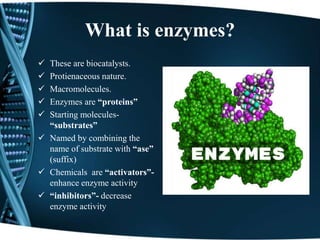
What is enzymes?
 These are biocatalysts.
 Protienaceous nature.
 Macromolecules.
 Enzymes are “proteins”
 Starting molecules-
“substrates”
 Named by combining the
name of substrate with “ase”
(suffix)
 Chemicals are “activators”-
enhance enzyme activity
 “inhibitors”- decrease
enzyme activity
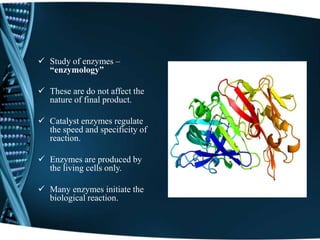
 Study of enzymes –
“enzymology”
 These are do not affect the
nature of final product.
 Catalyst enzymes regulate
the speed and specificity of
reaction.
 Enzymes are produced by
the living cells only.
 Many enzymes initiate the
biological reaction.
Classification of enzymes
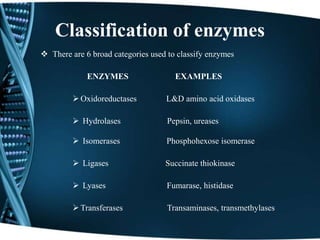
 There are 6 broad categories used to classify enzymes
ENZYMES EXAMPLES
 Oxidoreductases L&D amino acid oxidases
 Hydrolases Pepsin, ureases
 Isomerases Phosphohexose isomerase
 Ligases Succinate thiokinase
 Lyases Fumarase, histidase
 Transferases Transaminases, transmethylases
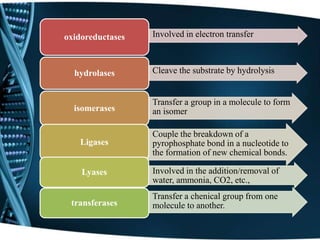
• Involved in electron transferoxidoreductases
• Cleave the substrate by hydrolysishydrolases
• Transfer a group in a molecule to form
an isomerisomerases
• Couple the breakdown of a
pyrophosphate bond in a nucleotide to
the formation of new chemical bonds.
Ligases
• Involved in the addition/removal of
water, ammonia, CO2, etc.,
Lyases
• Transfer a chenical group from one
molecule to another.transferases
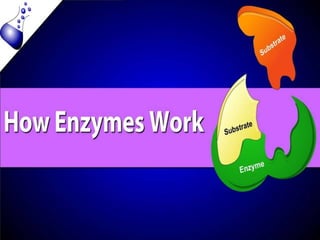
How enzymes work?
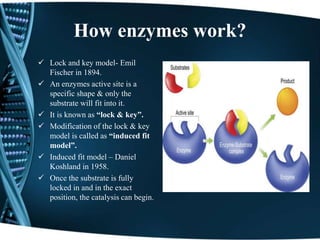
 Lock and key model- Emil
Fischer in 1894.
 An enzymes active site is a
specific shape & only the
substrate will fit into it.
 It is known as “lock & key”.
 Modification of the lock & key
model is called as “induced fit
model”.
 Induced fit model – Daniel
Koshland in 1958.
 Once the substrate is fully
locked in and in the exact
position, the catalysis can begin.
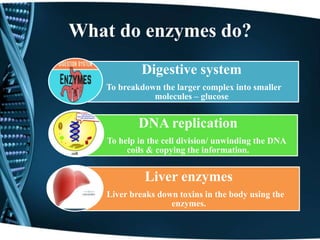
What do enzymes do?
Digestive system
To breakdown the larger complex into smaller
molecules – glucose
DNA replication
T To help in the cell division/ unwinding the DNA
coils & copying the information.
Liver enzymes
Liver breaks down toxins in the body using the
enzymes.
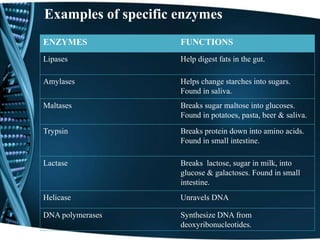
Examples of specific enzymes
ENZYMES FUNCTIONS
Lipases Help digest fats in the gut.
Amylases Helps change starches into sugars.
Found in saliva.
Maltases Breaks sugar maltose into glucoses.
Found in potatoes, pasta, beer & saliva.
Trypsin Breaks protein down into amino acids.
Found in small intestine.
Lactase Breaks lactose, sugar in milk, into
glucose & galactoses. Found in small
intestine.
Helicase Unravels DNA
DNA polymerases Synthesize DNA from
deoxyribonucleotides.
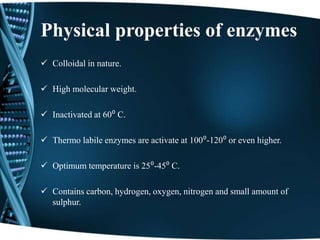
Physical properties of enzymes
 Colloidal in nature.
 High molecular weight.
 Inactivated at 60⁰ C.
 Thermo labile enzymes are activate at 100⁰-120⁰ or even higher.
 Optimum temperature is 25⁰-45⁰ C.
 Contains carbon, hydrogen, oxygen, nitrogen and small amount of
sulphur.
Cntnu….,
 Composed of amino acids that are linked together by peptide bonds.
 Provides structural support for cell.
 Provides a defense mechanisms against pathogens.
 Response to chemical stimuli.
 Secretes hormones.
Chemical properties of enzymes
Catalytic properties:
 Biological catalysts.
 Small quantity of enzyme catalyses the larger quantities of substances.
 Enzymes increase the rate of reaction.
Specificity of enzymes:
 Highly specific in nature.
 Particular enzyme can catalyze particular reaction.
 Example: sucrase can catalyze only hydrolysis of sucrose.
 Many enzymes are inactivate when first produced. that is called as
῝proenzymes or zymogens῞.
Cntnu…,
 They are active to bind with substrate. That is called as “coenzyme or
activator”.
 Simple protein enzymes – urease, amylase and papain.
 Complex protein enzymes – contain conjugated proteins.
 Protein part called as “apoenzymes”.
 Non protein called as “prosthetic group”.
 Non protein part associated with protein unit is called as “holoenzyme”.
 Less complex than proteins.
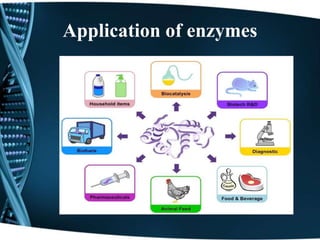
Application of enzymes
Reference
 Essentials of biochemistry, Satyanarayana.U.,2nd edition.
 www.thoughtco.com/enzyme-biochemistry-4042435
 www.medicalnewstoday.com/articles/319704.php
 https://www.pharmanewsonline.com/applications-of-enzymes-in-
industry/
 https://bluegreenfoods.com/enzyme-supplementation/
 https://www.livescience.com/45145-how-do-enzymes-work.html
Thank you

Enzymes

  • 1.
  • 2.
    Outlines  What isthe features of enzymes?  What are the classification?  How they works?  Examples  Functions  Proprties  Applications  References
  • 3.
    What is enzymes? These are biocatalysts.  Protienaceous nature.  Macromolecules.  Enzymes are “proteins”  Starting molecules- “substrates”  Named by combining the name of substrate with “ase” (suffix)  Chemicals are “activators”- enhance enzyme activity  “inhibitors”- decrease enzyme activity
  • 4.
     Study ofenzymes – “enzymology”  These are do not affect the nature of final product.  Catalyst enzymes regulate the speed and specificity of reaction.  Enzymes are produced by the living cells only.  Many enzymes initiate the biological reaction.
  • 5.
    Classification of enzymes There are 6 broad categories used to classify enzymes ENZYMES EXAMPLES  Oxidoreductases L&D amino acid oxidases  Hydrolases Pepsin, ureases  Isomerases Phosphohexose isomerase  Ligases Succinate thiokinase  Lyases Fumarase, histidase  Transferases Transaminases, transmethylases
  • 6.
    • Involved inelectron transferoxidoreductases • Cleave the substrate by hydrolysishydrolases • Transfer a group in a molecule to form an isomerisomerases • Couple the breakdown of a pyrophosphate bond in a nucleotide to the formation of new chemical bonds. Ligases • Involved in the addition/removal of water, ammonia, CO2, etc., Lyases • Transfer a chenical group from one molecule to another.transferases
  • 8.
    How enzymes work? Lock and key model- Emil Fischer in 1894.  An enzymes active site is a specific shape & only the substrate will fit into it.  It is known as “lock & key”.  Modification of the lock & key model is called as “induced fit model”.  Induced fit model – Daniel Koshland in 1958.  Once the substrate is fully locked in and in the exact position, the catalysis can begin.
  • 9.
    What do enzymesdo? Digestive system To breakdown the larger complex into smaller molecules – glucose DNA replication T To help in the cell division/ unwinding the DNA coils & copying the information. Liver enzymes Liver breaks down toxins in the body using the enzymes.
  • 10.
    Examples of specificenzymes ENZYMES FUNCTIONS Lipases Help digest fats in the gut. Amylases Helps change starches into sugars. Found in saliva. Maltases Breaks sugar maltose into glucoses. Found in potatoes, pasta, beer & saliva. Trypsin Breaks protein down into amino acids. Found in small intestine. Lactase Breaks lactose, sugar in milk, into glucose & galactoses. Found in small intestine. Helicase Unravels DNA DNA polymerases Synthesize DNA from deoxyribonucleotides.
  • 12.
    Physical properties ofenzymes  Colloidal in nature.  High molecular weight.  Inactivated at 60⁰ C.  Thermo labile enzymes are activate at 100⁰-120⁰ or even higher.  Optimum temperature is 25⁰-45⁰ C.  Contains carbon, hydrogen, oxygen, nitrogen and small amount of sulphur.
  • 13.
    Cntnu….,  Composed ofamino acids that are linked together by peptide bonds.  Provides structural support for cell.  Provides a defense mechanisms against pathogens.  Response to chemical stimuli.  Secretes hormones.
  • 14.
    Chemical properties ofenzymes Catalytic properties:  Biological catalysts.  Small quantity of enzyme catalyses the larger quantities of substances.  Enzymes increase the rate of reaction. Specificity of enzymes:  Highly specific in nature.  Particular enzyme can catalyze particular reaction.  Example: sucrase can catalyze only hydrolysis of sucrose.  Many enzymes are inactivate when first produced. that is called as ῝proenzymes or zymogens῞.
  • 15.
    Cntnu…,  They areactive to bind with substrate. That is called as “coenzyme or activator”.  Simple protein enzymes – urease, amylase and papain.  Complex protein enzymes – contain conjugated proteins.  Protein part called as “apoenzymes”.  Non protein called as “prosthetic group”.  Non protein part associated with protein unit is called as “holoenzyme”.  Less complex than proteins.
  • 16.
  • 17.
    Reference  Essentials ofbiochemistry, Satyanarayana.U.,2nd edition.  www.thoughtco.com/enzyme-biochemistry-4042435  www.medicalnewstoday.com/articles/319704.php  https://www.pharmanewsonline.com/applications-of-enzymes-in- industry/  https://bluegreenfoods.com/enzyme-supplementation/  https://www.livescience.com/45145-how-do-enzymes-work.html
  • 18.