Enzyme Inhibition
Namrata Chhabra
M.D. Biochemistry
Enzyme Inhibition- Definition and Purpose
Enzyme Inhibition- Reduction in the rate of the enzyme catalyzed
reaction
EnzymeInhibition
Therapeutic
Poisons/Toxins
Physiological
regulation
Research
15-May-20 Enzyme inhibition- NAMRATA CHHABRA 2
• Inhibitors are chemicals that reduce the rate of the enzymatic
reactions,
• They are usually specific and work at low concentrations,
• They block the enzyme, but they do not usually destroy it,
• Many drugs and poisons are inhibitors of enzymes in the nervous
system,
• Inhibitors of the catalytic activities of enzymes provide both
pharmacologic agents and research tools for study of the mechanism
of enzyme action.
Enzyme Inhibitors
15-May-20 Enzyme inhibition- NAMRATA CHHABRA 3
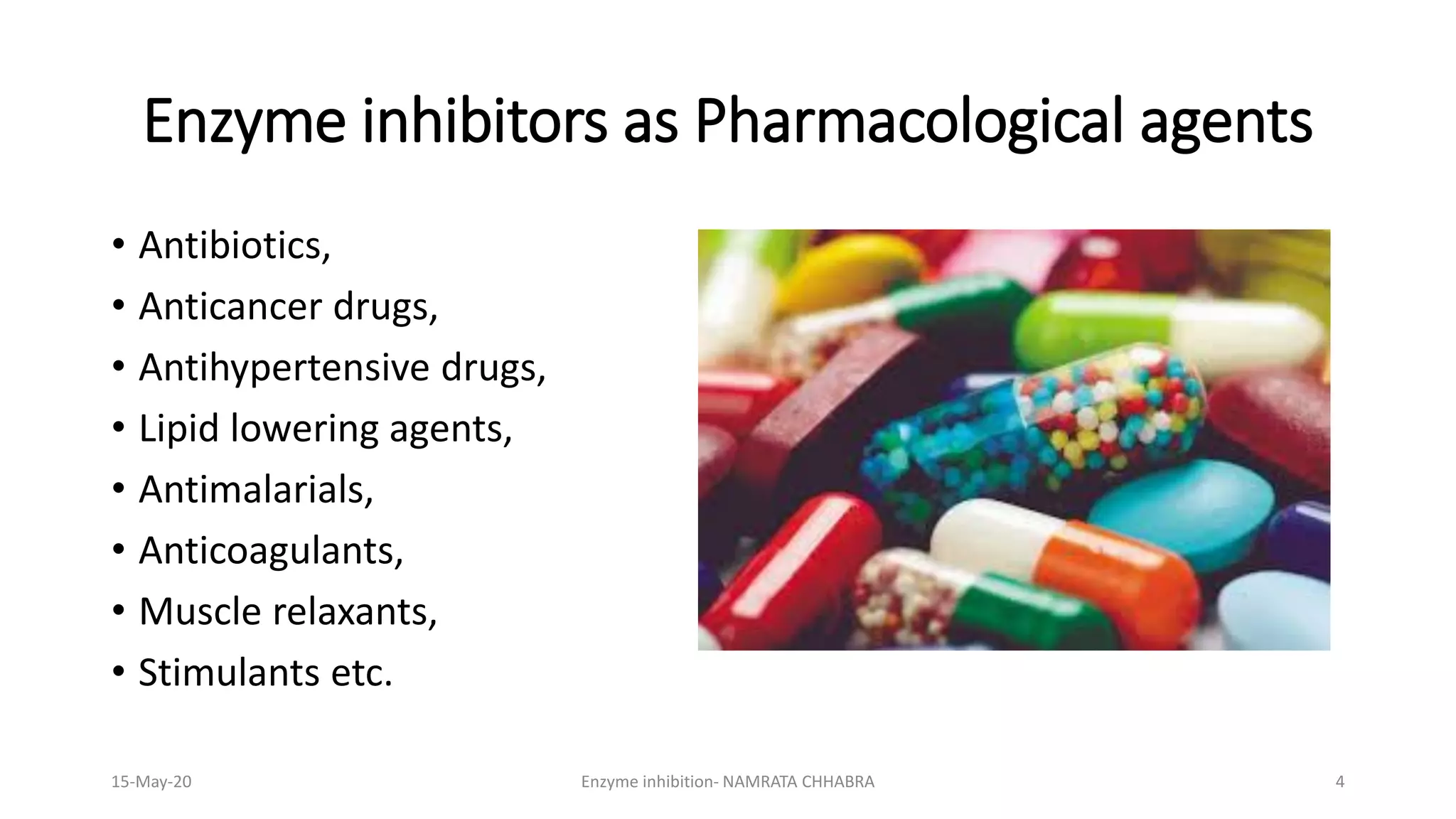
Enzyme inhibitors as Pharmacological agents
• Antibiotics,
• Anticancer drugs,
• Antihypertensive drugs,
• Lipid lowering agents,
• Antimalarials,
• Anticoagulants,
• Muscle relaxants,
• Stimulants etc.
15-May-20 Enzyme inhibition- NAMRATA CHHABRA 4
Enzyme inhibitors as Poisons
• Snakebite
• Nerve gases
• Plant alkaloids
• Heavy metals
etc.
15-May-20 Enzyme inhibition- NAMRATA CHHABRA 5
Enzyme Inhibitors as physiological regulators
• Feedback inhibition
• Product inhibition
• Allosteric inhibition
15-May-20 Enzyme inhibition- NAMRATA CHHABRA 6
• Irreversible inhibitors: Combine irreversibly with the functional
groups of the amino acids at the active site.
• Reversible inhibitors: Combine reversibly and can be washed out
of the solution of enzyme by dialysis.
Types of enzyme inhibitors
15-May-20 Enzyme inhibition- NAMRATA CHHABRA 7
• Competitive Enzyme Inhibition
• Non- Competitive Enzyme Inhibition
• Uncompetitive Enzyme Inhibition
• Suicidal enzyme Inhibition
• Allosteric enzyme Inhibition
Types of Enzyme inhibition
15-May-20 Enzyme inhibition- NAMRATA CHHABRA 8
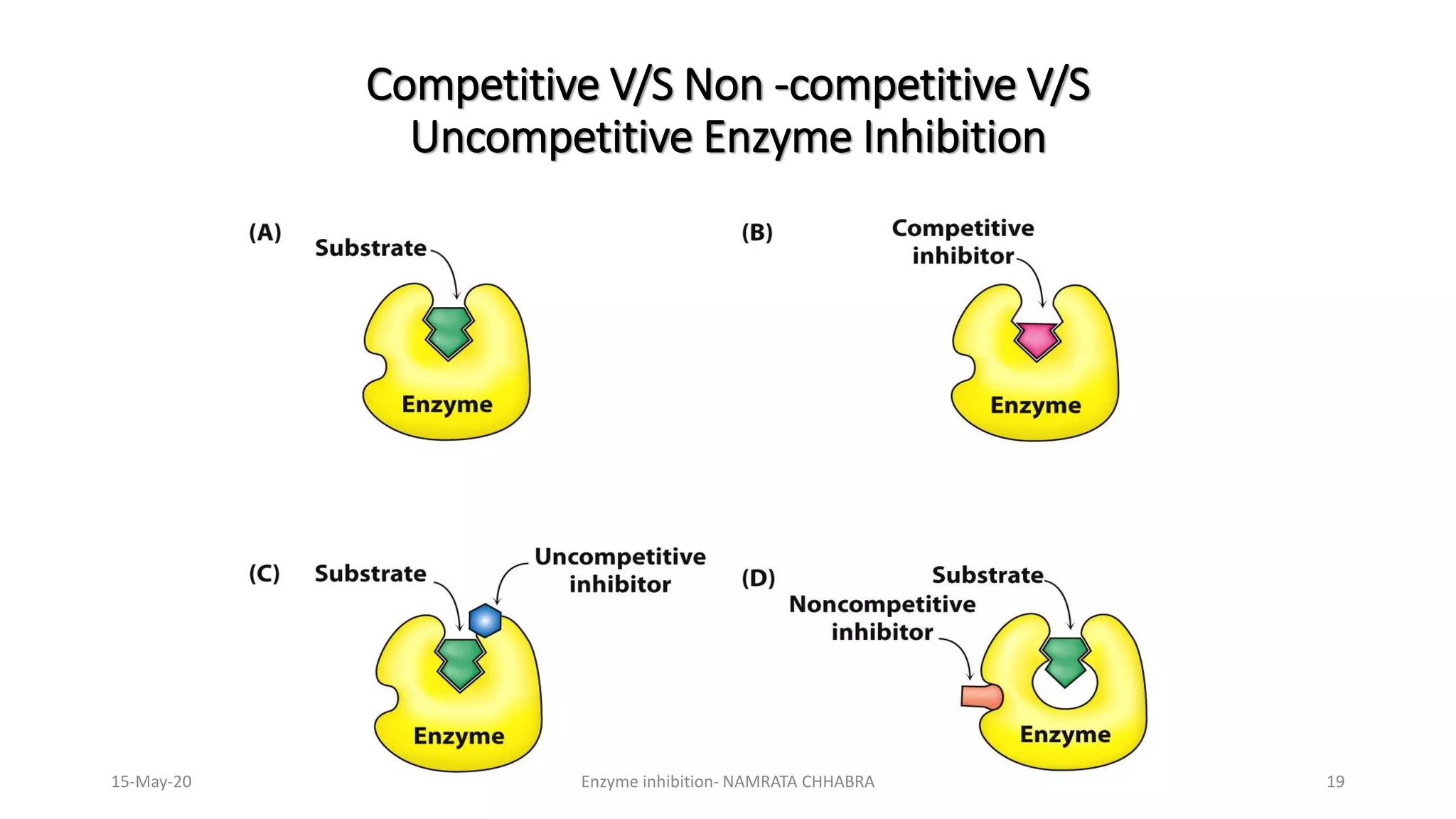
A competitive inhibitor
• Has a structural similarity with the substrate(structural analog),
• Occupies active site,
• Competes with substrate for the active site,
• Effects can be reversed by increasing substrate concentration,
• Vmax remains the same but Km is increased.
Competitive Enzyme Inhibition
15-May-20 Enzyme inhibition- NAMRATA CHHABRA 9
Competitive Enzyme Inhibition
15-May-20 Enzyme inhibition- NAMRATA CHHABRA 10
Competitive enzyme inhibition
As the concentration of a competitive inhibitor increases, higher concentrations of substrate are
required to attain a particular reaction velocity. A sufficiently high concentration of substrate can
completely relieve competitive inhibition.
15-May-20 Enzyme inhibition- NAMRATA CHHABRA 11
Examples of competitive Inhibitors
1) HMG Co A Reductase- inhibited by Statins- used as cholesterol lowering drugs.
2) Epoxide Reductase – inhibited by Dicoumarol- used as an anticoagulant.
3) Dihydrofolate Reductase-inhibited by Methotrexate- used as anticancer drug.
4) Pteroyl Synthase- inhibited by PABA (Para- amino –benzoic –acid) used as antibiotic.
5) Angiotensin converting enzyme Inhibitor- inhibited by Captopril –used as an antihypertensive
drug.
6) Succinate dehydrogenase- inhibited by Malonate acts as a poison.
7) Lactate dehydrogenase- inhibited by Oxamate- acts as a poison.
15-May-20 Enzyme inhibition- NAMRATA CHHABRA 12
• Noncompetitive inhibitors bind enzymes at sites distinct from the
substrate-binding site
• Generally bear little or no structural resemblance to the substrate
• Binding of the inhibitor does not affect binding of substrate
• Formation of both EI and EIS complexes is therefore possible
• The enzyme-inhibitor complex can still bind substrate, its efficiency at
transforming substrate to product, reflected by Vmax, is decreased.
Non- Competitive Enzyme Inhibition
15-May-20 Enzyme inhibition- NAMRATA CHHABRA 13
Non-Competitive Enzyme Inhibition
15-May-20 Enzyme inhibition- NAMRATA CHHABRA 14
Non- Competitive Enzyme Inhibition
15-May-20 Enzyme inhibition- NAMRATA CHHABRA 15
Lineweaver Burk plot
In the presence of a competitive inhibitor,
Vmax can still be reached if sufficient
substrate is available,
one-half Vmax requires a higher [S] than
before and thus Km is larger.
With noncompetitive inhibition, enzyme
rate (velocity) is reduced for all values of [S],
including
Vmax and one-half Vmax but
Km remains unchanged.
15-May-20 Enzyme inhibition- NAMRATA CHHABRA 16
• Cyanide inhibits cytochrome oxidase
• Fluoride inhibits Enolase and hence glycolysis
• Iodoacetate inhibits enzymes having SH groups in their active sites
• BAL ( British Anti Lewisite, dimercaprol) is used as an antidote for
heavy metal poisoning
• Heavy metals act as enzyme poisons by reacting with the SH groups
• BAL has several SH groups with which the heavy metal ions bind and thereby
their poisonous effects are reduced.
Examples of Non-competitive Enzyme
Inhibitors
15-May-20 Enzyme inhibition- NAMRATA CHHABRA 17
• Inhibitor binds to enzyme-
substrate complex
• Both Vmax and Km are
decreased
• e.g ; Inhibition of placental
alkaline phosphatase (Regan
isoenzyme) by phenylalanine
Uncompetitive Enzyme Inhibition
15-May-20 Enzyme inhibition- NAMRATA CHHABRA 18
Competitive V/S Non -competitive V/S
Uncompetitive Enzyme Inhibition
15-May-20 Enzyme inhibition- NAMRATA CHHABRA 19
• Irreversible inhibition
• Structural analog of the substrate is converted to more effective
inhibitor with the help of enzyme to be inhibited
• The new product irreversibly binds to the enzyme and inhibits further
reaction.
• e.g;
• Ornithine decarboxylase – is irreversibly inhibited by difluormethyl ornithine,
as a result multiplication of parasite is arrested . Used against trypanosome in
sleeping sickness
Suicidal Inhibition
15-May-20 Enzyme inhibition- NAMRATA CHHABRA 20
Suicide Inhibition
15-May-20 Enzyme inhibition- NAMRATA CHHABRA 21
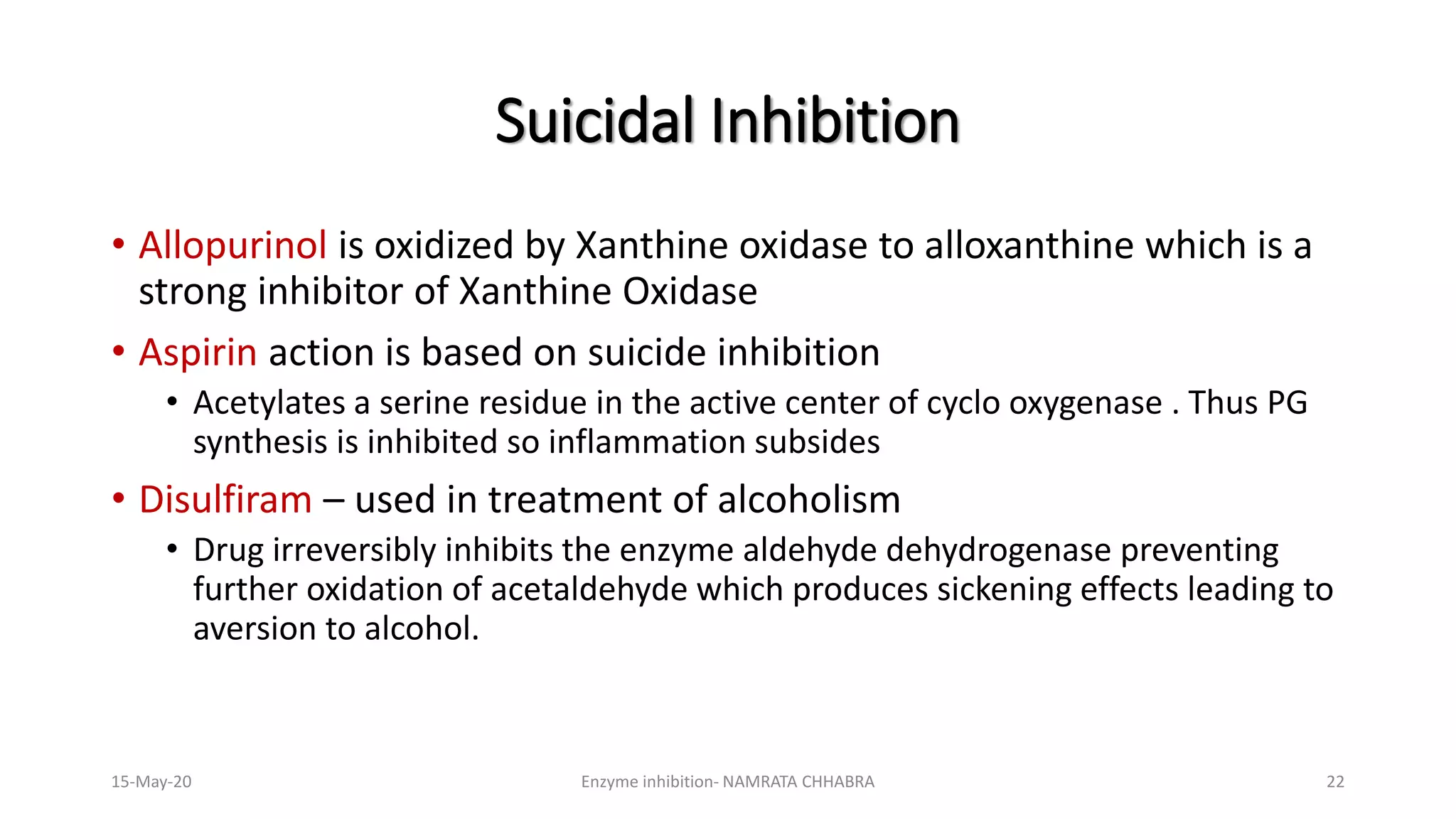
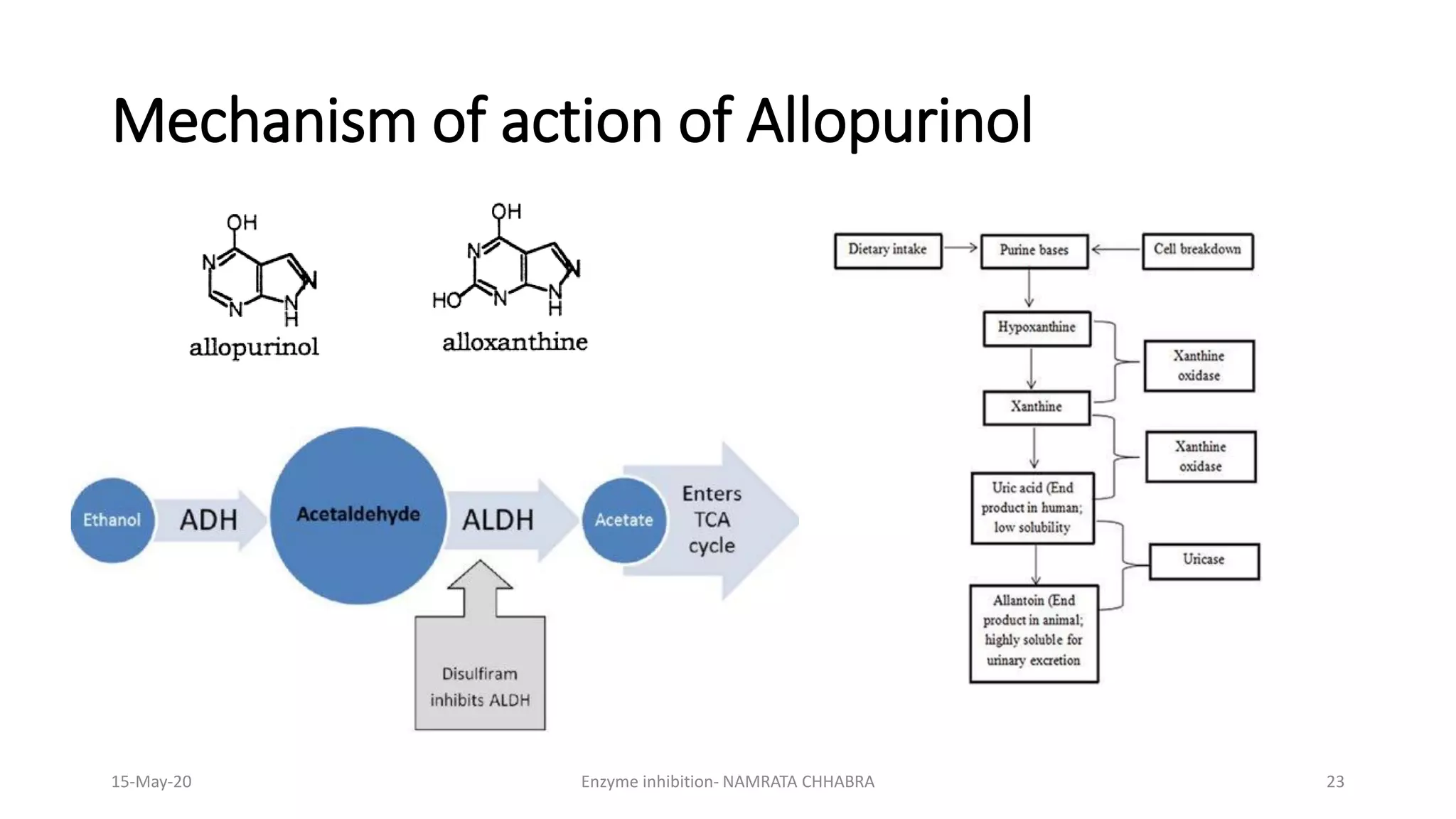
• Allopurinol is oxidized by Xanthine oxidase to alloxanthine which is a
strong inhibitor of Xanthine Oxidase
• Aspirin action is based on suicide inhibition
• Acetylates a serine residue in the active center of cyclo oxygenase . Thus PG
synthesis is inhibited so inflammation subsides
• Disulfiram – used in treatment of alcoholism
• Drug irreversibly inhibits the enzyme aldehyde dehydrogenase preventing
further oxidation of acetaldehyde which produces sickening effects leading to
aversion to alcohol.
Suicidal Inhibition
15-May-20 Enzyme inhibition- NAMRATA CHHABRA 22
Mechanism of action of Allopurinol
15-May-20 Enzyme inhibition- NAMRATA CHHABRA 23
• Allosteric means “other site”
Allosteric Inhibition
EActive site
Allosteric site
❑ These enzymes have one catalytic
site (active site) where the
substrate binds and another
separate allosteric site where the
modifier binds.
❑ The allosteric sites may or may
not be physically adjacent.
❑ The binding of the modifier may
enhance (positive modifier) or
inhibit (negative modifier) the
enzyme activity.
15-May-20 Enzyme inhibition- NAMRATA CHHABRA 24
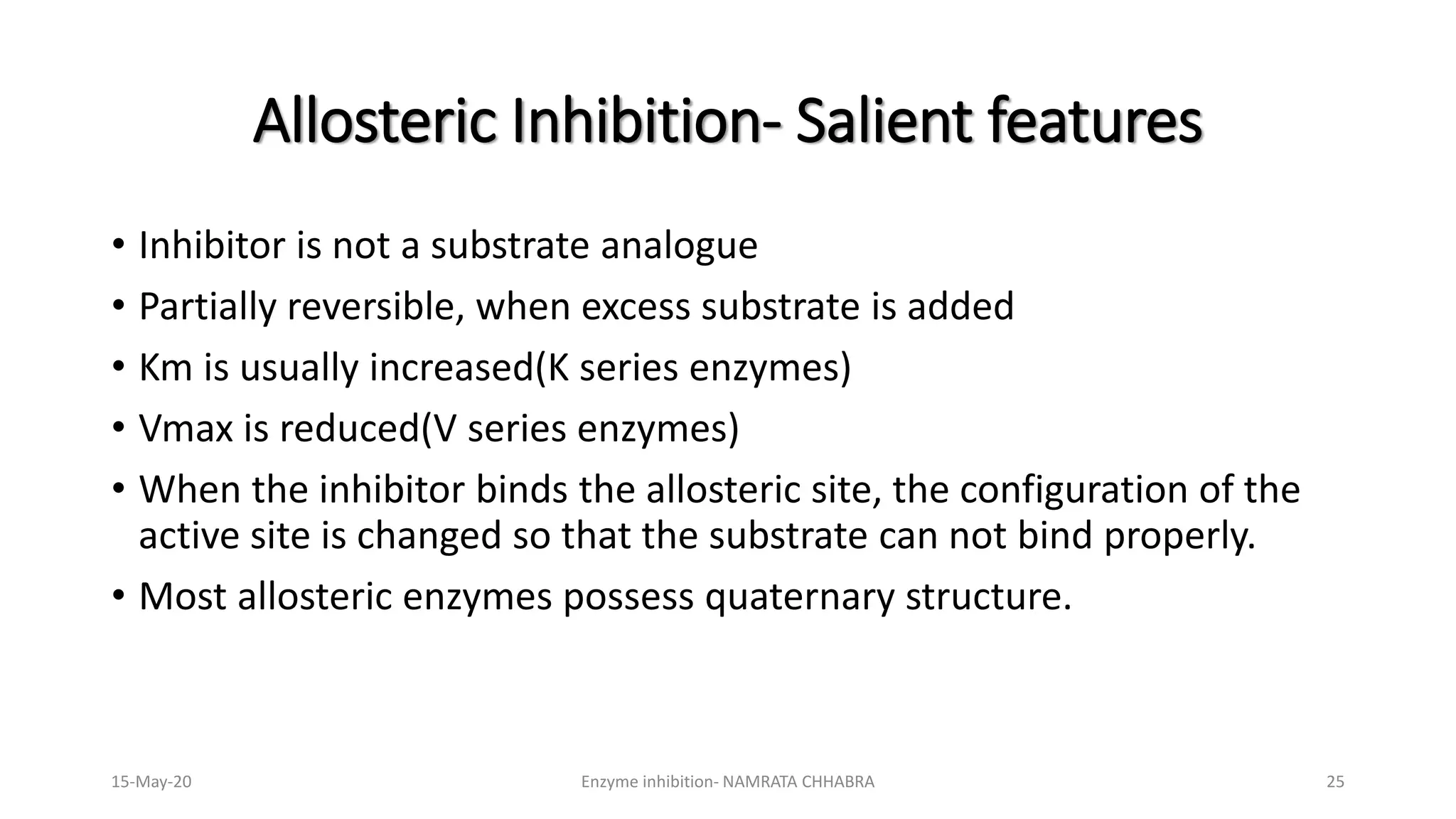
• Inhibitor is not a substrate analogue
• Partially reversible, when excess substrate is added
• Km is usually increased(K series enzymes)
• Vmax is reduced(V series enzymes)
• When the inhibitor binds the allosteric site, the configuration of the
active site is changed so that the substrate can not bind properly.
• Most allosteric enzymes possess quaternary structure.
Allosteric Inhibition- Salient features
15-May-20 Enzyme inhibition- NAMRATA CHHABRA 25
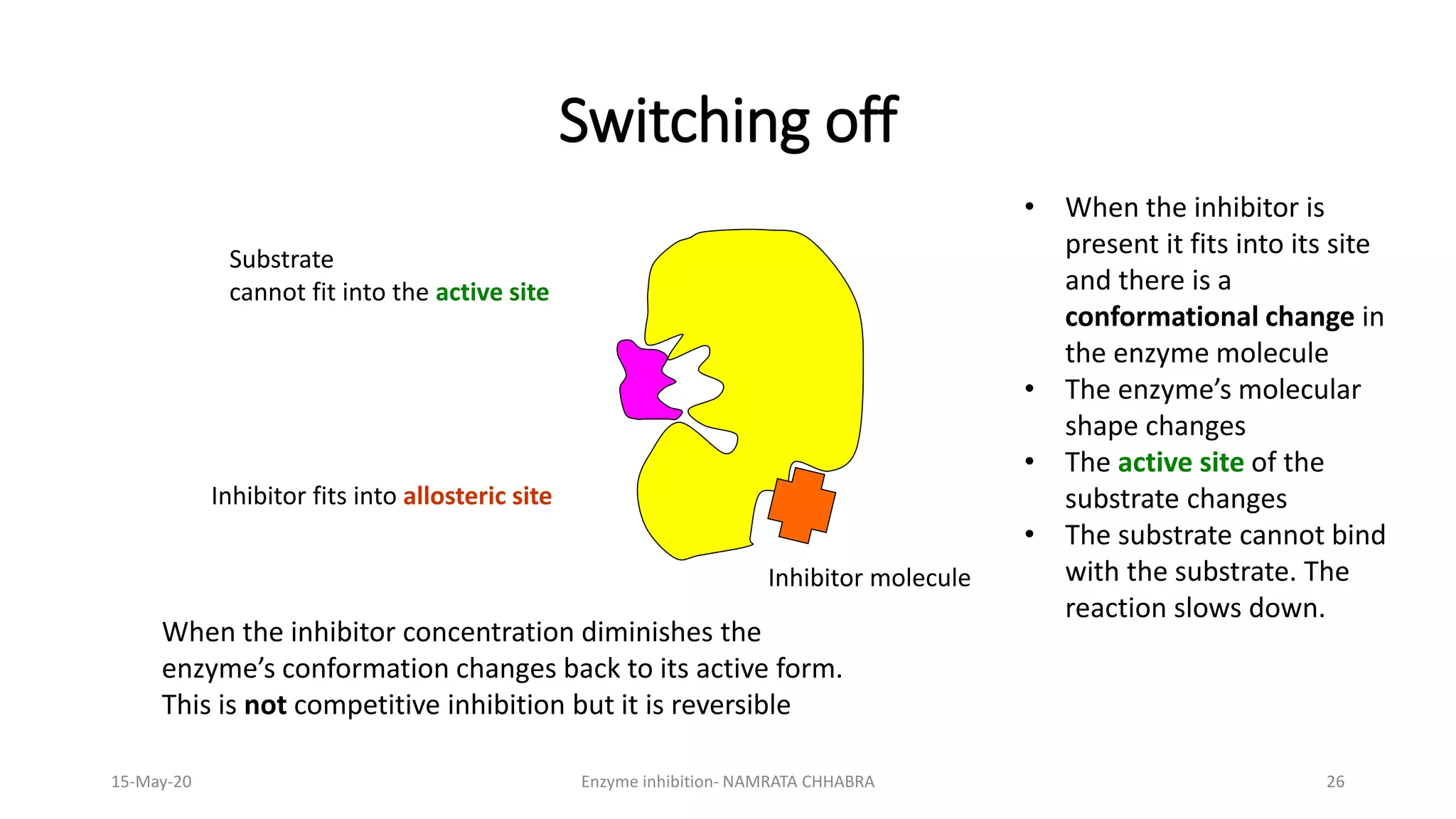
Switching off
Inhibitor molecule
Substrate
cannot fit into the active site
Inhibitor fits into allosteric site
• When the inhibitor is
present it fits into its site
and there is a
conformational change in
the enzyme molecule
• The enzyme’s molecular
shape changes
• The active site of the
substrate changes
• The substrate cannot bind
with the substrate. The
reaction slows down.
When the inhibitor concentration diminishes the
enzyme’s conformation changes back to its active form.
This is not competitive inhibition but it is reversible
15-May-20 Enzyme inhibition- NAMRATA CHHABRA 26
15-May-20 Enzyme inhibition- NAMRATA CHHABRA 27
• Phosphofructokinase -This enzyme has an active site for fructose-6-
phosphate molecules to bind with another phosphate group.
• It has an allosteric site for ATP molecules, the inhibitor.
• When the cell consumes a lot of ATP the level of ATP in the cell falls
• No ATP binds to the allosteric site of phosphofructokinase
• The enzyme’s conformation (shape) changes and the active site accepts substrate
molecules
Allosteric Modification (Positive)
15-May-20 Enzyme inhibition- NAMRATA CHHABRA 28
• Phosphofructokinase
• The respiration pathway accelerates and ATP (the final product) builds up in the
cell
• As the ATP increases, more and more ATP fits into the allosteric site of the
phosphofructokinase molecules
• The enzyme’s conformation changes again and stops accepting substrate
molecules in the active site
• Respiration slows down.
Allosteric Modification (negative)
15-May-20 Enzyme inhibition- NAMRATA CHHABRA 29
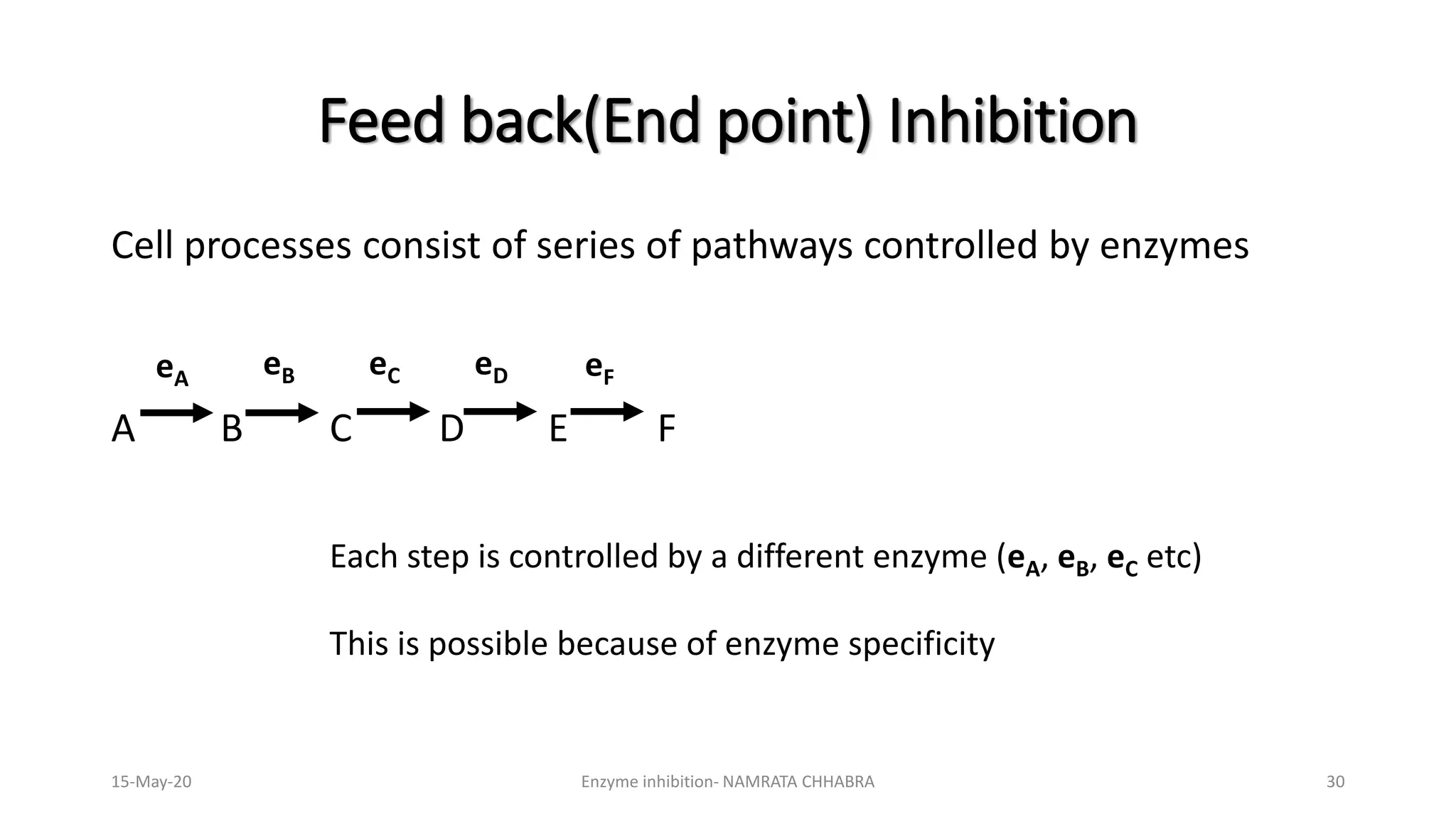
Cell processes consist of series of pathways controlled by enzymes
A B C D E F
Feed back(End point) Inhibition
eFeDeCeA eB
Each step is controlled by a different enzyme (eA, eB, eC etc)
This is possible because of enzyme specificity
15-May-20 Enzyme inhibition- NAMRATA CHHABRA 30
• The first step (controlled by eA) is often controlled by the end-
product (F)
• Therefore negative feedback is possible
A B C D E F
Feed back(End point) inhibition
Inhibition
eFeDeCeA eB
The end products are controlling
their own rate of production
There is no build up of
intermediates (B,C, D and E).
Usually such end -product
inhibition is effected allosterically
15-May-20 Enzyme inhibition- NAMRATA CHHABRA 31
Feedback Inhibition
Accumulated product binds at a site
other than the active site to bring
about conformational changes, soas
to inhibit the binding of the
substrate. The rate of reaction
declines.
15-May-20 Enzyme inhibition- NAMRATA CHHABRA 32
Clinical problem-1
A recently diagnosed hypertensive patient has been prescribed an
ACE inhibitor (Angiotensin convertase inhibitor) which is known to act
by lowering Vmax, what is the possible mechanism of inhibition of
this drug?
a) Competitive
b) Noncompetitive
c) Uncompetitive
d) Suicidal.
15-May-20 Enzyme inhibition- NAMRATA CHHABRA 33
Problem-2
Which statement out of the followings is incorrect about the effect of
increasing temperature on enzyme activity-
a) Raising the temperature increases the kinetic energy of molecules
b) A ten degrees centigrade rise in temperature will increase the
activity of most enzymes by 50 to 100%.
c) Most animal enzymes rapidly become denatured at temperatures
above 40oC
d) Storage of enzymes at 5°C or below is generally not suitable.
15-May-20 Enzyme inhibition- NAMRATA CHHABRA 34
Problem-3
The drug Fluorouracil is recommended for the treatment of cancers.
It undergoes a series of changes and then binds to thymidylate
synthase enzyme resulting in its inhibition and blockage of cell
division. This mode of inhibition is most probably due to-
a) Allosteric inhibition
b) Competitive inhibition
c) Noncompetitive Inhibition
d) Suicidal inhibition.
15-May-20 Enzyme inhibition- NAMRATA CHHABRA 35
Problem-4
• A 56- year- old female presents with difficulty
opening her eye lids, as well as inability to raise
herself from sitting position.
• She is diagnosed with "myasthenia gravis", a
disease of extreme fatigue, due to decreased
concentration of Acetyl choline in her muscles.
• She has been prescribed physostigmine, a drug
that increases the amount of available Acetyl
choline by inhibiting acetyl cholinesterase.
• Physostigmine is a structural analogue of Acetyl
choline.
• What is the type of inhibition ?
15-May-20 Enzyme inhibition- NAMRATA CHHABRA 36
Problem-5
• A 55-year-old male presents with difficult breathing and swollen
ankles.
• He is found to have a failing heart, resulting in blood backing up into
his lungs (pulmonary congestion) and making it difficult for him to
breathe.
• He is administered a drug that inhibits Angiotensin converting
enzyme (ACE).
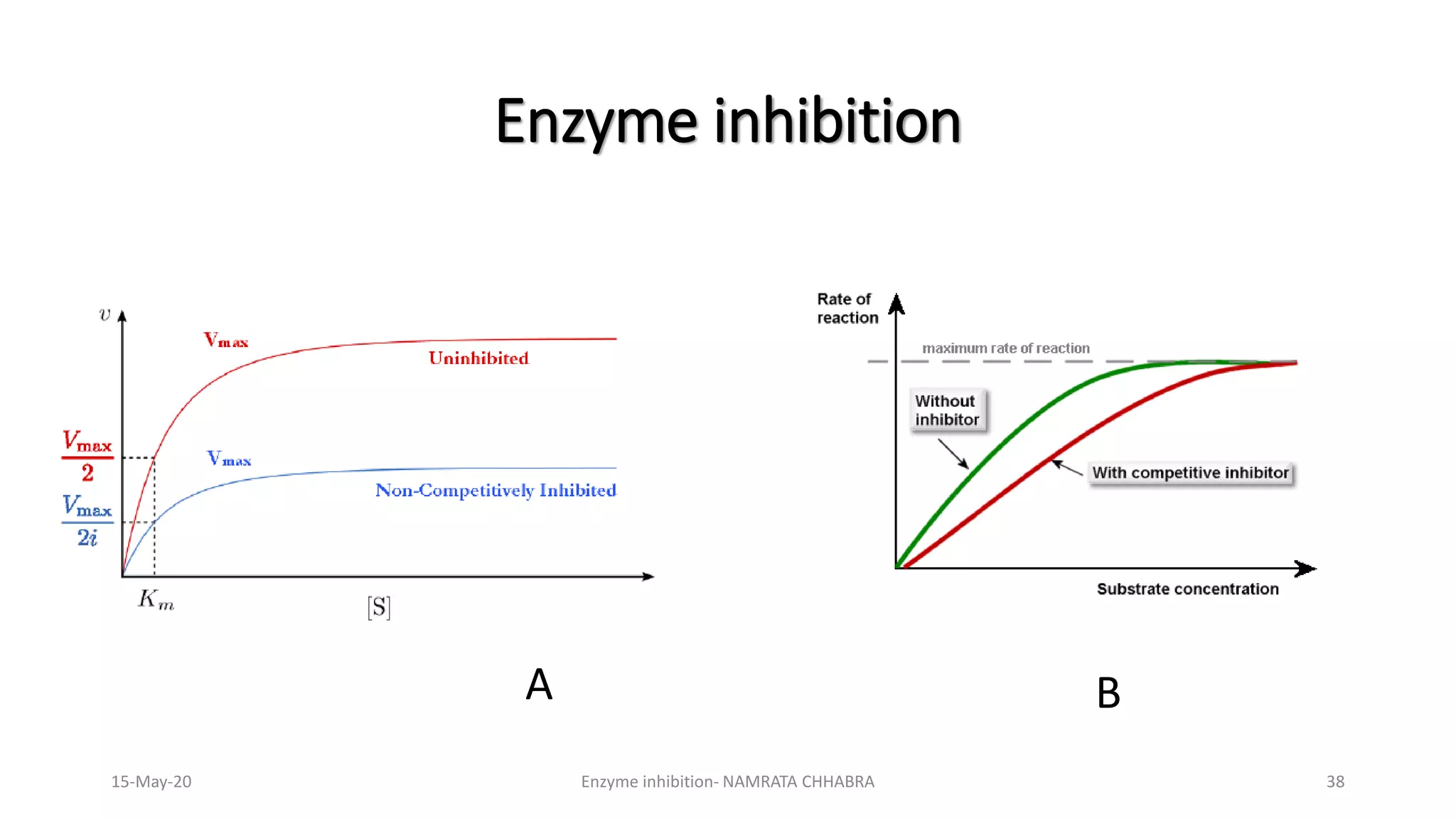
• Hhich of the following curves corresponds with the mechanism of
action of the drug?
15-May-20 Enzyme inhibition- NAMRATA CHHABRA 37
Enzyme inhibition
15-May-20 Enzyme inhibition- NAMRATA CHHABRA 38
BA
Thank you
15-May-20 Enzyme inhibition- NAMRATA CHHABRA 39

Enzyme inhibition

  • 1.
  • 2.
    Enzyme Inhibition- Definitionand Purpose Enzyme Inhibition- Reduction in the rate of the enzyme catalyzed reaction EnzymeInhibition Therapeutic Poisons/Toxins Physiological regulation Research 15-May-20 Enzyme inhibition- NAMRATA CHHABRA 2
  • 3.
    • Inhibitors arechemicals that reduce the rate of the enzymatic reactions, • They are usually specific and work at low concentrations, • They block the enzyme, but they do not usually destroy it, • Many drugs and poisons are inhibitors of enzymes in the nervous system, • Inhibitors of the catalytic activities of enzymes provide both pharmacologic agents and research tools for study of the mechanism of enzyme action. Enzyme Inhibitors 15-May-20 Enzyme inhibition- NAMRATA CHHABRA 3
  • 4.
    Enzyme inhibitors asPharmacological agents • Antibiotics, • Anticancer drugs, • Antihypertensive drugs, • Lipid lowering agents, • Antimalarials, • Anticoagulants, • Muscle relaxants, • Stimulants etc. 15-May-20 Enzyme inhibition- NAMRATA CHHABRA 4
  • 5.
    Enzyme inhibitors asPoisons • Snakebite • Nerve gases • Plant alkaloids • Heavy metals etc. 15-May-20 Enzyme inhibition- NAMRATA CHHABRA 5
  • 6.
    Enzyme Inhibitors asphysiological regulators • Feedback inhibition • Product inhibition • Allosteric inhibition 15-May-20 Enzyme inhibition- NAMRATA CHHABRA 6
  • 7.
    • Irreversible inhibitors:Combine irreversibly with the functional groups of the amino acids at the active site. • Reversible inhibitors: Combine reversibly and can be washed out of the solution of enzyme by dialysis. Types of enzyme inhibitors 15-May-20 Enzyme inhibition- NAMRATA CHHABRA 7
  • 8.
    • Competitive EnzymeInhibition • Non- Competitive Enzyme Inhibition • Uncompetitive Enzyme Inhibition • Suicidal enzyme Inhibition • Allosteric enzyme Inhibition Types of Enzyme inhibition 15-May-20 Enzyme inhibition- NAMRATA CHHABRA 8
  • 9.
    A competitive inhibitor •Has a structural similarity with the substrate(structural analog), • Occupies active site, • Competes with substrate for the active site, • Effects can be reversed by increasing substrate concentration, • Vmax remains the same but Km is increased. Competitive Enzyme Inhibition 15-May-20 Enzyme inhibition- NAMRATA CHHABRA 9
  • 10.
    Competitive Enzyme Inhibition 15-May-20Enzyme inhibition- NAMRATA CHHABRA 10
  • 11.
    Competitive enzyme inhibition Asthe concentration of a competitive inhibitor increases, higher concentrations of substrate are required to attain a particular reaction velocity. A sufficiently high concentration of substrate can completely relieve competitive inhibition. 15-May-20 Enzyme inhibition- NAMRATA CHHABRA 11
  • 12.
    Examples of competitiveInhibitors 1) HMG Co A Reductase- inhibited by Statins- used as cholesterol lowering drugs. 2) Epoxide Reductase – inhibited by Dicoumarol- used as an anticoagulant. 3) Dihydrofolate Reductase-inhibited by Methotrexate- used as anticancer drug. 4) Pteroyl Synthase- inhibited by PABA (Para- amino –benzoic –acid) used as antibiotic. 5) Angiotensin converting enzyme Inhibitor- inhibited by Captopril –used as an antihypertensive drug. 6) Succinate dehydrogenase- inhibited by Malonate acts as a poison. 7) Lactate dehydrogenase- inhibited by Oxamate- acts as a poison. 15-May-20 Enzyme inhibition- NAMRATA CHHABRA 12
  • 13.
    • Noncompetitive inhibitorsbind enzymes at sites distinct from the substrate-binding site • Generally bear little or no structural resemblance to the substrate • Binding of the inhibitor does not affect binding of substrate • Formation of both EI and EIS complexes is therefore possible • The enzyme-inhibitor complex can still bind substrate, its efficiency at transforming substrate to product, reflected by Vmax, is decreased. Non- Competitive Enzyme Inhibition 15-May-20 Enzyme inhibition- NAMRATA CHHABRA 13
  • 14.
    Non-Competitive Enzyme Inhibition 15-May-20Enzyme inhibition- NAMRATA CHHABRA 14
  • 15.
    Non- Competitive EnzymeInhibition 15-May-20 Enzyme inhibition- NAMRATA CHHABRA 15
  • 16.
    Lineweaver Burk plot Inthe presence of a competitive inhibitor, Vmax can still be reached if sufficient substrate is available, one-half Vmax requires a higher [S] than before and thus Km is larger. With noncompetitive inhibition, enzyme rate (velocity) is reduced for all values of [S], including Vmax and one-half Vmax but Km remains unchanged. 15-May-20 Enzyme inhibition- NAMRATA CHHABRA 16
  • 17.
    • Cyanide inhibitscytochrome oxidase • Fluoride inhibits Enolase and hence glycolysis • Iodoacetate inhibits enzymes having SH groups in their active sites • BAL ( British Anti Lewisite, dimercaprol) is used as an antidote for heavy metal poisoning • Heavy metals act as enzyme poisons by reacting with the SH groups • BAL has several SH groups with which the heavy metal ions bind and thereby their poisonous effects are reduced. Examples of Non-competitive Enzyme Inhibitors 15-May-20 Enzyme inhibition- NAMRATA CHHABRA 17
  • 18.
    • Inhibitor bindsto enzyme- substrate complex • Both Vmax and Km are decreased • e.g ; Inhibition of placental alkaline phosphatase (Regan isoenzyme) by phenylalanine Uncompetitive Enzyme Inhibition 15-May-20 Enzyme inhibition- NAMRATA CHHABRA 18
  • 19.
    Competitive V/S Non-competitive V/S Uncompetitive Enzyme Inhibition 15-May-20 Enzyme inhibition- NAMRATA CHHABRA 19
  • 20.
    • Irreversible inhibition •Structural analog of the substrate is converted to more effective inhibitor with the help of enzyme to be inhibited • The new product irreversibly binds to the enzyme and inhibits further reaction. • e.g; • Ornithine decarboxylase – is irreversibly inhibited by difluormethyl ornithine, as a result multiplication of parasite is arrested . Used against trypanosome in sleeping sickness Suicidal Inhibition 15-May-20 Enzyme inhibition- NAMRATA CHHABRA 20
  • 21.
    Suicide Inhibition 15-May-20 Enzymeinhibition- NAMRATA CHHABRA 21
  • 22.
    • Allopurinol isoxidized by Xanthine oxidase to alloxanthine which is a strong inhibitor of Xanthine Oxidase • Aspirin action is based on suicide inhibition • Acetylates a serine residue in the active center of cyclo oxygenase . Thus PG synthesis is inhibited so inflammation subsides • Disulfiram – used in treatment of alcoholism • Drug irreversibly inhibits the enzyme aldehyde dehydrogenase preventing further oxidation of acetaldehyde which produces sickening effects leading to aversion to alcohol. Suicidal Inhibition 15-May-20 Enzyme inhibition- NAMRATA CHHABRA 22
  • 23.
    Mechanism of actionof Allopurinol 15-May-20 Enzyme inhibition- NAMRATA CHHABRA 23
  • 24.
    • Allosteric means“other site” Allosteric Inhibition EActive site Allosteric site ❑ These enzymes have one catalytic site (active site) where the substrate binds and another separate allosteric site where the modifier binds. ❑ The allosteric sites may or may not be physically adjacent. ❑ The binding of the modifier may enhance (positive modifier) or inhibit (negative modifier) the enzyme activity. 15-May-20 Enzyme inhibition- NAMRATA CHHABRA 24
  • 25.
    • Inhibitor isnot a substrate analogue • Partially reversible, when excess substrate is added • Km is usually increased(K series enzymes) • Vmax is reduced(V series enzymes) • When the inhibitor binds the allosteric site, the configuration of the active site is changed so that the substrate can not bind properly. • Most allosteric enzymes possess quaternary structure. Allosteric Inhibition- Salient features 15-May-20 Enzyme inhibition- NAMRATA CHHABRA 25
  • 26.
    Switching off Inhibitor molecule Substrate cannotfit into the active site Inhibitor fits into allosteric site • When the inhibitor is present it fits into its site and there is a conformational change in the enzyme molecule • The enzyme’s molecular shape changes • The active site of the substrate changes • The substrate cannot bind with the substrate. The reaction slows down. When the inhibitor concentration diminishes the enzyme’s conformation changes back to its active form. This is not competitive inhibition but it is reversible 15-May-20 Enzyme inhibition- NAMRATA CHHABRA 26
  • 27.
    15-May-20 Enzyme inhibition-NAMRATA CHHABRA 27
  • 28.
    • Phosphofructokinase -Thisenzyme has an active site for fructose-6- phosphate molecules to bind with another phosphate group. • It has an allosteric site for ATP molecules, the inhibitor. • When the cell consumes a lot of ATP the level of ATP in the cell falls • No ATP binds to the allosteric site of phosphofructokinase • The enzyme’s conformation (shape) changes and the active site accepts substrate molecules Allosteric Modification (Positive) 15-May-20 Enzyme inhibition- NAMRATA CHHABRA 28
  • 29.
    • Phosphofructokinase • Therespiration pathway accelerates and ATP (the final product) builds up in the cell • As the ATP increases, more and more ATP fits into the allosteric site of the phosphofructokinase molecules • The enzyme’s conformation changes again and stops accepting substrate molecules in the active site • Respiration slows down. Allosteric Modification (negative) 15-May-20 Enzyme inhibition- NAMRATA CHHABRA 29
  • 30.
    Cell processes consistof series of pathways controlled by enzymes A B C D E F Feed back(End point) Inhibition eFeDeCeA eB Each step is controlled by a different enzyme (eA, eB, eC etc) This is possible because of enzyme specificity 15-May-20 Enzyme inhibition- NAMRATA CHHABRA 30
  • 31.
    • The firststep (controlled by eA) is often controlled by the end- product (F) • Therefore negative feedback is possible A B C D E F Feed back(End point) inhibition Inhibition eFeDeCeA eB The end products are controlling their own rate of production There is no build up of intermediates (B,C, D and E). Usually such end -product inhibition is effected allosterically 15-May-20 Enzyme inhibition- NAMRATA CHHABRA 31
  • 32.
    Feedback Inhibition Accumulated productbinds at a site other than the active site to bring about conformational changes, soas to inhibit the binding of the substrate. The rate of reaction declines. 15-May-20 Enzyme inhibition- NAMRATA CHHABRA 32
  • 33.
    Clinical problem-1 A recentlydiagnosed hypertensive patient has been prescribed an ACE inhibitor (Angiotensin convertase inhibitor) which is known to act by lowering Vmax, what is the possible mechanism of inhibition of this drug? a) Competitive b) Noncompetitive c) Uncompetitive d) Suicidal. 15-May-20 Enzyme inhibition- NAMRATA CHHABRA 33
  • 34.
    Problem-2 Which statement outof the followings is incorrect about the effect of increasing temperature on enzyme activity- a) Raising the temperature increases the kinetic energy of molecules b) A ten degrees centigrade rise in temperature will increase the activity of most enzymes by 50 to 100%. c) Most animal enzymes rapidly become denatured at temperatures above 40oC d) Storage of enzymes at 5°C or below is generally not suitable. 15-May-20 Enzyme inhibition- NAMRATA CHHABRA 34
  • 35.
    Problem-3 The drug Fluorouracilis recommended for the treatment of cancers. It undergoes a series of changes and then binds to thymidylate synthase enzyme resulting in its inhibition and blockage of cell division. This mode of inhibition is most probably due to- a) Allosteric inhibition b) Competitive inhibition c) Noncompetitive Inhibition d) Suicidal inhibition. 15-May-20 Enzyme inhibition- NAMRATA CHHABRA 35
  • 36.
    Problem-4 • A 56-year- old female presents with difficulty opening her eye lids, as well as inability to raise herself from sitting position. • She is diagnosed with "myasthenia gravis", a disease of extreme fatigue, due to decreased concentration of Acetyl choline in her muscles. • She has been prescribed physostigmine, a drug that increases the amount of available Acetyl choline by inhibiting acetyl cholinesterase. • Physostigmine is a structural analogue of Acetyl choline. • What is the type of inhibition ? 15-May-20 Enzyme inhibition- NAMRATA CHHABRA 36
  • 37.
    Problem-5 • A 55-year-oldmale presents with difficult breathing and swollen ankles. • He is found to have a failing heart, resulting in blood backing up into his lungs (pulmonary congestion) and making it difficult for him to breathe. • He is administered a drug that inhibits Angiotensin converting enzyme (ACE). • Hhich of the following curves corresponds with the mechanism of action of the drug? 15-May-20 Enzyme inhibition- NAMRATA CHHABRA 37
  • 38.
    Enzyme inhibition 15-May-20 Enzymeinhibition- NAMRATA CHHABRA 38 BA
  • 39.
    Thank you 15-May-20 Enzymeinhibition- NAMRATA CHHABRA 39