ENZYMES
Presented By:
Dr. Nayyab Tariq
Dr. Of Physical Therapist - DPT
s are protein catalysts for chemical reaction in biological systems. They
increase the rate of chemical reactions taking place within living cells
without changing themselves.
Enzymes are protein catalysts for chemical reaction in
biological systems. They increase the rate of chemical
reactions taking place within living cells without
changing themselves.
It is made up of only protein molecules not bound to
any non – proteins.
It is made up of protein groups and non-protein
component
The protein component of this holo enzymes is called
apoenzyme
The non-protein component of the holo enzyme is
called a cofactor.
If this cofactor is an organic compound it is called a
coenzyme
If it is an
inorganic
group it is
called
activator.
If the cofactor is bound so tightly to the apoenzyme and is difficult to remove
without damaging the enzyme it is sometimes called a prosthetic group
1. ACTIVE SITE
2. CATALYTIC
EFFICIENCY
3. SPECIFICITY
4. REGULATION
5. ZYMOGENS –
INACTIVE FORM
6. ISOENZYMES
Enzyme molecules contain a special pocket or cleft called the
active site. The active site contains amino acid chains that create a
three-dimensional surface complementary to the substrate.
The active site binds the substrate, forming an enzyme-substrate
(ES) complex. ES is converted to enzyme-product (EP); which
subsequently dissociates to enzyme and product.
For the combination with substrate, each enzyme is said to
possess one or more active sites where the substrate can be taken
up.
The active site of the enzyme may contain free hydroxyl group of
serine, phenolic (hydroxyl) group of tyrosine, SH-thiol (Sulfhydryl)
group of cysteine or imindazolle group of histidine to interact with
there is substrates.
It is also possible that the active site (Catalytic site) is different
from the binding site in which case they are situated closely
together in the enzyme molecule.
Most enzyme- catalyzed reactions are highly
efficient proceeding from 103 to 108 times faster
than uncatalyzed reactions.
Typically each enzyme molecule is capable of
transforming 100 to 1000 substrate molecule in to
product each second.
Enzymes are specific for their substrate.
Specificity of enzymes are divided into:
1. Absolute specificity:
This means one enzyme catalyzes or acts on only one
substrate.
For example: Urease catalyzes hydrolysis of urea but not
thiourea.
2. Stereo specificity:
Some enzymes are specific to only one isomer even if the
compound is one type of molecule.
 *Maltase catalyzes the hydrolysis of α- but not β –
glycosides.
Enzyme activity can be regulated- that is,
enzyme can be, activated or inhibited so that
the rate of product formation responds to the
needs of the cell.
 Some enzymes are produced in nature in an inactive form which can be
activated when they are required. Such type of enzymes is called Zymogens
(Proenzymes).
 Many of the digestive enzymes and enzymes concerned with blood coagulation
are in this group.
Examples:
Pepsinogen - This zymogen is from gastric juice - when required
Pepsinogen - converts to Pepsin
Trypsinogen - This zymogen is found in the pancreatic juice, and when it is
required gets converted to trypsin.
The activation is brought about by specific ions or by other enzymes that are
proteolytic.
Pepsinogen + H+ Pepsin
Trypsinogen Enteropeptidase Trypsin
 Zymogen forms of enzymes a protective mechanism to prevent auto digestion
of tissue producing the digestive enzymes and to prevent intravascular
coagulation of blood.
These are enzymes having:
Similar catalytic activity
Act on the same substrate and produces the
same product
Originated at different site
Exhibiting different physical and chemical
characteristics such as:
1. Electrophoretic Mobilities
2. Amino Acid Composition
3. Immunological Behavior
 Mechanism begins with the binding of the substrate (or substrates) to the active site on the
enzyme forming Enzyme-Substrate Complex.
 This binding of the substrate to the enzyme causes changes in the distribution of electrons
in the chemical bonds of the substrate and ultimately causes the reactions that lead to the
formation of products.
LOWERING OF
ACTIVATION ENERGY
THEORY OF ENZYME
ACTION
Enzymes carry out their function of lowering Activation
Energy by temporarily combining with the chemicals
involved in the reaction.
Activation energy is the energy required to convert one
mole of reacting substance from ground state to the
transition state.
Enzyme are said to reduce the magnitude of this activation
energy.
Enzyme reacts with the Substrate to form Enzyme-
Substrate Complex. This is the Transition state.
In Transition state, the probability of making or breaking a
chemical bond to form the product is very high.
This results in acceleration of the reaction forming
products.
During the formation of an ES complex, the substrate
attaches itself to the specific active sites on the enzyme
molecule by Reversible interactions formed by Electrostatic
Lock and Key
Model
Induced Fit Model
Postulated in 1890 by Emil Fischer.
The lock is the enzyme and the key is the substrate.
Specific shape of substrate allows it to fit into the
Enzyme.
Only the correctly sized key (substrate) fits into the key
hole (active site) of the lock (enzyme).
Smaller keys, larger keys (incorrectly shaped or sized
substrate molecules) do not fit into the lock (enzyme).
Formulated by Daniel Koshland in 1958
The substrate plays a role in determining the final
shape of the enzyme
The enzyme is partially flexible
Only the proper substrate is capable of including
the proper alignment of the active site.
FACTORS AFFECTING ENZYME
ACTIVITY
 Physical and chemical factors are affecting the enzyme activity.
 These include:
1.
TEMPERATURE
 Temperature at which Enzyme shows
Maximum Activity
 Optiomal Temperature of Enzyme –
37 ºC
2. EFFECT OF
PH
pH measures – Concentration of Hydrogen Ions.
ENZYM
E
DENATURED
ENZYME
Changing in pH leads to:
1. Breakage of Ionic bonds – enzyme
denatured
2. Effect the charges of amino acids – ES
complex
 pH at which an enzyme
catalyses a reaction at
the maximum rate.
Examples:
 Pepsin – pH 2
Pancreatic Lipase – pH
9
3. CONCENTRATION OF
SUBSTARTE
At fixed enzyme concentration pH and temperature the activity of enzymes is influenced by
increase in substrate concentration.
An increase in the substrate concentration increases the enzyme activity till a maximum is
reached. Further increase in substrate concentration does not increase rate of reaction.MAXIMUM RATE
(Vmax)
The characteristic shape of the substrate saturation curve for an enzyme
can be expressed mathematically by the Michaelis Menten equation:
V = Vmax [S] / Km + [S]
Where: V= Velocity at a given concentration of substrate (initial reaction
velocity)
Vmax = Maximal velocity possible with excess of substrate
[S] = concentration of the substrate at velocity V
Km = michaelis-constant of the enzyme for particular substrate.
4. RELATIONSHIP OF VELOCITY TO
ENZYME CONCENTRATION
The rate of the reaction is directly proportional to enzyme concentration at all substrate
concentration.
For example, if the enzyme concentration halved, the initial rate of the reaction (Vo) is reduced to
one half that of the original.
Order of Reaction
 When [S] is much less than Km, the velocity of the reaction is roughly proportional to the
substrate concentration.
When [S] is much greater than Km, the velocity is constant and equal to V max. The rate of
reaction is then independent of substrate concentration and said to be zero order with respect to
substrate concentration.
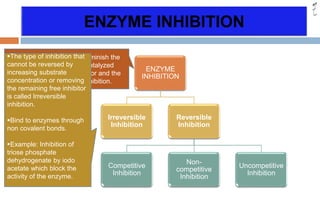
ENZYMES INHIBITION
ENZYME
INHIBITION
Irreversible
Inhibition
Reversible
Inhibition
Competitive
Inhibition
Non-
competitive
Inhibition
Uncompetitive
Inhibition
Any substance that can diminish the
velocity of an enzyme-catalyzed
reaction is called an inhibitor and the
process is known as inhibition.
The type of inhibition that
cannot be reversed by
increasing substrate
concentration or removing
the remaining free inhibitor
is called Irreversible
inhibition.
Bind to enzymes through
non covalent bonds.
Example: Inhibition of
triose phosphate
dehydrogenate by iodo
acetate which block the
activity of the enzyme.
Competiti
ve
Inhibition
Effect of Competitive
inhibitors
Examples of
Competitive Inhibitors
- Statin Drugs
This type of inhibition occurs when the inhibitor binds
reversibly to the same site that the substrate would
normally occupy, therefore, competes with the substrate
for that site.
In competitive inhibition the inhibitor and substrate
compete for the same active site on the enzyme as a
result of similarity in structure.
A classical example is Malonate that competes with
succinate and inhibits the action of succinate
dehydrogenase to produce fumarate in the Krebs cycle.
Effect on Vmax: The effect of a competitive inhibitor is
reversed by increasing at a sufficiently high substrate
concentration; the reaction velocity reaches the Vmax
observed in the absence of inhibitor.This means that the
effect remains same.
Effect on Km: A competitive inhibitor increases the
apparent Km for a given substrate. This means that in the
presence of a competitive inhibitor more substrate is
needed to achieve ½ Vmax.
This group of antihyperlipidemic agents competitively
inhibits the first committed step in cholesterol synthesis.
This reaction is catalyzed by hydroxymethylglutaryl–CoA
reductase (HMG-CoA reductase)
Statin drugs, such as atorvastatin (Lipitor) and
pravastatin (Pravachol),1 are structural analogs of the
natural substrate for this enzyme, and compete
effectively to inhibit HMG-CoA reductase.
By doing so, they inhibit de novo cholesterol synthesis,
thereby lowering plasma cholesterol levels.
Non -
Competitiv
e
Inhibition
Effect of Non
Competitive inhibitors
Examples of
Noncompetitive
Inhibitors
In non-competitive inhibition the inhibitor binds at different
site rather than the substrate-binding site.
When the inhibitor binds at this site there will be a change
in conformation of the enzyme molecules, which leads to the
reversible inactivation of the catalytic site.
Non-competitive inhibitors bind reversibly either to the free-
enzyme or the ES complex to form the inactive complexes
An Example: The inhibition of L-threonine dehydratase by
L-isoleucine. Such type of Enzyme is called Allosteric
Enzyme, which has a specific sites or allosteric site other
than the substrate-binding site.
Effect on Vmax: Non-Competitive inhibition cannot be
overcome by increasing the concentration of substrate.
Thus, non-competitive inhibitors decrease the Vmas of
the reaction.
Effect on Km: Non-competitive inhibitors do not
interfere with the binding of substrate to enzyme. Thus,
the enzyme shows the same Km in the presence or
absence of the noncompetitive inhibitor.
Some inhibitors act by forming covalent
bonds with specific groups of enzymes.
Example:
1. Lead forms covalent bonds with the
sulfhydryl side chains of cysteine in
proteins. The binding of the heavy metal
shows noncompetitive inhibition.
2. Ferrochelatase, an enzyme that catalyzes
the insertion of Fe2+ into protoporphyrin
(a precursor of heme), is an example of
an enzyme sensitive to inhibition by lead
3. Other examples of noncompetitive
inhibition are certain insecticides, whose
neurotoxic effects are a result of their
covalent binding at the catalytic site of the
enzyme acetylcholinesterase (an enzyme
that cleaves the neurotransmitter,
acetylcholine).
Un
Competitive
Inhibition
ENZYME
INHIBITORS AS
DRUGS
 IMPORTANCE OF REGULATION
 Regulation of enzyme activity is important to coordinate
the different metabolic processes.
 It is also important for homeostasis i.e. to maintain the
internal environment of the organism constant.
1. Control of enzyme quantity
• Alternating the rate of enzyme synthesis and degradation
• Induction
• Respiration
• Derespression
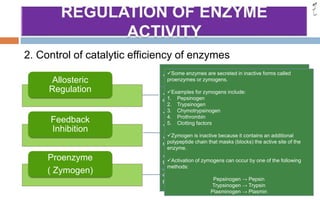
2. Control of catalytic efficiency of enzymes
• Allosteric Regulation
• Feedback Inhibition
• Proenzyme ( Zymogen)
MECHANISMS FOR REGULATION OF ENZYME
ACTIVITY
1. Control of Enzyme Quantity
Alternating the rate of enzyme
synthesis and degradation
Induction
Respiration
Derespression
As enzymes are protein in nature, they are
synthesized from amino acids under gene
control and degraded again to amino acids
after doing its work.
Enzyme quantity depends on the rate of
enzyme synthesis and the rate of its
degradation.
Increased enzyme quantity may be due to an
increase in the rate of synthesis, a decrease in
the rate of degradation or both.
Decreased enzyme quantity may be due to a
decrease in the rate of synthesis, an increase
in the rate of degradation or both.
Induction means an increase in the rate
of enzyme synthesis by substances called
inducers.
According to the response to inducers,
enzymes are classified into:
1. Constitutive enzymes, the
concentration of these enzymes does
not depend on inducers.
1. Inducible enzymes the concentration of
these enzymes depends on the
presence of inducers
Repression means a decrease in the rate of
enzyme synthesis by substances called
repressors.
Repressors are low molecular weight
substances that decrease the rate of enzyme
synthesis at the level of gene expression.
Repressors are usually end products of
biosynthetic reaction, so repression is
sometimes called feedback regulation.
Removal of the repressor or its
exhaustion, enzyme synthesis retains its
normal rate.
2. Control of catalytic efficiency of enzymes
Allosteric
Regulation
Feedback
Inhibition
Proenzyme
( Zymogen)
Allosteric means another site.
Allosteric enzyme is formed of more than one protein
subunit.
It has two sites:
1. Catalytic site for substrate binding and
2. Allosteric site that is the regulatory site, to which an
effector binds.
If binding of the effector to the enzyme increases it activity, it
is called positive effector or allosteric activator e.g. ADP is
allosteric activator for phosphofructokinase enzyme.
If binding of the effector to the enzyme causes a decrease in
its activity, it is called negative effector or allosteric inhibitor
e.g. ATP and citrate are allosteric inhibitors for
phosphofructokinase enzyme.
It means that an end product directly inhibits an
enzyme early in biosynthetic pathways.
It does not affect enzyme quantity.
It decreases enzyme activity.
It is a direct and rapid process that occurs in
seconds to -minutes.
For example, CTP inhibits aspartate-
transcarbamylase enzyme in pyrimidine synthesis
Some enzymes are secreted in inactive forms called
proenzymes or zymogens.
Examples for zymogens include:
1. Pepsinogen
2. Trypsinogen
3. Chymotrypsinogen
4. Prothrombin
5. Clotting factors
Zymogen is inactive because it contains an additional
polypeptide chain that masks (blocks) the active site of the
enzyme.
Activation of zymogens can occur by one of the following
methods:
Pepsinogen → Pepsin
Trypsinogen → Trypsin
Plasminogen → Plasmin
WAKE UPPP…!!! ITS OVERRR……
THANKS FOR YOUR PATIENCE..!!!!
ANY QUESTION ??

Enzymes

  • 1.
    ENZYMES Presented By: Dr. NayyabTariq Dr. Of Physical Therapist - DPT
  • 3.
    s are proteincatalysts for chemical reaction in biological systems. They increase the rate of chemical reactions taking place within living cells without changing themselves. Enzymes are protein catalysts for chemical reaction in biological systems. They increase the rate of chemical reactions taking place within living cells without changing themselves. It is made up of only protein molecules not bound to any non – proteins. It is made up of protein groups and non-protein component The protein component of this holo enzymes is called apoenzyme The non-protein component of the holo enzyme is called a cofactor. If this cofactor is an organic compound it is called a coenzyme If it is an inorganic group it is called activator. If the cofactor is bound so tightly to the apoenzyme and is difficult to remove without damaging the enzyme it is sometimes called a prosthetic group
  • 4.
    1. ACTIVE SITE 2.CATALYTIC EFFICIENCY 3. SPECIFICITY 4. REGULATION 5. ZYMOGENS – INACTIVE FORM 6. ISOENZYMES Enzyme molecules contain a special pocket or cleft called the active site. The active site contains amino acid chains that create a three-dimensional surface complementary to the substrate. The active site binds the substrate, forming an enzyme-substrate (ES) complex. ES is converted to enzyme-product (EP); which subsequently dissociates to enzyme and product. For the combination with substrate, each enzyme is said to possess one or more active sites where the substrate can be taken up. The active site of the enzyme may contain free hydroxyl group of serine, phenolic (hydroxyl) group of tyrosine, SH-thiol (Sulfhydryl) group of cysteine or imindazolle group of histidine to interact with there is substrates. It is also possible that the active site (Catalytic site) is different from the binding site in which case they are situated closely together in the enzyme molecule. Most enzyme- catalyzed reactions are highly efficient proceeding from 103 to 108 times faster than uncatalyzed reactions. Typically each enzyme molecule is capable of transforming 100 to 1000 substrate molecule in to product each second. Enzymes are specific for their substrate. Specificity of enzymes are divided into: 1. Absolute specificity: This means one enzyme catalyzes or acts on only one substrate. For example: Urease catalyzes hydrolysis of urea but not thiourea. 2. Stereo specificity: Some enzymes are specific to only one isomer even if the compound is one type of molecule.  *Maltase catalyzes the hydrolysis of α- but not β – glycosides. Enzyme activity can be regulated- that is, enzyme can be, activated or inhibited so that the rate of product formation responds to the needs of the cell.  Some enzymes are produced in nature in an inactive form which can be activated when they are required. Such type of enzymes is called Zymogens (Proenzymes).  Many of the digestive enzymes and enzymes concerned with blood coagulation are in this group. Examples: Pepsinogen - This zymogen is from gastric juice - when required Pepsinogen - converts to Pepsin Trypsinogen - This zymogen is found in the pancreatic juice, and when it is required gets converted to trypsin. The activation is brought about by specific ions or by other enzymes that are proteolytic. Pepsinogen + H+ Pepsin Trypsinogen Enteropeptidase Trypsin  Zymogen forms of enzymes a protective mechanism to prevent auto digestion of tissue producing the digestive enzymes and to prevent intravascular coagulation of blood. These are enzymes having: Similar catalytic activity Act on the same substrate and produces the same product Originated at different site Exhibiting different physical and chemical characteristics such as: 1. Electrophoretic Mobilities 2. Amino Acid Composition 3. Immunological Behavior
  • 6.
     Mechanism beginswith the binding of the substrate (or substrates) to the active site on the enzyme forming Enzyme-Substrate Complex.  This binding of the substrate to the enzyme causes changes in the distribution of electrons in the chemical bonds of the substrate and ultimately causes the reactions that lead to the formation of products.
  • 7.
    LOWERING OF ACTIVATION ENERGY THEORYOF ENZYME ACTION Enzymes carry out their function of lowering Activation Energy by temporarily combining with the chemicals involved in the reaction. Activation energy is the energy required to convert one mole of reacting substance from ground state to the transition state. Enzyme are said to reduce the magnitude of this activation energy. Enzyme reacts with the Substrate to form Enzyme- Substrate Complex. This is the Transition state. In Transition state, the probability of making or breaking a chemical bond to form the product is very high. This results in acceleration of the reaction forming products. During the formation of an ES complex, the substrate attaches itself to the specific active sites on the enzyme molecule by Reversible interactions formed by Electrostatic Lock and Key Model Induced Fit Model Postulated in 1890 by Emil Fischer. The lock is the enzyme and the key is the substrate. Specific shape of substrate allows it to fit into the Enzyme. Only the correctly sized key (substrate) fits into the key hole (active site) of the lock (enzyme). Smaller keys, larger keys (incorrectly shaped or sized substrate molecules) do not fit into the lock (enzyme). Formulated by Daniel Koshland in 1958 The substrate plays a role in determining the final shape of the enzyme The enzyme is partially flexible Only the proper substrate is capable of including the proper alignment of the active site.
  • 8.
  • 9.
     Physical andchemical factors are affecting the enzyme activity.  These include:
  • 10.
    1. TEMPERATURE  Temperature atwhich Enzyme shows Maximum Activity  Optiomal Temperature of Enzyme – 37 ºC
  • 11.
    2. EFFECT OF PH pHmeasures – Concentration of Hydrogen Ions. ENZYM E DENATURED ENZYME Changing in pH leads to: 1. Breakage of Ionic bonds – enzyme denatured 2. Effect the charges of amino acids – ES complex  pH at which an enzyme catalyses a reaction at the maximum rate. Examples:  Pepsin – pH 2 Pancreatic Lipase – pH 9
  • 12.
    3. CONCENTRATION OF SUBSTARTE Atfixed enzyme concentration pH and temperature the activity of enzymes is influenced by increase in substrate concentration. An increase in the substrate concentration increases the enzyme activity till a maximum is reached. Further increase in substrate concentration does not increase rate of reaction.MAXIMUM RATE (Vmax) The characteristic shape of the substrate saturation curve for an enzyme can be expressed mathematically by the Michaelis Menten equation: V = Vmax [S] / Km + [S] Where: V= Velocity at a given concentration of substrate (initial reaction velocity) Vmax = Maximal velocity possible with excess of substrate [S] = concentration of the substrate at velocity V Km = michaelis-constant of the enzyme for particular substrate.
  • 13.
    4. RELATIONSHIP OFVELOCITY TO ENZYME CONCENTRATION The rate of the reaction is directly proportional to enzyme concentration at all substrate concentration. For example, if the enzyme concentration halved, the initial rate of the reaction (Vo) is reduced to one half that of the original. Order of Reaction  When [S] is much less than Km, the velocity of the reaction is roughly proportional to the substrate concentration. When [S] is much greater than Km, the velocity is constant and equal to V max. The rate of reaction is then independent of substrate concentration and said to be zero order with respect to substrate concentration.
  • 14.
  • 15.
    ENZYME INHIBITION Irreversible Inhibition Reversible Inhibition Competitive Inhibition Non- competitive Inhibition Uncompetitive Inhibition Any substance thatcan diminish the velocity of an enzyme-catalyzed reaction is called an inhibitor and the process is known as inhibition. The type of inhibition that cannot be reversed by increasing substrate concentration or removing the remaining free inhibitor is called Irreversible inhibition. Bind to enzymes through non covalent bonds. Example: Inhibition of triose phosphate dehydrogenate by iodo acetate which block the activity of the enzyme.
  • 16.
    Competiti ve Inhibition Effect of Competitive inhibitors Examplesof Competitive Inhibitors - Statin Drugs This type of inhibition occurs when the inhibitor binds reversibly to the same site that the substrate would normally occupy, therefore, competes with the substrate for that site. In competitive inhibition the inhibitor and substrate compete for the same active site on the enzyme as a result of similarity in structure. A classical example is Malonate that competes with succinate and inhibits the action of succinate dehydrogenase to produce fumarate in the Krebs cycle. Effect on Vmax: The effect of a competitive inhibitor is reversed by increasing at a sufficiently high substrate concentration; the reaction velocity reaches the Vmax observed in the absence of inhibitor.This means that the effect remains same. Effect on Km: A competitive inhibitor increases the apparent Km for a given substrate. This means that in the presence of a competitive inhibitor more substrate is needed to achieve ½ Vmax. This group of antihyperlipidemic agents competitively inhibits the first committed step in cholesterol synthesis. This reaction is catalyzed by hydroxymethylglutaryl–CoA reductase (HMG-CoA reductase) Statin drugs, such as atorvastatin (Lipitor) and pravastatin (Pravachol),1 are structural analogs of the natural substrate for this enzyme, and compete effectively to inhibit HMG-CoA reductase. By doing so, they inhibit de novo cholesterol synthesis, thereby lowering plasma cholesterol levels.
  • 17.
    Non - Competitiv e Inhibition Effect ofNon Competitive inhibitors Examples of Noncompetitive Inhibitors In non-competitive inhibition the inhibitor binds at different site rather than the substrate-binding site. When the inhibitor binds at this site there will be a change in conformation of the enzyme molecules, which leads to the reversible inactivation of the catalytic site. Non-competitive inhibitors bind reversibly either to the free- enzyme or the ES complex to form the inactive complexes An Example: The inhibition of L-threonine dehydratase by L-isoleucine. Such type of Enzyme is called Allosteric Enzyme, which has a specific sites or allosteric site other than the substrate-binding site. Effect on Vmax: Non-Competitive inhibition cannot be overcome by increasing the concentration of substrate. Thus, non-competitive inhibitors decrease the Vmas of the reaction. Effect on Km: Non-competitive inhibitors do not interfere with the binding of substrate to enzyme. Thus, the enzyme shows the same Km in the presence or absence of the noncompetitive inhibitor. Some inhibitors act by forming covalent bonds with specific groups of enzymes. Example: 1. Lead forms covalent bonds with the sulfhydryl side chains of cysteine in proteins. The binding of the heavy metal shows noncompetitive inhibition. 2. Ferrochelatase, an enzyme that catalyzes the insertion of Fe2+ into protoporphyrin (a precursor of heme), is an example of an enzyme sensitive to inhibition by lead 3. Other examples of noncompetitive inhibition are certain insecticides, whose neurotoxic effects are a result of their covalent binding at the catalytic site of the enzyme acetylcholinesterase (an enzyme that cleaves the neurotransmitter, acetylcholine).
  • 18.
  • 20.
     IMPORTANCE OFREGULATION  Regulation of enzyme activity is important to coordinate the different metabolic processes.  It is also important for homeostasis i.e. to maintain the internal environment of the organism constant.
  • 21.
    1. Control ofenzyme quantity • Alternating the rate of enzyme synthesis and degradation • Induction • Respiration • Derespression 2. Control of catalytic efficiency of enzymes • Allosteric Regulation • Feedback Inhibition • Proenzyme ( Zymogen) MECHANISMS FOR REGULATION OF ENZYME ACTIVITY
  • 22.
    1. Control ofEnzyme Quantity Alternating the rate of enzyme synthesis and degradation Induction Respiration Derespression As enzymes are protein in nature, they are synthesized from amino acids under gene control and degraded again to amino acids after doing its work. Enzyme quantity depends on the rate of enzyme synthesis and the rate of its degradation. Increased enzyme quantity may be due to an increase in the rate of synthesis, a decrease in the rate of degradation or both. Decreased enzyme quantity may be due to a decrease in the rate of synthesis, an increase in the rate of degradation or both. Induction means an increase in the rate of enzyme synthesis by substances called inducers. According to the response to inducers, enzymes are classified into: 1. Constitutive enzymes, the concentration of these enzymes does not depend on inducers. 1. Inducible enzymes the concentration of these enzymes depends on the presence of inducers Repression means a decrease in the rate of enzyme synthesis by substances called repressors. Repressors are low molecular weight substances that decrease the rate of enzyme synthesis at the level of gene expression. Repressors are usually end products of biosynthetic reaction, so repression is sometimes called feedback regulation. Removal of the repressor or its exhaustion, enzyme synthesis retains its normal rate.
  • 23.
    2. Control ofcatalytic efficiency of enzymes Allosteric Regulation Feedback Inhibition Proenzyme ( Zymogen) Allosteric means another site. Allosteric enzyme is formed of more than one protein subunit. It has two sites: 1. Catalytic site for substrate binding and 2. Allosteric site that is the regulatory site, to which an effector binds. If binding of the effector to the enzyme increases it activity, it is called positive effector or allosteric activator e.g. ADP is allosteric activator for phosphofructokinase enzyme. If binding of the effector to the enzyme causes a decrease in its activity, it is called negative effector or allosteric inhibitor e.g. ATP and citrate are allosteric inhibitors for phosphofructokinase enzyme. It means that an end product directly inhibits an enzyme early in biosynthetic pathways. It does not affect enzyme quantity. It decreases enzyme activity. It is a direct and rapid process that occurs in seconds to -minutes. For example, CTP inhibits aspartate- transcarbamylase enzyme in pyrimidine synthesis Some enzymes are secreted in inactive forms called proenzymes or zymogens. Examples for zymogens include: 1. Pepsinogen 2. Trypsinogen 3. Chymotrypsinogen 4. Prothrombin 5. Clotting factors Zymogen is inactive because it contains an additional polypeptide chain that masks (blocks) the active site of the enzyme. Activation of zymogens can occur by one of the following methods: Pepsinogen → Pepsin Trypsinogen → Trypsin Plasminogen → Plasmin
  • 24.
    WAKE UPPP…!!! ITSOVERRR…… THANKS FOR YOUR PATIENCE..!!!! ANY QUESTION ??