Microsomal Enzymes
Dr. Renu Yadav
Resident Pharmacology
Learning Objectives
• Introduction
• Biotransformation
• Microsomal enzymes
• Cytochrome p450 enzymes
• Clinical relevance of drug metabolism
• Conclusion
Bio-transformation
• DEFINITION : Chemical alteration of the drug in the body.
Non-polar compounds to polar (lipid-insoluble) compounds.
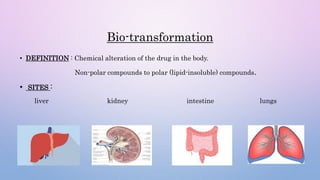
• SITES :
liver kidney intestine lungs
• ACTIONS
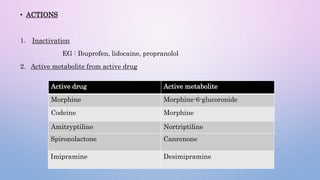
1. Inactivation
EG : Ibuprofen, lidocaine, propranolol
2. Active metabolite from active drug
Active drug Active metabolite
Morphine Morphine-6-glucoronide
Codeine Morphine
Amitryptiline Nortriptiline
Spironolactone Canrenone
Imipramine Desimipramine
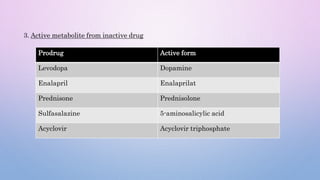
3. Active metabolite from inactive drug
Prodrug Active form
Levodopa Dopamine
Enalapril Enalaprilat
Prednisone Prednisolone
Sulfasalazine 5-aminosalicylic acid
Acyclovir Acyclovir triphosphate
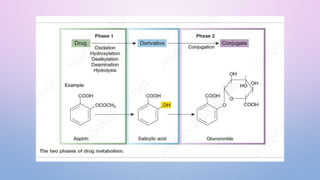
Bio-transformation Phases
Phase 1 Phase 2
• Non-Synthetic/functionalization
reactions
• Metabolite may be active or inactive
1. Oxidation
2. Reduction
3. Hydrolysis
4. Cyclization
5. De-cyclization
(On Race Honda CD)
• Synthetic / conjugation reaction
• Mostly inactive
1. Glucuronide conjugation
2. Acetylation
3. Methylation
4. Sulphate conjugation
5. Glycine conjugation
6. Glutathione conjugation
7. Ribonucleotide/nucleotide synthesis
(Get A Motor Scooter, Go Get Racing)
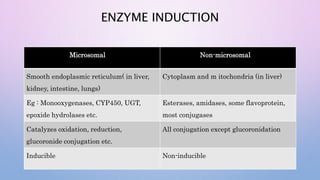
ENZYME INDUCTION
Microsomal Non-microsomal
Smooth endoplasmic reticulum( in liver,
kidney, intestine, lungs)
Cytoplasm and m itochondria (in liver)
Eg : Monooxygenases, CYP450, UGT,
epoxide hydrolases etc.
Esterases, amidases, some flavoprotein,
most conjugases
Catalyzes oxidation, reduction,
glucoronide conjugation etc.
All conjugation except glucoronidation
Inducible Non-inducible
Microsomal Enzymes
• Microsomes : ER is isolated by homogenization and fractionation of cells
reform into
Vesicles known as microsomes
• They are inducible by drugs and environmental factors and some dietary
constituents.
• For e,g
1. A component of grapefruit juice inhibits drug metabolism (leading to potentially
disastrous consequences, including cardiac dysrhythmias)
2. Brussel sprouts and cigarette smoke induce P450 enzymes.
3. Components of the herbal medicine St John’s wort induces CYP450 isoenzymes as
well as P-glycoprotein (P-gp)
Different Microsomal Enzymes
• Flavin monooxygenases
• Cytochrome p450
• UDP glucoronosyl transferases
• Glutathione s transferases
• Epoxide hydrolases
• Carboxyl esterases
Cytochrome P450
• Cytochrome P450 enzymes are heme proteins, comprising a large family (‘superfamily’)
each referred to as CYP followed by a defining set of numbers and a letter.
• P450 because reduced heme protein binds with CO to form a complex that absorbs light
maximally at 450nm.
• Not all 57 human CYPs are involved in drug metabolism.
• CYP enzymes in families 1–3 mediate 70%–80% of all drug metabolism.
• Twelve CYPs accounted for 93.0% of drug metabolism.
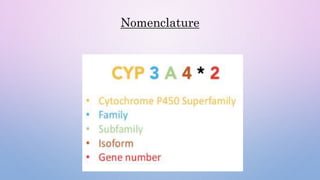
Nomenclature
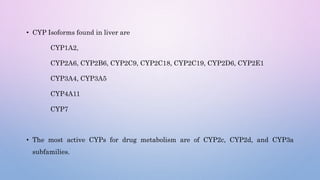
• CYP Isoforms found in liver are
CYP1A2,
CYP2A6, CYP2B6, CYP2C9, CYP2C18, CYP2C19, CYP2D6, CYP2E1
CYP3A4, CYP3A5
CYP4A11
CYP7
• The most active CYPs for drug metabolism are of CYP2c, CYP2d, and CYP3a
subfamilies.
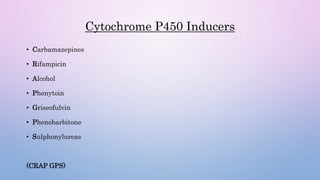
Cytochrome P450 Inducers
• Carbamazepines
• Rifampicin
• Alcohol
• Phenytoin
• Griseofulvin
• Phenobarbitone
• Sulphonylureas
(CRAP GPS)
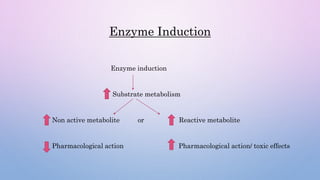
Enzyme Induction
Enzyme induction
Substrate metabolism
Non active metabolite or Reactive metabolite
Pharmacological action Pharmacological action/ toxic effects
Drug interaction due to enzyme induction
Auto-induction : Because the inducing agent is often itself a substrate for the induced
enzymes, the process can result in slowly developing tolerance
Eg: carbamazepine, rifampicin, nevirapine dose needed to be doubled after 2 weeks.
Enzyme induction can increase toxicity of an active metabolite of paracetamol by its
metabolite N-acetyl-P-benzoquinone imine (NAPQI).
The risk of serious hepatic injury following paracetamol overdose is increased in
patients in whom CYP has been induced, for example, by chronic alcohol Consumption.
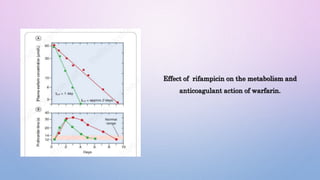
Antibiotic rifampicin, given for 3 days, reduces the effectiveness of warfarin as an
anticoagulant.
Effect of rifampicin on the metabolism and
anticoagulant action of warfarin.
Therapeutic Uses Of Enzyme Induction
• Non-hemolytic anemia : Its due to deficient glucuronidation of bilirubin,
phenobarbitone hastens its clearance.
• Cushings syndrome: Phenytoin may reduce the manifestation by enhancing
degradation of adrenal steroids.
• Chronic poisoning
• Liver diseases.
Enzyme Inhibition
• Competitive inhibition of co-administered drug : Cimetidine ,
Ketoconazole,
Erythromycin
• Suicidal inhibition : Chloramphenicol
Clopidogrel
Ritonavir
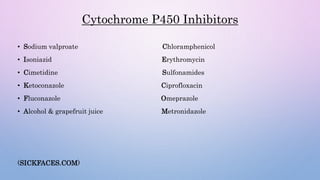
Cytochrome P450 Inhibitors
• Sodium valproate Chloramphenicol
• Isoniazid Erythromycin
• Cimetidine Sulfonamides
• Ketoconazole Ciprofloxacin
• Fluconazole Omeprazole
• Alcohol & grapefruit juice Metronidazole
(SICKFACES.COM)
Drug Interaction Due To Enzyme Inhibition
• Several inhibitors of drug metabolism influence the metabolism of different
stereoisomers selectively.
• Examples of drugs that inhibit the metabolism of the active (S) and less active (R)
isomers of warfarin
Inhibition of metabolism drugs
Stereoselective for ( S ) isomer Phenylbutazone
Metronidazole
Sulfinpyrazone
Trimethoprim–
sulfamethoxazole
Disulfiram
Stereoselective for ( R ) isomer Cimetidine
Omeprazole
Non-stereoselective amiodarone
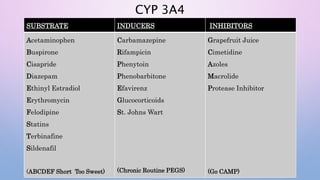
CYP 3A4
SUBSTRATE INDUCERS INHIBITORS
Acetaminophen
Buspirone
Cisapride
Diazepam
Ethinyl Estradiol
Erythromycin
Felodipine
Statins
Terbinafine
Sildenafil
(ABCDEF Short Too Sweet)
Carbamazepine
Rifampicin
Phenytoin
Phenobarbitone
Efavirenz
Glucocorticoids
St. Johns Wart
(Chronic Routine PEGS)
Grapefruit Juice
Cimetidine
Azoles
Macrolide
Protease Inhibitor
(Go CAMP)
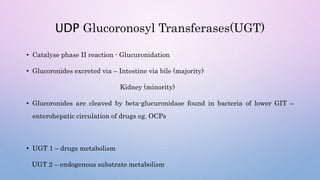
UDP Glucoronosyl Transferases(UGT)
• Catalyse phase II reaction - Glucuronidation
• Glucoronides excreted via – Intestine via bile (majority)
Kidney (minority)
• Glucoronides are cleaved by beta-glucuronidase found in bacteria of lower GIT –
enterohepatic circulation of drugs eg. OCPs
• UGT 1 – drugs metabolism
UGT 2 – endogenous substrate metabolism
Flavin Monooxygenases
• Phase I reaction
• 6 families are present
• FMO 3 is most abundant in human liver
• They are not induced or inhibited by any drug
Not involved in drug-drug interaction
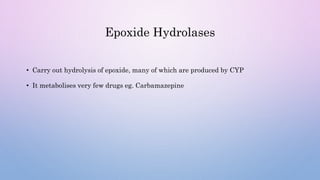
Epoxide Hydrolases
• Carry out hydrolysis of epoxide, many of which are produced by CYP
• It metabolises very few drugs eg. Carbamazepine
Glutathione S Transferases (GST)
• Found in both ER and cytosol
• Microsomal form – metabolism of endogenous leukotrienes and prostaglandins
• Cytosolic form – conjugation, reduction, isomerization reaction of drug metabolism.
Factors Affecting Drug Metabolism
Genetic Factors Non-genetic Factors
Genetic polymorphism Commensal Gut Microflora
Diet And Envt Factors
Age And Sex
Concurrent Exposure To Inhibitors or Inducers
Diseases
Genetic Polymorphism
• Definition : Occurrence of a variant allele of a gene at a population frequency more
than 1%, resulting in altered expression of functional activity of the gene product, or
both.
• Based on metabolic ratio, individuals are divided into 1- Poor metabolisers
2- Extensive metabolisers
3- Ultra rapid metabolisers
• Metabolic Ratio = Percentage of dose excreted as unchanged drug
Percent of dose excreted as metabolite in urine
Conclusion
• Understanding drug metabolism and interaction within the body allows principles of
biotransformation to be applied in better designing and therapeutic uses of drug.
• Increased understanding of biotransformation based on pharmacogenomics will also
render pharmacologic treatment of disease more individualised, efficacious and safe.
THANK YOU

Microsomal enzyme induction

  • 1.
    Microsomal Enzymes Dr. RenuYadav Resident Pharmacology
  • 2.
    Learning Objectives • Introduction •Biotransformation • Microsomal enzymes • Cytochrome p450 enzymes • Clinical relevance of drug metabolism • Conclusion
  • 3.
    Bio-transformation • DEFINITION :Chemical alteration of the drug in the body. Non-polar compounds to polar (lipid-insoluble) compounds. • SITES : liver kidney intestine lungs
  • 4.
    • ACTIONS 1. Inactivation EG: Ibuprofen, lidocaine, propranolol 2. Active metabolite from active drug Active drug Active metabolite Morphine Morphine-6-glucoronide Codeine Morphine Amitryptiline Nortriptiline Spironolactone Canrenone Imipramine Desimipramine
  • 5.
    3. Active metabolitefrom inactive drug Prodrug Active form Levodopa Dopamine Enalapril Enalaprilat Prednisone Prednisolone Sulfasalazine 5-aminosalicylic acid Acyclovir Acyclovir triphosphate
  • 6.
    Bio-transformation Phases Phase 1Phase 2 • Non-Synthetic/functionalization reactions • Metabolite may be active or inactive 1. Oxidation 2. Reduction 3. Hydrolysis 4. Cyclization 5. De-cyclization (On Race Honda CD) • Synthetic / conjugation reaction • Mostly inactive 1. Glucuronide conjugation 2. Acetylation 3. Methylation 4. Sulphate conjugation 5. Glycine conjugation 6. Glutathione conjugation 7. Ribonucleotide/nucleotide synthesis (Get A Motor Scooter, Go Get Racing)
  • 8.
    ENZYME INDUCTION Microsomal Non-microsomal Smoothendoplasmic reticulum( in liver, kidney, intestine, lungs) Cytoplasm and m itochondria (in liver) Eg : Monooxygenases, CYP450, UGT, epoxide hydrolases etc. Esterases, amidases, some flavoprotein, most conjugases Catalyzes oxidation, reduction, glucoronide conjugation etc. All conjugation except glucoronidation Inducible Non-inducible
  • 9.
    Microsomal Enzymes • Microsomes: ER is isolated by homogenization and fractionation of cells reform into Vesicles known as microsomes
  • 10.
    • They areinducible by drugs and environmental factors and some dietary constituents. • For e,g 1. A component of grapefruit juice inhibits drug metabolism (leading to potentially disastrous consequences, including cardiac dysrhythmias) 2. Brussel sprouts and cigarette smoke induce P450 enzymes. 3. Components of the herbal medicine St John’s wort induces CYP450 isoenzymes as well as P-glycoprotein (P-gp)
  • 11.
    Different Microsomal Enzymes •Flavin monooxygenases • Cytochrome p450 • UDP glucoronosyl transferases • Glutathione s transferases • Epoxide hydrolases • Carboxyl esterases
  • 12.
    Cytochrome P450 • CytochromeP450 enzymes are heme proteins, comprising a large family (‘superfamily’) each referred to as CYP followed by a defining set of numbers and a letter. • P450 because reduced heme protein binds with CO to form a complex that absorbs light maximally at 450nm. • Not all 57 human CYPs are involved in drug metabolism. • CYP enzymes in families 1–3 mediate 70%–80% of all drug metabolism. • Twelve CYPs accounted for 93.0% of drug metabolism.
  • 13.
  • 14.
    • CYP Isoformsfound in liver are CYP1A2, CYP2A6, CYP2B6, CYP2C9, CYP2C18, CYP2C19, CYP2D6, CYP2E1 CYP3A4, CYP3A5 CYP4A11 CYP7 • The most active CYPs for drug metabolism are of CYP2c, CYP2d, and CYP3a subfamilies.
  • 16.
    Cytochrome P450 Inducers •Carbamazepines • Rifampicin • Alcohol • Phenytoin • Griseofulvin • Phenobarbitone • Sulphonylureas (CRAP GPS)
  • 17.
    Enzyme Induction Enzyme induction Substratemetabolism Non active metabolite or Reactive metabolite Pharmacological action Pharmacological action/ toxic effects
  • 18.
    Drug interaction dueto enzyme induction Auto-induction : Because the inducing agent is often itself a substrate for the induced enzymes, the process can result in slowly developing tolerance Eg: carbamazepine, rifampicin, nevirapine dose needed to be doubled after 2 weeks. Enzyme induction can increase toxicity of an active metabolite of paracetamol by its metabolite N-acetyl-P-benzoquinone imine (NAPQI). The risk of serious hepatic injury following paracetamol overdose is increased in patients in whom CYP has been induced, for example, by chronic alcohol Consumption. Antibiotic rifampicin, given for 3 days, reduces the effectiveness of warfarin as an anticoagulant.
  • 19.
    Effect of rifampicinon the metabolism and anticoagulant action of warfarin.
  • 20.
    Therapeutic Uses OfEnzyme Induction • Non-hemolytic anemia : Its due to deficient glucuronidation of bilirubin, phenobarbitone hastens its clearance. • Cushings syndrome: Phenytoin may reduce the manifestation by enhancing degradation of adrenal steroids. • Chronic poisoning • Liver diseases.
  • 21.
    Enzyme Inhibition • Competitiveinhibition of co-administered drug : Cimetidine , Ketoconazole, Erythromycin • Suicidal inhibition : Chloramphenicol Clopidogrel Ritonavir
  • 22.
    Cytochrome P450 Inhibitors •Sodium valproate Chloramphenicol • Isoniazid Erythromycin • Cimetidine Sulfonamides • Ketoconazole Ciprofloxacin • Fluconazole Omeprazole • Alcohol & grapefruit juice Metronidazole (SICKFACES.COM)
  • 23.
    Drug Interaction DueTo Enzyme Inhibition • Several inhibitors of drug metabolism influence the metabolism of different stereoisomers selectively. • Examples of drugs that inhibit the metabolism of the active (S) and less active (R) isomers of warfarin Inhibition of metabolism drugs Stereoselective for ( S ) isomer Phenylbutazone Metronidazole Sulfinpyrazone Trimethoprim– sulfamethoxazole Disulfiram Stereoselective for ( R ) isomer Cimetidine Omeprazole Non-stereoselective amiodarone
  • 24.
    CYP 3A4 SUBSTRATE INDUCERSINHIBITORS Acetaminophen Buspirone Cisapride Diazepam Ethinyl Estradiol Erythromycin Felodipine Statins Terbinafine Sildenafil (ABCDEF Short Too Sweet) Carbamazepine Rifampicin Phenytoin Phenobarbitone Efavirenz Glucocorticoids St. Johns Wart (Chronic Routine PEGS) Grapefruit Juice Cimetidine Azoles Macrolide Protease Inhibitor (Go CAMP)
  • 25.
    UDP Glucoronosyl Transferases(UGT) •Catalyse phase II reaction - Glucuronidation • Glucoronides excreted via – Intestine via bile (majority) Kidney (minority) • Glucoronides are cleaved by beta-glucuronidase found in bacteria of lower GIT – enterohepatic circulation of drugs eg. OCPs • UGT 1 – drugs metabolism UGT 2 – endogenous substrate metabolism
  • 26.
    Flavin Monooxygenases • PhaseI reaction • 6 families are present • FMO 3 is most abundant in human liver • They are not induced or inhibited by any drug Not involved in drug-drug interaction
  • 27.
    Epoxide Hydrolases • Carryout hydrolysis of epoxide, many of which are produced by CYP • It metabolises very few drugs eg. Carbamazepine
  • 28.
    Glutathione S Transferases(GST) • Found in both ER and cytosol • Microsomal form – metabolism of endogenous leukotrienes and prostaglandins • Cytosolic form – conjugation, reduction, isomerization reaction of drug metabolism.
  • 29.
    Factors Affecting DrugMetabolism Genetic Factors Non-genetic Factors Genetic polymorphism Commensal Gut Microflora Diet And Envt Factors Age And Sex Concurrent Exposure To Inhibitors or Inducers Diseases
  • 30.
    Genetic Polymorphism • Definition: Occurrence of a variant allele of a gene at a population frequency more than 1%, resulting in altered expression of functional activity of the gene product, or both. • Based on metabolic ratio, individuals are divided into 1- Poor metabolisers 2- Extensive metabolisers 3- Ultra rapid metabolisers • Metabolic Ratio = Percentage of dose excreted as unchanged drug Percent of dose excreted as metabolite in urine
  • 31.
    Conclusion • Understanding drugmetabolism and interaction within the body allows principles of biotransformation to be applied in better designing and therapeutic uses of drug. • Increased understanding of biotransformation based on pharmacogenomics will also render pharmacologic treatment of disease more individualised, efficacious and safe.
  • 32.

Editor's Notes

  • #8 Phase 1 reactions often introduce a reactive group, such as hydroxyl, into the molecule, a process known as ‘functionalisation’. This group then serves as the point of attack for the conjugating system to attach a substituent such as glucuronide explaining why phase 1 reactions so often precede phase 2 reactions
  • #9 Both microsomal and non-microsomal enzymes are deficient in new born ESP PREMATURE, hence making them more susceptible to many drugs.
  • #16 Each of the pink or blue rectangles represents one single molecule of cytochrome P450 (P450) undergoing a catalytic cycle. Iron in P450 is in either the ferric (pink rectangles) or ferrous (blue rectangles) state. P450 containing ferric iron (fe3+) combines with a molecule of drug (‘DH’), and receives an electron from NADPH– P450 reductase, which reduces the iron to fe2+. This combines with molecular oxygen, a proton and a second electron (either from NADPH–P450 reductase or from cytochrome b5) to form an fe2+ooh–dh complex. This combines with another proton to yield water and a ferric oxene (feo)3+–dh complex. (Feo)3+ extracts a hydrogen atom from DH, with the formation of a pair of short-lived free radicals (see text), liberation from the complex of oxidised drug (‘DOH’), and regeneration of P450 enzyme.
  • #19 (When starting treatment with the antiepileptic drug carbamazepine. Treatment starts at a low dose to avoid toxicity (because liver enzymes are not induced initially) and is gradually increased over a period of a few weeks, during which it induces its own metabolism)