Enzyme
Yubraj Bhatta
M.sc. MLT Clinical Biochemistry
bhattayuvraj12@gmail.com
Enzyme
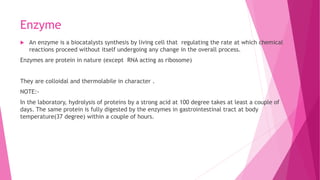
 An enzyme is a biocatalysts synthesis by living cell that regulating the rate at which chemical
reactions proceed without itself undergoing any change in the overall process.
Enzymes are protein in nature (except RNA acting as ribosome)
They are colloidal and thermolabile in character .
NOTE:-
In the laboratory, hydrolysis of proteins by a strong acid at 100 degree takes at least a couple of
days. The same protein is fully digested by the enzymes in gastrointestinal tract at body
temperature(37 degree) within a couple of hours.
Classification of enzymes
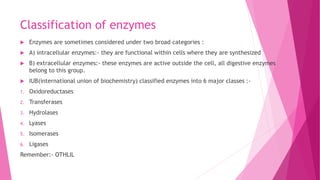
 Enzymes are sometimes considered under two broad categories :
 A) intracellular enzymes:- they are functional within cells where they are synthesized
 B) extracellular enzymes:- these enzymes are active outside the cell, all digestive enzymes
belong to this group.
 IUB(international union of biochemistry) classified enzymes into 6 major classes :-
1. Oxidoreductases
2. Transferases
3. Hydrolases
4. Lyases
5. Isomerases
6. Ligases
Remember:- OTHLIL
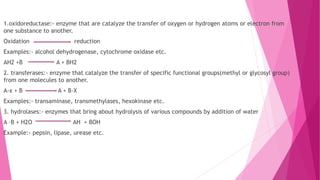
1.oxidoreductase:- enzyme that are catalyze the transfer of oxygen or hydrogen atoms or electron from
one substance to another.
Oxidation reduction
Examples:- alcohol dehydrogenase, cytochrome oxidase etc.
AH2 +B A + BH2
2. transferases:- enzyme that catalyze the transfer of specific functional groups(methyl or glycosyl group)
from one molecules to another.
A-x + B A + B-X
Examples:- transaminase, transmethylases, hexokinase etc.
3. hydrolases:- enzymes that bring about hydrolysis of various compounds by addition of water
A –B + H2O AH + BOH
Example:- pepsin, lipase, urease etc.
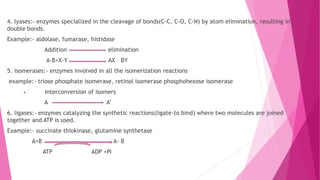
4. lyases:- enzymes specialized in the cleavage of bonds(C-C, C-O, C-N) by atom elimination, resulting in
double bonds.
Example:- aldolase, fumarase, histidase
Addition elimination
A-B+X-Y AX – BY
5. isomerases:- enzymes involved in all the isomerization reactions
example:- triose phosphate isomerase, retinol isomerase phosphohexose isomerase
interconversion of isomers
A A’
6. ligases:- enzymes catalyzing the synthetic reactions(ligate-to bind) where two molecules are joined
together and ATP is used.
Example:- succinate thiokinase, glutamine synthetase
A+B A- B
ATP ADP +Pi
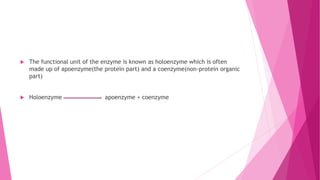
 The functional unit of the enzyme is known as holoenzyme which is often
made up of apoenzyme(the protein part) and a coenzyme(non-protein organic
part)
 Holoenzyme apoenzyme + coenzyme
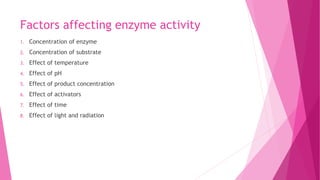
Factors affecting enzyme activity
1. Concentration of enzyme
2. Concentration of substrate
3. Effect of temperature
4. Effect of pH
5. Effect of product concentration
6. Effect of activators
7. Effect of time
8. Effect of light and radiation
Factor affecting enzymes
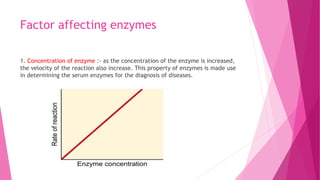
1. Concentration of enzyme :- as the concentration of the enzyme is increased,
the velocity of the reaction also increase. This property of enzymes is made use
in determining the serum enzymes for the diagnosis of diseases.
2. Concentration of substrate
 Increase in the substrate concentration gradually increase the velocity of
enzyme reaction within the limited range of substrate level.
3.Effect of temperature
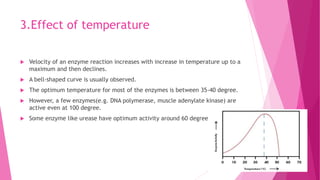
 Velocity of an enzyme reaction increases with increase in temperature up to a
maximum and then declines.
 A bell-shaped curve is usually observed.
 The optimum temperature for most of the enzymes is between 35-40 degree.
 However, a few enzymes(e.g. DNA polymerase, muscle adenylate kinase) are
active even at 100 degree.
 Some enzyme like urease have optimum activity around 60 degree.
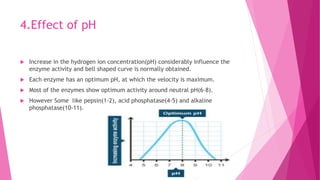
4.Effect of pH
 Increase in the hydrogen ion concentration(pH) considerably influence the
enzyme activity and bell shaped curve is normally obtained.
 Each enzyme has an optimum pH, at which the velocity is maximum.
 Most of the enzymes show optimum activity around neutral pH(6-8).
 However Some like pepsin(1-2), acid phosphatase(4-5) and alkaline
phosphatase(10-11).
5. Effect of product concentration
 The accumulation of reaction products generally decreases the enzyme velocity.
6.EFFECT OF ACTIVATORS:-
Some of the enzymes require certain inorganic metallic cations like mg++, Mg++, Mn++,Zn++, Ca++, Cu++
etc. for their optimum activity.
Rarely anions are also needed for enzyme activity e.g. chloride ion for amylase
Enzymes requiring metal for their activity are:-
1. Metal-activated enzymes:-
-The metal is not tightly held by the enzyme and can be exchanged easily other ions.
e.g. ATpase(Mg++ and Ca++), Enolase(Mg++)
2. Metalloenzymes:-
-these enzymes hold the metals rather tightly which are not readily exchanged.
e.g. alcohol dehydrogenase, carbonic anhydrase, alkaline phosphatase.
7. Effect of time:-
- Under ideal and optimal conditions(like pH, temperature etc.), the time required for an
enzyme reaction is less. Variations in the time of the reaction are generally related to the
alterations in pH and temperature.
8. Effect of light and radiation:-
- Exposure of enzymes to ultraviolet, beta, gamma and X-rays inactivates certain enzymes due
to the formation of peroxides.
- E.g. UV rays inhibits salivary amylase activity.
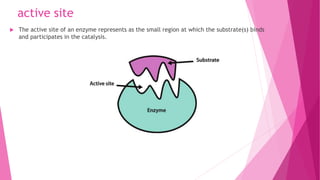
active site
 The active site of an enzyme represents as the small region at which the substrate(s) binds
and participates in the catalysis.
Salient features of active site
1. The existence of active site is due to the tertiary structure of protein resulting in three
dimensional native conformation.
2. The active site is made up of amino acids which are far from each other in the linear
sequence of amino acids.
3. Actives sites are regarded as clefts or pockets occupying a small region in a big enzyme
molecule.
4. The active is not rigid in structure and shape. It is rather flexible to promote the specific
substrate binding.
5. Generally the active site possesses a substrate binding site and catalytic site.
6. The substrate(s) binds at the active site by weak noncovalent bonds.
7. Enzymes are specific in their function due to the existence of active sites.
8. The substrate(s) binds the enzyme€ at the active site to form enzyme-substrate
complex(ES)
Enzyme inhibition
 Enzyme inhibitor is defined as a substance which binds with the enzyme and
bring about a decrease in catalytic of that enzyme.
 The inhibitor may be organic or inorganic in nature.
 Categories of enzyme inhibition are:-
1. Reversible inhibition.
2. Irreversible inhibition
3. Allosteric inhibition
1. Reversible inhibition
 The inhibitor binds non-covalently with enzyme and the enzyme inhibition can
be reversed if the inhibitor is removed.
 The reversible inhibitor is further sub-divided into
A). Competitive inhibition
B). Non-competitive inhibition
C). Uncompetitive inhibition
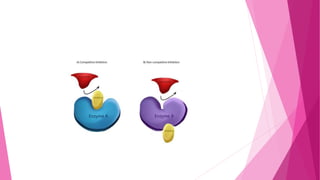
A). Competitive inhibition:-
- The inhibitor which closely resembles the real substrate.
- The inhibitor competes with substrate and binds at the active site of the
enzyme but does not undergo any catalysis.
- E.g. the enzyme succinate dehydrogenase(SDH) is example of competitive
inhibition with succinic acid as its substrate. Malonic acid, glutamic acid and
oxalic acid compete with the substrate for binding at the active site of SDH.
Non competitive inhibition
 The inhibitor binds at binds at a site other than the active site on the enzyme
surface.
 The inhibitor has no structural resemble with the substrate.
 This binding impairs the enzyme function.
 The inhibitor generally binds with the enzyme as well as the ES complex.
 Heavy metal ions(Ag++, Pb++, Hg++ etc.) can non-competitively inhibit the
enzymes the sulfhydryl groups.
Uncompetitive inhibition
 This is also known as anti-competitive inhibition.
 The inhibitor binds to the enzyme-substrate complex(ES) and not to the free
enzyme.
 Thus, ES complex should be formed prior to the binding of uncompetitive
inhibitor.
 An uncompetitive inhibitor need not have any structural resemblance with
the substrate.
 E.g. inhibition of placental alkaline phosphatase by phenylalanine.
Irreversible inhibition
 The inhibitor bind covalently with the enzymes and inactivate them, which is
irreversible.
 These inhibitors are usually toxic substances that poison enzymes.
e.g. iodoacetate is an irreversible inhibitor of the enzymes like papain and
glyceraldehyde 3-phosphate dehydrogenase.
Iodoacetate combines with sulfhydryl(-SH) group at the active site of these
enzymes and makes them inactive.
The penicillin antibiotics act as irreversible inhibitors of serine- containing
enzymes, and block the bacterial cell wall synthesis.
Fluorite inhibit enolase.
Suicide inhibition
 Suicide inhibition is a specialized form of irreversible inhibition.
 In this case, the original inhibitor is converted to a more potent form by the
same enzyme that ought to be inhibited.
 Inhibitor binds irreversibly with the enzyme.
 E.g. allopurinol(used in treatment of gout) an inhibitor of xanthine oxidase,
gets converted to alloxanthine, more effective inhibitor of this enzyme.
 E.g. aspirin inhibits cyclooxygenase of prostaglandin synthesis.
 E.g. zidovudine(AZT) used in the treatment of AIDS inhibit the enzyme reverse
transcriptase.
3. Allosteric inhibition
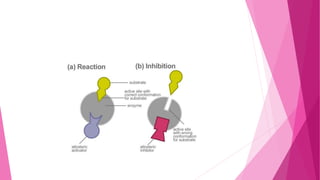
 Some of the enzymes possess additional sites, known as allosteric sites,
besides the active site. Such enzyme are known as allosteric enzymes.
 The enzyme activity is increased when a positive(+) allosteric effector binds
at the allosteric site is known as activator site.
 When negative(-) allosteric effector binds at the allosteric site is known as
inhibitor site and inhibits the enzyme activity.
Mechanism of enzyme action
 Catalysis is the prime function of enzymes.
 Enzymes are powerful catalyst.
 The energy required by the reactants to undergo the reaction is known as
activation energy.
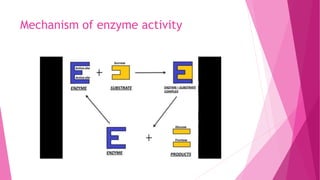
 The substrate must combine with the enzyme(E) at the active site to form
enzyme-substrate complex(ES) which ultimately result in the product
formation(P)
 E + S ES E + P
Mechanism of enzyme activity
Theories that explain
1. Lock and key model theory
2. Induced fit theory or koshland’s model
3. Substrate strain theory
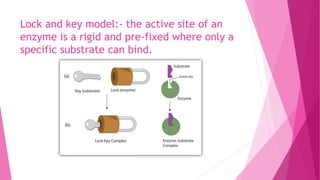
Lock and key model:- the active site of an
enzyme is a rigid and pre-fixed where only a
specific substrate can bind.
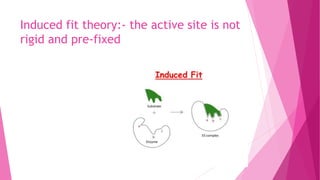
Induced fit theory:- the active site is not
rigid and pre-fixed
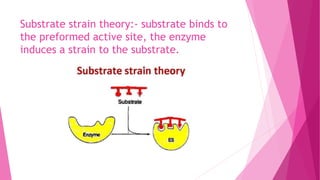
Substrate strain theory:- substrate binds to
the preformed active site, the enzyme
induces a strain to the substrate.
Regulation of enzyme activity in the living
system:- in biological system, regulation of
enzyme activities occurs at different stages
in one or more of the following ways:-
1. Allosteric regulation
2. Activation of latent enzymes
3. Compartmentation of metabolic pathways
4. Control of enzyme synthesis
5. Enzyme degradation
6. isoenzymes
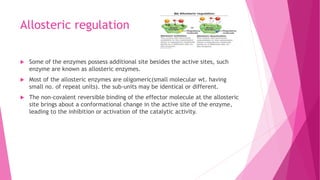
Allosteric regulation
 Some of the enzymes possess additional site besides the active sites, such
enzyme are known as allosteric enzymes.
 Most of the allosteric enzymes are oligomeric(small molecular wt. having
small no. of repeat units). the sub-units may be identical or different.
 The non-covalent reversible binding of the effector molecule at the allosteric
site brings about a conformational change in the active site of the enzyme,
leading to the inhibition or activation of the catalytic activity.
2).Active and inactive enzymes:-
- Latent enzymes, are inactive.
- Some enzymes are synthesized as proenzyme which undergo irreversible
covalent activation by the breakdown of one or more peptide bonds.
- E.g. chymotrypsin, pepsinogen and plasminogen are respectively converted to
the active enzymes chymotrypsin, pepsin and plasmin.
- Certain enzymes exist in the active and inactive forms which are
interconvertible, depending on the needs of the body.
- The interconversion is brought about by the phosphorylation and
dephosphorylation, and oxidation and reduction of disulfide bonds.
3. compartmentation:-
- There are certain substance in the body which are synthesized and also degraded.
- The enzymes for fatty acid synthesis are found in the cytosol whereas enzymes for
fatty acid oxidation are present in the mitochondria.
4. Control of enzyme synthesis:-
- Most of the enzymes, particularly the rate limiting ones, are present in very low
concentration.
- Many rate limiting enzymes have short half-lives.
- There are two types of enzymes
- A). Constitutive enzymes:- the level of which are not controlled and remain
fairly(justly) constant
- B). Adaptive enzymes:- their concentration increase or decrease as per body needs
and are well- regulated.
5. Enzyme degradation:-
- Enzymes are not immortal.
- The half-lives of some enzyme are days, some enzyme are hours.
- e.g. LDH4- 5 to 6 days, LDH1 8 to 12 hours, amylase- 3 to 5 hours
- In general regulatory enzymes are most rapidly degraded.
- If not needed, they immediately disappear and when required, they are quickly synthesized.
6. isoenzymes:-
- Multiple forms of the same enzyme are called isoenzyme .
- These also help in the regulation of enzyme activity.
e.g. isoenzyme of LDH(lactate dehydrogenase) are LDH1, LDH2, LDH3, LDH4, LDH5
Units of enzyme activity
 Enzyme are never expressed in terms of their concentration( as mg or
microgram etc.) but expressed only as activities.
 Units of enzyme activity expressed in katal, millikatal, microkatals nano
katal, IU(international unit)
 1 IU= 16.67 nkat.
 Enzyme activities also have been expressed in king-Armstrong units, Somogyi
units, Reitman-frankel units and spectrophotometric unit.
Application of enzymes
A). Therapeutic application
B). Analytical application reagents
c). Application in genetic engineering
D). Industrial application
A). Therapeutic application:-
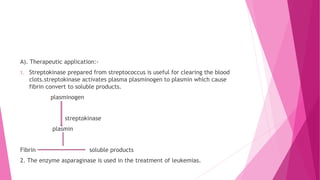
1. Streptokinase prepared from streptococcus is useful for clearing the blood
clots.streptokinase activates plasma plasminogen to plasmin which cause
fibrin convert to soluble products.
plasminogen
streptokinase
plasmin
Fibrin soluble products
2. The enzyme asparaginase is used in the treatment of leukemias.
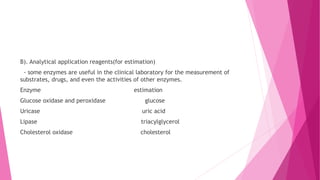
B). Analytical application reagents(for estimation)
- some enzymes are useful in the clinical laboratory for the measurement of
substrates, drugs, and even the activities of other enzymes.
Enzyme estimation
Glucose oxidase and peroxidase glucose
Uricase uric acid
Lipase triacylglycerol
Cholesterol oxidase cholesterol
C). Application in genetic engineering:-
Restriction endonucleases gene transfer, DNA finger printing
DNA polymerase polymerase chain reaction
D). Industrial applications:-
Renin cheese preparation
Glucose isomerase production of high fructose syrup
Alpha amylase in food industry
Proteases washing powder
Plasma/serum enzymes
 Enzymes in the circulation are divided into two groups- plasma functional and
plasma non-functional.
1. Plasma specific or plasma functional enzymes:-
- certain enzymes are normally present in the plasma and they have specific
function to perform. These enzyme activities are higher in plasma than in the
tissues.
e.g. lipoprotein lipase, plasmin, thrombin, ceruloplasmin etc.
2. non-plasma specific or plasma non-functional enzymes:-
- These enzymes are either totally absent or present at a low concentration in
plasma compared to their levels found in the tissues.
- E.g. amylase, pepsin, trypsin, lipase etc.
Diagnostic importance of enzymes
 Estimation of enzymes activities in plasma/serum is of great clinical
importance.
 Particularly non-plasma specific enzyme are very important for the diagnosis
and prognosis of several diseases.
 The raised enzymes levels could be due to cellular damage, increased rate of
cell turnover, proliferation of cells, increased synthesis of enzymes etc.
Coenzymes
 The non-protein, organic, low molecular weight and dialysable substance
associated with enzyme function is known as coenzyme.
 The functional enzyme is referred to as holoenzyme which is made up of a
protein part(apoenzyme) and a non-protein part(coenzyme).
 Cofactor may be organic or inorganic in nature.
 Coenzymes are second substrates
Function of co-enzyme
Isoenzymes
 The multiple forms of an enzyme catalyzing the same reaction are isoenzymes
or isozymes.
Feature of isoenzymes:-
 They are differ in their physical and chemical properties.
 Isoenzymes synthesized from different genes . E.g. malate dehydrogenase of
cytosol is different from that found in mitochondria.
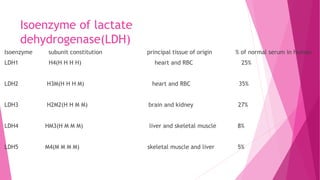
Isoenzyme of lactate
dehydrogenase(LDH)
Isoenzyme subunit constitution principal tissue of origin % of normal serum in human
LDH1 H4(H H H H) heart and RBC 25%
LDH2 H3M(H H H M) heart and RBC 35%
LDH3 H2M2(H H M M) brain and kidney 27%
LDH4 HM3(H M M M) liver and skeletal muscle 8%
LDH5 M4(M M M M) skeletal muscle and liver 5%
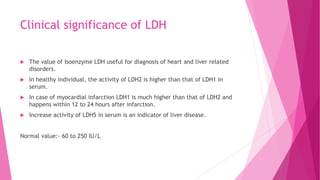
Clinical significance of LDH
 The value of Isoenzyme LDH useful for diagnosis of heart and liver related
disorders.
 In healthy individual, the activity of LDH2 is higher than that of LDH1 in
serum.
 In case of myocardial infarction LDH1 is much higher than that of LDH2 and
happens within 12 to 24 hours after infarction.
 Increase activity of LDH5 in serum is an indicator of liver disease.
Normal value:- 60 to 250 IU/L
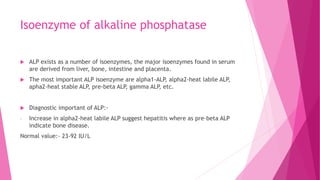
Isoenzyme of alkaline phosphatase
 ALP exists as a number of isoenzymes, the major isoenzymes found in serum
are derived from liver, bone, intestine and placenta.
 The most important ALP isoenzyme are alpha1-ALP, alpha2-heat labile ALP,
apha2-heat stable ALP, pre-beta ALP, gamma ALP, etc.
 Diagnostic important of ALP:-
- Increase in alpha2-heat labile ALP suggest hepatitis where as pre-beta ALP
indicate bone disease.
Normal value:- 23-92 IU/L
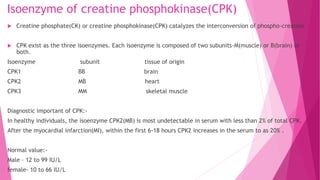
Isoenzyme of creatine phosphokinase(CPK)
 Creatine phosphate(CK) or creatine phosphokinase(CPK) catalyzes the interconversion of phospho-creatine
 CPK exist as the three isoenzymes. Each isoenzyme is composed of two subunits-M(muscle) or B(brain) or
both.
Isoenzyme subunit tissue of origin
CPK1 BB brain
CPK2 MB heart
CPK3 MM skeletal muscle
Diagnostic important of CPK:-
In healthy individuals, the isoenzyme CPK2(MB) is most undetectable in serum with less than 2% of total CPK.
After the myocardial infarction(MI), within the first 6-18 hours CPK2 increases in the serum to as 20% .
Normal value:-
Male – 12 to 99 IU/L
female- 10 to 66 IU/L
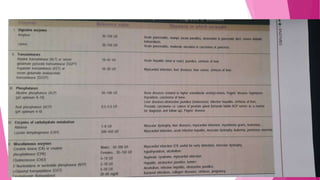
Enzyme pattern in diseases
 Enzymes in myocardial infarction(MI):-
- The enzymes creatine phosphokinase(CPK), aspartate transaminase(AST) and
lactate dehydrogenase(LDH) are important for the diagnosis of myocardial
infarction(MI).
- Some non-enzymatic biomarkers in MI:- cardiac troponin(CT)- troponin T
troponin I
Enzymes in liver diseases:-
1. Alanine transaminase
2. Aspartate transaminase
3. Lactate dehydrogenase
Enzymes in muscle disease:-
1. Creatine phosphokinase
2. Aldolase
3. Aspartate transaminase

enzyme cmlt 2nd year.pptx

  • 1.
    Enzyme Yubraj Bhatta M.sc. MLTClinical Biochemistry bhattayuvraj12@gmail.com
  • 2.
    Enzyme  An enzymeis a biocatalysts synthesis by living cell that regulating the rate at which chemical reactions proceed without itself undergoing any change in the overall process. Enzymes are protein in nature (except RNA acting as ribosome) They are colloidal and thermolabile in character . NOTE:- In the laboratory, hydrolysis of proteins by a strong acid at 100 degree takes at least a couple of days. The same protein is fully digested by the enzymes in gastrointestinal tract at body temperature(37 degree) within a couple of hours.
  • 3.
    Classification of enzymes Enzymes are sometimes considered under two broad categories :  A) intracellular enzymes:- they are functional within cells where they are synthesized  B) extracellular enzymes:- these enzymes are active outside the cell, all digestive enzymes belong to this group.  IUB(international union of biochemistry) classified enzymes into 6 major classes :- 1. Oxidoreductases 2. Transferases 3. Hydrolases 4. Lyases 5. Isomerases 6. Ligases Remember:- OTHLIL
  • 4.
    1.oxidoreductase:- enzyme thatare catalyze the transfer of oxygen or hydrogen atoms or electron from one substance to another. Oxidation reduction Examples:- alcohol dehydrogenase, cytochrome oxidase etc. AH2 +B A + BH2 2. transferases:- enzyme that catalyze the transfer of specific functional groups(methyl or glycosyl group) from one molecules to another. A-x + B A + B-X Examples:- transaminase, transmethylases, hexokinase etc. 3. hydrolases:- enzymes that bring about hydrolysis of various compounds by addition of water A –B + H2O AH + BOH Example:- pepsin, lipase, urease etc.
  • 5.
    4. lyases:- enzymesspecialized in the cleavage of bonds(C-C, C-O, C-N) by atom elimination, resulting in double bonds. Example:- aldolase, fumarase, histidase Addition elimination A-B+X-Y AX – BY 5. isomerases:- enzymes involved in all the isomerization reactions example:- triose phosphate isomerase, retinol isomerase phosphohexose isomerase interconversion of isomers A A’ 6. ligases:- enzymes catalyzing the synthetic reactions(ligate-to bind) where two molecules are joined together and ATP is used. Example:- succinate thiokinase, glutamine synthetase A+B A- B ATP ADP +Pi
  • 6.
     The functionalunit of the enzyme is known as holoenzyme which is often made up of apoenzyme(the protein part) and a coenzyme(non-protein organic part)  Holoenzyme apoenzyme + coenzyme
  • 7.
    Factors affecting enzymeactivity 1. Concentration of enzyme 2. Concentration of substrate 3. Effect of temperature 4. Effect of pH 5. Effect of product concentration 6. Effect of activators 7. Effect of time 8. Effect of light and radiation
  • 8.
    Factor affecting enzymes 1.Concentration of enzyme :- as the concentration of the enzyme is increased, the velocity of the reaction also increase. This property of enzymes is made use in determining the serum enzymes for the diagnosis of diseases.
  • 9.
    2. Concentration ofsubstrate  Increase in the substrate concentration gradually increase the velocity of enzyme reaction within the limited range of substrate level.
  • 10.
    3.Effect of temperature Velocity of an enzyme reaction increases with increase in temperature up to a maximum and then declines.  A bell-shaped curve is usually observed.  The optimum temperature for most of the enzymes is between 35-40 degree.  However, a few enzymes(e.g. DNA polymerase, muscle adenylate kinase) are active even at 100 degree.  Some enzyme like urease have optimum activity around 60 degree.
  • 11.
    4.Effect of pH Increase in the hydrogen ion concentration(pH) considerably influence the enzyme activity and bell shaped curve is normally obtained.  Each enzyme has an optimum pH, at which the velocity is maximum.  Most of the enzymes show optimum activity around neutral pH(6-8).  However Some like pepsin(1-2), acid phosphatase(4-5) and alkaline phosphatase(10-11).
  • 12.
    5. Effect ofproduct concentration  The accumulation of reaction products generally decreases the enzyme velocity. 6.EFFECT OF ACTIVATORS:- Some of the enzymes require certain inorganic metallic cations like mg++, Mg++, Mn++,Zn++, Ca++, Cu++ etc. for their optimum activity. Rarely anions are also needed for enzyme activity e.g. chloride ion for amylase Enzymes requiring metal for their activity are:- 1. Metal-activated enzymes:- -The metal is not tightly held by the enzyme and can be exchanged easily other ions. e.g. ATpase(Mg++ and Ca++), Enolase(Mg++) 2. Metalloenzymes:- -these enzymes hold the metals rather tightly which are not readily exchanged. e.g. alcohol dehydrogenase, carbonic anhydrase, alkaline phosphatase.
  • 13.
    7. Effect oftime:- - Under ideal and optimal conditions(like pH, temperature etc.), the time required for an enzyme reaction is less. Variations in the time of the reaction are generally related to the alterations in pH and temperature. 8. Effect of light and radiation:- - Exposure of enzymes to ultraviolet, beta, gamma and X-rays inactivates certain enzymes due to the formation of peroxides. - E.g. UV rays inhibits salivary amylase activity.
  • 14.
    active site  Theactive site of an enzyme represents as the small region at which the substrate(s) binds and participates in the catalysis.
  • 15.
    Salient features ofactive site 1. The existence of active site is due to the tertiary structure of protein resulting in three dimensional native conformation. 2. The active site is made up of amino acids which are far from each other in the linear sequence of amino acids. 3. Actives sites are regarded as clefts or pockets occupying a small region in a big enzyme molecule. 4. The active is not rigid in structure and shape. It is rather flexible to promote the specific substrate binding. 5. Generally the active site possesses a substrate binding site and catalytic site. 6. The substrate(s) binds at the active site by weak noncovalent bonds. 7. Enzymes are specific in their function due to the existence of active sites. 8. The substrate(s) binds the enzyme€ at the active site to form enzyme-substrate complex(ES)
  • 16.
    Enzyme inhibition  Enzymeinhibitor is defined as a substance which binds with the enzyme and bring about a decrease in catalytic of that enzyme.  The inhibitor may be organic or inorganic in nature.  Categories of enzyme inhibition are:- 1. Reversible inhibition. 2. Irreversible inhibition 3. Allosteric inhibition
  • 17.
    1. Reversible inhibition The inhibitor binds non-covalently with enzyme and the enzyme inhibition can be reversed if the inhibitor is removed.  The reversible inhibitor is further sub-divided into A). Competitive inhibition B). Non-competitive inhibition C). Uncompetitive inhibition A). Competitive inhibition:- - The inhibitor which closely resembles the real substrate. - The inhibitor competes with substrate and binds at the active site of the enzyme but does not undergo any catalysis. - E.g. the enzyme succinate dehydrogenase(SDH) is example of competitive inhibition with succinic acid as its substrate. Malonic acid, glutamic acid and oxalic acid compete with the substrate for binding at the active site of SDH.
  • 19.
    Non competitive inhibition The inhibitor binds at binds at a site other than the active site on the enzyme surface.  The inhibitor has no structural resemble with the substrate.  This binding impairs the enzyme function.  The inhibitor generally binds with the enzyme as well as the ES complex.  Heavy metal ions(Ag++, Pb++, Hg++ etc.) can non-competitively inhibit the enzymes the sulfhydryl groups.
  • 20.
    Uncompetitive inhibition  Thisis also known as anti-competitive inhibition.  The inhibitor binds to the enzyme-substrate complex(ES) and not to the free enzyme.  Thus, ES complex should be formed prior to the binding of uncompetitive inhibitor.  An uncompetitive inhibitor need not have any structural resemblance with the substrate.  E.g. inhibition of placental alkaline phosphatase by phenylalanine.
  • 21.
    Irreversible inhibition  Theinhibitor bind covalently with the enzymes and inactivate them, which is irreversible.  These inhibitors are usually toxic substances that poison enzymes. e.g. iodoacetate is an irreversible inhibitor of the enzymes like papain and glyceraldehyde 3-phosphate dehydrogenase. Iodoacetate combines with sulfhydryl(-SH) group at the active site of these enzymes and makes them inactive. The penicillin antibiotics act as irreversible inhibitors of serine- containing enzymes, and block the bacterial cell wall synthesis. Fluorite inhibit enolase.
  • 22.
    Suicide inhibition  Suicideinhibition is a specialized form of irreversible inhibition.  In this case, the original inhibitor is converted to a more potent form by the same enzyme that ought to be inhibited.  Inhibitor binds irreversibly with the enzyme.  E.g. allopurinol(used in treatment of gout) an inhibitor of xanthine oxidase, gets converted to alloxanthine, more effective inhibitor of this enzyme.  E.g. aspirin inhibits cyclooxygenase of prostaglandin synthesis.  E.g. zidovudine(AZT) used in the treatment of AIDS inhibit the enzyme reverse transcriptase.
  • 23.
    3. Allosteric inhibition Some of the enzymes possess additional sites, known as allosteric sites, besides the active site. Such enzyme are known as allosteric enzymes.  The enzyme activity is increased when a positive(+) allosteric effector binds at the allosteric site is known as activator site.  When negative(-) allosteric effector binds at the allosteric site is known as inhibitor site and inhibits the enzyme activity.
  • 25.
    Mechanism of enzymeaction  Catalysis is the prime function of enzymes.  Enzymes are powerful catalyst.  The energy required by the reactants to undergo the reaction is known as activation energy.  The substrate must combine with the enzyme(E) at the active site to form enzyme-substrate complex(ES) which ultimately result in the product formation(P)  E + S ES E + P
  • 26.
  • 27.
    Theories that explain 1.Lock and key model theory 2. Induced fit theory or koshland’s model 3. Substrate strain theory
  • 28.
    Lock and keymodel:- the active site of an enzyme is a rigid and pre-fixed where only a specific substrate can bind.
  • 29.
    Induced fit theory:-the active site is not rigid and pre-fixed
  • 30.
    Substrate strain theory:-substrate binds to the preformed active site, the enzyme induces a strain to the substrate.
  • 31.
    Regulation of enzymeactivity in the living system:- in biological system, regulation of enzyme activities occurs at different stages in one or more of the following ways:- 1. Allosteric regulation 2. Activation of latent enzymes 3. Compartmentation of metabolic pathways 4. Control of enzyme synthesis 5. Enzyme degradation 6. isoenzymes
  • 32.
    Allosteric regulation  Someof the enzymes possess additional site besides the active sites, such enzyme are known as allosteric enzymes.  Most of the allosteric enzymes are oligomeric(small molecular wt. having small no. of repeat units). the sub-units may be identical or different.  The non-covalent reversible binding of the effector molecule at the allosteric site brings about a conformational change in the active site of the enzyme, leading to the inhibition or activation of the catalytic activity.
  • 33.
    2).Active and inactiveenzymes:- - Latent enzymes, are inactive. - Some enzymes are synthesized as proenzyme which undergo irreversible covalent activation by the breakdown of one or more peptide bonds. - E.g. chymotrypsin, pepsinogen and plasminogen are respectively converted to the active enzymes chymotrypsin, pepsin and plasmin. - Certain enzymes exist in the active and inactive forms which are interconvertible, depending on the needs of the body. - The interconversion is brought about by the phosphorylation and dephosphorylation, and oxidation and reduction of disulfide bonds.
  • 34.
    3. compartmentation:- - Thereare certain substance in the body which are synthesized and also degraded. - The enzymes for fatty acid synthesis are found in the cytosol whereas enzymes for fatty acid oxidation are present in the mitochondria. 4. Control of enzyme synthesis:- - Most of the enzymes, particularly the rate limiting ones, are present in very low concentration. - Many rate limiting enzymes have short half-lives. - There are two types of enzymes - A). Constitutive enzymes:- the level of which are not controlled and remain fairly(justly) constant - B). Adaptive enzymes:- their concentration increase or decrease as per body needs and are well- regulated.
  • 35.
    5. Enzyme degradation:- -Enzymes are not immortal. - The half-lives of some enzyme are days, some enzyme are hours. - e.g. LDH4- 5 to 6 days, LDH1 8 to 12 hours, amylase- 3 to 5 hours - In general regulatory enzymes are most rapidly degraded. - If not needed, they immediately disappear and when required, they are quickly synthesized. 6. isoenzymes:- - Multiple forms of the same enzyme are called isoenzyme . - These also help in the regulation of enzyme activity. e.g. isoenzyme of LDH(lactate dehydrogenase) are LDH1, LDH2, LDH3, LDH4, LDH5
  • 36.
    Units of enzymeactivity  Enzyme are never expressed in terms of their concentration( as mg or microgram etc.) but expressed only as activities.  Units of enzyme activity expressed in katal, millikatal, microkatals nano katal, IU(international unit)  1 IU= 16.67 nkat.  Enzyme activities also have been expressed in king-Armstrong units, Somogyi units, Reitman-frankel units and spectrophotometric unit.
  • 37.
    Application of enzymes A).Therapeutic application B). Analytical application reagents c). Application in genetic engineering D). Industrial application
  • 38.
    A). Therapeutic application:- 1.Streptokinase prepared from streptococcus is useful for clearing the blood clots.streptokinase activates plasma plasminogen to plasmin which cause fibrin convert to soluble products. plasminogen streptokinase plasmin Fibrin soluble products 2. The enzyme asparaginase is used in the treatment of leukemias.
  • 39.
    B). Analytical applicationreagents(for estimation) - some enzymes are useful in the clinical laboratory for the measurement of substrates, drugs, and even the activities of other enzymes. Enzyme estimation Glucose oxidase and peroxidase glucose Uricase uric acid Lipase triacylglycerol Cholesterol oxidase cholesterol
  • 40.
    C). Application ingenetic engineering:- Restriction endonucleases gene transfer, DNA finger printing DNA polymerase polymerase chain reaction D). Industrial applications:- Renin cheese preparation Glucose isomerase production of high fructose syrup Alpha amylase in food industry Proteases washing powder
  • 41.
    Plasma/serum enzymes  Enzymesin the circulation are divided into two groups- plasma functional and plasma non-functional. 1. Plasma specific or plasma functional enzymes:- - certain enzymes are normally present in the plasma and they have specific function to perform. These enzyme activities are higher in plasma than in the tissues. e.g. lipoprotein lipase, plasmin, thrombin, ceruloplasmin etc. 2. non-plasma specific or plasma non-functional enzymes:- - These enzymes are either totally absent or present at a low concentration in plasma compared to their levels found in the tissues. - E.g. amylase, pepsin, trypsin, lipase etc.
  • 42.
    Diagnostic importance ofenzymes  Estimation of enzymes activities in plasma/serum is of great clinical importance.  Particularly non-plasma specific enzyme are very important for the diagnosis and prognosis of several diseases.  The raised enzymes levels could be due to cellular damage, increased rate of cell turnover, proliferation of cells, increased synthesis of enzymes etc.
  • 44.
    Coenzymes  The non-protein,organic, low molecular weight and dialysable substance associated with enzyme function is known as coenzyme.  The functional enzyme is referred to as holoenzyme which is made up of a protein part(apoenzyme) and a non-protein part(coenzyme).  Cofactor may be organic or inorganic in nature.  Coenzymes are second substrates
  • 45.
  • 46.
    Isoenzymes  The multipleforms of an enzyme catalyzing the same reaction are isoenzymes or isozymes. Feature of isoenzymes:-  They are differ in their physical and chemical properties.  Isoenzymes synthesized from different genes . E.g. malate dehydrogenase of cytosol is different from that found in mitochondria.
  • 47.
    Isoenzyme of lactate dehydrogenase(LDH) Isoenzymesubunit constitution principal tissue of origin % of normal serum in human LDH1 H4(H H H H) heart and RBC 25% LDH2 H3M(H H H M) heart and RBC 35% LDH3 H2M2(H H M M) brain and kidney 27% LDH4 HM3(H M M M) liver and skeletal muscle 8% LDH5 M4(M M M M) skeletal muscle and liver 5%
  • 48.
    Clinical significance ofLDH  The value of Isoenzyme LDH useful for diagnosis of heart and liver related disorders.  In healthy individual, the activity of LDH2 is higher than that of LDH1 in serum.  In case of myocardial infarction LDH1 is much higher than that of LDH2 and happens within 12 to 24 hours after infarction.  Increase activity of LDH5 in serum is an indicator of liver disease. Normal value:- 60 to 250 IU/L
  • 49.
    Isoenzyme of alkalinephosphatase  ALP exists as a number of isoenzymes, the major isoenzymes found in serum are derived from liver, bone, intestine and placenta.  The most important ALP isoenzyme are alpha1-ALP, alpha2-heat labile ALP, apha2-heat stable ALP, pre-beta ALP, gamma ALP, etc.  Diagnostic important of ALP:- - Increase in alpha2-heat labile ALP suggest hepatitis where as pre-beta ALP indicate bone disease. Normal value:- 23-92 IU/L
  • 50.
    Isoenzyme of creatinephosphokinase(CPK)  Creatine phosphate(CK) or creatine phosphokinase(CPK) catalyzes the interconversion of phospho-creatine  CPK exist as the three isoenzymes. Each isoenzyme is composed of two subunits-M(muscle) or B(brain) or both. Isoenzyme subunit tissue of origin CPK1 BB brain CPK2 MB heart CPK3 MM skeletal muscle Diagnostic important of CPK:- In healthy individuals, the isoenzyme CPK2(MB) is most undetectable in serum with less than 2% of total CPK. After the myocardial infarction(MI), within the first 6-18 hours CPK2 increases in the serum to as 20% . Normal value:- Male – 12 to 99 IU/L female- 10 to 66 IU/L
  • 51.
    Enzyme pattern indiseases  Enzymes in myocardial infarction(MI):- - The enzymes creatine phosphokinase(CPK), aspartate transaminase(AST) and lactate dehydrogenase(LDH) are important for the diagnosis of myocardial infarction(MI). - Some non-enzymatic biomarkers in MI:- cardiac troponin(CT)- troponin T troponin I Enzymes in liver diseases:- 1. Alanine transaminase 2. Aspartate transaminase 3. Lactate dehydrogenase Enzymes in muscle disease:- 1. Creatine phosphokinase 2. Aldolase 3. Aspartate transaminase