Pharmacology
of
Proteins and
Peptides
Dr. Rohan Kolla

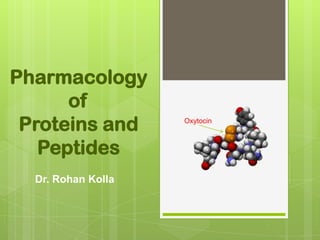
Oxytocin
2

Contents










Historical perspective
Introduction
Comparison of neuropeptides and conventional
neurotransmitters
Bisosynthesis
Proteins and peptides as drugs
Peptide agonists and antagonists
Identification, Isolation And charachterization
Future
Dr. Rohan Kolla
3

Historical perspective

Dr. Rohan Kolla
4

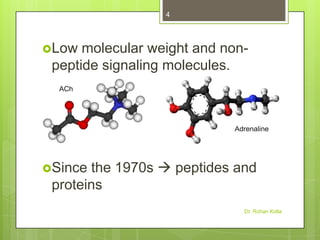
Low

molecular weight and nonpeptide signaling molecules.
ACh

Adrenaline

the 1970s  peptides and
proteins

Since

Dr. Rohan Kolla
5

Bias
 Substance P
 Most drugs  natural (mainly plant) products.
 Very few  peptides or acted through peptide
signaling systems.
 Methodology required to study peptides  1930





HPLC, HPTLC,
Solid-phase peptide synthesis, and
Radioimmunoassay and immunocytochemistry
Dr. Rohan Kolla
6

The Beginnings
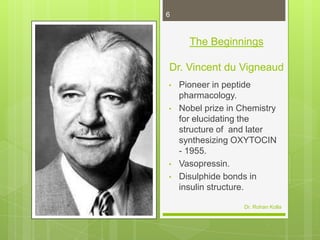
Dr. Vincent du Vigneaud
•
•

•
•

Pioneer in peptide
pharmacology.
Nobel prize in Chemistry
for elucidating the
structure of and later
synthesizing OXYTOCIN
- 1955.
Vasopressin.
Disulphide bonds in
insulin structure.
Dr. Rohan Kolla
7

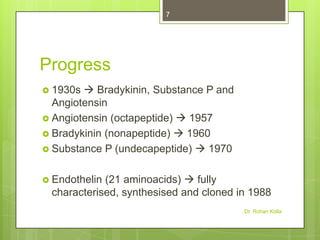
Progress
 Bradykinin, Substance P and
Angiotensin
 Angiotensin (octapeptide)  1957
 Bradykinin (nonapeptide)  1960
 Substance P (undecapeptide)  1970
 1930s

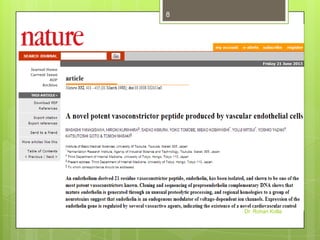
(21 aminoacids)  fully
characterised, synthesised and cloned in 1988

 Endothelin

Dr. Rohan Kolla
8

Dr. Rohan Kolla
9

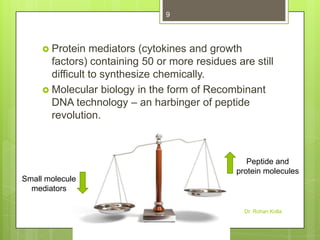
 Protein

mediators (cytokines and growth
factors) containing 50 or more residues are still
difficult to synthesize chemically.
 Molecular biology in the form of Recombinant
DNA technology – an harbinger of peptide
revolution.

Peptide and
protein molecules
Small molecule
mediators
Dr. Rohan Kolla
10

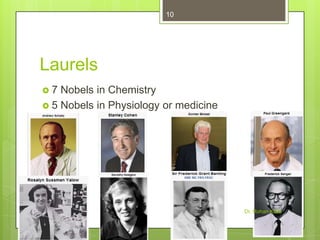
Laurels
7

Nobels in Chemistry
 5 Nobels in Physiology or medicine

Dr. Rohan Kolla
11

Introduction

Dr. Rohan Kolla
12

Terminology
(from Gr. "digested")  short chains
of amino acid monomers linked by peptide
(amide) bonds, the covalent chemical bonds
formed when the carboxyl group of one amino
acid reacts with the amino group of another.

 Peptides


long,
unbranched peptide chain

 Polypeptide

continuous,

and

Dr. Rohan Kolla
13

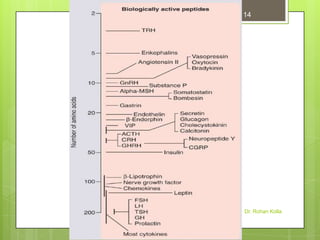
and peptide mediators 
3 to 200 residues

 Protein

 Difference

between
peptides
and
proteins  arbitrary dividing line of 50
amino acid residues
Dr. Rohan Kolla
14

Dr. Rohan Kolla
15

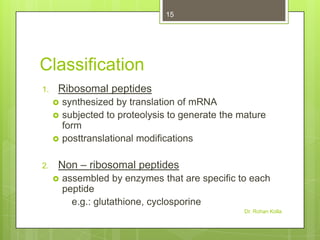
Classification
1.

Ribosomal peptides




2.

synthesized by translation of mRNA
subjected to proteolysis to generate the mature
form
posttranslational modifications

Non – ribosomal peptides


assembled by enzymes that are specific to each
peptide
e.g.: glutathione, cyclosporine
Dr. Rohan Kolla
16

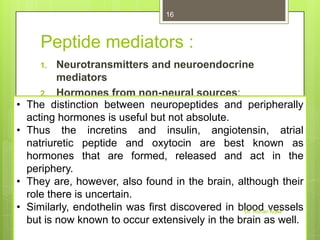
Peptide mediators :
Neurotransmitters and neuroendocrine
mediators
2. Hormones from non-neural sources:
The a) Plasma-derived peptides, notably angiotensin peripherally
distinction between neuropeptides and and
bradykinin,
acting hormones is useful but not absolute.
substances such and insulin, angiotensin, atrial
Thus b) the incretins as insulin, endothelin, atrial
natriuretic peptide and leptin
natriuretic peptide and oxytocin are best known as
3. Growth factors: produced by many different
hormones that are formed, released and act in the
cells
periphery. and tissues that control cell growth and
differentiation
They are, however, also found in the brain, although their
role there is uncertain. immune system (cytokines
4. Mediators of the
Similarly, endothelin was first discovered in blood vessels
and chemokines)
Dr. Rohan Kolla
but is now known to occur extensively in the brain as well.
1.

•
•

•
•
17

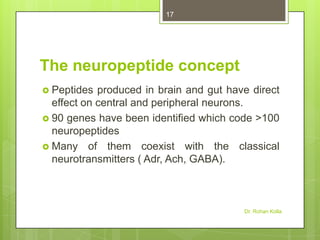
The neuropeptide concept
 Peptides

produced in brain and gut have direct
effect on central and peripheral neurons.
 90 genes have been identified which code >100
neuropeptides
 Many of them coexist with the classical
neurotransmitters ( Adr, Ach, GABA).

Dr. Rohan Kolla
18

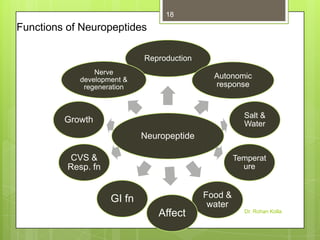
Functions of Neuropeptides
Reproduction
Nerve
development &
regeneration

Autonomic
response

Salt &
Water

Growth
Neuropeptide
CVS &
Resp. fn

Temperat
ure

GI fn
Affect

Food &
water
Dr. Rohan Kolla
19

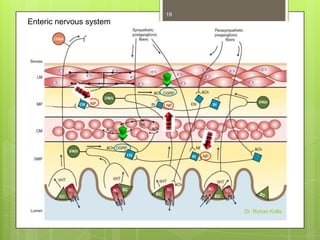
Enteric nervous system

Dr. Rohan Kolla
20

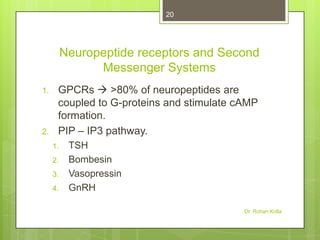
Neuropeptide receptors and Second
Messenger Systems
1.

2.

GPCRs  >80% of neuropeptides are
coupled to G-proteins and stimulate cAMP
formation.
PIP – IP3 pathway.
1.
2.
3.
4.

TSH
Bombesin
Vasopressin
GnRH
Dr. Rohan Kolla
21

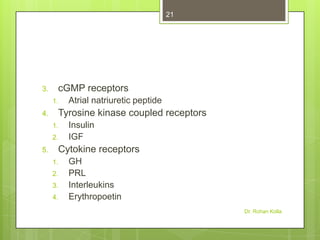
3.

cGMP receptors
1.

4.

Tyrosine kinase coupled receptors
1.
2.

5.

Atrial natriuretic peptide
Insulin
IGF

Cytokine receptors
1.
2.
3.
4.

GH
PRL
Interleukins
Erythropoetin
Dr. Rohan Kolla
22

Comparison of neuropeptides
and conventional transmitters

Dr. Rohan Kolla
23

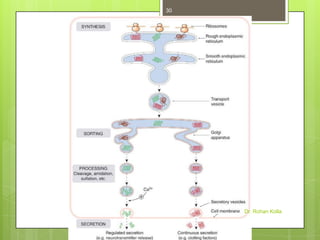
 Vesicles

are loaded with peptide precursors in
the cell body, the active peptides being
generated within the vesicles as they move to
the nerve terminals.
 Vesicles for neuropeptides are called LDCVs
 Following exocytosis, the vesicles cannot be
reloaded in situ.
 Transmitter turnover is therefore less rapid and
recapture of the released transmitter does not
occur

Dr. Rohan Kolla
24

–
excitatory/inhibitory
and
presynaptic/postsynaptic.
 Endogenous peptides rarely activate ligandgated ion channels.
 Effects

[Some spider venom peptides, for example, produce
pain by activating the ion-channel linked capsaicin
receptor TRPV1]




Peptides are much more susceptible to
evolutionary change than are the structures of
non-peptide mediators.
But conversely there is high degree of
conservation evolutionarily across taxa.
e.g.: GnRH, Insulin in mammals
Dr. Rohan Kolla
25

Co-transmitters
 Two

well-documented examples : The parasympathetic nerves innervating the
salivary glands (where the secretory response
is produced by acetylcholine and the
vasodilatation partly by vasoactive intestinal
peptide) and
 The sympathetic innervation to many tissues,
which releases the vasoconstrictor
neuropeptide Y in addition to noradrenaline
Dr. Rohan Kolla
(norepinephrine).
26

Biosynthesis and Regulation
of Proteins

Dr. Rohan Kolla
27

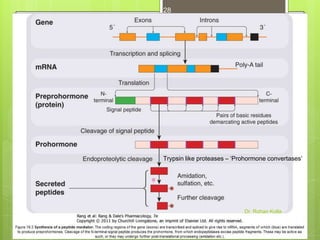
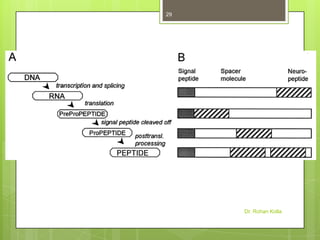
Peptide precursors
 Peptide

synthesis begins with the manufacture
of a precursor protein in which the peptide
sequence is embedded, along with specific
proteolytic enzymes that excise the active
peptide.
 Preprohormone:


Signal peptide

 Prohormone
Dr. Rohan Kolla
28

Trypsin like proteases – ‘Prohormone convertases’

Dr. Rohan Kolla
29

Dr. Rohan Kolla
30

Dr. Rohan Kolla
31

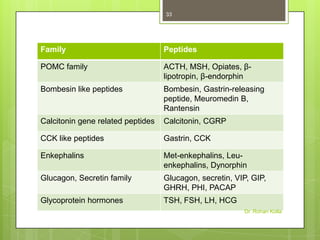
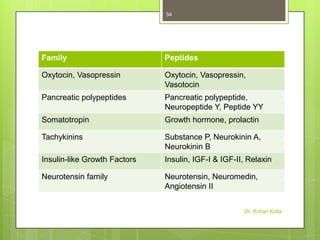
Diversity within peptide families
 Peptides

commonly occur in families with
similar or related sequences and actions.
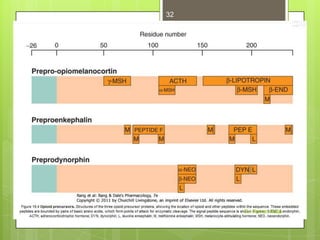
 Opioid peptides, defined as peptides with
opiate-like pharmacological effects, are coded
by three distinct genes whose products
are, respectively,




prepro-opiomelanocortin (POMC),
preproenkephalin and
preprodynorphin.

 Each

of these precursors contains the
Dr.
sequences of a number of opioid peptides Rohan Kolla
32

Dr. Rohan Kolla
33

Family

Peptides

POMC family

ACTH, MSH, Opiates, βlipotropin, β-endorphin

Bombesin like peptides

Bombesin, Gastrin-releasing
peptide, Meuromedin B,
Rantensin

Calcitonin gene related peptides

Calcitonin, CGRP

CCK like peptides

Gastrin, CCK

Enkephalins

Met-enkephalins, Leuenkephalins, Dynorphin

Glucagon, Secretin family

Glucagon, secretin, VIP, GIP,
GHRH, PHI, PACAP

Glycoprotein hormones

TSH, FSH, LH, HCG
Dr. Rohan Kolla
34

Family

Peptides

Oxytocin, Vasopressin

Oxytocin, Vasopressin,
Vasotocin

Pancreatic polypeptides

Pancreatic polypeptide,
Neuropeptide Y, Peptide YY

Somatotropin

Growth hormone, prolactin

Tachykinins

Substance P, Neurokinin A,
Neurokinin B

Insulin-like Growth Factors

Insulin, IGF-I & IGF-II, Relaxin

Neurotensin family

Neurotensin, Neuromedin,
Angiotensin II
Dr. Rohan Kolla
35

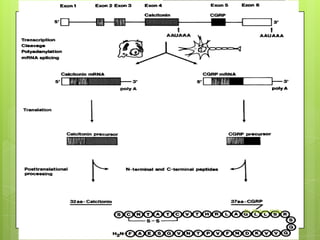
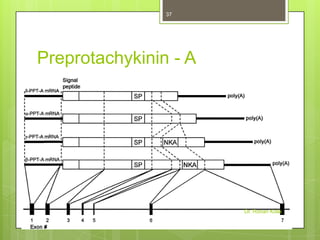
Gene Splicing as a source for
peptide diversity
 When

the gene is transcribed, RNA
(heterologous nuclear RNA; hnRNA) is spliced
to remove the introns and some of the
exons, forming the final mRNA that is
translated.
 Control of the splicing process allows a
measure of cellular control over the peptides
that are produced.
 Good examples of this are calcitonin/CGRP and
substance P/neurokinin A.
Dr. Rohan Kolla
36

Dr. Rohan Kolla
37

Preprotachykinin - A

Dr. Rohan Kolla
38





Tissues may also generate peptides of varying
length from the same primary sequence by the
action of specific peptidases that cut the chain at
different points.
E.g.: 



procholecystokinin (pro-CCK) contains the sequences
of at least five CCK-like peptides ranging in length from
4 to 58 amino acid residues, all with the same Cterminal sequence.
CCK itself (33 residues) is the main peptide produced
by the intestine, whereas the brain produces mainly
CCK-8.
Dr. Rohan Kolla
39

Proteins and peptides as
drugs

Dr. Rohan Kolla
40



1.
2.

3.
4.
5.

Many of the proteins currently in therapeutic use 
functional human proteins prepared by recombinant
technology, which are used to supplement the action
of endogenous mediators.
Insulin
Growth hormone
ACTH
Erythopoetin
GM-CSF
Dr. Rohan Kolla
41





Despite the large number of known peptide mediators,
only a few peptides, mostly close analogues of
endogenous mediators, are currently useful as drugs.
In most cases, peptides make poor drugs, because:









- they are poorly absorbed when given orally
- they have a short duration of action because of rapid
degradation in vivo
- they do not predictably cross the blood-brain barrier
- they are expensive and difficult to manufacture
- they may be immunogenic.

Smaller peptides are used therapeutically mainly when
there is simply no viable alternative
Dr. Rohan Kolla
42

Peptide agonists and
antagonists

Dr. Rohan Kolla
43

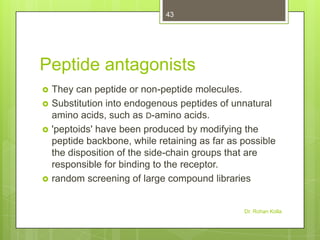
Peptide antagonists






They can peptide or non-peptide molecules.
Substitution into endogenous peptides of unnatural
amino acids, such as D-amino acids.
'peptoids' have been produced by modifying the
peptide backbone, while retaining as far as possible
the disposition of the side-chain groups that are
responsible for binding to the receptor.
random screening of large compound libraries

Dr. Rohan Kolla
44

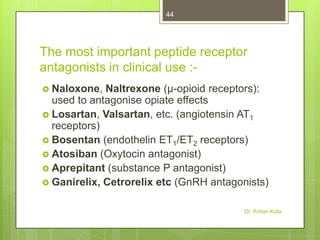
The most important peptide receptor
antagonists in clinical use : Naloxone,

Naltrexone (μ-opioid receptors):
used to antagonise opiate effects
 Losartan, Valsartan, etc. (angiotensin AT1
receptors)
 Bosentan (endothelin ET1/ET2 receptors)
 Atosiban (Oxytocin antagonist)
 Aprepitant (substance P antagonist)
 Ganirelix, Cetrorelix etc (GnRH antagonists)
Dr. Rohan Kolla
45

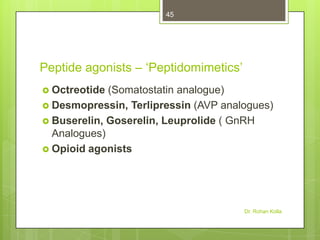
Peptide agonists – ‘Peptidomimetics’
 Octreotide

(Somatostatin analogue)
 Desmopressin, Terlipressin (AVP analogues)
 Buserelin, Goserelin, Leuprolide ( GnRH
Analogues)
 Opioid agonists

Dr. Rohan Kolla
46

Identification, Isolation and
Characterization of Peptides

Dr. Rohan Kolla
47

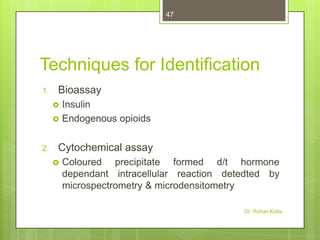
Techniques for Identification
1.

Bioassay



2.

Insulin
Endogenous opioids

Cytochemical assay


Coloured precipitate formed d/t hormone
dependant intracellular reaction detedted by
microspectrometry & microdensitometry
Dr. Rohan Kolla
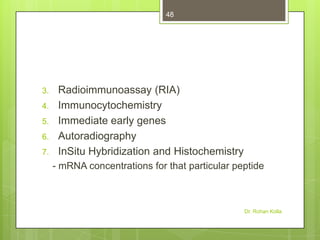
48

3.
4.
5.
6.
7.

Radioimmunoassay (RIA)
Immunocytochemistry
Immediate early genes
Autoradiography
InSitu Hybridization and Histochemistry
- mRNA concentrations for that particular peptide

Dr. Rohan Kolla
49

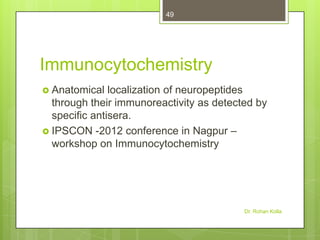
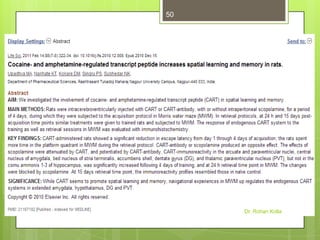
Immunocytochemistry
 Anatomical

localization of neuropeptides
through their immunoreactivity as detected by
specific antisera.
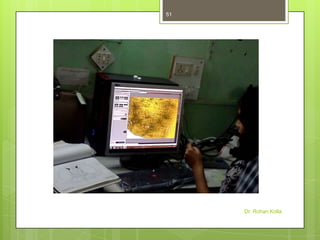
 IPSCON -2012 conference in Nagpur –
workshop on Immunocytochemistry

Dr. Rohan Kolla
50

Dr. Rohan Kolla
51

Dr. Rohan Kolla
52

Tools for isolation and
characterization
1.
2.
3.
4.
5.

Capillary electrophoresis
Immunofluorescence
Fast atom bombardment spectrometry
LC-MS
MALDI-TOF MS

Dr. Rohan Kolla
53

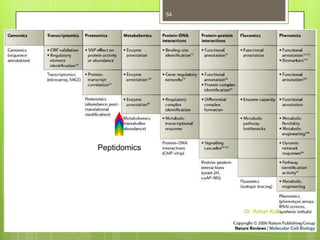
Peptidomics
 Refers

to the techniques that permit quantitative
determination of the peptide content of whole
cells.
 This novel concept aims at the comprehensive
visualization and analysis of small polypeptides.

Dr. Rohan Kolla
54

Peptidomics

Dr. Rohan Kolla
55

Genetic manipulations
1.
2.
3.
4.

Transgenic animals
Gene targeting and knockout mice
Genomics
Site-directed mutagenesis

Dr. Rohan Kolla
56

Future

Dr. Rohan Kolla
57

Designer Proteins –
Dawn of new era therapeutics
 'Designer

proteins'-genetically engineered
variants of natural proteins-for specific
purposes are already a reality .
 E.g.:
'humanised antibodies' and fusion
proteins
consisting
of
an
antibody
(targeted, for example, at a tumour antigen) or
a
peptide
(e.g.
bombesin
or
somatostatin, which bind to receptors on
tumour cells) linked to a toxin (such as ricin or
diphtheria toxin) to kill the target cells
Dr. Rohan Kolla
58

References








Rang & Dale’s Pharmacology 7th ed,
Basic & Clinical Pharmacology, Katzung’s, 12th ed.
Neuropeptides, Contemporary
Neuropharmacogy, Wiley Press, London. 2007
Holmgren S, Jörgen J. Evolution of vertebrate
neuropeptides, Brain Research Bulletin, Volume
55, Issue 6, August 2001, Pages 723-735
Alexander, S.P., Mathie, A., Peters, J.A.
(Eds.), 2006. Guide to receptors and channels, 2nd
ed. Br. J. Pharmacol. 147 (Suppl. 3), S1-S168
Dr. Rohan Kolla
59

References (Contd.)






Banks, W.A., 2006. The CNS as a target for
peptides and peptide-based drugs. Expert Opin.
Drug. Deliv. 3, 707-712
Meunier, J.-C., Mollereau, C., Toll, L., et al., 1995.
Isolation and structure of the endogenous agonist of
opioid receptor-like ORL1 receptor
Yanagisawa, M., Kurihara, H., Kimura, S., et al.,
1988. A novel potent vasoconstrictor peptide
produced by vascular endothelial cells. Nature 332,
411-415
Dr. Rohan Kolla
60

Thank you
Dr. Rohan Kolla