Clinical Enzymology
Methods for enzymes
determination in serum and
urine
1
Enzyme classification
Plasma vs. non-plasma specific enzymes
A) Plasma specific enzymes have a very definite/specific
function in the plasma.
1) Plasma is normal site of action
2) Concentration in plasma is greater than in most tissues
3) Often are liver synthesized
4) Examples: cholinesterase, plasmin, thrombin
2
Enzyme classification
B) Non-plasma specific enzymes have no known
physiological function in the plasma.
1) Some are secreted into the plasma.
2) A number of enzymes associated with cell metabolism
normally found in the plasma only in low concentrations.
3) An increased plasma concentration of these enzymes
is associated with cell disruption or death.
3
Classes of enzymes
4
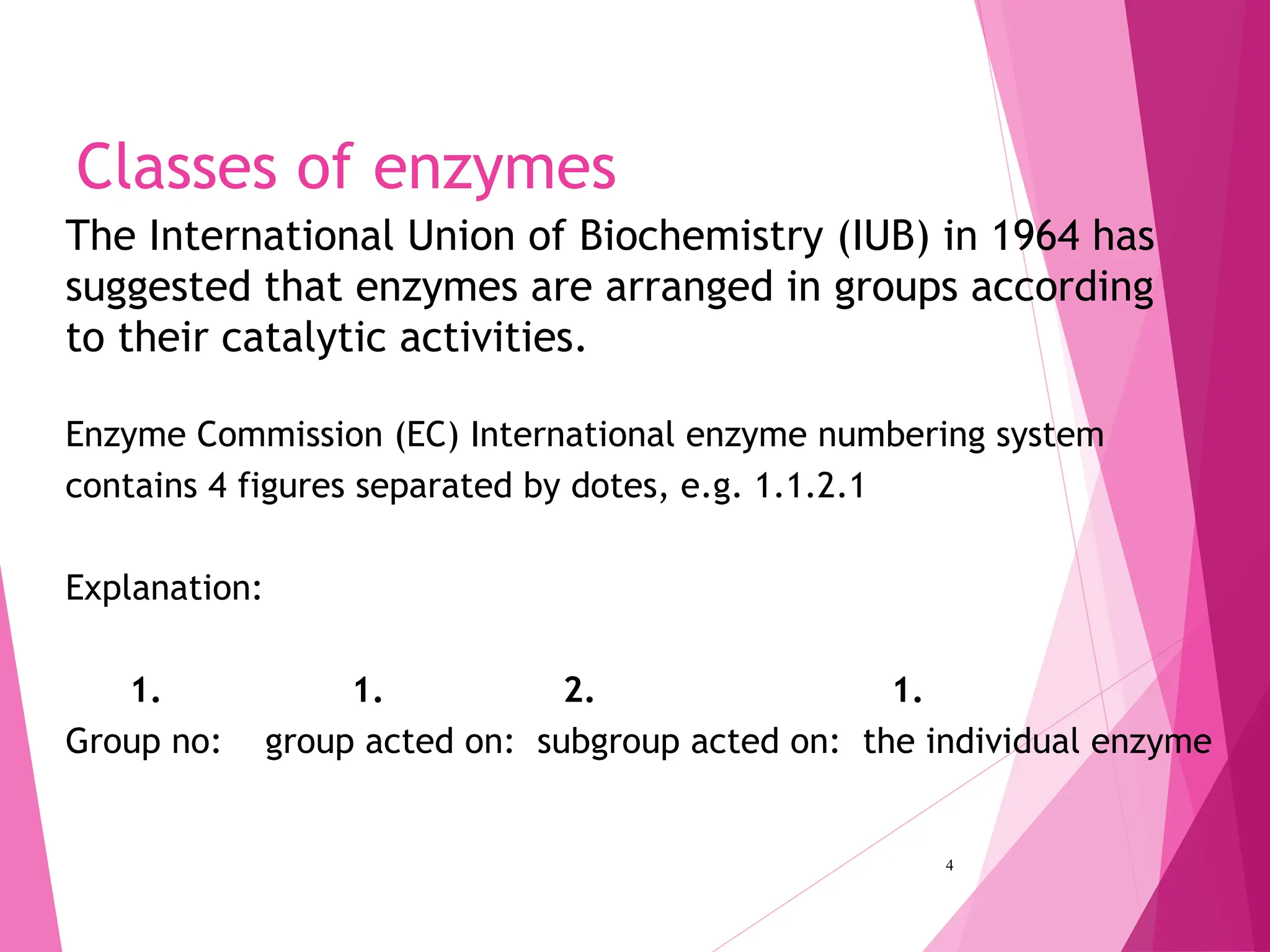
The International Union of Biochemistry (IUB) in 1964 has
suggested that enzymes are arranged in groups according
to their catalytic activities.
Enzyme Commission (EC) International enzyme numbering system
contains 4 figures separated by dotes, e.g. 1.1.2.1
Explanation:
1. 1. 2. 1.
Group no: group acted on: subgroup acted on: the individual enzyme
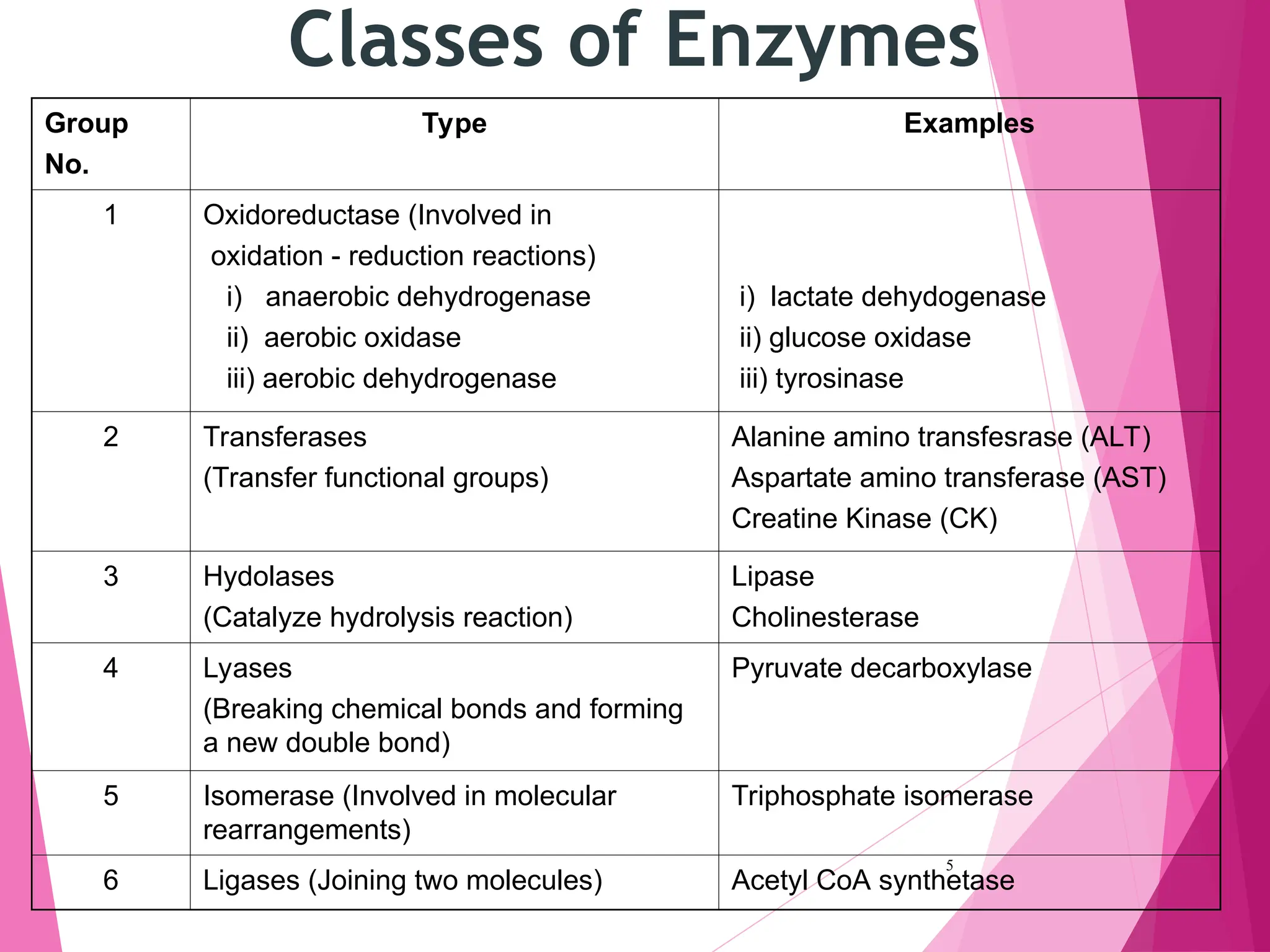
Group
No.
Type Examples
1 Oxidoreductase (Involved in
oxidation - reduction reactions)
i) anaerobic dehydrogenase
ii) aerobic oxidase
iii) aerobic dehydrogenase
i) lactate dehydogenase
ii) glucose oxidase
iii) tyrosinase
2 Transferases
(Transfer functional groups)
Alanine amino transfesrase (ALT)
Aspartate amino transferase (AST)
Creatine Kinase (CK)
3 Hydolases
(Catalyze hydrolysis reaction)
Lipase
Cholinesterase
4 Lyases
(Breaking chemical bonds and forming
a new double bond)
Pyruvate decarboxylase
5 Isomerase (Involved in molecular
rearrangements)
Triphosphate isomerase
6 Ligases (Joining two molecules) Acetyl CoA synthetase
5
Classes of Enzymes
General consideration in enzyme
assays in the clinical laboratory
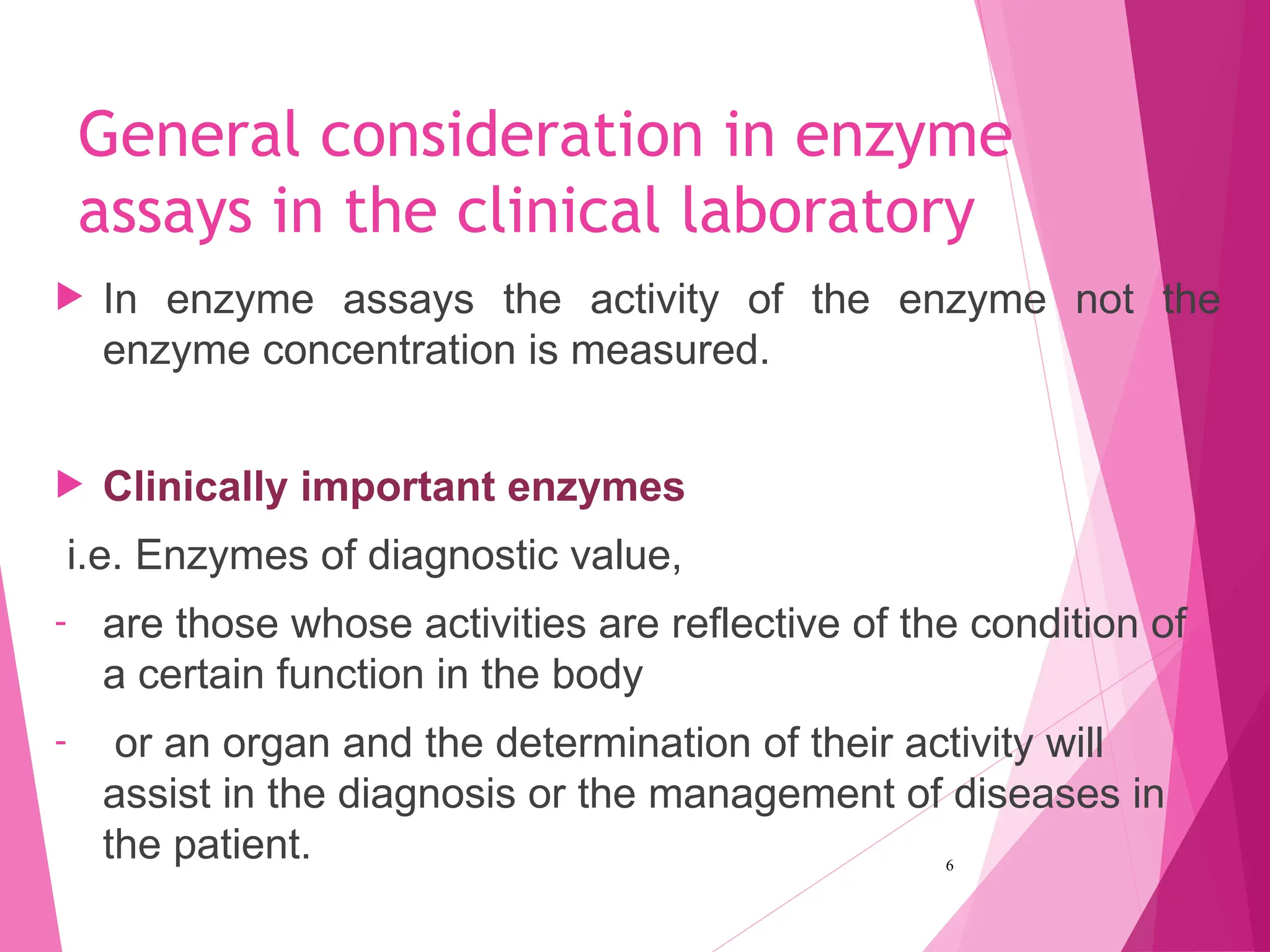
 In enzyme assays the activity of the enzyme not the
enzyme concentration is measured.
 Clinically important enzymes
i.e. Enzymes of diagnostic value,
- are those whose activities are reflective of the condition of
a certain function in the body
- or an organ and the determination of their activity will
assist in the diagnosis or the management of diseases in
the patient. 6
General consideration in enzyme
assays in the clinical laboratory
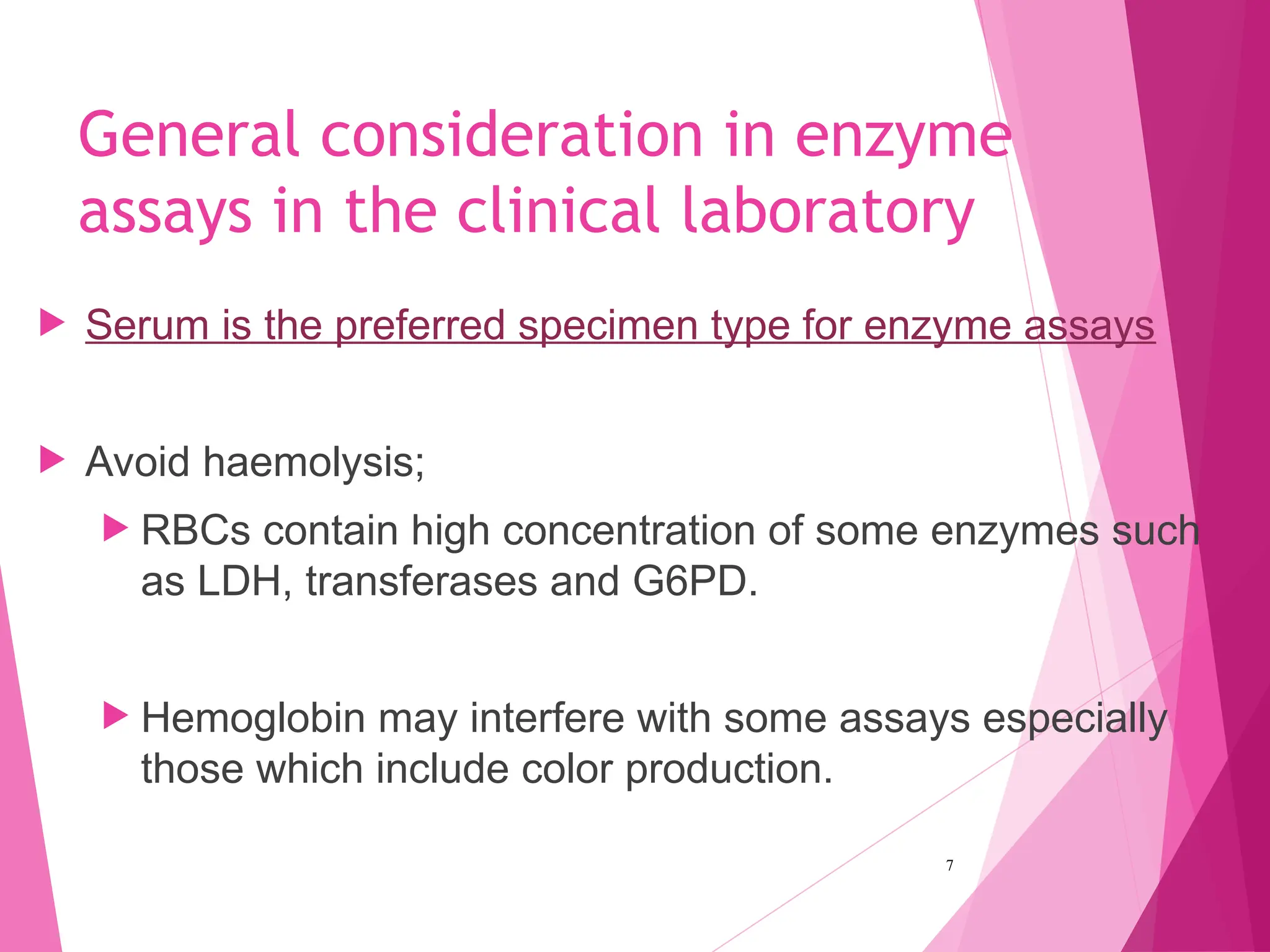
 Serum is the preferred specimen type for enzyme assays
 Avoid haemolysis;
 RBCs contain high concentration of some enzymes such
as LDH, transferases and G6PD.
 Hemoglobin may interfere with some assays especially
those which include color production.
7
Precaution's while doing enzyme
assays in the clinical laboratory
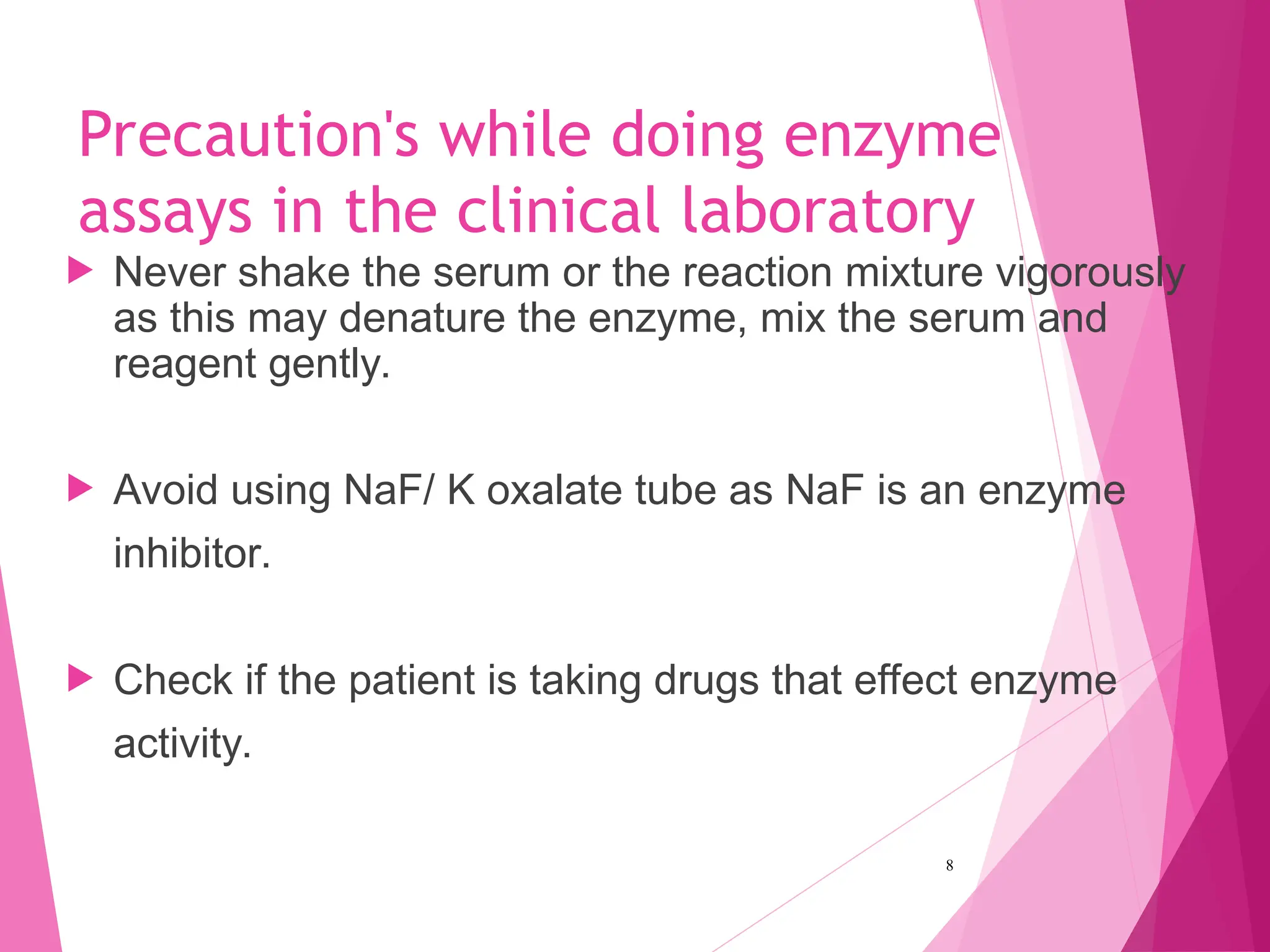
 Never shake the serum or the reaction mixture vigorously
as this may denature the enzyme, mix the serum and
reagent gently.
 Avoid using NaF/ K oxalate tube as NaF is an enzyme
inhibitor.
 Check if the patient is taking drugs that effect enzyme
activity.
8
Continue……….
 Avoid prolonged application of tourniquet as it effect some
enzymes such as LDH.
 Note the physical condition of the patient (e.g. exercise or
long walk may effect CK activity).
 Some enzymes are sex related, i.e. higher or present in
one sex type (e.g. prostatic ACP)
 Some enzymes are age related (e.g. ALP)
9
Continue……….
 Some enzymes catalyze both direction of the reaction
while others catalyze one direction only.
 Many enzymes present as isoenzymes (different forms in
different organs), such enzymes have a good diagnostic
value.
 The isoenzyme related to the organ should be analyzed
together with the total enzyme activity; e.g. CK & CK-MB.
10
Enzymes involvement in various
reactions
Because the enzyme activity is measured, many conditions
affect such reactions which include;
 Substrate type and concentration
 Product type and concentration
 Amount of enzyme present
 Buffer type and pH
 Activators and coenzymes
 Temperature of the reaction
 Specificity of the enzyme to substrate
 Presence of inhibitors
 Direction of reaction (forward or reverse direction)
11
Continue……
 Due to the effects of various conditions on enzyme
activity, each lab must determine its normal range for the
enzymes in question and not rely on published data.
 The effect of the various conditions on enzyme activity
make enzyme assays less precise than other smaller
analytes, so a coefficient of variation (cv) of up to 10% is
acceptable.
 Kinetic enzyme (rate of reaction ) assays are to be used
instead of end point (two-point) assays because they
provided better accuracy.
12
Enzyme activity measurment
 Enzymes are not directly measured.
 Enzymes are commonly measured in terms of their
catalytic activity.
 We don’t measure the molecule, we measure how much
“work” it performs (catalytic activity).
 The rate at which it catalyzes the conversion of
substrate to product.
 The enzymatic activity is a reflection of its concentration.
 Activity is proportional to concentration.
Measuring enzyme activity
 Enzyme activity can be tested by measuring:

Increase of product
 Decrease of substrate
 Decrease of co-enzyme
Increase of altered co-enzyme
 If substrate and co-enzyme are in excess concentration,
the reaction rate is controlled by the enzyme activity.
14
Measuring enzyme activity
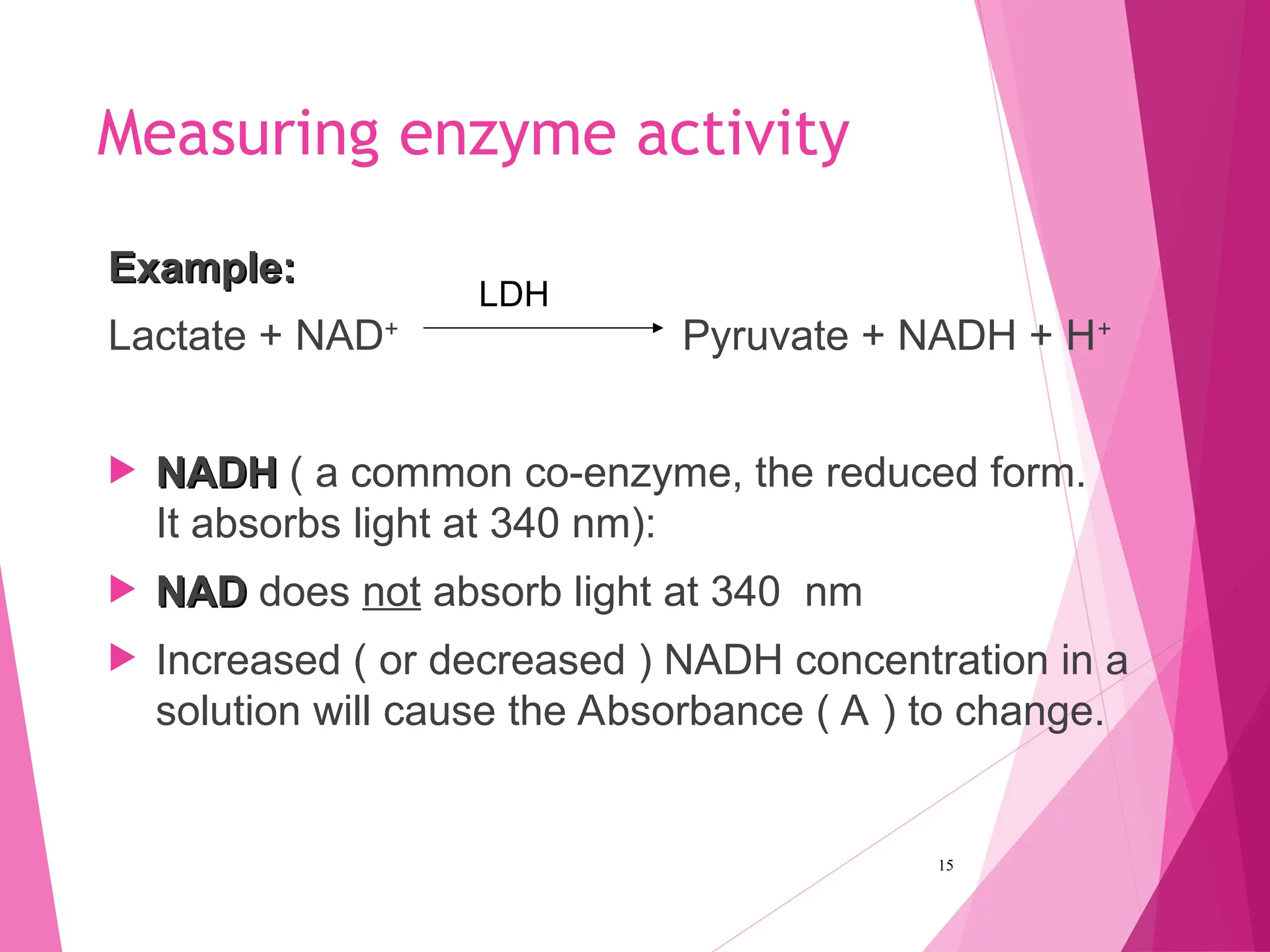
Example:
Example:
Lactate + NAD+
Pyruvate + NADH + H+
 NADH
NADH ( a common co-enzyme, the reduced form.
It absorbs light at 340 nm):
 NAD
NAD does not absorb light at 340 nm
 Increased ( or decreased ) NADH concentration in a
solution will cause the Absorbance ( A ) to change.
15
LDH
Other Conditions are…………
 Excess amounts of substrate and any cofactors or
coenzymes.
 Sufficient amount of substrate to handle possible
abnormally high patient enzyme levels.
 Proper temperature and pH.
16
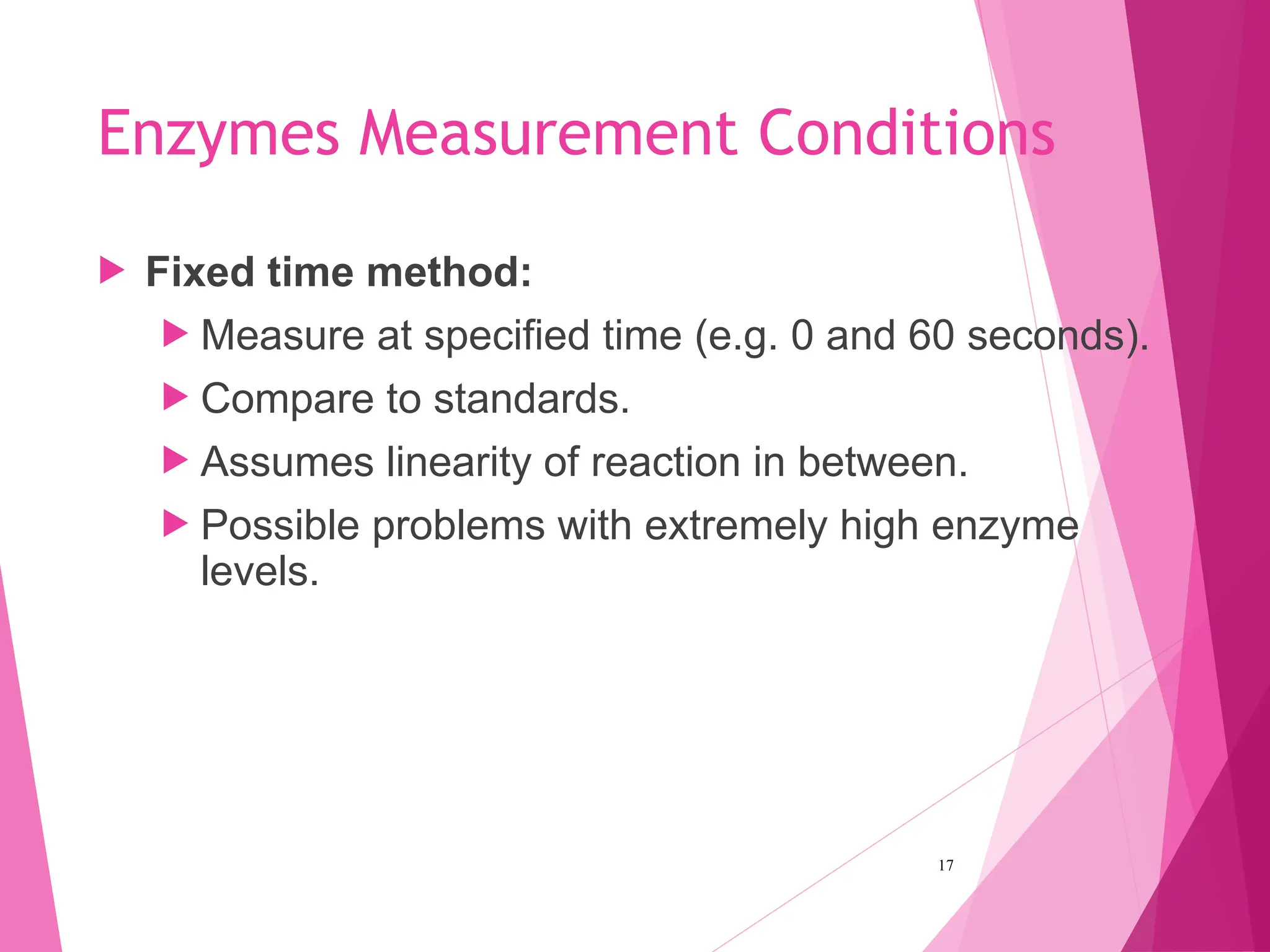
Enzymes Measurement Conditions
 Fixed time method:
 Measure at specified time (e.g. 0 and 60 seconds).
 Compare to standards.
 Assumes linearity of reaction in between.
 Possible problems with extremely high enzyme
levels.
17
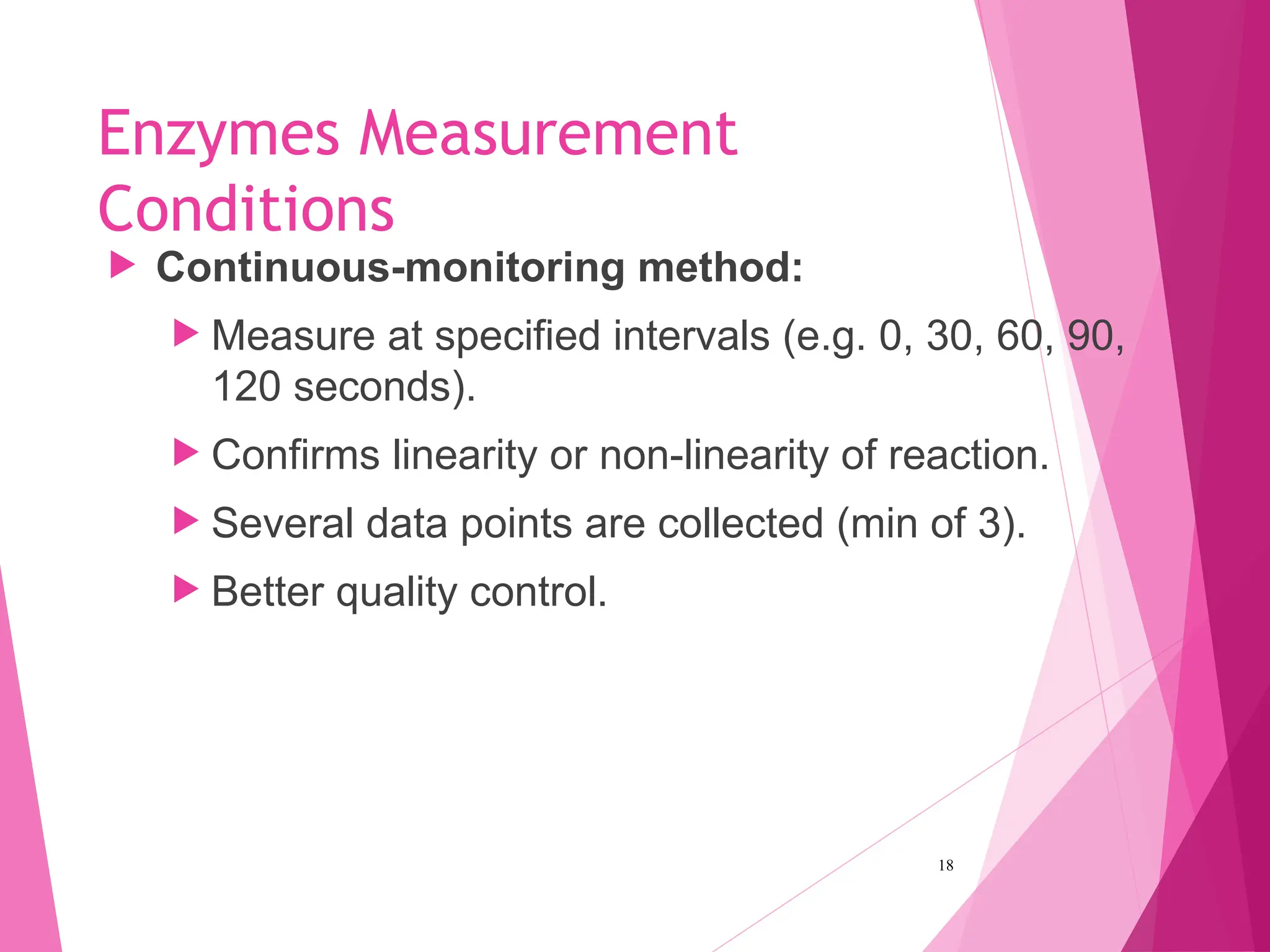
Enzymes Measurement
Conditions
 Continuous-monitoring method:
 Measure at specified intervals (e.g. 0, 30, 60, 90,
120 seconds).
 Confirms linearity or non-linearity of reaction.
 Several data points are collected (min of 3).
 Better quality control.
18
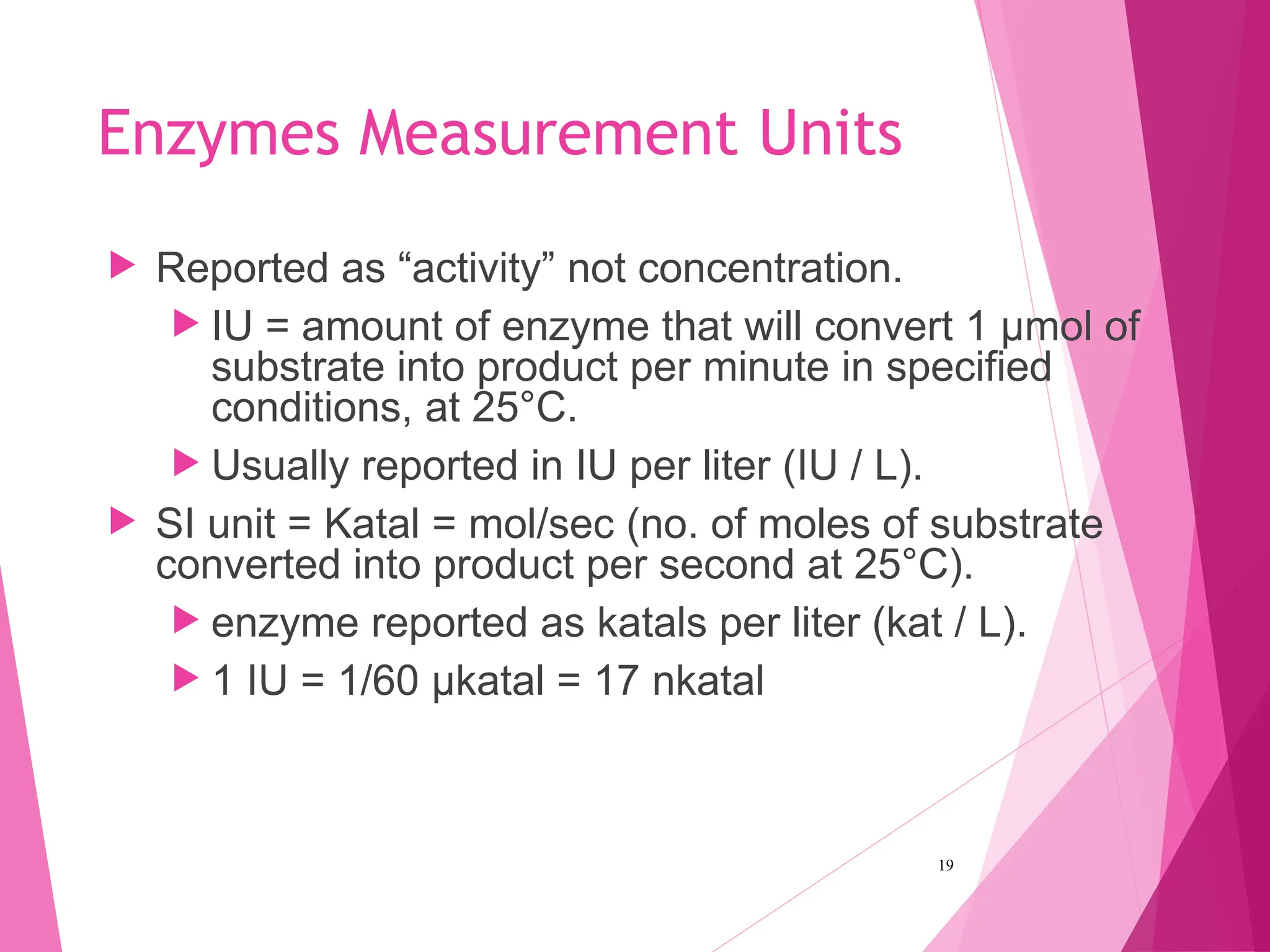
Enzymes Measurement Units
 Reported as “activity” not concentration.
 IU = amount of enzyme that will convert 1 μmol of
substrate into product per minute in specified
conditions, at 25°C.
 Usually reported in IU per liter (IU / L).
 SI unit = Katal = mol/sec (no. of moles of substrate
converted into product per second at 25°C).
 enzyme reported as katals per liter (kat / L).
 1 IU = 1/60 μkatal = 17 nkatal
19
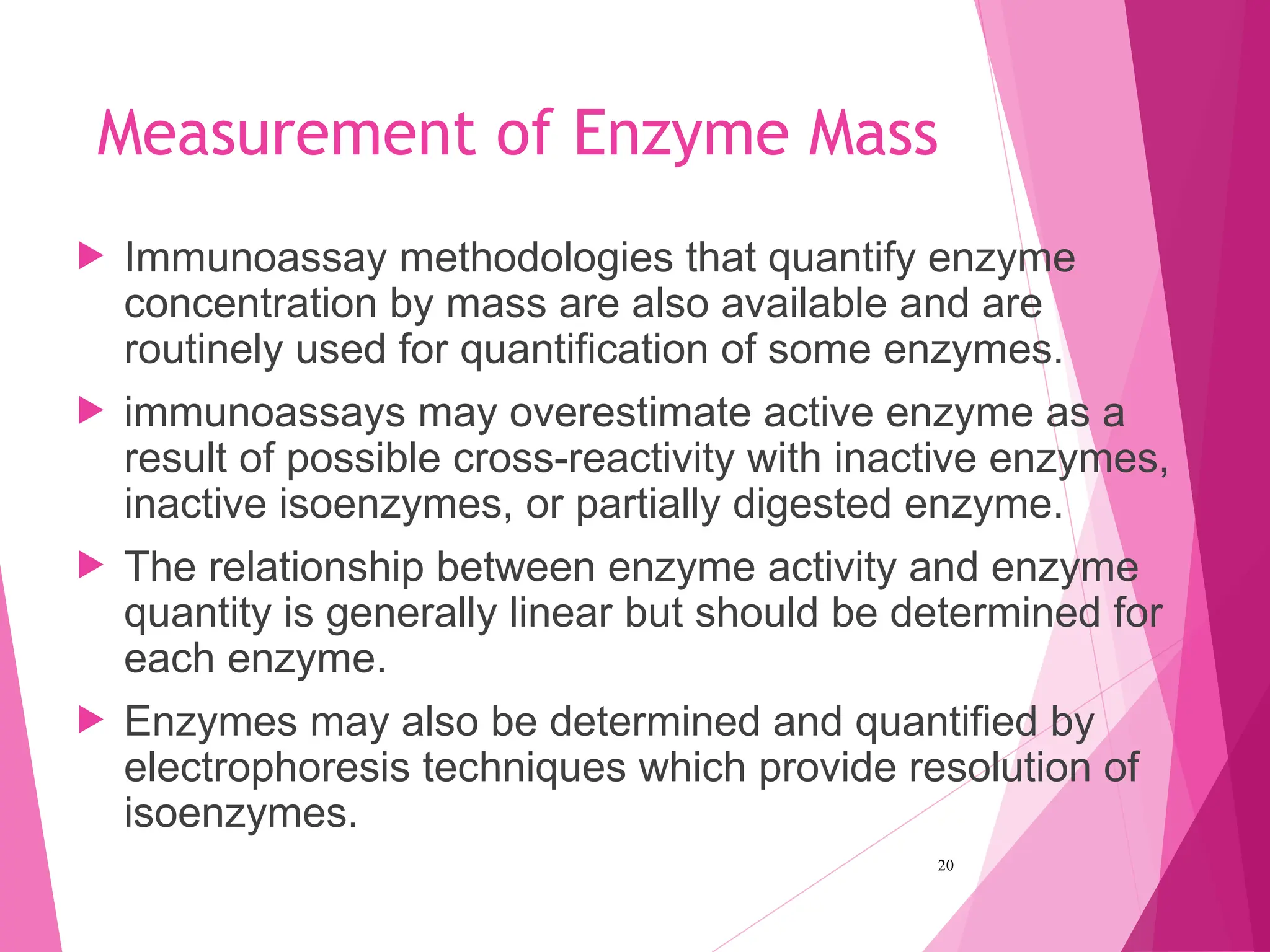
Measurement of Enzyme Mass
 Immunoassay methodologies that quantify enzyme
concentration by mass are also available and are
routinely used for quantification of some enzymes.
 immunoassays may overestimate active enzyme as a
result of possible cross-reactivity with inactive enzymes,
inactive isoenzymes, or partially digested enzyme.
 The relationship between enzyme activity and enzyme
quantity is generally linear but should be determined for
each enzyme.
 Enzymes may also be determined and quantified by
electrophoresis techniques which provide resolution of
isoenzymes.
20
21

Introduction to Enzymes in health and diseases.ppt

  • 1.
    Clinical Enzymology Methods forenzymes determination in serum and urine 1
  • 2.
    Enzyme classification Plasma vs.non-plasma specific enzymes A) Plasma specific enzymes have a very definite/specific function in the plasma. 1) Plasma is normal site of action 2) Concentration in plasma is greater than in most tissues 3) Often are liver synthesized 4) Examples: cholinesterase, plasmin, thrombin 2
  • 3.
    Enzyme classification B) Non-plasmaspecific enzymes have no known physiological function in the plasma. 1) Some are secreted into the plasma. 2) A number of enzymes associated with cell metabolism normally found in the plasma only in low concentrations. 3) An increased plasma concentration of these enzymes is associated with cell disruption or death. 3
  • 4.
    Classes of enzymes 4 TheInternational Union of Biochemistry (IUB) in 1964 has suggested that enzymes are arranged in groups according to their catalytic activities. Enzyme Commission (EC) International enzyme numbering system contains 4 figures separated by dotes, e.g. 1.1.2.1 Explanation: 1. 1. 2. 1. Group no: group acted on: subgroup acted on: the individual enzyme
  • 5.
    Group No. Type Examples 1 Oxidoreductase(Involved in oxidation - reduction reactions) i) anaerobic dehydrogenase ii) aerobic oxidase iii) aerobic dehydrogenase i) lactate dehydogenase ii) glucose oxidase iii) tyrosinase 2 Transferases (Transfer functional groups) Alanine amino transfesrase (ALT) Aspartate amino transferase (AST) Creatine Kinase (CK) 3 Hydolases (Catalyze hydrolysis reaction) Lipase Cholinesterase 4 Lyases (Breaking chemical bonds and forming a new double bond) Pyruvate decarboxylase 5 Isomerase (Involved in molecular rearrangements) Triphosphate isomerase 6 Ligases (Joining two molecules) Acetyl CoA synthetase 5 Classes of Enzymes
  • 6.
    General consideration inenzyme assays in the clinical laboratory  In enzyme assays the activity of the enzyme not the enzyme concentration is measured.  Clinically important enzymes i.e. Enzymes of diagnostic value, - are those whose activities are reflective of the condition of a certain function in the body - or an organ and the determination of their activity will assist in the diagnosis or the management of diseases in the patient. 6
  • 7.
    General consideration inenzyme assays in the clinical laboratory  Serum is the preferred specimen type for enzyme assays  Avoid haemolysis;  RBCs contain high concentration of some enzymes such as LDH, transferases and G6PD.  Hemoglobin may interfere with some assays especially those which include color production. 7
  • 8.
    Precaution's while doingenzyme assays in the clinical laboratory  Never shake the serum or the reaction mixture vigorously as this may denature the enzyme, mix the serum and reagent gently.  Avoid using NaF/ K oxalate tube as NaF is an enzyme inhibitor.  Check if the patient is taking drugs that effect enzyme activity. 8
  • 9.
    Continue……….  Avoid prolongedapplication of tourniquet as it effect some enzymes such as LDH.  Note the physical condition of the patient (e.g. exercise or long walk may effect CK activity).  Some enzymes are sex related, i.e. higher or present in one sex type (e.g. prostatic ACP)  Some enzymes are age related (e.g. ALP) 9
  • 10.
    Continue……….  Some enzymescatalyze both direction of the reaction while others catalyze one direction only.  Many enzymes present as isoenzymes (different forms in different organs), such enzymes have a good diagnostic value.  The isoenzyme related to the organ should be analyzed together with the total enzyme activity; e.g. CK & CK-MB. 10
  • 11.
    Enzymes involvement invarious reactions Because the enzyme activity is measured, many conditions affect such reactions which include;  Substrate type and concentration  Product type and concentration  Amount of enzyme present  Buffer type and pH  Activators and coenzymes  Temperature of the reaction  Specificity of the enzyme to substrate  Presence of inhibitors  Direction of reaction (forward or reverse direction) 11
  • 12.
    Continue……  Due tothe effects of various conditions on enzyme activity, each lab must determine its normal range for the enzymes in question and not rely on published data.  The effect of the various conditions on enzyme activity make enzyme assays less precise than other smaller analytes, so a coefficient of variation (cv) of up to 10% is acceptable.  Kinetic enzyme (rate of reaction ) assays are to be used instead of end point (two-point) assays because they provided better accuracy. 12
  • 13.
    Enzyme activity measurment Enzymes are not directly measured.  Enzymes are commonly measured in terms of their catalytic activity.  We don’t measure the molecule, we measure how much “work” it performs (catalytic activity).  The rate at which it catalyzes the conversion of substrate to product.  The enzymatic activity is a reflection of its concentration.  Activity is proportional to concentration.
  • 14.
    Measuring enzyme activity Enzyme activity can be tested by measuring:  Increase of product  Decrease of substrate  Decrease of co-enzyme Increase of altered co-enzyme  If substrate and co-enzyme are in excess concentration, the reaction rate is controlled by the enzyme activity. 14
  • 15.
    Measuring enzyme activity Example: Example: Lactate+ NAD+ Pyruvate + NADH + H+  NADH NADH ( a common co-enzyme, the reduced form. It absorbs light at 340 nm):  NAD NAD does not absorb light at 340 nm  Increased ( or decreased ) NADH concentration in a solution will cause the Absorbance ( A ) to change. 15 LDH
  • 16.
    Other Conditions are………… Excess amounts of substrate and any cofactors or coenzymes.  Sufficient amount of substrate to handle possible abnormally high patient enzyme levels.  Proper temperature and pH. 16
  • 17.
    Enzymes Measurement Conditions Fixed time method:  Measure at specified time (e.g. 0 and 60 seconds).  Compare to standards.  Assumes linearity of reaction in between.  Possible problems with extremely high enzyme levels. 17
  • 18.
    Enzymes Measurement Conditions  Continuous-monitoringmethod:  Measure at specified intervals (e.g. 0, 30, 60, 90, 120 seconds).  Confirms linearity or non-linearity of reaction.  Several data points are collected (min of 3).  Better quality control. 18
  • 19.
    Enzymes Measurement Units Reported as “activity” not concentration.  IU = amount of enzyme that will convert 1 μmol of substrate into product per minute in specified conditions, at 25°C.  Usually reported in IU per liter (IU / L).  SI unit = Katal = mol/sec (no. of moles of substrate converted into product per second at 25°C).  enzyme reported as katals per liter (kat / L).  1 IU = 1/60 μkatal = 17 nkatal 19
  • 20.
    Measurement of EnzymeMass  Immunoassay methodologies that quantify enzyme concentration by mass are also available and are routinely used for quantification of some enzymes.  immunoassays may overestimate active enzyme as a result of possible cross-reactivity with inactive enzymes, inactive isoenzymes, or partially digested enzyme.  The relationship between enzyme activity and enzyme quantity is generally linear but should be determined for each enzyme.  Enzymes may also be determined and quantified by electrophoresis techniques which provide resolution of isoenzymes. 20
  • 21.

Editor's Notes

  • #2 cholinesterase is an enzyme that catalyzes the hydrolysis of the neurotransmitter acetylcholine into choline and acetic acid, a reaction necessary to allow a cholinergic neuron to return to its resting state after activation.