Enzyme Assay Methods
• The assay is the act of measuring how fast a given
(unknown) amount of enzyme will convert
substrate to product (the act of measuring a
velocity).velocity).
• An assay requires to determine the concentration
of a product or substrate at a given time after
starting the reaction.
• Different enzymes require different estimation
methods depending on the type of reaction
catalyzed, the nature of S and P or coenzyme.
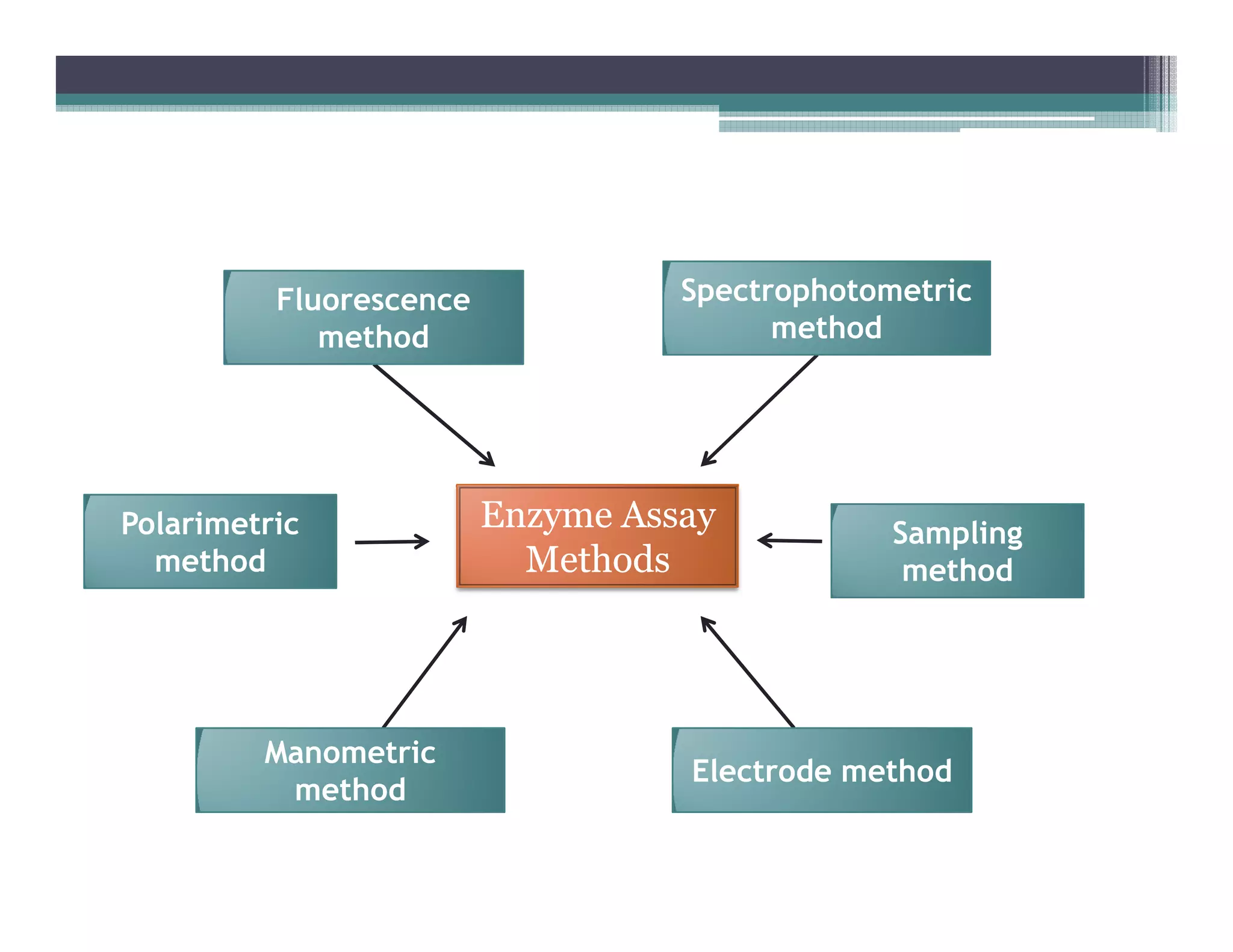
Spectrophotometric
method
Fluorescence
method
Enzyme AssayEnzyme Assay
MethodsMethods
Manometric
method
Electrode method
Polarimetric
method
Sampling
method
Spectrophotometric methods
• Many substrates and products of enzyme reactions absorb
light either in the visible region or in the U.V. region.
• Mostly the spectra of S and P are not the same.
▫ The conversion of one into another is followed by a▫ The conversion of one into another is followed by a
considerable change of absorption and by measuring this
change the progress of the reaction can be followed
quantitatively.
• The enzyme is allowed to react with substrate and the
decrease in the conc. of substrate or the increase of
product produced will be followed spectrophotometrically
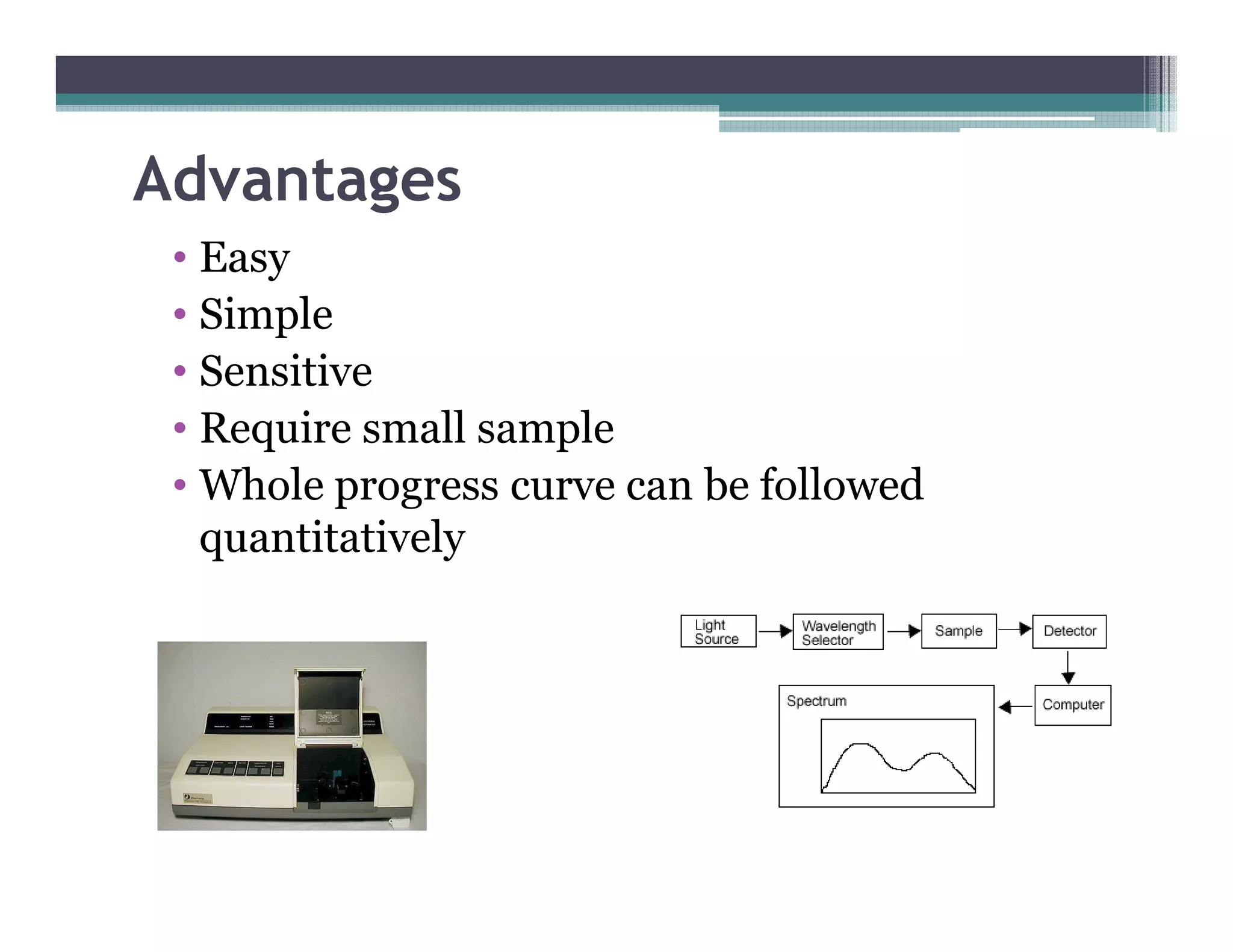
Advantages
• Easy
• Simple
• Sensitive
• Require small sample
• Whole progress curve can be followed• Whole progress curve can be followed
quantitatively
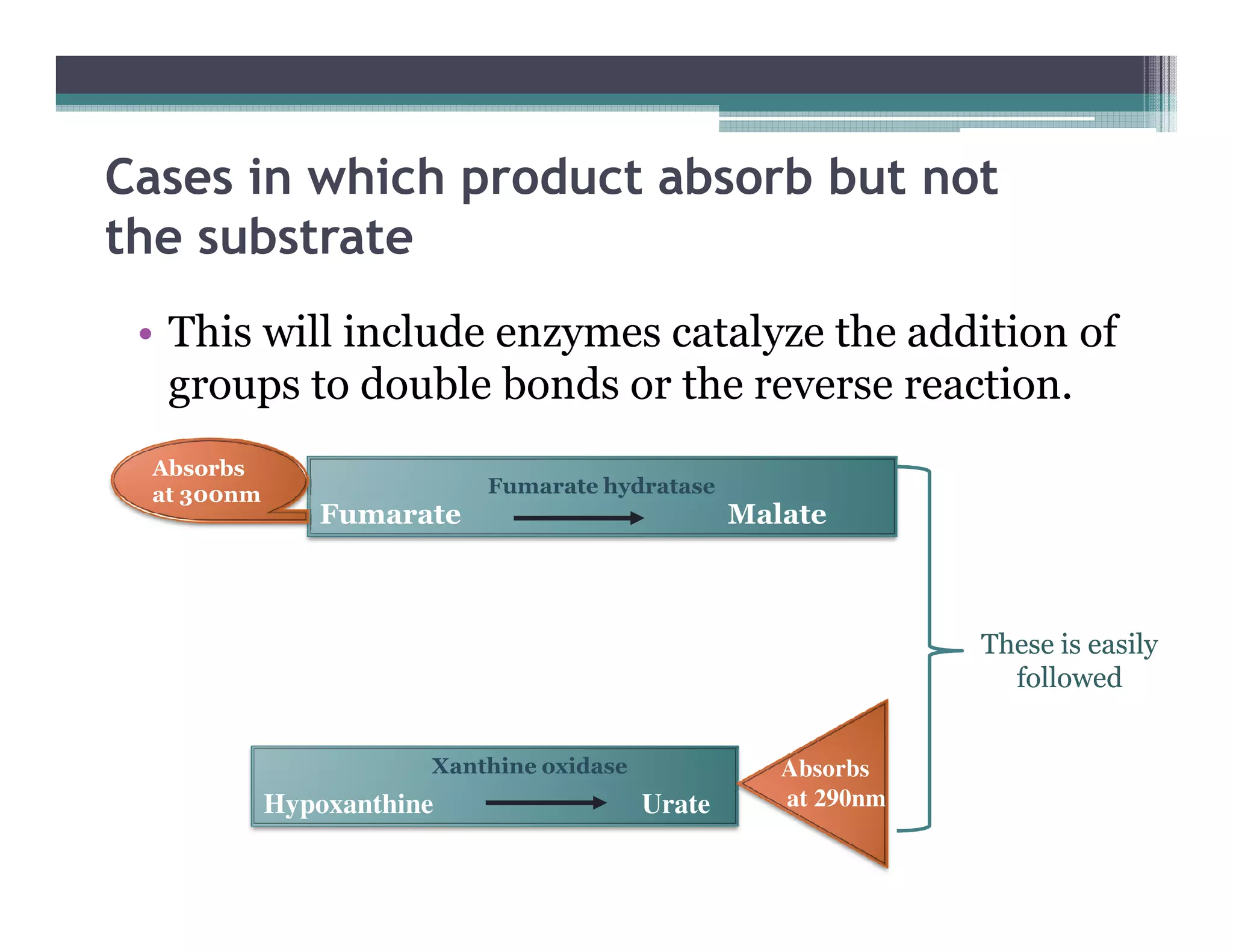
Cases in which product absorb but not
the substrate
• This will include enzymes catalyze the addition of
groups to double bonds or the reverse reaction.
Absorbs
Fumarate hydratase
Fumarate Malate
Absorbs
at 300nm
Hypoxanthine Urate
Absorbs
at 290nm
TheseThese is easilyis easily
followedfollowed
Fumarate hydratase
Xanthine oxidase
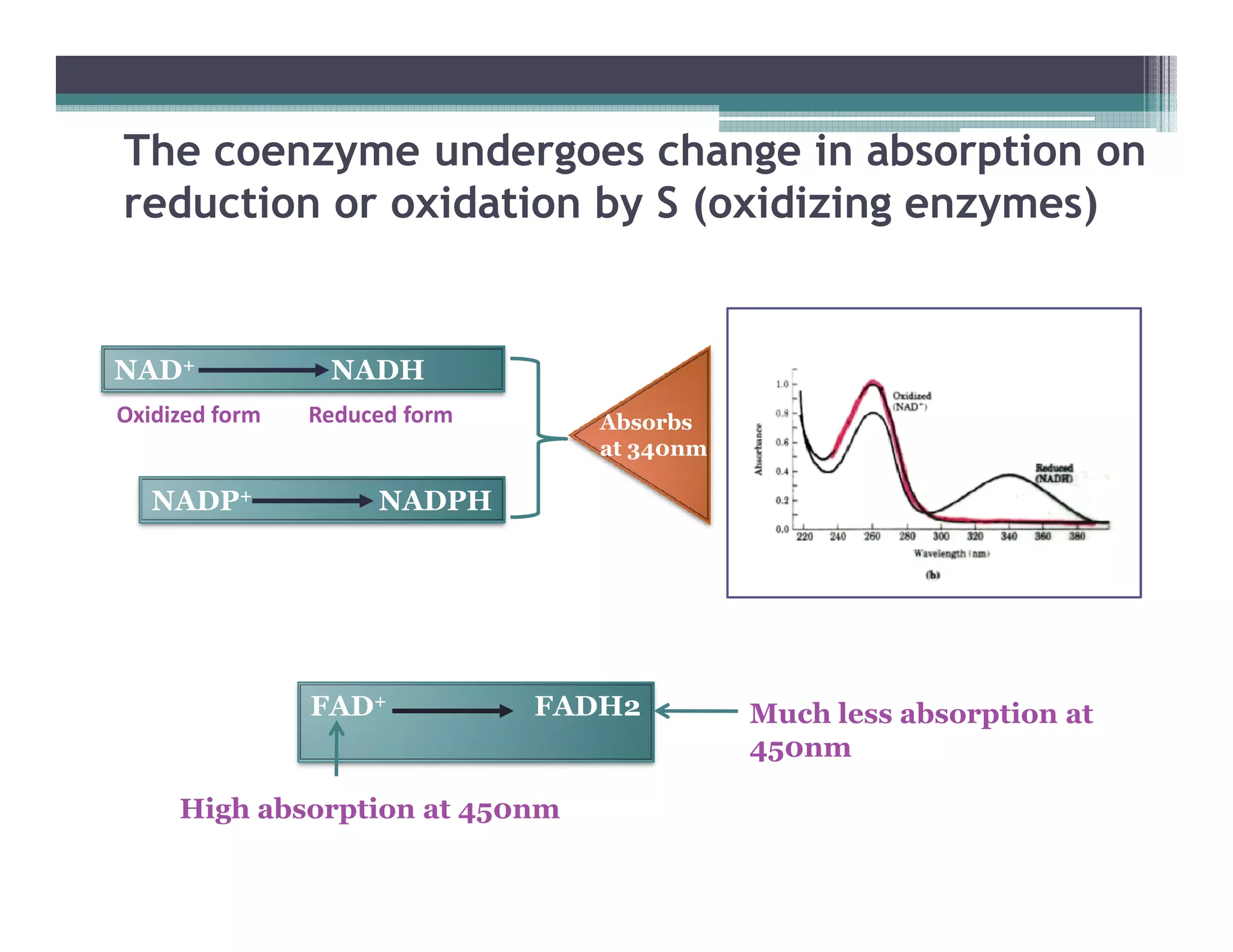
The coenzyme undergoes change in absorption on
reduction or oxidation by S (oxidizing enzymes)
NAD+ NADH
Absorbs
at 340nm
Oxidized form Reduced form
NADP+ NADPH
FAD+ FADH2 Much less absorption at
450nm
High absorption at 450nm
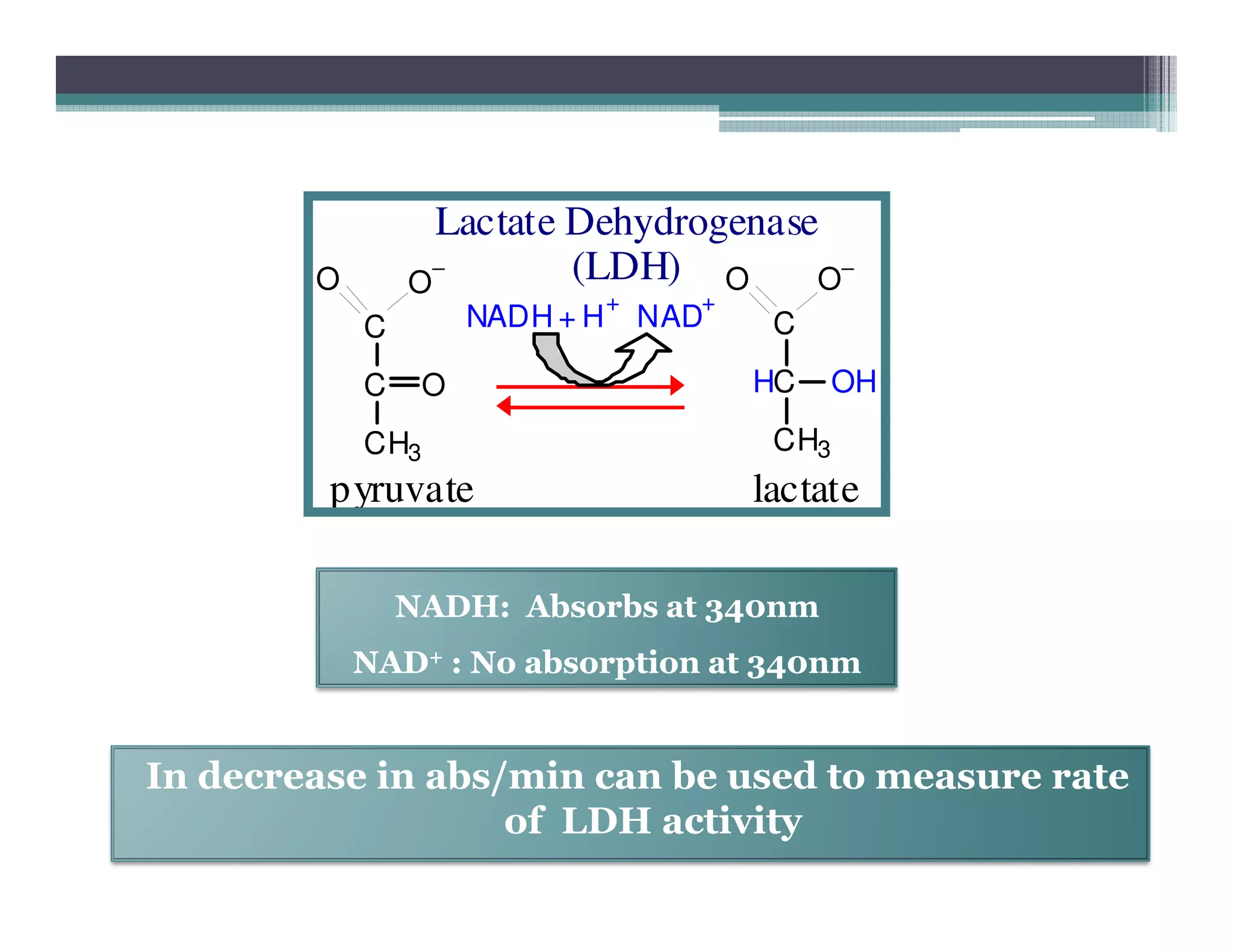
C
C
CH3
O
−
O
O
C
HC
CH3
O−
OH
O
NADH + H
+
NAD
+
Lactate Dehydrogenase
(LDH)
pyruvate lactate
In decrease in abs/min can be used to measure rate
of LDH activity
pyruvate lactate
NADH: Absorbs at 340nmNADH: Absorbs at 340nm
NADNAD++ : No absorption at 340nm: No absorption at 340nm
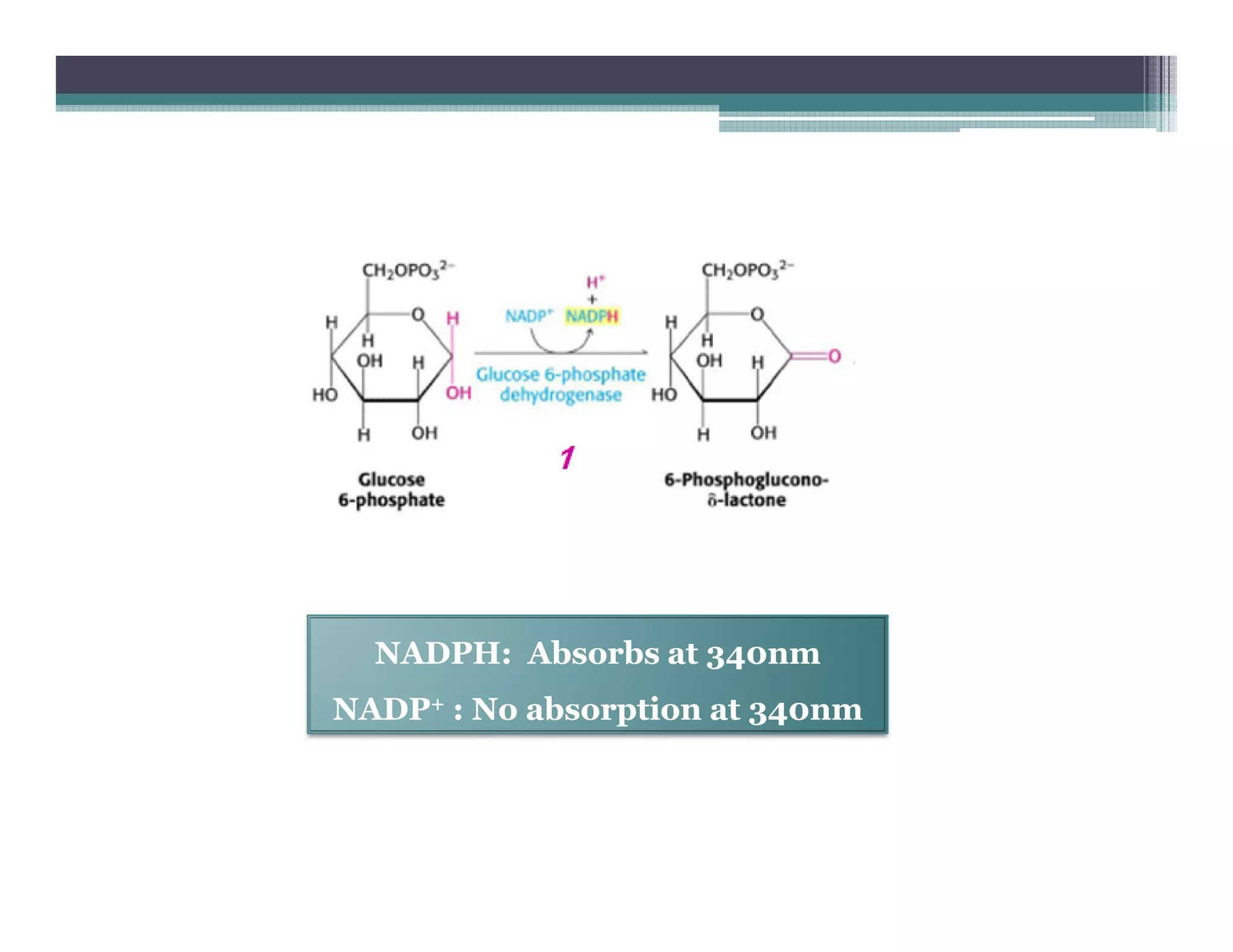
NADPH: Absorbs at 340nmNADPH: Absorbs at 340nm
NADPNADP++ : No absorption at 340nm: No absorption at 340nm
Coupled
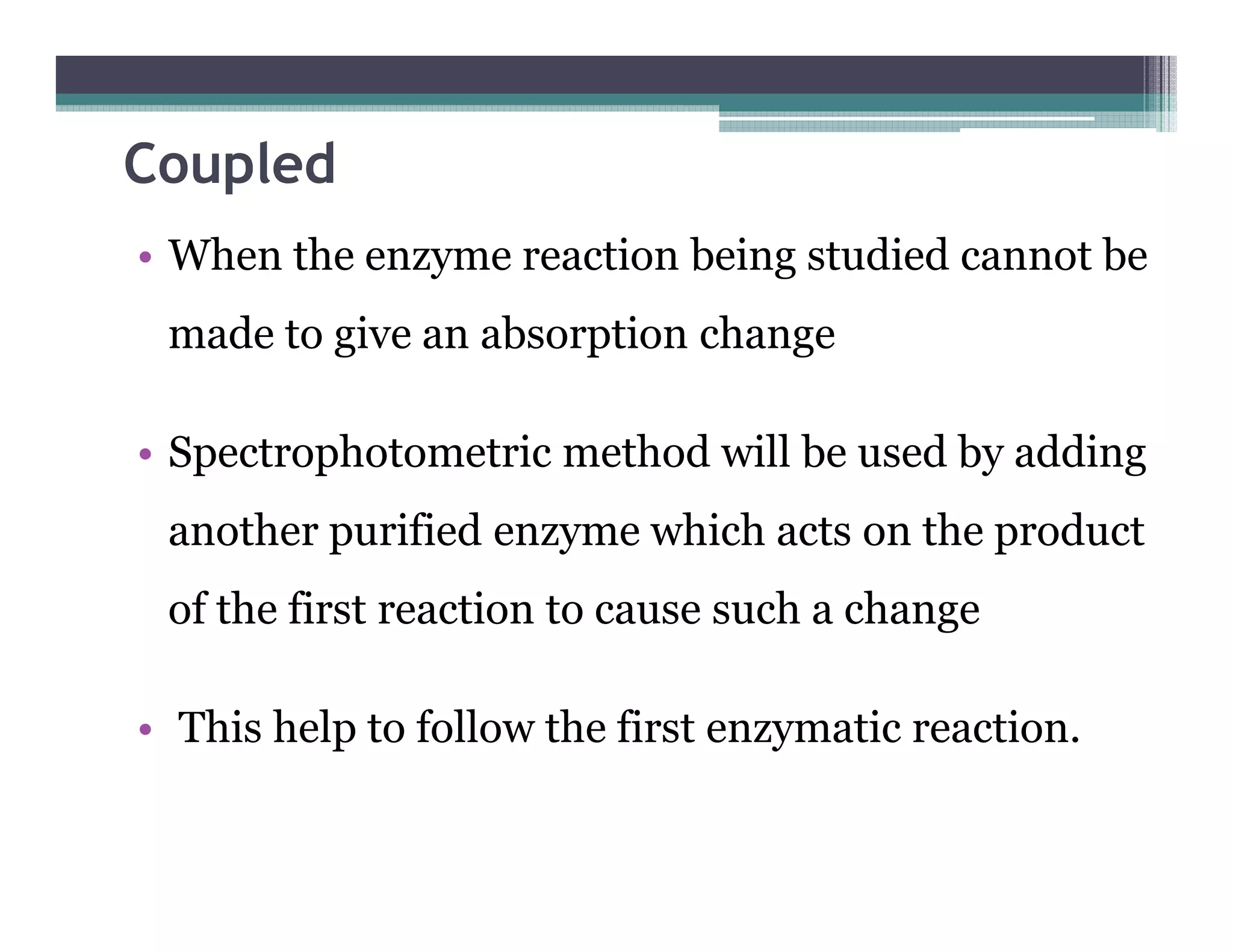
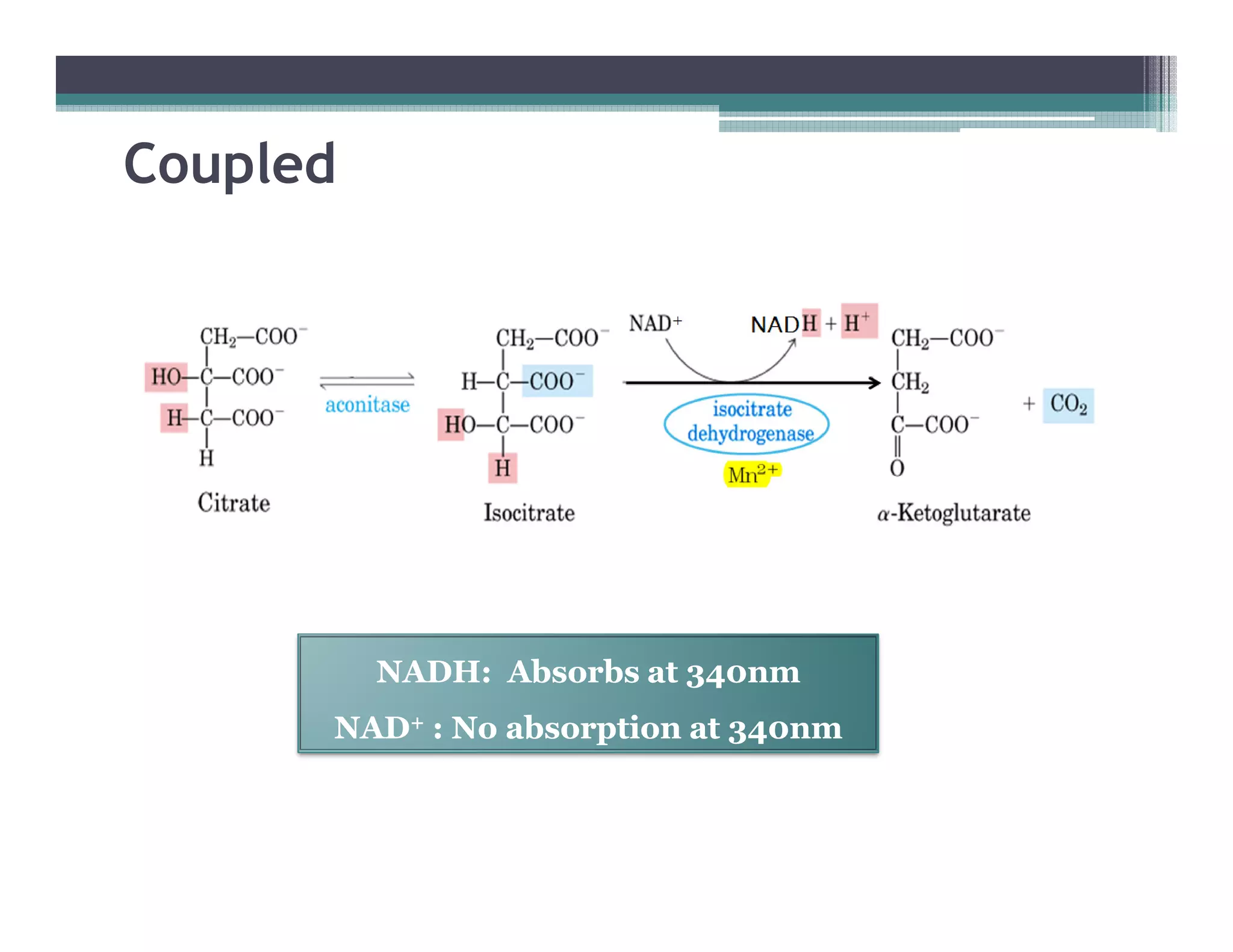
• When the enzyme reaction being studied cannot be
made to give an absorption change
• Spectrophotometric method will be used by adding• Spectrophotometric method will be used by adding
another purified enzyme which acts on the product
of the first reaction to cause such a change
• This help to follow the first enzymatic reaction.
Coupled
NADH: Absorbs at 340nmNADH: Absorbs at 340nm
NADNAD++ : No absorption at 340nm: No absorption at 340nm
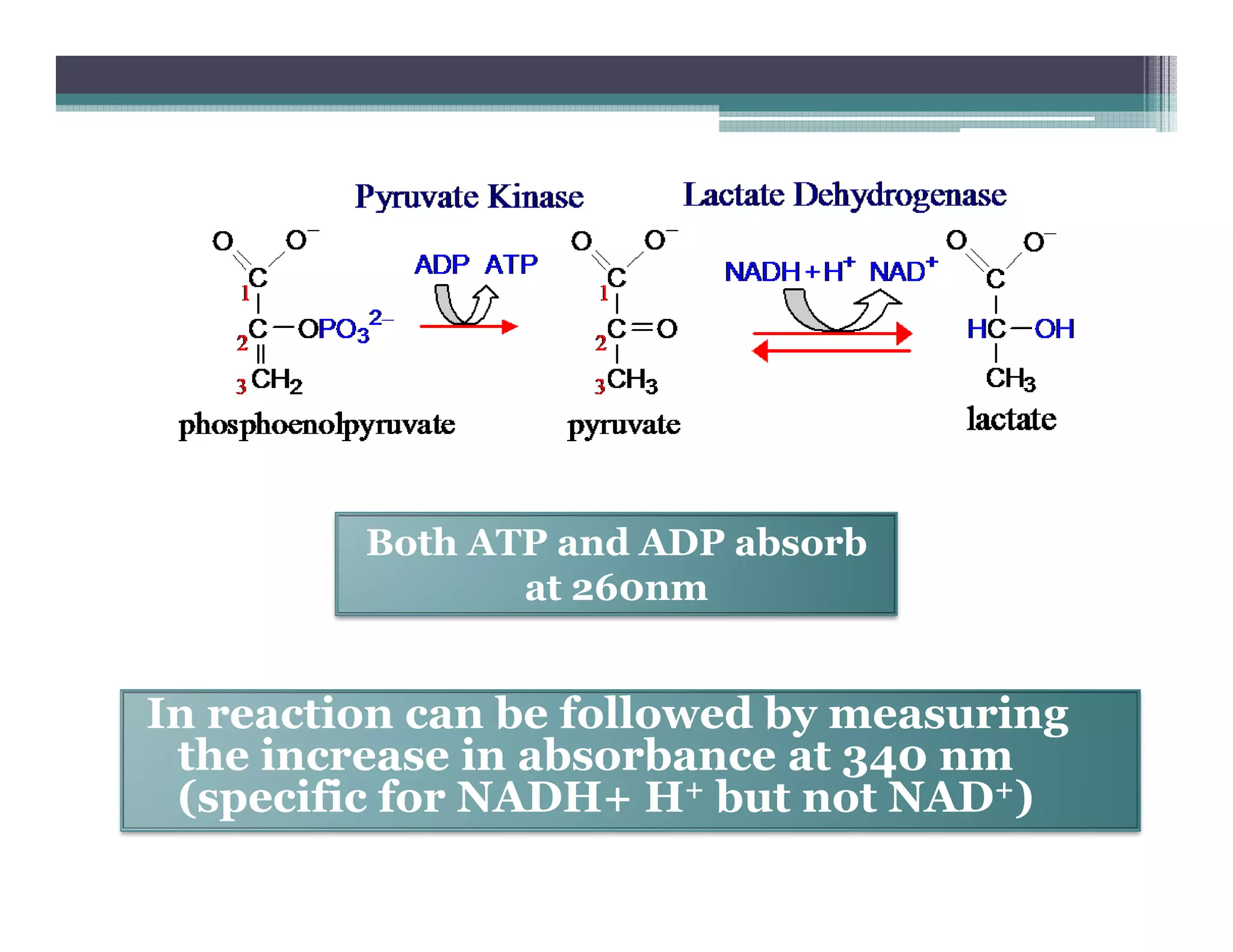
In reaction can be followed by measuring
the increase in absorbance at 340 nm
(specific for NADH+ H+ but not NAD+)
Both ATP and ADP absorb
at 260nm
Fluorescence Method: (Fluorimetric
method)
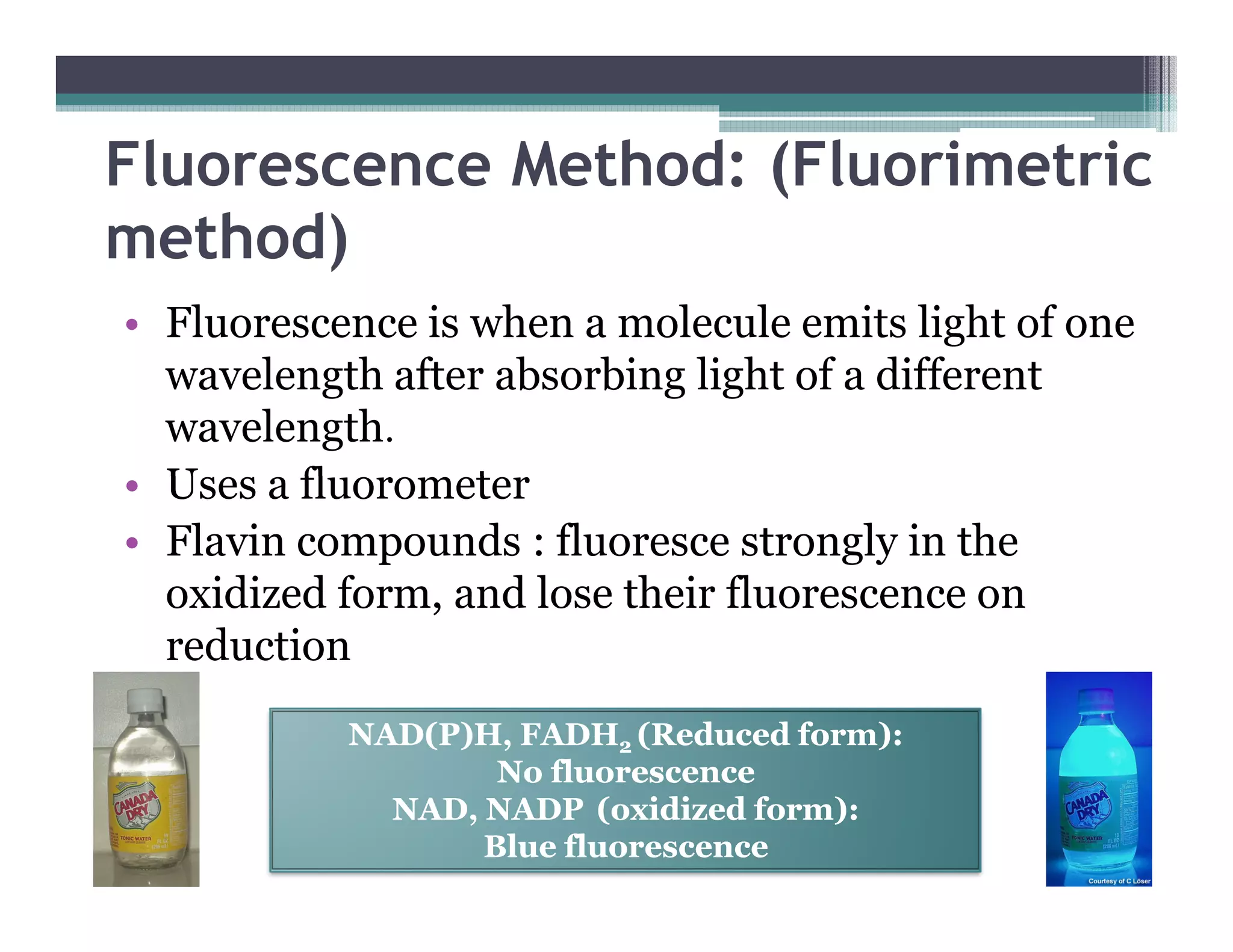
• Fluorescence is when a molecule emits light of one
wavelength after absorbing light of a different
wavelength.
• Uses a fluorometer• Uses a fluorometer
• Flavin compounds : fluoresce strongly in the
oxidized form, and lose their fluorescence on
reduction
NAD(P)H, FADHNAD(P)H, FADH22 (Reduced form):(Reduced form):
No fluorescenceNo fluorescence
NAD, NADPNAD, NADP (oxidized form):(oxidized form):
Blue fluorescenceBlue fluorescence
Fluorescence Method: (Fluorimetric
method)
• In this can be used for following enzymatic
oxidation reduction reactionoxidation reduction reaction
• Oxidation: decrease in fluorescence
• Reduction reactions: an increase in fluorescence
Advantages
• Highly sensitive - much more sensitive than
spectrophotometric assays
• Detection in small quantities
• non-dangerous• non-dangerous
• sensitive to environment
Manometric Method
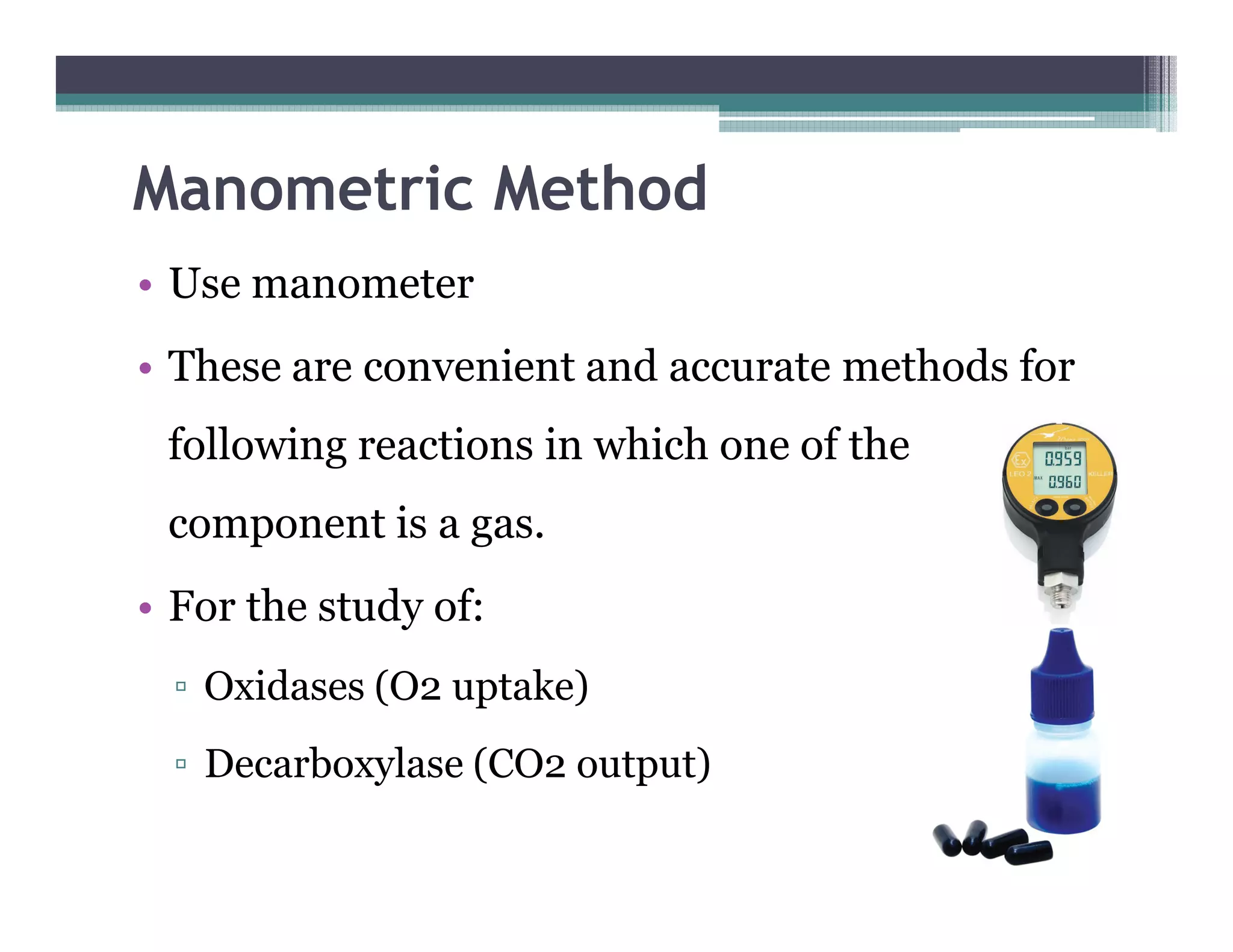
• Use manometer
• These are convenient and accurate methods for
following reactions in which one of the
component is a gas.
• For the study of:
▫ Oxidases (O2 uptake)
▫ Decarboxylase (CO2 output)
Electrode Method
• To follow reactions which involve the
production of acids.
▫ Use glass or platinum electrode.
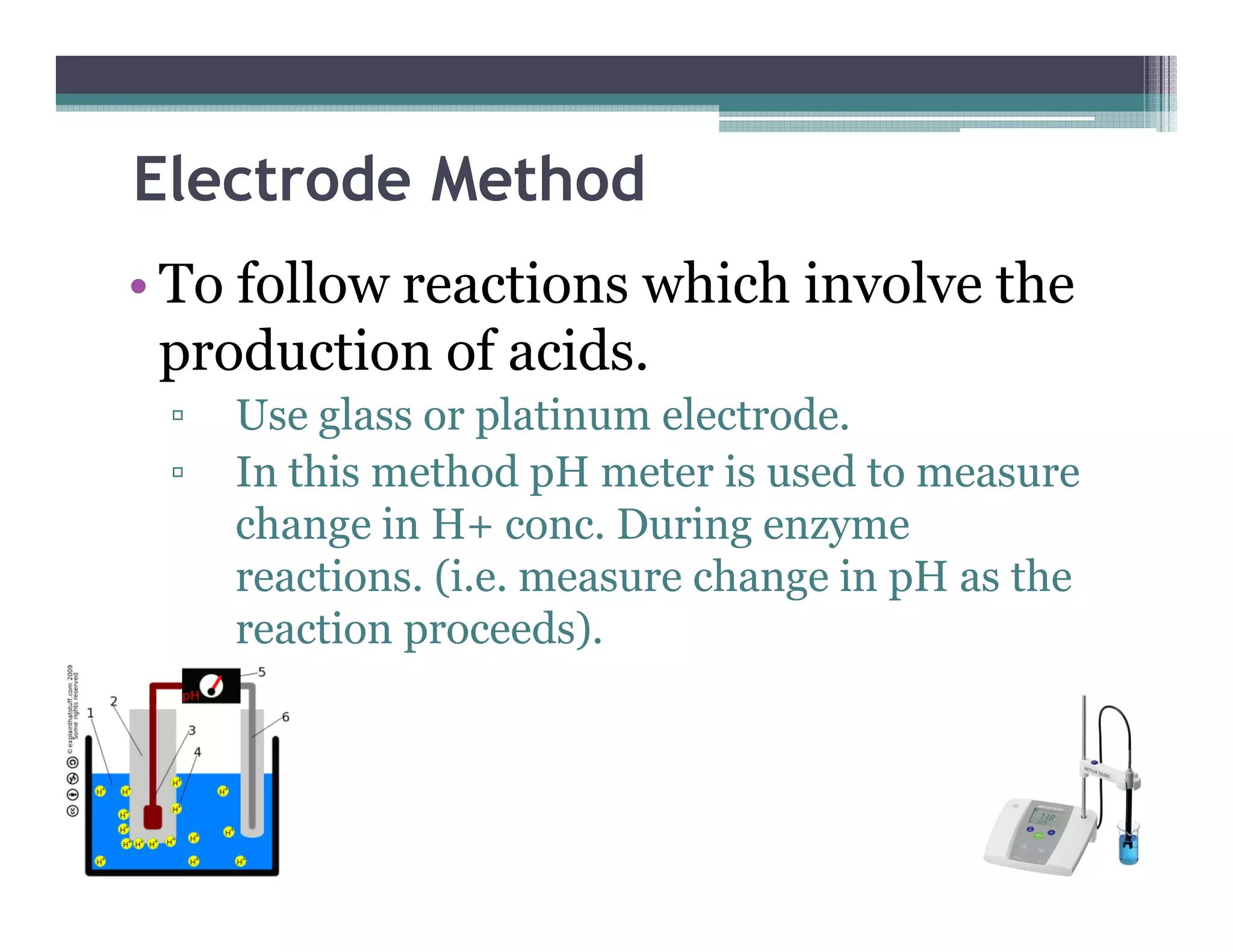
▫ In this method pH meter is used to measure▫ In this method pH meter is used to measure
change in H+ conc. During enzyme
reactions. (i.e. measure change in pH as the
reaction proceeds).
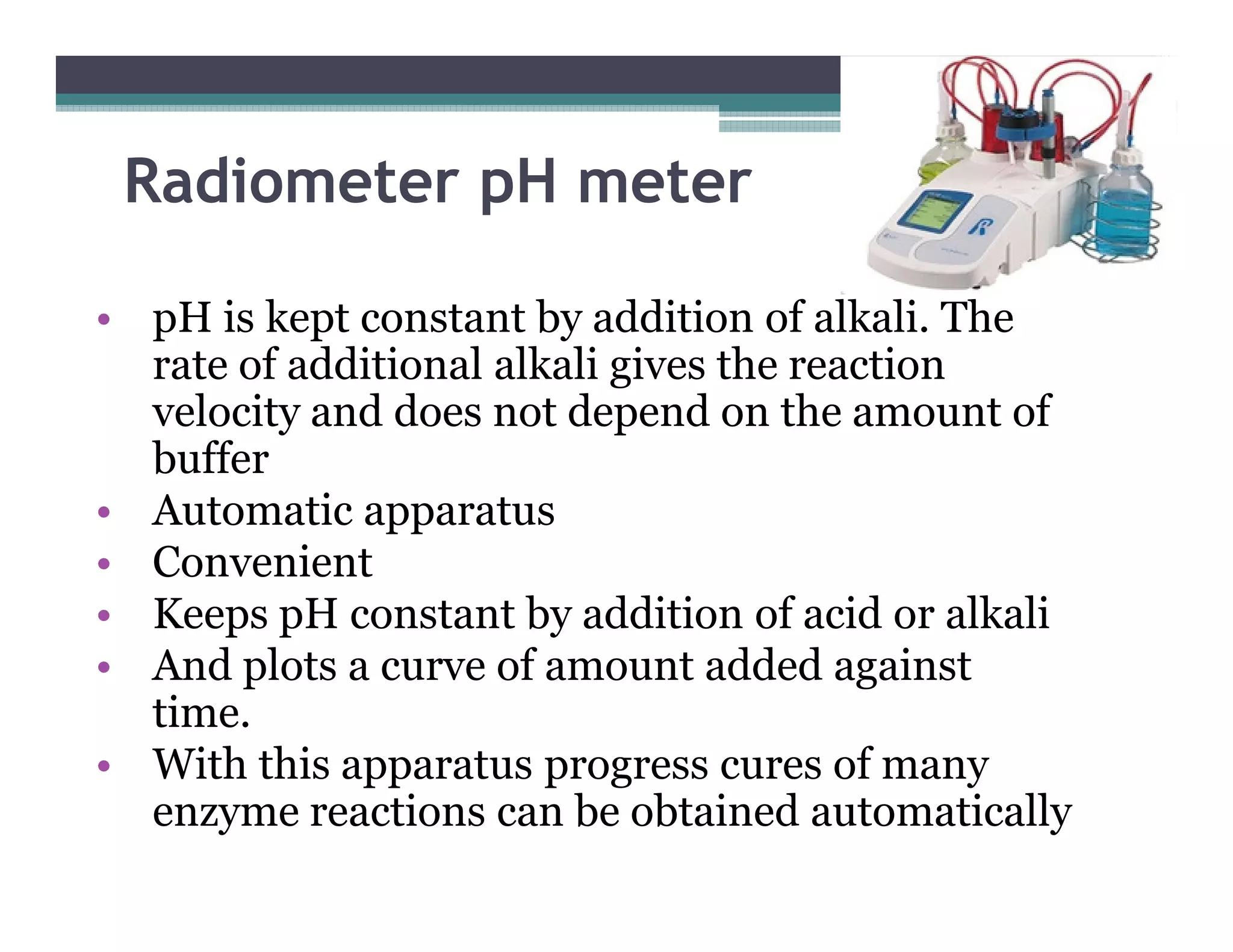
Radiometer pH meter
• pH is kept constant by addition of alkali. The
rate of additional alkali gives the reaction
velocity and does not depend on the amount of
bufferbuffer
• Automatic apparatus
• Convenient
• Keeps pH constant by addition of acid or alkali
• And plots a curve of amount added against
time.
• With this apparatus progress cures of many
enzyme reactions can be obtained automatically
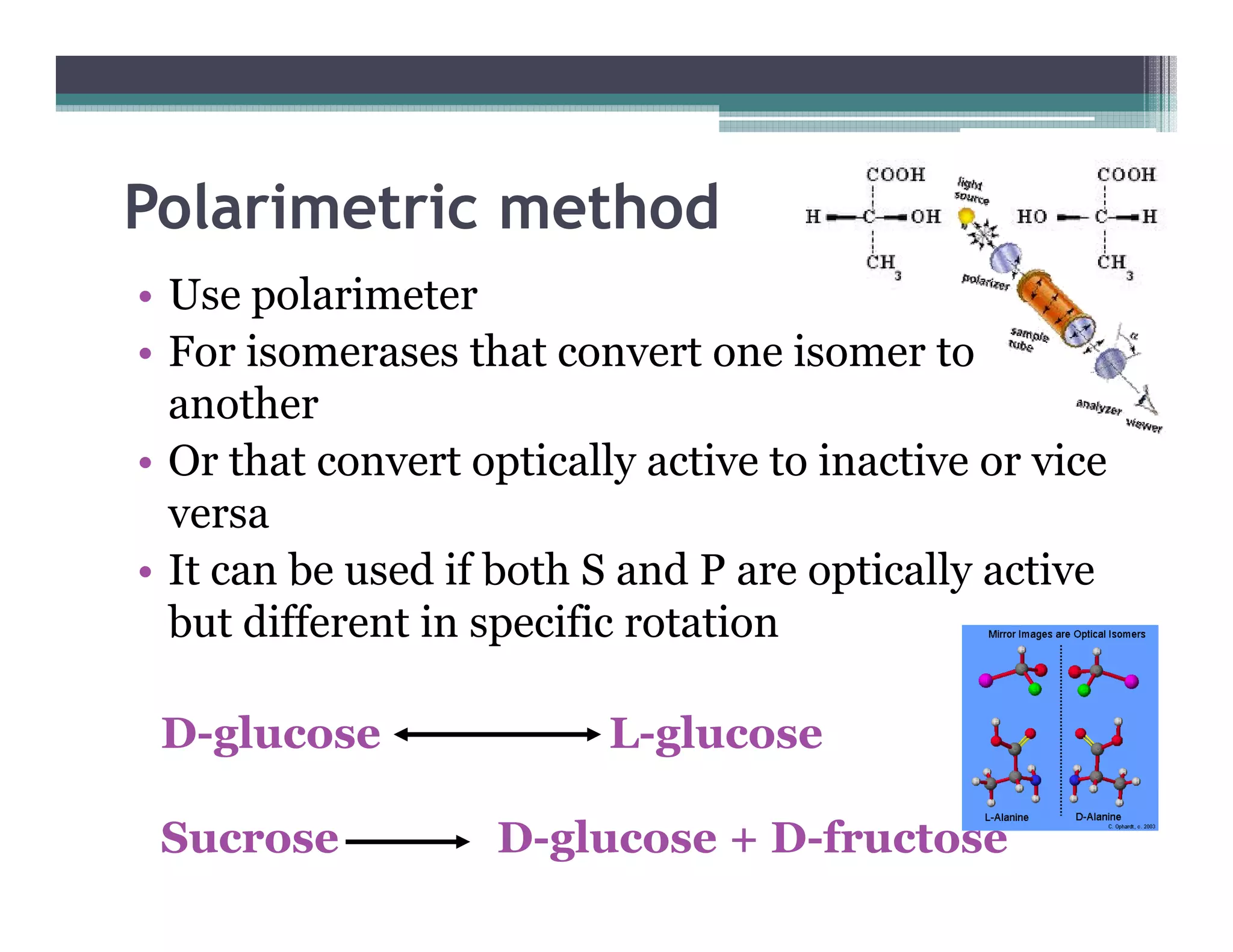
Polarimetric method
• Use polarimeter
• For isomerases that convert one isomer to
another
• Or that convert optically active to inactive or vice• Or that convert optically active to inactive or vice
versa
• It can be used if both S and P are optically active
but different in specific rotation
D-glucose L-glucose
Sucrose D-glucose + D-fructose
Sampling method
• Many enzyme reactions are followed by
withdrawing samples at intervals and
estimating the substrate or product by
chemical methods in different enzymes requirechemical methods in different enzymes require
different estimation methods.
▫ Fiske and SabbaRow method:
It is for inorganic phosphate. It can be used
for phosphatase, phosphorylase, nucleotides
and all enzymes involving ATP or ADP
including some kinase and synthetase.
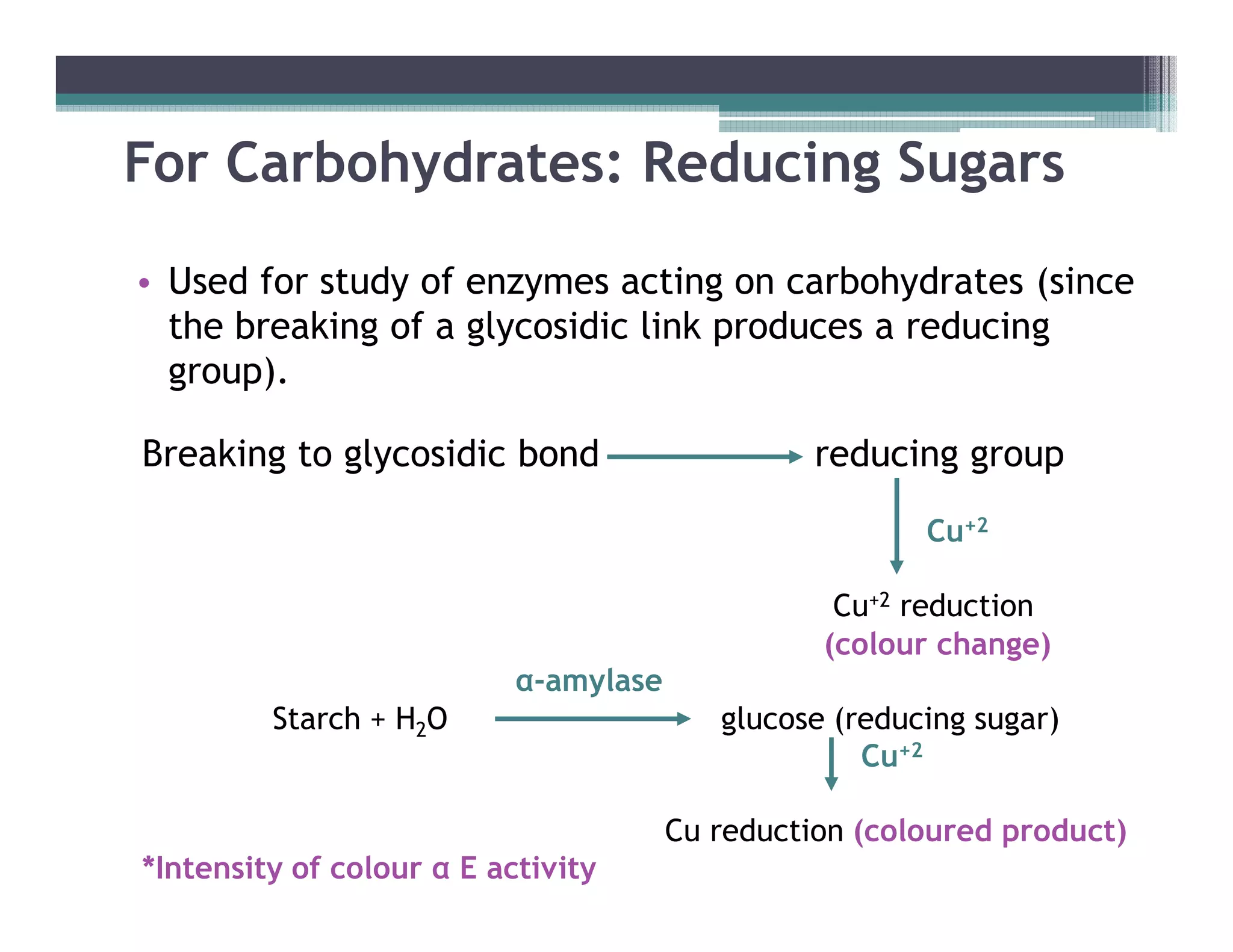
For Carbohydrates: Reducing Sugars
• Used for study of enzymes acting on carbohydrates (since
the breaking of a glycosidic link produces a reducing
group).
Breaking to glycosidic bond reducing groupBreaking to glycosidic bond reducing group
Cu+2
Cu+2 reduction
(colour change)
α-amylase
Starch + H2O glucose (reducing sugar)
Cu+2
Cu reduction (coloured product)
*Intensity of colour α E activity
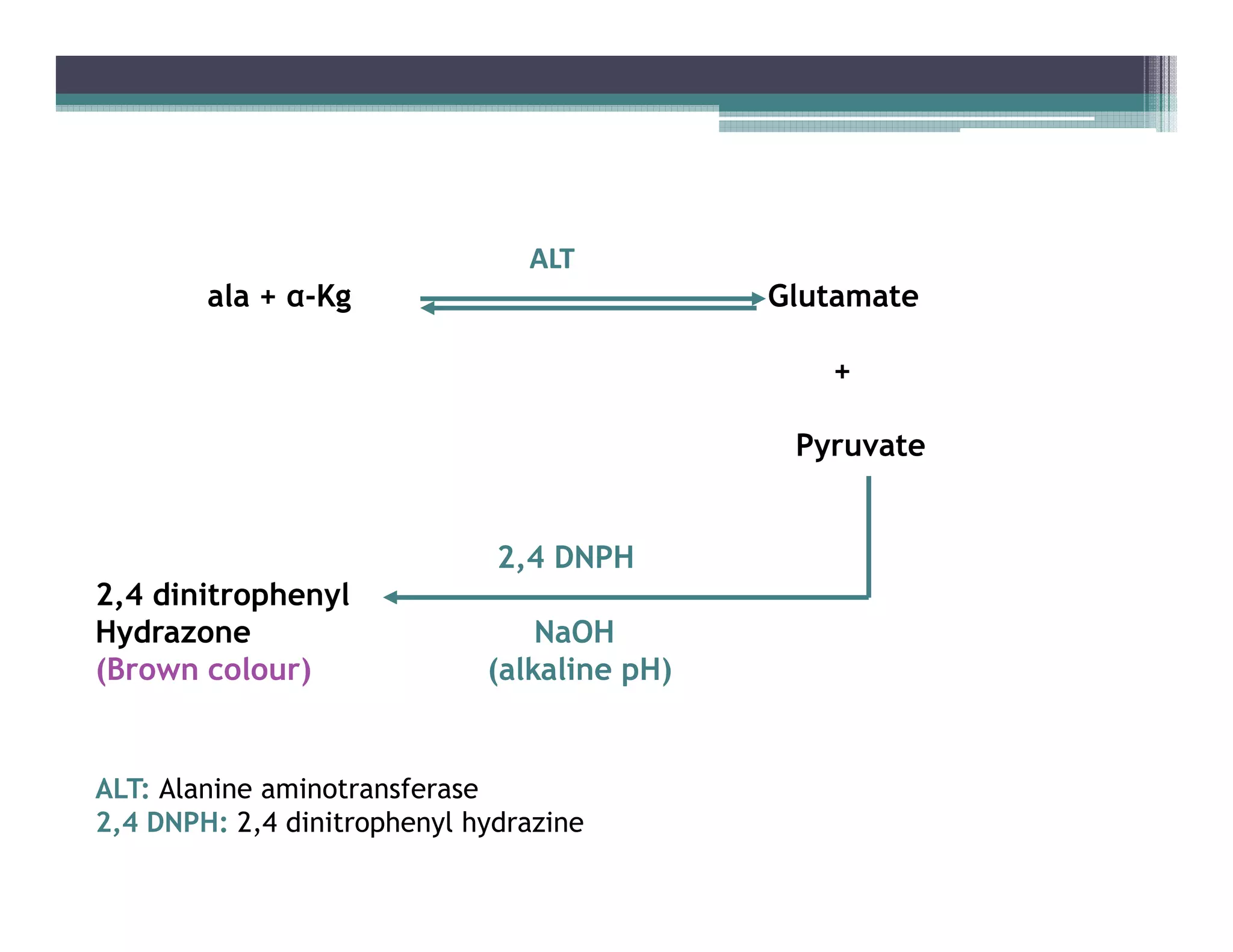
ALT
ala + α-Kg Glutamate
+
Pyruvate
2,4 DNPH
2,4 dinitrophenyl
Hydrazone NaOH
(Brown colour) (alkaline pH)
ALT: Alanine aminotransferase
2,4 DNPH: 2,4 dinitrophenyl hydrazine

Enzyme Assay Methods

  • 1.
  • 2.
    Enzyme Assay Methods •The assay is the act of measuring how fast a given (unknown) amount of enzyme will convert substrate to product (the act of measuring a velocity).velocity). • An assay requires to determine the concentration of a product or substrate at a given time after starting the reaction. • Different enzymes require different estimation methods depending on the type of reaction catalyzed, the nature of S and P or coenzyme.
  • 3.
  • 4.
    Spectrophotometric methods • Manysubstrates and products of enzyme reactions absorb light either in the visible region or in the U.V. region. • Mostly the spectra of S and P are not the same. ▫ The conversion of one into another is followed by a▫ The conversion of one into another is followed by a considerable change of absorption and by measuring this change the progress of the reaction can be followed quantitatively. • The enzyme is allowed to react with substrate and the decrease in the conc. of substrate or the increase of product produced will be followed spectrophotometrically
  • 5.
    Advantages • Easy • Simple •Sensitive • Require small sample • Whole progress curve can be followed• Whole progress curve can be followed quantitatively
  • 6.
    Cases in whichproduct absorb but not the substrate • This will include enzymes catalyze the addition of groups to double bonds or the reverse reaction. Absorbs Fumarate hydratase Fumarate Malate Absorbs at 300nm Hypoxanthine Urate Absorbs at 290nm TheseThese is easilyis easily followedfollowed Fumarate hydratase Xanthine oxidase
  • 7.
    The coenzyme undergoeschange in absorption on reduction or oxidation by S (oxidizing enzymes) NAD+ NADH Absorbs at 340nm Oxidized form Reduced form NADP+ NADPH FAD+ FADH2 Much less absorption at 450nm High absorption at 450nm
  • 8.
    C C CH3 O − O O C HC CH3 O− OH O NADH + H + NAD + LactateDehydrogenase (LDH) pyruvate lactate In decrease in abs/min can be used to measure rate of LDH activity pyruvate lactate NADH: Absorbs at 340nmNADH: Absorbs at 340nm NADNAD++ : No absorption at 340nm: No absorption at 340nm
  • 9.
    NADPH: Absorbs at340nmNADPH: Absorbs at 340nm NADPNADP++ : No absorption at 340nm: No absorption at 340nm
  • 10.
    Coupled • When theenzyme reaction being studied cannot be made to give an absorption change • Spectrophotometric method will be used by adding• Spectrophotometric method will be used by adding another purified enzyme which acts on the product of the first reaction to cause such a change • This help to follow the first enzymatic reaction.
  • 11.
    Coupled NADH: Absorbs at340nmNADH: Absorbs at 340nm NADNAD++ : No absorption at 340nm: No absorption at 340nm
  • 12.
    In reaction canbe followed by measuring the increase in absorbance at 340 nm (specific for NADH+ H+ but not NAD+) Both ATP and ADP absorb at 260nm
  • 13.
    Fluorescence Method: (Fluorimetric method) •Fluorescence is when a molecule emits light of one wavelength after absorbing light of a different wavelength. • Uses a fluorometer• Uses a fluorometer • Flavin compounds : fluoresce strongly in the oxidized form, and lose their fluorescence on reduction NAD(P)H, FADHNAD(P)H, FADH22 (Reduced form):(Reduced form): No fluorescenceNo fluorescence NAD, NADPNAD, NADP (oxidized form):(oxidized form): Blue fluorescenceBlue fluorescence
  • 14.
    Fluorescence Method: (Fluorimetric method) •In this can be used for following enzymatic oxidation reduction reactionoxidation reduction reaction • Oxidation: decrease in fluorescence • Reduction reactions: an increase in fluorescence
  • 15.
    Advantages • Highly sensitive- much more sensitive than spectrophotometric assays • Detection in small quantities • non-dangerous• non-dangerous • sensitive to environment
  • 16.
    Manometric Method • Usemanometer • These are convenient and accurate methods for following reactions in which one of the component is a gas. • For the study of: ▫ Oxidases (O2 uptake) ▫ Decarboxylase (CO2 output)
  • 17.
    Electrode Method • Tofollow reactions which involve the production of acids. ▫ Use glass or platinum electrode. ▫ In this method pH meter is used to measure▫ In this method pH meter is used to measure change in H+ conc. During enzyme reactions. (i.e. measure change in pH as the reaction proceeds).
  • 18.
    Radiometer pH meter •pH is kept constant by addition of alkali. The rate of additional alkali gives the reaction velocity and does not depend on the amount of bufferbuffer • Automatic apparatus • Convenient • Keeps pH constant by addition of acid or alkali • And plots a curve of amount added against time. • With this apparatus progress cures of many enzyme reactions can be obtained automatically
  • 19.
    Polarimetric method • Usepolarimeter • For isomerases that convert one isomer to another • Or that convert optically active to inactive or vice• Or that convert optically active to inactive or vice versa • It can be used if both S and P are optically active but different in specific rotation D-glucose L-glucose Sucrose D-glucose + D-fructose
  • 20.
    Sampling method • Manyenzyme reactions are followed by withdrawing samples at intervals and estimating the substrate or product by chemical methods in different enzymes requirechemical methods in different enzymes require different estimation methods. ▫ Fiske and SabbaRow method: It is for inorganic phosphate. It can be used for phosphatase, phosphorylase, nucleotides and all enzymes involving ATP or ADP including some kinase and synthetase.
  • 21.
    For Carbohydrates: ReducingSugars • Used for study of enzymes acting on carbohydrates (since the breaking of a glycosidic link produces a reducing group). Breaking to glycosidic bond reducing groupBreaking to glycosidic bond reducing group Cu+2 Cu+2 reduction (colour change) α-amylase Starch + H2O glucose (reducing sugar) Cu+2 Cu reduction (coloured product) *Intensity of colour α E activity
  • 22.
    ALT ala + α-KgGlutamate + Pyruvate 2,4 DNPH 2,4 dinitrophenyl Hydrazone NaOH (Brown colour) (alkaline pH) ALT: Alanine aminotransferase 2,4 DNPH: 2,4 dinitrophenyl hydrazine