VIJAY
JRF
GIT, BENGALURU.
A natural disaster is the effect of earths natural
hazards, for
example flood, tornado, hurricane, volcanic
eruption, earthquake, heatwave, or landslide.
They can lead to financial, environmental or
human losses. The resulting loss depends on
the vulnerability of the affected population to
resist the hazard, also called their resilience. If
these disasters continue it would be a great
danger for the earth.
•EARTHQUAKES
•FLOODS
•VOLCANOES
•TSUNAMI
•DROUGHTS
•HURRICANES
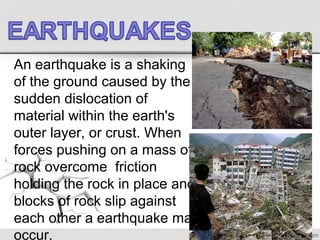
An earthquake is a shaking
of the ground caused by the
sudden dislocation of
material within the earth's
outer layer, or crust. When
forces pushing on a mass of
rock overcome friction
holding the rock in place and
blocks of rock slip against
each other a earthquake may
occur.
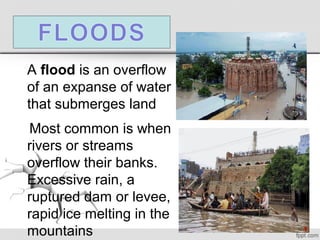
A flood is an overflow
of an expanse of water
that submerges land
Most common is when
rivers or streams
overflow their banks.
Excessive rain, a
ruptured dam or levee,
rapid ice melting in the
mountains
A Volcano is a vent in the
earth through which hot
gases and molten rock rise
to the surface. A cone
shaped mountain of
erupted material around
such a vent is also called a
volcano.Volcanic eruption
deadly,damaging property
and infrastructure.
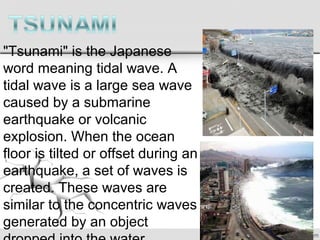
"Tsunami" is the Japanese
word meaning tidal wave. A
tidal wave is a large sea wave
caused by a submarine
earthquake or volcanic
explosion. When the ocean
floor is tilted or offset during an
earthquake, a set of waves is
created. These waves are
similar to the concentric waves
generated by an object
Drought is a period or condition
of unusually dry weather within
a geographic area where
rainfall is normally present.
During a drought there is a
lack of precipitation. Droughts
occur in all climatic zones.
However, its characteristics
vary significantly from one
region to another.Drought usually results in a
water shortage that seriously
interferes with human activity
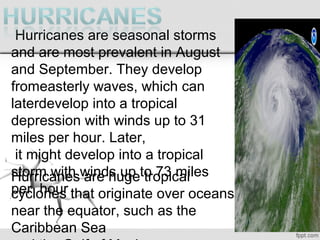
Hurricanes are seasonal storms
and are most prevalent in August
and September. They develop
fromeasterly waves, which can
laterdevelop into a tropical
depression with winds up to 31
miles per hour. Later,
it might develop into a tropical
storm with winds up to 73 miles
per hour
Hurricanes are huge tropical
cyclones that originate over oceans
near the equator, such as the
Caribbean Sea
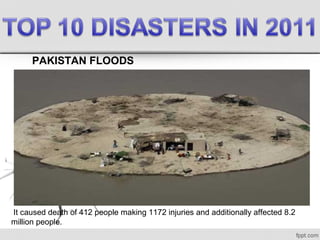
PAKISTAN FLOODS
 It caused death of 412 people making 1172 injuries and additionally affected 8.2 
million people.
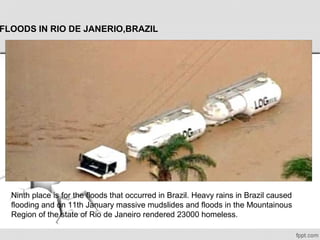
FLOODS IN RIO DE JANERIO,BRAZIL
Ninth place is for the floods that occurred in Brazil. Heavy rains in Brazil caused 
flooding and on 11th January massive mudslides and floods in the Mountainous 
Region of the state of Rio de Janeiro rendered 23000 homeless.
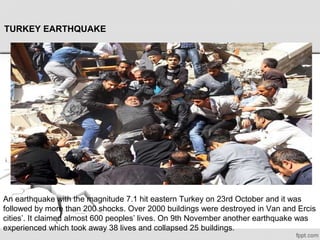
TURKEY EARTHQUAKE
An earthquake with the magnitude 7.1 hit eastern Turkey on 23rd October and it was 
followed by more than 200 shocks. Over 2000 buildings were destroyed in Van and Ercis 
cities’. It claimed almost 600 peoples’ lives. On 9th November another earthquake was 
experienced which took away 38 lives and collapsed 25 buildings.
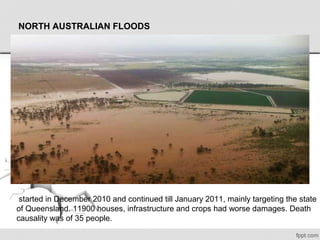
NORTH AUSTRALIAN FLOODS
 started in December 2010 and continued till January 2011, mainly targeting the state 
of Queensland. 11900 houses, infrastructure and crops had worse damages. Death 
causality was of 35 people. 
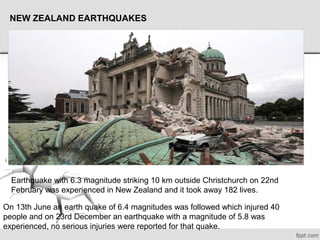
Earthquake with 6.3 magnitude striking 10 km outside Christchurch on 22nd 
February was experienced in New Zealand and it took away 182 lives.
On 13th June an earth quake of 6.4 magnitudes was followed which injured 40 
people and on 23rd December an earthquake with a magnitude of 5.8 was 
experienced, no serious injuries were reported for that quake.
NEW ZEALAND EARTHQUAKES
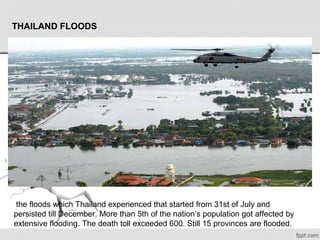
 the floods which Thailand experienced that started from 31st of July and 
persisted till December. More than 5th of the nation’s population got affected by 
extensive flooding. The death toll exceeded 600. Still 15 provinces are flooded. 
THAILAND FLOODS
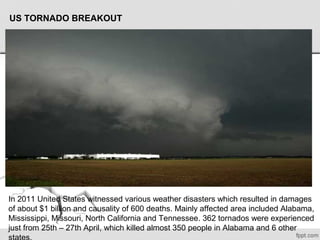
US TORNADO BREAKOUT
In 2011 United States witnessed various weather disasters which resulted in damages 
of about $1 billion and causality of 600 deaths. Mainly affected area included Alabama, 
Mississippi, Missouri, North California and Tennessee. 362 tornados were experienced 
just from 25th – 27th April, which killed almost 350 people in Alabama and 6 other 
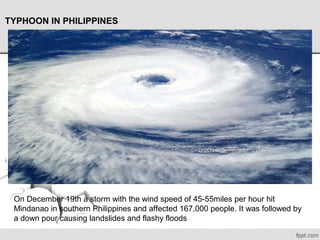
TYPHOON IN PHILIPPINES
On December 19th a storm with the wind speed of 45-55miles per hour hit 
Mindanao in southern Philippines and affected 167,000 people. It was followed by 
a down pour causing landslides and flashy floods
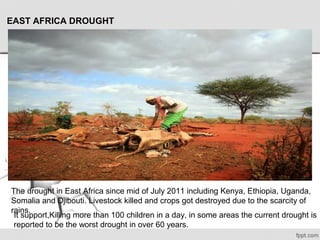
EAST AFRICA DROUGHT
The drought in East Africa since mid of July 2011 including Kenya, Ethiopia, Uganda, 
Somalia and Djibouti. Livestock killed and crops got destroyed due to the scarcity of 
rains. 
It support,Killing more than 100 children in a day, in some areas the current drought is 
reported to be the worst drought in over 60 years.
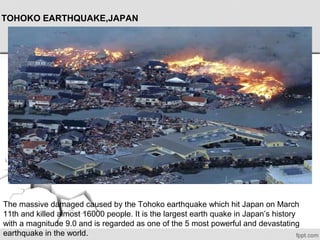
TOHOKO EARTHQUAKE,JAPAN
The massive damaged caused by the Tohoko earthquake which hit Japan on March 
11th and killed almost 16000 people. It is the largest earth quake in Japan’s history 
with a magnitude 9.0 and is regarded as one of the 5 most powerful and devastating 
earthquake in the world.
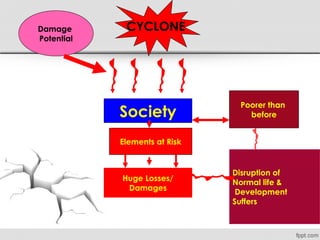
CYCLONEDamage
Potential
Society
Poorer than
before
Disruption of
Normal life &
Development
Suffers
Huge Losses/
Damages
Elements at Risk
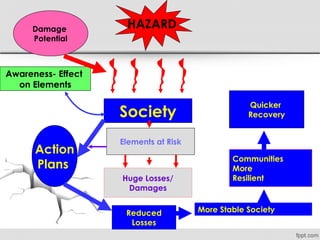
HAZARDDamage
Potential
Awareness- Effect
on Elements
Society
Quicker
Recovery
Action
Plans
Communities
More
ResilientHuge Losses/
Damages
Reduced
Losses
Elements at Risk
More Stable Society
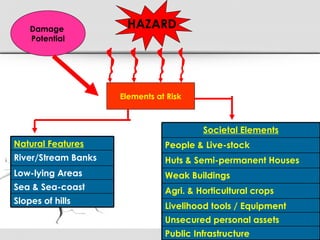
HAZARDDamage
Potential
Elements at Risk
Slopes of hills
Sea & Sea-coast
Low-lying Areas
River/Stream Banks
Natural Features
Unsecured personal assets
Livelihood tools / Equipment
Public Infrastructure
Agri. & Horticultural crops
Weak Buildings
Huts & Semi-permanent Houses
People & Live-stock
Societal Elements
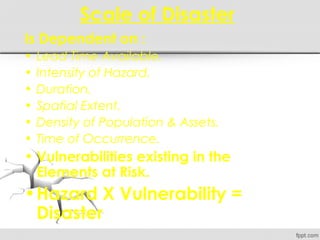
Scale of Disaster
Is Dependent on :
• Lead Time Available.
• Intensity of Hazard.
• Duration.
• Spatial Extent.
• Density of Population & Assets.
• Time of Occurrence.
• Vulnerabilities existing in the
Elements at Risk.
•Hazard X Vulnerability =
Disaster
ELEMENTS AT RISK
• People
• Livestock
• Rural Housing Stock
• Houses Vulnerable
• Crops, Trees,Telephone, Electric
poles
• Boats, Looms, Working Implements
• Personal Property
• Electricity, Water and Food Supplies
• Infrastructure Support
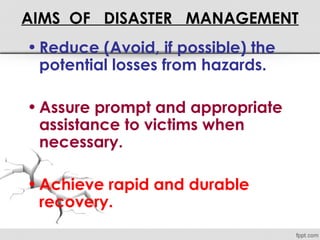
AIMS OF DISASTER MANAGEMENT
•Reduce (Avoid, if possible) the
potential losses from hazards.
•Assure prompt and appropriate
assistance to victims when
necessary.
•Achieve rapid and durable
recovery.
 
 
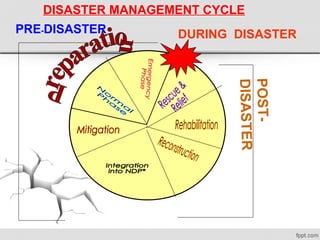
DURING DISASTER
DISASTER MANAGEMENT CYCLE
PRE-DISASTER 


POST-
DISASTER
 
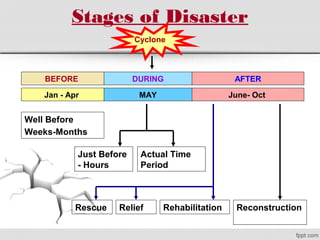
Stages of Disaster
Cyclone
Well Before
Weeks-Months
Just Before
- Hours
Actual Time
Period
Rescue RehabilitationRelief Reconstruction
BEFORE AFTERDURING
Jan - Apr MAY June- Oct
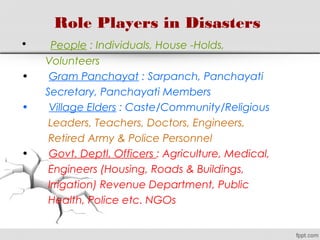
Role Players in Disasters
•       People : Individuals, House -Holds,
Volunteers
• Gram Panchayat : Sarpanch, Panchayati
Secretary, Panchayati Members
• Village Elders : Caste/Community/Religious
Leaders, Teachers, Doctors, Engineers,
Retired Army & Police Personnel
• Govt. Deptl. Officers : Agriculture, Medical,
Engineers (Housing, Roads & Buildings,
Irrigation) Revenue Department, Public
Health, Police etc. NGOs
DEFINITIONS OF “VULNERABILITY”
• “The extent to which a community, 
structure, service or geographic 
area is likely to be damaged or 
disrupted by the impact of particular 
disaster hazard…”
• “Vulnerability is the propensity of 
things to be damaged by a hazard”.
DISASTER PREPAREDNESS
• Disaster preparedness aims at
minimizing the adverse effects of a hazard -
• Through effective precautionary actions
• Ensure timely, appropriate and efficient
organisation and delivery of emergency
response following the impact of a disaster.
PREPAREDNESS
• Vulnerability Analysis and Mapping to include
Resources.
• Assess strengthening requirements and execute.
• Funding for preparedness must be arranged.
• Peoples’ cooperation through Political leaders,
elders, Volunteers and NGOs
• Create lead time by interpreting Warnings
• Plan to include movement of resources with time
frame.
• Aim to reduce the destructive potential of
cyclones, timely & appropriate relief to victims
and quick & durable recovery
Disaster Preparedness
Framework
RehearsalsPublic
Education
and Training
Response
Mechanisms
Warning
Systems
Resource
Base
Information
System
Institutional
Framework
PlanningVulnerability
Assessment
COMPONENTS OF PREPAREDNESS
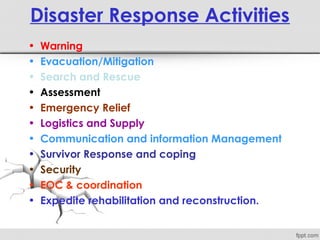
Disaster Response Activities
• Warning
• Evacuation/Mitigation
• Search and Rescue
• Assessment
• Emergency Relief
• Logistics and Supply
• Communication and information Management
• Survivor Response and coping
• Security
• EOC & coordination
• Expedite rehabilitation and reconstruction.
Role of individuals in prevention of pollution
1) Use low-phosphate, phosphate-free or biodegradable dishwashing
liquid, laundry detergent, and shampoo.
2) Don't use water fresheners in toilets.
3) Use manure or compost instead of commercial inorganic fertilizers to
fertilize gardens and yard plant.
4) Use biological methods or integrated pest management to control
garden, yard, and household pests.
5) Don't pour pesticides, paints, solvents, oils, or other products
containing harmful chemicals down drain or on the ground. Contact the
authorities responsible for their disposal.
6) Recycle old motor oil and antifreeze at an auto service center that has an oil
recycling program.
7) If you get water from a private well or suspect that municipal water is
contaminated, have tested by an EPA certified laboratory for lead, nitrates,
trihalomethanes, radon, volatile, organic compounds and pesticides.
8)Run water from taps for several minutes every morning before using the water for
drinking or cooking. Save it and use it to water plants.
If you have a septic tank, monitor it yearly and have it cleaned out every three to five
years by a reputable contractor so that it won’t contribute to groundwater pollution.
Do not use a septic tank cleaner, which contain toxic chemicals that can kill bacteria
important to sewage decomposition and that can contaminate groundwater if
systems malfunction.
9) Support ecological land-use planning in your community.
10) Get to know your local water bodies and form watchdog groups to help monitor,
protect, and restore them.
Natural disasters and its managment

Natural disasters and its managment

Editor's Notes

  • #22 If you look at the right half of the slide you will find that the damage potential in the hazard causes the damages to the society Life comes to a halt and the poorer sections of the society can never recover to the pre-disaster causes serious disruption to life of the society But with awareness and preparation through action plans the society suffers less damages and is thus a more stable society.to recover faster.


  • #23 If you look at the right half of the slide you will find that the damage potential in the hazard causes the damages to the society Life comes to a halt and the poorer sections of the society can never recover to the pre-disaster causes serious disruption to life of the society But with awareness and preparation through action plans the society suffers less damages and is thus a more stable society.to recover faster.
  • #24 If you look at the right half of the slide you will find that the damage potential in the hazard causes the damages to the society Life comes to a halt and the poorer sections of the society can never recover to the pre-disaster causes serious disruption to life of the society But with awareness and preparation through action plans the society suffers less damages and is thus a more stable society.to recover faster.