Topic: Protein-Protein Interactions
Presented by: D.Sairam
Course: Bioorganic and Bioinorganic
Chemistry
Course Code: BSBT-211
Course Instructor: Dr. Vineet Sharma
Presentation Code: U3P1
Overview of the Presentation
Introduction
Types of Protein- Protein Interactions
Techniques used to study them
Factors affecting these Interactions
Methods used to Investigate Interactions
Applications of Protein- Protein Interactions
Introduction
• Proteins are the workhorses that facilitate most biological processes
in a cell, including gene expression, cell growth, proliferation,
nutrient uptake, morphology, motility, intercellular communication
and apoptosis.
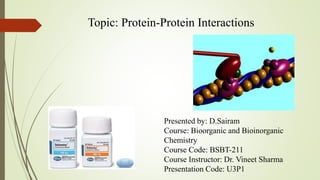
• Protein–protein interactions (PPIs) refer to intentional physical
contacts established between two or more proteins as a result of
biochemical events and/or electrostatic forces.
• These interactions are very important in our lives as any disorder in
them can lead to fatal diseases such as Alzheimer’s and Creutzfeld-
Jacob Disease.
• Perhaps the most well known example of Protein-Protein
Interaction is between Actin and Myosin while regulating Muscular
contraction in our body.
• Another prominent application of PPIs is in Signal Transmission
inside the lining of a cell or along the boundaries of various cell.
Types of Protein-Protein Interactions
On the basis of their Composition
 Homo-Oligomers: These are macromolecule complexes having one type
of protein subunits.
E.g. : PPIs in Muscle Contraction
 Hetero-Oligomers: These are macromolecule complexes having multiple
types protein subunits.
E.g. : PPI between Cytochrome Oxidase and TRPC3 (Transient receptor
potential cation channels
On the basis of their Duration of Interaction
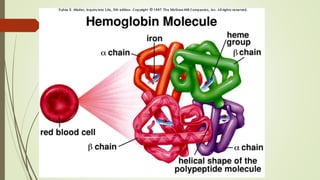
• Stable Interactions: These comprise of interactions that last for a
long duration. These Interactions carry out Functional or Structural
roles.
E.g.: Haemoglobin structure
• Transient Interactions : Interactions that last a short period of
time.
E.g.: Muscle Contraction
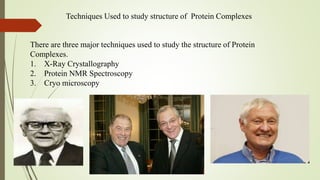
Techniques Used to study structure of Protein Complexes
There are three major techniques used to study the structure of Protein
Complexes.
1. X-Ray Crystallography
2. Protein NMR Spectroscopy
3. Cryo microscopy
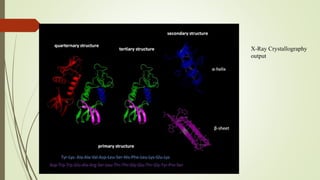
X-Ray Crystallography
output
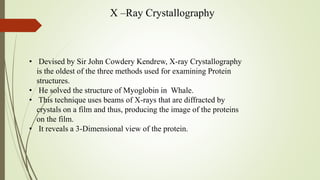
X –Ray Crystallography
• Devised by Sir John Cowdery Kendrew, X-ray Crystallography
is the oldest of the three methods used for examining Protein
structures.
• He solved the structure of Myoglobin in Whale.
• This technique uses beams of X-rays that are diffracted by
crystals on a film and thus, producing the image of the proteins
on the film.
• It reveals a 3-Dimensional view of the protein.
Protein NMR Spectroscopy
• It is a field of structural biology in which NMR spectroscopy is used to
obtain information about the structure and dynamics of proteins, and
also nucleic acids, and their complexes.
• The field was pioneered by Richard R. Ernst and Kurt Wüthrich who
were awarded the Nobel for their contributions in 2002.
• Structure determination by NMR spectroscopy usually consists of
several phases, each using a separate set of highly specialized
techniques.
• The sample is prepared, measurements are made, interpretive
approaches are applied, and a structure is calculated and validated.
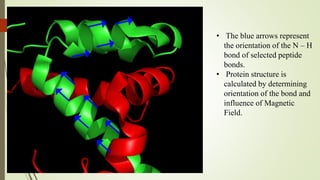
• The blue arrows represent
the orientation of the N – H
bond of selected peptide
bonds.
• Protein structure is
calculated by determining
orientation of the bond and
influence of Magnetic
Field.
Cryo Electron Microscopy
• This is a form of transmission electron microscopy (EM) where the
sample is studied at cryogenic temperatures (generally liquid
nitrogen temperatures).
• This technique was devised by a group of scientists led by Frank Joachim
in EMBL i.e. European Molecular Biology Laboratory.
• Their biggest advantage is that the specimen does not need to be stained
unlike the other two methods.
• However, the resolution of the molecule obtained is not as good as the
other two techniques.
• This technique is still very much a work in progress technique.
Factors affecting PPIs
• Protein concentration, which in turn are affected by expression levels and
degradation rates
• Protein affinity for proteins or other binding ligands;
• Ligands concentrations (substrates, ions, etc.);
• Presence of other proteins, nucleic acids, and ions;
• Electric fields around proteins.
• Occurrence of covalent modifications
Methods to Investigate PPIs
• There are many methods to investigate Protein-Protein Interactions namely
o-immuno-precipitation, protein microarrays, analytical
ultracentrifugation, light scattering, fluorescence spectroscopy, Resonance-
energy transfer systems, Surface Plasmon resonance, protein-fragment
complementation assay, and Calorimetry etc…
• The two most prominent methods used for investigating PPIs are:
• Affinity purification coupled to mass spectrometry
• Yeast two-hybrid screening
Yeast two-hybrid screening Technique
 It was first proven using Saccharomyces cerevisiae as biological model by
Fields and Song.
 Yeast cells are transfected with two plasmids: Prey and Bait
 Bait comprises of protein of interest with DNA binding domain factor like
GaI4.
 Prey has cDNA portion that can active the above domain.
 Thus, transcription does not take place until both of them bind.
Disadvantages of Yeast two hybrid screening technique
• It’s specificity is very low.
• Number of PPIs identified are low as they are lost during
purification.
• As it uses Yeast as a model organism, it can have trouble while
studying other organisms.
Affinity purification coupled to mass spectrometry
• Affinity purification coupled to mass spectrometry mostly
detects stable interactions and thus is better than Yeast 2 hybrid
method.
• This method starts by purification of the tagged protein.
• One of the most advantageous and widely used method to
purify proteins with very low contaminating background is
the Tandem affinity purification
• This was developed by Bertrand Seraphin and Mathias Mann
Applications of PPIs
 Many PPIs are being used as therapeutic targets as they exhibit properties such
as allosteric sites.
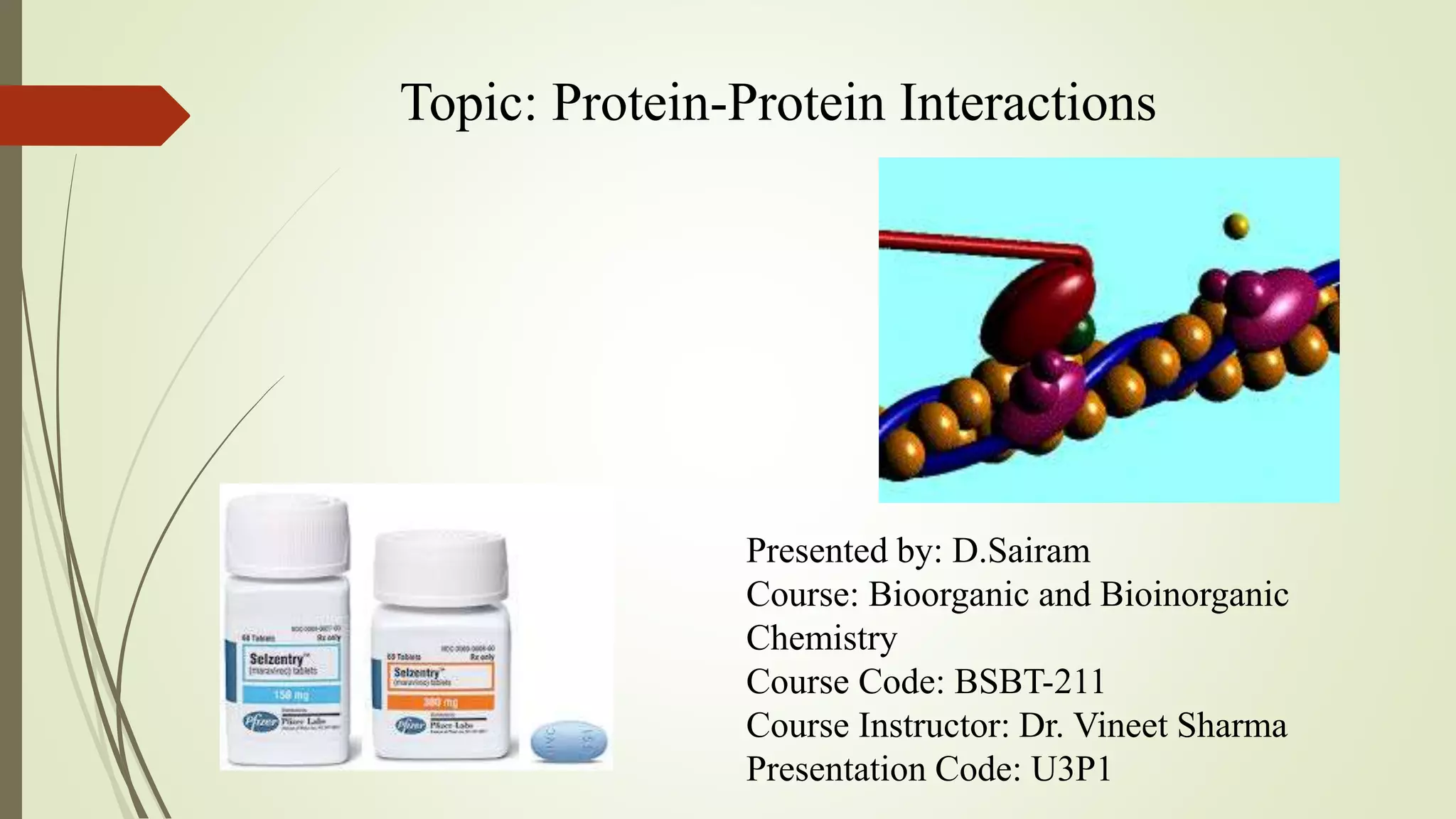
 Maraviroc, a drug that inhibits CCR5 gp 120 interaction and is a prominent
anti HIV drug.
 Recently , a group of scientists were able to develop 30 peptides using
protein–protein interaction studies to inhibit telomerase recruitment towards
telomeres.
 PPIs have been used to identify the functions of unknown proteins.
 It is based on the assumption that uncharacterized proteins have similar
functions as their interacting proteins
 YbeB, a protein of unknown function was found to interact with ribosomal
proteins and later shown to be involved in translation.
References
• http://www.pnas.org/content/106/16/6706.full.pdf
• http://www.trpchannel.org/interactions/show?trp=TRPC3&interactor=
Cytochrome+c+oxidase+5A&type=Interactor
• https://dx.doi.org/10.1016%2Fj.ymeth.2012.07.015
• https://dx.doi.org/10.1093%2Fbioinformatics%2Fbti514
• https://dx.doi.org/10.1016%2Fj.tips.2013.04.007
• http://www.quintarabio.com/screen
• http://bioinfo3d.cs.tau.ac.il/MAPPIS/mappis_info.html
• http://www.wisegeek.com/what-are-purkinje-cells.htm
• http://www.trpchannel.org/proteins/show?id=Cytochrome+c+oxidase+
5A
• http://www.piercenet.com/method/overview-protein-protein-
interaction-analysis

Protein-Protein Interactions (PPIs)

  • 1.
    Topic: Protein-Protein Interactions Presentedby: D.Sairam Course: Bioorganic and Bioinorganic Chemistry Course Code: BSBT-211 Course Instructor: Dr. Vineet Sharma Presentation Code: U3P1
  • 2.
    Overview of thePresentation Introduction Types of Protein- Protein Interactions Techniques used to study them Factors affecting these Interactions Methods used to Investigate Interactions Applications of Protein- Protein Interactions
  • 3.
    Introduction • Proteins arethe workhorses that facilitate most biological processes in a cell, including gene expression, cell growth, proliferation, nutrient uptake, morphology, motility, intercellular communication and apoptosis. • Protein–protein interactions (PPIs) refer to intentional physical contacts established between two or more proteins as a result of biochemical events and/or electrostatic forces. • These interactions are very important in our lives as any disorder in them can lead to fatal diseases such as Alzheimer’s and Creutzfeld- Jacob Disease. • Perhaps the most well known example of Protein-Protein Interaction is between Actin and Myosin while regulating Muscular contraction in our body. • Another prominent application of PPIs is in Signal Transmission inside the lining of a cell or along the boundaries of various cell.
  • 4.
    Types of Protein-ProteinInteractions On the basis of their Composition  Homo-Oligomers: These are macromolecule complexes having one type of protein subunits. E.g. : PPIs in Muscle Contraction  Hetero-Oligomers: These are macromolecule complexes having multiple types protein subunits. E.g. : PPI between Cytochrome Oxidase and TRPC3 (Transient receptor potential cation channels
  • 5.
    On the basisof their Duration of Interaction • Stable Interactions: These comprise of interactions that last for a long duration. These Interactions carry out Functional or Structural roles. E.g.: Haemoglobin structure • Transient Interactions : Interactions that last a short period of time. E.g.: Muscle Contraction
  • 7.
    Techniques Used tostudy structure of Protein Complexes There are three major techniques used to study the structure of Protein Complexes. 1. X-Ray Crystallography 2. Protein NMR Spectroscopy 3. Cryo microscopy
  • 8.
  • 9.
    X –Ray Crystallography •Devised by Sir John Cowdery Kendrew, X-ray Crystallography is the oldest of the three methods used for examining Protein structures. • He solved the structure of Myoglobin in Whale. • This technique uses beams of X-rays that are diffracted by crystals on a film and thus, producing the image of the proteins on the film. • It reveals a 3-Dimensional view of the protein.
  • 10.
    Protein NMR Spectroscopy •It is a field of structural biology in which NMR spectroscopy is used to obtain information about the structure and dynamics of proteins, and also nucleic acids, and their complexes. • The field was pioneered by Richard R. Ernst and Kurt Wüthrich who were awarded the Nobel for their contributions in 2002. • Structure determination by NMR spectroscopy usually consists of several phases, each using a separate set of highly specialized techniques. • The sample is prepared, measurements are made, interpretive approaches are applied, and a structure is calculated and validated.
  • 11.
    • The bluearrows represent the orientation of the N – H bond of selected peptide bonds. • Protein structure is calculated by determining orientation of the bond and influence of Magnetic Field.
  • 12.
    Cryo Electron Microscopy •This is a form of transmission electron microscopy (EM) where the sample is studied at cryogenic temperatures (generally liquid nitrogen temperatures). • This technique was devised by a group of scientists led by Frank Joachim in EMBL i.e. European Molecular Biology Laboratory. • Their biggest advantage is that the specimen does not need to be stained unlike the other two methods. • However, the resolution of the molecule obtained is not as good as the other two techniques. • This technique is still very much a work in progress technique.
  • 13.
    Factors affecting PPIs •Protein concentration, which in turn are affected by expression levels and degradation rates • Protein affinity for proteins or other binding ligands; • Ligands concentrations (substrates, ions, etc.); • Presence of other proteins, nucleic acids, and ions; • Electric fields around proteins. • Occurrence of covalent modifications
  • 14.
    Methods to InvestigatePPIs • There are many methods to investigate Protein-Protein Interactions namely o-immuno-precipitation, protein microarrays, analytical ultracentrifugation, light scattering, fluorescence spectroscopy, Resonance- energy transfer systems, Surface Plasmon resonance, protein-fragment complementation assay, and Calorimetry etc… • The two most prominent methods used for investigating PPIs are: • Affinity purification coupled to mass spectrometry • Yeast two-hybrid screening
  • 15.
    Yeast two-hybrid screeningTechnique  It was first proven using Saccharomyces cerevisiae as biological model by Fields and Song.  Yeast cells are transfected with two plasmids: Prey and Bait  Bait comprises of protein of interest with DNA binding domain factor like GaI4.  Prey has cDNA portion that can active the above domain.  Thus, transcription does not take place until both of them bind.
  • 16.
    Disadvantages of Yeasttwo hybrid screening technique • It’s specificity is very low. • Number of PPIs identified are low as they are lost during purification. • As it uses Yeast as a model organism, it can have trouble while studying other organisms.
  • 17.
    Affinity purification coupledto mass spectrometry • Affinity purification coupled to mass spectrometry mostly detects stable interactions and thus is better than Yeast 2 hybrid method. • This method starts by purification of the tagged protein. • One of the most advantageous and widely used method to purify proteins with very low contaminating background is the Tandem affinity purification • This was developed by Bertrand Seraphin and Mathias Mann
  • 18.
    Applications of PPIs Many PPIs are being used as therapeutic targets as they exhibit properties such as allosteric sites.  Maraviroc, a drug that inhibits CCR5 gp 120 interaction and is a prominent anti HIV drug.  Recently , a group of scientists were able to develop 30 peptides using protein–protein interaction studies to inhibit telomerase recruitment towards telomeres.  PPIs have been used to identify the functions of unknown proteins.  It is based on the assumption that uncharacterized proteins have similar functions as their interacting proteins  YbeB, a protein of unknown function was found to interact with ribosomal proteins and later shown to be involved in translation.
  • 19.
    References • http://www.pnas.org/content/106/16/6706.full.pdf • http://www.trpchannel.org/interactions/show?trp=TRPC3&interactor= Cytochrome+c+oxidase+5A&type=Interactor •https://dx.doi.org/10.1016%2Fj.ymeth.2012.07.015 • https://dx.doi.org/10.1093%2Fbioinformatics%2Fbti514 • https://dx.doi.org/10.1016%2Fj.tips.2013.04.007 • http://www.quintarabio.com/screen • http://bioinfo3d.cs.tau.ac.il/MAPPIS/mappis_info.html • http://www.wisegeek.com/what-are-purkinje-cells.htm • http://www.trpchannel.org/proteins/show?id=Cytochrome+c+oxidase+ 5A • http://www.piercenet.com/method/overview-protein-protein- interaction-analysis