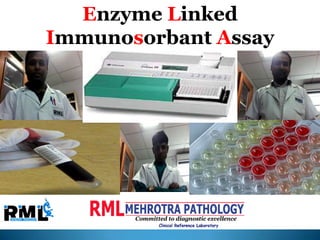
ELISA
ENZYME LINKED
IMMUNOSORBENT
     ASSAY
INTRODUCTION TO ELISA


 ELISA, or enzyme-linked immunosorbent assay,
  are quantitative immunological procedures in
  which the Ag- Ab reaction is monitored by
  enzyme measurements.
 The term ELISA was first used by Engvall &
  Perlma in 1971.
 The ELISA test, or the enzyme immunoassay
  (EIA), was the first screening test commonly
  employed for HIV. It has a high sensitivity.
Enzyme Linked
Immunosorbant Assay
ELISA is the abbreviation of
     ENZYME-LINKED
IMMUNOSORBENT ASSAY
    It is useful & powerful
method in estimating ng/mL
 to pg/mL ordered materials
        in the solution .
Why known as ......?
 Enzyme Linked Immunosorbent Assay
1. Antigen of interest is absorbed on to plastic surface
   („sorbent‟).
2. Antigen is recognised by specific antibody („immuno‟).
3. This antibody is recognised by second antibody
   („immuno‟) which has enzyme attached („enzyme-
   linked‟).
4. Substrate reacts with enzyme to produce product, usually
   coloured.
BASIC PRINCIPLE OF ELISA
 Use an enzyme to detect the binding of antigen (Ag)
  antibody (Ab).
 The enzyme converts a colorless substrate
  (chromogen) to a colored product, indicating the
  presence of Ag : Ab binding.
 An ELISA can be used to detect either the presence
  of Antigens or antibodies in a sample depending how
  the test is designed.
 ELISA was dveloped in 1970 and became rapidly
  accepted
Secondary
                     antibody
 Substrate


Coloured
product


                            Primary
                            antibody


       Different antigens in sample
ELISA Qualitative/Quantitative
 Qualitative
   determines antigen or antibody is present or absent
 Quantitative
   determines the quantity of the antibody
   Titer
   The highest dilution of the specimen usually serum
    which gives a positive reaction in the test
Basic Steps Of
Enzyme-Linked
Immunosorbant
Assay
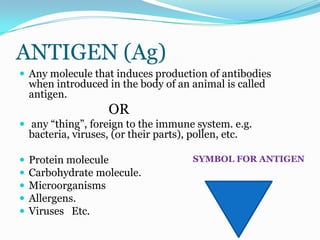
ANTIGEN (Ag)
 Any molecule that induces production of antibodies
    when introduced in the body of an animal is called
    antigen.
                      OR
 any “thing”, foreign to the immune system. e.g.
    bacteria, viruses, (or their parts), pollen, etc.

   Protein molecule                      SYMBOL FOR ANTIGEN
   Carbohydrate molecule.
   Microorganisms
   Allergens.
   Viruses Etc.
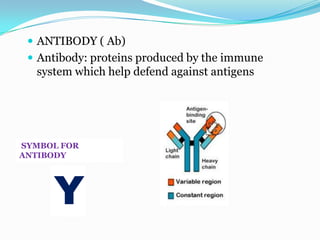
 ANTIBODY ( Ab)
  Antibody: proteins produced by the immune
  system which help defend against antigens


SYMBOL FOR
ANTIBODY


     Y
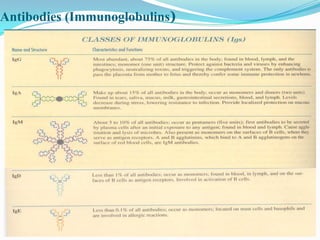
Antibodies (Immunoglobulins)
Materials Needed
 Testing sample
 Antibody (1st, 2nd) / Antigen
 Polystyrene microtiter plate
 Blocking buffer
 Washing buffer
 Substrate
 Enzyme
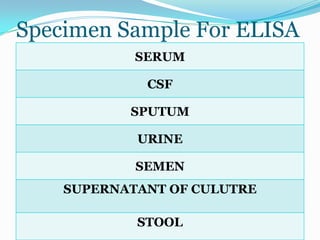
Specimen Sample For ELISA
            SERUM

             CSF

           SPUTUM

            URINE

            SEMEN
    SUPERNATANT OF CULUTRE

            STOOL
Workstation
Inventory
              Lab Equipment and Supplies:

              Micro plate strips, pipettes, pipette
                             tips,
              transfer pipette, wash buffer, paper
                             towels,
              marking pen
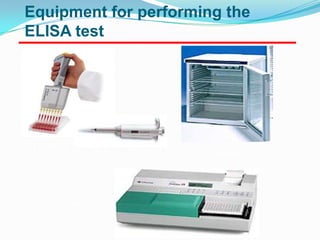
Equipment for performing the
ELISA test


 Pipettes
                       Incubator


  ELISA reader
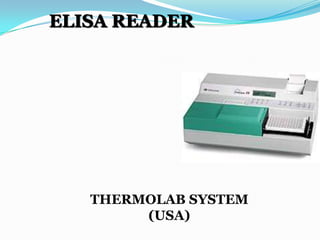
ELISA READER


   THERMOLAB SYSTEM
        (USA)
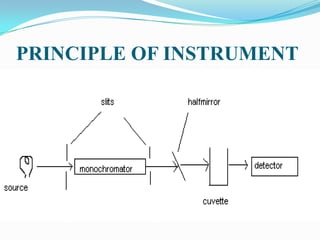
PRINCIPLE OF INSTRUMENT
TYPES OF ELISA
 Solid phase immunoassay
 Enzyme Label

   Competitive assay


   Non-competitive assay
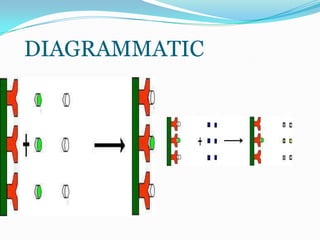
Competitive Elisa
 Used to determine small molecule antigens.(T3,T4,progesterone etc.)
 antibody coated microwell
 serum antigen and labelled antigen added together--competition.
 antibody-antigen-enzyme complex bound is inversely related to the
  concentration of antigen present in the sample.
 The bound enzyme conjugate reacts with the chromogenic substrate added to
  produce a color reaction (blue to yellow color). .
 Increased serum antigen results in reduced binding of the antigen-enzyme
  conjugate with the capture antibody producing less enzyme activity and color
  (yellow) formation
    Substrate product concentration is inversely
    proportional to the concentration of standard or test
    antigen added
DIAGRAMMATIC
Noncompetitive
 Sandwich Assay
 Direct Assay
    Antigen capture ELISA Antigen adsorbed directly detected by labeled
     enzyme
    Antibody capture ELISA Antibody adsorbed directly by labeled enzyme.
 Indirect Assay
    Antigen directly adsorbed onto the solid phase is first incubated with
     patient serum, and then with a labeled antibody specific for human
     immunoglobulin.
    Detection of infectious agents(HIV,HBV,HCV) and auto antibodies
In Indirect ELISA color change is directly proportional
to the concentration of specific antibodies in specimen
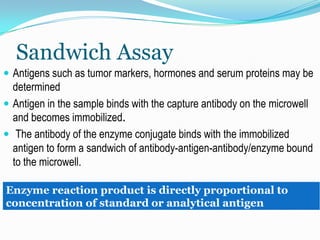
Sandwich Assay
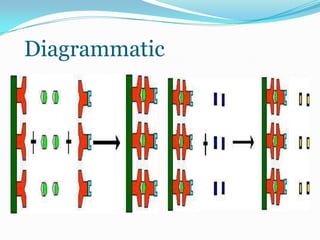
 Antigens such as tumor markers, hormones and serum proteins may be
  determined
 Antigen in the sample binds with the capture antibody on the microwell
  and becomes immobilized.
 The antibody of the enzyme conjugate binds with the immobilized
  antigen to form a sandwich of antibody-antigen-antibody/enzyme bound
  to the microwell.

Enzyme reaction product is directly proportional to
concentration of standard or analytical antigen
Diagrammatic
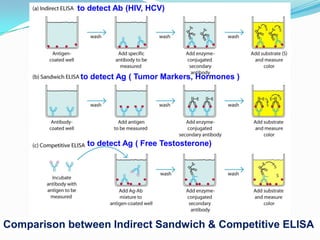
to detect Ab (HIV, HCV)


             to detect Ag ( Tumor Markers, Hormones )


               to detect Ag ( Free Testosterone)


Comparison between Indirect Sandwich & Competitive ELISA
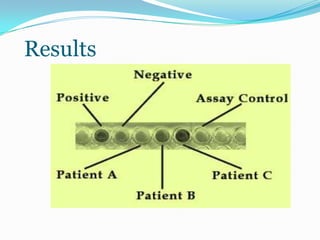
Results
Importance of incubation step:-
 During the test performance incubation time and
  mentioned temperature is must required For the
  proper binding between antigen and antibody and
  also binding with conjugate and color development
  of substrate.
 Importance of Washing :- For the removal of any
  unbound Antibody/Antigen proper washing and
  taping is required other wise we get the incorrect
  result.
 So incubation & washing is much important for good
  results.
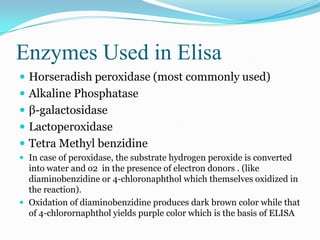
Enzymes Used in Elisa
 Horseradish peroxidase (most commonly used)
 Alkaline Phosphatase
 β-galactosidase
 Lactoperoxidase
 Tetra Methyl benzidine
 In case of peroxidase, the substrate hydrogen peroxide is converted
  into water and o2 in the presence of electron donors . (like
  diaminobenzidine or 4-chloronaphthol which themselves oxidized in
  the reaction).
 Oxidation of diaminobenzidine produces dark brown color while that
  of 4-chlorornaphthol yields purple color which is the basis of ELISA
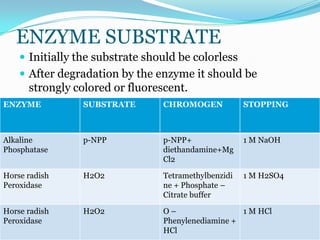
ENZYME SUBSTRATE
     Initially the substrate should be colorless
     After degradation by the enzyme it should be
      strongly colored or fluorescent.
ENZYME           SUBSTRATE       CHROMOGEN            STOPPING


Alkaline         p-NPP           p-NPP+               1 M NaOH
Phosphatase                      diethandamine+Mg
                                 Cl2

Horse radish     H2O2            Tetramethylbenzidi   1 M H2SO4
Peroxidase                       ne + Phosphate –
                                 Citrate buffer

Horse radish     H2O2            O–                 1 M HCl
Peroxidase                       Phenylenediamine +
                                 HCl
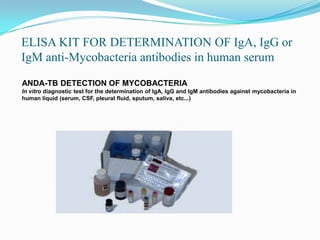
ELISA KIT FOR DETERMINATION OF IgA, IgG or
IgM anti-Mycobacteria antibodies in human serum
ANDA-TB DETECTION OF MYCOBACTERIA
In vitro diagnostic test for the determination of IgA, IgG and IgM antibodies against mycobacteria in
human liquid (serum, CSF, pleural fluid, sputum, saliva, etc...)
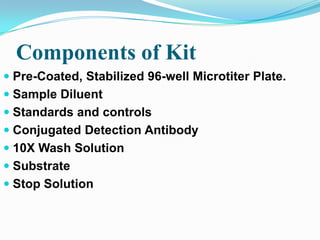
Components of Kit
 Pre-Coated, Stabilized 96-well Microtiter Plate.
 Sample Diluent
 Standards and controls
 Conjugated Detection Antibody
 10X Wash Solution
 Substrate
 Stop Solution
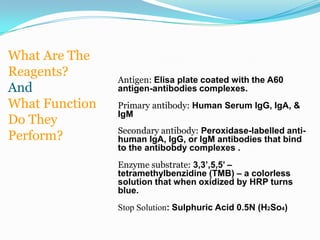
What Are The
Reagents?
                Antigen: Elisa plate coated with the A60
And             antigen-antibodies complexes.
What Function   Primary antibody: Human Serum IgG, IgA, &
                IgM
Do They
                Secondary antibody: Peroxidase-labelled anti-
Perform?        human IgA, IgG, or IgM antibodies that bind
                to the antibobdy complexes .
                Enzyme substrate: 3,3’,5,5’ –
                tetramethylbenzidine (TMB) – a colorless
                solution that when oxidized by HRP turns
                blue.
                Stop Solution: Sulphuric Acid 0.5N (H2So4)
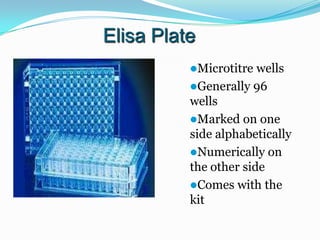
Elisa Plate
          Microtitre  wells
          Generally 96
          wells
          Marked on one
          side alphabetically
          Numerically on
          the other side
          Comes with the
          kit
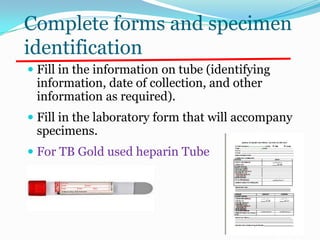
Complete forms and specimen
identification
 Fill in the information on tube (identifying
 information, date of collection, and other
 information as required).
 Fill in the laboratory form that will accompany
 specimens.
 For TB Gold used heparin Tube


 FFFI
Collection and processing of
serum
  Collect blood in a tube that does not contain any
   chemicals or anticoagulants.
  Collect 5mL of whole blood (for very small children
   collect 1mL).
  Place tube upright for 30-60 minutes then when firm
   clot has formed, centrifuge tube for 20 minutes at
   2500rpm.
  Remove serum with a pipette and place in a plastic
   storage tube (2-3mL microtube or cryovial).
  If 5mL of blood was collected it will result in about
   2mL of serum.
TEST PERFORMANCE
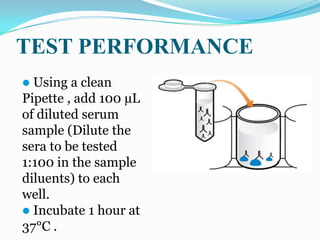
 Using  a clean
Pipette , add 100 µL
of diluted serum
sample (Dilute the
sera to be tested
1:100 in the sample
diluents) to each
well.
 Incubate 1 hour at
37°C .
 After incubation empty out contents of
  wells into waste container.
 Using pipette, fill wells with washing
  buffer then empty out.
 Tap wells upside down on paper towel.
 Wash the wells 5 times. At the end of the
  washing process, the wells must be
  entirely dry after the last wash.
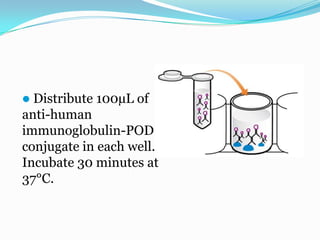
 Distribute   100µL of
anti-human
immunoglobulin-POD
conjugate in each well.
Incubate 30 minutes at
37°C.
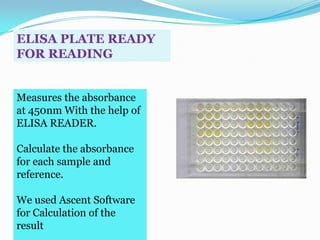
ELISA PLATE READY
FOR READING


Measures the absorbance
at 450nm With the help of
ELISA READER.

Calculate the absorbance
for each sample and
reference.

We used Ascent Software
for Calculation of the
result
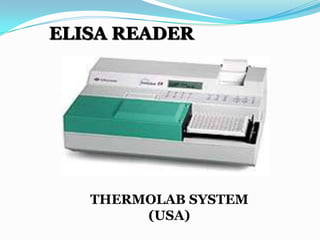
ELISA READER


   THERMOLAB SYSTEM
        (USA)
RESULT DETERMINATION:-
A) IgA and IgG Tests:-
 Plot the O.D. result of each reference , except for the negative reference on the
vertical axis (Y-axis) in relation to the number of corresponding units on the
horizontal axis (X-axis).
Using the absorbance value for each sample , determine the corresponding
concentration of antibodies expressed in units/ml from the reference curve.


B) IgM Tests :-
 We can calculate the cut off value A450nm sample / A450nm Positive limit
reference
 the normalized value of the positive reference is 1 .
 All samples whose value is comprised between 0.8 and 1.0 are considered
dubious and all samples whose normalized value is above 1.0 are considered
positive for IgM antibodies.
What is Cut-off Value ………?


Cut-off: provided in the kits by the manufacturer. The cut-off value
defines a range in which 90% of the normal population is negative below
the cut-off value and 10% of the normal population is positive above the
cut-off value.


 ELISA is semiquantitative method. The calculation is done as
follows. The units of ELISA is OD ratio:
Sample value= sample OD/cut-off OD
RANGE OF IgM IgG & IgA

  IgM- < 0.8 Negative , 1.0
  Borderline, > 1.0 Positive
  IgG - < 125 Negative 125-225 Borderline,
  > 225 Positive
  IgA - < 200 Negative, 201 – 300
  Borderline – Negative, 301 – 350
  Borderline – positive, > 350 Positive
Advantages of ELISA
 Reagents are relatively cheap & have a long
  shelf life
 ELISA is highly specific and sensitive
 No radiation hazards occur during labelling or
  disposal of waste.
 Easy to perform and quick procedures
 Equipment can be inexpensive and widely
  available.
 ELISA can be used to a variety of infections.
Disadvantages of ELISA
 Measurement of enzyme activity can be more complex
    than measurement of activity of some type of
    radioisotopes.
   Enzyme activity may be affected by plasma
    constituents.
   Kits are commercially available, but not cheap
   Very specific to a particular antigen. Won‟t recognize
    any other antigen
   False positives/negatives possible, especially with
    mutated/altered antigen
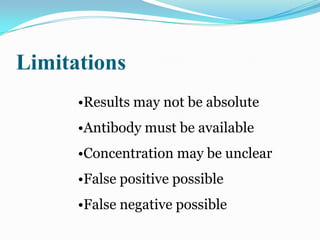
Limitations
      •Results may not be absolute
      •Antibody must be available
      •Concentration may be unclear
      •False positive possible
      •False negative possible
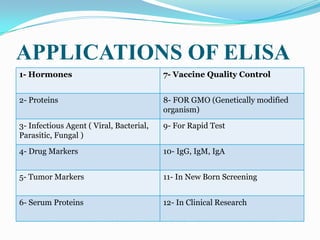
APPLICATIONS OF ELISA
1- Hormones                               7- Vaccine Quality Control


2- Proteins                               8- FOR GMO (Genetically modified
                                          organism)

3- Infectious Agent ( Viral, Bacterial,   9- For Rapid Test
Parasitic, Fungal )

4- Drug Markers                           10- IgG, IgM, IgA


5- Tumor Markers                          11- In New Born Screening


6- Serum Proteins                         12- In Clinical Research
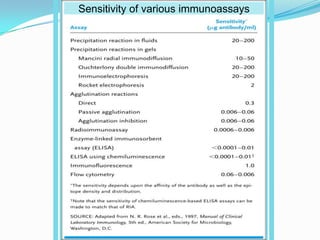
Sensitivity of various immunoassays
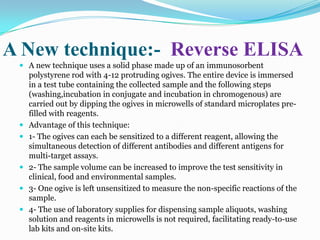
A New technique:- Reverse ELISA
  A new technique uses a solid phase made up of an immunosorbent
   polystyrene rod with 4-12 protruding ogives. The entire device is immersed
     in a test tube containing the collected sample and the following steps
     (washing,incubation in conjugate and incubation in chromogenous) are
     carried out by dipping the ogives in microwells of standard microplates pre-
     filled with reagents.
    Advantage of this technique:
    1- The ogives can each be sensitized to a different reagent, allowing the
     simultaneous detection of different antibodies and different antigens for
     multi-target assays.
    2- The sample volume can be increased to improve the test sensitivity in
     clinical, food and environmental samples.
    3- One ogive is left unsensitized to measure the non-specific reactions of the
     sample.
    4- The use of laboratory supplies for dispensing sample aliquots, washing
     solution and reagents in microwells is not required, facilitating ready-to-use
     lab kits and on-site kits.
Questions & Answers