Group 7
Group Members :
Muhammad Shahriar Kabir(36)
Shamsuttiyeba Shifa(38)
Bidhan Sarkar(39)
Shakil Md Shafiullah(40)
The Definition Of Enzyme Assay
 Enzyme assays are laboratory methods for
measuring enzymatic activity.
 Vital for study of enzyme kinetics and enzyme
inhibitions.
 Measuring of enzyme activity – follow the change
in concentrations of substrates or product –
measure reaction rate.
What are the purposes ?
 To identify a special enzyme to prove its
presence or absence in a distinct specimen , like
an organism or tissue.
 To determine the amount of enzyme in a sample.
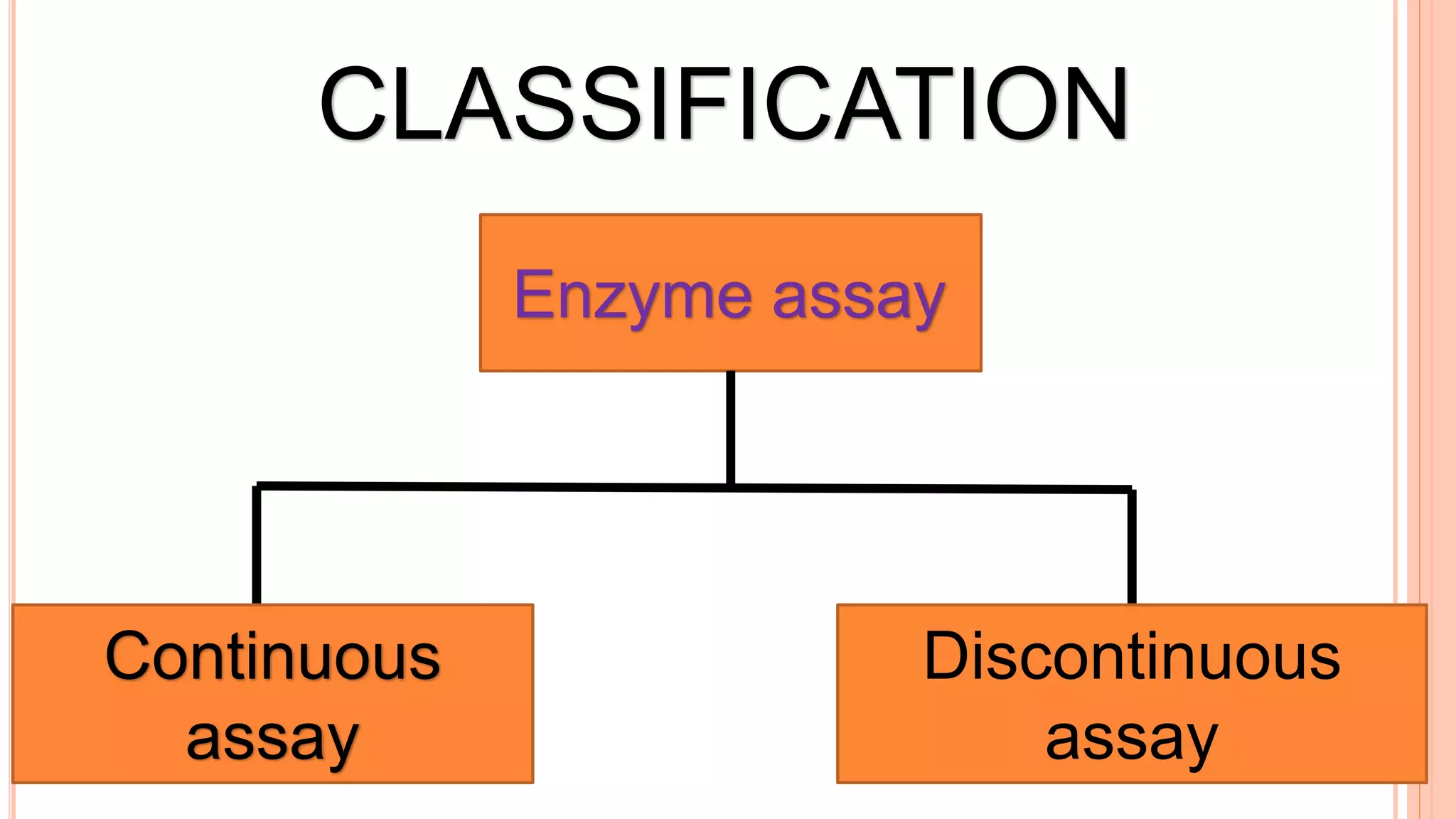
CLASSIFICATION
Enzyme assay
Continuous
assay
Discontinuous
assay
Continuous assay :
 Where the assay gives a continuous reading
of activity.
 Manipulation necessary to detect product
formation allows continuous observation of
the change .
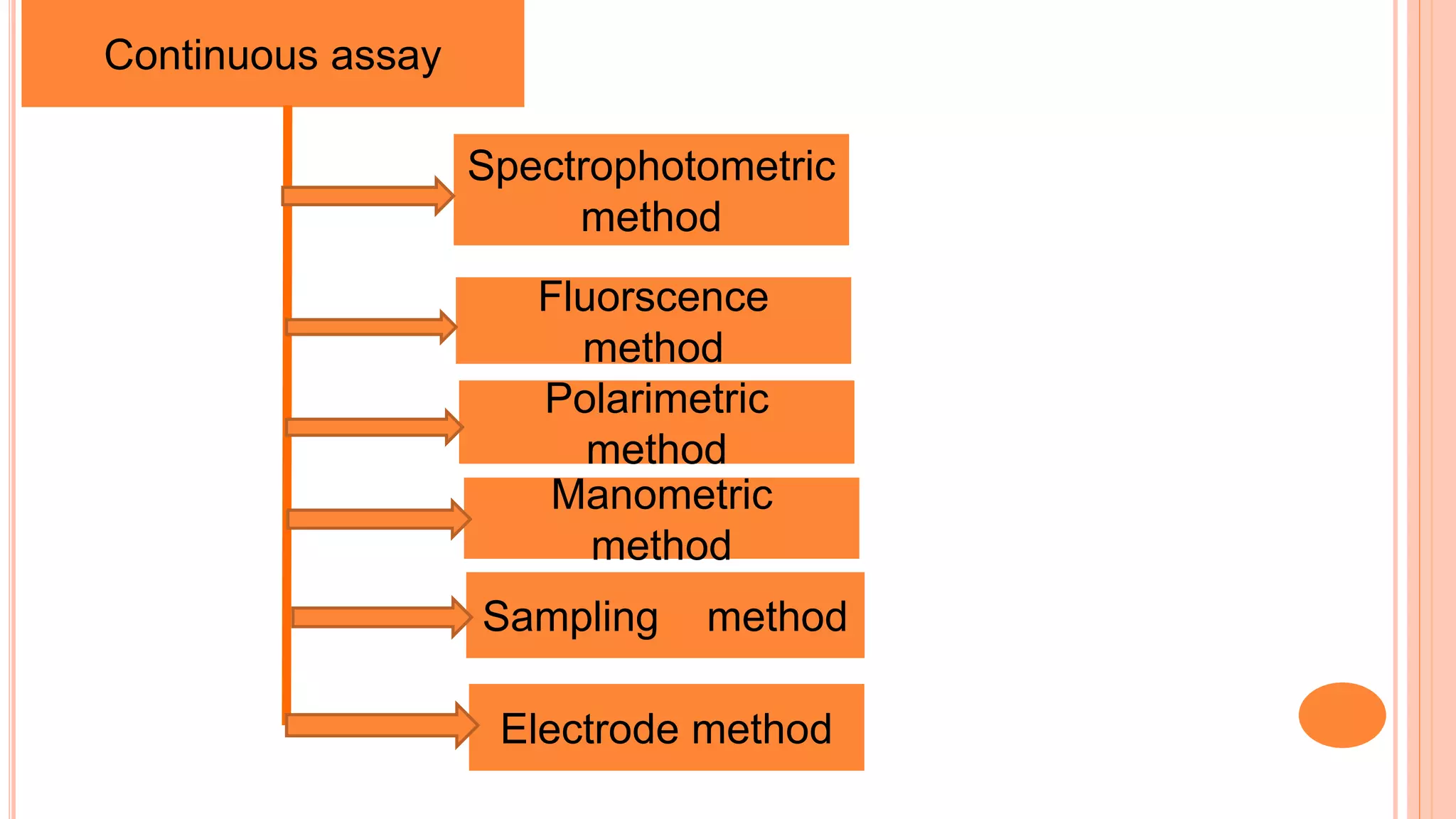
Continuous assay
Sampling method
Manometric
method
Electrode method
Spectrophotometric
method
Polarimetric
method
Fluorscence
method
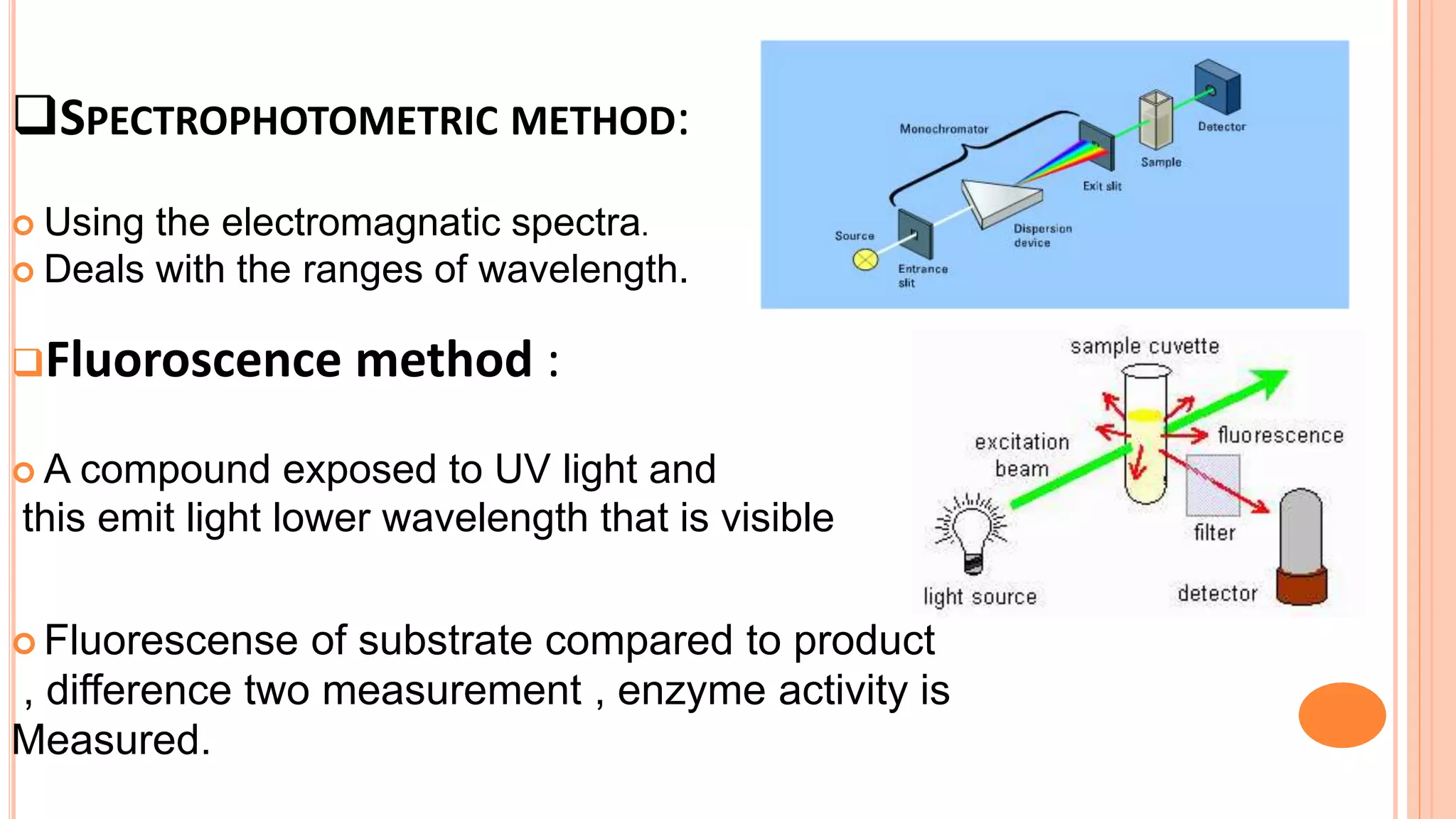
SPECTROPHOTOMETRIC METHOD:
 Using the electromagnatic spectra.
 Deals with the ranges of wavelength.
Fluoroscence method :
 A compound exposed to UV light and
this emit light lower wavelength that is visible
 Fluorescense of substrate compared to product
, difference two measurement , enzyme activity is
Measured.
POLARIMETRIC METHOD :
 Many enzyme act on the optical
isomer of their substrate.
 In that case , the reaction can be
followed by recording the change in optical rotation.
Manometric method :
 Convenient and accurate methods for
 reactions which one component is gas .
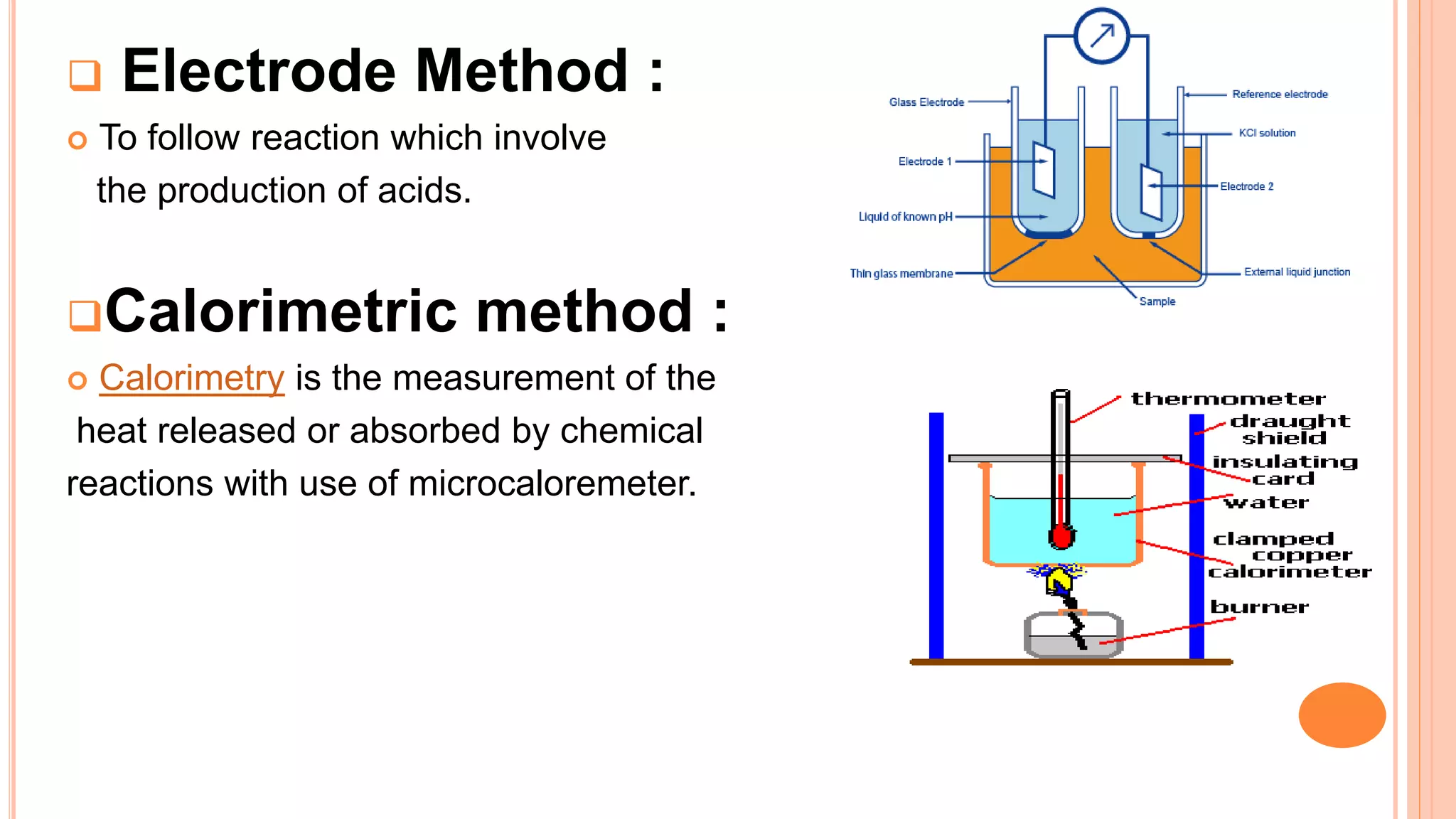
 Electrode Method :
 To follow reaction which involve
the production of acids.
Calorimetric method :
 Calorimetry is the measurement of the
heat released or absorbed by chemical
reactions with use of microcaloremeter.
DISCONTINUOUS ASSAY
when samples are taken from an enzyme
reaction at intervals.
the amount of product production or
substrate consumption is measured in these
samples.
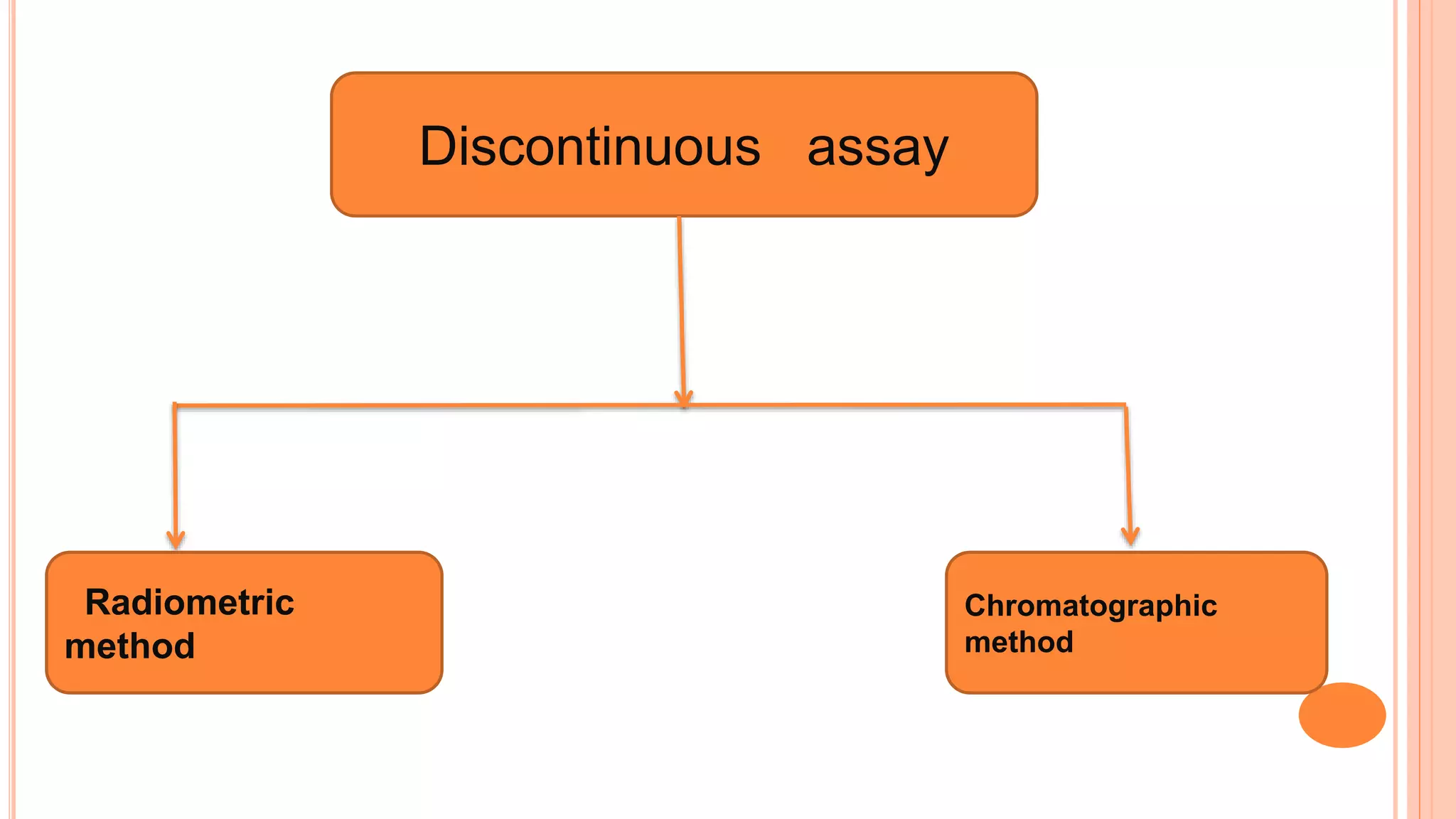
Discontinuous assay
Radiometric
method
Chromatographic
method
RADIOMETRIC METHOD :
 measure the incorporation of radioactivity into substrates or its release from
substrates.
 Radioactive isotopes most frequently used in these assays are 14C, 32P, 35S and 125I.
Chromatographic method :
 measure product formation by separating
the reaction mixture into its components
by chromatography.
 Usually done by high performance liquid chromatography.
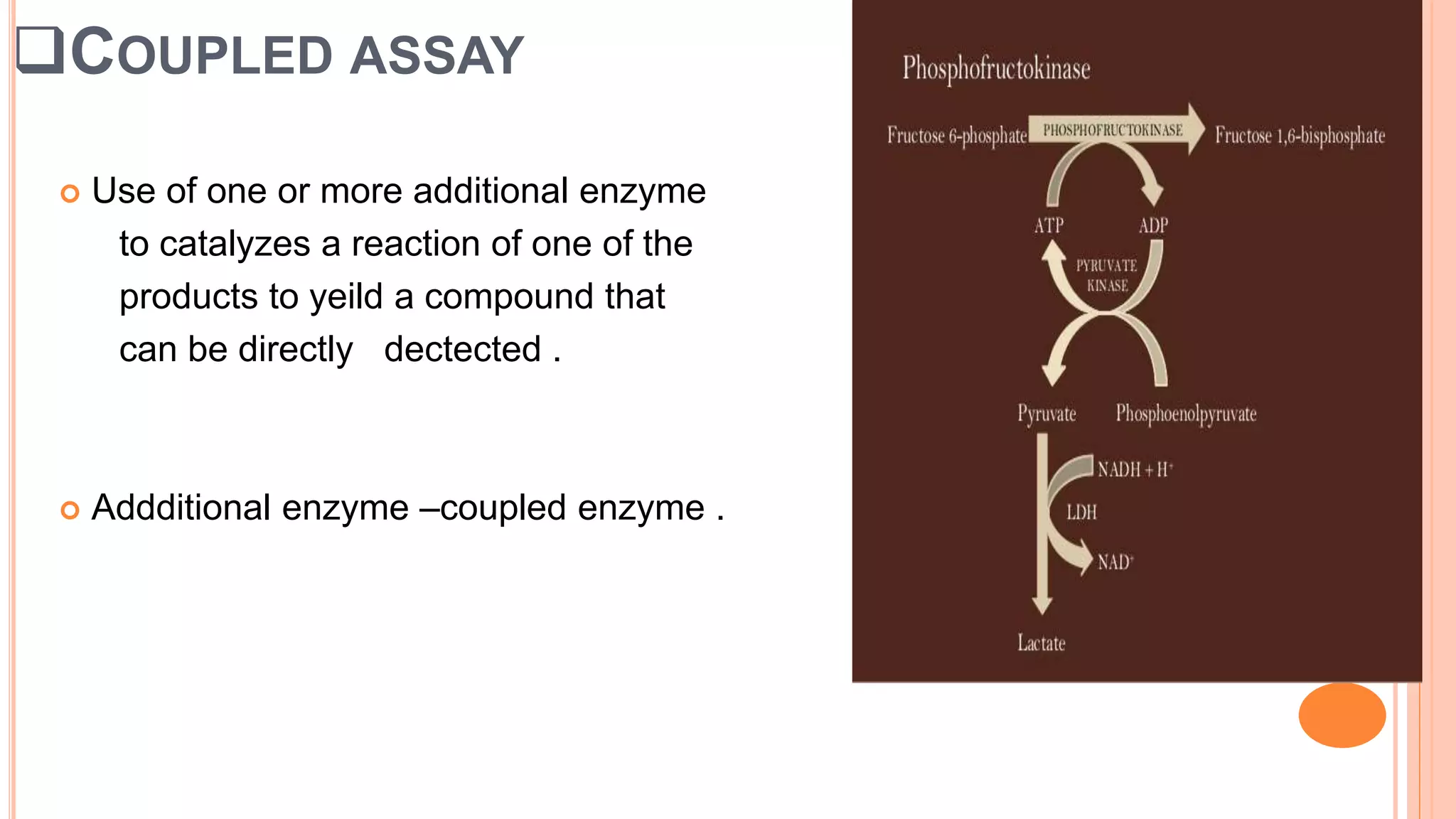
COUPLED ASSAY
 Use of one or more additional enzyme
to catalyzes a reaction of one of the
products to yeild a compound that
can be directly dectected .
 Addditional enzyme –coupled enzyme .
FACTORS TO CONTROL IN ASSAYS :
 Salt Concentration
 Effects of Temperature
 Effects of pH
 Substrate Saturation
 Level of crowding
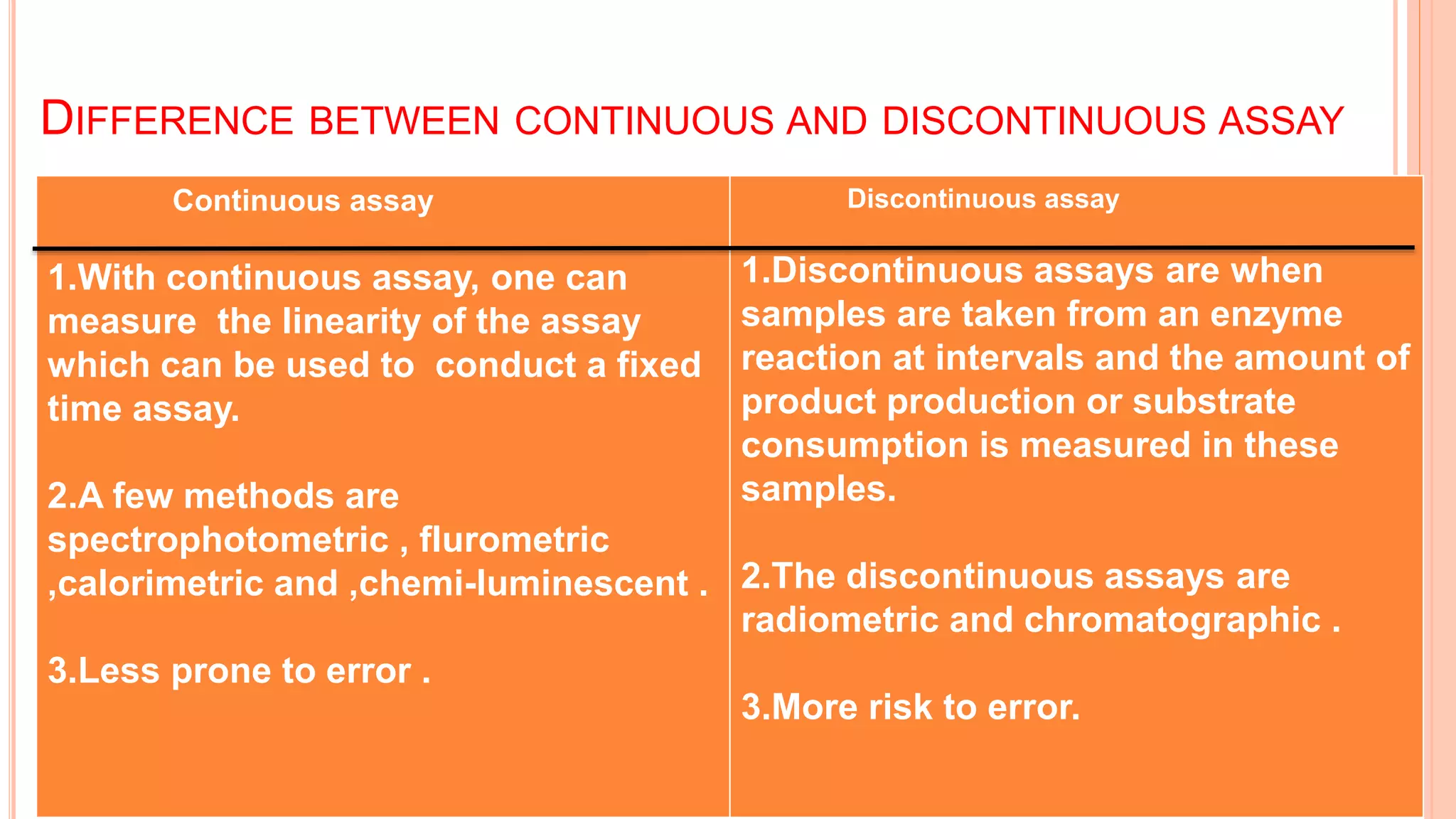
DIFFERENCE BETWEEN CONTINUOUS AND DISCONTINUOUS ASSAY
Continuous assay
1.With continuous assay, one can
measure the linearity of the assay
which can be used to conduct a fixed
time assay.
2.A few methods are
spectrophotometric , flurometric
,calorimetric and ,chemi-luminescent .
3.Less prone to error .
Discontinuous assay
1.Discontinuous assays are when
samples are taken from an enzyme
reaction at intervals and the amount of
product production or substrate
consumption is measured in these
samples.
2.The discontinuous assays are
radiometric and chromatographic .
3.More risk to error.
SIMPLY , WHY WE NEED TO ASSAY ENZYME ?
Measurement of enzyme kinetics provides crucial information –
I. On the mechanisms of enzyme catalysis .
II. On the interactions enzymes with substrates, inhibitors , drugs , and
drug candidates .
 Find an easiest and cheapest way to assay enzymes , get
the nobel .

Enzyme assay VII

  • 2.
    Group 7 Group Members: Muhammad Shahriar Kabir(36) Shamsuttiyeba Shifa(38) Bidhan Sarkar(39) Shakil Md Shafiullah(40)
  • 3.
    The Definition OfEnzyme Assay  Enzyme assays are laboratory methods for measuring enzymatic activity.  Vital for study of enzyme kinetics and enzyme inhibitions.  Measuring of enzyme activity – follow the change in concentrations of substrates or product – measure reaction rate.
  • 4.
    What are thepurposes ?  To identify a special enzyme to prove its presence or absence in a distinct specimen , like an organism or tissue.  To determine the amount of enzyme in a sample.
  • 5.
  • 6.
    Continuous assay : Where the assay gives a continuous reading of activity.  Manipulation necessary to detect product formation allows continuous observation of the change .
  • 7.
    Continuous assay Sampling method Manometric method Electrodemethod Spectrophotometric method Polarimetric method Fluorscence method
  • 8.
    SPECTROPHOTOMETRIC METHOD:  Usingthe electromagnatic spectra.  Deals with the ranges of wavelength. Fluoroscence method :  A compound exposed to UV light and this emit light lower wavelength that is visible  Fluorescense of substrate compared to product , difference two measurement , enzyme activity is Measured.
  • 9.
    POLARIMETRIC METHOD : Many enzyme act on the optical isomer of their substrate.  In that case , the reaction can be followed by recording the change in optical rotation. Manometric method :  Convenient and accurate methods for  reactions which one component is gas .
  • 10.
     Electrode Method:  To follow reaction which involve the production of acids. Calorimetric method :  Calorimetry is the measurement of the heat released or absorbed by chemical reactions with use of microcaloremeter.
  • 11.
    DISCONTINUOUS ASSAY when samplesare taken from an enzyme reaction at intervals. the amount of product production or substrate consumption is measured in these samples.
  • 12.
  • 13.
    RADIOMETRIC METHOD : measure the incorporation of radioactivity into substrates or its release from substrates.  Radioactive isotopes most frequently used in these assays are 14C, 32P, 35S and 125I. Chromatographic method :  measure product formation by separating the reaction mixture into its components by chromatography.  Usually done by high performance liquid chromatography.
  • 14.
    COUPLED ASSAY  Useof one or more additional enzyme to catalyzes a reaction of one of the products to yeild a compound that can be directly dectected .  Addditional enzyme –coupled enzyme .
  • 15.
    FACTORS TO CONTROLIN ASSAYS :  Salt Concentration  Effects of Temperature  Effects of pH  Substrate Saturation  Level of crowding
  • 16.
    DIFFERENCE BETWEEN CONTINUOUSAND DISCONTINUOUS ASSAY Continuous assay 1.With continuous assay, one can measure the linearity of the assay which can be used to conduct a fixed time assay. 2.A few methods are spectrophotometric , flurometric ,calorimetric and ,chemi-luminescent . 3.Less prone to error . Discontinuous assay 1.Discontinuous assays are when samples are taken from an enzyme reaction at intervals and the amount of product production or substrate consumption is measured in these samples. 2.The discontinuous assays are radiometric and chromatographic . 3.More risk to error.
  • 17.
    SIMPLY , WHYWE NEED TO ASSAY ENZYME ? Measurement of enzyme kinetics provides crucial information – I. On the mechanisms of enzyme catalysis . II. On the interactions enzymes with substrates, inhibitors , drugs , and drug candidates .
  • 18.
     Find aneasiest and cheapest way to assay enzymes , get the nobel .