3
“Different Assay Strategies”
-Protein production-
Biotechnology student level3
Section 2
Different assay strategies
• Numerous strategies have been developed for following over time the loss of
substrate or the appearance of product that result from enzyme turnover.
• The enzyme activity could be measured by estimating the substrate consumption
or product formation as shown in figure 3.
.
It is favorable to measure the change in product concentration than that for
substrate concentration, why? Because it is easier to detect an increase in product
concentration than to detect the substrate concentration decrease.
• To measure the velocity of a reaction, it is necessary to follow a signal that
reports product formation or substrate depletion over time.
• The type of signal that is followed varies from enzyme to enzyme but usually
relies on some unique physicochemical property of the substrate or product,
and/or the analyst’s ability to separate the substrate from the product.
NOTE
Continuous assay
(1) Direct assay-
• Substrate or product one of them must be detected.
• the activity is measured directly over time by measuring substrate
consumption or product formation. Why because any of them has a
physiochemical property that is changed over time and so it could be
measured and used as a function of enzyme activity.
measuring the activity of cytochrome oxidase by measure
substrate consumption at 550 nm.
Cytochrome C (reduced) Cytochrome C (oxidized)
Example
Observation-
cytochrome C (reduced) has a strong signal (absorbance) at 550 nm that is decreasing when
oxidation occurs by cytochrome C oxidase.
This decrease in measurement reflects the activity of this enzyme.
(2)Indirect assay-
“product formation could be coupled to another, non-enzymatic,
reaction that does produce a convenient signal”
• the substrate and product of an enzymatic reaction are
spectrometrically silent.
So it will not be possible to measure the activity of the enzyme with
these substrates and products.
Example
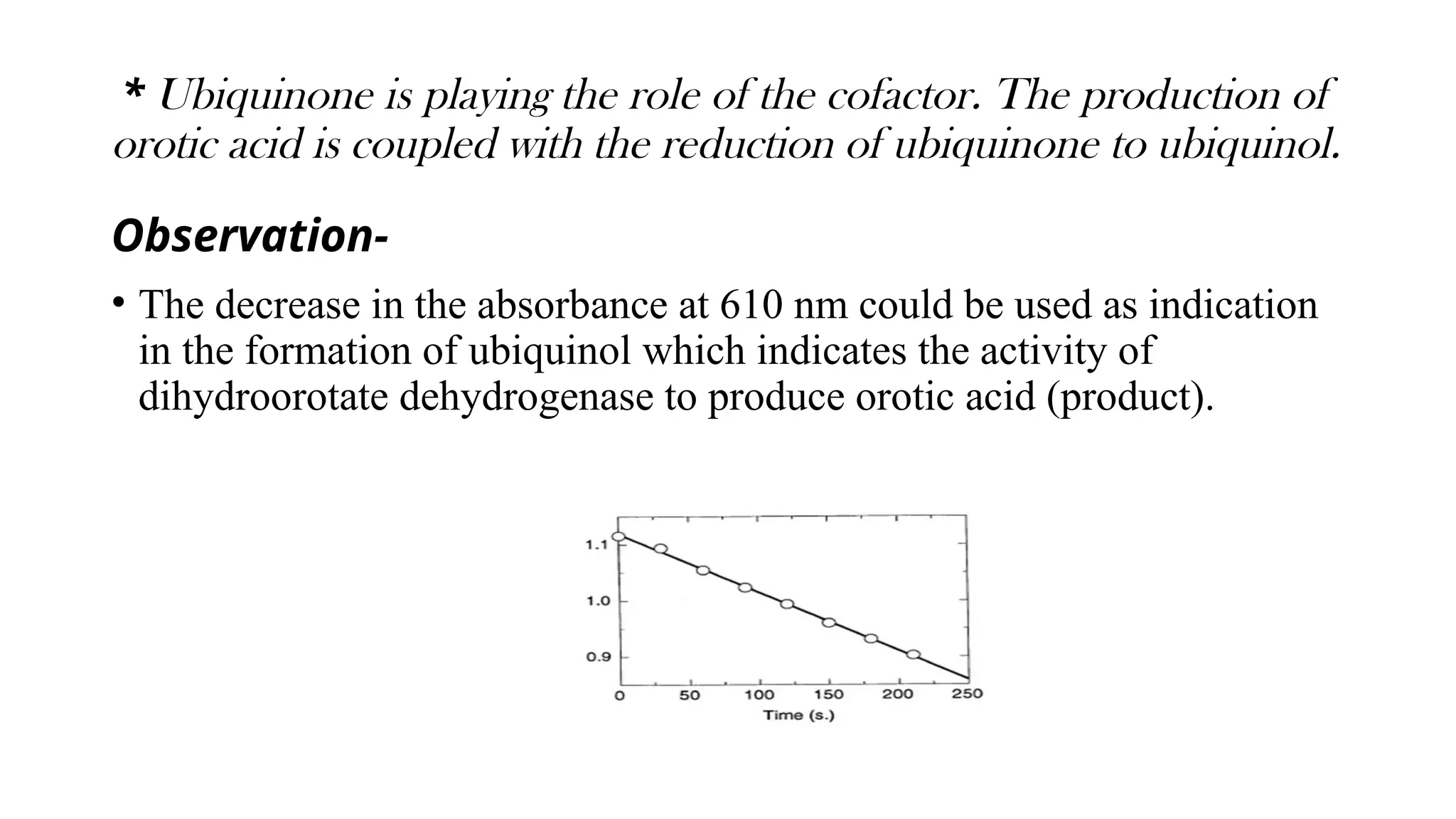
* Ubiquinone is playing the role of the cofactor. The production of
orotic acid is coupled with the reduction of ubiquinone to ubiquinol.
Observation-
• The decrease in the absorbance at 610 nm could be used as indication
in the formation of ubiquinol which indicates the activity of
dihydroorotate dehydrogenase to produce orotic acid (product).
(3)Couple assay ”enzyme-catalyzed reaction”-
• Here the enzymatic reaction of interest is coupled with a second
enzymatic reaction, which can be conveniently measured.
• In the couple assay, Two point should be considered:
*the product of first enzyme should be substrate of the second.
*the second enzymatic reaction should be faster than the first enzyme.
Example
the absorbance is increased at 340 nm.
This increase could be considered as a function in hexokinase
activity.
End point=Discontinuous assay
• Use separation techniques such as;
Liquid chromatography ”HPLC” OR Electrophoresis
• Established linear time period for assay, one measure the signal at
single specific points.
Example
• it is necessary to quench or stop the reaction at a specific time, to prevent
further enzymatic production of product or utilization of substrate.
• Methods for stopping enzymatic reactions :
1. denaturation of the enzyme (addition of strong acid or base,
immersion in a boiling water bath).
2. rapid freezing of the reaction solution. ( immersion in a dry ice—
ethanol slurry)
3. reagents addition For example, the activity of many metalloenzymes
can be quenched by adding an excess of a metal chelating agent, such as
(EDTA).
Three points must be considered in choosing a quenching method for an
enzymatic reaction:-
1. Quenching technique must not interfere with the subsequent
detection of product or substrate.
2. it must be established experimentally that the quenching technique
completely stop the reaction.
3. the volume change that occurs upon addition of the quenching
reagent to the reaction mixture must be accounted in calculations.
Qualitative assay of Alpha Amylase:-
• Alpha-amylase Activity present in all living organism.
• Act on linear carbohydrate polymers at internal bonds.
• Alpha-amylase catalyzes the hydrolysis of internal alpha-1,4-glucan
links in polysaccharide containing 3 or more alpha-1,4-linked D-
glucose units, yielding a mixture of maltose and glucose.
• Characteristics of alpha amylase:
• Starch + H2o α – amylase reducing sugars
Optimal pH 7
Activators Calcium and chloride ions necessary for stability.
Inhibitors Phenolic compound and Urea.
Applications • Ethanol production
• Reduction of starch or glycogen molecules.
Alpha amylase Assay:
Buffer
Starch
Iodine
Buffer
Iodine
α – amylase
Buffer
Starch
Iodine
α – amylase
In water bath (37 ºc - 42 ºc )
(Blue) ( yellow ) ( yellow)

section 2 protein production and its strategies

  • 1.
    3 “Different Assay Strategies” -Proteinproduction- Biotechnology student level3 Section 2
  • 2.
    Different assay strategies •Numerous strategies have been developed for following over time the loss of substrate or the appearance of product that result from enzyme turnover. • The enzyme activity could be measured by estimating the substrate consumption or product formation as shown in figure 3.
  • 3.
    . It is favorableto measure the change in product concentration than that for substrate concentration, why? Because it is easier to detect an increase in product concentration than to detect the substrate concentration decrease. • To measure the velocity of a reaction, it is necessary to follow a signal that reports product formation or substrate depletion over time. • The type of signal that is followed varies from enzyme to enzyme but usually relies on some unique physicochemical property of the substrate or product, and/or the analyst’s ability to separate the substrate from the product. NOTE
  • 4.
    Continuous assay (1) Directassay- • Substrate or product one of them must be detected. • the activity is measured directly over time by measuring substrate consumption or product formation. Why because any of them has a physiochemical property that is changed over time and so it could be measured and used as a function of enzyme activity. measuring the activity of cytochrome oxidase by measure substrate consumption at 550 nm. Cytochrome C (reduced) Cytochrome C (oxidized) Example
  • 5.
    Observation- cytochrome C (reduced)has a strong signal (absorbance) at 550 nm that is decreasing when oxidation occurs by cytochrome C oxidase. This decrease in measurement reflects the activity of this enzyme.
  • 6.
    (2)Indirect assay- “product formationcould be coupled to another, non-enzymatic, reaction that does produce a convenient signal” • the substrate and product of an enzymatic reaction are spectrometrically silent. So it will not be possible to measure the activity of the enzyme with these substrates and products. Example
  • 7.
    * Ubiquinone isplaying the role of the cofactor. The production of orotic acid is coupled with the reduction of ubiquinone to ubiquinol. Observation- • The decrease in the absorbance at 610 nm could be used as indication in the formation of ubiquinol which indicates the activity of dihydroorotate dehydrogenase to produce orotic acid (product).
  • 8.
    (3)Couple assay ”enzyme-catalyzedreaction”- • Here the enzymatic reaction of interest is coupled with a second enzymatic reaction, which can be conveniently measured. • In the couple assay, Two point should be considered: *the product of first enzyme should be substrate of the second. *the second enzymatic reaction should be faster than the first enzyme. Example the absorbance is increased at 340 nm. This increase could be considered as a function in hexokinase activity.
  • 9.
    End point=Discontinuous assay •Use separation techniques such as; Liquid chromatography ”HPLC” OR Electrophoresis • Established linear time period for assay, one measure the signal at single specific points. Example
  • 10.
    • it isnecessary to quench or stop the reaction at a specific time, to prevent further enzymatic production of product or utilization of substrate. • Methods for stopping enzymatic reactions : 1. denaturation of the enzyme (addition of strong acid or base, immersion in a boiling water bath). 2. rapid freezing of the reaction solution. ( immersion in a dry ice— ethanol slurry) 3. reagents addition For example, the activity of many metalloenzymes can be quenched by adding an excess of a metal chelating agent, such as (EDTA).
  • 11.
    Three points mustbe considered in choosing a quenching method for an enzymatic reaction:- 1. Quenching technique must not interfere with the subsequent detection of product or substrate. 2. it must be established experimentally that the quenching technique completely stop the reaction. 3. the volume change that occurs upon addition of the quenching reagent to the reaction mixture must be accounted in calculations.
  • 12.
    Qualitative assay ofAlpha Amylase:- • Alpha-amylase Activity present in all living organism. • Act on linear carbohydrate polymers at internal bonds. • Alpha-amylase catalyzes the hydrolysis of internal alpha-1,4-glucan links in polysaccharide containing 3 or more alpha-1,4-linked D- glucose units, yielding a mixture of maltose and glucose. • Characteristics of alpha amylase: • Starch + H2o α – amylase reducing sugars Optimal pH 7 Activators Calcium and chloride ions necessary for stability. Inhibitors Phenolic compound and Urea. Applications • Ethanol production • Reduction of starch or glycogen molecules.
  • 13.
    Alpha amylase Assay: Buffer Starch Iodine Buffer Iodine α– amylase Buffer Starch Iodine α – amylase In water bath (37 ºc - 42 ºc ) (Blue) ( yellow ) ( yellow)