Entoptic phenomena
BY: ASMAA J. ABDALWAHID
1
The First & The Only Franchise in the Country
Entoptic phenomena
2
Entoptic Phenomena literally translates as “phenomena
inside the eye”. They are visual effects and sensations
that occur from causes within the human eye itself. So
the eye sees itself.
These phenomena may result from either normal
anatomic components of the eye or pathologic
imperfections.
Entoptic phenomena
3
The optical illusions are caused by the visual system by
causing things doesn’t exist, or pictures that we
perceive differently than they really are.
Because entoptic images are caused by phenomena
within the observer's own eye, the observer cannot
share a direct and specific view of the phenomenon
with others (the same with illusions) .
4
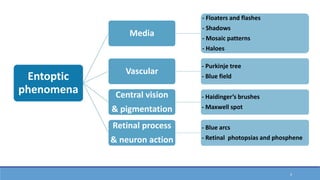
Entoptic
phenomena
Media
- Floaters and flashes
- Shadows
- Mosaic patterns
- Haloes
Vascular
- Purkinje tree
- Blue field
Central vision
& pigmentation
- Haidinger’s brushes
- Maxwell spot
Retinal process
& neuron action
- Blue arcs
- Retinal photopsias and phosphene
Entoptic phenomena- Media
5
The optical density and the refractive index of the structures are
important in the formation of entoptic phenomena.
The location of the inner-eye structure and changing the illuminating
angle, the eye can detect the direction of the movement of the shadow
that the structure caused it according to the location from the pupil:
1. Opacity in a structure behind the pupil: the shadows are cast on the retina will
move in the opposite direction to the illuminating source.
2. Opacity in a structure in front of the pupil: the shadows are cast on the retina will
move with the direction of the illuminating source.
EP - Media
6
The structure’s distance from the pupil also plays an important role. The
further away the structure is from the pupil, a greater shift of the
shadow is observed; so patients are most disturbed by opacities that are
located in the posterior vitreous body.
Entoptic phenomena occurs because of the Optic media, are resulting
from:
1. Refractive causes: occur when the light passes through structures with
different density, changing its direction, which is perceived as a shadow
2. Diffractive causes: occur from the light bending and dispersing on the
fringes of imperfections of the optical system, which is perceived as a
halos
7
Refractive
Cause
Posterior
segment
- Degenerative changes to the vitreous (Aging changes) causing
floaters and moving spots
- Vitreous hemorrhage (because of retinal tears or detachment,
choroidal melanoma, occlusion of retinal veins, diabetes
retinopathy)
Anterior
segment
- Jumping shadows from the eyelashes (sometime with colours
because of diffraction)
- Excessive mucus and oil excretion from meibomian glands can
result in (corneal mosaic patterns)
- Folds of the Descement’s membrane (Corneal deformations
resulting from incorrectly wearing rigid contact lenses)
EP - Media
8
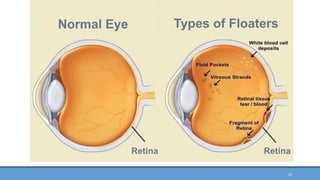
Vitreous changes and the Floaters (musca volitans)
- Floaters or flying flies: are small spots, most of them are small protein
called collagen
- Floaters usually happen because of normal changes in the eyes with
the age (and more likely in myopic eye)
- With the age; the vitreous body starts to liquefy and the structure of
collagen fibrils breaks down and stick together to cast shadows on the
retina
- The shadows of those opacities appear as the floaters (spots)
- They usually don’t totally go away, and they move as the eye moves
- Blinking does not remove the floaters
- Floaters could be also due to internal eye inflammation and infection
EP - Media
9
Vitreous changes and the Floaters
- They become most noticeable when looking into a bright and
uniformly illuminated light source (the sky or a white paper)
- It does not need a treatment, but if the patient saw a flash, a sudden
increase in the number of floaters, loss of side vision and a drop in the
vision, he needs to see a doctor immediately, because this means there
is:
- Retinal detachment
- Vitreous detachment
- Bleeding in vitreous
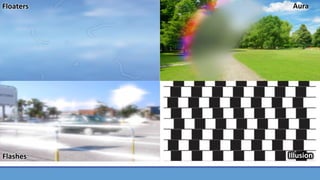
*Visual aura can come with a migraine headache and last for 30 min
EP - Media
10
Floaters
Flashes
Aura
Illusion
12
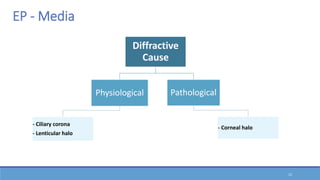
Diffractive
Cause
Pathological
- Corneal halo
Physiological
- Ciliary corona
- Lenticular halo
EP - Media
13
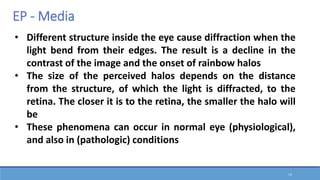
• Different structure inside the eye cause diffraction when the
light bend from their edges. The result is a decline in the
contrast of the image and the onset of rainbow halos
• The size of the perceived halos depends on the distance
from the structure, of which the light is diffracted, to the
retina. The closer it is to the retina, the smaller the halo will
be
• These phenomena can occur in normal eye (physiological),
and also in (pathologic) conditions
EP - Media
14
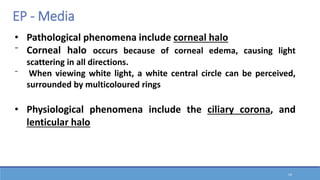
• Pathological phenomena include corneal halo
⁻ Corneal halo occurs because of corneal edema, causing light
scattering in all directions.
⁻ When viewing white light, a white central circle can be perceived,
surrounded by multicoloured rings
• Physiological phenomena include the ciliary corona, and
lenticular halo
EP - Media
15
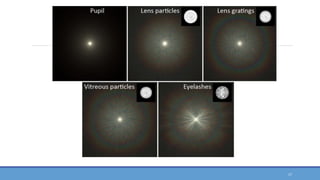
⁻ Ciliary corona occur when watching a singular illuminated object in
the dark (e.g., a street lamp), the illumination source is surrounded
by a halo with slightly coloured needles.
⁻ This is the result of the light reflecting from numerous tiny particles
(proteins) in the lens nucleus, and the tiny irregularities in the
structure of other ocular parts (deposits on the corneal endothelial
cells, the cells in the anterior chamber and the anterior lens capsule)
⁻ Lenticular halo may occur when the pupil is dilated in a dim area, a
ribbon of colour around the illumination source will appear
⁻ It is caused by light bouncing from the zonular and anterior parts of
the lens
EP - Media
Corneal halo Ciliary corona
Illusion
Lenticular halo
17
Entoptic phenomena- Vascular
18
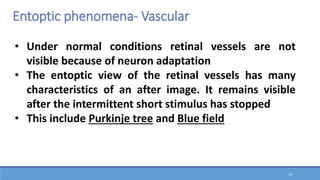
• Under normal conditions retinal vessels are not
visible because of neuron adaptation
• The entoptic view of the retinal vessels has many
characteristics of an after image. It remains visible
after the intermittent short stimulus has stopped
• This include Purkinje tree and Blue field
19
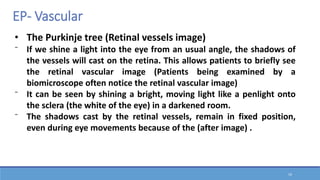
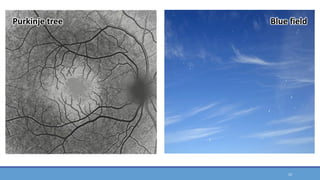
• The Purkinje tree (Retinal vessels image)
⁻ If we shine a light into the eye from an usual angle, the shadows of
the vessels will cast on the retina. This allows patients to briefly see
the retinal vascular image (Patients being examined by a
biomicroscope often notice the retinal vascular image)
⁻ It can be seen by shining a bright, moving light like a penlight onto
the sclera (the white of the eye) in a darkened room.
⁻ The shadows cast by the retinal vessels, remain in fixed position,
even during eye movements because of the (after image) .
EP- Vascular
20
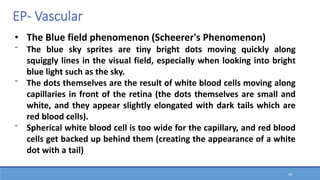
• The Blue field phenomenon (Scheerer's Phenomenon)
⁻ The blue sky sprites are tiny bright dots moving quickly along
squiggly lines in the visual field, especially when looking into bright
blue light such as the sky.
⁻ The dots themselves are the result of white blood cells moving along
capillaries in front of the retina (the dots themselves are small and
white, and they appear slightly elongated with dark tails which are
red blood cells).
⁻ Spherical white blood cell is too wide for the capillary, and red blood
cells get backed up behind them (creating the appearance of a white
dot with a tail)
EP- Vascular
21
• The Blue field phenomenon (Scheerer's Phenomenon)
⁻ Blue light is absorbed by the red blood cells which fill the capillaries.
And the white blood cells, which are much less than the red ones and
do not absorb blue light, but allowed to pass to the retina making gaps
appear as the spots
⁻ The dots appear in the central field of view, within 10 to 15 degrees
from the fixation point. The dots will not appear at the very center of
the visual field, because there are no blood vessels in the foveal
avascular zone.
EP- Vascular
EP- Vascular
22
• The Blue field phenomenon (Scheerer's Phenomenon)
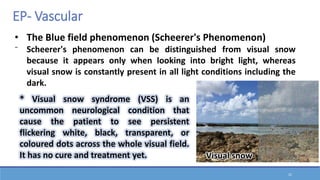
⁻ Scheerer's phenomenon can be distinguished from visual snow
because it appears only when looking into bright light, whereas
visual snow is constantly present in all light conditions including the
dark.
* Visual snow syndrome (VSS) is an
uncommon neurological condition that
cause the patient to see persistent
flickering white, black, transparent, or
coloured dots across the whole visual field.
It has no cure and treatment yet. Visual snow
23
Purkinje tree Blue field
24
• The center of the retina is the macula, and the center of it there
is the fovea (macula lutea-yellow spot) which responsible for
central vision. It's the point at which visual acuity is at its
highest.
• In the fovea, there are NO rods (only cones), and there is no
blood vessels (avascular).
• Central vision phenomena is due to the absorption of blue light
by a yellow pigment in the macula called xanthophyll which acts
as yellow filter
• It is include Haidinger’s brushes and Maxwell’s spot phenomena
Entoptic Phenomena - Central Vision
25
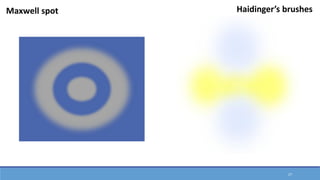
• Haidinger’s brushes phenomenon
⁻ A pale interlinked blue and yellow bar or bow tie shape, visible in the
centre of the visual field against the blue sky viewed while facing away
from the sun. Or on any bright background, due to light polarization.
⁻ Central vision phenomena is due to the absorption of blue polarized
light as a result of dichroic xanthophyll pigment
⁻ The direction of light polarization is perpendicular to the yellow bar (i.e.,
vertical if the bar is horizontal).
⁻ Haidinger’s brush is formed only on the macula and centered on the
fovea, so we can use it to measure eccentric fixation and detect any
macular problem early
EP- Central Vision
26
• Maxwell spot
⁻ A dark spot can be seen in the centre of the visual field surrounded by a
brighter circle with a halo when a white surface is viewed by a normal
observer through a dichroic filter transmitting red and blue lights.
⁻ The central dark circle is the result of blue light absorption in the
xanthophyll pigment of the central fovea.
⁻ The phenomenon can be used to test eccentric fixation.
* Eccentric fixation means the eye uses a portion of the retina
other than the fovea for fixation.
EP- Central Vision
27
Maxwell spot Haidinger’s brushes
28
• The stimulation of the retinal receptors with an energy other
than the light energy, may lead to those phenomena, which
include Blue arc and Phosphene
• Blue arcs
⁻ It is viewing two pale blue arcs above and below the fixation point
for a short period of time coming from electronic devices or artificial
lighting in dark room as a result of secondary electrical stimulation of
the retina
⁻ The position and orientation of the arcs are correspond to arcuate
nerve fiber bundles extending to the optic disk
Entoptic Phenomena – Retinal & Neuron Action
29
• Photopsias and Phosphene
⁻ Photopsias are perceptions of light without an actual light because of the
pressure on the retina which results in activation of retinal ganglion cells
⁻ Photopsias occur as result of direct retinal stimulation
⁻ The person sees colorful shapes and light, geometric patterns, sparks and
zig-zag lines, floating shapes, moving dots, …etc.
⁻ Photopsias can occur beacause of numerous pathological ocular or
systemic conditions
⁻ Phosphenes are a subgroup of photopsias
⁻ Phosphenes is can be induced by mechanical, electrical, or magnetic
stimulation of the retina, visual cortex, or any part related to the eye,
they are more intense and of shorter duration
EP – Retinal & Neuron Action
30
Phosphenes
Blue arc
31
• Phosphene Causes
1. Mechanical stimulation: The most common phosphenes are pressure
phosphenes, caused by rubbing or applying pressure on the closed eyes.
Pressure mechanically stimulates the cells of the retina
Another common phosphene is "seeing stars" from a sneeze, laughter, a
heavy and deep cough, blowing of the nose, a blow on the head or low blood
pressure
Less commonly, phosphenes can also be caused by some diseases of the
retina and nerves, such as multiple sclerosis
EP – Retinal & Neuron Action
32
• Phosphene Causes
2. Electrical stimulation: Phosphenes can be created by electrical stimulation
of the brain.
3. Others:
Transcranial magnetic stimulation and magnetic field.
Radiation of space or radiotherapy cause phosphenes (pateints reported
seeing blue flashes of light)
Phosphenes can be caused by some medications, such as Ivabradine (used to
treat heart failure)
EP – Retinal & Neuron Action
33
• Photopsias Causes
⁻ Causes:
1. Peripheral vitreous detachment: if it occurs too rapidly, it can cause
photopsia which manifests in flashes and floaters in the vision, separation
of posterior vitreous from the optic disk results in appearance of central large
annular opacity (Weiss ring)
2. Macular degeneration: the second most common cause of photopsia
3. Retinal detachment
4. Ocular migraine cause visual auras
5. Optic neuritis; an inflammation that damages the optic nerve
6. Neurological causes such as poor blood flow to the back of the brain
EP – Retinal & Neuron Action
34
• Photopsias Causes
7. The presence of the permanent violet flashing indicates a retinal ischaemia
(no enough blood)
8. Proliferative diabetic retinopathy
9. Charles Bonnet Syndrome (CBS): A phenomenon affecting people who
have partially or completely lost their sight, in which they still “see” things
that aren’t there
10. Retinitis pigmentosa
11. Blood pressure problems
EP – Retinal & Neuron Action

Entoptic phenomena

  • 1.
    Entoptic phenomena BY: ASMAAJ. ABDALWAHID 1 The First & The Only Franchise in the Country
  • 2.
    Entoptic phenomena 2 Entoptic Phenomenaliterally translates as “phenomena inside the eye”. They are visual effects and sensations that occur from causes within the human eye itself. So the eye sees itself. These phenomena may result from either normal anatomic components of the eye or pathologic imperfections.
  • 3.
    Entoptic phenomena 3 The opticalillusions are caused by the visual system by causing things doesn’t exist, or pictures that we perceive differently than they really are. Because entoptic images are caused by phenomena within the observer's own eye, the observer cannot share a direct and specific view of the phenomenon with others (the same with illusions) .
  • 4.
    4 Entoptic phenomena Media - Floaters andflashes - Shadows - Mosaic patterns - Haloes Vascular - Purkinje tree - Blue field Central vision & pigmentation - Haidinger’s brushes - Maxwell spot Retinal process & neuron action - Blue arcs - Retinal photopsias and phosphene
  • 5.
    Entoptic phenomena- Media 5 Theoptical density and the refractive index of the structures are important in the formation of entoptic phenomena. The location of the inner-eye structure and changing the illuminating angle, the eye can detect the direction of the movement of the shadow that the structure caused it according to the location from the pupil: 1. Opacity in a structure behind the pupil: the shadows are cast on the retina will move in the opposite direction to the illuminating source. 2. Opacity in a structure in front of the pupil: the shadows are cast on the retina will move with the direction of the illuminating source.
  • 6.
    EP - Media 6 Thestructure’s distance from the pupil also plays an important role. The further away the structure is from the pupil, a greater shift of the shadow is observed; so patients are most disturbed by opacities that are located in the posterior vitreous body. Entoptic phenomena occurs because of the Optic media, are resulting from: 1. Refractive causes: occur when the light passes through structures with different density, changing its direction, which is perceived as a shadow 2. Diffractive causes: occur from the light bending and dispersing on the fringes of imperfections of the optical system, which is perceived as a halos
  • 7.
    7 Refractive Cause Posterior segment - Degenerative changesto the vitreous (Aging changes) causing floaters and moving spots - Vitreous hemorrhage (because of retinal tears or detachment, choroidal melanoma, occlusion of retinal veins, diabetes retinopathy) Anterior segment - Jumping shadows from the eyelashes (sometime with colours because of diffraction) - Excessive mucus and oil excretion from meibomian glands can result in (corneal mosaic patterns) - Folds of the Descement’s membrane (Corneal deformations resulting from incorrectly wearing rigid contact lenses) EP - Media
  • 8.
    8 Vitreous changes andthe Floaters (musca volitans) - Floaters or flying flies: are small spots, most of them are small protein called collagen - Floaters usually happen because of normal changes in the eyes with the age (and more likely in myopic eye) - With the age; the vitreous body starts to liquefy and the structure of collagen fibrils breaks down and stick together to cast shadows on the retina - The shadows of those opacities appear as the floaters (spots) - They usually don’t totally go away, and they move as the eye moves - Blinking does not remove the floaters - Floaters could be also due to internal eye inflammation and infection EP - Media
  • 9.
    9 Vitreous changes andthe Floaters - They become most noticeable when looking into a bright and uniformly illuminated light source (the sky or a white paper) - It does not need a treatment, but if the patient saw a flash, a sudden increase in the number of floaters, loss of side vision and a drop in the vision, he needs to see a doctor immediately, because this means there is: - Retinal detachment - Vitreous detachment - Bleeding in vitreous *Visual aura can come with a migraine headache and last for 30 min EP - Media
  • 10.
  • 11.
  • 12.
    12 Diffractive Cause Pathological - Corneal halo Physiological -Ciliary corona - Lenticular halo EP - Media
  • 13.
    13 • Different structureinside the eye cause diffraction when the light bend from their edges. The result is a decline in the contrast of the image and the onset of rainbow halos • The size of the perceived halos depends on the distance from the structure, of which the light is diffracted, to the retina. The closer it is to the retina, the smaller the halo will be • These phenomena can occur in normal eye (physiological), and also in (pathologic) conditions EP - Media
  • 14.
    14 • Pathological phenomenainclude corneal halo ⁻ Corneal halo occurs because of corneal edema, causing light scattering in all directions. ⁻ When viewing white light, a white central circle can be perceived, surrounded by multicoloured rings • Physiological phenomena include the ciliary corona, and lenticular halo EP - Media
  • 15.
    15 ⁻ Ciliary coronaoccur when watching a singular illuminated object in the dark (e.g., a street lamp), the illumination source is surrounded by a halo with slightly coloured needles. ⁻ This is the result of the light reflecting from numerous tiny particles (proteins) in the lens nucleus, and the tiny irregularities in the structure of other ocular parts (deposits on the corneal endothelial cells, the cells in the anterior chamber and the anterior lens capsule) ⁻ Lenticular halo may occur when the pupil is dilated in a dim area, a ribbon of colour around the illumination source will appear ⁻ It is caused by light bouncing from the zonular and anterior parts of the lens EP - Media
  • 16.
    Corneal halo Ciliarycorona Illusion Lenticular halo
  • 17.
  • 18.
    Entoptic phenomena- Vascular 18 •Under normal conditions retinal vessels are not visible because of neuron adaptation • The entoptic view of the retinal vessels has many characteristics of an after image. It remains visible after the intermittent short stimulus has stopped • This include Purkinje tree and Blue field
  • 19.
    19 • The Purkinjetree (Retinal vessels image) ⁻ If we shine a light into the eye from an usual angle, the shadows of the vessels will cast on the retina. This allows patients to briefly see the retinal vascular image (Patients being examined by a biomicroscope often notice the retinal vascular image) ⁻ It can be seen by shining a bright, moving light like a penlight onto the sclera (the white of the eye) in a darkened room. ⁻ The shadows cast by the retinal vessels, remain in fixed position, even during eye movements because of the (after image) . EP- Vascular
  • 20.
    20 • The Bluefield phenomenon (Scheerer's Phenomenon) ⁻ The blue sky sprites are tiny bright dots moving quickly along squiggly lines in the visual field, especially when looking into bright blue light such as the sky. ⁻ The dots themselves are the result of white blood cells moving along capillaries in front of the retina (the dots themselves are small and white, and they appear slightly elongated with dark tails which are red blood cells). ⁻ Spherical white blood cell is too wide for the capillary, and red blood cells get backed up behind them (creating the appearance of a white dot with a tail) EP- Vascular
  • 21.
    21 • The Bluefield phenomenon (Scheerer's Phenomenon) ⁻ Blue light is absorbed by the red blood cells which fill the capillaries. And the white blood cells, which are much less than the red ones and do not absorb blue light, but allowed to pass to the retina making gaps appear as the spots ⁻ The dots appear in the central field of view, within 10 to 15 degrees from the fixation point. The dots will not appear at the very center of the visual field, because there are no blood vessels in the foveal avascular zone. EP- Vascular
  • 22.
    EP- Vascular 22 • TheBlue field phenomenon (Scheerer's Phenomenon) ⁻ Scheerer's phenomenon can be distinguished from visual snow because it appears only when looking into bright light, whereas visual snow is constantly present in all light conditions including the dark. * Visual snow syndrome (VSS) is an uncommon neurological condition that cause the patient to see persistent flickering white, black, transparent, or coloured dots across the whole visual field. It has no cure and treatment yet. Visual snow
  • 23.
  • 24.
    24 • The centerof the retina is the macula, and the center of it there is the fovea (macula lutea-yellow spot) which responsible for central vision. It's the point at which visual acuity is at its highest. • In the fovea, there are NO rods (only cones), and there is no blood vessels (avascular). • Central vision phenomena is due to the absorption of blue light by a yellow pigment in the macula called xanthophyll which acts as yellow filter • It is include Haidinger’s brushes and Maxwell’s spot phenomena Entoptic Phenomena - Central Vision
  • 25.
    25 • Haidinger’s brushesphenomenon ⁻ A pale interlinked blue and yellow bar or bow tie shape, visible in the centre of the visual field against the blue sky viewed while facing away from the sun. Or on any bright background, due to light polarization. ⁻ Central vision phenomena is due to the absorption of blue polarized light as a result of dichroic xanthophyll pigment ⁻ The direction of light polarization is perpendicular to the yellow bar (i.e., vertical if the bar is horizontal). ⁻ Haidinger’s brush is formed only on the macula and centered on the fovea, so we can use it to measure eccentric fixation and detect any macular problem early EP- Central Vision
  • 26.
    26 • Maxwell spot ⁻A dark spot can be seen in the centre of the visual field surrounded by a brighter circle with a halo when a white surface is viewed by a normal observer through a dichroic filter transmitting red and blue lights. ⁻ The central dark circle is the result of blue light absorption in the xanthophyll pigment of the central fovea. ⁻ The phenomenon can be used to test eccentric fixation. * Eccentric fixation means the eye uses a portion of the retina other than the fovea for fixation. EP- Central Vision
  • 27.
  • 28.
    28 • The stimulationof the retinal receptors with an energy other than the light energy, may lead to those phenomena, which include Blue arc and Phosphene • Blue arcs ⁻ It is viewing two pale blue arcs above and below the fixation point for a short period of time coming from electronic devices or artificial lighting in dark room as a result of secondary electrical stimulation of the retina ⁻ The position and orientation of the arcs are correspond to arcuate nerve fiber bundles extending to the optic disk Entoptic Phenomena – Retinal & Neuron Action
  • 29.
    29 • Photopsias andPhosphene ⁻ Photopsias are perceptions of light without an actual light because of the pressure on the retina which results in activation of retinal ganglion cells ⁻ Photopsias occur as result of direct retinal stimulation ⁻ The person sees colorful shapes and light, geometric patterns, sparks and zig-zag lines, floating shapes, moving dots, …etc. ⁻ Photopsias can occur beacause of numerous pathological ocular or systemic conditions ⁻ Phosphenes are a subgroup of photopsias ⁻ Phosphenes is can be induced by mechanical, electrical, or magnetic stimulation of the retina, visual cortex, or any part related to the eye, they are more intense and of shorter duration EP – Retinal & Neuron Action
  • 30.
  • 31.
    31 • Phosphene Causes 1.Mechanical stimulation: The most common phosphenes are pressure phosphenes, caused by rubbing or applying pressure on the closed eyes. Pressure mechanically stimulates the cells of the retina Another common phosphene is "seeing stars" from a sneeze, laughter, a heavy and deep cough, blowing of the nose, a blow on the head or low blood pressure Less commonly, phosphenes can also be caused by some diseases of the retina and nerves, such as multiple sclerosis EP – Retinal & Neuron Action
  • 32.
    32 • Phosphene Causes 2.Electrical stimulation: Phosphenes can be created by electrical stimulation of the brain. 3. Others: Transcranial magnetic stimulation and magnetic field. Radiation of space or radiotherapy cause phosphenes (pateints reported seeing blue flashes of light) Phosphenes can be caused by some medications, such as Ivabradine (used to treat heart failure) EP – Retinal & Neuron Action
  • 33.
    33 • Photopsias Causes ⁻Causes: 1. Peripheral vitreous detachment: if it occurs too rapidly, it can cause photopsia which manifests in flashes and floaters in the vision, separation of posterior vitreous from the optic disk results in appearance of central large annular opacity (Weiss ring) 2. Macular degeneration: the second most common cause of photopsia 3. Retinal detachment 4. Ocular migraine cause visual auras 5. Optic neuritis; an inflammation that damages the optic nerve 6. Neurological causes such as poor blood flow to the back of the brain EP – Retinal & Neuron Action
  • 34.
    34 • Photopsias Causes 7.The presence of the permanent violet flashing indicates a retinal ischaemia (no enough blood) 8. Proliferative diabetic retinopathy 9. Charles Bonnet Syndrome (CBS): A phenomenon affecting people who have partially or completely lost their sight, in which they still “see” things that aren’t there 10. Retinitis pigmentosa 11. Blood pressure problems EP – Retinal & Neuron Action