

1
The Labor
• Labor is the physiological process
in which products of conception
(the fetus, membranes, umbilical
cord, and placenta) is passed from
the uterus to the outside world
between 38 and 42 completed weeks
of pregnancy.
2
• The period begins with the onset of
regular uterine contractions (UCs)
and lasts until the expulsion of the
placenta; we called the Intrapartum.
• Delivery is the birth of baby itself.
• Delivery can occur in two ways,
vaginally or by a cesarean delivery.
3
A normal labour is the Vaginal delivery with
the following characteristics:
• Spontaneous onset (it begins on its own,
without medical intervention)
• Rhythmic and regular uterine contractions
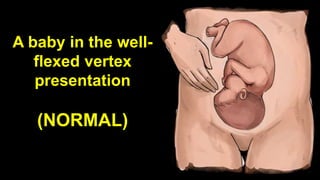
• Vertex presentation (the ‘crown’ of the
baby’s head is presented to the opening
cervix)
• No maternal or fetal complications.
4
Normal Labor Signs
1. Pre-labor (1 - 4 weeks before labor):
• The baby drops lower (lightening) and
his head drops down.
• Increased back pain and cramps
• Abdominal pain
• Joints feel looser
• Diarrhea
• Cervix effacement and dilation (opening
and thins out of cervix) 5
2. Early labor (Hours before labor):
• Bloody show: vaginal discharge
becomes thicker and pink.
• Water breaks: rupture and break of
the amniotic sac.
• Uterine contractions (UCs): painful,
regular, strong contraction.
6
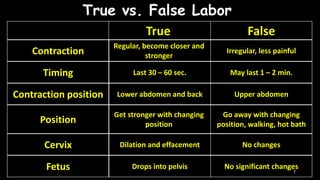
True vs. False Labor
7
FalseTrue
Irregular, less painful
Regular, become closer and
strongerContraction
May last 1 – 2 min.Last 30 – 60 sec.Timing
Upper abdomenLower abdomen and backContraction position
Go away with changing
position, walking, hot bath
Get stronger with changing
positionPosition
No changesDilation and effacementCervix
No significant changesDrops into pelvisFetus
Factors affecting Labor (5 P’s)
In every labor; there are five essential factors affect the
process. These are easily remembered as the five P’s:
1. Passenger: the fetus
2. Passageway: the pelvis and birth canal
3. Powers: the uterine contractions
4. Position: maternal postures and physical
positions
5. Psyche: the response of the mother
8
1.Passenger (The Fetus):
The fetus relationship to the passageway is the major
factor in the birthing process. The relationship includes:
• Fetal skull and size
• Number of fetuses
• Position of feus
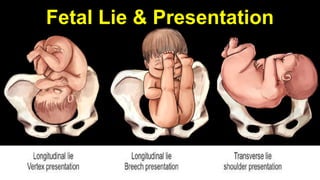
− Fetal lie: relationship of fetal spine to maternal spine;
longitudinal (vertical) or transverse (horizontal)
− Fetal presentation: part of fetus that enters pelvis first
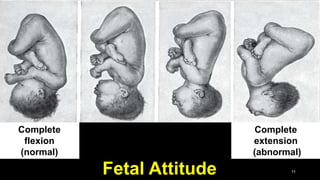
− Fetal attitude: relationship of fetal body parts to each other;
flexion (normal) or extension (abnormal)
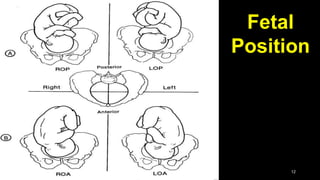
− Fetal position: fetal direction in the pelvis
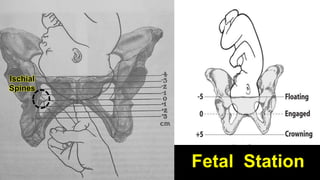
− Fetal station: position of the baby's head relative to the lower
bone of pelvis called the ischial spines 9
10
Fetal Lie & Presentation
Fetal Attitude 11
Complete
extension
(abnormal)
Complete
flexion
(normal)
Fetal
Position
12
Fetal Station
Ischial
Spines
A baby in the well-
flexed vertex
presentation
(NORMAL)
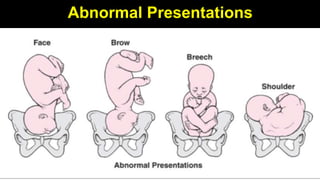
Abnormal Presentations
16
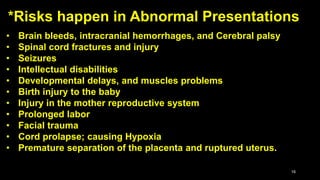
• Brain bleeds, intracranial hemorrhages, and Cerebral palsy
• Spinal cord fractures and injury
• Seizures
• Intellectual disabilities
• Developmental delays, and muscles problems
• Birth injury to the baby
• Injury in the mother reproductive system
• Prolonged labor
• Facial trauma
• Cord prolapse; causing Hypoxia
• Premature separation of the placenta and ruptured uterus.
*Risks happen in Abnormal Presentations
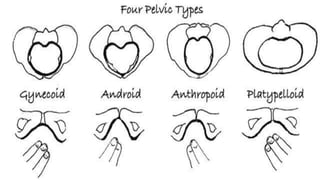
2. Passageway (The pelvis):
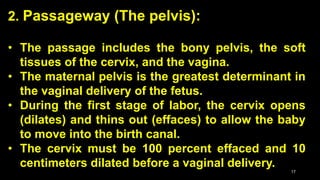
• The passage includes the bony pelvis, the soft
tissues of the cervix, and the vagina.
• The maternal pelvis is the greatest determinant in
the vaginal delivery of the fetus.
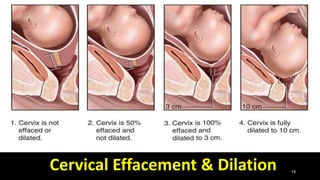
• During the first stage of labor, the cervix opens
(dilates) and thins out (effaces) to allow the baby
to move into the birth canal.
• The cervix must be 100 percent effaced and 10
centimeters dilated before a vaginal delivery.
17
18
19
Cervical Effacement & Dilation
3. Powers:
• Powers refer to the involuntary Uterine
Contractions (UCs) and voluntary pushing of
fetus.
• Contractions are a tightening and relaxing of the
muscles in the abdomen and the back.
• Uterine Contractions have two major goals:
1. To dilate the cervix
2. To push the fetus through the birth canal
• After each contraction there is a uterine
relaxation that allows blood flow to the uterus.
20
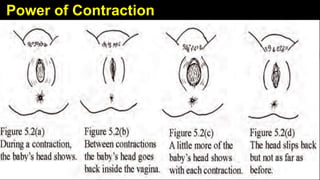
Power of Contraction
21
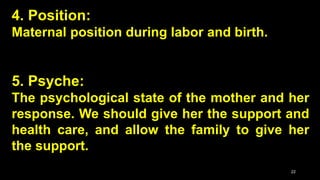
4. Position:
Maternal position during labor and birth.
5. Psyche:
The psychological state of the mother and her
response. We should give her the support and
health care, and allow the family to give her
the support.
22
23
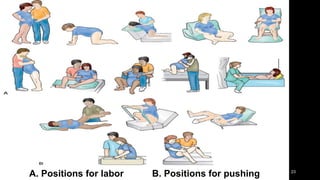
A. Positions for labor B. Positions for pushing
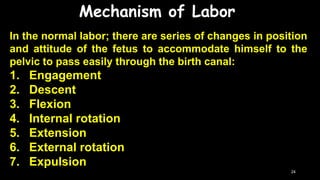
Mechanism of Labor
In the normal labor; there are series of changes in position
and attitude of the fetus to accommodate himself to the
pelvic to pass easily through the birth canal:
1. Engagement
2. Descent
3. Flexion
4. Internal rotation
5. Extension
6. External rotation
7. Expulsion
24
25
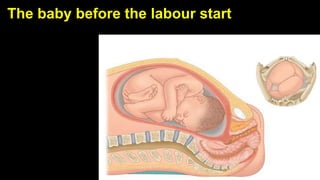
The baby before the labour start
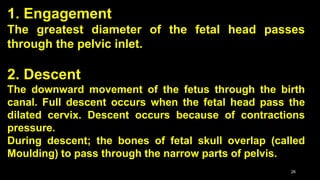
1. Engagement
The greatest diameter of the fetal head passes
through the pelvic inlet.
2. Descent
The downward movement of the fetus through the birth
canal. Full descent occurs when the fetal head pass the
dilated cervix. Descent occurs because of contractions
pressure.
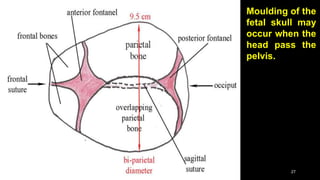
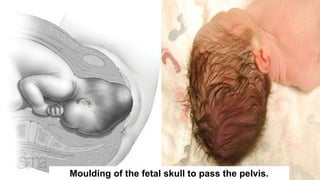
During descent; the bones of fetal skull overlap (called
Moulding) to pass through the narrow parts of pelvis.
26
Moulding of the
fetal skull may
occur when the
head pass the
pelvis.
27
28
Moulding of the fetal skull to pass the pelvis.
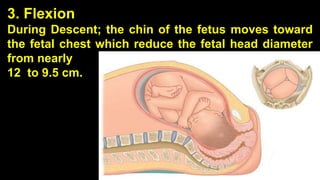
3. Flexion
During Descent; the chin of the fetus moves toward
the fetal chest which reduce the fetal head diameter
from nearly
12 to 9.5 cm.
29
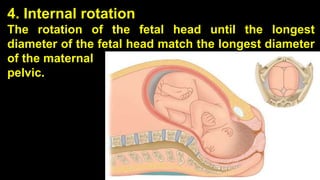
4. Internal rotation
The rotation of the fetal head until the longest
diameter of the fetal head match the longest diameter
of the maternal
pelvic.
30
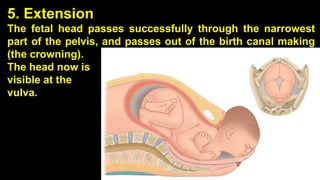
5. Extension
The fetal head passes successfully through the narrowest
part of the pelvis, and passes out of the birth canal making
(the crowning).
The head now is
visible at the
vulva.
31
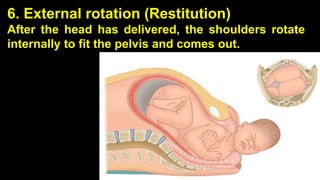
6. External rotation (Restitution)
After the head has delivered, the shoulders rotate
internally to fit the pelvis and comes out.
32
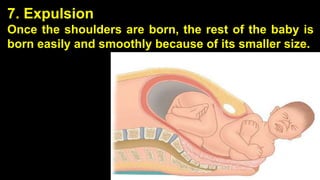
7. Expulsion
Once the shoulders are born, the rest of the baby is
born easily and smoothly because of its smaller size.
33
The Stages of Labor
1. 1st stage (cervix dilation): begins with onset of
labor and ends with complete cervical dilation.
2. 2nd stage (baby delivery): begins with complete
dilation of cervix and ends with delivery of baby.
3. 3rd stage (placenta delivery): begins after
delivery of baby and ends with delivery of
placenta.
4. 4th stage (postpartum): begins after delivery of
the placenta and is completed 4 hours later.
34
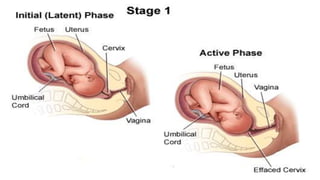
1. First stage (6-36 hours):
• This is the onset of labor to complete
dilation of cervix.
• This stage divided into two phases:
1. Latent phase: contractions become
frequent, very strong, and painful. Cervix
dilates about 4 cm. Contractions begins by
lasting about 40 seconds and coming every
ten minutes.
35
2. Active phase: dilatation of the cervix from 6
to 10 centimeters (Full dilation of cervix).
Contractions become regular, longer, more
severe, and more frequent. In most cases,
the active phase is shorter than the latent
phase.
36
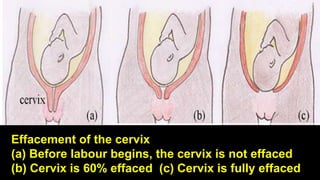
Effacement of the cervix
(a) Before labour begins, the cervix is not effaced
(b) Cervix is 60% effaced (c) Cervix is fully effaced
38
2. Second stage (1 hrs. – 2 hrs.):
• It starts when the cervix is completely
opened and ends with the delivery of the
baby.
• The second stage is often referred to as the
"pushing" stage when the mom push the
baby outside to the world.
• Contractions will last about 60 to 90
seconds every 2 to 5 minutes.
39
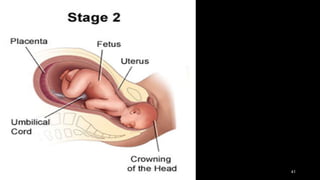
2. Second stage (1 hrs. – 2 hrs.):
• When the baby's head is visible at the
opening of the vagina, it is called
"crowning."
• The second stage is shorter than the first
stage, and may take between 30 minutes to
3 hours for a woman's first pregnancy.
40
41
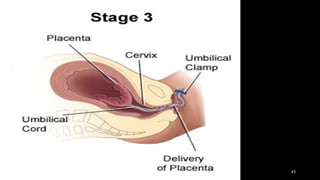
3. Third stage (30 min.):
• Is the delivery of the placenta; which occurs
after the birth of the baby and the umbilical cord
is clamped.
• Once a baby is born, the womb (uterus)
continues to contract, causing the placenta to
separate from the wall of the uterus.
• This stage usually lasts just a few minutes up to
a half-hour.
• There are two ways; Physiological management
(spontaneously with the mother effort) and
Active management.
43
Active management of the third stage:
• It involves three components:
1. Giving a drug (uterotonic) to contract the
uterus.
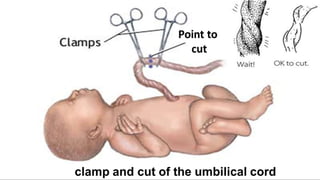
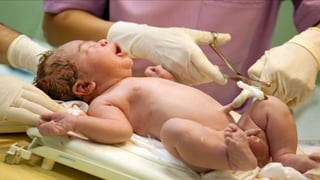
2. Clamp and cut the cord after cord
pulsations have ceased or approximately
2–3 minutes after birth of the baby,
whichever comes first.
44
Active management of the third stage:
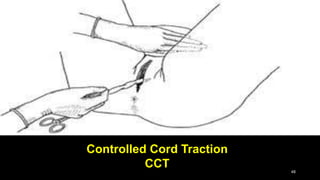
3. Traction is applied to the cord with counter-
pressure on the uterus to deliver the
placenta (Controlled Cord Traction CCT).
• After delivery of the placenta; massage the
uterus immediately until it is firm.
• During recovery, assist the woman to
breastfeed the baby.
45
47
48
Controlled Cord Traction
CCT
Fourth stage:
• An hour to four hours after delivery, and
sometimes for about six weeks, or with the
stabilization of the mother.
• The baby should be assessed and the mother
should have regular assessments for uterine
contraction, vaginal bleeding (The normal blood
loss is about 500 mL), heart rate and blood
pressure, and temperature, for the first 24 hours
after birth.
49
Fourth stage:
• Normally, after the delivery of the placenta,
the woman might feel strong contractions
until the uterus return to its normal status.
• Reassure the mother that these
contractions are healthy, and help to stop
the bleeding.
50

The normal labor and delivery

  • 1.
  • 2.
    The Labor • Laboris the physiological process in which products of conception (the fetus, membranes, umbilical cord, and placenta) is passed from the uterus to the outside world between 38 and 42 completed weeks of pregnancy. 2
  • 3.
    • The periodbegins with the onset of regular uterine contractions (UCs) and lasts until the expulsion of the placenta; we called the Intrapartum. • Delivery is the birth of baby itself. • Delivery can occur in two ways, vaginally or by a cesarean delivery. 3
  • 4.
    A normal labouris the Vaginal delivery with the following characteristics: • Spontaneous onset (it begins on its own, without medical intervention) • Rhythmic and regular uterine contractions • Vertex presentation (the ‘crown’ of the baby’s head is presented to the opening cervix) • No maternal or fetal complications. 4
  • 5.
    Normal Labor Signs 1.Pre-labor (1 - 4 weeks before labor): • The baby drops lower (lightening) and his head drops down. • Increased back pain and cramps • Abdominal pain • Joints feel looser • Diarrhea • Cervix effacement and dilation (opening and thins out of cervix) 5
  • 6.
    2. Early labor(Hours before labor): • Bloody show: vaginal discharge becomes thicker and pink. • Water breaks: rupture and break of the amniotic sac. • Uterine contractions (UCs): painful, regular, strong contraction. 6
  • 7.
    True vs. FalseLabor 7 FalseTrue Irregular, less painful Regular, become closer and strongerContraction May last 1 – 2 min.Last 30 – 60 sec.Timing Upper abdomenLower abdomen and backContraction position Go away with changing position, walking, hot bath Get stronger with changing positionPosition No changesDilation and effacementCervix No significant changesDrops into pelvisFetus
  • 8.
    Factors affecting Labor(5 P’s) In every labor; there are five essential factors affect the process. These are easily remembered as the five P’s: 1. Passenger: the fetus 2. Passageway: the pelvis and birth canal 3. Powers: the uterine contractions 4. Position: maternal postures and physical positions 5. Psyche: the response of the mother 8
  • 9.
    1.Passenger (The Fetus): Thefetus relationship to the passageway is the major factor in the birthing process. The relationship includes: • Fetal skull and size • Number of fetuses • Position of feus − Fetal lie: relationship of fetal spine to maternal spine; longitudinal (vertical) or transverse (horizontal) − Fetal presentation: part of fetus that enters pelvis first − Fetal attitude: relationship of fetal body parts to each other; flexion (normal) or extension (abnormal) − Fetal position: fetal direction in the pelvis − Fetal station: position of the baby's head relative to the lower bone of pelvis called the ischial spines 9
  • 10.
    10 Fetal Lie &Presentation
  • 11.
  • 12.
  • 13.
  • 14.
    A baby inthe well- flexed vertex presentation (NORMAL)
  • 15.
  • 16.
    16 • Brain bleeds,intracranial hemorrhages, and Cerebral palsy • Spinal cord fractures and injury • Seizures • Intellectual disabilities • Developmental delays, and muscles problems • Birth injury to the baby • Injury in the mother reproductive system • Prolonged labor • Facial trauma • Cord prolapse; causing Hypoxia • Premature separation of the placenta and ruptured uterus. *Risks happen in Abnormal Presentations
  • 17.
    2. Passageway (Thepelvis): • The passage includes the bony pelvis, the soft tissues of the cervix, and the vagina. • The maternal pelvis is the greatest determinant in the vaginal delivery of the fetus. • During the first stage of labor, the cervix opens (dilates) and thins out (effaces) to allow the baby to move into the birth canal. • The cervix must be 100 percent effaced and 10 centimeters dilated before a vaginal delivery. 17
  • 18.
  • 19.
  • 20.
    3. Powers: • Powersrefer to the involuntary Uterine Contractions (UCs) and voluntary pushing of fetus. • Contractions are a tightening and relaxing of the muscles in the abdomen and the back. • Uterine Contractions have two major goals: 1. To dilate the cervix 2. To push the fetus through the birth canal • After each contraction there is a uterine relaxation that allows blood flow to the uterus. 20
  • 21.
  • 22.
    4. Position: Maternal positionduring labor and birth. 5. Psyche: The psychological state of the mother and her response. We should give her the support and health care, and allow the family to give her the support. 22
  • 23.
    23 A. Positions forlabor B. Positions for pushing
  • 24.
    Mechanism of Labor Inthe normal labor; there are series of changes in position and attitude of the fetus to accommodate himself to the pelvic to pass easily through the birth canal: 1. Engagement 2. Descent 3. Flexion 4. Internal rotation 5. Extension 6. External rotation 7. Expulsion 24
  • 25.
    25 The baby beforethe labour start
  • 26.
    1. Engagement The greatestdiameter of the fetal head passes through the pelvic inlet. 2. Descent The downward movement of the fetus through the birth canal. Full descent occurs when the fetal head pass the dilated cervix. Descent occurs because of contractions pressure. During descent; the bones of fetal skull overlap (called Moulding) to pass through the narrow parts of pelvis. 26
  • 27.
    Moulding of the fetalskull may occur when the head pass the pelvis. 27
  • 28.
    28 Moulding of thefetal skull to pass the pelvis.
  • 29.
    3. Flexion During Descent;the chin of the fetus moves toward the fetal chest which reduce the fetal head diameter from nearly 12 to 9.5 cm. 29
  • 30.
    4. Internal rotation Therotation of the fetal head until the longest diameter of the fetal head match the longest diameter of the maternal pelvic. 30
  • 31.
    5. Extension The fetalhead passes successfully through the narrowest part of the pelvis, and passes out of the birth canal making (the crowning). The head now is visible at the vulva. 31
  • 32.
    6. External rotation(Restitution) After the head has delivered, the shoulders rotate internally to fit the pelvis and comes out. 32
  • 33.
    7. Expulsion Once theshoulders are born, the rest of the baby is born easily and smoothly because of its smaller size. 33
  • 34.
    The Stages ofLabor 1. 1st stage (cervix dilation): begins with onset of labor and ends with complete cervical dilation. 2. 2nd stage (baby delivery): begins with complete dilation of cervix and ends with delivery of baby. 3. 3rd stage (placenta delivery): begins after delivery of baby and ends with delivery of placenta. 4. 4th stage (postpartum): begins after delivery of the placenta and is completed 4 hours later. 34
  • 35.
    1. First stage(6-36 hours): • This is the onset of labor to complete dilation of cervix. • This stage divided into two phases: 1. Latent phase: contractions become frequent, very strong, and painful. Cervix dilates about 4 cm. Contractions begins by lasting about 40 seconds and coming every ten minutes. 35
  • 36.
    2. Active phase:dilatation of the cervix from 6 to 10 centimeters (Full dilation of cervix). Contractions become regular, longer, more severe, and more frequent. In most cases, the active phase is shorter than the latent phase. 36
  • 37.
    Effacement of thecervix (a) Before labour begins, the cervix is not effaced (b) Cervix is 60% effaced (c) Cervix is fully effaced
  • 38.
  • 39.
    2. Second stage(1 hrs. – 2 hrs.): • It starts when the cervix is completely opened and ends with the delivery of the baby. • The second stage is often referred to as the "pushing" stage when the mom push the baby outside to the world. • Contractions will last about 60 to 90 seconds every 2 to 5 minutes. 39
  • 40.
    2. Second stage(1 hrs. – 2 hrs.): • When the baby's head is visible at the opening of the vagina, it is called "crowning." • The second stage is shorter than the first stage, and may take between 30 minutes to 3 hours for a woman's first pregnancy. 40
  • 41.
  • 42.
    3. Third stage(30 min.): • Is the delivery of the placenta; which occurs after the birth of the baby and the umbilical cord is clamped. • Once a baby is born, the womb (uterus) continues to contract, causing the placenta to separate from the wall of the uterus. • This stage usually lasts just a few minutes up to a half-hour. • There are two ways; Physiological management (spontaneously with the mother effort) and Active management.
  • 43.
  • 44.
    Active management ofthe third stage: • It involves three components: 1. Giving a drug (uterotonic) to contract the uterus. 2. Clamp and cut the cord after cord pulsations have ceased or approximately 2–3 minutes after birth of the baby, whichever comes first. 44
  • 45.
    Active management ofthe third stage: 3. Traction is applied to the cord with counter- pressure on the uterus to deliver the placenta (Controlled Cord Traction CCT). • After delivery of the placenta; massage the uterus immediately until it is firm. • During recovery, assist the woman to breastfeed the baby. 45
  • 47.
  • 48.
  • 49.
    Fourth stage: • Anhour to four hours after delivery, and sometimes for about six weeks, or with the stabilization of the mother. • The baby should be assessed and the mother should have regular assessments for uterine contraction, vaginal bleeding (The normal blood loss is about 500 mL), heart rate and blood pressure, and temperature, for the first 24 hours after birth. 49
  • 50.
    Fourth stage: • Normally,after the delivery of the placenta, the woman might feel strong contractions until the uterus return to its normal status. • Reassure the mother that these contractions are healthy, and help to stop the bleeding. 50