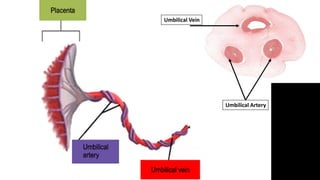
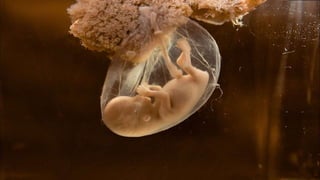
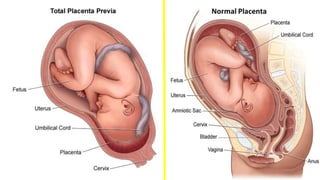
Normal Placenta
• The placenta is a new organ formed in
the uterus during pregnancy, and
connect the fetus to the uterus via the
Umbilical cord and surrounded by a
thick gel (Amniotic Fluid).
• The baby's umbilical cord arises from
the placenta.
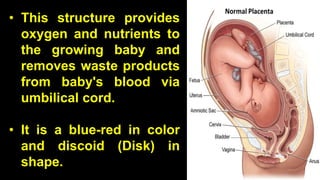
• This structure provides
oxygen and nutrients to
the growing baby and
removes waste products
from baby's blood via
umbilical cord.
• It is a blue-red in color
and discoid (Disk) in
shape.
• Is about 22 cm in diameter and 2.5 cm thick
in the center.
• Placenta is about 500 g in weight.
• Normally; the placenta attaches at the top or
side of the uterus.
• The baby attach to the placenta via the
umbilical cord.
• The normal umbilical cord is 51-60 cm long,
and 2-2.5 cm in diameter. Contains two
arteries and one vein.
Umbilical Artery
Umbilical Vein
Placental Abnormalities and Hemorrhagic Complications
• Blood loss during pregnancy is a first
cause of both mother and fetal morbidity
and mortality (Death & defect).
• Up to 1,000 mL/min of maternal blood
flows through the placenta at term.
• Hemorrhage is a MEDICAL EMERGENCY
• All placental problems can detected and
observed by ultrasound.
Placental Abnormalities and
Hemorrhagic Complications
1. Antepartum Hemorrhage (APH)
2. Postpartum Hemorrhage (PPH)
3. Ectopic Pregnancy
4. Abortion
1. Antepartum Hemorrhage (APH)
• Antepartum hemorrhage (APH) is a bleeding from
the birth canal (Vagina) after the 24th week (some
said after the 20th week) of pregnancy.
• It can occur at any time until the second stage of
labor is complete.
• It called also; the third-trimester bleeding
complicates about 4% of all pregnancies and
considered as medical emergency.
• Bleeding before the week 24 of pregnancy is
miscarriage.
APH Common Causes
a. Placental Previa
b. Placental Abruption
c. Uterine Rupture
d. Vasa Previa
e. Reproductive system injuries
f. Neoplasia
Life threatening
• The condition in which the placenta partially
or totally covers the cervix (the lower part of
uterus).
• It may cause anemia and death due to
severe blood loss.
• The most common symptom of placenta
previa is painless vaginal bleeding (bright
red blood).
a. Placental Previa
Risk factors:
• Previous Caesarean section
• Old mother (>35 years)
• Previous placenta previa
• Diabetes or hypertension
• Cigarette smoking
• Uterine problems and anomalies
• Multiple fetuses
a. Placental Previa
Classification:
1. Total (Complete): The placenta completely
covers the cervix.
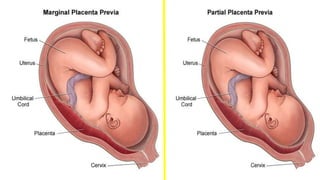
2. Partial: The placenta is partially covers the
cervix.
3. Marginal: The placenta is near the edge of the
cervix.
a. Placental Previa
Management:
• Treatment depends on gestational age, severity and type
of the pervia, blood loss, and the health of the mom and
the baby.
• Reducing activities and bed rest.
• Medicines to prevent early labor.
• Steroid may be given to help mature the baby’s lungs.
• Blood transfusion for the mother as necessary.
• After 36 weeks, a caesarean section is usually
performed.
• If the bleeding can't be controlled; an emergency C-
section is important even if the baby is premature.
a. Placental Previa
• We called also abruptio placentae.
• Placental abruption is the separation of a
placenta from the wall of the uterus before
the delivery.
• This condition can occur any time after the
20th week of pregnancy.
• When the placenta separate from the uterus,
the vessels within the placenta detached and
start to bleed.
b. Placental Abruption
Risk factors:
• Old mother (>35 years)
• Previous placental abruption
• High blood pressure
• Cigarette smoking
• Uterine problems and anomalies
• Multiple fetuses
• Abdominal trauma
b. Placental Abruption
Effects & Complications:
• Shock due to blood loss
• The need for a blood transfusion
• A serious blood clotting complication
• Poor blood flow and damage to kidneys or brain of
the mother
• Premature birth
• Fetus heart rates problems
• Fetal death
b. Placental Abruption
Symptoms and signs:
• Vaginal bleeding (dark red blood)
• Abdominal pain
• Uterine contractions that doesn't relax.
• Blood in amniotic fluid
• Nausea
• Faint feeling
• Decreased fetal movements
b. Placental Abruption
Classification:
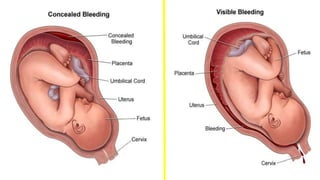
• Revealed (Visible – External bleeding):
Causes vaginal bleeding that helps with early
detection.
• Concealed (Internal): The blood gets trapped,
pooling and clotting behind the placenta. It can
only be detected only through an ultrasound.
b. Placental Abruption
Management:
• The treatment depends on depends on the
amount of bleeding, the gestational age, and
condition of the fetus.
• Before week 34 the mom should rest.
• After week 34:
− If the fetus is normal, and the bleeding is
mild; vaginal labor is possible
− If not; C-Section is necessary
b. Placental Abruption
• There is no treatment to stop placental
abruption or reattach the placenta.
• After the baby is born, bleeding from the site
of the placental attachment is likely.
• If the bleeding can't be controlled,
emergency removal of the uterus
(hysterectomy) might be needed.
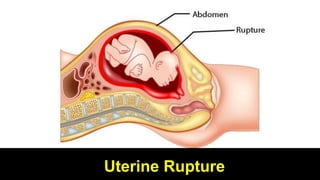
• A uterine rupture is a tear in the wall of the
uterus.
c. Uterine Rupture
Risk factors:
• Previous C-Section
• Previous uterine surgery
• Abdominal trauma
Uterine Rupture
c. Uterine Rupture
Symptoms and signs:
• Excessive vaginal bleeding
• Sharp pain between contractions
• Contractions that slow down and relax
• Unusual abdominal pain or tenderness
• Baby’s head moving back up not down
• Rapid heart rate and abnormally low blood
pressure in the mother
• Amniotic fluid embolus
c. Uterine Rupture
Management:
• Immediate C-section is necessary in uterine
rupture.
• Followed by repair of the uterus.
• Antibiotics is important to prevent infection.
• If the damage to the woman's uterus is
extensive and the bleeding can't be controlled,
she'll need a hysterectomy.
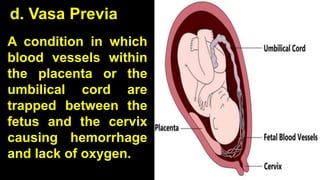
d. Vasa Previa
A condition in which
blood vessels within
the placenta or the
umbilical cord are
trapped between the
fetus and the cervix
causing hemorrhage
and lack of oxygen.
d. Vasa Previa
Symptoms:
• Painless vaginal bleeding
Risk factors:
• Previous C-Section
• Low-lying placentas (Inferior placenta)
• Multiple fetuses
Management:
• Steroid treatment to develop fetal lung maturity.
• The C-section should be done early to avoid an emergency
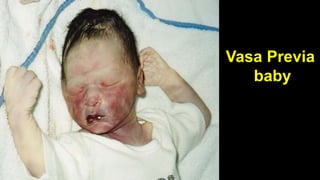
Vasa Previa
baby

Antepartum Hemorrhage (APH)

  • 2.
    Normal Placenta • Theplacenta is a new organ formed in the uterus during pregnancy, and connect the fetus to the uterus via the Umbilical cord and surrounded by a thick gel (Amniotic Fluid). • The baby's umbilical cord arises from the placenta.
  • 3.
    • This structureprovides oxygen and nutrients to the growing baby and removes waste products from baby's blood via umbilical cord. • It is a blue-red in color and discoid (Disk) in shape.
  • 4.
    • Is about22 cm in diameter and 2.5 cm thick in the center. • Placenta is about 500 g in weight. • Normally; the placenta attaches at the top or side of the uterus. • The baby attach to the placenta via the umbilical cord. • The normal umbilical cord is 51-60 cm long, and 2-2.5 cm in diameter. Contains two arteries and one vein.
  • 5.
  • 7.
    Placental Abnormalities andHemorrhagic Complications • Blood loss during pregnancy is a first cause of both mother and fetal morbidity and mortality (Death & defect). • Up to 1,000 mL/min of maternal blood flows through the placenta at term. • Hemorrhage is a MEDICAL EMERGENCY • All placental problems can detected and observed by ultrasound.
  • 8.
    Placental Abnormalities and HemorrhagicComplications 1. Antepartum Hemorrhage (APH) 2. Postpartum Hemorrhage (PPH) 3. Ectopic Pregnancy 4. Abortion
  • 9.
    1. Antepartum Hemorrhage(APH) • Antepartum hemorrhage (APH) is a bleeding from the birth canal (Vagina) after the 24th week (some said after the 20th week) of pregnancy. • It can occur at any time until the second stage of labor is complete. • It called also; the third-trimester bleeding complicates about 4% of all pregnancies and considered as medical emergency. • Bleeding before the week 24 of pregnancy is miscarriage.
  • 10.
    APH Common Causes a.Placental Previa b. Placental Abruption c. Uterine Rupture d. Vasa Previa e. Reproductive system injuries f. Neoplasia Life threatening
  • 11.
    • The conditionin which the placenta partially or totally covers the cervix (the lower part of uterus). • It may cause anemia and death due to severe blood loss. • The most common symptom of placenta previa is painless vaginal bleeding (bright red blood). a. Placental Previa
  • 12.
    Risk factors: • PreviousCaesarean section • Old mother (>35 years) • Previous placenta previa • Diabetes or hypertension • Cigarette smoking • Uterine problems and anomalies • Multiple fetuses a. Placental Previa
  • 13.
    Classification: 1. Total (Complete):The placenta completely covers the cervix. 2. Partial: The placenta is partially covers the cervix. 3. Marginal: The placenta is near the edge of the cervix. a. Placental Previa
  • 16.
    Management: • Treatment dependson gestational age, severity and type of the pervia, blood loss, and the health of the mom and the baby. • Reducing activities and bed rest. • Medicines to prevent early labor. • Steroid may be given to help mature the baby’s lungs. • Blood transfusion for the mother as necessary. • After 36 weeks, a caesarean section is usually performed. • If the bleeding can't be controlled; an emergency C- section is important even if the baby is premature. a. Placental Previa
  • 17.
    • We calledalso abruptio placentae. • Placental abruption is the separation of a placenta from the wall of the uterus before the delivery. • This condition can occur any time after the 20th week of pregnancy. • When the placenta separate from the uterus, the vessels within the placenta detached and start to bleed. b. Placental Abruption
  • 18.
    b. Placental Abruption Riskfactors: • Old mother (>35 years) • Previous placental abruption • High blood pressure • Cigarette smoking • Uterine problems and anomalies • Multiple fetuses • Abdominal trauma
  • 19.
    b. Placental Abruption Effects& Complications: • Shock due to blood loss • The need for a blood transfusion • A serious blood clotting complication • Poor blood flow and damage to kidneys or brain of the mother • Premature birth • Fetus heart rates problems • Fetal death
  • 20.
    b. Placental Abruption Symptomsand signs: • Vaginal bleeding (dark red blood) • Abdominal pain • Uterine contractions that doesn't relax. • Blood in amniotic fluid • Nausea • Faint feeling • Decreased fetal movements
  • 21.
    b. Placental Abruption Classification: •Revealed (Visible – External bleeding): Causes vaginal bleeding that helps with early detection. • Concealed (Internal): The blood gets trapped, pooling and clotting behind the placenta. It can only be detected only through an ultrasound.
  • 23.
    b. Placental Abruption Management: •The treatment depends on depends on the amount of bleeding, the gestational age, and condition of the fetus. • Before week 34 the mom should rest. • After week 34: − If the fetus is normal, and the bleeding is mild; vaginal labor is possible − If not; C-Section is necessary
  • 24.
    b. Placental Abruption •There is no treatment to stop placental abruption or reattach the placenta. • After the baby is born, bleeding from the site of the placental attachment is likely. • If the bleeding can't be controlled, emergency removal of the uterus (hysterectomy) might be needed.
  • 25.
    • A uterinerupture is a tear in the wall of the uterus. c. Uterine Rupture Risk factors: • Previous C-Section • Previous uterine surgery • Abdominal trauma
  • 26.
  • 27.
    c. Uterine Rupture Symptomsand signs: • Excessive vaginal bleeding • Sharp pain between contractions • Contractions that slow down and relax • Unusual abdominal pain or tenderness • Baby’s head moving back up not down • Rapid heart rate and abnormally low blood pressure in the mother • Amniotic fluid embolus
  • 28.
    c. Uterine Rupture Management: •Immediate C-section is necessary in uterine rupture. • Followed by repair of the uterus. • Antibiotics is important to prevent infection. • If the damage to the woman's uterus is extensive and the bleeding can't be controlled, she'll need a hysterectomy.
  • 29.
    d. Vasa Previa Acondition in which blood vessels within the placenta or the umbilical cord are trapped between the fetus and the cervix causing hemorrhage and lack of oxygen.
  • 30.
    d. Vasa Previa Symptoms: •Painless vaginal bleeding Risk factors: • Previous C-Section • Low-lying placentas (Inferior placenta) • Multiple fetuses Management: • Steroid treatment to develop fetal lung maturity. • The C-section should be done early to avoid an emergency
  • 31.