1
Neonatal Care & Resuscitation
• Most babies breathe spontaneously as soon as they are
born and we need to follow the steps of basic new-born
care.
• The moment when a baby is born we have just a few
seconds (5 Sec.) to make a very rapid assessment of the
condition of the new-born to decide if he can breathe or
not; or the baby will die because he is not able to get
enough oxygen.
• If the baby can breathe Care
If the baby cannot breathe Resuscitation
2
• Normally, a healthy baby starts to breath
spontaneously immediately after delivery
without depends on his mother.
• Healthy new-born well have pinkish skin
colour and semi-flexed arms and legs.
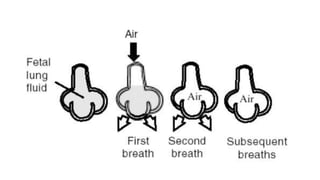
• The Fluid in the lung is absorbed, and blood
vessels in the lung tissue relax; now the O₂ will
go easily to the lung.
Neonatal Care
3
4
1. Warm & Dry the baby: The mother and the baby
should be kept skin-to-skin contact, covered with a
clean dry blanket. This should be done immediately
after the birth, even before cut the cord.
2. Clean childbirth and cord care to prevent any
infection. And clear the airway.
3. Check the new-born: Immediately after delivery,
clear airways and stimulate the baby while drying
and look for: 5
― Breathing: babies should start to breathe
normally within seconds after birth.
― Colour: the baby’s skin should be a normal
colour – not pale or bluish.
― Muscle tone: the baby should move his or her
arms and legs vigorously.
All of these things should be checked simultaneously
within the first minute after birth.
4. If everything is normal after the birth, the mother
should start to breastfeed her baby. 6
• Asphyxia is shortage of oxygen.
• It may result in Learning difficulties or newborn death.
• Neonatal asphyxia is mainly happen due to:
1. Failure of the new-born to breathe after birth.
2. The baby’s heart fails to pump enough blood to the
lungs.
3. Low haemoglobin levels (anaemia) so it cannot
deliver enough oxygen around the body.
4. Asphyxia of the baby before even he is born.
7
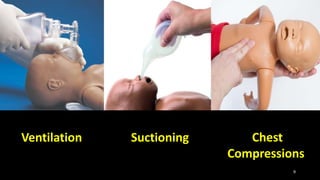
• There are three techniques:
1. Ventilation: using a hand-operated pump called an
ambu-bag, which pumps air into the baby’s lungs
through a mask fitted over its nose and mouth.
2. Suctioning: using a device called a bulb syringe to
extract mucus and fluid from the baby’s nose and
mouth.
3. Chest Compressions: pressing on the baby’s chest
in a rhythmic way to stimulate the heartbeat.
8
Chest
Compressions
9
SuctioningVentilation
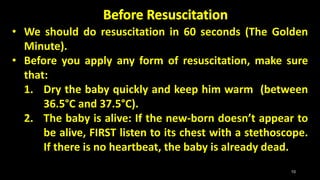
• We should do resuscitation in 60 seconds (The Golden
Minute).
• Before you apply any form of resuscitation, make sure
that:
1. Dry the baby quickly and keep him warm (between
36.5°C and 37.5°C).
2. The baby is alive: If the new-born doesn’t appear to
be alive, FIRST listen to its chest with a stethoscope.
If there is no heartbeat, the baby is already dead.
10
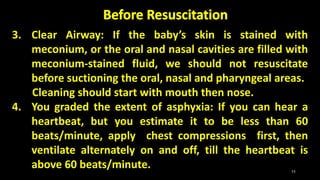
3. Clear Airway: If the baby’s skin is stained with
meconium, or the oral and nasal cavities are filled with
meconium-stained fluid, we should not resuscitate
before suctioning the oral, nasal and pharyngeal areas.
Cleaning should start with mouth then nose.
4. You graded the extent of asphyxia: If you can hear a
heartbeat, but you estimate it to be less than 60
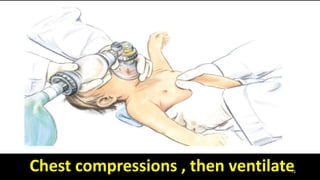
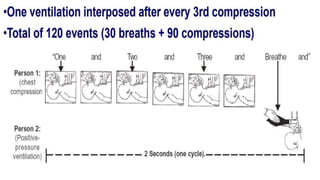
beats/minute, apply chest compressions first, then
ventilate alternately on and off, till the heartbeat is
above 60 beats/minute. 11
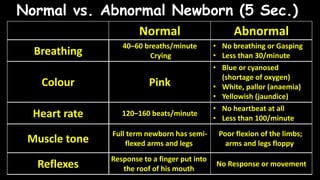
AbnormalNormal
• No breathing or Gasping
• Less than 30/minute
40–60 breaths/minute
CryingBreathing
• Blue or cyanosed
(shortage of oxygen)
• White, pallor (anaemia)
• Yellowish (jaundice)
PinkColour
• No heartbeat at all
• Less than 100/minute
120–160 beats/minuteHeart rate
Poor flexion of the limbs;
arms and legs floppy
Full term newborn has semi-
flexed arms and legsMuscle tone
No Response or movement
Response to a finger put into
the roof of his mouthReflexes
Normal vs. Abnormal Newborn (5 Sec.)
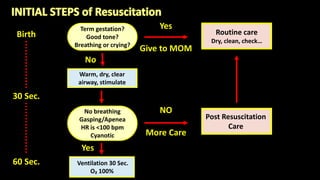
Yes
Give to MOM
Term gestation?
Good tone?
Breathing or crying?
Birth
30 Sec.
60 Sec.
Routine care
Dry, clean, check…
No
Warm, dry, clear
airway, stimulate
No breathing
Gasping/Apenea
HR is ˂100 bpm
Cyanotic
NO
More Care
Ventilation 30 Sec.
O₂ 100%
Yes
Post Resuscitation
Care
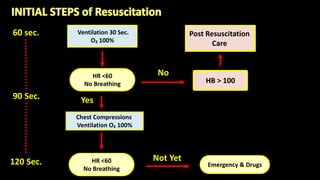
HR <60
No Breathing
60 sec.
90 Sec.
120 Sec.
Yes
Ventilation 30 Sec.
O₂ 100%
No
Chest Compressions
Ventilation O₂ 100%
HB ˃ 100
Not Yet
Emergency & Drugs
HR <60
No Breathing
Post Resuscitation
Care
15Chest compressions , then ventilate
16
• Rapid rise in heart rate
• Improvement in oxygenation
• Improving muscle tone
• Audible breath sound
• Chest movement
17
• Eye ointment to prevent Gonococcal and
Chlamydia Infection.
• Immunization (first dose of oral polio
vaccine, BCG vaccine against tuberculosis,
and Hepatitis B .
• Inject vitamin K to prevent any bleeding.
18
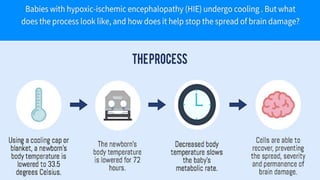
1. Therapeutic hypothermia (Cooling Brain): A
technique we use it to manage brain damage due
to Lack of O₂ and Blood.
The treatment consists of lowering a new-born's
body temperature to around 33-35 C⁰ for a period
of about 72 hours.
2. Glucose: To maintain the normal blood glucose
at normal range.
19
20

neonatal resuscitation and care

  • 1.
  • 2.
    Neonatal Care &Resuscitation • Most babies breathe spontaneously as soon as they are born and we need to follow the steps of basic new-born care. • The moment when a baby is born we have just a few seconds (5 Sec.) to make a very rapid assessment of the condition of the new-born to decide if he can breathe or not; or the baby will die because he is not able to get enough oxygen. • If the baby can breathe Care If the baby cannot breathe Resuscitation 2
  • 3.
    • Normally, ahealthy baby starts to breath spontaneously immediately after delivery without depends on his mother. • Healthy new-born well have pinkish skin colour and semi-flexed arms and legs. • The Fluid in the lung is absorbed, and blood vessels in the lung tissue relax; now the O₂ will go easily to the lung. Neonatal Care 3
  • 4.
  • 5.
    1. Warm &Dry the baby: The mother and the baby should be kept skin-to-skin contact, covered with a clean dry blanket. This should be done immediately after the birth, even before cut the cord. 2. Clean childbirth and cord care to prevent any infection. And clear the airway. 3. Check the new-born: Immediately after delivery, clear airways and stimulate the baby while drying and look for: 5
  • 6.
    ― Breathing: babiesshould start to breathe normally within seconds after birth. ― Colour: the baby’s skin should be a normal colour – not pale or bluish. ― Muscle tone: the baby should move his or her arms and legs vigorously. All of these things should be checked simultaneously within the first minute after birth. 4. If everything is normal after the birth, the mother should start to breastfeed her baby. 6
  • 7.
    • Asphyxia isshortage of oxygen. • It may result in Learning difficulties or newborn death. • Neonatal asphyxia is mainly happen due to: 1. Failure of the new-born to breathe after birth. 2. The baby’s heart fails to pump enough blood to the lungs. 3. Low haemoglobin levels (anaemia) so it cannot deliver enough oxygen around the body. 4. Asphyxia of the baby before even he is born. 7
  • 8.
    • There arethree techniques: 1. Ventilation: using a hand-operated pump called an ambu-bag, which pumps air into the baby’s lungs through a mask fitted over its nose and mouth. 2. Suctioning: using a device called a bulb syringe to extract mucus and fluid from the baby’s nose and mouth. 3. Chest Compressions: pressing on the baby’s chest in a rhythmic way to stimulate the heartbeat. 8
  • 9.
  • 10.
    • We shoulddo resuscitation in 60 seconds (The Golden Minute). • Before you apply any form of resuscitation, make sure that: 1. Dry the baby quickly and keep him warm (between 36.5°C and 37.5°C). 2. The baby is alive: If the new-born doesn’t appear to be alive, FIRST listen to its chest with a stethoscope. If there is no heartbeat, the baby is already dead. 10
  • 11.
    3. Clear Airway:If the baby’s skin is stained with meconium, or the oral and nasal cavities are filled with meconium-stained fluid, we should not resuscitate before suctioning the oral, nasal and pharyngeal areas. Cleaning should start with mouth then nose. 4. You graded the extent of asphyxia: If you can hear a heartbeat, but you estimate it to be less than 60 beats/minute, apply chest compressions first, then ventilate alternately on and off, till the heartbeat is above 60 beats/minute. 11
  • 12.
    AbnormalNormal • No breathingor Gasping • Less than 30/minute 40–60 breaths/minute CryingBreathing • Blue or cyanosed (shortage of oxygen) • White, pallor (anaemia) • Yellowish (jaundice) PinkColour • No heartbeat at all • Less than 100/minute 120–160 beats/minuteHeart rate Poor flexion of the limbs; arms and legs floppy Full term newborn has semi- flexed arms and legsMuscle tone No Response or movement Response to a finger put into the roof of his mouthReflexes Normal vs. Abnormal Newborn (5 Sec.)
  • 13.
    Yes Give to MOM Termgestation? Good tone? Breathing or crying? Birth 30 Sec. 60 Sec. Routine care Dry, clean, check… No Warm, dry, clear airway, stimulate No breathing Gasping/Apenea HR is ˂100 bpm Cyanotic NO More Care Ventilation 30 Sec. O₂ 100% Yes Post Resuscitation Care
  • 14.
    HR <60 No Breathing 60sec. 90 Sec. 120 Sec. Yes Ventilation 30 Sec. O₂ 100% No Chest Compressions Ventilation O₂ 100% HB ˃ 100 Not Yet Emergency & Drugs HR <60 No Breathing Post Resuscitation Care
  • 15.
    15Chest compressions ,then ventilate
  • 16.
  • 17.
    • Rapid risein heart rate • Improvement in oxygenation • Improving muscle tone • Audible breath sound • Chest movement 17
  • 18.
    • Eye ointmentto prevent Gonococcal and Chlamydia Infection. • Immunization (first dose of oral polio vaccine, BCG vaccine against tuberculosis, and Hepatitis B . • Inject vitamin K to prevent any bleeding. 18
  • 19.
    1. Therapeutic hypothermia(Cooling Brain): A technique we use it to manage brain damage due to Lack of O₂ and Blood. The treatment consists of lowering a new-born's body temperature to around 33-35 C⁰ for a period of about 72 hours. 2. Glucose: To maintain the normal blood glucose at normal range. 19
  • 20.