Chronic Otitis Media Prepaired by:  Dr.Hiwa As’ad M.B.Ch.B.  F.I.C.M.S.(ENT)  C.A.B.S.(ENT H&N Surgery)
Chronic Otitis Media Introduction: Def:  It is an inflammation of middle ear space with a long standing infection. Chronic ear infections are much less common than acute ear infections. its incidence  is less common than in the pre- antibiotic era.  Chronic middle ear infection may be more  destructive than an acute middle ear  infection, because its effects are prolonged or repeated.
It may cause permanent damage to the ear, however a chronic infection causes less sever symptoms.  Chronic middle ear infection includes several  clinical entities which differ in aetiology , pathology and in the part of middle ear cleft principally  involved.
Chronic Otitis Media Divided into :  1- Chronic non-specific otitis media.  a-Chronic suppurative otitis media. b-Chronic non-suppurative otitis media. 2- Chronic specific otitis media.
Or  devided into: 1.Chronic active otitis media. A. Safe  B. Unsafe 2.Chronic inactive otitis media. A.Sequally of CSOM  B. Adhesive OM
Chronic Suppurative Otitis Media It is a chronic inflammation of the middle ear space & mastoid cavity. Duration is from 6 weeks - 3 months or more.  Presents with recurrent ear discharges through a tympanic membrane perforation. CSOM is a major cause of acquired hearing impairment in developing countries.
Epidemiology The true incidence of CSOM   with or without  Cholesteatoma   is unknown. Risk factors : * Poor living conditions & living in crowded  conditions. * Poor nutrition & hygiene. * Being a member of a large family. * Studies of parental education ,passive smoking, breast feeding ,socioeconomic status and  the annual number of upper resp.tract infection are inconclusive. * Multiple episodes of acute otitis media.
* Craniofacial anomalies   increase the risk like :cleft lip or palate ,downs syndrome ,cri-du-chat syndrome ,choanal atresia & microcephaly ,all increase risk presumably because of altered eustachian tube anatomy & function. *  Age:   Children more than adults. * Ethnic group  :   Native Americans,Alaskan,Green-land,Australian aborigines,New Zealand natives all have higher incidence of CSOM.
Classification CSOM  is usually classified in to two main  groups  : 1.Tubotympanic disease * Non cholesteatomatus CSOM. * Safe CSOM. 2.Atticoantral disease * Cholesteatomatus CSOM. * Tympanomastoid CSOM. * Unsafe CSOM.
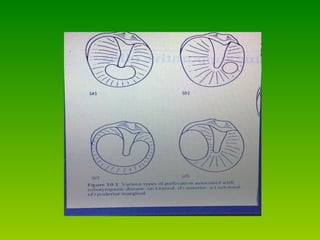
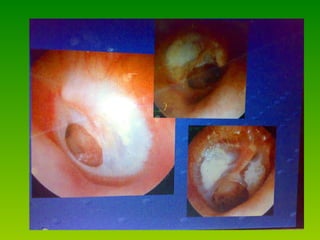
Tubotympanic disease * Charactrised by a perforation of the pars  tensa [ central perforation ] . * adequate atticoantral drainage. * disease confirm to the mucosa of the antero- inferior portion of the middle ear cleft. * risk of serious complication is minimal. * most perforations arise when an acute perforation occurs during an episodes of acute suppurative otitis media.
Tubotympanic type   of CSOM is further subdi   -vided in to   two types  : 1-Tubal type  : the route of infection is from the  eustachian tube. * the underlying causes of infection lies either  In the nose ,sinuses or nasopharynx. * usually seen in children of low socio-economic state ,these children present with profuse  bilateral mucopurulent discharge. * often involving both ears.
2-Tympanic type : * infection reaches the middle ear through a defect  in the tympanic membrane. * there is a central perforation. * usually seen in adults. * usually involves one ear. * there is scanty discharge which respond to anti- biotic & this is again occurs after the introduction of water into the ear.


Bacteriology - Pseudomonas aerugenosa ( 48 to 98 % ) - Staphylococcus aureus ( 15 to 30 % ). - Klebsiella spieces ( 10 to 20 % ). - Proteus merabilis ( 10 to 15% ). - Polymicrobial ( 5 to 10 % ) which include : Gram positive ,gram negative ,Aspergillus ,  Candida. - Anaerobes e.g.Bacteroids ,Peptostrepto- coccus , Propioni bacterium ( 20 to 50 %).
The bacteria are infrequently found in  the  skin of the EAC ,but they may proliferate  in the presence of trauma ,inflammation ,lacer  -ations or high humidity. * these bacteria may then again enter into the  middle ear through a chronic perforation. * among these bacteria for e.g. pseudomonas  has been particularly blamed for the deep sea  -ted & progressive destruction of the middle  ear & mastoid structures ,through its toxins &  enzymes .
Histopathological features of CSOM Otitis media presents as an early acute phase with essentially reversible mucosal & bony pathological changes which continues  to a late chronic phase with well established intractable mucoperiosteal disease . The recurrent episodes of otorrhoea& mucosal changes are characterized by osteoneogenesis ,bony erosions & osteitis ,that include the temporal bone & ossicles ,this is followed by ossicular  destruction& or ankylosis which together with TM perforation contribute to hearing loss.
Clinical Features of CSOM 1. Discharge  : it is mucoid,often scanty,usually intermittent,but becoming purulent&profuse during exacerbations.the ear is usually pain  -less except when eczematoid otitis externa  intervenes. *  it may be   blood stained discharge ,when it is associated with aural polyps ,excessive granulations , ulceration or tumor . 2. Deafness  : usually conductive in type ,the  degree varies with the size & position of the  perforation.
Clinical Assessment : 1. For the scar of previous surgery. 2. For discharge. 3. Otoscopy & Otomicroscopy : For the presence of TM perforation ,site & size of perforation ,the state of reminder of TM.   For the mucosa of middle ear ,for the ossicular chain ,presence of epithelialization  ,granulations,ulceration & polyp. 4. Nose & Throat examination. 5. Eustachian tube function assessment .
6. Audiological assessment  : * Pure tone audiomtry  : detect level of hearing  loss & type of hearing loss . * Speech audiomtry  : which measures speech  recognition(reception)threshold & speech dis- crimination  ability reflected in the speech  recognition score (speech may be presented by Monitored live voice , Cassette  tape  or Compact disc CD).
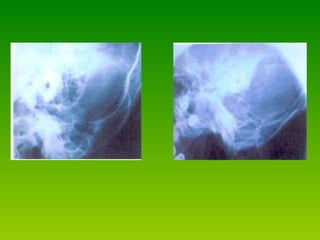
Radiological assessment * Plain radiogram  : it is of value in cholesteat  -omatus cases(shows lytic lesions) ,also it detect variation in anatomic landmarks. * CT-Scan :   CTscanning  performed when:  1. intratemporal or intracranial  complications are suspected  2. surgical intervention being planned 3.to study anatomy of temporal bone These studies should include both axial & coronal fine cuts (1-1.5mm) through the temporal bone.
 
Treatment of CSOM * Swab should be taken for culture&senstivity. * Aural toilet  daily by suctioning the ear ,it is  better to be done under the microscope. * Antibiotics  : Usually after aural toilet & placement of ototopic medication is all  that is needed to stop the chronic otorrhoea. -Ofloxacin otic drops -   combination of (neomycin,polymixin B ,ciprofloxacin )with steroids like hydro-cortisone.The addition of corticosteroids aids in the resolution of inflammation.
Topical antimicrobial therapy frequently results in rapid resolution of the otorrhoea in 1to 2 weeks. Oral antimicrobial agents alone are frequently ineffective in treating CSOM. In patients with refractory otorrhoea ,consideration must be given to:  -a resistant organism.  -poor drug delivery. - the presence of chronic otomastoid  osteitis,granulation tissue,or  cholesteatomas.
Culture Directed intravenous antibiotics  are a reasonable approach ,usually an antipseudomonal penicillin or a second or third generation cephalosporin will cover the offending organisms ,daily suctioning & inst-  illation of ototopic agents is also useful ,in these  cases  7 to 10  days of treatment will usually dry  the ear without the need of further therapy.
Surgical Surgery should be considered for failure to respond to a combination of topical and systemic therapy.  A  tympanomastoidectomy  can eliminate infection and stop otorrhoea in  80%  of patients.  Tympanoplasty(Myrigoplasty and ossiculoplasty)   can seal a perforation and prevents transfer of bacteria from the external ear canal into the middle ear and reconstruct the hearing mechanism.
Attico-antral CSOM. - Cholesteatomatus   CSOM - Tympanomastoid CSOM - Unsafe CSOM
Tympanomastoid otitis media In this type of infection the bone of attic, antrum or mastoid process is involved as well  as the  mucosa  of  the  middle  ear  cleft  ,  therefore it is regarded as atticoantral disease  as erosion of bone may extend to adjacent  vital structures ,there is always a danger of  serious complications. The bony involvement  may give rise to granulations or polypi ,these  may be true granulation tissue ,but it may be  due to an inflammatory swelling of the mucosa of the ear ,however there presence
Is evidence of bony involvement. There are  three basic pathological  findings in the  Tympanomasoid type of the disease : . 1. Cholesteatoma . 2. Granulation tissue with osteitis.  3. Cholesterol granuloma.
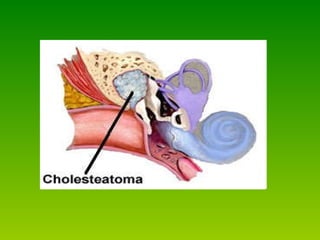
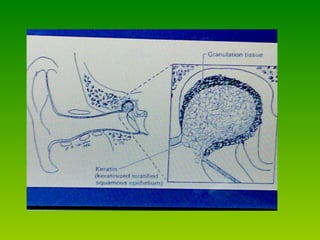
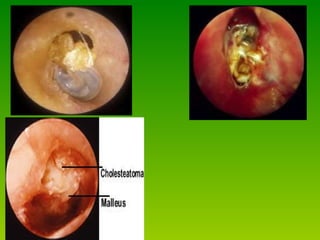
1- Cholesteatoma It is an epidermal inclusion cyst ,localized  in the middle ear & petrous bone ,whose caps  -ule & matrix is formed from stratified squamo  -us epithelium. The desquamating debris include pearly white  Lamellae of keratin that accumulate concentri  -cally ,forming the  cholesteatomatus mass . The term cholesteatoma is actually misnomer  it is derived from Greek “chole” or bile “steat  -os” or fat & “oma” tumor.
The suffix “oma” is more appropriate ,because it can be considered as an epidermal inclusion cyst. It is made up of : - cystic content  :a nucleate keratin squamous. - matrix  keratinizing squamous epithelium . - peri matrix   granulation tissue ,incontact with  Bone  (   produces proteolytic enzymes  ).
 
 
2-Granulation tissue: This is basically a low grade osteitis of  the  Mastoid bone ,it may be localized to one area e.g.  Posterosuperior meatal wall & middle ear, or  Extend through out the middle ear & mastoid ,it  Can also cause destruction of surrounding  Structures. 3- Cholesterole granuloma  : this can be seen  on its own or in combination with either  cholesteatoma or granulations ,it appear as a  dark brown often with a lot of bone  destruction & if present in the middle ear
gives the TM a dark blue or black appearance .  Histological examination  shows it to consist of  Cholesterol crystals surrounded by FB giant  Cells & granulation tissue.
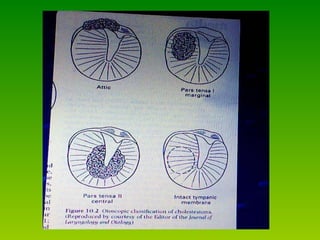
Classification of Cholesteatoma 1. Congenital. 2. Acquired : -Primary acquired (retraction pocket ) -Secondary acquired
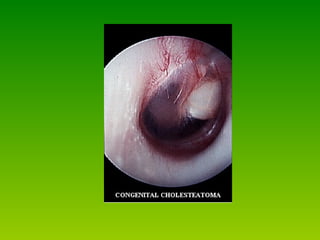
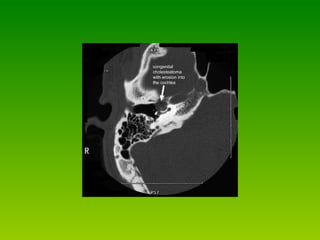
pathogenesis of congenital cholesteatoma Arises from entrapped ectodermal cellular de-  bris ,during embryonic development. Location  (  petrous pyramid ,mastoid & middle ear cleft  ). * Levisohn criteria : - white mass medial to normal TM (retrotympa-  nic mass). - normal pars flaccida & pars tensa. - no history of otorrhoea or perforation. - no prior otologic procidures. - prior bouts of otitis media not grounds for  exclusion .
 
 
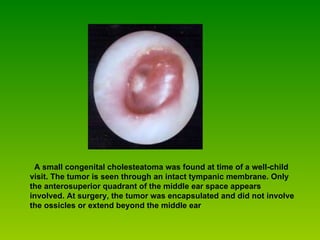
   A small congenital cholesteatoma was found at time of a well-child visit. The tumor is seen through an intact tympanic membrane. Only the anterosuperior quadrant of the middle ear space appears involved. At surgery, the tumor was encapsulated and did not involve the ossicles or extend beyond the middle ear
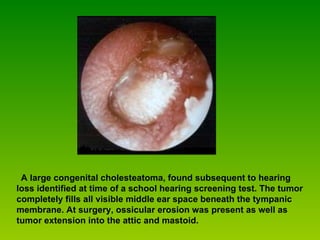
   A large congenital cholesteatoma, found subsequent to hearing loss identified at time of a school hearing screening test. The tumor completely fills all visible middle ear space beneath the tympanic membrane. At surgery, ossicular erosion was present as well as tumor extension into the attic and mastoid.
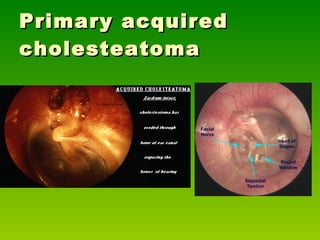
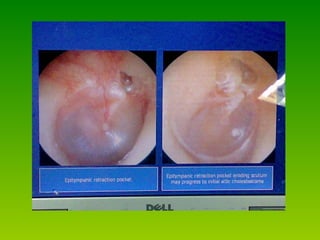
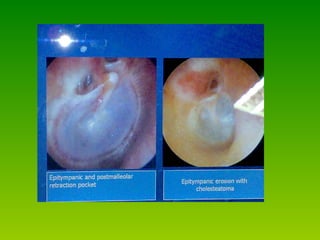
Pathogenesis of acquired : Primary acquired ( epitympanic retraction  Pocket) that become so deep that keratin  debris no longer expelled ,leading to it is  accumulation ,such retraction pocket may be  asymptomatic  until  it  become  infected  ,  Progressive hearing loss may be the only  Symptom due to erosion of ossicular chain.
Primary acquired cholesteatoma


Predisposing factors for acquired : - Eustachian tube dysfunction . - poor aeriation of epitympanic space. - retraction of pars flaccida. - normal migratory pattern altered. - perforation of weakened area. - accumulation of keratin & invasion of attic. - enlargement of the sac (which may surround  the ossicles & invade the aditus).
 
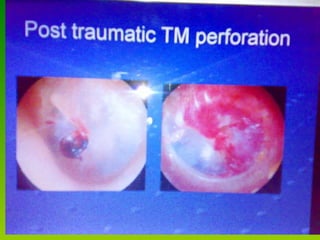
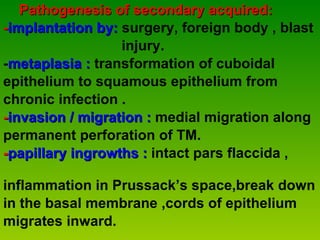
Pathogenesis of secondary acquired: - implantation by:   surgery, foreign body , blast  injury. - metaplasia :  transformation of cuboidal  epithelium to squamous epithelium from  chronic infection . - invasion / migration :  medial migration along  permanent perforation of TM. - papillary ingrowths :  intact pars flaccida ,  inflammation in Prussack’s space,break down  in the basal membrane ,cords of epithelium  migrates inward.
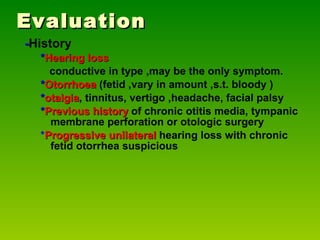
Evaluation - History * Hearing loss   conductive in type ,may be the only symptom. * Otorrhoea  (fetid ,vary in amount ,s.t. bloody ) * otalgia , tinnitus, vertigo ,headache, facial palsy * Previous history   of chronic otitis media, tympanic membrane perforation or otologic surgery * Progressive unilateral  hearing loss with chronic fetid otorrhea suspicious
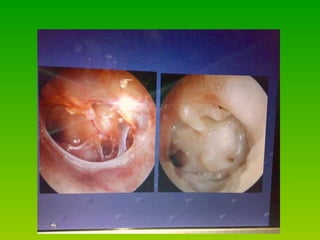
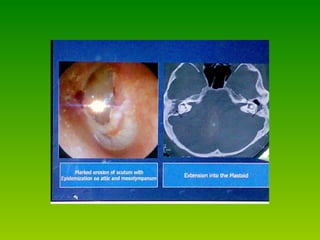
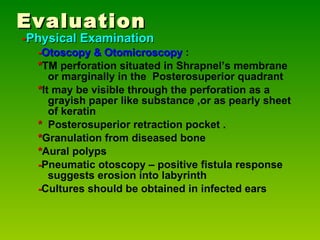
Evaluation - Physical Examination - Otoscopy & Otomicroscopy  : * TM perforation situated in Shrapnel’s membrane or marginally in the  Posterosuperior quadrant * It may be visible through the perforation as a grayish paper like substance ,or as pearly sheet of keratin  *   Posterosuperior retraction pocket . * Granulation from diseased bone * Aural polyps - Pneumatic otoscopy – positive fistula response suggests erosion into labyrinth - Cultures should be obtained in infected ears
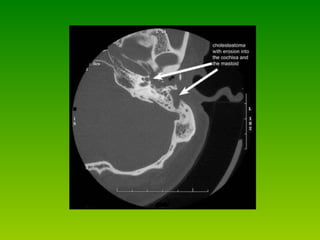
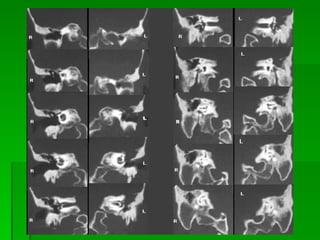
Evaluation - Audiology  – usually conductive loss. - Imaging   * CT temporal bone   :  for  -revision cases  -complications of chronic suppurative otitis media  -sensorineural hearing loss  -vestibular symptom  -other complications of cholesteatoma


Management of cholesteatoma Definite objectives - management of complications which takes priority over the  other objectives . - total eradication of cholesteatoma to obtain a safe , dry ear .  - to restoration or maintaining the functional capacity of the  ear , the hearing . - is to maintain a normal anatomic appearance of the ear if  Possible .
Management of cholesteatoma - Medical  :  Elderly patient with a poor general medical condition & patient with unacceptable anesthetic risks. - Otomicroscopy and aggressive aural toilet to prevent extension of the disease process and development of infection and other complications. - This  is particularly useful in those patients in whom  disease is limited.  Topical antibiotic therapy  may prove useful in alleviating otorrhea.
- preventive  :  * Tympanostomy tube insertion for ventilation of the middle ear may alleviate early tympanic membrane retraction associated with eustachian tube dysfunction. *  a long term ventilation tube is often necessary .   *  If the pocket persists despite tube placement, surgical exploration is indicated.
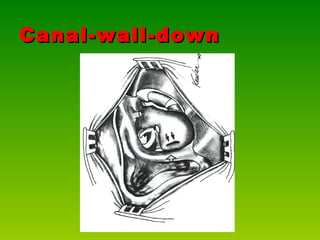
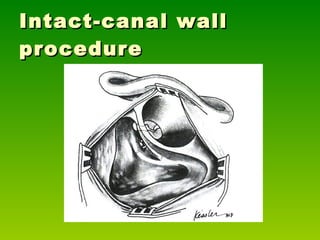
Management of cholesteatoma - cholesteatoma is a surgical disease . the surgical procedure to be used should be designed for each individual case according to the extent of disease.   Surgical Management - Intact-canal-wall up (closed) Tympanoplasty - Canal-wall-down (open) Tympanoplasty
Canal-wall-down
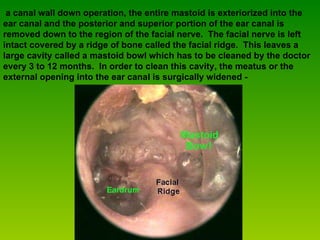
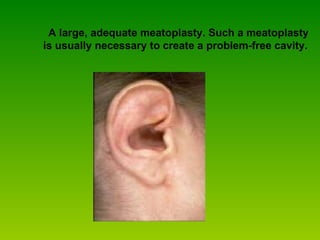
a canal wall down operation, the entire mastoid is exteriorized into the ear canal and the posterior and superior portion of the ear canal is removed down to the region of the facial nerve.  The facial nerve is left intact covered by a ridge of bone called the facial ridge.  This leaves a large cavity called a mastoid bowl which has to be cleaned by the doctor every 3 to 12 months.  In order to clean this cavity, the meatus or the external opening into the ear canal is surgically widened - 
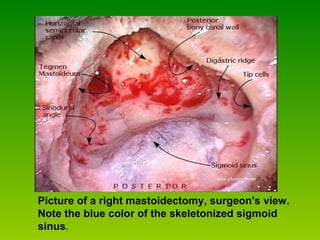
Picture of a left mastoidectomy, surgeon's view. Picture of a right mastoidectomy, surgeon's view.  Note the blue color of the skeletonized sigmoid sinus .
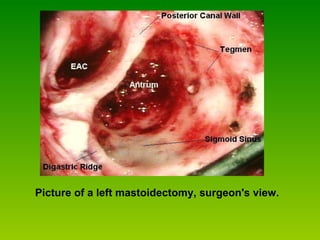
Picture of a left mastoidectomy, surgeon's view.
A large, adequate meatoplasty. Such a meatoplasty is usually necessary to create a problem-free cavity.                       
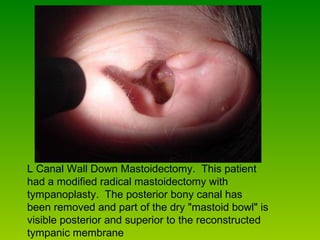
L Canal Wall Down Mastoidectomy.  This patient had a modified radical mastoidectomy with tympanoplasty.  The posterior bony canal has been removed and part of the dry "mastoid bowl" is visible posterior and superior to the reconstructed tympanic membrane
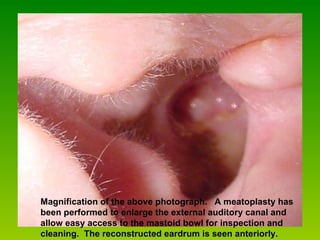
Magnification of the above photograph.   A meatoplasty has been performed to enlarge the external auditory canal and allow easy access to the mastoid bowl for inspection and cleaning.  The reconstructed eardrum is seen anteriorly.
 
Intact-canal wall procedure
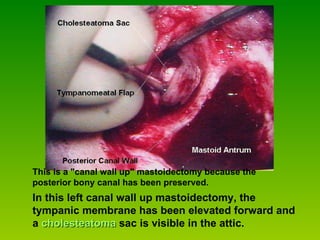
In this left canal wall up mastoidectomy, the tympanic membrane has been elevated forward and a  cholesteatoma   sac is visible in the attic. This is a "canal wall up" mastoidectomy because the posterior bony canal has been preserved.
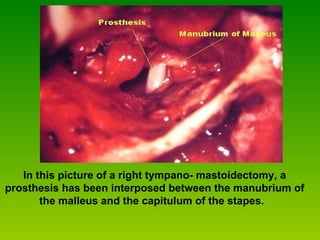
In this picture of a right tympano- mastoidectomy, a prosthesis has been interposed between the manubrium of the malleus and the capitulum of the stapes. 
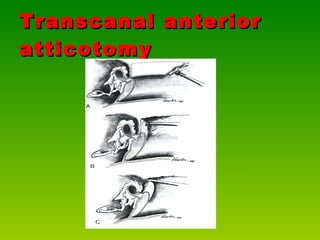
Transcanal anterior atticotomy
Complications of cholesteatoma Hearing loss Labyrinthine fistula Facial paralysis Intracranial complications
Chronic non Suppurative Otitis Media
-  it is a clinical condition characterized by  the presence of a  non purulent fluid  in the  middle ear cleft . - acute  &  chronic  forms can be distinguished  ,  according to the mode of onset &  by  their  duration  ,but  the distinctions  may  not  be  clear & the condition is often recurrent.  - most children get glue ear at some stage in their lives.
- Synonyms :   Glue ear, serous or secretary  otitis media , catarrhal otitis media or  mucinous otitis media.
Aetiology  1. Adenoids  :large adenoids at  the  back  of  the nose & passive smoking are the commonest causes for glue ear to persist in children.   Other causes of tubal occlusion : * stricture or adhesion after adenoidectomy. * ulceration or neoplasm of the postnasal  space involving the orifice  of the tube. * Paralysis of palatal muscles from myopathic or neuropathic causes e.g. Myasthenia gravis * nasopharyngeal  atresia ,congenital or acquired * post nasal packs.
2. Extension of infection through the ET from the  RT  3. Thick mucoid fluid plugging the tubal isthmus.   4. Unresolved acute OM 5. Viral   infection  of ME :adenoviruses & rhinoviruses  causing nasopharyngitis & rhinitis. 6. Allergic reaction  e.g. Hay fever may be associated with ME  effusion .   7.  Cleft palate or Downs syndrome .
Clinical feature 1. Deafness  :  - conductive in type. - of mild to moderate degree. - often it is the only symptom. - one or frequently both ears affected in children. - onset may be sudden or gradual. - may be unrecognised for a long period in young  children. - adult often refer the onset to a recent cold or even to one acquired months previously.
- changes of position of the head cause changes in  the degree of deafness ,when the fluid is thin.  - speech may be delayed ,especially if deafness  occurs  early in childhood. 2. Tinnitus  :  - older children & adults often complain of noises in the ears. - variable may be cracking & bubbling noises . - sensation of fluid in the ear especially on blowing  nose & swallowing. - may be buzzing & whistling like noises.
3. Some   sufferers get frequent earaches , usually  worse at night . 4.  Poor balance & clumsiness may be a feature  .  Diagnosis 1. diagnosis   is based on history  ,  physical exam.  & special investigations. - specialist  may be  able  to  see  the signs of fluid  behind  the TM with the otoscope , this is not always  possible ,because wax or discharge  may  block  the  the view , some children  may not  be  sufficiently Cooperative for examination .
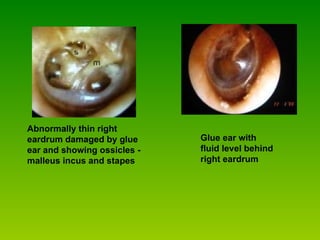
2. Otoscopic appearance of TM  : - it is usually dull & retracted . - the malleus short process is prominent . - the handle of malleus is shortened & more horizontal . - when the ME is completely filled with fluid the TM  may not be distorted , bubbles  or  even  foam  formation may be seen in the fluid . - the colour of TM depend on  the  colour  of  fluid  behind it . - it is usually pale yellow ,  may be grey or even  blue . - but some time it may be near normal.
3 . Ear   discharge  : - varies in quantity & viscosity . - it may be clear or opaque , colourless , yellow or  dark brown . - it varies from serous to a glue like consistency .  - the fluid is generally bacteriologically is sterile .  - but it may be secondarily infected . - eosinophils swarm in the effusion of allergic cases  is seen .
                                Glue ear with fluid level behind right eardrum                            Abnormally thin right eardrum damaged by glue ear and showing ossicles - malleus incus and stapes
4. Tympanogram   : - it is a physical test on the movement of the TM .  - a flat trace on the tympanogram usually means glue  ear.  5. Audiogram  :  - it is carried out on children old enough to cooperate  with the test . - to assess the degree of hearing loss .
Treatment - the fluid frequently goes away by itself so a policy  of “watchful waiting” is usually advised . - eliminate aetiological & predisposing factors. - antibiotics & painkillers can be used for associated  ear infections . - decongestants are often prescribed  - other treatments including antihistamines &steroids  - glue ear can be seasonal , worse in  the  winter &  better in the summer .
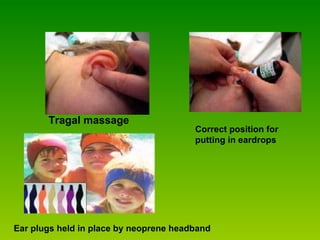
                                Correct position for putting in eardrops                                   Tragal massage                                   Ear plugs held in place by neoprene headband
- if deafness persists for longer  than  three months  ,  an operation is usually needed . - the decision to operate is always individual , based  on all the factors in that particular case. - surgical measures may be necessary if the effusion  persists , which include : 1. Myringotomy   & evacuation  of fluid under GA ,  the operating microscope & suction should always  be used.
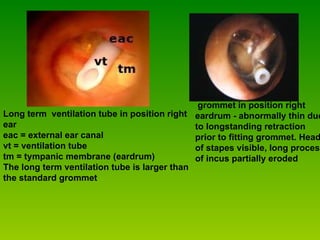
2. Indwelling Teflon  tubes   or  grommets   are  often  inserted through the membrane . They  left  in  position  until  they  rejected  spontaneously  usually after nine months . 3. Intratympanic injection of  urea solution  may help  to facilitate  the  evacuation  of  excessively  thick  glue . 4. Cortical  mastoidectomy  may  be  indicated  very  rarely . -recurrence occurs in about  20 %  of cases .
                                    grommet in position right eardrum - abnormally thin due to longstanding retraction prior to fitting grommet. Head of stapes visible, long process of incus partially eroded                                    Long term  ventilation tube in position right ear eac = external ear canal vt = ventilation tube tm = tympanic membrane (eardrum) The long term ventilation tube is larger than the standard grommet
Tuberculous Otitis Media TOM is now it is a rare condition. It is divided in to  two groups : 1- in infants & very young child  ; who are fed on un Sterilized cows milk ,which contain the bovine type  Of tubercle bacillus ,suppurative OM in an infant  which is not responding to treatment ,should make  One think of TOM. 2-  in advanced stages of  pul. Tub.  disease of the ME  cleft sometime occurs.
TOM  incidence : -In developed countries its incidence is low about 5  To 20 cases / 100000 population.  -in developing countries it is often a disease of  Childhood. -it is also common in immunocompromisedpatients Clinical feature of TOM : - It has an insidious course. - painless. - profuse otorrhoea. - hearing loss. - presentation may be painful with acute mastoiditis.
Diagnosis  - Otoscopic examination  : multiple perforation of TM.  watery discharge , pale granulation tissue . - AFB   staining of discharge  . - PCR   for tuberculous bacilli . - Histopathologic exam .  For granulation tissue. - culture . - chest x-ray . - CT scan   for complications.
Treatment - Medical:  using multidrug therapy because  of changing resistance pattern . The duration of treatment depend on : * host immune function. * multidrug resistance tuberculosis. * primary or reactivation state. * in general a dry ear need 2 to 4 months treatment. - in tuberculous mastioditis  ,  surgery   is needed .

E.N.T. COM.(dr.hewa)

  • 1.
    Chronic Otitis MediaPrepaired by: Dr.Hiwa As’ad M.B.Ch.B. F.I.C.M.S.(ENT) C.A.B.S.(ENT H&N Surgery)
  • 2.
    Chronic Otitis MediaIntroduction: Def: It is an inflammation of middle ear space with a long standing infection. Chronic ear infections are much less common than acute ear infections. its incidence is less common than in the pre- antibiotic era. Chronic middle ear infection may be more destructive than an acute middle ear infection, because its effects are prolonged or repeated.
  • 3.
    It may causepermanent damage to the ear, however a chronic infection causes less sever symptoms. Chronic middle ear infection includes several clinical entities which differ in aetiology , pathology and in the part of middle ear cleft principally involved.
  • 4.
    Chronic Otitis MediaDivided into : 1- Chronic non-specific otitis media. a-Chronic suppurative otitis media. b-Chronic non-suppurative otitis media. 2- Chronic specific otitis media.
  • 5.
    Or devidedinto: 1.Chronic active otitis media. A. Safe B. Unsafe 2.Chronic inactive otitis media. A.Sequally of CSOM B. Adhesive OM
  • 6.
    Chronic Suppurative OtitisMedia It is a chronic inflammation of the middle ear space & mastoid cavity. Duration is from 6 weeks - 3 months or more. Presents with recurrent ear discharges through a tympanic membrane perforation. CSOM is a major cause of acquired hearing impairment in developing countries.
  • 7.
    Epidemiology The trueincidence of CSOM with or without Cholesteatoma is unknown. Risk factors : * Poor living conditions & living in crowded conditions. * Poor nutrition & hygiene. * Being a member of a large family. * Studies of parental education ,passive smoking, breast feeding ,socioeconomic status and the annual number of upper resp.tract infection are inconclusive. * Multiple episodes of acute otitis media.
  • 8.
    * Craniofacial anomalies increase the risk like :cleft lip or palate ,downs syndrome ,cri-du-chat syndrome ,choanal atresia & microcephaly ,all increase risk presumably because of altered eustachian tube anatomy & function. * Age: Children more than adults. * Ethnic group : Native Americans,Alaskan,Green-land,Australian aborigines,New Zealand natives all have higher incidence of CSOM.
  • 9.
    Classification CSOM is usually classified in to two main groups : 1.Tubotympanic disease * Non cholesteatomatus CSOM. * Safe CSOM. 2.Atticoantral disease * Cholesteatomatus CSOM. * Tympanomastoid CSOM. * Unsafe CSOM.
  • 10.
    Tubotympanic disease *Charactrised by a perforation of the pars tensa [ central perforation ] . * adequate atticoantral drainage. * disease confirm to the mucosa of the antero- inferior portion of the middle ear cleft. * risk of serious complication is minimal. * most perforations arise when an acute perforation occurs during an episodes of acute suppurative otitis media.
  • 11.
    Tubotympanic type of CSOM is further subdi -vided in to two types : 1-Tubal type : the route of infection is from the eustachian tube. * the underlying causes of infection lies either In the nose ,sinuses or nasopharynx. * usually seen in children of low socio-economic state ,these children present with profuse bilateral mucopurulent discharge. * often involving both ears.
  • 12.
    2-Tympanic type :* infection reaches the middle ear through a defect in the tympanic membrane. * there is a central perforation. * usually seen in adults. * usually involves one ear. * there is scanty discharge which respond to anti- biotic & this is again occurs after the introduction of water into the ear.
  • 13.
  • 14.
  • 15.
  • 16.
  • 17.
    Bacteriology - Pseudomonasaerugenosa ( 48 to 98 % ) - Staphylococcus aureus ( 15 to 30 % ). - Klebsiella spieces ( 10 to 20 % ). - Proteus merabilis ( 10 to 15% ). - Polymicrobial ( 5 to 10 % ) which include : Gram positive ,gram negative ,Aspergillus , Candida. - Anaerobes e.g.Bacteroids ,Peptostrepto- coccus , Propioni bacterium ( 20 to 50 %).
  • 18.
    The bacteria areinfrequently found in the skin of the EAC ,but they may proliferate in the presence of trauma ,inflammation ,lacer -ations or high humidity. * these bacteria may then again enter into the middle ear through a chronic perforation. * among these bacteria for e.g. pseudomonas has been particularly blamed for the deep sea -ted & progressive destruction of the middle ear & mastoid structures ,through its toxins & enzymes .
  • 19.
    Histopathological features ofCSOM Otitis media presents as an early acute phase with essentially reversible mucosal & bony pathological changes which continues to a late chronic phase with well established intractable mucoperiosteal disease . The recurrent episodes of otorrhoea& mucosal changes are characterized by osteoneogenesis ,bony erosions & osteitis ,that include the temporal bone & ossicles ,this is followed by ossicular destruction& or ankylosis which together with TM perforation contribute to hearing loss.
  • 20.
    Clinical Features ofCSOM 1. Discharge : it is mucoid,often scanty,usually intermittent,but becoming purulent&profuse during exacerbations.the ear is usually pain -less except when eczematoid otitis externa intervenes. * it may be blood stained discharge ,when it is associated with aural polyps ,excessive granulations , ulceration or tumor . 2. Deafness : usually conductive in type ,the degree varies with the size & position of the perforation.
  • 21.
    Clinical Assessment :1. For the scar of previous surgery. 2. For discharge. 3. Otoscopy & Otomicroscopy : For the presence of TM perforation ,site & size of perforation ,the state of reminder of TM. For the mucosa of middle ear ,for the ossicular chain ,presence of epithelialization ,granulations,ulceration & polyp. 4. Nose & Throat examination. 5. Eustachian tube function assessment .
  • 22.
    6. Audiological assessment : * Pure tone audiomtry : detect level of hearing loss & type of hearing loss . * Speech audiomtry : which measures speech recognition(reception)threshold & speech dis- crimination ability reflected in the speech recognition score (speech may be presented by Monitored live voice , Cassette tape or Compact disc CD).
  • 23.
    Radiological assessment *Plain radiogram : it is of value in cholesteat -omatus cases(shows lytic lesions) ,also it detect variation in anatomic landmarks. * CT-Scan : CTscanning performed when: 1. intratemporal or intracranial complications are suspected 2. surgical intervention being planned 3.to study anatomy of temporal bone These studies should include both axial & coronal fine cuts (1-1.5mm) through the temporal bone.
  • 24.
  • 25.
    Treatment of CSOM* Swab should be taken for culture&senstivity. * Aural toilet daily by suctioning the ear ,it is better to be done under the microscope. * Antibiotics : Usually after aural toilet & placement of ototopic medication is all that is needed to stop the chronic otorrhoea. -Ofloxacin otic drops - combination of (neomycin,polymixin B ,ciprofloxacin )with steroids like hydro-cortisone.The addition of corticosteroids aids in the resolution of inflammation.
  • 26.
    Topical antimicrobial therapyfrequently results in rapid resolution of the otorrhoea in 1to 2 weeks. Oral antimicrobial agents alone are frequently ineffective in treating CSOM. In patients with refractory otorrhoea ,consideration must be given to: -a resistant organism. -poor drug delivery. - the presence of chronic otomastoid osteitis,granulation tissue,or cholesteatomas.
  • 27.
    Culture Directed intravenousantibiotics are a reasonable approach ,usually an antipseudomonal penicillin or a second or third generation cephalosporin will cover the offending organisms ,daily suctioning & inst- illation of ototopic agents is also useful ,in these cases 7 to 10 days of treatment will usually dry the ear without the need of further therapy.
  • 28.
    Surgical Surgery shouldbe considered for failure to respond to a combination of topical and systemic therapy. A tympanomastoidectomy can eliminate infection and stop otorrhoea in 80% of patients. Tympanoplasty(Myrigoplasty and ossiculoplasty) can seal a perforation and prevents transfer of bacteria from the external ear canal into the middle ear and reconstruct the hearing mechanism.
  • 29.
    Attico-antral CSOM. -Cholesteatomatus CSOM - Tympanomastoid CSOM - Unsafe CSOM
  • 30.
    Tympanomastoid otitis mediaIn this type of infection the bone of attic, antrum or mastoid process is involved as well as the mucosa of the middle ear cleft , therefore it is regarded as atticoantral disease as erosion of bone may extend to adjacent vital structures ,there is always a danger of serious complications. The bony involvement may give rise to granulations or polypi ,these may be true granulation tissue ,but it may be due to an inflammatory swelling of the mucosa of the ear ,however there presence
  • 31.
    Is evidence ofbony involvement. There are three basic pathological findings in the Tympanomasoid type of the disease : . 1. Cholesteatoma . 2. Granulation tissue with osteitis. 3. Cholesterol granuloma.
  • 32.
    1- Cholesteatoma Itis an epidermal inclusion cyst ,localized in the middle ear & petrous bone ,whose caps -ule & matrix is formed from stratified squamo -us epithelium. The desquamating debris include pearly white Lamellae of keratin that accumulate concentri -cally ,forming the cholesteatomatus mass . The term cholesteatoma is actually misnomer it is derived from Greek “chole” or bile “steat -os” or fat & “oma” tumor.
  • 33.
    The suffix “oma”is more appropriate ,because it can be considered as an epidermal inclusion cyst. It is made up of : - cystic content :a nucleate keratin squamous. - matrix keratinizing squamous epithelium . - peri matrix granulation tissue ,incontact with Bone ( produces proteolytic enzymes ).
  • 34.
  • 35.
  • 36.
    2-Granulation tissue: Thisis basically a low grade osteitis of the Mastoid bone ,it may be localized to one area e.g. Posterosuperior meatal wall & middle ear, or Extend through out the middle ear & mastoid ,it Can also cause destruction of surrounding Structures. 3- Cholesterole granuloma : this can be seen on its own or in combination with either cholesteatoma or granulations ,it appear as a dark brown often with a lot of bone destruction & if present in the middle ear
  • 37.
    gives the TMa dark blue or black appearance . Histological examination shows it to consist of Cholesterol crystals surrounded by FB giant Cells & granulation tissue.
  • 38.
    Classification of Cholesteatoma1. Congenital. 2. Acquired : -Primary acquired (retraction pocket ) -Secondary acquired
  • 39.
    pathogenesis of congenitalcholesteatoma Arises from entrapped ectodermal cellular de- bris ,during embryonic development. Location ( petrous pyramid ,mastoid & middle ear cleft ). * Levisohn criteria : - white mass medial to normal TM (retrotympa- nic mass). - normal pars flaccida & pars tensa. - no history of otorrhoea or perforation. - no prior otologic procidures. - prior bouts of otitis media not grounds for exclusion .
  • 40.
  • 41.
  • 42.
      Asmall congenital cholesteatoma was found at time of a well-child visit. The tumor is seen through an intact tympanic membrane. Only the anterosuperior quadrant of the middle ear space appears involved. At surgery, the tumor was encapsulated and did not involve the ossicles or extend beyond the middle ear
  • 43.
      Alarge congenital cholesteatoma, found subsequent to hearing loss identified at time of a school hearing screening test. The tumor completely fills all visible middle ear space beneath the tympanic membrane. At surgery, ossicular erosion was present as well as tumor extension into the attic and mastoid.
  • 44.
    Pathogenesis of acquired: Primary acquired ( epitympanic retraction Pocket) that become so deep that keratin debris no longer expelled ,leading to it is accumulation ,such retraction pocket may be asymptomatic until it become infected , Progressive hearing loss may be the only Symptom due to erosion of ossicular chain.
  • 45.
  • 46.
  • 47.
  • 48.
  • 49.
    Predisposing factors foracquired : - Eustachian tube dysfunction . - poor aeriation of epitympanic space. - retraction of pars flaccida. - normal migratory pattern altered. - perforation of weakened area. - accumulation of keratin & invasion of attic. - enlargement of the sac (which may surround the ossicles & invade the aditus).
  • 50.
  • 51.
    Pathogenesis of secondaryacquired: - implantation by: surgery, foreign body , blast injury. - metaplasia : transformation of cuboidal epithelium to squamous epithelium from chronic infection . - invasion / migration : medial migration along permanent perforation of TM. - papillary ingrowths : intact pars flaccida , inflammation in Prussack’s space,break down in the basal membrane ,cords of epithelium migrates inward.
  • 52.
    Evaluation - History* Hearing loss conductive in type ,may be the only symptom. * Otorrhoea (fetid ,vary in amount ,s.t. bloody ) * otalgia , tinnitus, vertigo ,headache, facial palsy * Previous history of chronic otitis media, tympanic membrane perforation or otologic surgery * Progressive unilateral hearing loss with chronic fetid otorrhea suspicious
  • 53.
    Evaluation - PhysicalExamination - Otoscopy & Otomicroscopy : * TM perforation situated in Shrapnel’s membrane or marginally in the Posterosuperior quadrant * It may be visible through the perforation as a grayish paper like substance ,or as pearly sheet of keratin * Posterosuperior retraction pocket . * Granulation from diseased bone * Aural polyps - Pneumatic otoscopy – positive fistula response suggests erosion into labyrinth - Cultures should be obtained in infected ears
  • 54.
    Evaluation - Audiology – usually conductive loss. - Imaging * CT temporal bone : for -revision cases -complications of chronic suppurative otitis media -sensorineural hearing loss -vestibular symptom -other complications of cholesteatoma
  • 55.
  • 56.
  • 57.
  • 58.
    Management of cholesteatomaDefinite objectives - management of complications which takes priority over the other objectives . - total eradication of cholesteatoma to obtain a safe , dry ear . - to restoration or maintaining the functional capacity of the ear , the hearing . - is to maintain a normal anatomic appearance of the ear if Possible .
  • 59.
    Management of cholesteatoma- Medical : Elderly patient with a poor general medical condition & patient with unacceptable anesthetic risks. - Otomicroscopy and aggressive aural toilet to prevent extension of the disease process and development of infection and other complications. - This is particularly useful in those patients in whom disease is limited.  Topical antibiotic therapy may prove useful in alleviating otorrhea.
  • 60.
    - preventive : * Tympanostomy tube insertion for ventilation of the middle ear may alleviate early tympanic membrane retraction associated with eustachian tube dysfunction. * a long term ventilation tube is often necessary . * If the pocket persists despite tube placement, surgical exploration is indicated.
  • 61.
    Management of cholesteatoma- cholesteatoma is a surgical disease . the surgical procedure to be used should be designed for each individual case according to the extent of disease. Surgical Management - Intact-canal-wall up (closed) Tympanoplasty - Canal-wall-down (open) Tympanoplasty
  • 62.
  • 63.
    a canal walldown operation, the entire mastoid is exteriorized into the ear canal and the posterior and superior portion of the ear canal is removed down to the region of the facial nerve.  The facial nerve is left intact covered by a ridge of bone called the facial ridge.  This leaves a large cavity called a mastoid bowl which has to be cleaned by the doctor every 3 to 12 months.  In order to clean this cavity, the meatus or the external opening into the ear canal is surgically widened - 
  • 64.
    Picture of aleft mastoidectomy, surgeon's view. Picture of a right mastoidectomy, surgeon's view.  Note the blue color of the skeletonized sigmoid sinus .
  • 65.
    Picture of aleft mastoidectomy, surgeon's view.
  • 66.
    A large, adequatemeatoplasty. Such a meatoplasty is usually necessary to create a problem-free cavity.                       
  • 67.
    L Canal WallDown Mastoidectomy.  This patient had a modified radical mastoidectomy with tympanoplasty.  The posterior bony canal has been removed and part of the dry "mastoid bowl" is visible posterior and superior to the reconstructed tympanic membrane
  • 68.
    Magnification of theabove photograph.   A meatoplasty has been performed to enlarge the external auditory canal and allow easy access to the mastoid bowl for inspection and cleaning.  The reconstructed eardrum is seen anteriorly.
  • 69.
  • 70.
  • 71.
    In this leftcanal wall up mastoidectomy, the tympanic membrane has been elevated forward and a cholesteatoma sac is visible in the attic. This is a "canal wall up" mastoidectomy because the posterior bony canal has been preserved.
  • 72.
    In this pictureof a right tympano- mastoidectomy, a prosthesis has been interposed between the manubrium of the malleus and the capitulum of the stapes. 
  • 73.
  • 74.
    Complications of cholesteatomaHearing loss Labyrinthine fistula Facial paralysis Intracranial complications
  • 75.
  • 76.
    - itis a clinical condition characterized by the presence of a non purulent fluid in the middle ear cleft . - acute & chronic forms can be distinguished , according to the mode of onset & by their duration ,but the distinctions may not be clear & the condition is often recurrent. - most children get glue ear at some stage in their lives.
  • 77.
    - Synonyms : Glue ear, serous or secretary otitis media , catarrhal otitis media or mucinous otitis media.
  • 78.
    Aetiology 1.Adenoids :large adenoids at the back of the nose & passive smoking are the commonest causes for glue ear to persist in children. Other causes of tubal occlusion : * stricture or adhesion after adenoidectomy. * ulceration or neoplasm of the postnasal space involving the orifice of the tube. * Paralysis of palatal muscles from myopathic or neuropathic causes e.g. Myasthenia gravis * nasopharyngeal atresia ,congenital or acquired * post nasal packs.
  • 79.
    2. Extension ofinfection through the ET from the RT 3. Thick mucoid fluid plugging the tubal isthmus. 4. Unresolved acute OM 5. Viral infection of ME :adenoviruses & rhinoviruses causing nasopharyngitis & rhinitis. 6. Allergic reaction e.g. Hay fever may be associated with ME effusion . 7. Cleft palate or Downs syndrome .
  • 80.
    Clinical feature 1.Deafness : - conductive in type. - of mild to moderate degree. - often it is the only symptom. - one or frequently both ears affected in children. - onset may be sudden or gradual. - may be unrecognised for a long period in young children. - adult often refer the onset to a recent cold or even to one acquired months previously.
  • 81.
    - changes ofposition of the head cause changes in the degree of deafness ,when the fluid is thin. - speech may be delayed ,especially if deafness occurs early in childhood. 2. Tinnitus : - older children & adults often complain of noises in the ears. - variable may be cracking & bubbling noises . - sensation of fluid in the ear especially on blowing nose & swallowing. - may be buzzing & whistling like noises.
  • 82.
    3. Some sufferers get frequent earaches , usually worse at night . 4. Poor balance & clumsiness may be a feature . Diagnosis 1. diagnosis is based on history , physical exam. & special investigations. - specialist may be able to see the signs of fluid behind the TM with the otoscope , this is not always possible ,because wax or discharge may block the the view , some children may not be sufficiently Cooperative for examination .
  • 83.
    2. Otoscopic appearanceof TM : - it is usually dull & retracted . - the malleus short process is prominent . - the handle of malleus is shortened & more horizontal . - when the ME is completely filled with fluid the TM may not be distorted , bubbles or even foam formation may be seen in the fluid . - the colour of TM depend on the colour of fluid behind it . - it is usually pale yellow , may be grey or even blue . - but some time it may be near normal.
  • 84.
    3 . Ear discharge : - varies in quantity & viscosity . - it may be clear or opaque , colourless , yellow or dark brown . - it varies from serous to a glue like consistency . - the fluid is generally bacteriologically is sterile . - but it may be secondarily infected . - eosinophils swarm in the effusion of allergic cases is seen .
  • 85.
                                    Glueear with fluid level behind right eardrum                          Abnormally thin right eardrum damaged by glue ear and showing ossicles - malleus incus and stapes
  • 86.
    4. Tympanogram : - it is a physical test on the movement of the TM . - a flat trace on the tympanogram usually means glue ear. 5. Audiogram : - it is carried out on children old enough to cooperate with the test . - to assess the degree of hearing loss .
  • 87.
    Treatment - thefluid frequently goes away by itself so a policy of “watchful waiting” is usually advised . - eliminate aetiological & predisposing factors. - antibiotics & painkillers can be used for associated ear infections . - decongestants are often prescribed - other treatments including antihistamines &steroids - glue ear can be seasonal , worse in the winter & better in the summer .
  • 88.
                                    Correctposition for putting in eardrops                                 Tragal massage                                 Ear plugs held in place by neoprene headband
  • 89.
    - if deafnesspersists for longer than three months , an operation is usually needed . - the decision to operate is always individual , based on all the factors in that particular case. - surgical measures may be necessary if the effusion persists , which include : 1. Myringotomy & evacuation of fluid under GA , the operating microscope & suction should always be used.
  • 90.
    2. Indwelling Teflon tubes or grommets are often inserted through the membrane . They left in position until they rejected spontaneously usually after nine months . 3. Intratympanic injection of urea solution may help to facilitate the evacuation of excessively thick glue . 4. Cortical mastoidectomy may be indicated very rarely . -recurrence occurs in about 20 % of cases .
  • 91.
                                   grommet in position right eardrum - abnormally thin due to longstanding retraction prior to fitting grommet. Head of stapes visible, long process of incus partially eroded                                 Long term ventilation tube in position right ear eac = external ear canal vt = ventilation tube tm = tympanic membrane (eardrum) The long term ventilation tube is larger than the standard grommet
  • 92.
    Tuberculous Otitis MediaTOM is now it is a rare condition. It is divided in to two groups : 1- in infants & very young child ; who are fed on un Sterilized cows milk ,which contain the bovine type Of tubercle bacillus ,suppurative OM in an infant which is not responding to treatment ,should make One think of TOM. 2- in advanced stages of pul. Tub. disease of the ME cleft sometime occurs.
  • 93.
    TOM incidence: -In developed countries its incidence is low about 5 To 20 cases / 100000 population. -in developing countries it is often a disease of Childhood. -it is also common in immunocompromisedpatients Clinical feature of TOM : - It has an insidious course. - painless. - profuse otorrhoea. - hearing loss. - presentation may be painful with acute mastoiditis.
  • 94.
    Diagnosis -Otoscopic examination : multiple perforation of TM. watery discharge , pale granulation tissue . - AFB staining of discharge . - PCR for tuberculous bacilli . - Histopathologic exam . For granulation tissue. - culture . - chest x-ray . - CT scan for complications.
  • 95.
    Treatment - Medical: using multidrug therapy because of changing resistance pattern . The duration of treatment depend on : * host immune function. * multidrug resistance tuberculosis. * primary or reactivation state. * in general a dry ear need 2 to 4 months treatment. - in tuberculous mastioditis , surgery is needed .