Humra shamim
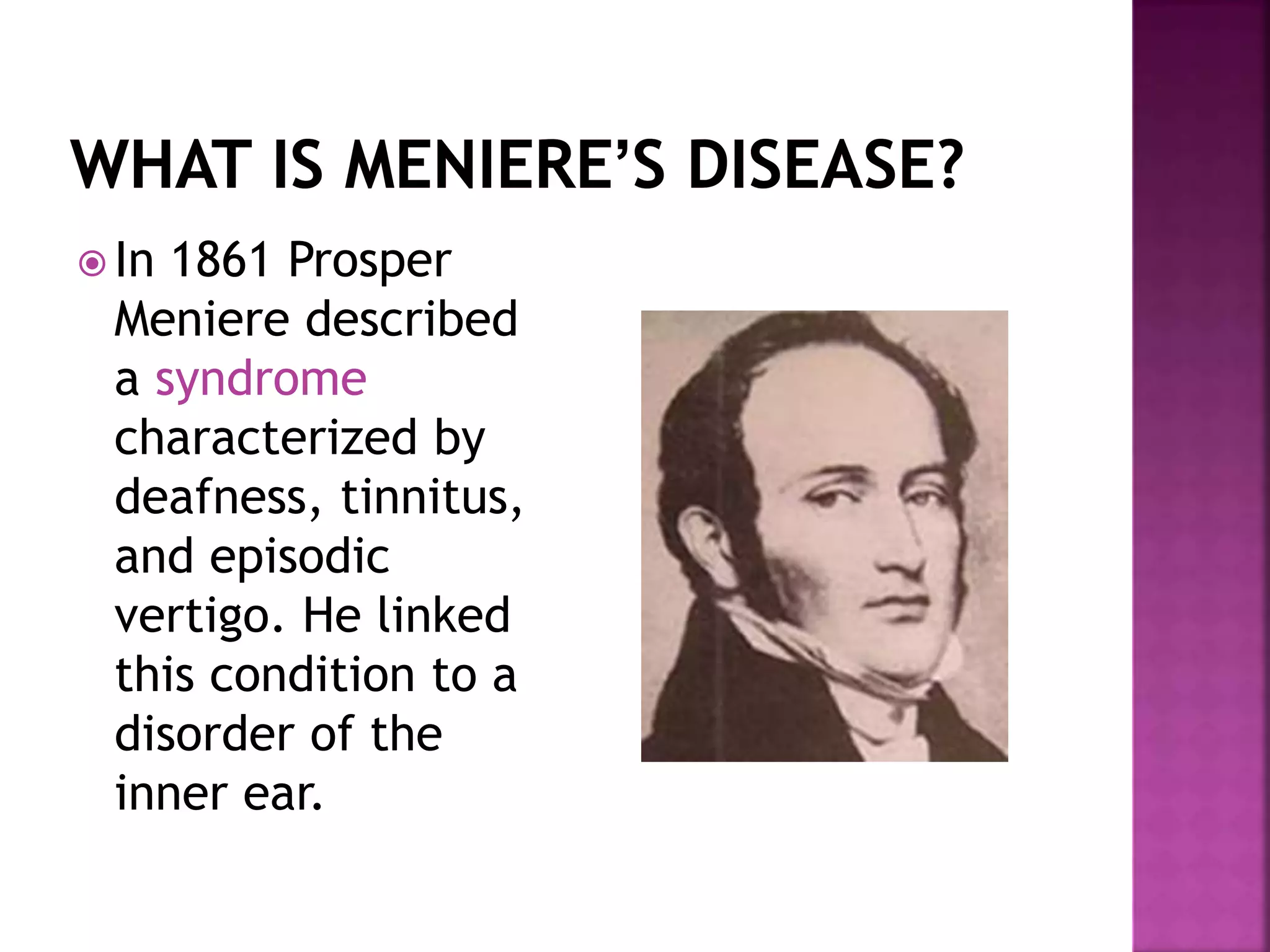
 In 1861 Prosper
Meniere described
a syndrome
characterized by
deafness, tinnitus,
and episodic
vertigo. He linked
this condition to a
disorder of the
inner ear.
 In 1871 Knapp advanced the hypothesis that
hydrops was similar to ocular glaucoma :
aural glaucoma
 In 1938 Hallpike and Cairns described the
underlying pathology of Meniere’s disease as
being endolymphatic hydrops but the precise
etiology still remains elusive
 In 1902, Parry performed a CN VIII division
for vertigo in a patient with suspected
Meniere’s disease.
 Portman did endolymphatic sac
decompression via a transmastoid approach
in 1926.
 In 1931,McKenzie performed a selective
vestibular neurectomy.
Ménière’s disease, also called endolymphatic
hydrops, is a disorder of the inner ear where
the endolymphatic system is distended with
endolymph. It is characterized by
(i) Vertigo,
(ii) Sensorineural hearing loss,
(iii) Tinnitus and
(iv) Aural fullness.
 The disease seems to be more prevalent
among whites, with a variable female-to-
male ratio ( ranging from 1:1, 1.3:1, 2:1 ;
female preponderance ).
 The peak age at onset is in the fourth and
fifth decades of life, although presentation
can be at almost any age.
 The incidence of bilateral disease probably is
in the range of 19% to 24%.
 Familial occurrence of Meniere’s disease has
been reported in 10% to 20% (An AD mode)
Migraine is strongly associated in such cases.
 The incidence is elevated in persons with
specific major histocompatability complexes
(MHCs).
 Human leukocyte antigens (HLA) B8/DR3 and
Cw7 have been associated with Meniere’s
disease.
Review of anatomy
 Resorption of the water content of endolymph
 Ability to participate in some ionic exchanges with
endolymph
 Removal of metabolic and cellular debris, including
otoconia
 Immunodefense function ( perisaccular )
 Inactivation and removal of viruses
 Secretion of Glycoproteins to attract extra fluid
(Glycoproteins act as a driving force for longitudinal
flow)
The main pathology is
distension of endolymphatic
system,mainly affecting the
cochlear duct (scala media)
and the saccule, and to a
lesser extent the utricle
and semicircularcanals. The
dilatation of cochlear duct
is such that it may
completely fill the scala
vestibuli; there is marked
bulging of Reissner’s
membrane, which may even
herniate through the
helicotrema into the apical
part of scala tympani
 Endolymphatic hydrops causes distortion of
membranous labyrinth
 Pressure building up in the scala media may
cause mirco ruptures of membranous
labyrinth
 This would account for the episodic nature
of the attacks
 Healing of these ruptures causes resolution
of the disorder
 Main pathology here is distention of
endolymphatic system due to increased
volume of endolymph
1. Increased production of endolymph
2. Faulty absorption
3. Both
Exact cause not known
1. Defective absorption by endolymphatic sac
2. Vasomotor disturbances: there is
sympathetic over-activity resulting the
spasm of internal auditory artery and/or
its branches intefering with the function of
cochlear or ventibular sensory
neuroepithelium.
3. Allergy
4. Sodium and water retention
5. Hypothyroidism(3% of cases)
6. Autoimmune and viral aetiologies
 Anatomical-abnormalities
 Genetic- AD
 Immunological - immune complex deposition
 Viral-serum IgE to herpes simples virus types
I and II, Epstein-Barr virus and CMV
 Vascular-associated with migraines
 Metabolic-potassium intoxication
Meniere’s disease
Autoimmune
process
Viral infection
(herpes family)
stress
Sodium and water
retention
tinnitus
Episodic vertigo
Aural fullness
Endocrinal
(hypothyroidism)
Defective
absorption by sac
Food or
inhalant
allergen
Fluctuating hearing
loss
Normal membranous labyrinth Dilated membranous labyrinth
in Meniere's disease (Hydrops)
 Classical Meniere’s disease
 Vestibular Meniere’s disease – vestibular
symptoms and aural pressure
 Cochlear Meniere’s disease – cochlear
symptoms and aural pressure
 Lermoyez syndrome – Reverse Meniere’s
 Tumarkin’s crisis – Utricular Meniere’s
 variant of Meniere’s disease
 sudden sensorineural hearing loss, which
improves during or immediately after the
attack of vertigo.
 Cause is sudden spasm of the labyrinthine
artery followed by immediate dilatation
 TBD showed hydrops and membrane rupture
typically in basal cochlea and saccule
 AKA Tumarkin’s drop attacks
 abrupt falling attacks of brief
duration without loss of
consciousness.
 due to an enlarging utricle due to
excess endolymphatic volume
 an erroneous vertical gravity
reference occurs as a consequence
of an abrupt change in otolithic
input. This in turn generates an
inappropriate postural adjustment
via the vestibulospinal pathway,
which results in a sudden fall.
 The typical history consists of recurring attacks
of vertigo (96.2%) with tinnitus (91.1%) and
ipsilateral hearing loss (87.7%).
 Attacks often are preceded by an aura
consisting of a sense of fullness in the ear,
increasing tinnitus, and a decrease in hearing.
 The classic presentation is not always detailed
by the patient. This is particularly true early in
the disease presentation. the disease seems to
manifest with a predominance of either
vestibular or auditory complaints, 50% of
patients came to medical attention with vertigo
and hearing loss together, 19% with vertigo only,
and 26% with only deafness.
• Sensorineural hearing loss is fluctuating and progressive, with the
sensation of fullness or pressure in the ear.
• In only 1% to 2% of patients does the hearing loss progress to
profound deafness.
• Additional features include diplacusis, a difference in the
perception of pitch between the ears (43.6%) and recruitment (56%)
.
• Tinnitus tends to be nonpulsatile and variously described as
whistling or roaring. It may be continuous or intermittent. Tinnitus
often begins, gets louder, or changes pitch as an attack approaches.
Frequently a period of improvement follows the attack.
• The Romberg test generally shows significant instability
and worsening when the eyes are closed.
• The Weber tuning fork test usually lateralizes away from
the affected ear.
• The Rinne test usually indicates that air conduction
remains better than bone conduction.
• Complete neurologic evaluation is important. New-onset
vertigo might be an early sign of stroke, migraine, or
brainstem compression that may require emergent
evaluation and care.
Particularly helpful to document present hearing acuity
and to detect future change.
-The patient may not notice a loss at specific
frequencies. Low-frequency or mixed low- and high-
frequency insufficiency may be observed.
- Typically, the lower frequencies are affected
more severely. This is due to preferential sensitivity of
the apex to the hydrops.
- Multiple hearing tests, which document
fluctuating hearing loss, are helpful in diagnosing
Ménière.
 The diagnosis of Meniere disease is made
based on a careful history and physical
exam.
 If the work-up is normal and the classic
symptoms continue, the diagnosis of
Meniere disease is made.
 This is abnormal
growth in the
perceived intensity
of sound
 This is usually
positive in patients
with Meniere’s
disease
 ABLB is the test
used to look for the
presence of
recruitment
 Ratio of amplitudes of the SP
and the 8th cranial nerve
action potential (AP), the
SP/AP ratio.
 The SP becomes relatively
larger in hydrops;
accordingly, the SP/AP ratio
increases; SP:AP > 0.45
 The summating potential (SP)
is larger and more negative
due to distention of the
basilar membrane into the
scala tympani, causing an
increase in the normal
asymmetry of its vibration
 No single test makes the diagnosis of Meniere
disease. Rather a complete history that
includes a detailed description of the pattern
of disease presentation, supported by
quantitative testing, is required. The most
recent definition of the disease has been
established by the Committee on Hearing and
Equilibrium of the American Academy of
Otolaryngology– Head and Neck Surgery
(AAO-HNS); this is summarized as follows:
Major Symptoms
1.Vertigo
 Recurrent, well-defined episodes of spinning or rotation • Duration from 20
minutes to 24 hours.
 Nystagmus associated with attacks
 Nausea and vomiting during vertigo spells common
 No neurologic symptoms with vertigo
2.Deafness
 Hearing deficits fluctuate
 Sensorineural hearing loss
 Hearing loss progressive, usually unilateral
3.Tinnitus
 Variable, often low-pitched and louder during attacks
 Usually unilateral
 Subjective
 Possible Meniere’s disease
1. Episodic vertigo without hearing loss or
2. Sensorineural hearing loss, fluctuating or fixed, with dysequilibrium,
but without definite episodes
3. Other causes excluded
 Probable Meniere’s disease
1. One definitive episode of vertigo
2. Hearing loss documented by audiogram at least once
3. Tinnitus or sense of aural fullness in the presumed affected ear
4. Other causes excluded
 Definite Meniere’s disease
1. Two or more definitive spontaneous episodes of vertigo lasting at
least 20 minutes
2. Audiometrically documented hearing loss on at least one occasion
3. Tinnitus or sense of aural fullness in the presumed affected ear
4. Other causes excluded
 Certain Meniere’s disease
 Definite Meniere’s disease, plus histopathologic confirmation
Vertigo
a. Any treatment should be evaluated after at least 24 months.
b. Formula to obtain numeric value for vertigo:
ratio of average number of definitive spells per month after therapy
divided by definitive spells per month before therapy (averaged over a
24-month period) × 100 = numeric value.
Numeric value scale Control Class
0 Complete control of
definitive spells
A
0-40 Limited control of definitive
spells
B
41-80 Insignificant control of
definitive spells
C
81-120 D
>120 Secondary treatment
initiated
E
Disability
a. No disability
b. Mild disability: intermittent or continuous
dizziness/unsteadiness that precludes working
in a hazardous environment.
c. Moderate disability: intermittent or
continuous dizziness that results in a
sedentary occupation
d. Severe disability: symptoms so severe as to
exclude gainful employment
 Hearing is measured using a four-frequency pure-tone
average (PTA) of 500 Hz, 1 kHz, 2 kHz, and 3 kHz.
• Pretreatment hearing level: worst hearing level during 6 months
before therapy
• Post-treatment hearing level: poorest hearing level measured 18-
24 months after institution of therapy
 Hearing classification:
i. Unchanged: ≤10-dB PTA improvement or worsening or ≤15%
speech discrimination improvement or worsening.
ii. Improved: >10-dB PTA improvement or >15% discrimination
improvement
iii. Worse: >10-dB PTA worsening or >15% discrimination worsening
 In 1996, the Committee on Hearing and Equilibrium
reaffirmed and clarified the guidelines, adding
initial staging and reporting guidelines:
 Initial Hearing Level
Stage Four tone
average(dB)
1 < 25
2 26-40
3 41-70
4 >70
 Therapy is aimed at the reduction of
symptoms, and the optimal curative
treatment should stop vertigo, abolish
tinnitus, and reverse hearing loss..
 Electrocochleography
 Dehydrating Agents
 Vestibular evoked Myopotentials
 Vestibular evoked myogenic potential
 Measures the relaxation of sternomastoid muscle
in response to ipsilateral click stimulus
 Brief high intensity ipsilateral clicks produce
large short latency inhibitory potentials (VEMP)
in the toncially contracted Ipsilateral
sternomastoid muscle
 Afferent arises from sound responsive cells in
the saccule, conducted via the inferior
vestibular nerve.
 Efferent is via vestibulo spinal tract
 Normal responses are composed of biphasic
(positive-negative) waves
 VEMP reveals saccular dysfunction
 Glycerol
 Mannitol
 Frusemide
 Isosorbide
 These tests involve the subject ingesting
glycerol or mannitol and observing for a
change in symptoms and a measurable
improvement in hearing
Tests are positive if there is pure tone
improvement of 10dB or more at two / more
frequencies between 200-2000Hz
 First introduced by Klockhoff and Lindblom –
1966
 Glycerol is administered in doses of 1.5 mg/kg
body wt in empty stomach
 Serum osmolality should increase at least by 10
mos/kg
 Side effects include Headache, Nausea,
vomiting, drowsiness
 PTA is performed 2-3 hours after administration
 False positivity is rare
 Positivity depends on the phase of the disease
• Dietary modifications and diuretics
• Vasodilators
• Symptomatic treatment
– Antiverginous medications
– Antiemetics
– Sedatives
– Antidepressants
– Psychiatric treament
• Local overpressure therapy
 Salt restriction and diuresis may be the best
initial therapy for Meniere disease. The goal of
salt restriction and use of diuretics is to reduce
endolymph volume by fluid removal and/or
reduced production.
 Carbonic anhydrase inhibitors such as
acetazolamide were recommended based on the
localization of carbonic anhydrase in the dark
cells and the stria vascularis
 Despite the lack of hard evidence of their
efficacy, we feel that a low-salt diet combined
with diuresis is an appropriate and effective
treatment for Meniere disease that has a low risk
of side effects.
• Salt wasting diuretic such as diazide (1 month
trial)
• Betahistine (2 week trial, often combined with
verapamil)
– Relaxes the precapillary sphincters and thus improves
the microcirculation of inner ear
– Antivertigo action due to imhibition of massive
impulses to the polysynaptic lateral vestibular
nucleus)
• Lipoflavins and vitamins ( hypothetical
importance )
 Since 2000, the Meniett
device has been approved
for use by the U.S. Food
and Drug Administration
(FDA). The device is a
handheld air-pressure
generator that the patient
can use to self-administer
therapeutic pressure
pulses. The pressure is
delivered in complex
pulses of up to 20 cm of
water delivered over 5
minutes, and the device
requires a ventilation tube
to be placed in the
tympanic membrane prior
to starting therapy
 Restoring balance in the hydrodynamic
system of the inner ear by applying low-
pressure pulses to the middle ear
 A randomized controlled trial
demonstrated that patients using the
Meniett device experienced a significant
decrease in vertigo symptoms for the first
3 months of therapy but that findings
afterward were similar to those with
placebo.
1. Classic unilateral Meniere’s disease
2. Intense vestibular / cochlear symptoms
3. Failed medical therapy
4. Over 65 years of age
5. Imbalance / aural fullness / tinnitus after
gentamycin treatment
 Intratympanic injection
 Endolymphatic sac surgery
 Nerve section
 Labyrinthectomy
 To be offered when vertigo is intractable but the patient still
has some functional hearing.
 The risk of hearing loss or other complications from the
steroid injection appears to be low.
 A small randomized trial has shown complete resolution of
vertigo symptoms in 82% of patients receiving
dexamethasone, compared with 57% receiving saline
injection.
 Dexamethasone injections may need to be repeated every 3
months to maintain the patient free of vertigo symptoms,
although the optimal dosing frequency is variable and
unknown.
 Concentrations used have varied from 2 to 24 mg/mL.
 After giving puncture in the TM, with needle
being just above the round window 0.5ml of
hyaluronidase & 1 ml of 16mg dexamethasone
mixed together; injected in ME
 Pt instructed to lie down for 3 hrs with injected
ear up, entire process repeated 3 consecutive
days
 Has a vestibulotoxicity that is high relative to its
cochleotoxicity; accordingly, it can be used to control
vestibular symptoms while sparing hearing.
 The gentamicin can be administered through either a
tympanostomy tube or directly injected through the
tympanic membrane.
 Peripheral vestibular deficits are evident on head thrust
testing after even a single dose of gentamicin
• 40 mg/ml gentamycin is buffered with soda bicarb (pH6.4) final
concentration 26.7mg/ml.
• 0.7ml of gentamicin injection mixed with 0.3ml of sodium bicarbonate
solution
• Three injections are given per day in outpatient setting
• Injections are given for 4 days
• After injection patient should lie supine with the infiltrated ear up for 30
mins
 The ideal procedure for Meniere disease
would restore normal function, or at least
preserve residual function, while stabilizing
the ear. As discussed next, two operative
procedures have been proposed to achieve
this goal:
 Cochleosacculotomy and
 Endolymphatic sac surgery(ELS) surgery.
 Vestibular neurectomy
 Cochleosacculotomy aims to create a
fracture dislocation of the osseous spiral
lamina (and hence a permanent fistulization
of the endolymph-containing cochlear duct)
by inserting a hook through the round
window metnbrane.
 Sacculotomy was proposed by Fick in 1964,
and consisted of using a needle to puncture
the saccule through the stapes footplate. A
later variation on this technique involved
leaving a sharp prosthesis in the footplate
that ruptured the saccule each time it
expanded.Long-term follow-up of patients so
treated has shown an unacceptable degree of
hearing loss
•Cochleosacculotomy creates a
fracture dislocation of osseous spiral
lamina, this procedures have
highdegree of hearing loss
• Helpful in treating debilitated
patients
• Involves disruption of osseous
spiral lamina
• Angular pick introduced via round
window towards oval window. It
will accommodate 3 mm long pick
• After perforation the pick is
withdrawn and the round window
is sealed by fat
 Endolynmphatic sac
surgery begins with
simple
mastoidectomy and
identification of the
tegmen, sigmoid
sinus, and facial
ridge.
 Once these
landmarks are
established, the
horizontal and
posterior canals
should be
skeletonized and
the bone over the
posterior fossa
thinned
 The last shell of
bone covering the
sigmoid sinus (SS)
and the posterior
fossa dura (PFD) is
being removed
The superior edge of the
endolymphatic sac
is identified; it usually lies
at or below
Donaldson's line, which
extends posteriorly
along the plane of the
horizontal canal and
bisects the posterior canal.
After the sigmoid
sinus (SS) and the
posterior fossa
dura(PFD) have been
uncovered, retraction
of the dura
posteriorly reveals
the endolymphatic
duct (<) exiting
medial to the
posterior semicircular
canal (PSC)
 The procedure from
this point varies
according to which
endolymphatic
surgery is
planned.Decompress
ion of the sac
requires only that
the bone of the
posterior fossa plate
be removed
 Using microscissors,
the lateral wall of
the endolymphatic
sac(<) is separated
from its medial wall
(^). PSC Posterior
semicircular canal
 Endolymphatic shunting is
most simply performed by
incising the exposed sac
and placing a stent to
keep the incision open.
 The popular Paparella and
Hanson technique involves
opening the edge of the
sac, lysing any
intraluminal adhesions,
and probing the duct to
insure that it is patent. A
piece of Silastic" is placed
through the incision in the
sac allowing long-term
drainage
A T-shaped piece of silicone is coiled
and placed into a lateral incision in
the endolymphatic sac to create a
drainage path to the mastoid cavity.
 Endolymphatic-subarachnoid
shunt. After exposing and
opening the lateral wall of the
endolymphatic sac, the medial
wall of the sac is incised to
open the lateral prolongation
of the basal cistern. Dissection
in the cistern is carried out
bluntly to avoid venous injury.
A silicone (Silastic®) shunt is
inserted to maintain drainage
path between the
endolymphatic sac and the
basal cistern.The lateral
endolymphatic sac is carefully
closed with a fascia graft to
prevent cerebrospinal fluid
leak.
 Several approaches to the vestibular nerve
have been described.
 The earliest approach was the retrosigmoid
 The term retrosigmoid and suboccipital are
now used interchangeably.
 The middle fossa approach to the internal
auditory canal and superior vestibular nerve
was developed by William House in the early
1960s and was later modified to include
inferior vestibular nerve section.
The skin incision is made as shown.
 An extended
mastoidectomy has been
achieved in a left
temporal bone
oThe dura has been uncovered from
the overlying bone.
 A 5 × 5-cm
craniotomy flap
(CT) has been
created. Note that
the craniotomy
should be located
posterior to the
sigmoid sinus (SS)
and inferior to the
transverse sinus
 A septal raspatory is
used to detach the
craniotomy flap
(CT) from the
underlying posterior
fossa dura
 The craniotomy flap
is separated from
the dura.
 An anteriorly based
flap (F) is created in
the posterior fossa
dura (PFD) and fixed
anteriorly using
sutures. TS
Transverse sinus
 Through the
craniotomy, the
acousticofacial
bundle (AFB)can be
seen entering the
internal auditory
canal (^). IX
Glossopharyngeal
nerve
The vestibular, cochlear, and facial
nerves are identified, and then the
superior and inferior vestibular
nerves can be sectioned .
Afterward the dura is
reapproximated, and the bone flap
is replaced and covered as the
wound is closed.
Retrosigmoid approach to vestibular nerve section. The cerebellum is
retracted medially giving a view of the superior and inferior
vestibular nerves. A, The posterior fossa is exposed and nerves are
identified.B, The superior vestibular nerve is separated from the
more anterior facial nerve. C, The superior vestibular nerve has been
sectioned
The skin incision is made as shown.
The site of the craniotomy (CT) carried
out for the middle cranial fossa approach.
 After the
craniotomy flap
(CT) has been
created in a left
temporal bone, a
septal raspatory is
carefully used to
separate the bony
flap from the
middle fossa dura.
 The craniotomy is
successfully elevated from
the middle fossa dura
(MFD). EAC External
auditory canal, ZP Base of
the zygomatic process
 The sharp bony
edges are smoothed
using a diamond
burr while the
middle fossa dura
(MFD) is being
retracted using the
suction tube. MFP
Middle fossa plate,
ZP Base of the
zygomatic process
 Elevation of the
middle fossa dura
(MFD) from the
middle fossa plate
(MFP).
 The first landmark to be
identified is the arcuate
eminence(AE)
 As dural elevation
advances anteriorly,
the middle
meningeal artery
(MMA) is identified
next.
 The greater petrosal
nerve (GPN) is
identified next
 The middle fossa
retractor is fixed at
the petrous ridge
(PR).
 The expected
location of the
internal auditory
canal (IAC).
 The bar-shaded
areas are the
locations for
drilling.
 A closer view shows
that the location of
the internal
auditory
 canal (IAC) has been
identified
 Further drilling
identifies the
posterior fossa dura
(PFD) under
the thin bone
covering.
 The bony covering
of the posterior
fossa dura (*) is
being removed.
 The bony covering
of the internal
auditory canal and
the posterior fossa
dura anterior to the
canal (*) is being
removed
 A hook is used to
create a hole in the
posterior fossa dura.
This step is useful in
live surgery, to
reduce intracranial
pressure
 The dura of the
internal auditory
canal (IAC) is being
opened.
 The acousticofacial
bundle (AFP) can be
seen within the
opened internal
auditory canal.
 The dura of the
internal auditory
canal has been
further removed.
 Bill’s bar (BB) can
be seen at the level
of the fundus.
 A small hook is used
carefully to dislodge
the superior
vestibular nerve
 The superior
vestibular nerve
(SV) has been
dissected away,
 and the hook now is
being used to
dissect the inferior
vestibular nerve
 Vestibular nerve section has a complete
vertigo control rate of about 85 to 95% with
80 to 90%of patients maintaining their
preoperative hearing immediately
postoperatively. The procedure offers much
greater vertigo control rates than
endolymphatic shunt procedures, but is also
a more invasive and technically challenging
procedure.
 Labyrinthectomy is the most destructive
procedure in the treatment of Meniere's as it
destroys both hearing and vestibular function
 Ideal candidate is a patient with no
functional hearing and in whom all more
consevative treatment like gentamycin
injection have failed
 There are two approaches:
Transcanal and
Transmastoid approach affords much better
exposure and is more popular.
Transcanal labyrinthectomy. A,
Removal of promontory bone and
stapes provides wide exposure of the
vestibule. B, The utricular
neuroepithelium (UN) is removed
from the elliptical recess of the
vestibule.
 The limitation of the transcanal approach is
the poor access it yields to the posterior
canal, located medial to the facial nerve;
thus, complete ablation may not be
achieved. The limited exposure also makes
the procedure more technically difficult than
the transmastoid approach.
 The transmastoid approach to
labyrinthectomy is more commonly
performed and has the advantage of allowing
direct visualization of the vestibular end
organs as they are removed
The approach begins with a standard postauricular incision.The mastoid cavity is
opened with identification of the three semicircular canals and the facial nerve. C,
The three semicircular canals are blue lined and traced to their ampullated ends. D,
The ampullae and neuroepithelium of the three semicircular canals are exposed, along
with the otolithic organs (the saccule and the utricle)
 CUMMINGS OTOLARYNGOLOGY HEAD &NECK
SURGERY 6TH EDITION
 Glasscock-Shambaugh surgery of ear 6th
edition
 The Temporal Bone A Manual for Dissection
and Surgical Approaches Mario Sanna, M.D.
Meniere disease

Meniere disease

  • 1.
  • 2.
     In 1861Prosper Meniere described a syndrome characterized by deafness, tinnitus, and episodic vertigo. He linked this condition to a disorder of the inner ear.
  • 3.
     In 1871Knapp advanced the hypothesis that hydrops was similar to ocular glaucoma : aural glaucoma  In 1938 Hallpike and Cairns described the underlying pathology of Meniere’s disease as being endolymphatic hydrops but the precise etiology still remains elusive
  • 4.
     In 1902,Parry performed a CN VIII division for vertigo in a patient with suspected Meniere’s disease.  Portman did endolymphatic sac decompression via a transmastoid approach in 1926.  In 1931,McKenzie performed a selective vestibular neurectomy.
  • 5.
    Ménière’s disease, alsocalled endolymphatic hydrops, is a disorder of the inner ear where the endolymphatic system is distended with endolymph. It is characterized by (i) Vertigo, (ii) Sensorineural hearing loss, (iii) Tinnitus and (iv) Aural fullness.
  • 6.
     The diseaseseems to be more prevalent among whites, with a variable female-to- male ratio ( ranging from 1:1, 1.3:1, 2:1 ; female preponderance ).  The peak age at onset is in the fourth and fifth decades of life, although presentation can be at almost any age.  The incidence of bilateral disease probably is in the range of 19% to 24%.
  • 7.
     Familial occurrenceof Meniere’s disease has been reported in 10% to 20% (An AD mode) Migraine is strongly associated in such cases.  The incidence is elevated in persons with specific major histocompatability complexes (MHCs).  Human leukocyte antigens (HLA) B8/DR3 and Cw7 have been associated with Meniere’s disease.
  • 8.
  • 10.
     Resorption ofthe water content of endolymph  Ability to participate in some ionic exchanges with endolymph  Removal of metabolic and cellular debris, including otoconia  Immunodefense function ( perisaccular )  Inactivation and removal of viruses  Secretion of Glycoproteins to attract extra fluid (Glycoproteins act as a driving force for longitudinal flow)
  • 12.
    The main pathologyis distension of endolymphatic system,mainly affecting the cochlear duct (scala media) and the saccule, and to a lesser extent the utricle and semicircularcanals. The dilatation of cochlear duct is such that it may completely fill the scala vestibuli; there is marked bulging of Reissner’s membrane, which may even herniate through the helicotrema into the apical part of scala tympani
  • 13.
     Endolymphatic hydropscauses distortion of membranous labyrinth  Pressure building up in the scala media may cause mirco ruptures of membranous labyrinth  This would account for the episodic nature of the attacks  Healing of these ruptures causes resolution of the disorder
  • 14.
     Main pathologyhere is distention of endolymphatic system due to increased volume of endolymph 1. Increased production of endolymph 2. Faulty absorption 3. Both
  • 15.
    Exact cause notknown 1. Defective absorption by endolymphatic sac 2. Vasomotor disturbances: there is sympathetic over-activity resulting the spasm of internal auditory artery and/or its branches intefering with the function of cochlear or ventibular sensory neuroepithelium. 3. Allergy 4. Sodium and water retention 5. Hypothyroidism(3% of cases) 6. Autoimmune and viral aetiologies
  • 16.
     Anatomical-abnormalities  Genetic-AD  Immunological - immune complex deposition  Viral-serum IgE to herpes simples virus types I and II, Epstein-Barr virus and CMV  Vascular-associated with migraines  Metabolic-potassium intoxication
  • 17.
    Meniere’s disease Autoimmune process Viral infection (herpesfamily) stress Sodium and water retention tinnitus Episodic vertigo Aural fullness Endocrinal (hypothyroidism) Defective absorption by sac Food or inhalant allergen Fluctuating hearing loss
  • 18.
    Normal membranous labyrinthDilated membranous labyrinth in Meniere's disease (Hydrops)
  • 19.
     Classical Meniere’sdisease  Vestibular Meniere’s disease – vestibular symptoms and aural pressure  Cochlear Meniere’s disease – cochlear symptoms and aural pressure  Lermoyez syndrome – Reverse Meniere’s  Tumarkin’s crisis – Utricular Meniere’s
  • 20.
     variant ofMeniere’s disease  sudden sensorineural hearing loss, which improves during or immediately after the attack of vertigo.  Cause is sudden spasm of the labyrinthine artery followed by immediate dilatation  TBD showed hydrops and membrane rupture typically in basal cochlea and saccule
  • 21.
     AKA Tumarkin’sdrop attacks  abrupt falling attacks of brief duration without loss of consciousness.  due to an enlarging utricle due to excess endolymphatic volume  an erroneous vertical gravity reference occurs as a consequence of an abrupt change in otolithic input. This in turn generates an inappropriate postural adjustment via the vestibulospinal pathway, which results in a sudden fall.
  • 22.
     The typicalhistory consists of recurring attacks of vertigo (96.2%) with tinnitus (91.1%) and ipsilateral hearing loss (87.7%).  Attacks often are preceded by an aura consisting of a sense of fullness in the ear, increasing tinnitus, and a decrease in hearing.  The classic presentation is not always detailed by the patient. This is particularly true early in the disease presentation. the disease seems to manifest with a predominance of either vestibular or auditory complaints, 50% of patients came to medical attention with vertigo and hearing loss together, 19% with vertigo only, and 26% with only deafness.
  • 23.
    • Sensorineural hearingloss is fluctuating and progressive, with the sensation of fullness or pressure in the ear. • In only 1% to 2% of patients does the hearing loss progress to profound deafness. • Additional features include diplacusis, a difference in the perception of pitch between the ears (43.6%) and recruitment (56%) . • Tinnitus tends to be nonpulsatile and variously described as whistling or roaring. It may be continuous or intermittent. Tinnitus often begins, gets louder, or changes pitch as an attack approaches. Frequently a period of improvement follows the attack.
  • 24.
    • The Rombergtest generally shows significant instability and worsening when the eyes are closed. • The Weber tuning fork test usually lateralizes away from the affected ear. • The Rinne test usually indicates that air conduction remains better than bone conduction. • Complete neurologic evaluation is important. New-onset vertigo might be an early sign of stroke, migraine, or brainstem compression that may require emergent evaluation and care.
  • 25.
    Particularly helpful todocument present hearing acuity and to detect future change. -The patient may not notice a loss at specific frequencies. Low-frequency or mixed low- and high- frequency insufficiency may be observed. - Typically, the lower frequencies are affected more severely. This is due to preferential sensitivity of the apex to the hydrops. - Multiple hearing tests, which document fluctuating hearing loss, are helpful in diagnosing Ménière.
  • 26.
     The diagnosisof Meniere disease is made based on a careful history and physical exam.  If the work-up is normal and the classic symptoms continue, the diagnosis of Meniere disease is made.
  • 30.
     This isabnormal growth in the perceived intensity of sound  This is usually positive in patients with Meniere’s disease  ABLB is the test used to look for the presence of recruitment
  • 31.
     Ratio ofamplitudes of the SP and the 8th cranial nerve action potential (AP), the SP/AP ratio.  The SP becomes relatively larger in hydrops; accordingly, the SP/AP ratio increases; SP:AP > 0.45  The summating potential (SP) is larger and more negative due to distention of the basilar membrane into the scala tympani, causing an increase in the normal asymmetry of its vibration
  • 32.
     No singletest makes the diagnosis of Meniere disease. Rather a complete history that includes a detailed description of the pattern of disease presentation, supported by quantitative testing, is required. The most recent definition of the disease has been established by the Committee on Hearing and Equilibrium of the American Academy of Otolaryngology– Head and Neck Surgery (AAO-HNS); this is summarized as follows:
  • 33.
    Major Symptoms 1.Vertigo  Recurrent,well-defined episodes of spinning or rotation • Duration from 20 minutes to 24 hours.  Nystagmus associated with attacks  Nausea and vomiting during vertigo spells common  No neurologic symptoms with vertigo 2.Deafness  Hearing deficits fluctuate  Sensorineural hearing loss  Hearing loss progressive, usually unilateral 3.Tinnitus  Variable, often low-pitched and louder during attacks  Usually unilateral  Subjective
  • 34.
     Possible Meniere’sdisease 1. Episodic vertigo without hearing loss or 2. Sensorineural hearing loss, fluctuating or fixed, with dysequilibrium, but without definite episodes 3. Other causes excluded  Probable Meniere’s disease 1. One definitive episode of vertigo 2. Hearing loss documented by audiogram at least once 3. Tinnitus or sense of aural fullness in the presumed affected ear 4. Other causes excluded  Definite Meniere’s disease 1. Two or more definitive spontaneous episodes of vertigo lasting at least 20 minutes 2. Audiometrically documented hearing loss on at least one occasion 3. Tinnitus or sense of aural fullness in the presumed affected ear 4. Other causes excluded  Certain Meniere’s disease  Definite Meniere’s disease, plus histopathologic confirmation
  • 35.
    Vertigo a. Any treatmentshould be evaluated after at least 24 months. b. Formula to obtain numeric value for vertigo: ratio of average number of definitive spells per month after therapy divided by definitive spells per month before therapy (averaged over a 24-month period) × 100 = numeric value. Numeric value scale Control Class 0 Complete control of definitive spells A 0-40 Limited control of definitive spells B 41-80 Insignificant control of definitive spells C 81-120 D >120 Secondary treatment initiated E
  • 36.
    Disability a. No disability b.Mild disability: intermittent or continuous dizziness/unsteadiness that precludes working in a hazardous environment. c. Moderate disability: intermittent or continuous dizziness that results in a sedentary occupation d. Severe disability: symptoms so severe as to exclude gainful employment
  • 37.
     Hearing ismeasured using a four-frequency pure-tone average (PTA) of 500 Hz, 1 kHz, 2 kHz, and 3 kHz. • Pretreatment hearing level: worst hearing level during 6 months before therapy • Post-treatment hearing level: poorest hearing level measured 18- 24 months after institution of therapy  Hearing classification: i. Unchanged: ≤10-dB PTA improvement or worsening or ≤15% speech discrimination improvement or worsening. ii. Improved: >10-dB PTA improvement or >15% discrimination improvement iii. Worse: >10-dB PTA worsening or >15% discrimination worsening
  • 38.
     In 1996,the Committee on Hearing and Equilibrium reaffirmed and clarified the guidelines, adding initial staging and reporting guidelines:  Initial Hearing Level Stage Four tone average(dB) 1 < 25 2 26-40 3 41-70 4 >70
  • 39.
     Therapy isaimed at the reduction of symptoms, and the optimal curative treatment should stop vertigo, abolish tinnitus, and reverse hearing loss..
  • 40.
     Electrocochleography  DehydratingAgents  Vestibular evoked Myopotentials
  • 41.
     Vestibular evokedmyogenic potential  Measures the relaxation of sternomastoid muscle in response to ipsilateral click stimulus  Brief high intensity ipsilateral clicks produce large short latency inhibitory potentials (VEMP) in the toncially contracted Ipsilateral sternomastoid muscle  Afferent arises from sound responsive cells in the saccule, conducted via the inferior vestibular nerve.  Efferent is via vestibulo spinal tract  Normal responses are composed of biphasic (positive-negative) waves  VEMP reveals saccular dysfunction
  • 42.
     Glycerol  Mannitol Frusemide  Isosorbide  These tests involve the subject ingesting glycerol or mannitol and observing for a change in symptoms and a measurable improvement in hearing Tests are positive if there is pure tone improvement of 10dB or more at two / more frequencies between 200-2000Hz
  • 43.
     First introducedby Klockhoff and Lindblom – 1966  Glycerol is administered in doses of 1.5 mg/kg body wt in empty stomach  Serum osmolality should increase at least by 10 mos/kg  Side effects include Headache, Nausea, vomiting, drowsiness  PTA is performed 2-3 hours after administration  False positivity is rare  Positivity depends on the phase of the disease
  • 44.
    • Dietary modificationsand diuretics • Vasodilators • Symptomatic treatment – Antiverginous medications – Antiemetics – Sedatives – Antidepressants – Psychiatric treament • Local overpressure therapy
  • 45.
     Salt restrictionand diuresis may be the best initial therapy for Meniere disease. The goal of salt restriction and use of diuretics is to reduce endolymph volume by fluid removal and/or reduced production.  Carbonic anhydrase inhibitors such as acetazolamide were recommended based on the localization of carbonic anhydrase in the dark cells and the stria vascularis  Despite the lack of hard evidence of their efficacy, we feel that a low-salt diet combined with diuresis is an appropriate and effective treatment for Meniere disease that has a low risk of side effects.
  • 46.
    • Salt wastingdiuretic such as diazide (1 month trial) • Betahistine (2 week trial, often combined with verapamil) – Relaxes the precapillary sphincters and thus improves the microcirculation of inner ear – Antivertigo action due to imhibition of massive impulses to the polysynaptic lateral vestibular nucleus) • Lipoflavins and vitamins ( hypothetical importance )
  • 47.
     Since 2000,the Meniett device has been approved for use by the U.S. Food and Drug Administration (FDA). The device is a handheld air-pressure generator that the patient can use to self-administer therapeutic pressure pulses. The pressure is delivered in complex pulses of up to 20 cm of water delivered over 5 minutes, and the device requires a ventilation tube to be placed in the tympanic membrane prior to starting therapy
  • 48.
     Restoring balancein the hydrodynamic system of the inner ear by applying low- pressure pulses to the middle ear  A randomized controlled trial demonstrated that patients using the Meniett device experienced a significant decrease in vertigo symptoms for the first 3 months of therapy but that findings afterward were similar to those with placebo.
  • 49.
    1. Classic unilateralMeniere’s disease 2. Intense vestibular / cochlear symptoms 3. Failed medical therapy 4. Over 65 years of age 5. Imbalance / aural fullness / tinnitus after gentamycin treatment
  • 50.
     Intratympanic injection Endolymphatic sac surgery  Nerve section  Labyrinthectomy
  • 51.
     To beoffered when vertigo is intractable but the patient still has some functional hearing.  The risk of hearing loss or other complications from the steroid injection appears to be low.  A small randomized trial has shown complete resolution of vertigo symptoms in 82% of patients receiving dexamethasone, compared with 57% receiving saline injection.  Dexamethasone injections may need to be repeated every 3 months to maintain the patient free of vertigo symptoms, although the optimal dosing frequency is variable and unknown.  Concentrations used have varied from 2 to 24 mg/mL.
  • 52.
     After givingpuncture in the TM, with needle being just above the round window 0.5ml of hyaluronidase & 1 ml of 16mg dexamethasone mixed together; injected in ME  Pt instructed to lie down for 3 hrs with injected ear up, entire process repeated 3 consecutive days
  • 53.
     Has avestibulotoxicity that is high relative to its cochleotoxicity; accordingly, it can be used to control vestibular symptoms while sparing hearing.  The gentamicin can be administered through either a tympanostomy tube or directly injected through the tympanic membrane.  Peripheral vestibular deficits are evident on head thrust testing after even a single dose of gentamicin
  • 54.
    • 40 mg/mlgentamycin is buffered with soda bicarb (pH6.4) final concentration 26.7mg/ml. • 0.7ml of gentamicin injection mixed with 0.3ml of sodium bicarbonate solution • Three injections are given per day in outpatient setting • Injections are given for 4 days • After injection patient should lie supine with the infiltrated ear up for 30 mins
  • 55.
     The idealprocedure for Meniere disease would restore normal function, or at least preserve residual function, while stabilizing the ear. As discussed next, two operative procedures have been proposed to achieve this goal:  Cochleosacculotomy and  Endolymphatic sac surgery(ELS) surgery.  Vestibular neurectomy
  • 56.
     Cochleosacculotomy aimsto create a fracture dislocation of the osseous spiral lamina (and hence a permanent fistulization of the endolymph-containing cochlear duct) by inserting a hook through the round window metnbrane.
  • 57.
     Sacculotomy wasproposed by Fick in 1964, and consisted of using a needle to puncture the saccule through the stapes footplate. A later variation on this technique involved leaving a sharp prosthesis in the footplate that ruptured the saccule each time it expanded.Long-term follow-up of patients so treated has shown an unacceptable degree of hearing loss
  • 58.
    •Cochleosacculotomy creates a fracturedislocation of osseous spiral lamina, this procedures have highdegree of hearing loss • Helpful in treating debilitated patients • Involves disruption of osseous spiral lamina • Angular pick introduced via round window towards oval window. It will accommodate 3 mm long pick • After perforation the pick is withdrawn and the round window is sealed by fat
  • 59.
     Endolynmphatic sac surgerybegins with simple mastoidectomy and identification of the tegmen, sigmoid sinus, and facial ridge.
  • 60.
     Once these landmarksare established, the horizontal and posterior canals should be skeletonized and the bone over the posterior fossa thinned
  • 61.
     The lastshell of bone covering the sigmoid sinus (SS) and the posterior fossa dura (PFD) is being removed
  • 62.
    The superior edgeof the endolymphatic sac is identified; it usually lies at or below Donaldson's line, which extends posteriorly along the plane of the horizontal canal and bisects the posterior canal.
  • 63.
    After the sigmoid sinus(SS) and the posterior fossa dura(PFD) have been uncovered, retraction of the dura posteriorly reveals the endolymphatic duct (<) exiting medial to the posterior semicircular canal (PSC)
  • 64.
     The procedurefrom this point varies according to which endolymphatic surgery is planned.Decompress ion of the sac requires only that the bone of the posterior fossa plate be removed
  • 65.
     Using microscissors, thelateral wall of the endolymphatic sac(<) is separated from its medial wall (^). PSC Posterior semicircular canal
  • 66.
     Endolymphatic shuntingis most simply performed by incising the exposed sac and placing a stent to keep the incision open.  The popular Paparella and Hanson technique involves opening the edge of the sac, lysing any intraluminal adhesions, and probing the duct to insure that it is patent. A piece of Silastic" is placed through the incision in the sac allowing long-term drainage A T-shaped piece of silicone is coiled and placed into a lateral incision in the endolymphatic sac to create a drainage path to the mastoid cavity.
  • 67.
     Endolymphatic-subarachnoid shunt. Afterexposing and opening the lateral wall of the endolymphatic sac, the medial wall of the sac is incised to open the lateral prolongation of the basal cistern. Dissection in the cistern is carried out bluntly to avoid venous injury. A silicone (Silastic®) shunt is inserted to maintain drainage path between the endolymphatic sac and the basal cistern.The lateral endolymphatic sac is carefully closed with a fascia graft to prevent cerebrospinal fluid leak.
  • 68.
     Several approachesto the vestibular nerve have been described.  The earliest approach was the retrosigmoid  The term retrosigmoid and suboccipital are now used interchangeably.  The middle fossa approach to the internal auditory canal and superior vestibular nerve was developed by William House in the early 1960s and was later modified to include inferior vestibular nerve section.
  • 69.
    The skin incisionis made as shown.
  • 70.
     An extended mastoidectomyhas been achieved in a left temporal bone
  • 71.
    oThe dura hasbeen uncovered from the overlying bone.
  • 72.
     A 5× 5-cm craniotomy flap (CT) has been created. Note that the craniotomy should be located posterior to the sigmoid sinus (SS) and inferior to the transverse sinus
  • 73.
     A septalraspatory is used to detach the craniotomy flap (CT) from the underlying posterior fossa dura
  • 74.
     The craniotomyflap is separated from the dura.
  • 75.
     An anteriorlybased flap (F) is created in the posterior fossa dura (PFD) and fixed anteriorly using sutures. TS Transverse sinus
  • 76.
     Through the craniotomy,the acousticofacial bundle (AFB)can be seen entering the internal auditory canal (^). IX Glossopharyngeal nerve The vestibular, cochlear, and facial nerves are identified, and then the superior and inferior vestibular nerves can be sectioned . Afterward the dura is reapproximated, and the bone flap is replaced and covered as the wound is closed.
  • 77.
    Retrosigmoid approach tovestibular nerve section. The cerebellum is retracted medially giving a view of the superior and inferior vestibular nerves. A, The posterior fossa is exposed and nerves are identified.B, The superior vestibular nerve is separated from the more anterior facial nerve. C, The superior vestibular nerve has been sectioned
  • 78.
    The skin incisionis made as shown. The site of the craniotomy (CT) carried out for the middle cranial fossa approach.
  • 79.
     After the craniotomyflap (CT) has been created in a left temporal bone, a septal raspatory is carefully used to separate the bony flap from the middle fossa dura.
  • 80.
     The craniotomyis successfully elevated from the middle fossa dura (MFD). EAC External auditory canal, ZP Base of the zygomatic process
  • 81.
     The sharpbony edges are smoothed using a diamond burr while the middle fossa dura (MFD) is being retracted using the suction tube. MFP Middle fossa plate, ZP Base of the zygomatic process
  • 82.
     Elevation ofthe middle fossa dura (MFD) from the middle fossa plate (MFP).
  • 83.
     The firstlandmark to be identified is the arcuate eminence(AE)
  • 84.
     As duralelevation advances anteriorly, the middle meningeal artery (MMA) is identified next.
  • 85.
     The greaterpetrosal nerve (GPN) is identified next
  • 86.
     The middlefossa retractor is fixed at the petrous ridge (PR).
  • 87.
     The expected locationof the internal auditory canal (IAC).  The bar-shaded areas are the locations for drilling.
  • 88.
     A closerview shows that the location of the internal auditory  canal (IAC) has been identified
  • 89.
     Further drilling identifiesthe posterior fossa dura (PFD) under the thin bone covering.
  • 90.
     The bonycovering of the posterior fossa dura (*) is being removed.
  • 91.
     The bonycovering of the internal auditory canal and the posterior fossa dura anterior to the canal (*) is being removed
  • 92.
     A hookis used to create a hole in the posterior fossa dura. This step is useful in live surgery, to reduce intracranial pressure
  • 93.
     The duraof the internal auditory canal (IAC) is being opened.
  • 94.
     The acousticofacial bundle(AFP) can be seen within the opened internal auditory canal.
  • 95.
     The duraof the internal auditory canal has been further removed.  Bill’s bar (BB) can be seen at the level of the fundus.
  • 96.
     A smallhook is used carefully to dislodge the superior vestibular nerve
  • 97.
     The superior vestibularnerve (SV) has been dissected away,  and the hook now is being used to dissect the inferior vestibular nerve
  • 98.
     Vestibular nervesection has a complete vertigo control rate of about 85 to 95% with 80 to 90%of patients maintaining their preoperative hearing immediately postoperatively. The procedure offers much greater vertigo control rates than endolymphatic shunt procedures, but is also a more invasive and technically challenging procedure.
  • 99.
     Labyrinthectomy isthe most destructive procedure in the treatment of Meniere's as it destroys both hearing and vestibular function  Ideal candidate is a patient with no functional hearing and in whom all more consevative treatment like gentamycin injection have failed  There are two approaches: Transcanal and Transmastoid approach affords much better exposure and is more popular.
  • 100.
    Transcanal labyrinthectomy. A, Removalof promontory bone and stapes provides wide exposure of the vestibule. B, The utricular neuroepithelium (UN) is removed from the elliptical recess of the vestibule.
  • 101.
     The limitationof the transcanal approach is the poor access it yields to the posterior canal, located medial to the facial nerve; thus, complete ablation may not be achieved. The limited exposure also makes the procedure more technically difficult than the transmastoid approach.
  • 102.
     The transmastoidapproach to labyrinthectomy is more commonly performed and has the advantage of allowing direct visualization of the vestibular end organs as they are removed
  • 103.
    The approach beginswith a standard postauricular incision.The mastoid cavity is opened with identification of the three semicircular canals and the facial nerve. C, The three semicircular canals are blue lined and traced to their ampullated ends. D, The ampullae and neuroepithelium of the three semicircular canals are exposed, along with the otolithic organs (the saccule and the utricle)
  • 104.
     CUMMINGS OTOLARYNGOLOGYHEAD &NECK SURGERY 6TH EDITION  Glasscock-Shambaugh surgery of ear 6th edition  The Temporal Bone A Manual for Dissection and Surgical Approaches Mario Sanna, M.D.

Editor's Notes

  • #7  These range from 17 per 100,000 in the Japanese population65 to a high of 513 per 100,000 in the population of southern Finland,66 with several studies reporting intermediate values. Wide variation exists in the published rates for incidence of Meniere’s disease. It may be explained by the diagnostic criteria used and by access to health care in a population. The frequency of bilateral disease is unclear, and the incidence in published reports is from 2% to 78%. The rate depends on the dura- tion of follow-up and the diagnostic criteria. The studies at the extreme ends of this range were from before 1980, when standardized diagnos- tic criteria were not in use. Symptoms of bilateral disease may appear many years or decades after onset of the unilateral symptoms.
  • #8 The etiology in these persons may be autoimmune.
  • #23 The attacks may, however, be sudden in onset, with little or no warning. Acute attacks typically last from minutes to hours, most commonly 2 to 3 hours.104 Attacks lasting longer than a day are unusual and if present should cast doubt on the diagnosis. variable initial presentations have led to the usage of the terms cochlear and vestibular Meniere’s disease. These subtypes are not widely used, however, and are considered by the AAO-HNS Commit- tee on Hearing and Equilibrium102 to be an inappropriate application of the diagnosis.106 Furthermor
  • #39 Functional Level Scale Regarding my current state of overall function, not just during attacks: My dizziness has no effect on my activities at all. When I am dizzy, I have to stop for a while, but it soon passes and I can resume my activities. I continue to work, drive, and engage in any activity I choose without restriction. I have not changed any plans or activities to accommodate my dizziness. When I am dizzy I have to stop what I am doing for a while, but it does pass and I can resume activities. I continue to work, drive, and engage in most activities I choose, but I have had to change some plans and make some allowance for my dizziness. I am able to work, drive, travel, and take care of a family or engage in most activities, but I must exert a great deal of effort to do so. I must constantly make adjustments in my activities and budget my energies. I am barely making it. I am unable to work, drive, or take care of a family. I am unable to do most of the active things that I used to do. Even essential activities must be limited. I am disabled. I have been disabled for 1 year or longer and/or I receive compensation because of my dizziness or balance problem.
  • #47 Diuretics -- those in common use all tend to be carbonic anhydrase inhibitors, or combinations, for reasons that are not entirely clear. These agents have the advantage that they may not require potassium supplementation. Dyazide or Maxide (triamterine/HCTZ). Moduretic(amiloride/HCTZ) Diamox (acetazolamide) Carbonic anhydrase inhibitors such as acetazolamide were recommended on the basis of the localization of carbonic anhy- drase to the dark cells and the stria vascularis. In the United States, Dyazide (triamterine/HCTZ) is prescribed almost universally for Menieres. Maxide is used when a smaller dose than found in Dyazide is needed (it is scored). Van Deelen and Huizing studied the use of diuretics in Meniere's disease in a double-blind, placebo controlled trial, and reported that it reduces vestibular complaints, but has no significant effect on hearing (1986). Thirlwall and S. Kundu (2006) were unable to come to a conclusion as to efficacy as no papers published up to 2006 were adequate for meta-analysis. Our observation in our very large Menieres population is that about 1/3 of Meniere's patients report a good response, and the remaining aren't sure whether it is doing them any good at all. Notes: as triamterine is a folate antagonist, pregnant women should take folate supplements if not otherwise contraindicated. Occasionally persons on long-term acetazolamide develop kidney stones. All of the above have sulfa in them, which persons with sulfa allergies may be unable to tolerate. Diuretics that do not contain sulfa (Ponka, 2006): amiloride ethacrynic acid spironolactone triamterine When there is sulfa allergy, one may try amiloride by itself, or ethacrinic acid (edecrin). Loop diuretics such as Edecrin should be used in low doses and with caution because they are ototoxic. Note that the diuretics listed are mainly ones that increase serum potassium. (Ponka, 2006). Vestibular Suppressants (click here for more details on drug treatments) Clonazepam(Klonapin) 0.5 mg twice a day or as needed lorazepam (Ativan) 0.5mg twice a day or as needed diazepam (Valium) 2 mg twice a day or as needed meclizine (Antivert ) 12.5 mg to 25 mg as needed up to 3-4 times/day Calcium Channel Blockers Verapamil (Calan, Isoptin, Verelan are brand names) 120-240 mg. Sustained release should be used. Watch out for drug interactions. Nimodipine Flunarizine/Cinnarizine (not available in the USA) There is good evidence for calcium channels peripherally, which are predominantly the L-type (Fuchs et al., 1990; Zidanic & Fuchs, 1995). In the periphery, Perin and others reported that in frog, all calcium channel blockers tested reduce resting rate and that L-channel blockers, such as nimodipine, nifedipine, and perhaps verapamil, reduce mechanically evoked activity (2000). Reducing the resting rate might reduce spontaneous nystagmus and reducing mechanically evoked activity might correlate with reduction in movement-induced symptoms. They suggested that L-type channels were involved in hair cell synaptic transmission and that another receptor was also involved with modulating afferent firing (2000). Centrally, Serafin et al (1990, 1991) have demonstrated the existence of high-threshold (L or N type) and low-threshold (T-type) calcium channels in the vestibular nucleus.  A negative interpretation is that these are sloppy drugs, and their vestibular suppressant effects are related to slop -- antihistamine or anticholinergic activity, or perhaps just sedation. In support of the idea that the calcium channel effect is not important, Sansom et al (1993) reported that L-type calcium channels do not contribute to static vestibular function in the guinea pig vestibular nucleus (Sansom et al, 1993). However, if L-type blockers affect the peripehery as Perin et al reported (2000), the lack of effect on the vestibular nucleus only means that these drugs do not act there. A third possibility is that these drugs are good anti-migraine agents, and they work when migraine is mixed in with Menieres. The reality is probably a mixture of all three. Steroids (commonly for severe bouts) Dexamethasone Prednisone Methylprednisoline (usually in a self-tapering "dose pack"). Immune suppressants (rarely, see AIED) Methotrexate Steroids (see above) Enbrel (injectable drug), Humira (injectable) Agents that are controversial Serc (betahistine) -- commonly used, may be placebo, but often worth trying. Usual dose is 16 mg twice/day but more can be used too. In the belief that Meniere’s disease was the result of strial ischemia, vasodilating agents have been used. Betahistine, an oral preparation of histamine, is one such medication. It has proved to be effective in treatment of Meniere’s disease in a placebo-controlled study. Antifungals such as mycostatin (Nystatin). Evidence is weak, and no rationale. (Leong et al, 2014) Histamine injections (irrational treatment as histamine is broken down rapidly in the body). Homeopathic treatments, such as VertigoHeel. As is the case with all homeopathic treatments, VertigoHeel is probably a placebo. Antiviral therapy (such as acyclovir, no evidence for effectiveness) Intratympanic dexamethasone or other steroids (becoming more common, reasonable evidence for temporary effectiveness, no rationale for a long term effect) Lipoflavins blocking histidine decarboxylase leading to decrease histamine
  • #48 This device is a handheld air pressure generator that the patient self-administers, The pressure is delivered in complex pulses of up to 20 cm of water, over a 5 minute period. The device requires a ventilation tube to be placed in the tym- panic membrane before initiation of therapy.
  • #52 The mechanism for steroid effect on vertigo symptoms is not currently clear. Some evidence suggests that Meniere’s disease has an autoimmune component, which the steroids may address. Several studies have reported a beneficial effect of intratympanic injection of dexamethasone in the control of vertigo from Meniere’s disease,150,151 although the effect on hearing loss and tinnitus is minimal. Shea gave it as After give two puncture in the TM, just above the round window 0.5ml of hyaluronidase and 1 ml of 16mg dexamethasone mixed together and injected in ME Pt instruccted to lie down for 3 hrs with injected ear up, entire process repeated 3 consecutive days
  • #54 In severe cases of episodic vertigo, such as due to Meniere's disease, treatments that deaden the inner ear such as gentamicin injections may be considered. This is usually a last resort treatment for persons who have severe attacks of vertigo. Injections of gentamicin are given through the ear drum, by way of a small needle. This is called "intratympanic gentamicin treatment". Some authors call the same process "transtympanic gentamicin" (e.g. Casani, Nuti et al. 2005), but the "intratympanic" term seems to be much more popular.0.7ml of gentamicin injection mixed with 0.3ml of sodium bicarbonatesolution which is injected intratympanically once weekly for 3 consecutive weeks
  • #55 40 mg/ml gentamycin is buffered with soda bicarb (pH6.4) final concentration 26.7mg/ml. T tube grommet inserted into the postero inferior quadrant of ear drum. A mcirocatheter is inserted through the grommet 1ml of gentamycin solution is injected into the middle ear cavity via the microcatheter