CHOLESTEATOMA
Moderator-Dr.Mohan
Presenter-Dr.Razal
Definition
• The term coined by Johannes Muller in 1838.
• defined as a cystic structure filled with desquamated
squamous debris lying on fibrous matrix.(skin in wrong
place)
Currently the Definition is,
 A three dimensional epidermoid structure
 Exhibiting independent growth
 Replacing the middle ear mucosa and resorption of the
underlying bone.
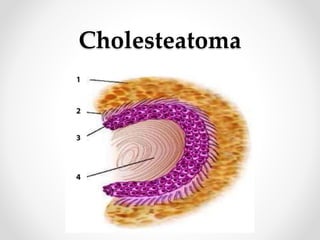
Histologically
• Cystic Content
o is composed of fully differentiated anucleate keratin squames.
• Matrix
o contains keratinizing squamous epithelium lining a cyst like
structure.
• Perimatrix
o known as lamina propria
o peripheral part of cholesteatoma consists of granulation tissue
and cholesterol granules.
o This layer is in contact with the bone. It is the granulation tissue
which releases enzymes that cause bone destruction.
Cholesteatoma
Classification
Can be classified as,
• Congenital cholesteatoma
• Acquired cholesteatoma.
o Primary acquired cholesteatoma
o Secondary acquired cholesteatoma
Primary acquired
• Etiology unknown
• there is no history of preexisting or previous episodes of
otitis media or perforation. Lesions just arise from the
attic region of the middle ear.
• Various theories have been proposed to explain the
pathophysiology
Pathophysiology
Cawthrone theory:
• suggested by Cawthrone in 1963
• that cholesteatoma always originated from
congenital embryonic cell rests present in
various areas of the temporal bone.
Pathophysiology
Tumarkin’s theory:
• cholesteatoma is derived by immigration of
squamous epithelium from the deep portion of
the external auditory canal into the middle ear
cleft through a marginal perforation or a total
perforation.
Pathophysiology
Toss theory of invagination:
• persistent negative pressure in the attic region
causes invagination of pars flaccida causing a
retraction pocket.
• This retraction pocket becomes later filled with
desquamated epithelial debris which forms a
nidus for the infection to occur later.
• Common organisms to infect this keratin debris
are Psuedomonas, E. coli, Proteus etc.
Retraction pockets
• A retraction pocket is an invagination of the
tympanic membrane. The negative middle ear
pressure, which is the cause of retraction pocket
• Toss classified attic retraction pockets into 4
grades:
• Grade I: The pars flaccida is not in contact with the neck
of the malleus.
• Grade II: The retracted pars flaccida is in contact with
the neck of the malleus and clothing it.
• Grade III: Here in addition to grade II features there is
minimal erosion of the outer attic wall
• Grade IV: In this grade in addition to all the above said
changes there is severe erosion of the outer attic wall
or scutum.
Pathophysiology
Metaplasia:
• This theory was first suggested by Wendt in
1873.
• The epithelium in the attic area of the middle
ear undergoes metaplastic changes in response
to subclinical infection.
• This metaplastic mucosa is squamous in nature
there by forming a nidus for cholesteatoma
formation in the attic region.
Pathophysiology
Habermann’s epithelial invasion theory:
• This theory suggests that following perforation of
the tympanic membrane, epithelium invades into
the attic area.
Secondary acquired
• This always follows active middle ear infection which
destroy the tympanic membrane along with the annulus.
• The destruction of annulus predisposes to epithelial
migration from the external auditory canal into the attic
region
Pathology
• Necrosis of tympanic membrane tissue along with its
annulus. caused due to the virulence of the organisms
involved i.e. beta-hemolytic streptococci.
• Necrosis starts to occur in those areas of ear drum
which have the poorest blood supply.
Congenital Cholesteatoma
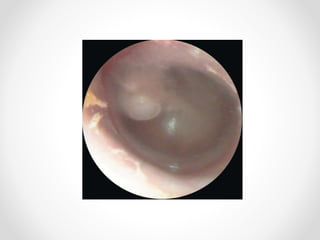
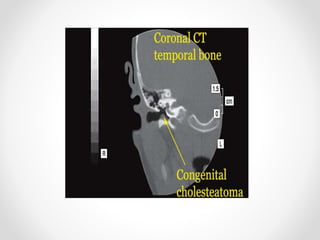
• Are epidermoid tumors originating from the
embryonic epidermoid rest located in the
temporal bone or adjacent meningeal spaces.
• It appears as whitish globular masses lying
medial to an intact tympanic membrane.
Pathogenesis
Teed’s epithelial cell rest theory:
• Suggested by Teed in 1936
• the persistence of squamous epithelial cell rests
in the temporal bone lead to the formation of
congenital cholesteatoma.
Pathogenesis
Implantation theory:
• Friedberg suggested, viable squamous epithelial
cells in the amniotic fluid present in the middle
ears of neonates and hypothesized that this was
a possible source of congenital cholesteatoma
Pathogenesis
Ruedi's invagination theory:
• This theory suggests that in utero infection of
tympanic membrane causes invagination of ear
drum into the middle ear cavity causing
congenital cholesteatoma.
Post-traumatic cholesteatoma
a/c Tertiary Acquired
Mechanisms:
• Epithelial entrapment in fracture line
• In growth of epithelium through fracture line
• Traumatic implantation of epithelium into middle
ear
Causes of bone destruction
• Hyperaemic decalcification
• Osteoclastic bone resorption due to:
o Acid phosphatase
o Collagenase
o Acid proteases
o Proteolytic enzymes
o Leukotrienes
o Cytokines
• Pressure necrosis: No role
• Bacterial toxins: No role
Evaluation
• History
• Head and neck examination
• Otologic examination
• tuning fork examination-conductive hearing loss
• Hearing evaluation (PTA) -conductive hearing loss
• Tympanometry-Flat tympanograms
• CT scan of temporal bones
Complications
• Infection
• Otorrhea
• Bone destruction
o Ossicles, tegmen
• Hearing loss
• Facial nerve paresis or paralysis
• Labyrinthine fistula
• Intracranial complications
Management
• Aural toilet
• Antibiotics
• Grommet insertion (to manage early retraction pockets)
• Canal wall down mastoidectomy
Aural toilet
• Done only for active stage
– Dry mopping with cotton swab
– Suction clearance: best method
– Gentle irrigation (wet mopping)
Removes accumulated debris
Acidic pH discourages bacterial growth
Cholesteatoma

Cholesteatoma

  • 1.
  • 2.
    Definition • The termcoined by Johannes Muller in 1838. • defined as a cystic structure filled with desquamated squamous debris lying on fibrous matrix.(skin in wrong place) Currently the Definition is,  A three dimensional epidermoid structure  Exhibiting independent growth  Replacing the middle ear mucosa and resorption of the underlying bone.
  • 3.
    Histologically • Cystic Content ois composed of fully differentiated anucleate keratin squames. • Matrix o contains keratinizing squamous epithelium lining a cyst like structure. • Perimatrix o known as lamina propria o peripheral part of cholesteatoma consists of granulation tissue and cholesterol granules. o This layer is in contact with the bone. It is the granulation tissue which releases enzymes that cause bone destruction.
  • 4.
  • 5.
    Classification Can be classifiedas, • Congenital cholesteatoma • Acquired cholesteatoma. o Primary acquired cholesteatoma o Secondary acquired cholesteatoma
  • 6.
    Primary acquired • Etiologyunknown • there is no history of preexisting or previous episodes of otitis media or perforation. Lesions just arise from the attic region of the middle ear. • Various theories have been proposed to explain the pathophysiology
  • 7.
    Pathophysiology Cawthrone theory: • suggestedby Cawthrone in 1963 • that cholesteatoma always originated from congenital embryonic cell rests present in various areas of the temporal bone.
  • 8.
    Pathophysiology Tumarkin’s theory: • cholesteatomais derived by immigration of squamous epithelium from the deep portion of the external auditory canal into the middle ear cleft through a marginal perforation or a total perforation.
  • 9.
    Pathophysiology Toss theory ofinvagination: • persistent negative pressure in the attic region causes invagination of pars flaccida causing a retraction pocket. • This retraction pocket becomes later filled with desquamated epithelial debris which forms a nidus for the infection to occur later. • Common organisms to infect this keratin debris are Psuedomonas, E. coli, Proteus etc.
  • 10.
    Retraction pockets • Aretraction pocket is an invagination of the tympanic membrane. The negative middle ear pressure, which is the cause of retraction pocket • Toss classified attic retraction pockets into 4 grades:
  • 11.
    • Grade I:The pars flaccida is not in contact with the neck of the malleus. • Grade II: The retracted pars flaccida is in contact with the neck of the malleus and clothing it. • Grade III: Here in addition to grade II features there is minimal erosion of the outer attic wall • Grade IV: In this grade in addition to all the above said changes there is severe erosion of the outer attic wall or scutum.
  • 12.
    Pathophysiology Metaplasia: • This theorywas first suggested by Wendt in 1873. • The epithelium in the attic area of the middle ear undergoes metaplastic changes in response to subclinical infection. • This metaplastic mucosa is squamous in nature there by forming a nidus for cholesteatoma formation in the attic region.
  • 13.
    Pathophysiology Habermann’s epithelial invasiontheory: • This theory suggests that following perforation of the tympanic membrane, epithelium invades into the attic area.
  • 14.
    Secondary acquired • Thisalways follows active middle ear infection which destroy the tympanic membrane along with the annulus. • The destruction of annulus predisposes to epithelial migration from the external auditory canal into the attic region
  • 15.
    Pathology • Necrosis oftympanic membrane tissue along with its annulus. caused due to the virulence of the organisms involved i.e. beta-hemolytic streptococci. • Necrosis starts to occur in those areas of ear drum which have the poorest blood supply.
  • 16.
    Congenital Cholesteatoma • Areepidermoid tumors originating from the embryonic epidermoid rest located in the temporal bone or adjacent meningeal spaces. • It appears as whitish globular masses lying medial to an intact tympanic membrane.
  • 19.
    Pathogenesis Teed’s epithelial cellrest theory: • Suggested by Teed in 1936 • the persistence of squamous epithelial cell rests in the temporal bone lead to the formation of congenital cholesteatoma.
  • 20.
    Pathogenesis Implantation theory: • Friedbergsuggested, viable squamous epithelial cells in the amniotic fluid present in the middle ears of neonates and hypothesized that this was a possible source of congenital cholesteatoma
  • 21.
    Pathogenesis Ruedi's invagination theory: •This theory suggests that in utero infection of tympanic membrane causes invagination of ear drum into the middle ear cavity causing congenital cholesteatoma.
  • 22.
    Post-traumatic cholesteatoma a/c TertiaryAcquired Mechanisms: • Epithelial entrapment in fracture line • In growth of epithelium through fracture line • Traumatic implantation of epithelium into middle ear
  • 23.
    Causes of bonedestruction • Hyperaemic decalcification • Osteoclastic bone resorption due to: o Acid phosphatase o Collagenase o Acid proteases o Proteolytic enzymes o Leukotrienes o Cytokines • Pressure necrosis: No role • Bacterial toxins: No role
  • 24.
    Evaluation • History • Headand neck examination • Otologic examination • tuning fork examination-conductive hearing loss • Hearing evaluation (PTA) -conductive hearing loss • Tympanometry-Flat tympanograms • CT scan of temporal bones
  • 25.
    Complications • Infection • Otorrhea •Bone destruction o Ossicles, tegmen • Hearing loss • Facial nerve paresis or paralysis • Labyrinthine fistula • Intracranial complications
  • 26.
    Management • Aural toilet •Antibiotics • Grommet insertion (to manage early retraction pockets) • Canal wall down mastoidectomy
  • 27.
    Aural toilet • Doneonly for active stage – Dry mopping with cotton swab – Suction clearance: best method – Gentle irrigation (wet mopping) Removes accumulated debris Acidic pH discourages bacterial growth

Editor's Notes

  • #17 ant. epitympanum), petrous apex, cerebello-pontine angle a portion of embryonic tissue that remains in the adult organism. Also called epithelial rest, fetal rest.
  • #25 History Hearing loss Otorrhea Evaluation Otalgia Nasal obstruction Tinnitus Vertigo Previous history of middle ear disease: CSOM TM perforation Previous surgery The erosion of ossicles, most commonly in the incus, may result in conductive hearing loss Tympanometry is a technique used to look at the function of the middle ear. Middle ear pressure values ranging from +50 daPa to –200 daPa for children, and +50 daPa to –50 daPa for adults is generally considered normal.