CHRONIC SUPPURATIVE
OTITIS MEDIA (CSOM)
DR AWAIS IRSHAD
LEARNING OBJECTIVES
What is CSOM
Type of CSOM
Etiology
Pathology
Feature
Investigation
Treatment
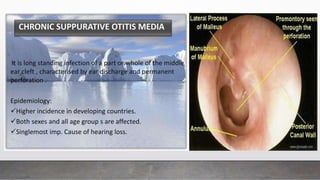
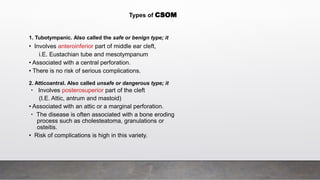
1. Tubotympanic. Also called the safe or benign type; it
• Involves anteroinferior part of middle ear cleft,
i.E. Eustachian tube and mesotympanum
• Associated with a central perforation.
• There is no risk of serious complications.
2. Atticoantral. Also called unsafe or dangerous type; it
・ Involves posterosuperior part of the cleft
(I.E. Attic, antrum and mastoid)
• Associated with an attic or a marginal perforation.
・ The disease is often associated with a bone eroding
process such as cholesteatoma, granulations or
osteitis.
• Risk of complications is high in this variety.
Types of CSOM
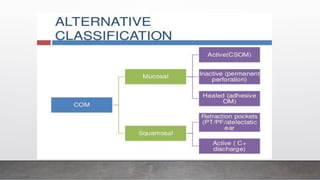
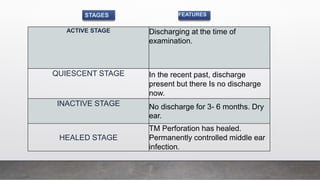
ACTIVE STAGE Discharging at the time of
examination.
QUIESCENT STAGE In the recent past, discharge
present but there Is no discharge
now.
INACTIVE STAGE No discharge for 3- 6 months. Dry
ear.
HEALED STAGE
TM Perforation has healed.
Permanently controlled middle ear
infection.
STAGES FEATURES
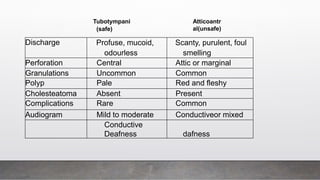
Discharge Profuse, mucoid,
odourless
Scanty, purulent, foul
smelling
Perforation Central Attic or marginal
Granulations Uncommon Common
Polyp Pale Red and fleshy
Cholesteatoma Absent Present
Complications Rare Common
Audiogram Mild to moderate Conductiveor mixed
Conductive
Deafness dafness
Tubotympani
(safe)
Atticoantr
al(unsafe)
• The disease starts in childhood
• It is the sequela of acute otitis.
-The perforation central and becomes permanent an( permits repeated infection
from the external ear;
• Ascending infections via the eustachian tube.
-Infection from tonsils, adenoids and infected sinuses may be responsible for
persistent or recurring otorrhoea.
• Persistent mucoid otorrhoea is sometimes the result of allergy to ingestants
such as milk, eggs, fish, etc.
ETIOLOGY
I. Perforation of pars tensa.
2. Middle ear mucosa.
It is oedematous and velvety when disease is active.
3. Polyp.
It is usually pale in contrast to pink, fleshy polyp seen in
atticoantral disease
4. Ossicular chain.
It is usually intact and mobile but may show some degree of necrosis,
particularly of the long process of incus.
5. Tympanosclerosis.
It is seen as white chalky deposit on the promontory ossicles, joints, tendons
and oval and round windows and interfere with the mobility of these structures
and cause conductive deafness.
6. Fibrosis and adhesions.
Pathology
• Pus culture in both types of aerobic and anaerobic
CSOM
• Common aerobic organisms
-Pseudomonas aeruginosa,
-Proteus,
-Escherichia coli
-Staphylococcus aureus,
• Anaerobes include Bacteroides fragilis and anaerobic
Streptococci.
Causative Organisms
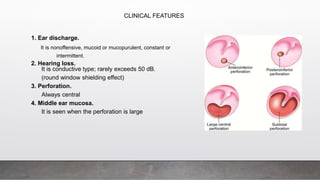
CLINICAL FEATURES
1. Ear discharge.
It is nonoffensive, mucoid or mucopurulent, constant or
intermittent.
2. Hearing loss.
It is conductive type; rarely exceeds 50 dB.
(round window shielding effect)
3. Perforation.
Always central
4. Middle ear mucosa.
It is seen when the perforation is large
1. Examination under microscope
2. Audiogram.
3. Culture and sensitivity of ear discharge.
4. Mastoid X-rays/CT scan temporal bone.
INVESTIGATIONS
HISTORY QUESTIONS TO ESTABLISH DIAGNOSIS
FOR TUBOTYMPANIC TYPE.
1. QUESTIONS ABOUT EAR DISCHARGE SAY WHETHER INTERMITTENT
OR PROFUSE , ODOURLESS OR NOT, BLOOD STAINED OR NOT,
WHITISH,MUCOID OR NOT .
2. IF WHETHER UNILATERAL,BILATERAL, PAINLESS, OTTORHEA.
3. QUESTIONS ABOUT HEARING LOSS WHICH IS USUALLY
CONDUCTIVE.
4. UPON INVESTIGATION WHAT KIND OF PEROFORATION IF CENTRAL
OR TOWRADS THE MARGINS.
5. PRESENCE OF A POLYP AND IF SO WHAT COLOR.
6. QUESTIONS ABOUT PREVIOUS EAR INFECTIONS, ALLERGIES (MILK,
EGG, FISH), ANY OTHER ASSCENDING INFECTIONS SUCH AS
TONSILS, ADENOIDS OR INFCTED SINUSES.
ANY DIFFERENTIAL DIAGNOSIS TO CSOMT
MYRINGITIS
OTITS EXTERNA
MASTOIDITIS
MENINGITIS
MANAGEMNET PLAN FOR CSOMTT
AIM:
1) TO CONTROL INFECTION
2)ELIMINATE EAR DISCHARGE
3) CONTROL HEARING LOSS
1. AURAL TOILET: REMOVAL OF DISCHARGE AND DEBRIS
FROM EAR BY DRY MOPPINGWITH ABSROBENT COTTON
BUDS, IRRIGATION WITH STERILE NORMAL SALINE AND
SUCTION CLEARANCE UNDER MICROCOPE.
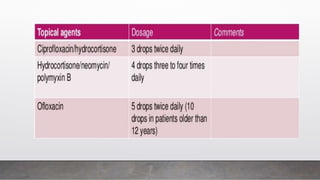
2. EAR DROPS: NEOMYCIN, POLYMYCIN AND
HYDROCORTISONE.
3. SYSTEMIC ANTIBIOTICS.
4. PRECAUTION: KEEP WATER OUT OF EAR, HARD NOSE
BLOWING SHOULD BE AVOIDED.
5. TREATMENT OF CONTRIBUTORY CAUSE: INFECTED
TONSILS, ADENOIDS, NASAL ALLERGY.
6. SURGICAL TRETAMENT: AURAL POLYPS OR
GRANULATION IF PRESENT.
7.RECONSTRUCTIVE SURGERY: MYRINGOPLASTY.
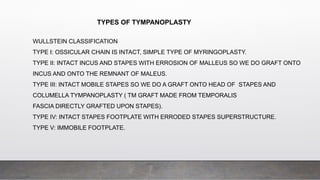
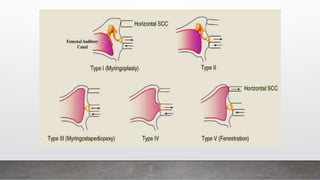
TYPES OF TYMPANOPLASTY
WULLSTEIN CLASSIFICATION
TYPE I: OSSICULAR CHAIN IS INTACT, SIMPLE TYPE OF MYRINGOPLASTY.
TYPE II: INTACT INCUS AND STAPES WITH ERROSION OF MALLEUS SO WE DO GRAFT ONTO
INCUS AND ONTO THE REMNANT OF MALEUS.
TYPE III: INTACT MOBILE STAPES SO WE DO A GRAFT ONTO HEAD OF STAPES AND
COLUMELLA TYMPANOPLASTY ( TM GRAFT MADE FROM TEMPORALIS
FASCIA DIRECTLY GRAFTED UPON STAPES).
TYPE IV: INTACT STAPES FOOTPLATE WITH ERRODED STAPES SUPERSTRUCTURE.
TYPE V: IMMOBILE FOOTPLATE.
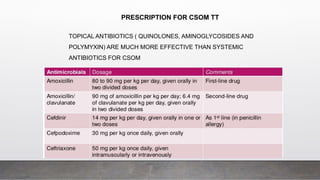
PRESCRIPTION FOR CSOM TT
TOPICAL ANTIBIOTICS ( QUINOLONES, AMINOGLYCOSIDES AND
POLYMYXIN) ARE MUCH MORE EFFECTIVE THAN SYSTEMIC
ANTIBIOTICS FOR CSOM
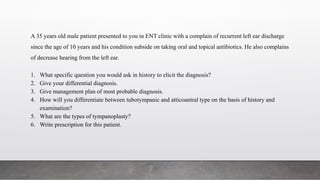
A 35 years old male patient presented to you in ENT clinic with a complain of recurrent left ear discharge
since the age of 10 years and his condition subside on taking oral and topical antibiotics. He also complains
of decrease hearing from the left ear.
1. What specific question you would ask in history to elicit the diagnosis?
2. Give your differential diagnosis.
3. Give management plan of most probable diagnosis.
4. How will you differentiate between tubotympanic and atticoantral type on the basis of history and
examination?
5. What are the types of tympanoplasty?
6. Write prescription for this patient.
csom.pptx

csom.pptx

  • 1.
    CHRONIC SUPPURATIVE OTITIS MEDIA(CSOM) DR AWAIS IRSHAD
  • 2.
    LEARNING OBJECTIVES What isCSOM Type of CSOM Etiology Pathology Feature Investigation Treatment
  • 4.
    1. Tubotympanic. Alsocalled the safe or benign type; it • Involves anteroinferior part of middle ear cleft, i.E. Eustachian tube and mesotympanum • Associated with a central perforation. • There is no risk of serious complications. 2. Atticoantral. Also called unsafe or dangerous type; it ・ Involves posterosuperior part of the cleft (I.E. Attic, antrum and mastoid) • Associated with an attic or a marginal perforation. ・ The disease is often associated with a bone eroding process such as cholesteatoma, granulations or osteitis. • Risk of complications is high in this variety. Types of CSOM
  • 6.
    ACTIVE STAGE Dischargingat the time of examination. QUIESCENT STAGE In the recent past, discharge present but there Is no discharge now. INACTIVE STAGE No discharge for 3- 6 months. Dry ear. HEALED STAGE TM Perforation has healed. Permanently controlled middle ear infection. STAGES FEATURES
  • 7.
    Discharge Profuse, mucoid, odourless Scanty,purulent, foul smelling Perforation Central Attic or marginal Granulations Uncommon Common Polyp Pale Red and fleshy Cholesteatoma Absent Present Complications Rare Common Audiogram Mild to moderate Conductiveor mixed Conductive Deafness dafness Tubotympani (safe) Atticoantr al(unsafe)
  • 8.
    • The diseasestarts in childhood • It is the sequela of acute otitis. -The perforation central and becomes permanent an( permits repeated infection from the external ear; • Ascending infections via the eustachian tube. -Infection from tonsils, adenoids and infected sinuses may be responsible for persistent or recurring otorrhoea. • Persistent mucoid otorrhoea is sometimes the result of allergy to ingestants such as milk, eggs, fish, etc. ETIOLOGY
  • 9.
    I. Perforation ofpars tensa. 2. Middle ear mucosa. It is oedematous and velvety when disease is active. 3. Polyp. It is usually pale in contrast to pink, fleshy polyp seen in atticoantral disease 4. Ossicular chain. It is usually intact and mobile but may show some degree of necrosis, particularly of the long process of incus. 5. Tympanosclerosis. It is seen as white chalky deposit on the promontory ossicles, joints, tendons and oval and round windows and interfere with the mobility of these structures and cause conductive deafness. 6. Fibrosis and adhesions. Pathology
  • 10.
    • Pus culturein both types of aerobic and anaerobic CSOM • Common aerobic organisms -Pseudomonas aeruginosa, -Proteus, -Escherichia coli -Staphylococcus aureus, • Anaerobes include Bacteroides fragilis and anaerobic Streptococci. Causative Organisms
  • 11.
    CLINICAL FEATURES 1. Eardischarge. It is nonoffensive, mucoid or mucopurulent, constant or intermittent. 2. Hearing loss. It is conductive type; rarely exceeds 50 dB. (round window shielding effect) 3. Perforation. Always central 4. Middle ear mucosa. It is seen when the perforation is large
  • 12.
    1. Examination undermicroscope 2. Audiogram. 3. Culture and sensitivity of ear discharge. 4. Mastoid X-rays/CT scan temporal bone. INVESTIGATIONS
  • 13.
    HISTORY QUESTIONS TOESTABLISH DIAGNOSIS FOR TUBOTYMPANIC TYPE. 1. QUESTIONS ABOUT EAR DISCHARGE SAY WHETHER INTERMITTENT OR PROFUSE , ODOURLESS OR NOT, BLOOD STAINED OR NOT, WHITISH,MUCOID OR NOT . 2. IF WHETHER UNILATERAL,BILATERAL, PAINLESS, OTTORHEA. 3. QUESTIONS ABOUT HEARING LOSS WHICH IS USUALLY CONDUCTIVE. 4. UPON INVESTIGATION WHAT KIND OF PEROFORATION IF CENTRAL OR TOWRADS THE MARGINS. 5. PRESENCE OF A POLYP AND IF SO WHAT COLOR. 6. QUESTIONS ABOUT PREVIOUS EAR INFECTIONS, ALLERGIES (MILK, EGG, FISH), ANY OTHER ASSCENDING INFECTIONS SUCH AS TONSILS, ADENOIDS OR INFCTED SINUSES.
  • 14.
    ANY DIFFERENTIAL DIAGNOSISTO CSOMT MYRINGITIS OTITS EXTERNA MASTOIDITIS MENINGITIS
  • 15.
    MANAGEMNET PLAN FORCSOMTT AIM: 1) TO CONTROL INFECTION 2)ELIMINATE EAR DISCHARGE 3) CONTROL HEARING LOSS 1. AURAL TOILET: REMOVAL OF DISCHARGE AND DEBRIS FROM EAR BY DRY MOPPINGWITH ABSROBENT COTTON BUDS, IRRIGATION WITH STERILE NORMAL SALINE AND SUCTION CLEARANCE UNDER MICROCOPE. 2. EAR DROPS: NEOMYCIN, POLYMYCIN AND HYDROCORTISONE. 3. SYSTEMIC ANTIBIOTICS.
  • 16.
    4. PRECAUTION: KEEPWATER OUT OF EAR, HARD NOSE BLOWING SHOULD BE AVOIDED. 5. TREATMENT OF CONTRIBUTORY CAUSE: INFECTED TONSILS, ADENOIDS, NASAL ALLERGY. 6. SURGICAL TRETAMENT: AURAL POLYPS OR GRANULATION IF PRESENT. 7.RECONSTRUCTIVE SURGERY: MYRINGOPLASTY.
  • 17.
    TYPES OF TYMPANOPLASTY WULLSTEINCLASSIFICATION TYPE I: OSSICULAR CHAIN IS INTACT, SIMPLE TYPE OF MYRINGOPLASTY. TYPE II: INTACT INCUS AND STAPES WITH ERROSION OF MALLEUS SO WE DO GRAFT ONTO INCUS AND ONTO THE REMNANT OF MALEUS. TYPE III: INTACT MOBILE STAPES SO WE DO A GRAFT ONTO HEAD OF STAPES AND COLUMELLA TYMPANOPLASTY ( TM GRAFT MADE FROM TEMPORALIS FASCIA DIRECTLY GRAFTED UPON STAPES). TYPE IV: INTACT STAPES FOOTPLATE WITH ERRODED STAPES SUPERSTRUCTURE. TYPE V: IMMOBILE FOOTPLATE.
  • 19.
    PRESCRIPTION FOR CSOMTT TOPICAL ANTIBIOTICS ( QUINOLONES, AMINOGLYCOSIDES AND POLYMYXIN) ARE MUCH MORE EFFECTIVE THAN SYSTEMIC ANTIBIOTICS FOR CSOM
  • 21.
    A 35 yearsold male patient presented to you in ENT clinic with a complain of recurrent left ear discharge since the age of 10 years and his condition subside on taking oral and topical antibiotics. He also complains of decrease hearing from the left ear. 1. What specific question you would ask in history to elicit the diagnosis? 2. Give your differential diagnosis. 3. Give management plan of most probable diagnosis. 4. How will you differentiate between tubotympanic and atticoantral type on the basis of history and examination? 5. What are the types of tympanoplasty? 6. Write prescription for this patient.