CHOLESTEATOMA
L AV I TA H A Z A R I K A
R O L L N O . : 3 8
6 T H S E M E S T E R
WHAT IS A CHOLESTEATOMA?
• Misnomer: neither a tumor, nor does it contain
cholesterol!
• Hence, also called “EPIDERMOSIS” or “KERATOMA”.
• “Skin in wrong place”
• A pathology of the attico-antral type of disease of the
middle ear.
• A sac or pocket in the middle ear cleft lined by keratinised
squamous epithelium and contains desquamated keratin
sheets in concentric circles, and has bone eroding
properties.
WHAT DOES A CHOLESTEATOMA
CONSIST OF?
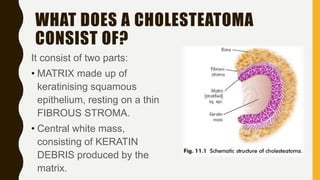
It consist of two parts:
• MATRIX made up of
keratinising squamous
epithelium, resting on a thin
FIBROUS STROMA.
• Central white mass,
consisting of KERATIN
DEBRIS produced by the
matrix.
HOW IS A
CHOLESTEATOMA
FORMED?
VA R I O U S T H E O R I E S O F C H O L E S T E AT O M A
F O R M AT I O N .
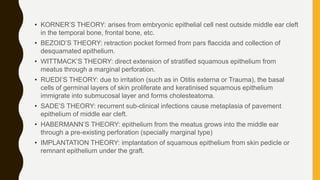
• KORNER’S THEORY: arises from embryonic epithelial cell nest outside middle ear cleft
in the temporal bone, frontal bone, etc.
• BEZOID’S THEORY: retraction pocket formed from pars flaccida and collection of
desquamated epithelium.
• WITTMACK’S THEORY: direct extension of stratified squamous epithelium from
meatus through a marginal perforation.
• RUEDI’S THEORY: due to irritation (such as in Otitis externa or Trauma), the basal
cells of germinal layers of skin proliferate and keratinised squamous epithelium
immigrate into submucosal layer and forms cholesteatoma.
• SADE’S THEORY: recurrent sub-clinical infections cause metaplasia of pavement
epithelium of middle ear cleft.
• HABERMANN’S THEORY: epithelium from the meatus grows into the middle ear
through a pre-existing perforation (specially marginal type)
• IMPLANTATION THEORY: implantation of squamous epithelium from skin pedicle or
remnant epithelium under the graft.
CLASSIFICATION
OF
CHOLESTEATOMA
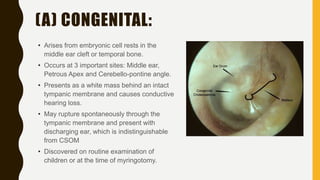
(A) CONGENITAL:
• Arises from embryonic cell rests in the
middle ear cleft or temporal bone.
• Occurs at 3 important sites: Middle ear,
Petrous Apex and Cerebello-pontine angle.
• Presents as a white mass behind an intact
tympanic membrane and causes conductive
hearing loss.
• May rupture spontaneously through the
tympanic membrane and present with
discharging ear, which is indistinguishable
from CSOM
• Discovered on routine examination of
children or at the time of myringotomy.
(B) ACQUIRED:
1. PRIMARY: no history of previous otitis media or
pre-existing perforation.
• Invagination of pars flaccida:
Persistant negative pressure in the attic causes a
retraction pocket which accumalates keratin debris;
if infected, the keratin mass expands towards the
middle ear.
• Basal cell hyperplasia:
Subclinical infection of childhood induces basal cell
of pars flaccida to grow inwards and form a
cholesteatoma, which ultimately breaks through
pars flaccida forming an attic perforation.
• Squamous metaplasia:
In cases like Otitis media with effusion, subclinical
infections etc, the normal pavement epithelium
undergoes metaplasia.
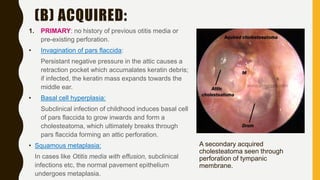
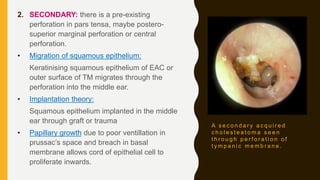
A secondary acquired
cholesteatoma seen through
perforation of tympanic
membrane.
A s e c o n d a r y a c q u i r e d
c h o l e s t e a t o m a s e e n
t h r o u g h p e r f o r a t i o n o f
t y m p a n i c m e m b r a n e .
2. SECONDARY: there is a pre-existing
perforation in pars tensa, maybe postero-
superior marginal perforation or central
perforation.
• Migration of squamous epithelium:
Keratinising squamous epithelium of EAC or
outer surface of TM migrates through the
perforation into the middle ear.
• Implantation theory:
Squamous epithelium implanted in the middle
ear through graft or trauma
• Papillary growth due to poor ventillation in
prussac’s space and breach in basal
membrane allows cord of epithelial cell to
proliferate inwards.
HOW DOES A CHOLESTEATOMA
EXPAND?
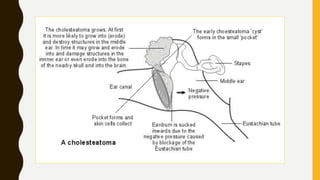
• Enters middle ear cleft, invades the surrounding structures first by following the path of least
resistance, and then by enzymatic bone destruction.
• There are two patterns of spread:
• Pars flaccida cholesteatoma: The lesion starts anterosuperiorly in 'Prussaks space', the area
just below the scutum, which is limited by the tympanic membrane, the malleus, and the lateral
ligament of the malleus. A cholesteatoma will then extend laterally towards the ossicular chain
and into the epitympanum.
• Pars tensa cholesteatoma: The cholesteatoma begins posterosuperiorly and extends
posteriorly towards the facial recess and tympanic sinus, and medially towards the ossicular
chain.
HOW DOES A
CHOLESTEATOMA
ERODE BONE?
T H E O R I E S O F B O N E E R O S I O N B Y A
C H O L E S T E AT O M A .
• Cholesteatoma may cause destruction of ear ossicles, erosion of bony labyrinth, canal
of facial nerve, sinus plate of tegmen tympani and thus cause several complications.
• CHEMICAL THEORY:
By liberation of certain chemicals at the perimatrix.
• ISCHAEMICS PRESSURE NECROSIS THEORY:
Surrounding bone, ossicles and air-cells are eroded by pressure of the cholesteatoma
mass. (no longer accepted)
• ENZYMATIC THEORY:
Various enzymes produced by perimatrix, osteoclasts and mononuclear inflammatory
cells seen in association with cholesteatoma. (most preferred theory)
HOW DOES A
CHOLESTEATOMA
PRESENT IN A
PATIENT?
S I G N S A N D S Y M P T O M S .
SYMPTOMS
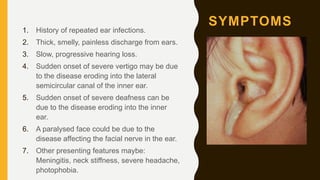
1. History of repeated ear infections.
2. Thick, smelly, painless discharge from ears.
3. Slow, progressive hearing loss.
4. Sudden onset of severe vertigo may be due
to the disease eroding into the lateral
semicircular canal of the inner ear.
5. Sudden onset of severe deafness can be
due to the disease eroding into the inner
ear.
6. A paralysed face could be due to the
disease affecting the facial nerve in the ear.
7. Other presenting features maybe:
Meningitis, neck stiffness, severe headache,
photophobia.
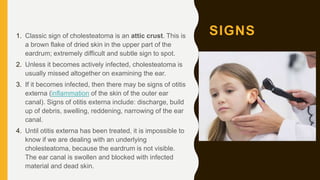
SIGNS1. Classic sign of cholesteatoma is an attic crust. This is
a brown flake of dried skin in the upper part of the
eardrum; extremely difficult and subtle sign to spot.
2. Unless it becomes actively infected, cholesteatoma is
usually missed altogether on examining the ear.
3. If it becomes infected, then there may be signs of otitis
externa (inflammation of the skin of the outer ear
canal). Signs of otitis externa include: discharge, build
up of debris, swelling, reddening, narrowing of the ear
canal.
4. Until otitis externa has been treated, it is impossible to
know if we are dealing with an underlying
cholesteatoma, because the eardrum is not visible.
The ear canal is swollen and blocked with infected
material and dead skin.
HOW TO
DIAGNOSE A CASE
OF
CHOLESTEATOMA?
• No lab tests or incisional biopsies are generally needed for
diagnosis.
1. Audiometry can be done prior to surgery. Pure tone
audiometry with air conduction and bone conduction is
the main test we use. The test doesn’t diagnose the
condition, but does tell us how much hearing has been
lost, and whether it is a conductive hearing loss (usually
due to damage to the eardrum and ossicles) or a
sensorineural hearing loss due to damage to the inner
ear.
2. CT scanning is the diagnostic imaging modality of
choice for lesions, owing to its ability to detect subtle
bony defects. A CT scan is needed if we suspect
complications, especially if we suspect there may be
spread of disease into the brain.
3. MRI can be done if very specific problems are suspected
like-
i. dural involvement or invasion,
ii. subdural or epidural abcess,
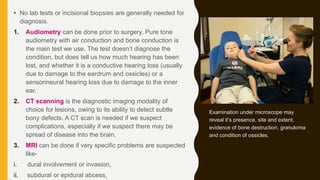
Examination under microscope may
reveal it’s presence, site and extent,
evidence of bone destruction, granuloma
and condition of ossicles.
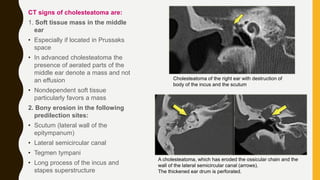
CT signs of cholesteatoma are:
1. Soft tissue mass in the middle
ear
• Especially if located in Prussaks
space
• In advanced cholesteatoma the
presence of aerated parts of the
middle ear denote a mass and not
an effusion
• Nondependent soft tissue
particularly favors a mass
2. Bony erosion in the following
predilection sites:
• Scutum (lateral wall of the
epitympanum)
• Lateral semicircular canal
• Tegmen tympani
• Long process of the incus and
stapes superstructure
Cholesteatoma of the right ear with destruction of
body of the incus and the scutum
A cholesteatoma, which has eroded the ossicular chain and the
wall of the lateral semicircular canal (arrows).
The thickened ear drum is perforated.
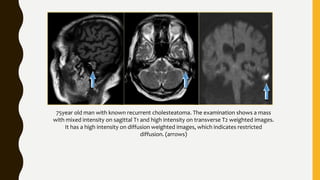
75year old man with known recurrent cholesteatoma. The examination shows a mass
with mixed intensity on sagittal T1 and high intensity on transverse T2 weighted images.
It has a high intensity on diffusion weighted images, which indicates restricted
diffusion. (arrows)
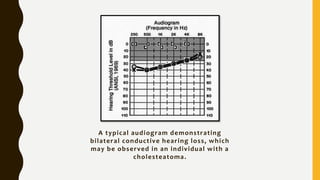
A typical audiogram demonstrating
bilateral conductive hearing loss, which
may be observed in an individual with a
cholesteatoma.
HOW TO MANAGE
A CASE OF
CHOLESTEATOMA?
M A N A G E M E N T O F C H O L E S T E AT O M A .
CONSERVATIVE MANAGEMENT
• Limited role of conservative management in case of a cholesteatoma;
can be tried in selective cases:
small and easily accessible cholesteatoma to suction clearance
under operating microscope. Periodic checkups and repeated suction
clearance are essential.
In elderly patients(>65years)
Patients unfit for general anesthesia
Patients refusing surgery.
• Other methods like aural toileting and dry ear precautions are
essential.
GOALS OF A SURGERY
FOR CHOLESTEATOMA
•To make the ear safe by
eliminating the cholesteatoma
and chronic infection
•To make the ear problem free
for all the usual activities of daily
living, including swimming
•To conserve residual hearing
•To improve hearing when
possible
•To provide acceptable cosmetic
appearnce.
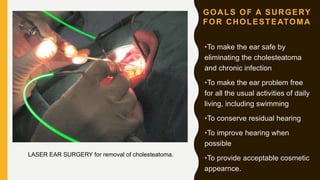
LASER EAR SURGERY for removal of cholesteatoma.
SURGICAL
MANAGEMENT
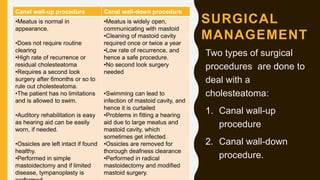
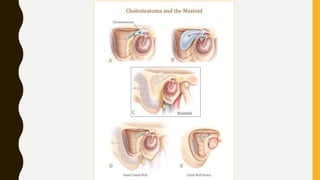
Canal wall-up procedure Canal wall-down procedure
•Meatus is normal in
appearance.
•Does not require routine
clearing
•High rate of recurrence or
residual cholesteatoma
•Requires a second look
surgery after 6months or so to
rule out cholesteatoma.
•The patient has no limitations
and is allowed to swim.
•Auditory rehabilitation is easy
as hearing aid can be easily
worn, if needed.
•Ossicles are left intact if found
healthy.
•Performed in simple
mastoidectomy and if limited
disease, tympanoplasty is
•Meatus is widely open,
communicating with mastoid
•Cleaning of mastoid cavity
required once or twice a year
•Low rate of recurrence, and
hence a safe procedure.
•No second look surgery
needed
•Swimming can lead to
infection of mastoid cavity, and
hence it is curtailed
•Problems in fitting a hearing
aid due to large meatus and
mastoid cavity, which
sometimes get infected.

•Ossicles are removed for
thorough deafness clearance
•Performed in radical
mastoidectomy and modified
mastoid surgery.
Two types of surgical
procedures are done to
deal with a
cholesteatoma:
1. Canal wall-up
procedure
2. Canal wall-down
procedure.
RECONSTRUCTIVE
SURGERY
• AIMS of “Tympanoplasty”:
i. Thorough eradication of tympanomastoid
disease.
ii. Restoration of tympanic membrane and
sound conducting system.
iii. Restoration of aerated tympanum.
• “TYMPANOPLASTY” includes:
a. Myringoplasty= reconstruction of tympanic
membrane
b. Canaloplasty=widening of EAC
c. Meatoplasty=enlargement of the opening of
cartilagenous meatus.
d. Ossiculoplasty=reconstruction of ossicular
chain for proper sound transmission.
The tympanic membrane
and the ossicles can be
reconstructed by
“Tympanoplasty” , either at
the time of primary surgery
or as a second stage
procedure.
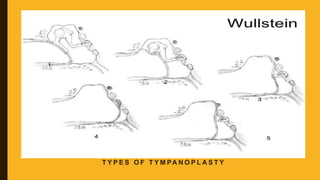
TYPES OF TYMPANOPLASTY
Type I Simple perforation of tympanic membrane with intact ossicular chain;
Repaired by a graft- also called “myringoplasty”
Type II Perforation of TM with erosion of malleus;
Graft placed on incus or remnant of malleus.
Type III Malleus and incus are absent.
Graft directly placed on stapes head- also called “Myringostapediopexy” or “Columella
tympanoplasty”
Type IV Only the footplate of stapes is present;
Graft is placed between the oval and round window.
Type V Stapes footplate is fixed, but the round window is functioning;
In such cases another window is created on the horizontal semi-circular canal and
covered with a graft- also called “ fenestration separation”
A. BASIC TYPES: According to Wullstein,
T Y P E S O F T Y M PA N O P L A S T Y
B. SPECIAL TYPES:
1. COMBINED APPROACH TYMPANOPLASTY (CAT): canal wall is kept intact
and middle ear and mastoid is approached through posterior tympanotomy
approach of Jansen.
2. HOMOGRAFT TYMPANOPLASTY: homograft TM and ossicles were grafted
in place of autograft membrane and ossicles.
3. TYMPANO-OSSICULOPLASTY
4. TYMPANOPLASTY with TORP or PORP: total or partial ossicular
replacement prosthesis.
If loss of superstructure of stapes with other ossicles, then TORP is used on
stapes footplate and TM.
If stapes is present, then PROP is used on stapes head and other end under
autograft TM.
WHAT CAN BE THE
COMPLICATIONS
AFTER SURGERY?
P O S T- O P E R AT I V E C O M P L I C AT I O N S
1. Labyrinthine fistula
2. Brain herniation
3. Post operative stenosis
4. Facial nerve damage
5. Total sensorineural hearing loss
6. Graft failure
7. Balance disturbance
8. Chondritis and Perichondritis
9. Persistant drainage from canal wall down cavity
10. Foreign bodies
11. Altered taste
HOW TO PREVENT
COMPLICATIONS
IN FUTURE?
L O N G T E R M M O N I T O R I N G
• Microscopic cleaning every 6-12 months
• Removing of crust and exposing of the areas to air for infection to resolve
• Administration of emollients once/twice a month to soften cerumen and reduce
itching
• Ear plugs should be used to prevent entry of water into the ears while bathing
or swimming as it may cause vertigo.
• Patients with canal wall-down procedure needs to be seen in order to keep the
ear free from desquamated epithelium and cerumen
• Patients with canal wall-up procedure need a second procedure 6-9months
after the original. Once the second look operation is healed, regular follow up
care at intervals of 6months is necessary to identify persistence or recurrence
of cholesteatoma.
THANK YOU!
T H E E N D .

Cholesteatoma

  • 1.
    CHOLESTEATOMA L AV ITA H A Z A R I K A R O L L N O . : 3 8 6 T H S E M E S T E R
  • 2.
    WHAT IS ACHOLESTEATOMA? • Misnomer: neither a tumor, nor does it contain cholesterol! • Hence, also called “EPIDERMOSIS” or “KERATOMA”. • “Skin in wrong place” • A pathology of the attico-antral type of disease of the middle ear. • A sac or pocket in the middle ear cleft lined by keratinised squamous epithelium and contains desquamated keratin sheets in concentric circles, and has bone eroding properties.
  • 3.
    WHAT DOES ACHOLESTEATOMA CONSIST OF? It consist of two parts: • MATRIX made up of keratinising squamous epithelium, resting on a thin FIBROUS STROMA. • Central white mass, consisting of KERATIN DEBRIS produced by the matrix.
  • 4.
    HOW IS A CHOLESTEATOMA FORMED? VAR I O U S T H E O R I E S O F C H O L E S T E AT O M A F O R M AT I O N .
  • 5.
    • KORNER’S THEORY:arises from embryonic epithelial cell nest outside middle ear cleft in the temporal bone, frontal bone, etc. • BEZOID’S THEORY: retraction pocket formed from pars flaccida and collection of desquamated epithelium. • WITTMACK’S THEORY: direct extension of stratified squamous epithelium from meatus through a marginal perforation. • RUEDI’S THEORY: due to irritation (such as in Otitis externa or Trauma), the basal cells of germinal layers of skin proliferate and keratinised squamous epithelium immigrate into submucosal layer and forms cholesteatoma. • SADE’S THEORY: recurrent sub-clinical infections cause metaplasia of pavement epithelium of middle ear cleft. • HABERMANN’S THEORY: epithelium from the meatus grows into the middle ear through a pre-existing perforation (specially marginal type) • IMPLANTATION THEORY: implantation of squamous epithelium from skin pedicle or remnant epithelium under the graft.
  • 6.
  • 7.
    (A) CONGENITAL: • Arisesfrom embryonic cell rests in the middle ear cleft or temporal bone. • Occurs at 3 important sites: Middle ear, Petrous Apex and Cerebello-pontine angle. • Presents as a white mass behind an intact tympanic membrane and causes conductive hearing loss. • May rupture spontaneously through the tympanic membrane and present with discharging ear, which is indistinguishable from CSOM • Discovered on routine examination of children or at the time of myringotomy.
  • 8.
    (B) ACQUIRED: 1. PRIMARY:no history of previous otitis media or pre-existing perforation. • Invagination of pars flaccida: Persistant negative pressure in the attic causes a retraction pocket which accumalates keratin debris; if infected, the keratin mass expands towards the middle ear. • Basal cell hyperplasia: Subclinical infection of childhood induces basal cell of pars flaccida to grow inwards and form a cholesteatoma, which ultimately breaks through pars flaccida forming an attic perforation. • Squamous metaplasia: In cases like Otitis media with effusion, subclinical infections etc, the normal pavement epithelium undergoes metaplasia. A secondary acquired cholesteatoma seen through perforation of tympanic membrane.
  • 9.
    A s ec o n d a r y a c q u i r e d c h o l e s t e a t o m a s e e n t h r o u g h p e r f o r a t i o n o f t y m p a n i c m e m b r a n e . 2. SECONDARY: there is a pre-existing perforation in pars tensa, maybe postero- superior marginal perforation or central perforation. • Migration of squamous epithelium: Keratinising squamous epithelium of EAC or outer surface of TM migrates through the perforation into the middle ear. • Implantation theory: Squamous epithelium implanted in the middle ear through graft or trauma • Papillary growth due to poor ventillation in prussac’s space and breach in basal membrane allows cord of epithelial cell to proliferate inwards.
  • 10.
    HOW DOES ACHOLESTEATOMA EXPAND? • Enters middle ear cleft, invades the surrounding structures first by following the path of least resistance, and then by enzymatic bone destruction. • There are two patterns of spread: • Pars flaccida cholesteatoma: The lesion starts anterosuperiorly in 'Prussaks space', the area just below the scutum, which is limited by the tympanic membrane, the malleus, and the lateral ligament of the malleus. A cholesteatoma will then extend laterally towards the ossicular chain and into the epitympanum. • Pars tensa cholesteatoma: The cholesteatoma begins posterosuperiorly and extends posteriorly towards the facial recess and tympanic sinus, and medially towards the ossicular chain.
  • 12.
    HOW DOES A CHOLESTEATOMA ERODEBONE? T H E O R I E S O F B O N E E R O S I O N B Y A C H O L E S T E AT O M A .
  • 13.
    • Cholesteatoma maycause destruction of ear ossicles, erosion of bony labyrinth, canal of facial nerve, sinus plate of tegmen tympani and thus cause several complications. • CHEMICAL THEORY: By liberation of certain chemicals at the perimatrix. • ISCHAEMICS PRESSURE NECROSIS THEORY: Surrounding bone, ossicles and air-cells are eroded by pressure of the cholesteatoma mass. (no longer accepted) • ENZYMATIC THEORY: Various enzymes produced by perimatrix, osteoclasts and mononuclear inflammatory cells seen in association with cholesteatoma. (most preferred theory)
  • 14.
    HOW DOES A CHOLESTEATOMA PRESENTIN A PATIENT? S I G N S A N D S Y M P T O M S .
  • 15.
    SYMPTOMS 1. History ofrepeated ear infections. 2. Thick, smelly, painless discharge from ears. 3. Slow, progressive hearing loss. 4. Sudden onset of severe vertigo may be due to the disease eroding into the lateral semicircular canal of the inner ear. 5. Sudden onset of severe deafness can be due to the disease eroding into the inner ear. 6. A paralysed face could be due to the disease affecting the facial nerve in the ear. 7. Other presenting features maybe: Meningitis, neck stiffness, severe headache, photophobia.
  • 16.
    SIGNS1. Classic signof cholesteatoma is an attic crust. This is a brown flake of dried skin in the upper part of the eardrum; extremely difficult and subtle sign to spot. 2. Unless it becomes actively infected, cholesteatoma is usually missed altogether on examining the ear. 3. If it becomes infected, then there may be signs of otitis externa (inflammation of the skin of the outer ear canal). Signs of otitis externa include: discharge, build up of debris, swelling, reddening, narrowing of the ear canal. 4. Until otitis externa has been treated, it is impossible to know if we are dealing with an underlying cholesteatoma, because the eardrum is not visible. The ear canal is swollen and blocked with infected material and dead skin.
  • 17.
    HOW TO DIAGNOSE ACASE OF CHOLESTEATOMA?
  • 18.
    • No labtests or incisional biopsies are generally needed for diagnosis. 1. Audiometry can be done prior to surgery. Pure tone audiometry with air conduction and bone conduction is the main test we use. The test doesn’t diagnose the condition, but does tell us how much hearing has been lost, and whether it is a conductive hearing loss (usually due to damage to the eardrum and ossicles) or a sensorineural hearing loss due to damage to the inner ear. 2. CT scanning is the diagnostic imaging modality of choice for lesions, owing to its ability to detect subtle bony defects. A CT scan is needed if we suspect complications, especially if we suspect there may be spread of disease into the brain. 3. MRI can be done if very specific problems are suspected like- i. dural involvement or invasion, ii. subdural or epidural abcess, Examination under microscope may reveal it’s presence, site and extent, evidence of bone destruction, granuloma and condition of ossicles.
  • 19.
    CT signs ofcholesteatoma are: 1. Soft tissue mass in the middle ear • Especially if located in Prussaks space • In advanced cholesteatoma the presence of aerated parts of the middle ear denote a mass and not an effusion • Nondependent soft tissue particularly favors a mass 2. Bony erosion in the following predilection sites: • Scutum (lateral wall of the epitympanum) • Lateral semicircular canal • Tegmen tympani • Long process of the incus and stapes superstructure Cholesteatoma of the right ear with destruction of body of the incus and the scutum A cholesteatoma, which has eroded the ossicular chain and the wall of the lateral semicircular canal (arrows). The thickened ear drum is perforated.
  • 20.
    75year old manwith known recurrent cholesteatoma. The examination shows a mass with mixed intensity on sagittal T1 and high intensity on transverse T2 weighted images. It has a high intensity on diffusion weighted images, which indicates restricted diffusion. (arrows)
  • 21.
    A typical audiogramdemonstrating bilateral conductive hearing loss, which may be observed in an individual with a cholesteatoma.
  • 22.
    HOW TO MANAGE ACASE OF CHOLESTEATOMA? M A N A G E M E N T O F C H O L E S T E AT O M A .
  • 23.
    CONSERVATIVE MANAGEMENT • Limitedrole of conservative management in case of a cholesteatoma; can be tried in selective cases: small and easily accessible cholesteatoma to suction clearance under operating microscope. Periodic checkups and repeated suction clearance are essential. In elderly patients(>65years) Patients unfit for general anesthesia Patients refusing surgery. • Other methods like aural toileting and dry ear precautions are essential.
  • 24.
    GOALS OF ASURGERY FOR CHOLESTEATOMA •To make the ear safe by eliminating the cholesteatoma and chronic infection •To make the ear problem free for all the usual activities of daily living, including swimming •To conserve residual hearing •To improve hearing when possible •To provide acceptable cosmetic appearnce. LASER EAR SURGERY for removal of cholesteatoma.
  • 25.
    SURGICAL MANAGEMENT Canal wall-up procedureCanal wall-down procedure •Meatus is normal in appearance. •Does not require routine clearing •High rate of recurrence or residual cholesteatoma •Requires a second look surgery after 6months or so to rule out cholesteatoma. •The patient has no limitations and is allowed to swim. •Auditory rehabilitation is easy as hearing aid can be easily worn, if needed. •Ossicles are left intact if found healthy. •Performed in simple mastoidectomy and if limited disease, tympanoplasty is •Meatus is widely open, communicating with mastoid •Cleaning of mastoid cavity required once or twice a year •Low rate of recurrence, and hence a safe procedure. •No second look surgery needed •Swimming can lead to infection of mastoid cavity, and hence it is curtailed •Problems in fitting a hearing aid due to large meatus and mastoid cavity, which sometimes get infected. •Ossicles are removed for thorough deafness clearance •Performed in radical mastoidectomy and modified mastoid surgery. Two types of surgical procedures are done to deal with a cholesteatoma: 1. Canal wall-up procedure 2. Canal wall-down procedure.
  • 27.
    RECONSTRUCTIVE SURGERY • AIMS of“Tympanoplasty”: i. Thorough eradication of tympanomastoid disease. ii. Restoration of tympanic membrane and sound conducting system. iii. Restoration of aerated tympanum. • “TYMPANOPLASTY” includes: a. Myringoplasty= reconstruction of tympanic membrane b. Canaloplasty=widening of EAC c. Meatoplasty=enlargement of the opening of cartilagenous meatus. d. Ossiculoplasty=reconstruction of ossicular chain for proper sound transmission. The tympanic membrane and the ossicles can be reconstructed by “Tympanoplasty” , either at the time of primary surgery or as a second stage procedure.
  • 28.
    TYPES OF TYMPANOPLASTY TypeI Simple perforation of tympanic membrane with intact ossicular chain; Repaired by a graft- also called “myringoplasty” Type II Perforation of TM with erosion of malleus; Graft placed on incus or remnant of malleus. Type III Malleus and incus are absent. Graft directly placed on stapes head- also called “Myringostapediopexy” or “Columella tympanoplasty” Type IV Only the footplate of stapes is present; Graft is placed between the oval and round window. Type V Stapes footplate is fixed, but the round window is functioning; In such cases another window is created on the horizontal semi-circular canal and covered with a graft- also called “ fenestration separation” A. BASIC TYPES: According to Wullstein,
  • 29.
    T Y PE S O F T Y M PA N O P L A S T Y
  • 30.
    B. SPECIAL TYPES: 1.COMBINED APPROACH TYMPANOPLASTY (CAT): canal wall is kept intact and middle ear and mastoid is approached through posterior tympanotomy approach of Jansen. 2. HOMOGRAFT TYMPANOPLASTY: homograft TM and ossicles were grafted in place of autograft membrane and ossicles. 3. TYMPANO-OSSICULOPLASTY 4. TYMPANOPLASTY with TORP or PORP: total or partial ossicular replacement prosthesis. If loss of superstructure of stapes with other ossicles, then TORP is used on stapes footplate and TM. If stapes is present, then PROP is used on stapes head and other end under autograft TM.
  • 31.
    WHAT CAN BETHE COMPLICATIONS AFTER SURGERY? P O S T- O P E R AT I V E C O M P L I C AT I O N S
  • 32.
    1. Labyrinthine fistula 2.Brain herniation 3. Post operative stenosis 4. Facial nerve damage 5. Total sensorineural hearing loss 6. Graft failure 7. Balance disturbance 8. Chondritis and Perichondritis 9. Persistant drainage from canal wall down cavity 10. Foreign bodies 11. Altered taste
  • 33.
    HOW TO PREVENT COMPLICATIONS INFUTURE? L O N G T E R M M O N I T O R I N G
  • 34.
    • Microscopic cleaningevery 6-12 months • Removing of crust and exposing of the areas to air for infection to resolve • Administration of emollients once/twice a month to soften cerumen and reduce itching • Ear plugs should be used to prevent entry of water into the ears while bathing or swimming as it may cause vertigo. • Patients with canal wall-down procedure needs to be seen in order to keep the ear free from desquamated epithelium and cerumen • Patients with canal wall-up procedure need a second procedure 6-9months after the original. Once the second look operation is healed, regular follow up care at intervals of 6months is necessary to identify persistence or recurrence of cholesteatoma.
  • 35.
    THANK YOU! T HE E N D .