Modal
auxiliary
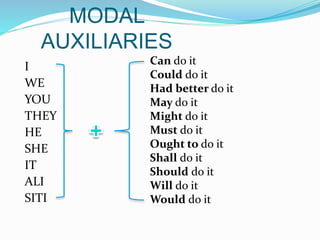
The modal auxiliaries in English are :
Can, Could, Had better, May, Might, Must, Ought to,
Shall, Should, Will, would.
Modal auxiliaries generally express a speaker’s attitudes, or
moods. For example, modals can express that a speaker feels
something is necessary, advisable, permissible, possible, or
probable, and in addition, they can convey the strength of
these attitudes.
MODAL
AUXILIARIES
I
WE
YOU
THEY
HE
SHE
IT
ALI
SITI
Can do it
Could do it
Had better do it
May do it
Might do it
Must do it
Ought to do it
Shall do it
Should do it
Will do it
Would do it
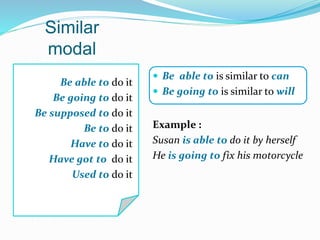
Similar
modal
Be able to do it
Be going to do it
Be supposed to do it
Be to do it
Have to do it
Have got to do it
Used to do it
 Be able to is similar to can
 Be going to is similar to will
Example :
Susan is able to do it by herself
He is going to fix his motorcycle
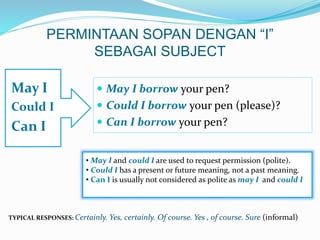
PERMINTAAN SOPAN DENGAN “I”
SEBAGAI SUBJECT
May I
Could I
Can I
 May I borrow your pen?
 Could I borrow your pen (please)?
 Can I borrow your pen?
• May I and could I are used to request permission (polite).
• Could I has a present or future meaning, not a past meaning.
• Can I is usually not considered as polite as may I and could I
TYPICAL RESPONSES: Certainly. Yes, certainly. Of course. Yes , of course. Sure (informal)
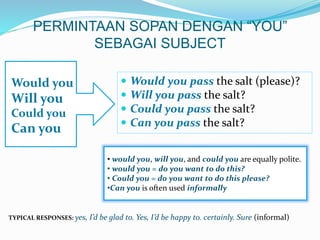
PERMINTAAN SOPAN DENGAN “YOU”
SEBAGAI SUBJECT
Would you
Will you
Could you
Can you
 Would you pass the salt (please)?
 Will you pass the salt?
 Could you pass the salt?
 Can you pass the salt?
• would you, will you, and could you are equally polite.
• would you = do you want to do this?
• Could you = do you want to do this please?
•Can you is often used informally
TYPICAL RESPONSES: yes, I’d be glad to. Yes, I’d be happy to. certainly. Sure (informal)
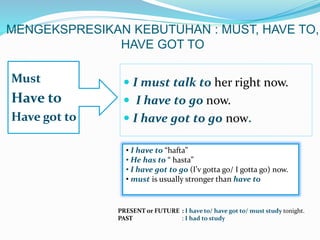
MENGEKSPRESIKAN KEBUTUHAN : MUST, HAVE TO,
HAVE GOT TO
Must
Have to
Have got to
 I must talk to her right now.
 I have to go now.
 I have got to go now.
• I have to “hafta”
• He has to “ hasta”
• I have got to go (I’v gotta go/ I gotta go) now.
• must is usually stronger than have to
PRESENT or FUTURE : I have to/ have got to/ must study tonight.
PAST : I had to study
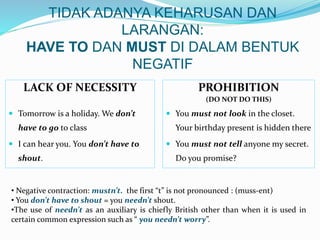
TIDAK ADANYA KEHARUSAN DAN
LARANGAN:
HAVE TO DAN MUST DI DALAM BENTUK
NEGATIF
LACK OF NECESSITY
 Tomorrow is a holiday. We don’t
have to go to class
 I can hear you. You don’t have to
shout.
PROHIBITION
(DO NOT DO THIS)
 You must not look in the closet.
Your birthday present is hidden there
 You must not tell anyone my secret.
Do you promise?
• Negative contraction: mustn’t. the first “t” is not pronounced : (muss-ent)
• You don’t have to shout = you needn’t shout.
•The use of needn’t as an auxiliary is chiefly British other than when it is used in
certain common expression such as “ you needn’t worry”.
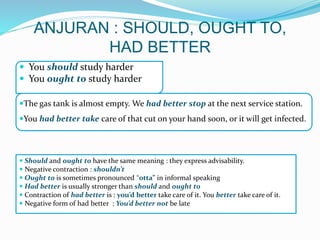
ANJURAN : SHOULD, OUGHT TO,
HAD BETTER
 You should study harder
 You ought to study harder
The gas tank is almost empty. We had better stop at the next service station.
You had better take care of that cut on your hand soon, or it will get infected.
 Should and ought to have the same meaning : they express advisability.
 Negative contraction : shouldn’t
 Ought to is sometimes pronounced “otta” in informal speaking
 Had better is usually stronger than should and ought to
 Contraction of had better is : you’d better take care of it. You better take care of it.
 Negative form of had better : You’d better not be late
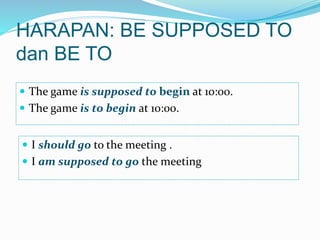
HARAPAN: BE SUPPOSED TO
dan BE TO
 The game is supposed to begin at 10:00.
 The game is to begin at 10:00.
 I should go to the meeting .
 I am supposed to go the meeting

English Modal

  • 1.
    Modal auxiliary The modal auxiliariesin English are : Can, Could, Had better, May, Might, Must, Ought to, Shall, Should, Will, would. Modal auxiliaries generally express a speaker’s attitudes, or moods. For example, modals can express that a speaker feels something is necessary, advisable, permissible, possible, or probable, and in addition, they can convey the strength of these attitudes.
  • 2.
    MODAL AUXILIARIES I WE YOU THEY HE SHE IT ALI SITI Can do it Coulddo it Had better do it May do it Might do it Must do it Ought to do it Shall do it Should do it Will do it Would do it
  • 3.
    Similar modal Be able todo it Be going to do it Be supposed to do it Be to do it Have to do it Have got to do it Used to do it  Be able to is similar to can  Be going to is similar to will Example : Susan is able to do it by herself He is going to fix his motorcycle
  • 4.
    PERMINTAAN SOPAN DENGAN“I” SEBAGAI SUBJECT May I Could I Can I  May I borrow your pen?  Could I borrow your pen (please)?  Can I borrow your pen? • May I and could I are used to request permission (polite). • Could I has a present or future meaning, not a past meaning. • Can I is usually not considered as polite as may I and could I TYPICAL RESPONSES: Certainly. Yes, certainly. Of course. Yes , of course. Sure (informal)
  • 5.
    PERMINTAAN SOPAN DENGAN“YOU” SEBAGAI SUBJECT Would you Will you Could you Can you  Would you pass the salt (please)?  Will you pass the salt?  Could you pass the salt?  Can you pass the salt? • would you, will you, and could you are equally polite. • would you = do you want to do this? • Could you = do you want to do this please? •Can you is often used informally TYPICAL RESPONSES: yes, I’d be glad to. Yes, I’d be happy to. certainly. Sure (informal)
  • 6.
    MENGEKSPRESIKAN KEBUTUHAN :MUST, HAVE TO, HAVE GOT TO Must Have to Have got to  I must talk to her right now.  I have to go now.  I have got to go now. • I have to “hafta” • He has to “ hasta” • I have got to go (I’v gotta go/ I gotta go) now. • must is usually stronger than have to PRESENT or FUTURE : I have to/ have got to/ must study tonight. PAST : I had to study
  • 7.
    TIDAK ADANYA KEHARUSANDAN LARANGAN: HAVE TO DAN MUST DI DALAM BENTUK NEGATIF LACK OF NECESSITY  Tomorrow is a holiday. We don’t have to go to class  I can hear you. You don’t have to shout. PROHIBITION (DO NOT DO THIS)  You must not look in the closet. Your birthday present is hidden there  You must not tell anyone my secret. Do you promise? • Negative contraction: mustn’t. the first “t” is not pronounced : (muss-ent) • You don’t have to shout = you needn’t shout. •The use of needn’t as an auxiliary is chiefly British other than when it is used in certain common expression such as “ you needn’t worry”.
  • 8.
    ANJURAN : SHOULD,OUGHT TO, HAD BETTER  You should study harder  You ought to study harder The gas tank is almost empty. We had better stop at the next service station. You had better take care of that cut on your hand soon, or it will get infected.  Should and ought to have the same meaning : they express advisability.  Negative contraction : shouldn’t  Ought to is sometimes pronounced “otta” in informal speaking  Had better is usually stronger than should and ought to  Contraction of had better is : you’d better take care of it. You better take care of it.  Negative form of had better : You’d better not be late
  • 9.
    HARAPAN: BE SUPPOSEDTO dan BE TO  The game is supposed to begin at 10:00.  The game is to begin at 10:00.  I should go to the meeting .  I am supposed to go the meeting