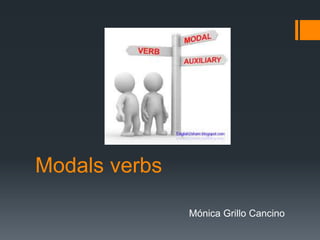
Modals verbs
Mónica Grillo Cancino
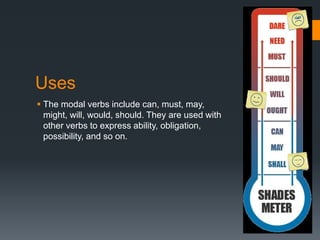
Uses
 The modal verbs include can, must, may,
might, will, would, should. They are used with
other verbs to express ability, obligation,
possibility, and so on.
Modal verbs are unlike other verbs
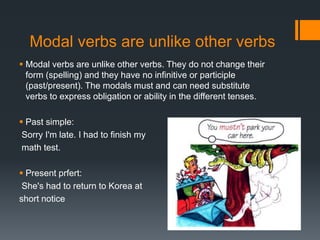
 Modal verbs are unlike other verbs. They do not change their
form (spelling) and they have no infinitive or participle
(past/present). The modals must and can need substitute
verbs to express obligation or ability in the different tenses.
 Past simple:
Sorry I'm late. I had to finish my
math test.
 Present prfert:
She's had to return to Korea at
short notice
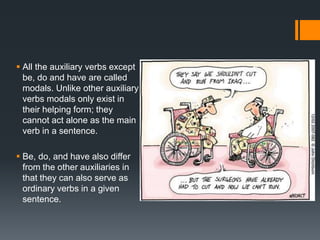
 All the auxiliary verbs except
be, do and have are called
modals. Unlike other auxiliary
verbs modals only exist in
their helping form; they
cannot act alone as the main
verb in a sentence.
 Be, do, and have also differ
from the other auxiliaries in
that they can also serve as
ordinary verbs in a given
sentence.
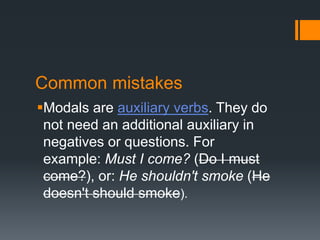
Common mistakes
Modals are auxiliary verbs. They do
not need an additional auxiliary in
negatives or questions. For
example: Must I come? (Do I must
come?), or: He shouldn't smoke (He
doesn't should smoke).
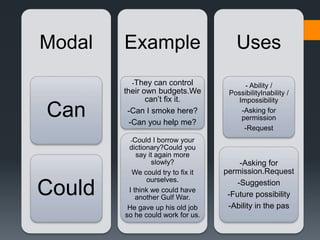
Modal
Can
Could
Example
-They can control
their own budgets.We
can’t fix it.
-Can I smoke here?
-Can you help me?
-Could I borrow your
dictionary?Could you
say it again more
slowly?
We could try to fix it
ourselves.
I think we could have
another Gulf War.
He gave up his old job
so he could work for us.
Uses
- Ability /
PossibilityInability /
Impossibility
-Asking for
permission
-Request
-Asking for
permission.Request
-Suggestion
-Future possibility
-Ability in the pas
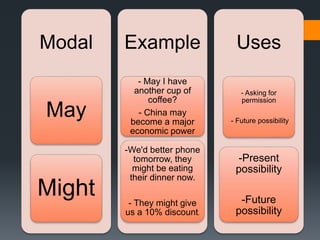
Modal
May
Might
Example
- May I have
another cup of
coffee?
- China may
become a major
economic power
-We'd better phone
tomorrow, they
might be eating
their dinner now.
- They might give
us a 10% discount.
Uses
- Asking for
permission
- Future possibility
-Present
possibility
-Future
possibility
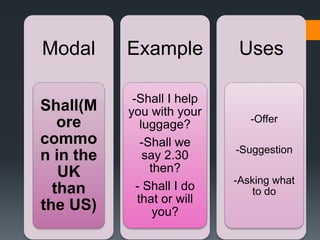
Modal
Shall(M
ore
commo
n in the
UK
than
the US)
Example
-Shall I help
you with your
luggage?
-Shall we
say 2.30
then?
- Shall I do
that or will
you?
Uses
-Offer
-Suggestion
-Asking what
to do
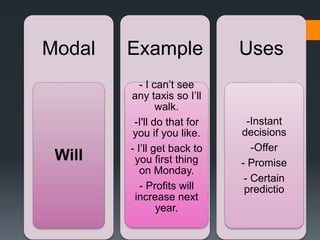
Modal
Will
Example
- I can’t see
any taxis so I’ll
walk.
-I'll do that for
you if you like.
- I’ll get back to
you first thing
on Monday.
- Profits will
increase next
year.
Uses
-Instant
decisions
-Offer
- Promise
- Certain
predictio
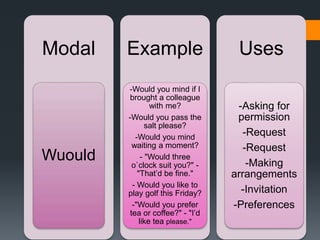
Modal
Wuould
Example
-Would you mind if I
brought a colleague
with me?
-Would you pass the
salt please?
-Would you mind
waiting a moment?
- "Would three
o`clock suit you?" -
"That’d be fine."
- Would you like to
play golf this Friday?
-"Would you prefer
tea or coffee?" - "I’d
like tea please."
Uses
-Asking for
permission
-Request
-Request
-Making
arrangements
-Invitation
-Preferences
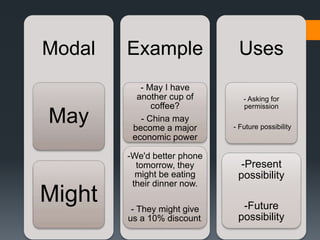
Modal
May
Might
Example
- May I have
another cup of
coffee?
- China may
become a major
economic power
-We'd better phone
tomorrow, they
might be eating
their dinner now.
- They might give
us a 10% discount.
Uses
- Asking for
permission
- Future possibility
-Present
possibility
-Future
possibility
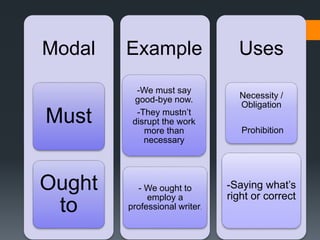
Modal
Must
Ought
to
Example
-We must say
good-bye now.
-They mustn’t
disrupt the work
more than
necessary
- We ought to
employ a
professional writer.
Uses
Necessity /
Obligation
Prohibition
-Saying what’s
right or correct

Modals verbs

  • 1.
  • 2.
    Uses  The modalverbs include can, must, may, might, will, would, should. They are used with other verbs to express ability, obligation, possibility, and so on.
  • 3.
    Modal verbs areunlike other verbs  Modal verbs are unlike other verbs. They do not change their form (spelling) and they have no infinitive or participle (past/present). The modals must and can need substitute verbs to express obligation or ability in the different tenses.  Past simple: Sorry I'm late. I had to finish my math test.  Present prfert: She's had to return to Korea at short notice
  • 4.
     All theauxiliary verbs except be, do and have are called modals. Unlike other auxiliary verbs modals only exist in their helping form; they cannot act alone as the main verb in a sentence.  Be, do, and have also differ from the other auxiliaries in that they can also serve as ordinary verbs in a given sentence.
  • 5.
    Common mistakes Modals areauxiliary verbs. They do not need an additional auxiliary in negatives or questions. For example: Must I come? (Do I must come?), or: He shouldn't smoke (He doesn't should smoke).
  • 6.
    Modal Can Could Example -They can control theirown budgets.We can’t fix it. -Can I smoke here? -Can you help me? -Could I borrow your dictionary?Could you say it again more slowly? We could try to fix it ourselves. I think we could have another Gulf War. He gave up his old job so he could work for us. Uses - Ability / PossibilityInability / Impossibility -Asking for permission -Request -Asking for permission.Request -Suggestion -Future possibility -Ability in the pas
  • 7.
    Modal May Might Example - May Ihave another cup of coffee? - China may become a major economic power -We'd better phone tomorrow, they might be eating their dinner now. - They might give us a 10% discount. Uses - Asking for permission - Future possibility -Present possibility -Future possibility
  • 8.
    Modal Shall(M ore commo n in the UK than theUS) Example -Shall I help you with your luggage? -Shall we say 2.30 then? - Shall I do that or will you? Uses -Offer -Suggestion -Asking what to do
  • 9.
    Modal Will Example - I can’tsee any taxis so I’ll walk. -I'll do that for you if you like. - I’ll get back to you first thing on Monday. - Profits will increase next year. Uses -Instant decisions -Offer - Promise - Certain predictio
  • 10.
    Modal Wuould Example -Would you mindif I brought a colleague with me? -Would you pass the salt please? -Would you mind waiting a moment? - "Would three o`clock suit you?" - "That’d be fine." - Would you like to play golf this Friday? -"Would you prefer tea or coffee?" - "I’d like tea please." Uses -Asking for permission -Request -Request -Making arrangements -Invitation -Preferences
  • 11.
    Modal May Might Example - May Ihave another cup of coffee? - China may become a major economic power -We'd better phone tomorrow, they might be eating their dinner now. - They might give us a 10% discount. Uses - Asking for permission - Future possibility -Present possibility -Future possibility
  • 12.
    Modal Must Ought to Example -We must say good-byenow. -They mustn’t disrupt the work more than necessary - We ought to employ a professional writer. Uses Necessity / Obligation Prohibition -Saying what’s right or correct