
Modal auxiliaries
FATIHA ROYAN
XI TKJ 2
The modal auxiliary can is used :

           • to express ability (in the sense of being able to do
1. CAN..

              something or knowing how to do something).

           • to expression permission (in the sense of being

              allowed or permitted to do something).

           • to express theoretical possibility.
(+)   I can speak English very well.
EXAMPLE..

            (−)   They can’t come to her party

                  tonight.

            (?)   Can I meet you at the bus stop this

                  morning?
The modal auxiliary could is used :

             • to express an ability in the past.
2. COULD..


             • to express past or future permission.

             • to express present possibility.

             • to express possibility or ability in contingent

                circumstances:
(+)   I could always play “congklak”
EXAMPLE..
                  when I was child.

            (−)   I couldn’t play soccer well.

            (?)   Could I see your new doll?
Will can be used :

            • to express willingness:
3. WILL..


            • to express intention (especially in the first person):

            • to express prediction : specific, timeless, and

               habitual
(+)   I will sweep the floor.
EXAMPLE..

            (−)   I won’t come to your office

                  tomorrow.

            (?)   Will you join us to go to the

                  movies?
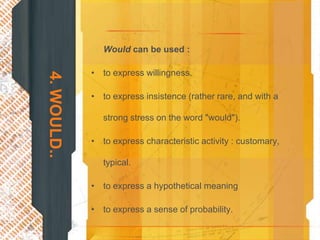
Would can be used :

             • to express willingness.
4. WOULD..


             • to express insistence (rather rare, and with a

                strong stress on the word "would").

             • to express characteristic activity : customary,

                typical.

             • to express a hypothetical meaning

             • to express a sense of probability.
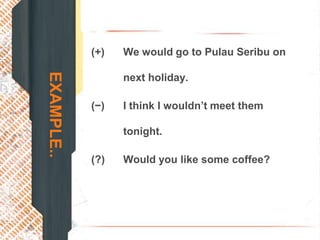
(+)   We would go to Pulau Seribu on
EXAMPLE..
                  next holiday.

            (−)   I think I wouldn’t meet them

                  tonight.

            (?)   Would you like some coffee?
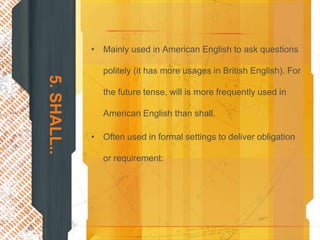
• Mainly used in American English to ask questions

                politely (it has more usages in British English). For
5. SHALL..

                the future tense, will is more frequently used in

                American English than shall.

             • Often used in formal settings to deliver obligation

                or requirement:
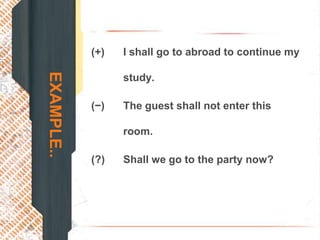
(+)   I shall go to abroad to continue my
EXAMPLE..
                  study.

            (−)   The guest shall not enter this

                  room.

            (?)   Shall we go to the party now?
Should can be used :

            • in auxiliary functions to express an opinion,
6. SHOULD

               suggestion, preference, or idea.

            • to express that you wish something had

               happened but it didn’t or couldn’t (should + have +

               past participle).

            • to ask for someone’s opinion.

            • to say something expected or correct.
(+)   You have toothache, you should
EXAMPLE..
                  go to a dentist.

            (−)   You shouldn’t wear expensive

                  jewelry.

            (?)   Should I teke a lots of money for

                  travel?
7. HAVE TO..      Have to can be used :

               • to express a strong obligation. I have to arrive at

                  work at 9 sharp. My boss is very strict.

               • In British English, we often use 'have got to' to

                  mean the same as 'have to'.

               • We can also use ' will have to' to talk about strong

                  obligations.
(+)   I have to take this book back to the

                  library.
EXAMPLE..

            (−)   You have not to listen this music.

            (?)   Have I to pay attention to you?
Must is most commonly used :

            • to express certainty.
8. MUST..


            • to express necessity or strong recommendation,

               although native speakers prefer the more flexible

               form "have to."

            • "Must not" can be used to prohibit actions.
(+)   You must to obey the rules in the
EXAMPLE..
                  class.

            (−)   You must not chat in the class.

            (?)   Must I listen the teacher?
1. I .... go to London tomorrow. (shall, can,

                could)
EXERCISE..

             2. You .... take an aspirin. (would, should, could)

             3. .... you please help me? (can, should, would)

             4. .... you mind clean the whiteboard? (would,

                will, can)

             5. I .... do my homework soon. (must, will,

                should)
The modals are used to do things like
FUNCTION..
             talking about :

             1. Ability

             2. Permission

             3. Request

             4. Suggestion and advice

             5. Offers and invitation
• I can swim like a fish.

            • I couldn’t dance very well.
ABILITY..


            • She can speak several languages.
• Can we go home now?
PERMISSION..

               • Can I ask a question, please?

               • You can go home now if you like.
• Could you take a message, please?
REQUEST..

            • Will you carry this for me, please?

            • Coul I have my bill, please?
• You shouldn’t take a taxi for travel.

           • You should take a warm coat.
ADVICE..


           • You should use credit card to buy

             something.
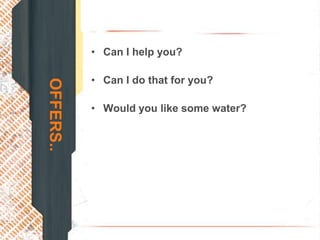
• Can I help you?

           • Can I do that for you?
OFFERS..


           • Would you like some water?
• http://www.talkenglish.com/Grammar/auxiliary

             -verbs-will-would-shall-should.aspx
SOURCE..

           • http://grammar.ccc.commnet.edu/grammar/au

             xiliary.htm

           • http://ismailmidi.com/english-130-auxiliary-

             verbs.html

           • http://www.englishgrammarsecrets.com/must

             haveto/menu.php
THE END..


            THANKS FOR YOUR
              ATTENTION ^^

Modal auxiliaries

  • 1.
  • 2.
    The modal auxiliarycan is used : • to express ability (in the sense of being able to do 1. CAN.. something or knowing how to do something). • to expression permission (in the sense of being allowed or permitted to do something). • to express theoretical possibility.
  • 3.
    (+) I can speak English very well. EXAMPLE.. (−) They can’t come to her party tonight. (?) Can I meet you at the bus stop this morning?
  • 4.
    The modal auxiliarycould is used : • to express an ability in the past. 2. COULD.. • to express past or future permission. • to express present possibility. • to express possibility or ability in contingent circumstances:
  • 5.
    (+) I could always play “congklak” EXAMPLE.. when I was child. (−) I couldn’t play soccer well. (?) Could I see your new doll?
  • 6.
    Will can beused : • to express willingness: 3. WILL.. • to express intention (especially in the first person): • to express prediction : specific, timeless, and habitual
  • 7.
    (+) I will sweep the floor. EXAMPLE.. (−) I won’t come to your office tomorrow. (?) Will you join us to go to the movies?
  • 8.
    Would can beused : • to express willingness. 4. WOULD.. • to express insistence (rather rare, and with a strong stress on the word "would"). • to express characteristic activity : customary, typical. • to express a hypothetical meaning • to express a sense of probability.
  • 9.
    (+) We would go to Pulau Seribu on EXAMPLE.. next holiday. (−) I think I wouldn’t meet them tonight. (?) Would you like some coffee?
  • 10.
    • Mainly usedin American English to ask questions politely (it has more usages in British English). For 5. SHALL.. the future tense, will is more frequently used in American English than shall. • Often used in formal settings to deliver obligation or requirement:
  • 11.
    (+) I shall go to abroad to continue my EXAMPLE.. study. (−) The guest shall not enter this room. (?) Shall we go to the party now?
  • 12.
    Should can beused : • in auxiliary functions to express an opinion, 6. SHOULD suggestion, preference, or idea. • to express that you wish something had happened but it didn’t or couldn’t (should + have + past participle). • to ask for someone’s opinion. • to say something expected or correct.
  • 13.
    (+) You have toothache, you should EXAMPLE.. go to a dentist. (−) You shouldn’t wear expensive jewelry. (?) Should I teke a lots of money for travel?
  • 14.
    7. HAVE TO.. Have to can be used : • to express a strong obligation. I have to arrive at work at 9 sharp. My boss is very strict. • In British English, we often use 'have got to' to mean the same as 'have to'. • We can also use ' will have to' to talk about strong obligations.
  • 15.
    (+) I have to take this book back to the library. EXAMPLE.. (−) You have not to listen this music. (?) Have I to pay attention to you?
  • 16.
    Must is mostcommonly used : • to express certainty. 8. MUST.. • to express necessity or strong recommendation, although native speakers prefer the more flexible form "have to." • "Must not" can be used to prohibit actions.
  • 17.
    (+) You must to obey the rules in the EXAMPLE.. class. (−) You must not chat in the class. (?) Must I listen the teacher?
  • 18.
    1. I ....go to London tomorrow. (shall, can, could) EXERCISE.. 2. You .... take an aspirin. (would, should, could) 3. .... you please help me? (can, should, would) 4. .... you mind clean the whiteboard? (would, will, can) 5. I .... do my homework soon. (must, will, should)
  • 19.
    The modals areused to do things like FUNCTION.. talking about : 1. Ability 2. Permission 3. Request 4. Suggestion and advice 5. Offers and invitation
  • 20.
    • I canswim like a fish. • I couldn’t dance very well. ABILITY.. • She can speak several languages.
  • 21.
    • Can wego home now? PERMISSION.. • Can I ask a question, please? • You can go home now if you like.
  • 22.
    • Could youtake a message, please? REQUEST.. • Will you carry this for me, please? • Coul I have my bill, please?
  • 23.
    • You shouldn’ttake a taxi for travel. • You should take a warm coat. ADVICE.. • You should use credit card to buy something.
  • 24.
    • Can Ihelp you? • Can I do that for you? OFFERS.. • Would you like some water?
  • 25.
    • http://www.talkenglish.com/Grammar/auxiliary -verbs-will-would-shall-should.aspx SOURCE.. • http://grammar.ccc.commnet.edu/grammar/au xiliary.htm • http://ismailmidi.com/english-130-auxiliary- verbs.html • http://www.englishgrammarsecrets.com/must haveto/menu.php
  • 26.
    THE END.. THANKS FOR YOUR ATTENTION ^^