Modal and Auxiliary
Verbs
AUXILIARIES and MODALS
 The verbs be (am, is, was, etc), have and do, when used with ordinary verbs
to make tenses, passive forms, questions and negatives, are called auxiliary
verbs or auxiliaries. (Auxiliary = helping)
 The verbs can, could, may, might, will, would, shall, should, must and
ought are called modal verbs or modals. They are used before ordinary verbs
and express meanings such as permission, possibility, certainty and necessity.
Need and dare can sometimes be used like modal verbs.
 Modals are often included in the group of auxiliaries. In some grammars they
are called “modal auxiliaries”.
 The modals can, could, may, might, shall,
should, will, would, must and ought are
termed Defective Verbs, because some parts
are wanting in them. They have no -s in the
third person singular; they have no infinitive
and -ing forms.
be
 The auxiliary be is used:
(1) In the formation of the continuous tenses; as,
He is working. I was writing.
(2) In the formation of the passive; as, The gate was opened.
Be followed by the infinitive is used (1) To indicate a plan, arrangement, or
agreement; as,
I am to sec him tomorrow. We are to be married next month.
(2) To denote command; as, You are to write your name at the top of each sheet of
paper. Mother says you are to go to market at once.
Be is used in the past tense with the perfect infinitive to indicate an arrangement that
was made but not carried out; as, They were to have been married last month but
had to postpone the marriage until June.
Have
 The auxiliary have is used in the formation of the perfect tenses; as,
 He has worked. He has been working.
 Have to is used with the infinitive to indicate obligation; as, I have to be there
by five o'clock. He has to move the furniture himself.
 The past form had to is used to express obligation in the past. I had to be
there by five o'clock. He had to move the furniture himself.
 In negatives and questions, have to and had to are used with do, does, did; as,
They have to go -- They don't have to go. Do they have to go?
 He has to go. -- He doesn't have to go. Does he have to go?
 He had to go. -- He didn't have to go. Did he have to go?
Do
 The auxiliary do is used:
(1) To form the negative and interrogative of the simple present and
simple past tenses of ordinary verbs; as,
He doesn't work. He didn’t work. Does he work? Did he work?
(1) To avoid repetition of a previous ordinary verb; as,
Do you know him? Yes, I do.
She sings well. Yes, she does.
You met him, didn't you?
He eats fish and so do you.
Do
 Do is also used to emphasize the affirmative nature of a
statement; as, You do look pale. I told him not to go, but he did
go.
 In the imperative, do makes a request or invitation more
persuasive; as,
 Do be quiet,
 Oh, do come! It's going to be such fun.
 In such cases do is strongly stressed.
Can, Could, May, Might
 Can usually expresses ability or capacity;
 as, I can swim across the river. He can work this sum. Can you lift this box?
 Can and may are used to express permission. May is rather formal. You
can/may go now. Can/May I borrow your umbrella?
 May is used to express possibility in affirmative sentences. Can is used in the
corresponding interrogative and negative sentences.
 It may rain tomorrow. He may be at home.
 Can this be true? It cannot be true.
 Compare 'It cannot be true' with 'It may not be true'.
 Cannot denotes impossibility, while may not denotes improbability.
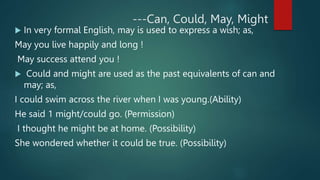
---Can, Could, May, Might
 In very formal English, may is used to express a wish; as,
May you live happily and long !
May success attend you !
 Could and might are used as the past equivalents of can and
may; as,
I could swim across the river when I was young.(Ability)
He said 1 might/could go. (Permission)
I thought he might be at home. (Possibility)
She wondered whether it could be true. (Possibility)
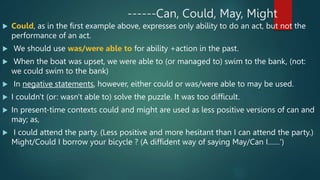
------Can, Could, May, Might
 Could, as in the first example above, expresses only ability to do an act, but not the
performance of an act.
 We should use was/were able to for ability +action in the past.
 When the boat was upset, we were able to (or managed to) swim to the bank, (not:
we could swim to the bank)
 In negative statements, however, either could or was/were able to may be used.
 I couldn't (or: wasn't able to) solve the puzzle. It was too difficult.
 In present-time contexts could and might are used as less positive versions of can and
may; as,
 I could attend the party. (Less positive and more hesitant than I can attend the party.)
Might/Could I borrow your bicycle ? (A diffident way of saying May/Can I……')
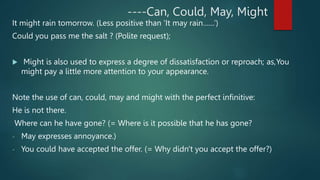
----Can, Could, May, Might
It might rain tomorrow. (Less positive than 'It may rain……’)
Could you pass me the salt ? (Polite request);
 Might is also used to express a degree of dissatisfaction or reproach; as,You
might pay a little more attention to your appearance.
Note the use of can, could, may and might with the perfect infinitive:
He is not there.
Where can he have gone? (= Where is it possible that he has gone?
- May expresses annoyance.)
- You could have accepted the offer. (= Why didn't you accept the offer?)
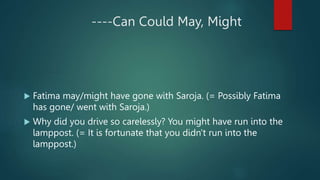
----Can Could May, Might
 Fatima may/might have gone with Saroja. (= Possibly Fatima
has gone/ went with Saroja.)
 Why did you drive so carelessly? You might have run into the
lamppost. (= It is fortunate that you didn't run into the
lamppost.)
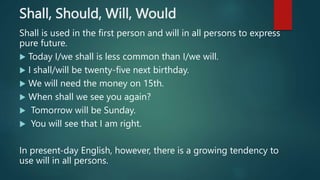
Shall, Should, Will, Would
Shall is used in the first person and will in all persons to express
pure future.
 Today I/we shall is less common than I/we will.
 I shall/will be twenty-five next birthday.
 We will need the money on 15th.
 When shall we see you again?
 Tomorrow will be Sunday.
 You will see that I am right.
In present-day English, however, there is a growing tendency to
use will in all persons.
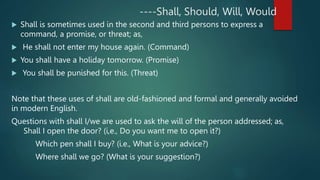
----Shall, Should, Will, Would
 Shall is sometimes used in the second and third persons to express a
command, a promise, or threat; as,
 He shall not enter my house again. (Command)
 You shall have a holiday tomorrow. (Promise)
 You shall be punished for this. (Threat)
Note that these uses of shall are old-fashioned and formal and generally avoided
in modern English.
Questions with shall I/we are used to ask the will of the person addressed; as,
Shall I open the door? (i,e., Do you want me to open it?)
Which pen shall I buy? (i.e., What is your advice?)
Where shall we go? (What is your suggestion?)
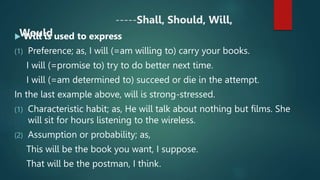
-----Shall, Should, Will,
Would
 Will is used to express
(1) Preference; as, I will (=am willing to) carry your books.
I will (=promise to) try to do better next time.
I will (=am determined to) succeed or die in the attempt.
In the last example above, will is strong-stressed.
(1) Characteristic habit; as, He will talk about nothing but films. She
will sit for hours listening to the wireless.
(2) Assumption or probability; as,
This will be the book you want, I suppose.
That will be the postman, I think.
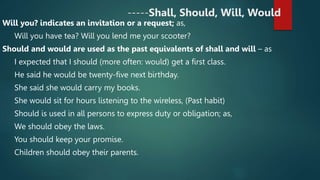
-----Shall, Should, Will, Would
Will you? indicates an invitation or a request; as,
Will you have tea? Will you lend me your scooter?
Should and would are used as the past equivalents of shall and will – as
I expected that I should (more often: would) get a first class.
He said he would be twenty-five next birthday.
She said she would carry my books.
She would sit for hours listening to the wireless, (Past habit)
Should is used in all persons to express duty or obligation; as,
We should obey the laws.
You should keep your promise.
Children should obey their parents.
---Shall, Should, Will, Would
 In clauses of condition, should is used to express a supposition that may not
be true.
 If it should rain, they will not come.
 If he should see me here, he will be annoyed.
 Should and would are also used as in the examples below.
(i) I should (or: would) like you to help her. ('should/would like' is a polite
form of 'want').
(ii) Would you lend me your scooter, please? ('Would you?' is more polite
than 'Will you?')
(iii) You should have been more careful. (Should + perfect infinitive
indicates a past obligation that was not fulfilled).
(iv) He should be in the library now. (Expresses probability)
(v) I wish you would not chatter so much. (Would after wish expresses" a
strong desire).
Must, Ought to
 Must is used to express necessity or obligation.
 You must improve your spelling.
 We must get up early.
Must refers to the present or the near future. To talk about the past we use
had to (the past form of have to); must has no past form.
Yesterday we had to get up early.
Must is often used when the obligation comes from the speaker. When the
obligation comes from somewhere else, have to is often used.
---must, ought to
 Compare:
 I must be on a diet. (It is my own idea.)
 I have to be on a diet. (The doctor has told me to be on a diet.)
 Must can also express logical certainty.
 Living in such crowded conditions must be difficult. (=1 am sure it is difficult.)
 She must have left already. (I am sure she has left already).
 Ought (to) expresses moral obligation or desirability; as,
 We ought to love our neighbours. We ought to help him. You ought to know better.
 Ought (to) can also be used to express probability. Prices ought to come down soon.
This book ought to be very useful.
Used (to), Need, Dare
The auxiliary used (to) expresses a discontinued habit.
There used to be a house there.
I used to live there when I was a boy.
Strictly speaking, used (to) is an auxiliary verb.
The auxiliary need, denoting necessity or obligation, can be conjugated
with or without do.
When conjugated without do, it has no -s and -ed forms and is used with
an infinitive without to only in negative and interrogative sentences and in
sentences that contain semi-negative words like 'scarcely' and 'hardly'.
He need not go. (= It is not necessary for him to go)
Need I write to him? I need hardly take his help.
---use(to), need, dare
Compare: (i) I didn't need to buy it. (=It was not necessary for me to buy it
and I didn't buy it.)
(ii) I needn't have bought it. (=It was not necessary for me to buy it, but I
bought it),
The auxiliary dare (=be brave enough to), as distinct from the ordinary
verb dare (=challenge), does not take -s in the third person singular present
tense.
It is generally used in negative and interrogative sentences.
• He dare not take such a step. • How dare you contradict me?
• He dared not do it. • He doesn't dare speak to me
Practice:
Choose the correct alternative :
1. I don't think I (shall, should, can) be able to go.
2. He (shall, will, dare) not pay unless he is compelled.
3. You (should, would, ought) be punctual.
4. I wish you (should, would, must) tell me earlier.
5. (Shall, should would) you please help me with this?
6. You (ought, should, must) to pay your debts.
7. He said T (can, might, should) use his telephone at any time.
8. If you (shall, should, would) see him, give him my regards.
9. He (need, dare, would) not ask for a rise, for fear of losing his job.
10. I (needn't to see, needn't have seen, didn't need to see) him, so I sent a letter.
11. To save my life, I ran fast, and (would, could, was able to) reach station.
Thanks!

Modal and Auxiliary Verbs.pptx

  • 1.
  • 2.
    AUXILIARIES and MODALS The verbs be (am, is, was, etc), have and do, when used with ordinary verbs to make tenses, passive forms, questions and negatives, are called auxiliary verbs or auxiliaries. (Auxiliary = helping)  The verbs can, could, may, might, will, would, shall, should, must and ought are called modal verbs or modals. They are used before ordinary verbs and express meanings such as permission, possibility, certainty and necessity. Need and dare can sometimes be used like modal verbs.  Modals are often included in the group of auxiliaries. In some grammars they are called “modal auxiliaries”.
  • 3.
     The modalscan, could, may, might, shall, should, will, would, must and ought are termed Defective Verbs, because some parts are wanting in them. They have no -s in the third person singular; they have no infinitive and -ing forms.
  • 4.
    be  The auxiliarybe is used: (1) In the formation of the continuous tenses; as, He is working. I was writing. (2) In the formation of the passive; as, The gate was opened. Be followed by the infinitive is used (1) To indicate a plan, arrangement, or agreement; as, I am to sec him tomorrow. We are to be married next month. (2) To denote command; as, You are to write your name at the top of each sheet of paper. Mother says you are to go to market at once. Be is used in the past tense with the perfect infinitive to indicate an arrangement that was made but not carried out; as, They were to have been married last month but had to postpone the marriage until June.
  • 5.
    Have  The auxiliaryhave is used in the formation of the perfect tenses; as,  He has worked. He has been working.  Have to is used with the infinitive to indicate obligation; as, I have to be there by five o'clock. He has to move the furniture himself.  The past form had to is used to express obligation in the past. I had to be there by five o'clock. He had to move the furniture himself.  In negatives and questions, have to and had to are used with do, does, did; as, They have to go -- They don't have to go. Do they have to go?  He has to go. -- He doesn't have to go. Does he have to go?  He had to go. -- He didn't have to go. Did he have to go?
  • 6.
    Do  The auxiliarydo is used: (1) To form the negative and interrogative of the simple present and simple past tenses of ordinary verbs; as, He doesn't work. He didn’t work. Does he work? Did he work? (1) To avoid repetition of a previous ordinary verb; as, Do you know him? Yes, I do. She sings well. Yes, she does. You met him, didn't you? He eats fish and so do you.
  • 7.
    Do  Do isalso used to emphasize the affirmative nature of a statement; as, You do look pale. I told him not to go, but he did go.  In the imperative, do makes a request or invitation more persuasive; as,  Do be quiet,  Oh, do come! It's going to be such fun.  In such cases do is strongly stressed.
  • 8.
    Can, Could, May,Might  Can usually expresses ability or capacity;  as, I can swim across the river. He can work this sum. Can you lift this box?  Can and may are used to express permission. May is rather formal. You can/may go now. Can/May I borrow your umbrella?  May is used to express possibility in affirmative sentences. Can is used in the corresponding interrogative and negative sentences.  It may rain tomorrow. He may be at home.  Can this be true? It cannot be true.  Compare 'It cannot be true' with 'It may not be true'.  Cannot denotes impossibility, while may not denotes improbability.
  • 9.
    ---Can, Could, May,Might  In very formal English, may is used to express a wish; as, May you live happily and long ! May success attend you !  Could and might are used as the past equivalents of can and may; as, I could swim across the river when I was young.(Ability) He said 1 might/could go. (Permission) I thought he might be at home. (Possibility) She wondered whether it could be true. (Possibility)
  • 10.
    ------Can, Could, May,Might  Could, as in the first example above, expresses only ability to do an act, but not the performance of an act.  We should use was/were able to for ability +action in the past.  When the boat was upset, we were able to (or managed to) swim to the bank, (not: we could swim to the bank)  In negative statements, however, either could or was/were able to may be used.  I couldn't (or: wasn't able to) solve the puzzle. It was too difficult.  In present-time contexts could and might are used as less positive versions of can and may; as,  I could attend the party. (Less positive and more hesitant than I can attend the party.) Might/Could I borrow your bicycle ? (A diffident way of saying May/Can I……')
  • 11.
    ----Can, Could, May,Might It might rain tomorrow. (Less positive than 'It may rain……’) Could you pass me the salt ? (Polite request);  Might is also used to express a degree of dissatisfaction or reproach; as,You might pay a little more attention to your appearance. Note the use of can, could, may and might with the perfect infinitive: He is not there. Where can he have gone? (= Where is it possible that he has gone? - May expresses annoyance.) - You could have accepted the offer. (= Why didn't you accept the offer?)
  • 12.
    ----Can Could May,Might  Fatima may/might have gone with Saroja. (= Possibly Fatima has gone/ went with Saroja.)  Why did you drive so carelessly? You might have run into the lamppost. (= It is fortunate that you didn't run into the lamppost.)
  • 13.
    Shall, Should, Will,Would Shall is used in the first person and will in all persons to express pure future.  Today I/we shall is less common than I/we will.  I shall/will be twenty-five next birthday.  We will need the money on 15th.  When shall we see you again?  Tomorrow will be Sunday.  You will see that I am right. In present-day English, however, there is a growing tendency to use will in all persons.
  • 14.
    ----Shall, Should, Will,Would  Shall is sometimes used in the second and third persons to express a command, a promise, or threat; as,  He shall not enter my house again. (Command)  You shall have a holiday tomorrow. (Promise)  You shall be punished for this. (Threat) Note that these uses of shall are old-fashioned and formal and generally avoided in modern English. Questions with shall I/we are used to ask the will of the person addressed; as, Shall I open the door? (i,e., Do you want me to open it?) Which pen shall I buy? (i.e., What is your advice?) Where shall we go? (What is your suggestion?)
  • 15.
    -----Shall, Should, Will, Would Will is used to express (1) Preference; as, I will (=am willing to) carry your books. I will (=promise to) try to do better next time. I will (=am determined to) succeed or die in the attempt. In the last example above, will is strong-stressed. (1) Characteristic habit; as, He will talk about nothing but films. She will sit for hours listening to the wireless. (2) Assumption or probability; as, This will be the book you want, I suppose. That will be the postman, I think.
  • 16.
    -----Shall, Should, Will,Would Will you? indicates an invitation or a request; as, Will you have tea? Will you lend me your scooter? Should and would are used as the past equivalents of shall and will – as I expected that I should (more often: would) get a first class. He said he would be twenty-five next birthday. She said she would carry my books. She would sit for hours listening to the wireless, (Past habit) Should is used in all persons to express duty or obligation; as, We should obey the laws. You should keep your promise. Children should obey their parents.
  • 17.
    ---Shall, Should, Will,Would  In clauses of condition, should is used to express a supposition that may not be true.  If it should rain, they will not come.  If he should see me here, he will be annoyed.  Should and would are also used as in the examples below. (i) I should (or: would) like you to help her. ('should/would like' is a polite form of 'want'). (ii) Would you lend me your scooter, please? ('Would you?' is more polite than 'Will you?') (iii) You should have been more careful. (Should + perfect infinitive indicates a past obligation that was not fulfilled). (iv) He should be in the library now. (Expresses probability) (v) I wish you would not chatter so much. (Would after wish expresses" a strong desire).
  • 18.
    Must, Ought to Must is used to express necessity or obligation.  You must improve your spelling.  We must get up early. Must refers to the present or the near future. To talk about the past we use had to (the past form of have to); must has no past form. Yesterday we had to get up early. Must is often used when the obligation comes from the speaker. When the obligation comes from somewhere else, have to is often used.
  • 19.
    ---must, ought to Compare:  I must be on a diet. (It is my own idea.)  I have to be on a diet. (The doctor has told me to be on a diet.)  Must can also express logical certainty.  Living in such crowded conditions must be difficult. (=1 am sure it is difficult.)  She must have left already. (I am sure she has left already).  Ought (to) expresses moral obligation or desirability; as,  We ought to love our neighbours. We ought to help him. You ought to know better.  Ought (to) can also be used to express probability. Prices ought to come down soon. This book ought to be very useful.
  • 20.
    Used (to), Need,Dare The auxiliary used (to) expresses a discontinued habit. There used to be a house there. I used to live there when I was a boy. Strictly speaking, used (to) is an auxiliary verb. The auxiliary need, denoting necessity or obligation, can be conjugated with or without do. When conjugated without do, it has no -s and -ed forms and is used with an infinitive without to only in negative and interrogative sentences and in sentences that contain semi-negative words like 'scarcely' and 'hardly'. He need not go. (= It is not necessary for him to go) Need I write to him? I need hardly take his help.
  • 21.
    ---use(to), need, dare Compare:(i) I didn't need to buy it. (=It was not necessary for me to buy it and I didn't buy it.) (ii) I needn't have bought it. (=It was not necessary for me to buy it, but I bought it), The auxiliary dare (=be brave enough to), as distinct from the ordinary verb dare (=challenge), does not take -s in the third person singular present tense. It is generally used in negative and interrogative sentences. • He dare not take such a step. • How dare you contradict me? • He dared not do it. • He doesn't dare speak to me
  • 22.
    Practice: Choose the correctalternative : 1. I don't think I (shall, should, can) be able to go. 2. He (shall, will, dare) not pay unless he is compelled. 3. You (should, would, ought) be punctual. 4. I wish you (should, would, must) tell me earlier. 5. (Shall, should would) you please help me with this? 6. You (ought, should, must) to pay your debts. 7. He said T (can, might, should) use his telephone at any time. 8. If you (shall, should, would) see him, give him my regards. 9. He (need, dare, would) not ask for a rise, for fear of losing his job. 10. I (needn't to see, needn't have seen, didn't need to see) him, so I sent a letter. 11. To save my life, I ran fast, and (would, could, was able to) reach station.
  • 23.