Modal
Auxiliaries
What’s Modal?!
Modal Auxiliaries digunakan untuk menambah makna
khusus pada kata kerja utamanya (main verb).
Misalnya: menunjukkan kemampuan (ability), ijin
(permission), kemungkinan (possibility), dan lain-lain.
2
Jenis-jenis modalitas
Modalitas epistemic
Modalitas ini berkaitan
dengan kemungkinan dari
proposisi yang benar atau
tidak benar, termasuk juga
dengan kemungkinan dan
kepastian.
Modalitas deontic
Modalitas ini berkaitan
dengan kemungkinan dan
kebutuhan dalam hal
kebebasan untuk
bertindak, termasuk juga
izin dan kewajiban.
Modalitas dinamis
Modalitas dinamis ini
agak sedikit mirip dengan
modalitas deontik, namun,
modalitas dinamis
merupakan bersifat
internal, seperti
kemampuan atau kemauan
dari subjek untuk
bertindak.
3
⬗ ‘You must be tired’ (kamu pasti lelah), dengan kata lain si
penutur berpikir bahwa ‘kamu’ pasti sedang lelah.
⬗ ‘You must leave, now’ (Kamu harus pergi sekarang), dengan kata
lain si penutur mengharuskan atau memerintahkan ‘kamu’ untuk
segera pergi.
4
Kinds of Modal Aux. Verbs
5
• Showing Permission (Ijin)
• Showing Possibility
(kemungkinan)
• Showing Ability
(Kemampuan)
• Showing (Polite) Request
• Showing Permission
• Showing Possibility
(Kemungkinan)
• Showing offer
• Showing obligation
(keharusan/kewajiban)
• Showing certainty
• Showing a moral obligation
• Asking and giving opinion
• Showing hope in the present
or future
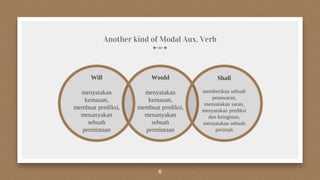
Another kind of Modal Aux. Verb
Would
menyatakan
kemauan,
membuat prediksi,
menanyakan
sebuah
permintaan
Will
menyatakan
kemauan,
membuat prediksi,
menanyakan
sebuah
permintaan
Shall
memberikan sebuah
penawaran,
menyatakan saran,
menyatakan prediksi
dan keinginan,
menyatakan sebuah
perintah
6
RUMUS MODAL VERB
Positif
They, we, I you, he, she, it + modal verbs + verb 1
Negatif
They, we, I you, he, she, it + modal verbs + not + verb 1
Interogatif
Modal verbs + They, we, I you, he, she, it + verb 1
7
Ciri-ciri Modal Auxiliaries
⬗ Modals don’t have an –s, -ed,
or ing ending. He can drive
(NOT: He cans drive)
⬗ Don’t use an infinitive with
modals. He can go. (NOT: He
can to go)
⬗ To form the negative, put
NOT after the modal. He
should not go.
8
Can/Could
Can you can a can as a canner
can can a can?
Can/Could as a permission, possibility, ability, and request
⬗ She can use my ruler for her math test.
⬗ You can have good scores if you prepare your test well.
⬗ When I was young, I could run very fast.
⬗ Could I use your car tomorrow?
10
May/Might
May/Might as permission, possibility, and offering
⬗ May I go to grandma’s house tomorrow morning?
⬗ It may rain today.
⬗ She might continue her studies next year.
⬗ May I help you?
12
Must/Have to
Must/Have to as obligation and certainty
⬗ I must study hard in order to pass the test.
⬗ I have to call him today or he will fire me.
⬗ A policeman stopped Husin on the freeway. He must have
been speeding.
⬗ You must be tired.
14
Should/Ought to
Must/Have to as obligation and certainty
⬗ You should respect your teachers.
⬗ He ought to visit his sick wife in the hospital.
⬗ What should I do to handle this?
⬗ Father left home an hour ago. He should be in the office
now.
16
Will/Would/Shall
Will/Would/Shall as willingness, prediction, request, offering, etc.
⬗ I will join the party if my father allows.
⬗ The president will join the meeting in Singapore next week.
⬗ We would come last night, if you had invited us.
⬗ Would you like something to drink?
⬗ Shall we meet again on sunday?
⬗ We shall remember this moment forever.
18
We … be careful with our work in order to get good mark.
might
could
would
should
19
20
The sky is very dark. It is going to rain. The children … bring their raincoat to go to school.
may
can
must
shall
Anti : Who is your English teacher?
Yana : Ms. Umi. She … speak English well.
Anti : Really?
Yana : Yes, she’s been in USA for about
two years.
can
could
able
ability
21
Asti : Yes, she’s suffering for a serious illness but her
husband hasn’t seen her yet.
Ira : As her husband, Mr. Usman … take care of her well.
can
must
should
might
22
23
Thanks!

Modal Aux.pptx

  • 1.
  • 2.
    What’s Modal?! Modal Auxiliariesdigunakan untuk menambah makna khusus pada kata kerja utamanya (main verb). Misalnya: menunjukkan kemampuan (ability), ijin (permission), kemungkinan (possibility), dan lain-lain. 2
  • 3.
    Jenis-jenis modalitas Modalitas epistemic Modalitasini berkaitan dengan kemungkinan dari proposisi yang benar atau tidak benar, termasuk juga dengan kemungkinan dan kepastian. Modalitas deontic Modalitas ini berkaitan dengan kemungkinan dan kebutuhan dalam hal kebebasan untuk bertindak, termasuk juga izin dan kewajiban. Modalitas dinamis Modalitas dinamis ini agak sedikit mirip dengan modalitas deontik, namun, modalitas dinamis merupakan bersifat internal, seperti kemampuan atau kemauan dari subjek untuk bertindak. 3
  • 4.
    ⬗ ‘You mustbe tired’ (kamu pasti lelah), dengan kata lain si penutur berpikir bahwa ‘kamu’ pasti sedang lelah. ⬗ ‘You must leave, now’ (Kamu harus pergi sekarang), dengan kata lain si penutur mengharuskan atau memerintahkan ‘kamu’ untuk segera pergi. 4
  • 5.
    Kinds of ModalAux. Verbs 5 • Showing Permission (Ijin) • Showing Possibility (kemungkinan) • Showing Ability (Kemampuan) • Showing (Polite) Request • Showing Permission • Showing Possibility (Kemungkinan) • Showing offer • Showing obligation (keharusan/kewajiban) • Showing certainty • Showing a moral obligation • Asking and giving opinion • Showing hope in the present or future
  • 6.
    Another kind ofModal Aux. Verb Would menyatakan kemauan, membuat prediksi, menanyakan sebuah permintaan Will menyatakan kemauan, membuat prediksi, menanyakan sebuah permintaan Shall memberikan sebuah penawaran, menyatakan saran, menyatakan prediksi dan keinginan, menyatakan sebuah perintah 6
  • 7.
    RUMUS MODAL VERB Positif They,we, I you, he, she, it + modal verbs + verb 1 Negatif They, we, I you, he, she, it + modal verbs + not + verb 1 Interogatif Modal verbs + They, we, I you, he, she, it + verb 1 7
  • 8.
    Ciri-ciri Modal Auxiliaries ⬗Modals don’t have an –s, -ed, or ing ending. He can drive (NOT: He cans drive) ⬗ Don’t use an infinitive with modals. He can go. (NOT: He can to go) ⬗ To form the negative, put NOT after the modal. He should not go. 8
  • 9.
    Can/Could Can you cana can as a canner can can a can?
  • 10.
    Can/Could as apermission, possibility, ability, and request ⬗ She can use my ruler for her math test. ⬗ You can have good scores if you prepare your test well. ⬗ When I was young, I could run very fast. ⬗ Could I use your car tomorrow? 10
  • 11.
  • 12.
    May/Might as permission,possibility, and offering ⬗ May I go to grandma’s house tomorrow morning? ⬗ It may rain today. ⬗ She might continue her studies next year. ⬗ May I help you? 12
  • 13.
  • 14.
    Must/Have to asobligation and certainty ⬗ I must study hard in order to pass the test. ⬗ I have to call him today or he will fire me. ⬗ A policeman stopped Husin on the freeway. He must have been speeding. ⬗ You must be tired. 14
  • 15.
  • 16.
    Must/Have to asobligation and certainty ⬗ You should respect your teachers. ⬗ He ought to visit his sick wife in the hospital. ⬗ What should I do to handle this? ⬗ Father left home an hour ago. He should be in the office now. 16
  • 17.
  • 18.
    Will/Would/Shall as willingness,prediction, request, offering, etc. ⬗ I will join the party if my father allows. ⬗ The president will join the meeting in Singapore next week. ⬗ We would come last night, if you had invited us. ⬗ Would you like something to drink? ⬗ Shall we meet again on sunday? ⬗ We shall remember this moment forever. 18
  • 19.
    We … becareful with our work in order to get good mark. might could would should 19
  • 20.
    20 The sky isvery dark. It is going to rain. The children … bring their raincoat to go to school. may can must shall
  • 21.
    Anti : Whois your English teacher? Yana : Ms. Umi. She … speak English well. Anti : Really? Yana : Yes, she’s been in USA for about two years. can could able ability 21
  • 22.
    Asti : Yes,she’s suffering for a serious illness but her husband hasn’t seen her yet. Ira : As her husband, Mr. Usman … take care of her well. can must should might 22
  • 23.