Modal Verbs What is Modal Verb?
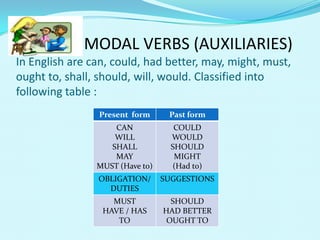
                 MODAL VERBS (AUXILIARIES)In English are can, could, had better, may, might, must, ought to, shall, should, will, would. Classified into following table :
The forms and meanings of modal verbs  Will         future timeCan                   ability May         permission Might        possibility  Should         suggestion Must         obligation
Video lesson Please you may click here to get more understanding about modal verbs.
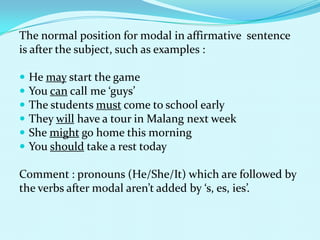
The normal position for modal in affirmative  sentence is after the subject, such as examples : He may start the game You can call me ‘guys’The students must come to school early They will have a tour in Malang next weekShe might go home this morningYou should take a rest today Comment : pronouns (He/She/It) which are followed by the verbs after modal aren’t added by ‘s, es, ies’.
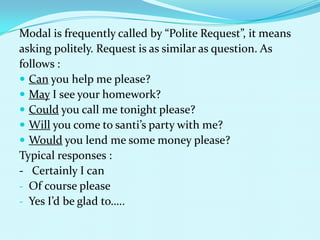
Modal is frequently called by “Polite Request”, it means asking politely. Request is as similar as question. As follows : Can you help me please? May I see your homework?Could you call me tonight please?Will you come to santi’s party with me?Would you lend me some money please?Typical responses : -   Certainly I can Of course please
Yes I’d be glad to…..   Polite request with “would you mind” in two functions. Asking permission  Would you mind if I closed the window?Would you mind if used the phone? Would you mind if knew your phone number? Typical responses : No. not at all
No. that would be fine
No. of course notNotes : asking permission with “would you mind” commonly use conditional sentences (if-Clause type 2)

Modal verbs (auxiliaries)

  • 1.
    Modal Verbs Whatis Modal Verb?
  • 2.
    MODAL VERBS (AUXILIARIES)In English are can, could, had better, may, might, must, ought to, shall, should, will, would. Classified into following table :
  • 3.
    The forms andmeanings of modal verbs Will future timeCan ability May permission Might possibility Should suggestion Must obligation
  • 4.
    Video lesson Pleaseyou may click here to get more understanding about modal verbs.
  • 5.
    The normal positionfor modal in affirmative sentence is after the subject, such as examples : He may start the game You can call me ‘guys’The students must come to school early They will have a tour in Malang next weekShe might go home this morningYou should take a rest today Comment : pronouns (He/She/It) which are followed by the verbs after modal aren’t added by ‘s, es, ies’.
  • 6.
    Modal is frequentlycalled by “Polite Request”, it means asking politely. Request is as similar as question. As follows : Can you help me please? May I see your homework?Could you call me tonight please?Will you come to santi’s party with me?Would you lend me some money please?Typical responses : - Certainly I can Of course please
  • 7.
    Yes I’d beglad to….. Polite request with “would you mind” in two functions. Asking permission Would you mind if I closed the window?Would you mind if used the phone? Would you mind if knew your phone number? Typical responses : No. not at all
  • 8.
  • 9.
    No. of coursenotNotes : asking permission with “would you mind” commonly use conditional sentences (if-Clause type 2)