EQUIPO 1 CURIEL RESENDIZ CYNTHIA S. FREGOSO MOYA GIOVANNA Y. PACHECO MOLINA NADIA L. PASOS AGANZA BERENIZE
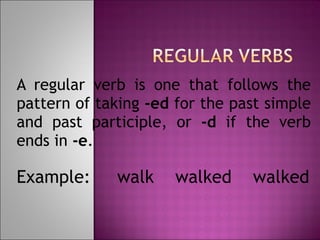
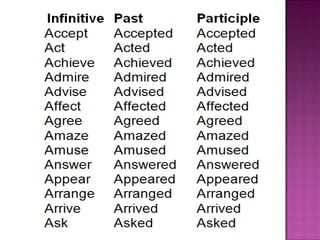
A regular verb is one that follows the pattern of taking  -ed  for the past simple and past participle, or  -d  if the verb ends in  -e .  Example:  walk  walked  walked
 
Exercise
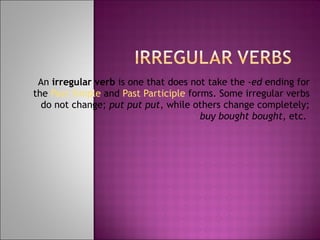
An  irregular verb  is one that does not take the  -ed  ending for the  Past Simple  and  Past Participle  forms. Some irregular verbs do not change;  put   put   put , while others change completely;  buy   bought   bought , etc.
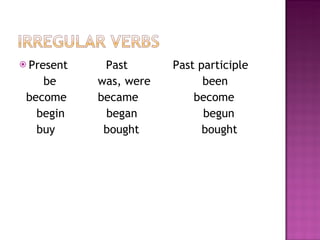
Present  Past  Past participle be  was, were  been become  became  become begin  began  begun buy  bought  bought
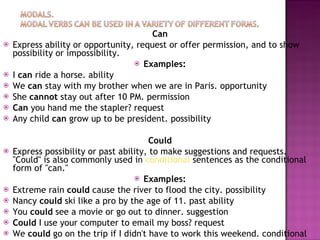
Can Express ability or opportunity, request or offer permission, and to show possibility or impossibility. Examples: I  can  ride a horse. ability  We  can  stay with my brother when we are in Paris. opportunity  She  cannot  stay out after 10 PM. permission Can  you hand me the stapler? request  Any child  can  grow up to be president. possibility  Could Express possibility or past ability, to make suggestions and requests. "Could" is also commonly used in  conditional  sentences as the conditional form of "can." Examples: Extreme rain  could  cause the river to flood the city. possibility Nancy  could  ski like a pro by the age of 11. past ability You  could  see a movie or go out to dinner. suggestion Could  I use your computer to email my boss? request We  could  go on the trip if I didn't have to work this weekend. conditional
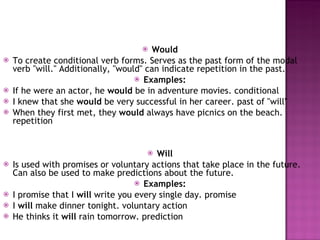
Would To create conditional verb forms. Serves as the past form of the modal verb "will." Additionally, "would" can indicate repetition in the past. Examples: If he were an actor, he  would  be in adventure movies. conditional I knew that she  would  be very successful in her career. past of "will"  When they first met, they  would  always have picnics on the beach. repetition  Will Is used with promises or voluntary actions that take place in the future. Can also be used to make predictions about the future. Examples: I promise that I  will  write you every single day. promise I  will  make dinner tonight. voluntary action He thinks it  will  rain tomorrow. prediction
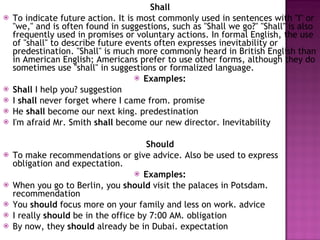
Shall To indicate future action. It is most commonly used in sentences with "I" or "we," and is often found in suggestions, such as "Shall we go?" "Shall" is also frequently used in promises or voluntary actions. In formal English, the use of "shall" to describe future events often expresses inevitability or predestination. "Shall" is much more commonly heard in British English than in American English; Americans prefer to use other forms, although they do sometimes use "shall" in suggestions or formalized language.  Examples: Shall  I help you? suggestion  I  shall  never forget where I came from. promise  He  shall  become our next king. predestination I'm afraid Mr. Smith  shall  become our new director. Inevitability Should To make recommendations or give advice. Also be used to express obligation and expectation. Examples: When you go to Berlin, you  should  visit the palaces in Potsdam. recommendation You  should  focus more on your family and less on work. advice I really  should  be in the office by 7:00 AM. obligation By now, they  should  already be in Dubai. expectation
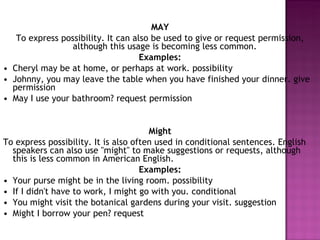
MAY To express possibility. It can also be used to give or request permission, although this usage is becoming less common. Examples: • Cheryl may be at home, or perhaps at work. possibility • Johnny, you may leave the table when you have finished your dinner. give permission • May I use your bathroom? request permission  Might To express possibility. It is also often used in conditional sentences. English speakers can also use "might" to make suggestions or requests, although this is less common in American English. Examples: • Your purse might be in the living room. possibility • If I didn't have to work, I might go with you. conditional • You might visit the botanical gardens during your visit. suggestion • Might I borrow your pen? request
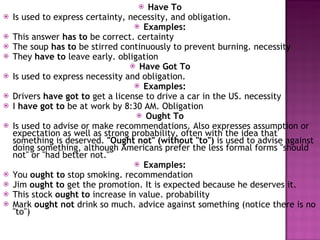
Have To Is used to express certainty, necessity, and obligation. Examples: This answer  has to  be correct. certainty The soup  has to  be stirred continuously to prevent burning. necessity  They  have to  leave early. obligation  Have Got To Is used to express necessity and obligation. Examples: Drivers  have got to  get a license to drive a car in the US. necessity I  have got to  be at work by 8:30 AM. Obligation Ought To Is used to advise or make recommendations. Also expresses assumption or expectation as well as strong probability, often with the idea that something is deserved.  "Ought not" (without "to")  is used to advise against doing something, although Americans prefer the less formal forms "should not" or "had better not." Examples: You  ought to  stop smoking. recommendation Jim  ought to  get the promotion. It is expected because he deserves it.  This stock  ought to  increase in value. probability Mark  ought not  drink so much. advice against something (notice there is no "to")
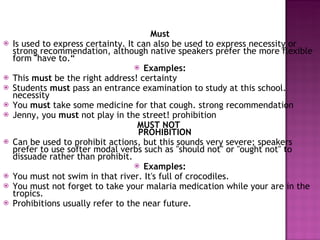
Must Is used to express certainty. It can also be used to express necessity or strong recommendation, although native speakers prefer the more flexible form "have to.“ Examples: This  must  be the right address! certainty Students  must  pass an entrance examination to study at this school. necessity You  must  take some medicine for that cough. strong recommendation Jenny, you  must  not play in the street! prohibition  MUST NOT   PROHIBITION Can be used to prohibit actions, but this sounds very severe; speakers prefer to use softer modal verbs such as "should not" or "ought not" to dissuade rather than prohibit.  Examples: You must not swim in that river. It's full of crocodiles.  You must not forget to take your malaria medication while your are in the tropics.  Prohibitions usually refer to the near future.

Grammar modals

  • 1.
    EQUIPO 1 CURIELRESENDIZ CYNTHIA S. FREGOSO MOYA GIOVANNA Y. PACHECO MOLINA NADIA L. PASOS AGANZA BERENIZE
  • 2.
    A regular verbis one that follows the pattern of taking -ed for the past simple and past participle, or -d if the verb ends in -e . Example: walk walked walked
  • 3.
  • 4.
  • 5.
    An irregularverb is one that does not take the -ed ending for the Past Simple and Past Participle forms. Some irregular verbs do not change; put put put , while others change completely; buy bought bought , etc.
  • 6.
    Present Past Past participle be was, were been become became become begin began begun buy bought bought
  • 7.
    Can Express abilityor opportunity, request or offer permission, and to show possibility or impossibility. Examples: I can ride a horse. ability We can stay with my brother when we are in Paris. opportunity She cannot stay out after 10 PM. permission Can you hand me the stapler? request Any child can grow up to be president. possibility Could Express possibility or past ability, to make suggestions and requests. "Could" is also commonly used in conditional sentences as the conditional form of "can." Examples: Extreme rain could cause the river to flood the city. possibility Nancy could ski like a pro by the age of 11. past ability You could see a movie or go out to dinner. suggestion Could I use your computer to email my boss? request We could go on the trip if I didn't have to work this weekend. conditional
  • 8.
    Would To createconditional verb forms. Serves as the past form of the modal verb "will." Additionally, "would" can indicate repetition in the past. Examples: If he were an actor, he would be in adventure movies. conditional I knew that she would be very successful in her career. past of "will" When they first met, they would always have picnics on the beach. repetition Will Is used with promises or voluntary actions that take place in the future. Can also be used to make predictions about the future. Examples: I promise that I will write you every single day. promise I will make dinner tonight. voluntary action He thinks it will rain tomorrow. prediction
  • 9.
    Shall To indicatefuture action. It is most commonly used in sentences with "I" or "we," and is often found in suggestions, such as "Shall we go?" "Shall" is also frequently used in promises or voluntary actions. In formal English, the use of "shall" to describe future events often expresses inevitability or predestination. "Shall" is much more commonly heard in British English than in American English; Americans prefer to use other forms, although they do sometimes use "shall" in suggestions or formalized language. Examples: Shall I help you? suggestion I shall never forget where I came from. promise He shall become our next king. predestination I'm afraid Mr. Smith shall become our new director. Inevitability Should To make recommendations or give advice. Also be used to express obligation and expectation. Examples: When you go to Berlin, you should visit the palaces in Potsdam. recommendation You should focus more on your family and less on work. advice I really should be in the office by 7:00 AM. obligation By now, they should already be in Dubai. expectation
  • 10.
    MAY To expresspossibility. It can also be used to give or request permission, although this usage is becoming less common. Examples: • Cheryl may be at home, or perhaps at work. possibility • Johnny, you may leave the table when you have finished your dinner. give permission • May I use your bathroom? request permission Might To express possibility. It is also often used in conditional sentences. English speakers can also use "might" to make suggestions or requests, although this is less common in American English. Examples: • Your purse might be in the living room. possibility • If I didn't have to work, I might go with you. conditional • You might visit the botanical gardens during your visit. suggestion • Might I borrow your pen? request
  • 11.
    Have To Isused to express certainty, necessity, and obligation. Examples: This answer has to be correct. certainty The soup has to be stirred continuously to prevent burning. necessity They have to leave early. obligation Have Got To Is used to express necessity and obligation. Examples: Drivers have got to get a license to drive a car in the US. necessity I have got to be at work by 8:30 AM. Obligation Ought To Is used to advise or make recommendations. Also expresses assumption or expectation as well as strong probability, often with the idea that something is deserved. "Ought not" (without "to") is used to advise against doing something, although Americans prefer the less formal forms "should not" or "had better not." Examples: You ought to stop smoking. recommendation Jim ought to get the promotion. It is expected because he deserves it. This stock ought to increase in value. probability Mark ought not drink so much. advice against something (notice there is no "to")
  • 12.
    Must Is usedto express certainty. It can also be used to express necessity or strong recommendation, although native speakers prefer the more flexible form "have to.“ Examples: This must be the right address! certainty Students must pass an entrance examination to study at this school. necessity You must take some medicine for that cough. strong recommendation Jenny, you must not play in the street! prohibition MUST NOT PROHIBITION Can be used to prohibit actions, but this sounds very severe; speakers prefer to use softer modal verbs such as "should not" or "ought not" to dissuade rather than prohibit. Examples: You must not swim in that river. It's full of crocodiles. You must not forget to take your malaria medication while your are in the tropics. Prohibitions usually refer to the near future.