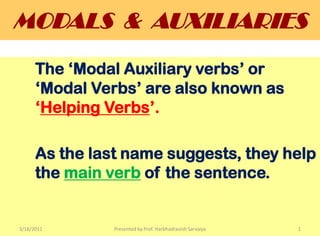
MODALS  &  AUXILIARIESThe ‘Modal Auxiliary verbs’ or 	‘Modal Verbs’ are also known as 	‘Helping Verbs’.As the last name suggests, they help       	the main verb of the sentence.3/18/2011Presented by Prof. Harbhadrasinh Sarvaiya1
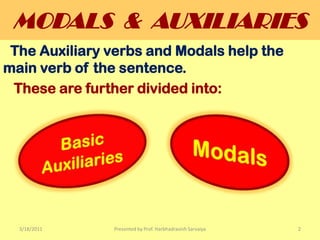
MODALS  &  AUXILIARIESThe Auxiliary verbs and Modals help the main verb of the sentence.These are further divided into:Basic AuxiliariesModals3/18/2011Presented by Prof. Harbhadrasinh Sarvaiya2
MODALS  &  AUXILIARIESBasic Auxiliaries:Be Have Do AmIs WasWere Has HadDoes Did 3/18/2011Presented by Prof. Harbhadrasinh Sarvaiya3
MODALS  &  AUXILIARIESLet us take a few examples:Rajesh can sing.They may attend the party tonight.May I use your telephone please?Sheila says she will  help me.You haven’t eaten all day. You must  be hungry.3/18/2011Presented by Prof. Harbhadrasinh Sarvaiya4
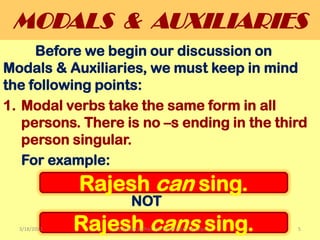
MODALS  &  AUXILIARIESBefore we begin our discussion on Modals & Auxiliaries, we must keep in mind the following points:Modal verbs take the same form in all persons. There is no –s ending in the third person singular. 	For example:					NOTRajesh can sing.Rajesh cans sing.3/18/2011Presented by Prof. Harbhadrasinh Sarvaiya5
MODALS  &  AUXILIARIES2. The affirmative is formed by putting the modal verb between the subject and the main verb.For example:3. The negative is formed by putting n’t/not after the main verb. For example:You should  visit your grandmother.Rajesh can’t  sing.3/18/2011Presented by Prof. Harbhadrasinh Sarvaiya6
MODALS  &  AUXILIARIES4. Questions can be formed by inverting the 	subject and the modal verb.For example:  Note:We do not use ‘do’ in questions and      	negatives.Rajesh can sing.Can Rajesh sing?3/18/2011Presented by Prof. Harbhadrasinh Sarvaiya7
MODALS  &  AUXILIARIESFor example: We cannot say,ORDoes Rajesh can sing?Rajesh doesn’t can sing.3/18/2011Presented by Prof. Harbhadrasinh Sarvaiya8
MODALS  &  AUXILIARIES5. We can use the structure:modal verb + be + … -ing.For example:Its getting dark. You should be leaving now.I might be going to Washington next week.3/18/2011Presented by Prof. Harbhadrasinh Sarvaiya9
MODALS  &  AUXILIARIESModal Verbs for Ability: Can, could, 				be able toWe use can to talk about ability, or to say that something is possible.	Its negative is can’t or cannot.For example:Shilpa can drive.Can you swim?They can’t  attend the meeting.3/18/2011Presented by Prof. Harbhadrasinh Sarvaiya10
MODALS  &  AUXILIARIESNote: Sometimes we can also use be able to 	instead of can, but the use of can is 	more common for our daily 	conversations.For example:Shilpa is able to drive a car.3/18/2011Presented by Prof. Harbhadrasinh Sarvaiya11
MODALS  &  AUXILIARIES2. We use could to say that someone had the ability to do something in a general sense, in the past.For example:We can also use was/were able to in the sentences given above.I could  talk when I was two years old.My grandfather could play football in his youth.I was able to talk when I was two years old.3/18/2011Presented by Prof. Harbhadrasinh Sarvaiya12
MODALS  &  AUXILIARIES3. When we talk about a specific situation of the past, in which someone had the ability to perform an action, then we use was/were able to.      In such particular situations of the past, displaying ability, could is not possible.Even though the ship was hit by an iceberg, the captain was able to bring the ship to land.The Principal was very busy, but still the students were able to meet him.3/18/2011Presented by Prof. Harbhadrasinh Sarvaiya13
MODALS  &  AUXILIARIESNote: In the situations that we just saw, it is also possible to use managed to or succeeded in instead of was/were able to.But with succeeded in, the –ing form will be added to the main verb.3/18/2011Presented by Prof. Harbhadrasinh Sarvaiya14
MODALS  &  AUXILIARIESFor example:The Principal was very busy, but still the students managed to meet him.The Principal was very busy, but still the students succeeded in meeting him.3/18/2011Presented by Prof. Harbhadrasinh Sarvaiya15
MODALS  &  AUXILIARIES4. When we use verbs of ‘perception’ and ‘thinking’ like see, hear, smell, taste, feel and understand, remember etc., we can use could. Could is used with these verbs even if the past situation is a specific situation.3/18/2011Presented by Prof. Harbhadrasinh Sarvaiya16
MODALS  &  AUXILIARIESFor example:We could smell  the aroma of delicious food from my aunt’s kitchen.Harish could hear  a noise outside his window.The Manager could remember  the names of all the employees.3/18/2011Presented by Prof. Harbhadrasinh Sarvaiya17
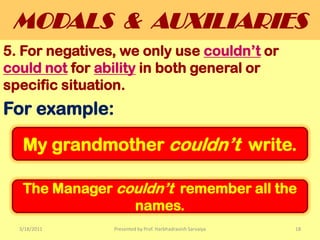
MODALS  &  AUXILIARIES5. For negatives, we only use couldn’t or could not for ability in both general or specific situation.For example:My grandmother couldn’t  write.The Manager couldn’t  remember all the names.3/18/2011Presented by Prof. Harbhadrasinh Sarvaiya18
MODALS  &  AUXILIARIES6. We use could have + past participle to indicate that someone did have the ability or opportunity to perform an action in the past, but he/she did not do it.For example:Meera could have helped  me with the project, but she didn’t.Ramesh could have told  Kamala everything, but he chose not to do so.3/18/2011Presented by Prof. Harbhadrasinh Sarvaiya19
MODALS  &  AUXILIARIES7. Can has no infinitive (to), -ingform or participles. Therefore, if need arises, we use be able to instead of can. For example:In the future, people will be able to live on Mars.(Not: …people will can live on Mars.)3/18/2011Presented by Prof. Harbhadrasinh Sarvaiya20
MODALS  &  AUXILIARIESModal Verbs for Permission: Can, could, may, might,  be allowed toGenerally, we use can, could or may to ask permission.For example:Can I borrow your pen?3/18/2011Presented by Prof. Harbhadrasinh Sarvaiya21
MODALS  &  AUXILIARIESNote: May is generally used in 	 	    formal situations. Could  I attend your lecture?May  we make a suggestion?3/18/2011Presented by Prof. Harbhadrasinh Sarvaiya22
MODALS  &  AUXILIARIESNote:Can is used by a more 	authoritative person, and could is 	more polite and less 	direct as 	compared to can.Might is sometimes used to replace  	may  For example:Might  we make a suggestion?3/18/2011Presented by Prof. Harbhadrasinh Sarvaiya23
MODALS  &  AUXILIARIES2. While giving permission to some one, can and may are used, but NOTcould and might.For example:Ques:Ans.:Can I borrow your bicycle?‘ Yes, of course you can.’3/18/2011Presented by Prof. Harbhadrasinh Sarvaiya24
MODALS  &  AUXILIARIES	The same statement can also be written asQues:Ans.:You can borrow my bicycle.Could I make a suggestion?Yes, you may.3/18/2011Presented by Prof. Harbhadrasinh Sarvaiya25
MODALS  &  AUXILIARIES3. In a conversation, when a reference is made to a law or a rule, i.e. for those things which are already permitted or not permitted, then we use the modals can’t or be (not) allowed to.3/18/2011Presented by Prof. Harbhadrasinh Sarvaiya26
MODALS  &  AUXILIARIESFor example: In this example, the speaker is not the one to give/not give permission, but he/she is referring to a law/rule made by a third party.You can’t /aren’t allowed to drink alcohol in Gujarat.3/18/2011Presented by Prof. Harbhadrasinh Sarvaiya27
MODALS  &  AUXILIARIES  For example:In India girls can get married/ are allowed to get married at the age of 18.The students can’t / are not allowed  to  park their vehicles inside the College ground.3/18/2011Presented by Prof. Harbhadrasinh Sarvaiya28
MODALS  &  AUXILIARIES4. While referring to permission, which one had got in the past time, we use modals could and was/were allowed to.For example:When I was 10 I could  go to school on my bicycle.3/18/2011Presented by Prof. Harbhadrasinh Sarvaiya29
MODALS  &  AUXILIARIESWas/Were allowed to can also be used in the example that we just saw.When I was10, I was allowed to go to school on my bicycle.3/18/2011Presented by Prof. Harbhadrasinh Sarvaiya30
MODALS  &  AUXILIARIESNote: However, when we want to say that 	someone had permission to do 	something, and he/she did it in a 	particular past situation, then we must 	use was/ were allowed to. (couldcannot 	be used).  We cannot sayThe players were allowed to  take rest yesterday.The players could  take rest yesterday.3/18/2011Presented by Prof. Harbhadrasinh Sarvaiya31
Thank you for watchingharbhadrasinh@gmail.comhttp://harbhadrasinh.blogspot.com/3/18/2011Presented by Prof. Harbhadrasinh Sarvaiya32

Modal auxiliary verbs

  • 1.
    MODALS & AUXILIARIESThe ‘Modal Auxiliary verbs’ or ‘Modal Verbs’ are also known as ‘Helping Verbs’.As the last name suggests, they help the main verb of the sentence.3/18/2011Presented by Prof. Harbhadrasinh Sarvaiya1
  • 2.
    MODALS & AUXILIARIESThe Auxiliary verbs and Modals help the main verb of the sentence.These are further divided into:Basic AuxiliariesModals3/18/2011Presented by Prof. Harbhadrasinh Sarvaiya2
  • 3.
    MODALS & AUXILIARIESBasic Auxiliaries:Be Have Do AmIs WasWere Has HadDoes Did 3/18/2011Presented by Prof. Harbhadrasinh Sarvaiya3
  • 4.
    MODALS & AUXILIARIESLet us take a few examples:Rajesh can sing.They may attend the party tonight.May I use your telephone please?Sheila says she will help me.You haven’t eaten all day. You must be hungry.3/18/2011Presented by Prof. Harbhadrasinh Sarvaiya4
  • 5.
    MODALS & AUXILIARIESBefore we begin our discussion on Modals & Auxiliaries, we must keep in mind the following points:Modal verbs take the same form in all persons. There is no –s ending in the third person singular. For example: NOTRajesh can sing.Rajesh cans sing.3/18/2011Presented by Prof. Harbhadrasinh Sarvaiya5
  • 6.
    MODALS & AUXILIARIES2. The affirmative is formed by putting the modal verb between the subject and the main verb.For example:3. The negative is formed by putting n’t/not after the main verb. For example:You should visit your grandmother.Rajesh can’t sing.3/18/2011Presented by Prof. Harbhadrasinh Sarvaiya6
  • 7.
    MODALS & AUXILIARIES4. Questions can be formed by inverting the subject and the modal verb.For example: Note:We do not use ‘do’ in questions and negatives.Rajesh can sing.Can Rajesh sing?3/18/2011Presented by Prof. Harbhadrasinh Sarvaiya7
  • 8.
    MODALS & AUXILIARIESFor example: We cannot say,ORDoes Rajesh can sing?Rajesh doesn’t can sing.3/18/2011Presented by Prof. Harbhadrasinh Sarvaiya8
  • 9.
    MODALS & AUXILIARIES5. We can use the structure:modal verb + be + … -ing.For example:Its getting dark. You should be leaving now.I might be going to Washington next week.3/18/2011Presented by Prof. Harbhadrasinh Sarvaiya9
  • 10.
    MODALS & AUXILIARIESModal Verbs for Ability: Can, could, be able toWe use can to talk about ability, or to say that something is possible. Its negative is can’t or cannot.For example:Shilpa can drive.Can you swim?They can’t attend the meeting.3/18/2011Presented by Prof. Harbhadrasinh Sarvaiya10
  • 11.
    MODALS & AUXILIARIESNote: Sometimes we can also use be able to instead of can, but the use of can is more common for our daily conversations.For example:Shilpa is able to drive a car.3/18/2011Presented by Prof. Harbhadrasinh Sarvaiya11
  • 12.
    MODALS & AUXILIARIES2. We use could to say that someone had the ability to do something in a general sense, in the past.For example:We can also use was/were able to in the sentences given above.I could talk when I was two years old.My grandfather could play football in his youth.I was able to talk when I was two years old.3/18/2011Presented by Prof. Harbhadrasinh Sarvaiya12
  • 13.
    MODALS & AUXILIARIES3. When we talk about a specific situation of the past, in which someone had the ability to perform an action, then we use was/were able to. In such particular situations of the past, displaying ability, could is not possible.Even though the ship was hit by an iceberg, the captain was able to bring the ship to land.The Principal was very busy, but still the students were able to meet him.3/18/2011Presented by Prof. Harbhadrasinh Sarvaiya13
  • 14.
    MODALS & AUXILIARIESNote: In the situations that we just saw, it is also possible to use managed to or succeeded in instead of was/were able to.But with succeeded in, the –ing form will be added to the main verb.3/18/2011Presented by Prof. Harbhadrasinh Sarvaiya14
  • 15.
    MODALS & AUXILIARIESFor example:The Principal was very busy, but still the students managed to meet him.The Principal was very busy, but still the students succeeded in meeting him.3/18/2011Presented by Prof. Harbhadrasinh Sarvaiya15
  • 16.
    MODALS & AUXILIARIES4. When we use verbs of ‘perception’ and ‘thinking’ like see, hear, smell, taste, feel and understand, remember etc., we can use could. Could is used with these verbs even if the past situation is a specific situation.3/18/2011Presented by Prof. Harbhadrasinh Sarvaiya16
  • 17.
    MODALS & AUXILIARIESFor example:We could smell the aroma of delicious food from my aunt’s kitchen.Harish could hear a noise outside his window.The Manager could remember the names of all the employees.3/18/2011Presented by Prof. Harbhadrasinh Sarvaiya17
  • 18.
    MODALS & AUXILIARIES5. For negatives, we only use couldn’t or could not for ability in both general or specific situation.For example:My grandmother couldn’t write.The Manager couldn’t remember all the names.3/18/2011Presented by Prof. Harbhadrasinh Sarvaiya18
  • 19.
    MODALS & AUXILIARIES6. We use could have + past participle to indicate that someone did have the ability or opportunity to perform an action in the past, but he/she did not do it.For example:Meera could have helped me with the project, but she didn’t.Ramesh could have told Kamala everything, but he chose not to do so.3/18/2011Presented by Prof. Harbhadrasinh Sarvaiya19
  • 20.
    MODALS & AUXILIARIES7. Can has no infinitive (to), -ingform or participles. Therefore, if need arises, we use be able to instead of can. For example:In the future, people will be able to live on Mars.(Not: …people will can live on Mars.)3/18/2011Presented by Prof. Harbhadrasinh Sarvaiya20
  • 21.
    MODALS & AUXILIARIESModal Verbs for Permission: Can, could, may, might, be allowed toGenerally, we use can, could or may to ask permission.For example:Can I borrow your pen?3/18/2011Presented by Prof. Harbhadrasinh Sarvaiya21
  • 22.
    MODALS & AUXILIARIESNote: May is generally used in formal situations. Could I attend your lecture?May we make a suggestion?3/18/2011Presented by Prof. Harbhadrasinh Sarvaiya22
  • 23.
    MODALS & AUXILIARIESNote:Can is used by a more authoritative person, and could is more polite and less direct as compared to can.Might is sometimes used to replace may For example:Might we make a suggestion?3/18/2011Presented by Prof. Harbhadrasinh Sarvaiya23
  • 24.
    MODALS & AUXILIARIES2. While giving permission to some one, can and may are used, but NOTcould and might.For example:Ques:Ans.:Can I borrow your bicycle?‘ Yes, of course you can.’3/18/2011Presented by Prof. Harbhadrasinh Sarvaiya24
  • 25.
    MODALS & AUXILIARIES The same statement can also be written asQues:Ans.:You can borrow my bicycle.Could I make a suggestion?Yes, you may.3/18/2011Presented by Prof. Harbhadrasinh Sarvaiya25
  • 26.
    MODALS & AUXILIARIES3. In a conversation, when a reference is made to a law or a rule, i.e. for those things which are already permitted or not permitted, then we use the modals can’t or be (not) allowed to.3/18/2011Presented by Prof. Harbhadrasinh Sarvaiya26
  • 27.
    MODALS & AUXILIARIESFor example: In this example, the speaker is not the one to give/not give permission, but he/she is referring to a law/rule made by a third party.You can’t /aren’t allowed to drink alcohol in Gujarat.3/18/2011Presented by Prof. Harbhadrasinh Sarvaiya27
  • 28.
    MODALS & AUXILIARIES For example:In India girls can get married/ are allowed to get married at the age of 18.The students can’t / are not allowed to park their vehicles inside the College ground.3/18/2011Presented by Prof. Harbhadrasinh Sarvaiya28
  • 29.
    MODALS & AUXILIARIES4. While referring to permission, which one had got in the past time, we use modals could and was/were allowed to.For example:When I was 10 I could go to school on my bicycle.3/18/2011Presented by Prof. Harbhadrasinh Sarvaiya29
  • 30.
    MODALS & AUXILIARIESWas/Were allowed to can also be used in the example that we just saw.When I was10, I was allowed to go to school on my bicycle.3/18/2011Presented by Prof. Harbhadrasinh Sarvaiya30
  • 31.
    MODALS & AUXILIARIESNote: However, when we want to say that someone had permission to do something, and he/she did it in a particular past situation, then we must use was/ were allowed to. (couldcannot be used). We cannot sayThe players were allowed to take rest yesterday.The players could take rest yesterday.3/18/2011Presented by Prof. Harbhadrasinh Sarvaiya31
  • 32.
    Thank you forwatchingharbhadrasinh@gmail.comhttp://harbhadrasinh.blogspot.com/3/18/2011Presented by Prof. Harbhadrasinh Sarvaiya32