MODALS
(AUXILIARY VERBS)
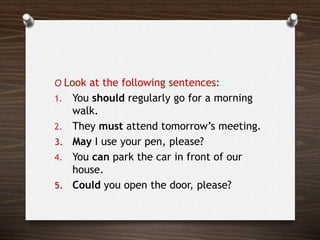
O Look at the following sentences:
1. You should regularly go for a morning
walk.
2. They must attend tomorrow’s meeting.
3. May I use your pen, please?
4. You can park the car in front of our
house.
5. Could you open the door, please?
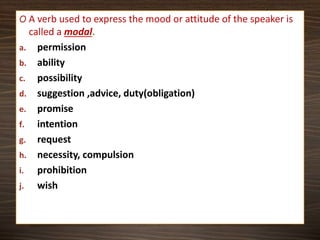
O A verb used to express the mood or attitude of the speaker is
called a modal.
a. permission
b. ability
c. possibility
d. suggestion ,advice, duty(obligation)
e. promise
f. intention
g. request
h. necessity, compulsion
i. prohibition
j. wish
Points to remember
1. Modals are always followed by a main verb.
They cannot stand on their own unless they are
used in a question tag.
Ex- should go must attend
can park may take
However, in question tags, modals can be used
alone:
You can lift this box, can’t you?
2. Modals do not change form with the person and
number of the subject.(remain the same)
You/We/They/I must go. He/She/It must go.
3. The main verb used after a modal must be in the
root form.
Permission : may, can and
could
O Can is informal. May is polite. Could is
more polite than may.
Two friends talking- can
A student talking to her teacher- may
A subordinate talking to his officer- could
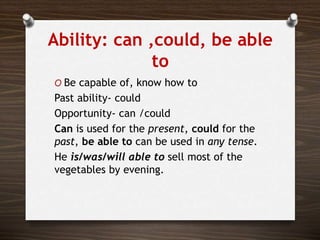
Ability: can ,could, be able
to
O Be capable of, know how to
Past ability- could
Opportunity- can /could
Can is used for the present, could for the
past, be able to can be used in any tense.
He is/was/will able to sell most of the
vegetables by evening.
Possibility : may, might,
could
O May suggests a good possibility. Might
suggests a weak possibility and could a
still weaker possibility. Could also
expresses a very weak possibility in the
future.
Suggestion, advice, duty(
obligation): should, ought to
O Should –suggestion /advice
O Ought to is a little stronger than should. It
suggests that something is the right thing to
do. It also conveys a sense of duty:
Ex – You ought to take care of your old
parents.(moral duty)
You aren’t keeping fit. You ought to go for
morning walk everyday.
Promise/suggestion :will,
shall
O We will attend your brother’s marriage.
(promise)
O These children cannot complete the work
on their own .Shall we help
them?(suggestion)
Intention or willingness: will,
shall
O I shall ring you up in the
evening.(intention)
O He will help you in business.(willingness)
Request: would, won’t, can,
could
O Would you buy me some woollens ,
please?(polite)
O Could you switch on the
fan?(polite/uncertain)
O Can I have some tea?(informal)
O Won’t you have something to eat?(have
something to eat)
Necessity, compulsion: must, have
to, had to, have got to, will have to
O I am getting late. I must take a
taxi.(necessity)
O In army you have to clean your shoes
yourself.(compulsion)
O Since he was not at home, I had to wait for
him.
O I have got to finish this work by evening.
(compulsion)
O I will have to go and get some
medicine.(necessity)
Must, have to
O Must suggests the desire of the speaker.
Have to suggests an external
compulsion.
Ex – You must pay the dues on time.
In army you have to clean your shoes
yourself.
Needn’t suggests that there is no necessity
or compulsion.
Ex – He needn’t go to the doctor.
Prohibition: must not, ought
not to
O Cars must not be parked in front of the
gate.
O You ought not to make fun of an old
man.(duty)
Wish: may
O May you live long!
O May god bless you!
Modals are really interesting by Rizwan Ahmad

Modals are really interesting by Rizwan Ahmad

  • 1.
  • 2.
    O Look atthe following sentences: 1. You should regularly go for a morning walk. 2. They must attend tomorrow’s meeting. 3. May I use your pen, please? 4. You can park the car in front of our house. 5. Could you open the door, please?
  • 3.
    O A verbused to express the mood or attitude of the speaker is called a modal. a. permission b. ability c. possibility d. suggestion ,advice, duty(obligation) e. promise f. intention g. request h. necessity, compulsion i. prohibition j. wish
  • 4.
    Points to remember 1.Modals are always followed by a main verb. They cannot stand on their own unless they are used in a question tag. Ex- should go must attend can park may take However, in question tags, modals can be used alone: You can lift this box, can’t you? 2. Modals do not change form with the person and number of the subject.(remain the same) You/We/They/I must go. He/She/It must go. 3. The main verb used after a modal must be in the root form.
  • 5.
    Permission : may,can and could O Can is informal. May is polite. Could is more polite than may. Two friends talking- can A student talking to her teacher- may A subordinate talking to his officer- could
  • 6.
    Ability: can ,could,be able to O Be capable of, know how to Past ability- could Opportunity- can /could Can is used for the present, could for the past, be able to can be used in any tense. He is/was/will able to sell most of the vegetables by evening.
  • 7.
    Possibility : may,might, could O May suggests a good possibility. Might suggests a weak possibility and could a still weaker possibility. Could also expresses a very weak possibility in the future.
  • 8.
    Suggestion, advice, duty( obligation):should, ought to O Should –suggestion /advice O Ought to is a little stronger than should. It suggests that something is the right thing to do. It also conveys a sense of duty: Ex – You ought to take care of your old parents.(moral duty) You aren’t keeping fit. You ought to go for morning walk everyday.
  • 9.
    Promise/suggestion :will, shall O Wewill attend your brother’s marriage. (promise) O These children cannot complete the work on their own .Shall we help them?(suggestion)
  • 10.
    Intention or willingness:will, shall O I shall ring you up in the evening.(intention) O He will help you in business.(willingness)
  • 11.
    Request: would, won’t,can, could O Would you buy me some woollens , please?(polite) O Could you switch on the fan?(polite/uncertain) O Can I have some tea?(informal) O Won’t you have something to eat?(have something to eat)
  • 12.
    Necessity, compulsion: must,have to, had to, have got to, will have to O I am getting late. I must take a taxi.(necessity) O In army you have to clean your shoes yourself.(compulsion) O Since he was not at home, I had to wait for him. O I have got to finish this work by evening. (compulsion) O I will have to go and get some medicine.(necessity)
  • 13.
    Must, have to OMust suggests the desire of the speaker. Have to suggests an external compulsion. Ex – You must pay the dues on time. In army you have to clean your shoes yourself. Needn’t suggests that there is no necessity or compulsion. Ex – He needn’t go to the doctor.
  • 14.
    Prohibition: must not,ought not to O Cars must not be parked in front of the gate. O You ought not to make fun of an old man.(duty)
  • 15.
    Wish: may O Mayyou live long! O May god bless you!