Modal Verb
Meaning
• A modal verb is a type of verb which is special verbs
that behave irregularly in English and used to indicate
modality
Characteristics
• Never change form. There is no s in singular
• There is no do/does in question.
• There is no don’t/doesn’t in negative
• Always followed by an infinitive without "to"
• Used with other verbs to express various things like
permission, certainty, possibility, willingness, obligation,
necessity, ability
Affirmative Sentences
Subject + Modal Verb + Verb Infinitive
Negative Sentences
Subject + Modal Verb + not + Verb Infinitive
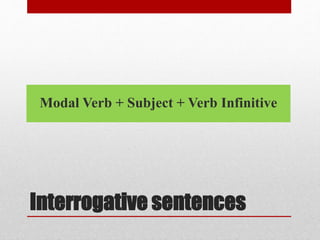
Interrogative sentences
Modal Verb + Subject + Verb Infinitive
List
• Can
• Could
• Will
• Would
• Shall
• Should
• May
• Might
• Must
• Have to
• Ought to
Can
1.Use in Ability or things that you can't do it
–I can drive a car.
–She can type 60 words per minutes.
–I can’t drive a car.
–She can’t type 60 words per minutes.
2.Use in Permission
–Can I enter the room?
–Yes, you can.
3.Use in Possibility
–She can finish her work by tomorrow.
Could
1. Use to be can Past Tense
–When I was young , I could run fast.
–I couldn’t understand your yesterday explanation.
2.Use In A polite request (Present Simple )
–Could I borrow your pen?
–Could you tell me the time to go?
3. Could + have + past participle
Use in A stunt or skill that has not been used or Inoperative
–They could have started working two hours ago.
–I could have finished it last year.
Will
• will:
-to talk about the future
-to talk about what people want willing to do or plan
-to make promises and offers
-used to express determination, insistence, or persistence
Example
• She will be late for English class.
• I will give you back some money after I found my wallet.
• Tomorrow I won’t come to school.
• Will you lend me a pencil?
• When will she arrive the school?
Would
• would is the past tense form of will. It is used:
-to talk about the past.
-to talk about hypotheses
-to express a wish or desire
-for politeness
Example
• If Lookpla was hippo, she would eat watermelon.
• I would like to have an iPhone 10.
• Dad wouldn’t lend me some money.
• Would you like to come to school tomorrow?
• Where would you like to go?
Past Tense
Subject + Would + Have + Past Participle
Example: I would have slept, but I didn’t
take a bath.
shall
Mainly used in American English to ask questions
politely (it has more usages in British English). For the
future tense, will is more frequently used in American
English than shall.
1. Shall expresses certain laws and rules
Example:
You shall obey the rules.
Students shall not enter here.
There shall be no food and drink on the premises.
c) Future expression and
promises
Example:
I shall be here at 7 tomorrow.
a) We use shall for offers
Examples:
Shall I pick you up from
airport?
Shall we dance?
2. Something take place or exist in the future
b) Suggestion
Examples:
Shall I open the window?
What time shall we meet?
Should
"Should" is most commonly used to make
recommendations or give advice. It can also be used to express
obligation as well as expectation.
Use ‘should’ in present tense :
Structure : Subject + should/shouldn’t + V. 1
Example:
Sarah shouldn't smoke so much. It's not good for her health.
Use ‘should’ in past tense :
Structure: Subject +Should/shouldn’t + have + V.3
Example:
Frank should have eaten low-fat foods. That might have
prevented his heart attack.
Use ‘should’ in future tense :
Structure : Subject + should/shouldn’t + V.1
Example :
Susan should be in New York by next week. Her new job
starts on Monday.
May/Might
• It’s a Helping Verb that use for present about
POSSIBILITY that use in Future or Present.
• Both of words are nothing different in meaning. So that
may or might therefore, be used to mean "probably" not
wrong too.
• Might use in Past Tense when talking about an event that
happened in the past.
May
• May use in Present Tense when talking about a current
situation.
• We use 'may' to suggest something is possible.
It may rain later today.
Punch may come with us.
Might
• Might use in Past Tense when talking about an event that
happened in the past.
• We use 'might' to suggest a small possibility of something
She might be at home by now but it's not
sure at all.
I might see you tomorrow.
Must
• used to express certainty.
• used to express necessity or strong recommendation.
• for rule
Example
• You’re student, you must wear the uniform.
• That must not be Lookpla and Namtan.
• Must you leave right now?
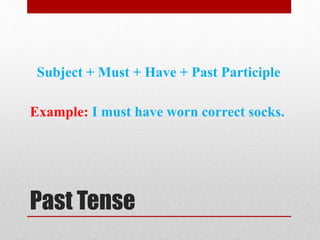
Past Tense
Subject + Must + Have + Past Participle
Example: I must have worn correct socks.
Have to
"Have to" is used to express certainty, necessity, and
obligation.
Structure : Subject + auxiliary verb + have + to-
infinitive
Use ‘Have to’ in present tense :
Example :
She doesn't have to read "Grapes of Wrath." It's optional
reading for extra credit
Use ‘Have to’ in past tense :
Example :
That has to have been the right restaurant. There were no
other restaurants on the street.
Use ‘Have to’ in future tense :
Example :
Mind will have to finish the other books before the final
exam.
Ought to
• When using ought to which means "something you
should do" because it's the rule and it shows "should be in
the future“
• Which shows that the event didn't really happened. The
event that happened was opposite of what has been told
For example: You should have come to the party yesterday.
• Do not do anything in the past but you do it already.
For example: The party was boring. I shouldn’t have gone
there.
Ought to+have+past
participle
• Do not do anything in the past but you do it already.
For example: The party was boring. I oughtn’t have gone
there.
• When we use in negative sentence you must put not in the
back of ought
For example: We oughtn't to go to the cinema tonight.
Ought to+have+past
participle

Modal verb

  • 1.
  • 2.
    Meaning • A modalverb is a type of verb which is special verbs that behave irregularly in English and used to indicate modality
  • 3.
    Characteristics • Never changeform. There is no s in singular • There is no do/does in question. • There is no don’t/doesn’t in negative • Always followed by an infinitive without "to" • Used with other verbs to express various things like permission, certainty, possibility, willingness, obligation, necessity, ability
  • 4.
    Affirmative Sentences Subject +Modal Verb + Verb Infinitive
  • 5.
    Negative Sentences Subject +Modal Verb + not + Verb Infinitive
  • 6.
    Interrogative sentences Modal Verb+ Subject + Verb Infinitive
  • 7.
    List • Can • Could •Will • Would • Shall • Should • May • Might • Must • Have to • Ought to
  • 8.
    Can 1.Use in Abilityor things that you can't do it –I can drive a car. –She can type 60 words per minutes. –I can’t drive a car. –She can’t type 60 words per minutes. 2.Use in Permission –Can I enter the room? –Yes, you can. 3.Use in Possibility –She can finish her work by tomorrow.
  • 9.
    Could 1. Use tobe can Past Tense –When I was young , I could run fast. –I couldn’t understand your yesterday explanation. 2.Use In A polite request (Present Simple ) –Could I borrow your pen? –Could you tell me the time to go? 3. Could + have + past participle Use in A stunt or skill that has not been used or Inoperative –They could have started working two hours ago. –I could have finished it last year.
  • 10.
    Will • will: -to talkabout the future -to talk about what people want willing to do or plan -to make promises and offers -used to express determination, insistence, or persistence
  • 11.
    Example • She willbe late for English class. • I will give you back some money after I found my wallet. • Tomorrow I won’t come to school. • Will you lend me a pencil? • When will she arrive the school?
  • 12.
    Would • would isthe past tense form of will. It is used: -to talk about the past. -to talk about hypotheses -to express a wish or desire -for politeness
  • 13.
    Example • If Lookplawas hippo, she would eat watermelon. • I would like to have an iPhone 10. • Dad wouldn’t lend me some money. • Would you like to come to school tomorrow? • Where would you like to go?
  • 14.
    Past Tense Subject +Would + Have + Past Participle Example: I would have slept, but I didn’t take a bath.
  • 15.
  • 16.
    Mainly used inAmerican English to ask questions politely (it has more usages in British English). For the future tense, will is more frequently used in American English than shall. 1. Shall expresses certain laws and rules Example: You shall obey the rules. Students shall not enter here. There shall be no food and drink on the premises.
  • 17.
    c) Future expressionand promises Example: I shall be here at 7 tomorrow. a) We use shall for offers Examples: Shall I pick you up from airport? Shall we dance? 2. Something take place or exist in the future b) Suggestion Examples: Shall I open the window? What time shall we meet?
  • 18.
  • 19.
    "Should" is mostcommonly used to make recommendations or give advice. It can also be used to express obligation as well as expectation. Use ‘should’ in present tense : Structure : Subject + should/shouldn’t + V. 1 Example: Sarah shouldn't smoke so much. It's not good for her health. Use ‘should’ in past tense : Structure: Subject +Should/shouldn’t + have + V.3 Example: Frank should have eaten low-fat foods. That might have prevented his heart attack.
  • 20.
    Use ‘should’ infuture tense : Structure : Subject + should/shouldn’t + V.1 Example : Susan should be in New York by next week. Her new job starts on Monday.
  • 21.
  • 22.
    • It’s aHelping Verb that use for present about POSSIBILITY that use in Future or Present. • Both of words are nothing different in meaning. So that may or might therefore, be used to mean "probably" not wrong too. • Might use in Past Tense when talking about an event that happened in the past.
  • 23.
    May • May usein Present Tense when talking about a current situation. • We use 'may' to suggest something is possible. It may rain later today. Punch may come with us.
  • 24.
    Might • Might usein Past Tense when talking about an event that happened in the past. • We use 'might' to suggest a small possibility of something She might be at home by now but it's not sure at all. I might see you tomorrow.
  • 25.
    Must • used toexpress certainty. • used to express necessity or strong recommendation. • for rule
  • 26.
    Example • You’re student,you must wear the uniform. • That must not be Lookpla and Namtan. • Must you leave right now?
  • 27.
    Past Tense Subject +Must + Have + Past Participle Example: I must have worn correct socks.
  • 28.
  • 29.
    "Have to" isused to express certainty, necessity, and obligation. Structure : Subject + auxiliary verb + have + to- infinitive Use ‘Have to’ in present tense : Example : She doesn't have to read "Grapes of Wrath." It's optional reading for extra credit
  • 30.
    Use ‘Have to’in past tense : Example : That has to have been the right restaurant. There were no other restaurants on the street. Use ‘Have to’ in future tense : Example : Mind will have to finish the other books before the final exam.
  • 31.
  • 32.
    • When usingought to which means "something you should do" because it's the rule and it shows "should be in the future“ • Which shows that the event didn't really happened. The event that happened was opposite of what has been told For example: You should have come to the party yesterday. • Do not do anything in the past but you do it already. For example: The party was boring. I shouldn’t have gone there. Ought to+have+past participle
  • 33.
    • Do notdo anything in the past but you do it already. For example: The party was boring. I oughtn’t have gone there. • When we use in negative sentence you must put not in the back of ought For example: We oughtn't to go to the cinema tonight. Ought to+have+past participle