Aya Sharaireh
9 A
JUBILEE
Kinetic Energy
 If an object is moving, it has energy.
(Be careful, the converse of this
statement is not always true!)
 This energy is called kinetic energy -
the energy of motion.
Kinetic Energy
 An object’s kinetic energy depends on:
 the object’s mass.
 Kinetic energy is directly proportional to
mass.
 the object’s speed.
 Kinetic energy is directly proportional to
the square of the object’s speed.
Kinetic Energy
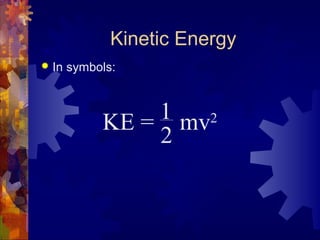
 In symbols:
KE = 1
2
mv2
Kinetic Energy
Kinetic energy is a scalar quantity.
Common units of kinetic energy:
Joules
An object with mass of 1 kg, moving
at 1 m/s, has a kinetic energy of 0.5
Joule.
Work
When the kinetic energy of an
object changes, work has been
done on the object.
Units of work: Joules
Work is a scalar quantity.
Work
 Work depends on:
 The amount of force applied to the object.
 The distance that the object moves while
the force is applied.
 The direction of the force with respect to
the direction the object moves.
Work
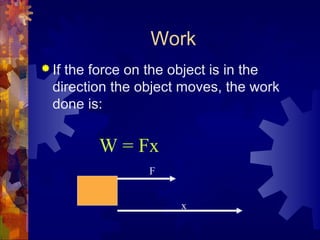
 If the force on the object is in the
direction the object moves, the work
done is:
W = Fx
F
x
Work
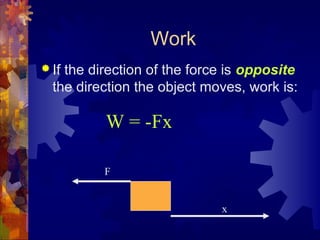
 If the direction of the force is opposite
the direction the object moves, work is:
W = -Fx
F
x
Force is NOT Work
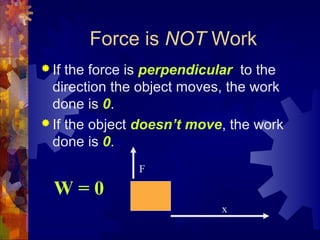
 If the force is perpendicular to the
direction the object moves, the work
done is 0.
 If the object doesn’t move, the work
done is 0.
F
x
W = 0
Work and Kinetic Energy
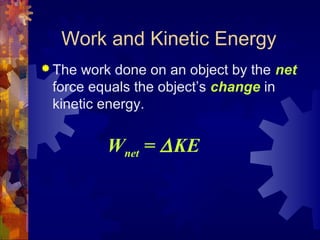
 The work done on an object by the net
force equals the object’s change in
kinetic energy.
Wnet = ∆KE
Potential Energy
 Sometimes work is not converted
directly into kinetic energy. Instead it is
“stored”, or “hidden”.
 Potential energy is stored energy or
stored work.
Potential Energy
 Potential energy is energy that an
object (system) has due to its position
or arrangement.
Calculating Potential Energy
 To calculate the potential energy of a
particular arrangement:
1. Pick a position or arrangement that
you want to call the “potential energy
= 0” situation.
Calculating Potential Energy
2. The potential energy of any other
position or arrangement equals the
negative of the work that the
conservative force does in changing
from the potential energy = 0 situation
to that one.
PE = - WorkF
Conservative Forces
 Energy or work is stored when a force
does work “against” a force such as the
gravitational force or a Hooke’s Law
(spring) force.
 Forces that store or hide energy are
called conservative forces.
Gravitational PE
 The gravitational potential energy of an
object at height h equals the negative of
the work that gravity does when the
object is lifted from the PE = 0 position.
GPE = mgh
Mechanical Energy
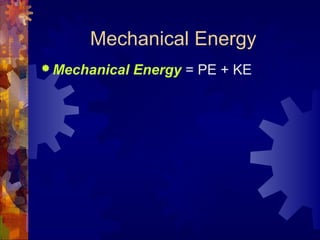
 Mechanical Energy = PE + KE
Conservation of Energy
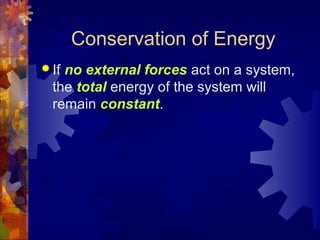
 If no external forces act on a system,
the total energy of the system will
remain constant.
Power
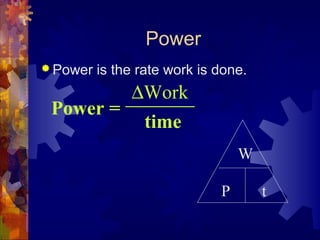
 Power is the rate work is done.
Power =
∆Work
time
W
P t
Power
 Units of power: 1 Joule/sec = 1 Watt
 1000 Watts = 1 kilowatt
 Power is a scalar quantity.
(Simple) Machines
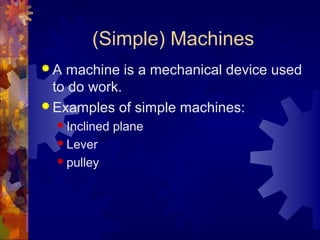
 A machine is a mechanical device used
to do work.
 Examples of simple machines:
 Inclined plane
 Lever
 pulley
(Simple) Machines
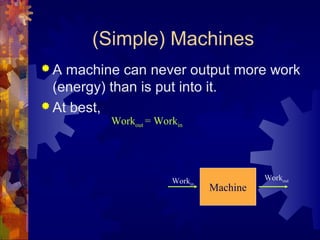
 A machine can never output more work
(energy) than is put into it.
 At best,
Workout = Workin
Machine
Workin
Workout
Mechanical Advantage
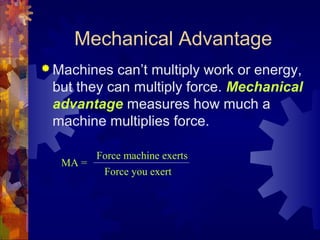
 Machines can’t multiply work or energy,
but they can multiply force. Mechanical
advantage measures how much a
machine multiplies force.
MA =
Force machine exerts
Force you exert
Efficiency
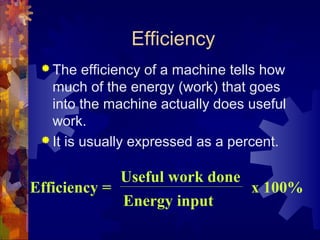
 The efficiency of a machine tells how
much of the energy (work) that goes
into the machine actually does useful
work.
 It is usually expressed as a percent.
Efficiency =
Useful work done
Energy input
x 100%
The End

Energy physics

  • 1.
  • 2.
    Kinetic Energy  Ifan object is moving, it has energy. (Be careful, the converse of this statement is not always true!)  This energy is called kinetic energy - the energy of motion.
  • 3.
    Kinetic Energy  Anobject’s kinetic energy depends on:  the object’s mass.  Kinetic energy is directly proportional to mass.  the object’s speed.  Kinetic energy is directly proportional to the square of the object’s speed.
  • 4.
    Kinetic Energy  Insymbols: KE = 1 2 mv2
  • 5.
    Kinetic Energy Kinetic energyis a scalar quantity. Common units of kinetic energy: Joules An object with mass of 1 kg, moving at 1 m/s, has a kinetic energy of 0.5 Joule.
  • 6.
    Work When the kineticenergy of an object changes, work has been done on the object. Units of work: Joules Work is a scalar quantity.
  • 7.
    Work  Work dependson:  The amount of force applied to the object.  The distance that the object moves while the force is applied.  The direction of the force with respect to the direction the object moves.
  • 8.
    Work  If theforce on the object is in the direction the object moves, the work done is: W = Fx F x
  • 9.
    Work  If thedirection of the force is opposite the direction the object moves, work is: W = -Fx F x
  • 10.
    Force is NOTWork  If the force is perpendicular to the direction the object moves, the work done is 0.  If the object doesn’t move, the work done is 0. F x W = 0
  • 11.
    Work and KineticEnergy  The work done on an object by the net force equals the object’s change in kinetic energy. Wnet = ∆KE
  • 12.
    Potential Energy  Sometimeswork is not converted directly into kinetic energy. Instead it is “stored”, or “hidden”.  Potential energy is stored energy or stored work.
  • 13.
    Potential Energy  Potentialenergy is energy that an object (system) has due to its position or arrangement.
  • 14.
    Calculating Potential Energy To calculate the potential energy of a particular arrangement: 1. Pick a position or arrangement that you want to call the “potential energy = 0” situation.
  • 15.
    Calculating Potential Energy 2.The potential energy of any other position or arrangement equals the negative of the work that the conservative force does in changing from the potential energy = 0 situation to that one. PE = - WorkF
  • 16.
    Conservative Forces  Energyor work is stored when a force does work “against” a force such as the gravitational force or a Hooke’s Law (spring) force.  Forces that store or hide energy are called conservative forces.
  • 17.
    Gravitational PE  Thegravitational potential energy of an object at height h equals the negative of the work that gravity does when the object is lifted from the PE = 0 position. GPE = mgh
  • 18.
  • 19.
    Conservation of Energy If no external forces act on a system, the total energy of the system will remain constant.
  • 20.
    Power  Power isthe rate work is done. Power = ∆Work time W P t
  • 21.
    Power  Units ofpower: 1 Joule/sec = 1 Watt  1000 Watts = 1 kilowatt  Power is a scalar quantity.
  • 22.
    (Simple) Machines  Amachine is a mechanical device used to do work.  Examples of simple machines:  Inclined plane  Lever  pulley
  • 23.
    (Simple) Machines  Amachine can never output more work (energy) than is put into it.  At best, Workout = Workin Machine Workin Workout
  • 24.
    Mechanical Advantage  Machinescan’t multiply work or energy, but they can multiply force. Mechanical advantage measures how much a machine multiplies force. MA = Force machine exerts Force you exert
  • 25.
    Efficiency  The efficiencyof a machine tells how much of the energy (work) that goes into the machine actually does useful work.  It is usually expressed as a percent. Efficiency = Useful work done Energy input x 100%
  • 26.