W O R K E N E R G Y
A N D P O W E R
Elizabeth George
Umaru Pateh Bah
Mariama Baindu Kamara
Yusif Kargbo
Yanjuba yemoh
David Tamba Pessima
Alusine Faith Koroma
Gracious Charles Bandor
Osman Sesay
Abu Bakarr S Kargbo
W O R K
• Force(N) -is push or pull effect on a
body.
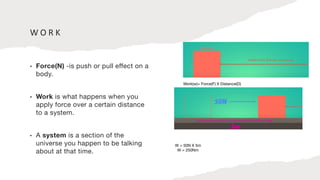
• Work is what happens when you
apply force over a certain distance
to a system.
• A system is a section of the
universe you happen to be talking
about at that time.
Work(w)= Force(F) X Distance(D)
W = 50N X 5m
W = 250Nm
F O R C E A P P L I E D AT A N A N G L E
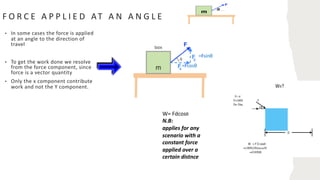
• In some cases the force is applied
at an angle to the direction of
travel
• To get the work done we resolve
from the force component, since
force is a vector quantity
• Only the x component contribute
work and not the Y component.
=Fsinθ
=Fcosθ
W= Fdcosθ
N.B:
applies for any
scenario with a
constant force
applied over a
certain distnce
W O R K D O N E W I T H
V A R Y I N G F O R C E ?
In a scenario where the force applied
changes with change in distance.
To calculate the workdone, one must
sum up the forces applied over each
small change in distance:
∫
!"
!#
𝐹 𝑥 𝑑𝑥 [assuming force is parallel
to distance moved].
• Work is a scalar quantity; it can be
positive or negative.
W = + W = -
work is negative if the
applied force is in the
direction opposite to the
motion of the object
work is positive if the applied
force is in the direction to the
motion of the object
W O R K A N D E N E R G Y
• Force multiplide by distance is one of the ways a physcist measure work and has a
unit Newton metre, it can also be expressed as Joules(J)
• Joules are often used as a unit of energy.
Work is a change in energy, it explains what happens when an external force is applied
to a system and changes the energy of the system.
Energy can be define as the ability to do work.
T Y P E S O F E N E R G Y
• There are different types of energy, eg. Kinetic energy,potential energy, electrical energy, thermal energy , nuclear energy etc.
The two main types of energy; KINETIC ENERGY and POTENTIAL ENERGY
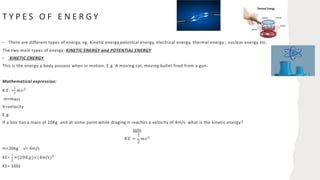
• KINETIC ENERGY
This is the energy a body possess when in motion. E.g. A moving car, moving bullet fired from a gun.
Mathematical expression:
K.E. =
!
"
𝑚𝑣"
m=mass
V=velocity
E.g.
If a box has a mass of 20Kg and at some point while draging it reaches a velocity of 4m/s. what is the kinetic energy?
soln
𝐾𝐸 =
1
2
𝑚𝑣"
m=20kg v= 4m/s
KE=
!
"
×(20𝐾𝑔)×(4m/s)"
KE= 160J
• POTENTIAL ENERGY
Potential energy is energy that could
be used to do work. Potential energy is
a way of storing energy.
• One common form of potential
energy is Gravitational potential
energy. This arises from the fact that
gravity exists.
• Another form of energy is
elastic/spring potential energy
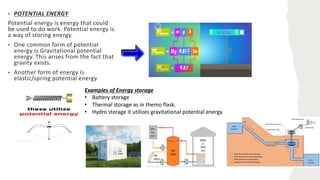
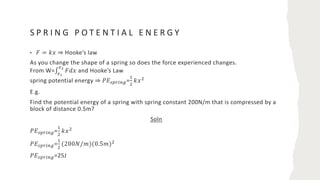
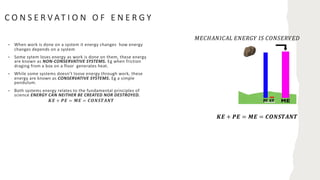
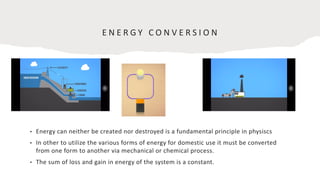
Examples of Energy storage
• Battery storage
• Thermal storage as in themo flask.
• Hydro storage it utilizes gravitational potential energy
S P R I N G P O T E N T I A L E N E R G Y
• 𝐹 = 𝑘𝑥 ⇒ Hooke’s law
As you change the shape of a spring so does the force experienced changes.
From W=∫
.!
."
𝐹𝑑𝑥 and Hooke’s Law
spring potential energy ⇒ 𝑃𝐸/01234=
5
6
𝑘𝑥6
E.g.
Find the potential energy of a spring with spring constant 200N/m that is compressed by a
block of distance 0.5m?
Soln
𝑃𝐸/01234=
5
6
𝑘𝑥6
𝑃𝐸/01234=
5
6
(200𝑁/𝑚)(0.5𝑚)6
𝑃𝐸/01234=25J
C O N S E R V AT I O N O F E N E R G Y
• When work is done on a system it energy changes how energy
changes depends on a system
• Some sytem loses energy as work is done on them, these energy
are known as NON-CONSERVATIVE SYSTEMS. Eg when friction
draging from a box on a floor generates heat.
• While some systems doesn’t loose energy through work, these
energy are known as CONSERVATIVE SYSTEMS. Eg a simple
pendulum.
• Both systems energy relates to the fundamental principles of
science ENERGY CAN NEITHER BE CREATED NOR DESTROYED.
𝑲𝑬 + 𝑷𝑬 = 𝑴𝑬 = 𝑪𝑶𝑵𝑺𝑻𝑨𝑵𝑻
𝑀𝐸𝐶𝐻𝐴𝑁𝐼𝐶𝐴𝐿 𝐸𝑁𝐸𝑅𝐺𝑌 𝐼𝑆 𝐶𝑂𝑁𝑆𝐸𝑅𝑉𝐸𝐷
E N E R G Y C O N V E R S I O N
• Energy can neither be created nor destroyed is a fundamental principle in physiscs
• In other to utilize the various forms of energy for domestic use it must be converted
from one form to another via mechanical or chemical process.
• The sum of loss and gain in energy of the system is a constant.
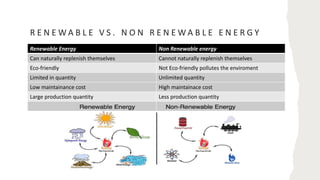
R E N E W A B L E V S . N O N R E N E W A B L E E N E R G Y
Renewable Energy Non Renewable energy
Can naturally replenish themselves Cannot naturally replenish themselves
Eco-friendly Not Eco-friendly pollutes the enviroment
Limited in quantity Unlimited quantity
Low maintainance cost High maintainace cost
Large production quantity Less production quantity
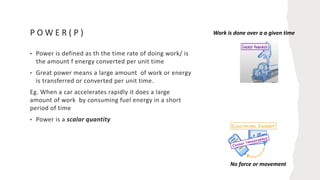
P O W E R ( P )
• Power is defined as th the time rate of doing work/ is
the amount f energy converted per unit time
• Great power means a large amount of work or energy
is transferred or converted per unit time.
Eg. When a car accelerates rapidly it does a large
amount of work by consuming fuel energy in a short
period of time
• Power is a scalar quantity
Work is done over a a given time
No force or movement
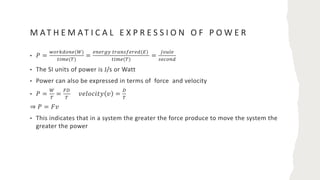
M AT H E M AT I C A L E X P R E S S I O N O F P O W E R
• 𝑃 =
$%&'(%)*(,)
./0*(1)
=
*)*&23 .&5)67*&*((8)
./0*(1)
=
9%:;*
6*<%)(
• The SI units of power is J/s or Watt
• Power can also be expressed in terms of force and velocity
• 𝑃 =
,
1
=
=>
1
𝑣𝑒𝑙𝑜𝑐𝑖𝑡𝑦 𝑣 =
>
1
⇒ 𝑃 = 𝐹𝑣
• This indicates that in a system the greater the force produce to move the system the
greater the power
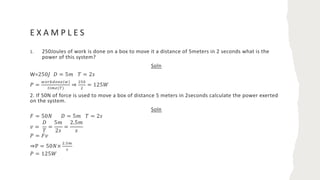
E X A M P L E S
1. 250Joules of work is done on a box to move it a distance of 5meters in 2 seconds what is the
power of this system?
Soln
W=250𝐽 𝐷 = 5𝑚 𝑇 = 2𝑠
𝑃 =
!"#$%"&'(!)
*+,'(-)
⇒
./0
.
= 125𝑊
2. If 50N of force is used to move a box of distance 5 meters in 2seconds calculate the power exerted
on the system.
Soln
𝐹 = 50𝑁 𝐷 = 5𝑚 𝑇 = 2𝑠
𝑣 =
𝐷
𝑇
=
5𝑚
2𝑠
=
2.5𝑚
𝑠
𝑃 = 𝐹𝑣
⇒P = 50𝑁×
../,
2
𝑃 = 125𝑊
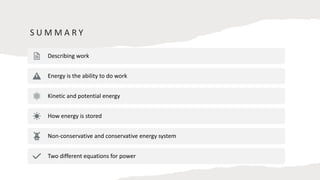
S U M M A R Y
Describing work
Energy is the ability to do work
Kinetic and potential energy
How energy is stored
Non-conservative and conservative energy system
Two different equations for power

Presentation on Applied Mechanics by Year 2

  • 1.
    W O RK E N E R G Y A N D P O W E R Elizabeth George Umaru Pateh Bah Mariama Baindu Kamara Yusif Kargbo Yanjuba yemoh David Tamba Pessima Alusine Faith Koroma Gracious Charles Bandor Osman Sesay Abu Bakarr S Kargbo
  • 2.
    W O RK • Force(N) -is push or pull effect on a body. • Work is what happens when you apply force over a certain distance to a system. • A system is a section of the universe you happen to be talking about at that time. Work(w)= Force(F) X Distance(D) W = 50N X 5m W = 250Nm
  • 3.
    F O RC E A P P L I E D AT A N A N G L E • In some cases the force is applied at an angle to the direction of travel • To get the work done we resolve from the force component, since force is a vector quantity • Only the x component contribute work and not the Y component. =Fsinθ =Fcosθ W= Fdcosθ N.B: applies for any scenario with a constant force applied over a certain distnce
  • 4.
    W O RK D O N E W I T H V A R Y I N G F O R C E ? In a scenario where the force applied changes with change in distance. To calculate the workdone, one must sum up the forces applied over each small change in distance: ∫ !" !# 𝐹 𝑥 𝑑𝑥 [assuming force is parallel to distance moved]. • Work is a scalar quantity; it can be positive or negative. W = + W = - work is negative if the applied force is in the direction opposite to the motion of the object work is positive if the applied force is in the direction to the motion of the object
  • 5.
    W O RK A N D E N E R G Y • Force multiplide by distance is one of the ways a physcist measure work and has a unit Newton metre, it can also be expressed as Joules(J) • Joules are often used as a unit of energy. Work is a change in energy, it explains what happens when an external force is applied to a system and changes the energy of the system. Energy can be define as the ability to do work.
  • 6.
    T Y PE S O F E N E R G Y • There are different types of energy, eg. Kinetic energy,potential energy, electrical energy, thermal energy , nuclear energy etc. The two main types of energy; KINETIC ENERGY and POTENTIAL ENERGY • KINETIC ENERGY This is the energy a body possess when in motion. E.g. A moving car, moving bullet fired from a gun. Mathematical expression: K.E. = ! " 𝑚𝑣" m=mass V=velocity E.g. If a box has a mass of 20Kg and at some point while draging it reaches a velocity of 4m/s. what is the kinetic energy? soln 𝐾𝐸 = 1 2 𝑚𝑣" m=20kg v= 4m/s KE= ! " ×(20𝐾𝑔)×(4m/s)" KE= 160J
  • 7.
    • POTENTIAL ENERGY Potentialenergy is energy that could be used to do work. Potential energy is a way of storing energy. • One common form of potential energy is Gravitational potential energy. This arises from the fact that gravity exists. • Another form of energy is elastic/spring potential energy Examples of Energy storage • Battery storage • Thermal storage as in themo flask. • Hydro storage it utilizes gravitational potential energy
  • 8.
    S P RI N G P O T E N T I A L E N E R G Y • 𝐹 = 𝑘𝑥 ⇒ Hooke’s law As you change the shape of a spring so does the force experienced changes. From W=∫ .! ." 𝐹𝑑𝑥 and Hooke’s Law spring potential energy ⇒ 𝑃𝐸/01234= 5 6 𝑘𝑥6 E.g. Find the potential energy of a spring with spring constant 200N/m that is compressed by a block of distance 0.5m? Soln 𝑃𝐸/01234= 5 6 𝑘𝑥6 𝑃𝐸/01234= 5 6 (200𝑁/𝑚)(0.5𝑚)6 𝑃𝐸/01234=25J
  • 9.
    C O NS E R V AT I O N O F E N E R G Y • When work is done on a system it energy changes how energy changes depends on a system • Some sytem loses energy as work is done on them, these energy are known as NON-CONSERVATIVE SYSTEMS. Eg when friction draging from a box on a floor generates heat. • While some systems doesn’t loose energy through work, these energy are known as CONSERVATIVE SYSTEMS. Eg a simple pendulum. • Both systems energy relates to the fundamental principles of science ENERGY CAN NEITHER BE CREATED NOR DESTROYED. 𝑲𝑬 + 𝑷𝑬 = 𝑴𝑬 = 𝑪𝑶𝑵𝑺𝑻𝑨𝑵𝑻 𝑲𝑬 + 𝑷𝑬 = 𝑴𝑬 = 𝑪𝑶𝑵𝑺𝑻𝑨𝑵𝑻 𝑀𝐸𝐶𝐻𝐴𝑁𝐼𝐶𝐴𝐿 𝐸𝑁𝐸𝑅𝐺𝑌 𝐼𝑆 𝐶𝑂𝑁𝑆𝐸𝑅𝑉𝐸𝐷
  • 10.
    E N ER G Y C O N V E R S I O N • Energy can neither be created nor destroyed is a fundamental principle in physiscs • In other to utilize the various forms of energy for domestic use it must be converted from one form to another via mechanical or chemical process. • The sum of loss and gain in energy of the system is a constant.
  • 11.
    R E NE W A B L E V S . N O N R E N E W A B L E E N E R G Y Renewable Energy Non Renewable energy Can naturally replenish themselves Cannot naturally replenish themselves Eco-friendly Not Eco-friendly pollutes the enviroment Limited in quantity Unlimited quantity Low maintainance cost High maintainace cost Large production quantity Less production quantity
  • 12.
    P O WE R ( P ) • Power is defined as th the time rate of doing work/ is the amount f energy converted per unit time • Great power means a large amount of work or energy is transferred or converted per unit time. Eg. When a car accelerates rapidly it does a large amount of work by consuming fuel energy in a short period of time • Power is a scalar quantity Work is done over a a given time No force or movement
  • 13.
    M AT HE M AT I C A L E X P R E S S I O N O F P O W E R • 𝑃 = $%&'(%)*(,) ./0*(1) = *)*&23 .&5)67*&*((8) ./0*(1) = 9%:;* 6*<%)( • The SI units of power is J/s or Watt • Power can also be expressed in terms of force and velocity • 𝑃 = , 1 = => 1 𝑣𝑒𝑙𝑜𝑐𝑖𝑡𝑦 𝑣 = > 1 ⇒ 𝑃 = 𝐹𝑣 • This indicates that in a system the greater the force produce to move the system the greater the power
  • 14.
    E X AM P L E S 1. 250Joules of work is done on a box to move it a distance of 5meters in 2 seconds what is the power of this system? Soln W=250𝐽 𝐷 = 5𝑚 𝑇 = 2𝑠 𝑃 = !"#$%"&'(!) *+,'(-) ⇒ ./0 . = 125𝑊 2. If 50N of force is used to move a box of distance 5 meters in 2seconds calculate the power exerted on the system. Soln 𝐹 = 50𝑁 𝐷 = 5𝑚 𝑇 = 2𝑠 𝑣 = 𝐷 𝑇 = 5𝑚 2𝑠 = 2.5𝑚 𝑠 𝑃 = 𝐹𝑣 ⇒P = 50𝑁× ../, 2 𝑃 = 125𝑊
  • 15.
    S U MM A R Y Describing work Energy is the ability to do work Kinetic and potential energy How energy is stored Non-conservative and conservative energy system Two different equations for power