Displacement and Velocity
pg 40 - 46
Objectives
The student will be able to:
•describe motion in terms of displacement, time and
velocity
•calculate the displacement of an object traveling at a
known velocity for a specific time interval
•construct and interpret graphs of position versus time
Displacement
Displacement: the change in position of an object
Units: meters (m)
Symbol: Δx
When an object is at rest, its displacement is zero
because its position does not change.
Displacement vs Distance
If you were to describe the trip from your home to school,
you would describe all the twists and turns in your journey.
However, the displacement is the same no matter what
route you take to school.
Any path connecting your house and the school will result in
the same displacement.
Coordinate Systems
Coordinate System: a system the uses coordinates to
establish position
In this first unit, we will be working in one dimension, which
means we'll only be measuring in one direction (left and
right, up and down, north and south, etc.)
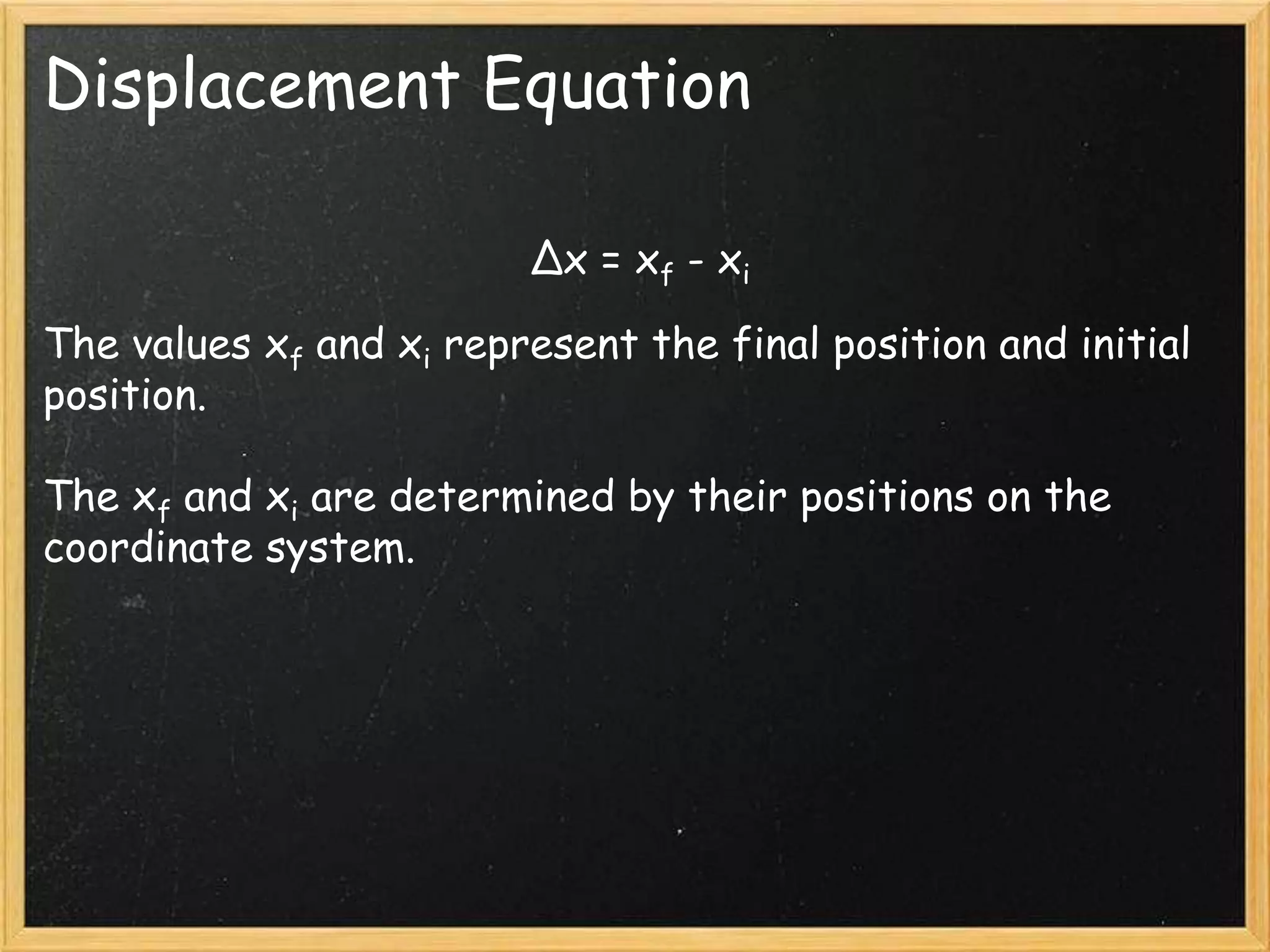
Displacement Equation
Δx = xf - xi
The values xf and xi represent the final position and initial
position.
The xf and xi are determined by their positions on the
coordinate system.
Negative and Positive
Displacement can be positive or negative.
Displacement is an example of a quantity that has both a
magnitude (size) and a direction.
The direction of the displacement is designated by the sign
(positive or negative.)
We will say that displacements to the left and down are
negative and displacements to the right and up are positive.
Average Velocity
Average Velocity: total displacement divided by the time
interval during which the displacement occured
Units: meters/second (m/s)
Symbol: vavg
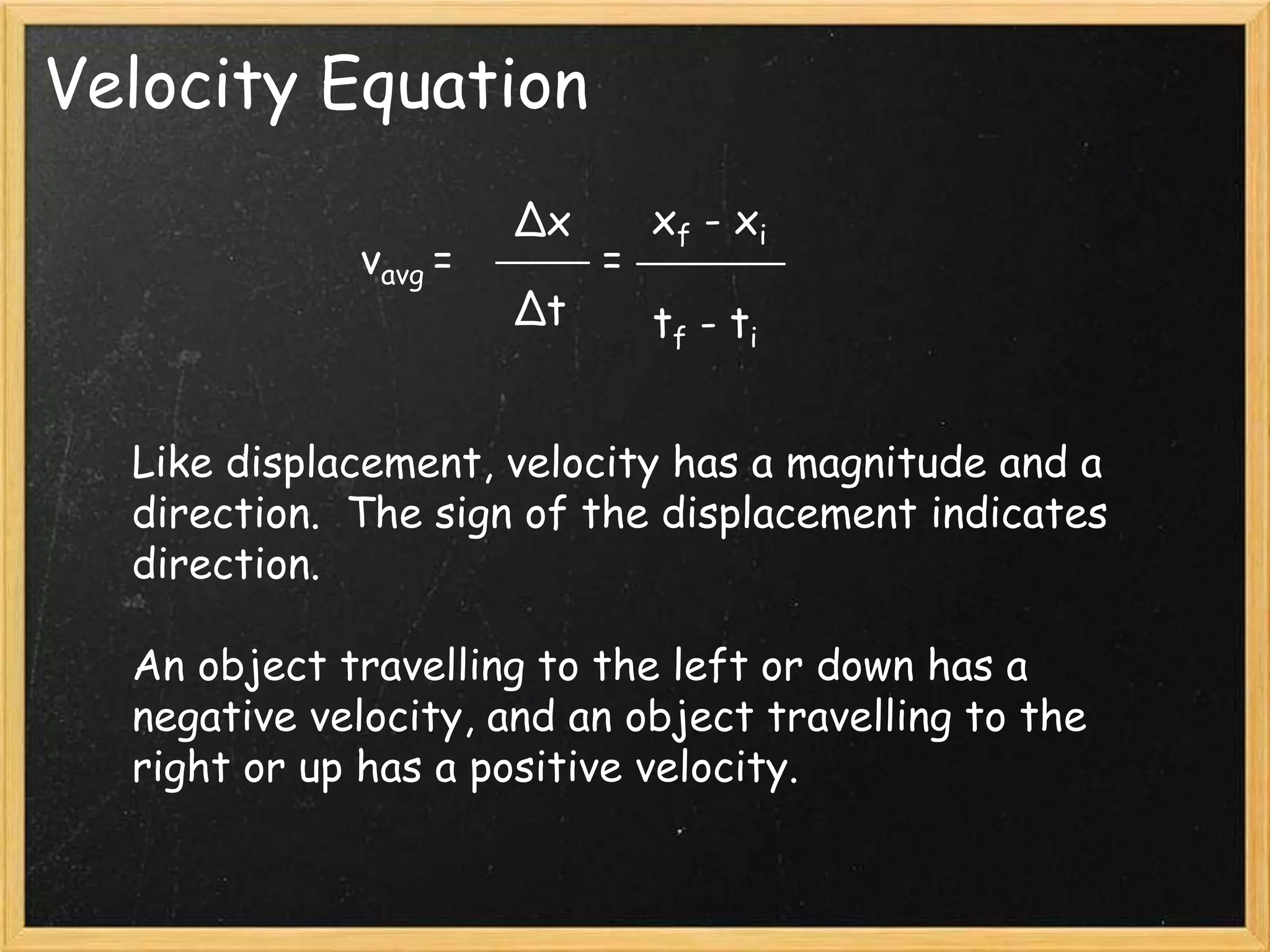
Velocity Equation
vavg =
Δx
Δt
xf - xi
tf - ti
=
Like displacement, velocity has a magnitude and a
direction. The sign of the displacement indicates
direction.
An object travelling to the left or down has a
negative velocity, and an object travelling to the
right or up has a positive velocity.
Velocity vs Speed
Velocity indicates how fast something is traveling, and the
direction in which it is traveling.
Speed, however, has no associated direction.
The average velocity depends on displacement, but the
average speed is equal to the distance traveled divided by
the time interval.
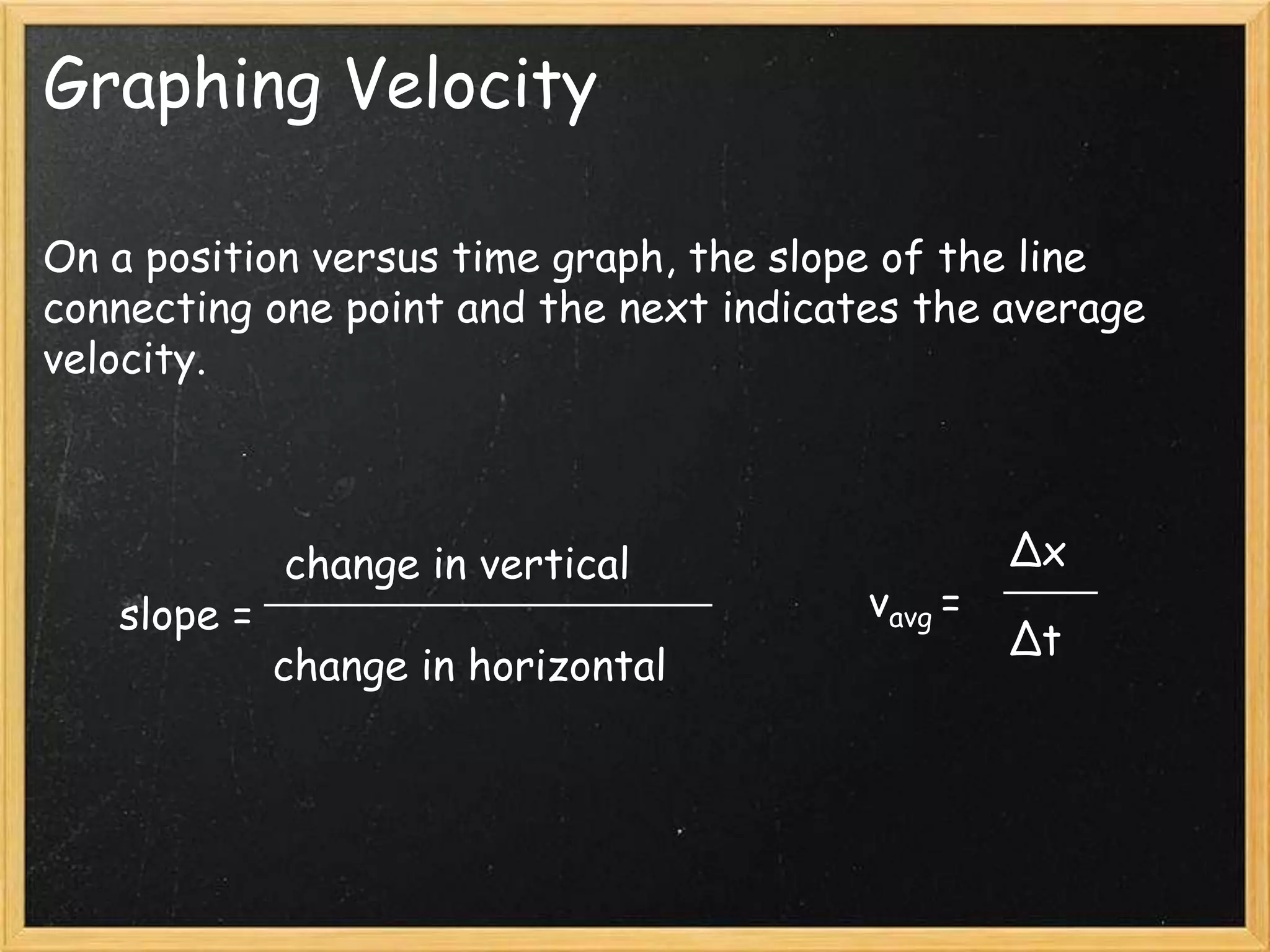
Graphing Velocity
On a position versus time graph, the slope of the line
connecting one point and the next indicates the average
velocity.
slope =
change in vertical
change in horizontal
vavg =
Δx
Δt
Homework
Pg 69-70, # 1, 2, 6, 9, 10, 11, 14

Displacement and Velocity

  • 1.
  • 2.
    Objectives The student willbe able to: •describe motion in terms of displacement, time and velocity •calculate the displacement of an object traveling at a known velocity for a specific time interval •construct and interpret graphs of position versus time
  • 3.
    Displacement Displacement: the changein position of an object Units: meters (m) Symbol: Δx When an object is at rest, its displacement is zero because its position does not change.
  • 4.
    Displacement vs Distance Ifyou were to describe the trip from your home to school, you would describe all the twists and turns in your journey. However, the displacement is the same no matter what route you take to school. Any path connecting your house and the school will result in the same displacement.
  • 5.
    Coordinate Systems Coordinate System:a system the uses coordinates to establish position In this first unit, we will be working in one dimension, which means we'll only be measuring in one direction (left and right, up and down, north and south, etc.)
  • 6.
    Displacement Equation Δx =xf - xi The values xf and xi represent the final position and initial position. The xf and xi are determined by their positions on the coordinate system.
  • 7.
    Negative and Positive Displacementcan be positive or negative. Displacement is an example of a quantity that has both a magnitude (size) and a direction. The direction of the displacement is designated by the sign (positive or negative.) We will say that displacements to the left and down are negative and displacements to the right and up are positive.
  • 8.
    Average Velocity Average Velocity:total displacement divided by the time interval during which the displacement occured Units: meters/second (m/s) Symbol: vavg
  • 9.
    Velocity Equation vavg = Δx Δt xf- xi tf - ti = Like displacement, velocity has a magnitude and a direction. The sign of the displacement indicates direction. An object travelling to the left or down has a negative velocity, and an object travelling to the right or up has a positive velocity.
  • 10.
    Velocity vs Speed Velocityindicates how fast something is traveling, and the direction in which it is traveling. Speed, however, has no associated direction. The average velocity depends on displacement, but the average speed is equal to the distance traveled divided by the time interval.
  • 11.
    Graphing Velocity On aposition versus time graph, the slope of the line connecting one point and the next indicates the average velocity. slope = change in vertical change in horizontal vavg = Δx Δt
  • 12.
    Homework Pg 69-70, #1, 2, 6, 9, 10, 11, 14