Thermal Physics
Heat
Temperature
Specific Heat Capacity
Specific Latent Heat
Key words: heat energy, temperature, specific
heat capacity

By the end of this lesson you will be able
to:
Describe and explain the terms heat
energy and temperature.
State that the same mass of different
materials needs different quantities of
heat energy to change their temperature
by one degree celsius.
Carry out calculations involving specific
heat capacity.
Heat and temperature
Are heat and temperature the same
thing? How would you explain to someone
else the difference between the two?

Can you use a thermometer to measure
heat?
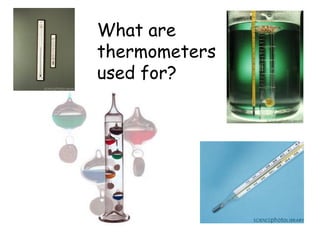
What are
thermometers
used for?
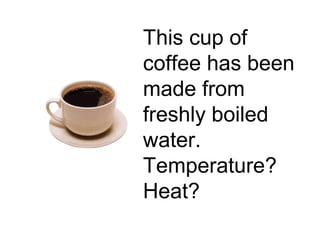
This cup of
coffee has been
made from
freshly boiled
water.
Temperature?
Heat?
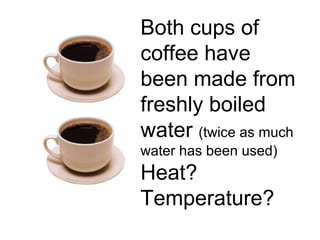
Both cups of
coffee have
been made from
freshly boiled
water (twice as much
water has been used)

Heat?
Temperature?
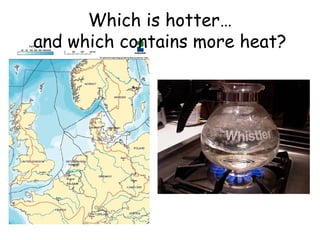
Which is hotter…
and which contains more heat?
Heat
Heat is a form of energy.
It is a scalar quantity.
It is measured in joules (J).
Temperature
Temperature is an indication of
how hot or cold an object is.
It is a scalar quantity.
It is measured in degrees celsius (°C).
What happens when we heat a
substance?
Virtual Int 2 Physics – Mechanics & Heat – Heat - Introduction

When we heat the air in a
room, the kinetic energy of
the molecules increases.
The air molecules move
faster.
When we heat snow, the
vibration of the molecules
increases and it eventually
melts.
When we heat water, the
molecules vibrate faster.
What happens when we heat a
substance?

When we heat a
substance it
becomes hotter
or changes state.
How much heat is needed to raise
the temperature of an object?
It might depend on…

Virtual Int 2 Physics – Mechanics & Heat – Heat – Specific Heat Capacity
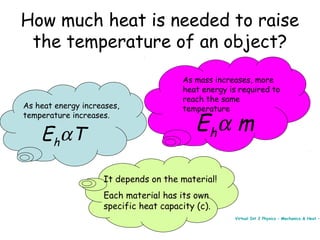
How much heat is needed to raise
the temperature of an object?

As heat energy increases,
temperature increases.

E h αT

As mass increases, more
heat energy is required to
reach the same
temperature

Ehα m

It depends on the material!
Each material has its own
specific heat capacity (c).
Virtual Int 2 Physics – Mechanics & Heat –
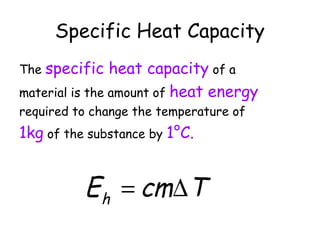
Specific Heat Capacity
specific heat capacity of a
material is the amount of heat energy
The

required to change the temperature of

1kg of the substance by 1°C.

E h = cm∆T
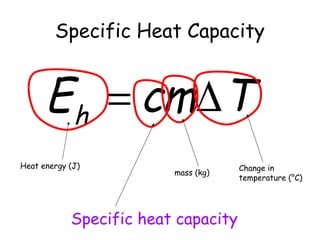
Specific Heat Capacity

E h = cm∆T
Heat energy (J)

mass (kg)

Specific heat capacity

Change in
temperature (°C)
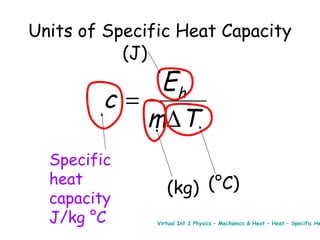
Units of Specific Heat Capacity
(J)

Eh
c=
m∆ T

Specific
heat
capacity
J/kg °C

(kg) (°C)

Virtual Int 2 Physics – Mechanics & Heat – Heat – Specific He
Activity 10
To measure the specific heat capacity of
different metals.
Find the power of the immersion heater.
What will you need to know?
How can you use the joulemeter and
stopclock to calculate the power of the
immersion heater?
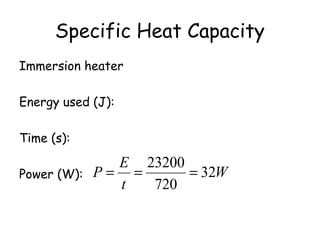
Specific Heat Capacity
Immersion heater
Energy used (J): 23200 J
Time (s): 12 x 60 = 720 s

E 23200
=
= 32W
Power (W): P =
t
720
Specific Heat Capacity
What will you need to know to find the specific heat
capacity of the metal block?
Use the apparatus to find the specific heat capacity.
You must find the mass of the block in kg first.
Metal:
Mass (kg):
Power (W):
Time taken (s):
Temperature change (°C):
Eh (by calculation):
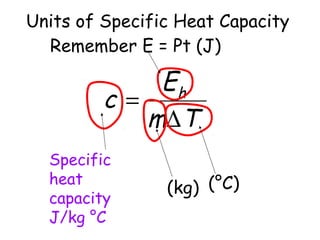
Units of Specific Heat Capacity
Remember E = Pt (J)

Eh
c=
m∆ T
Specific
heat
capacity
J/kg °C

(kg) (°C)
Specific Heat Capacity
Check your value against the data sheet.
How does it compare?
Explain any difference:
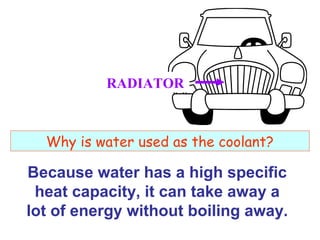
RADIATOR

Why is water used as the coolant?

Because water has a high specific
heat capacity, it can take away a
lot of energy without boiling away.
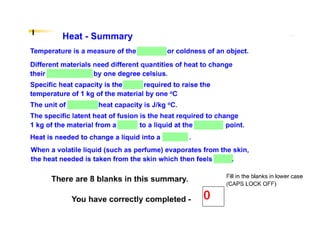
Key words: heat energy, change of state,
specific latent heat

By the end of this lesson you will be able
to:
State that heat is gained or lost by a
substance when its state is changed.
State that a change of state does not involve
a change in temperature.
Carry out calculations involving specific latent
heat.
Carry out calculations involving energy, work,
power and the principle of conservation of
energy.
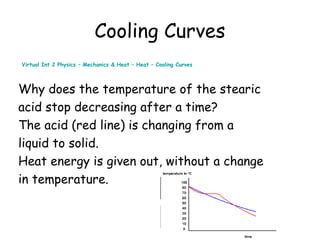
Cooling Curves
Virtual Int 2 Physics – Mechanics & Heat – Heat – Cooling Curves

Why does the temperature of the stearic
acid stop decreasing after a time?
The acid (red line) is changing from a
liquid to solid.
Heat energy is given out, without a change
in temperature.
What happens when we heat a
substance?

When we heat the air in a room, the
kinetic energy of the molecules increases.
The air molecules move faster.

When we heat water, the molecules
vibrate faster.

When we heat snow,
the vibration of the
molecules increases
and it eventually
melts.

The temperature does not
always rise!
What happens when we heat a
substance?
The temperature does not
always rise!
Where does the heat energy go?

We must supply energy to
change a solid to a liquid or a
liquid to a gas.
Virtual Int 2 Physics – Mechanics & Heat – Heat – Latent Heat (Fusion)
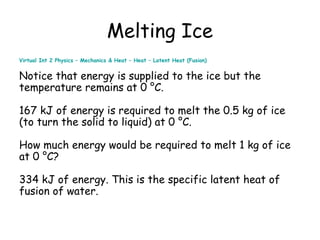
Melting Ice
Virtual Int 2 Physics – Mechanics & Heat – Heat – Latent Heat (Fusion)

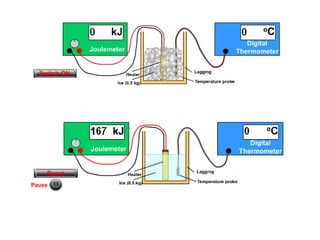
Notice that energy is supplied to the ice but the
temperature remains at 0 °C.
167 kJ of energy is required to melt the 0.5 kg of ice
(to turn the solid to liquid) at 0 °C.
How much energy would be required to melt 1 kg of ice
at 0 °C?
334 kJ of energy. This is the specific latent heat of
fusion of water.
Specific Latent Heat of Fusion
Virtual Int 2 Physics – Mechanics & Heat – Heat – Latent Heat (Fusion)

When we heat a solid, it will melt and become a liquid.
At this point, energy is required but the temperature
does not rise.

The specific latent heat of fusion of a
substance is the heat energy required to
change 1kg of solid at its melting point to
1 kg of liquid – without a change in
temperature.
Specific Latent Heat of Fusion
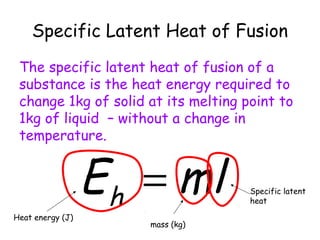
The specific latent heat of fusion of a
substance is the heat energy required to
change 1kg of solid at its melting point to
1kg of liquid – without a change in
temperature.

Heat energy (J)

E h = ml
mass (kg)

Specific latent
heat
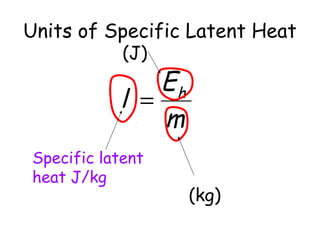
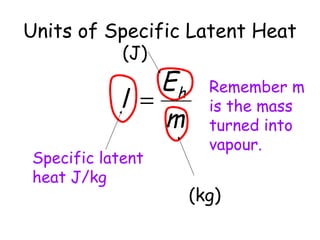
Units of Specific Latent Heat
(J)

Eh
l =
m
Specific latent
heat J/kg

(kg)
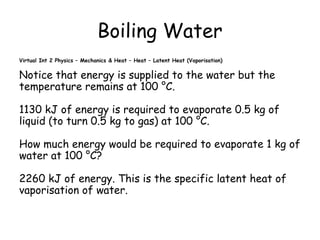
Boiling Water
Virtual Int 2 Physics – Mechanics & Heat – Heat – Latent Heat (Vaporisation)

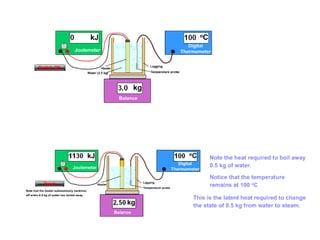
Notice that energy is supplied to the water but the
temperature remains at 100 °C.
1130 kJ of energy is required to evaporate 0.5 kg of
liquid (to turn 0.5 kg to gas) at 100 °C.
How much energy would be required to evaporate 1 kg of
water at 100 °C?
2260 kJ of energy. This is the specific latent heat of
vaporisation of water.
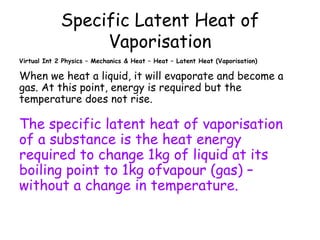
Specific Latent Heat of
Vaporisation
Virtual Int 2 Physics – Mechanics & Heat – Heat – Latent Heat (Vaporisation)

When we heat a liquid, it will evaporate and become a
gas. At this point, energy is required but the
temperature does not rise.

The specific latent heat of vaporisation
of a substance is the heat energy
required to change 1kg of liquid at its
boiling point to 1kg ofvapour (gas) –
without a change in temperature.
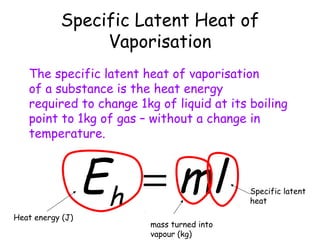
Specific Latent Heat of
Vaporisation
The specific latent heat of vaporisation
of a substance is the heat energy
required to change 1kg of liquid at its boiling
point to 1kg of gas – without a change in
temperature.

Heat energy (J)

E h = ml
mass turned into
vapour (kg)

Specific latent
heat
Units of Specific Latent Heat
(J)

Eh
l =
m
Specific latent
heat J/kg

Remember m
is the mass
turned into
vapour.

(kg)
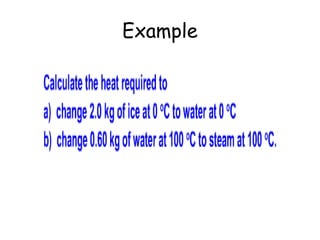
Example
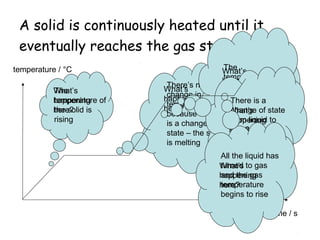
A solid is continuously heated until it
eventually reaches the gas state.
temperature / °C
The
What’s
temperature
happening of
the solid is
here?
rising

The
What’s
temperature
happening of
There’s no
the liquid is
What’s
here?
change in
rising
happening
There is a
temperature
here?
change
because there What’s of state
from liquid
happening to
is a change of
gas so
state – the solid here? no
change in
is melting
temperature
All the liquid has
turned
What’s to gas
and the gas
happening
temperature
here?
begins to rise
time / s
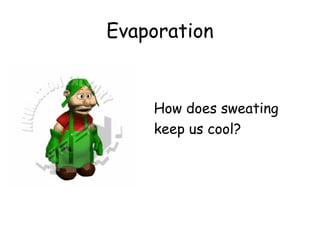
Evaporation

How does sweating
keep us cool?
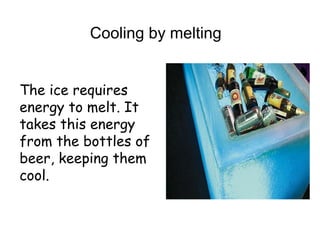
Cooling by melting
The ice requires
energy to melt. It
takes this energy
from the bottles of
beer, keeping them
cool.
Principle of Conservation of Energy

Energy cannot be created or destroyed –
simply transferred from one form to
another.
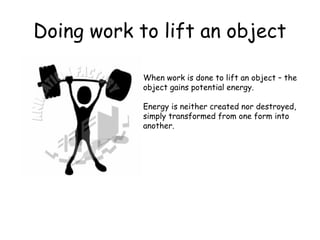
Doing work to lift an object
When work is done to lift an object – the
object gains potential energy.
Energy is neither created nor destroyed,
simply transformed from one form into
another.
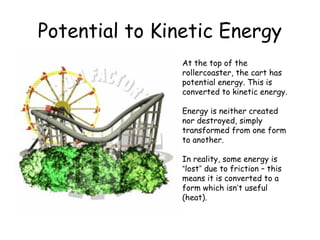
Potential to Kinetic Energy
At the top of the
rollercoaster, the cart has
potential energy. This is
converted to kinetic energy.
Energy is neither created
nor destroyed, simply
transformed from one form
to another.
In reality, some energy is
“lost” due to friction – this
means it is converted to a
form which isn’t useful
(heat).
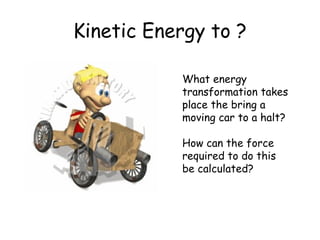
Kinetic Energy to ?
What energy
transformation takes
place the bring a
moving car to a halt?
How can the force
required to do this
be calculated?
Conservation of Energy
The principle of conservation of energy
also applies when we use electrical energy
to heat substances.
Example
Calculate the time taken for a 500 W
heater to melt 2 kg of ice at 0 °C.

Think – we are talking about change of
state without a change of temperature
therefore latent heat.
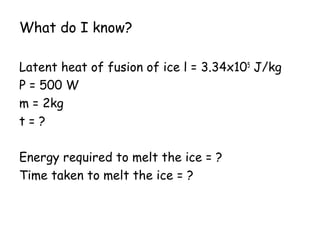
What do I know?
Latent heat of fusion of ice l = 3.34x10⁵ J/kg
P = 500 W
m = 2kg
t=?
Energy required to melt the ice = ?
Time taken to melt the ice = ?
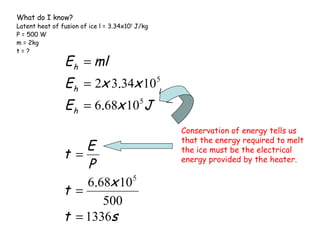
What do I know?

Latent heat of fusion of ice l = 3.34x10⁵ J/kg
P = 500 W
m = 2kg
t=?

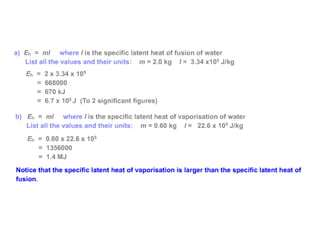
E h = ml

E h = 2x 3.34x 10

5

E h = 6.68x 10⁵ J
E
t =
P
6.68x 10 5
t =
500
t = 1336s

Conservation of energy tells us
that the energy required to melt
the ice must be the electrical
energy provided by the heater.

Thermal physics ppt

  • 1.
  • 2.
    Key words: heatenergy, temperature, specific heat capacity By the end of this lesson you will be able to: Describe and explain the terms heat energy and temperature. State that the same mass of different materials needs different quantities of heat energy to change their temperature by one degree celsius. Carry out calculations involving specific heat capacity.
  • 3.
    Heat and temperature Areheat and temperature the same thing? How would you explain to someone else the difference between the two? Can you use a thermometer to measure heat?
  • 4.
  • 5.
    This cup of coffeehas been made from freshly boiled water. Temperature? Heat?
  • 6.
    Both cups of coffeehave been made from freshly boiled water (twice as much water has been used) Heat? Temperature?
  • 7.
    Which is hotter… andwhich contains more heat?
  • 8.
    Heat Heat is aform of energy. It is a scalar quantity. It is measured in joules (J).
  • 9.
    Temperature Temperature is anindication of how hot or cold an object is. It is a scalar quantity. It is measured in degrees celsius (°C).
  • 10.
    What happens whenwe heat a substance? Virtual Int 2 Physics – Mechanics & Heat – Heat - Introduction When we heat the air in a room, the kinetic energy of the molecules increases. The air molecules move faster. When we heat snow, the vibration of the molecules increases and it eventually melts. When we heat water, the molecules vibrate faster.
  • 11.
    What happens whenwe heat a substance? When we heat a substance it becomes hotter or changes state.
  • 12.
    How much heatis needed to raise the temperature of an object? It might depend on… Virtual Int 2 Physics – Mechanics & Heat – Heat – Specific Heat Capacity
  • 13.
    How much heatis needed to raise the temperature of an object? As heat energy increases, temperature increases. E h αT As mass increases, more heat energy is required to reach the same temperature Ehα m It depends on the material! Each material has its own specific heat capacity (c). Virtual Int 2 Physics – Mechanics & Heat –
  • 14.
    Specific Heat Capacity specificheat capacity of a material is the amount of heat energy The required to change the temperature of 1kg of the substance by 1°C. E h = cm∆T
  • 15.
    Specific Heat Capacity Eh = cm∆T Heat energy (J) mass (kg) Specific heat capacity Change in temperature (°C)
  • 16.
    Units of SpecificHeat Capacity (J) Eh c= m∆ T Specific heat capacity J/kg °C (kg) (°C) Virtual Int 2 Physics – Mechanics & Heat – Heat – Specific He
  • 17.
    Activity 10 To measurethe specific heat capacity of different metals. Find the power of the immersion heater. What will you need to know? How can you use the joulemeter and stopclock to calculate the power of the immersion heater?
  • 18.
    Specific Heat Capacity Immersionheater Energy used (J): 23200 J Time (s): 12 x 60 = 720 s E 23200 = = 32W Power (W): P = t 720
  • 19.
    Specific Heat Capacity Whatwill you need to know to find the specific heat capacity of the metal block? Use the apparatus to find the specific heat capacity. You must find the mass of the block in kg first. Metal: Mass (kg): Power (W): Time taken (s): Temperature change (°C): Eh (by calculation):
  • 20.
    Units of SpecificHeat Capacity Remember E = Pt (J) Eh c= m∆ T Specific heat capacity J/kg °C (kg) (°C)
  • 21.
    Specific Heat Capacity Checkyour value against the data sheet. How does it compare? Explain any difference:
  • 22.
    RADIATOR Why is waterused as the coolant? Because water has a high specific heat capacity, it can take away a lot of energy without boiling away.
  • 23.
    Key words: heatenergy, change of state, specific latent heat By the end of this lesson you will be able to: State that heat is gained or lost by a substance when its state is changed. State that a change of state does not involve a change in temperature. Carry out calculations involving specific latent heat. Carry out calculations involving energy, work, power and the principle of conservation of energy.
  • 24.
    Cooling Curves Virtual Int2 Physics – Mechanics & Heat – Heat – Cooling Curves Why does the temperature of the stearic acid stop decreasing after a time? The acid (red line) is changing from a liquid to solid. Heat energy is given out, without a change in temperature.
  • 25.
    What happens whenwe heat a substance? When we heat the air in a room, the kinetic energy of the molecules increases. The air molecules move faster. When we heat water, the molecules vibrate faster. When we heat snow, the vibration of the molecules increases and it eventually melts. The temperature does not always rise!
  • 26.
    What happens whenwe heat a substance? The temperature does not always rise! Where does the heat energy go? We must supply energy to change a solid to a liquid or a liquid to a gas. Virtual Int 2 Physics – Mechanics & Heat – Heat – Latent Heat (Fusion)
  • 27.
    Melting Ice Virtual Int2 Physics – Mechanics & Heat – Heat – Latent Heat (Fusion) Notice that energy is supplied to the ice but the temperature remains at 0 °C. 167 kJ of energy is required to melt the 0.5 kg of ice (to turn the solid to liquid) at 0 °C. How much energy would be required to melt 1 kg of ice at 0 °C? 334 kJ of energy. This is the specific latent heat of fusion of water.
  • 29.
    Specific Latent Heatof Fusion Virtual Int 2 Physics – Mechanics & Heat – Heat – Latent Heat (Fusion) When we heat a solid, it will melt and become a liquid. At this point, energy is required but the temperature does not rise. The specific latent heat of fusion of a substance is the heat energy required to change 1kg of solid at its melting point to 1 kg of liquid – without a change in temperature.
  • 30.
    Specific Latent Heatof Fusion The specific latent heat of fusion of a substance is the heat energy required to change 1kg of solid at its melting point to 1kg of liquid – without a change in temperature. Heat energy (J) E h = ml mass (kg) Specific latent heat
  • 31.
    Units of SpecificLatent Heat (J) Eh l = m Specific latent heat J/kg (kg)
  • 32.
    Boiling Water Virtual Int2 Physics – Mechanics & Heat – Heat – Latent Heat (Vaporisation) Notice that energy is supplied to the water but the temperature remains at 100 °C. 1130 kJ of energy is required to evaporate 0.5 kg of liquid (to turn 0.5 kg to gas) at 100 °C. How much energy would be required to evaporate 1 kg of water at 100 °C? 2260 kJ of energy. This is the specific latent heat of vaporisation of water.
  • 34.
    Specific Latent Heatof Vaporisation Virtual Int 2 Physics – Mechanics & Heat – Heat – Latent Heat (Vaporisation) When we heat a liquid, it will evaporate and become a gas. At this point, energy is required but the temperature does not rise. The specific latent heat of vaporisation of a substance is the heat energy required to change 1kg of liquid at its boiling point to 1kg ofvapour (gas) – without a change in temperature.
  • 35.
    Specific Latent Heatof Vaporisation The specific latent heat of vaporisation of a substance is the heat energy required to change 1kg of liquid at its boiling point to 1kg of gas – without a change in temperature. Heat energy (J) E h = ml mass turned into vapour (kg) Specific latent heat
  • 36.
    Units of SpecificLatent Heat (J) Eh l = m Specific latent heat J/kg Remember m is the mass turned into vapour. (kg)
  • 37.
  • 40.
    A solid iscontinuously heated until it eventually reaches the gas state. temperature / °C The What’s temperature happening of the solid is here? rising The What’s temperature happening of There’s no the liquid is What’s here? change in rising happening There is a temperature here? change because there What’s of state from liquid happening to is a change of gas so state – the solid here? no change in is melting temperature All the liquid has turned What’s to gas and the gas happening temperature here? begins to rise time / s
  • 41.
  • 42.
    Cooling by melting Theice requires energy to melt. It takes this energy from the bottles of beer, keeping them cool.
  • 43.
    Principle of Conservationof Energy Energy cannot be created or destroyed – simply transferred from one form to another.
  • 44.
    Doing work tolift an object When work is done to lift an object – the object gains potential energy. Energy is neither created nor destroyed, simply transformed from one form into another.
  • 45.
    Potential to KineticEnergy At the top of the rollercoaster, the cart has potential energy. This is converted to kinetic energy. Energy is neither created nor destroyed, simply transformed from one form to another. In reality, some energy is “lost” due to friction – this means it is converted to a form which isn’t useful (heat).
  • 46.
    Kinetic Energy to? What energy transformation takes place the bring a moving car to a halt? How can the force required to do this be calculated?
  • 47.
    Conservation of Energy Theprinciple of conservation of energy also applies when we use electrical energy to heat substances.
  • 48.
    Example Calculate the timetaken for a 500 W heater to melt 2 kg of ice at 0 °C. Think – we are talking about change of state without a change of temperature therefore latent heat.
  • 49.
    What do Iknow? Latent heat of fusion of ice l = 3.34x10⁵ J/kg P = 500 W m = 2kg t=? Energy required to melt the ice = ? Time taken to melt the ice = ?
  • 50.
    What do Iknow? Latent heat of fusion of ice l = 3.34x10⁵ J/kg P = 500 W m = 2kg t=? E h = ml E h = 2x 3.34x 10 5 E h = 6.68x 10⁵ J E t = P 6.68x 10 5 t = 500 t = 1336s Conservation of energy tells us that the energy required to melt the ice must be the electrical energy provided by the heater.

Editor's Notes

  • #22 What is the purpose of the insulation? What effect will poor insulation have on the value of specific heat capacity? Values for reference: aluminium – I calculated as 1028 J/kgC but book is 897, brass is 387 , copper is 385 , iron is 450