copyright Sautter 2014
2
Measurement
•All measurement is comparison to a standard. Most
often that standard is an excepted standard such as a
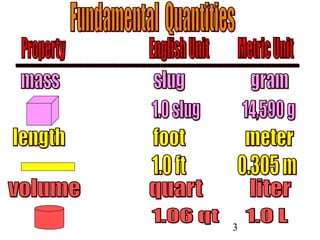
foot of length, liter of volume or gram of mass.
•Unusual standards may be used in obtaining
measurements but this is rarely done since few people
would be familiar with the standard used. For example,
someone measuring a distance can pace off that
distance but since the length of one’s step is variable
and this would give a very unreliable measure.
•We generally work with two systems of measurement,
English and metric. The metric system is used more
frequently in science although the English system can
be used.
3
4
Measurement
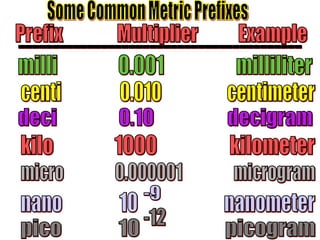
•Basic metric units are systematically subdivided
using a series of prefixes. Each prefix multiplies the
basic unit by a specific value. For example the prefix
“centi” multiplies by 0.01 (one hundredth – 100 cents
in a dollar), “deci” multiplies by 0.10 (one tenth - 10
dimes in a dollar) and so on.
•The prefix or multiplier may be applied to any basic
measurement, grams, liters or meters and others yet to
be discussed. The prefix may subdivide the unit or
enlarge it. For example, “milli” divides the unit into a
1000 parts (0.001 or one thousandth) while “kilo”
multiplies the unit by 1000 (a thousand times).
5
6
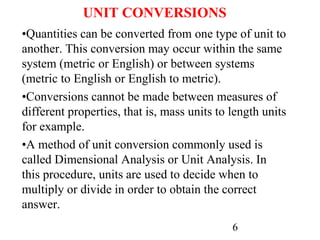
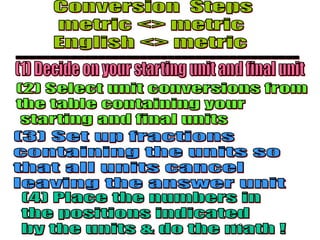
UNIT CONVERSIONS
•Quantities can be converted from one type of unit to
another. This conversion may occur within the same
system (metric or English) or between systems
(metric to English or English to metric).
•Conversions cannot be made between measures of
different properties, that is, mass units to length units
for example.
•A method of unit conversion commonly used is
called Dimensional Analysis or Unit Analysis. In
this procedure, units are used to decide when to
multiply or divide in order to obtain the correct
answer.
7
8
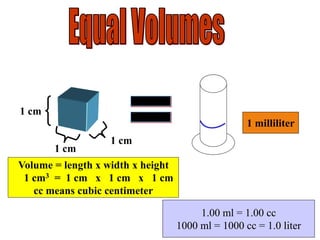
1 cm
1 cm
1 cm
Volume = length x width x height
1 cm3 = 1 cm x 1 cm x 1 cm
cc means cubic centimeter
1 milliliter
1.00 ml = 1.00 cc
1000 ml = 1000 cc = 1.0 liter
9
Unit Analysis
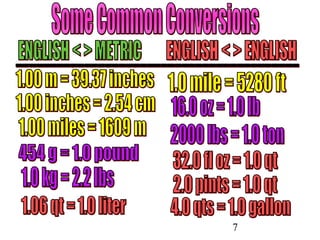
•Let’s apply Unit Analysis to a sample problem. In
order to use this method we must have available a list
of conversion factors from English to metric and vice
versa. Some have been provided on the previous
slides.
•To begin we will examine a metric to metric
conversion problem.
10
11
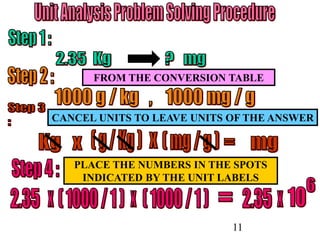
FROM THE CONVERSION TABLE
PLACE THE NUMBERS IN THE SPOTS
INDICATED BY THE UNIT LABELS
CANCEL UNITS TO LEAVE UNITS OF THE ANSWER
12
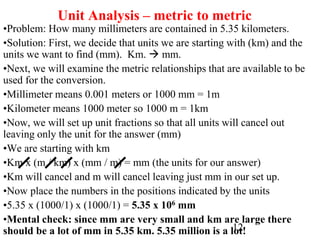
Unit Analysis – metric to metric
•Problem: How many millimeters are contained in 5.35 kilometers.
•Solution: First, we decide that units we are starting with (km) and the
units we want to find (mm). Km.  mm.
•Next, we will examine the metric relationships that are available to be
used for the conversion.
•Millimeter means 0.001 meters or 1000 mm = 1m
•Kilometer means 1000 meter so 1000 m = 1km
•Now, we will set up unit fractions so that all units will cancel out
leaving only the unit for the answer (mm)
•We are starting with km
•Km x (m / km) x (mm / m) = mm (the units for our answer)
•Km will cancel and m will cancel leaving just mm in our set up.
•Now place the numbers in the positions indicated by the units
•5.35 x (1000/1) x (1000/1) = 5.35 x 106 mm
•Mental check: since mm are very small and km are large there
should be a lot of mm in 5.35 km. 5.35 million is a lot!
13
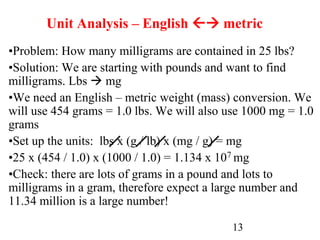
Unit Analysis – English  metric
•Problem: How many milligrams are contained in 25 lbs?
•Solution: We are starting with pounds and want to find
milligrams. Lbs  mg
•We need an English – metric weight (mass) conversion. We
will use 454 grams = 1.0 lbs. We will also use 1000 mg = 1.0
grams
•Set up the units: lbs x (g / lb) x (mg / g) = mg
•25 x (454 / 1.0) x (1000 / 1.0) = 1.134 x 10⁷ mg
•Check: there are lots of grams in a pound and lots to
milligrams in a gram, therefore expect a large number and
11.34 million is a large number!
14
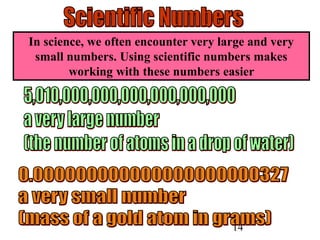
In science, we often encounter very large and very
small numbers. Using scientific numbers makes
working with these numbers easier
15
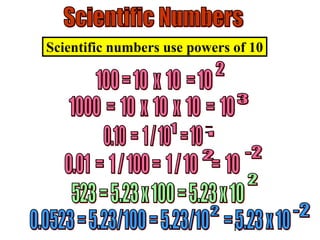
Scientific numbers use powers of 10
16
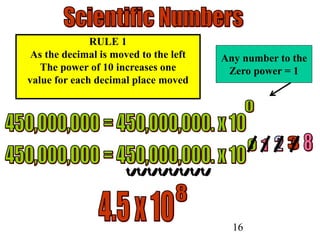
RULE 1
As the decimal is moved to the left
The power of 10 increases one
value for each decimal place moved
Any number to the
Zero power = 1
17
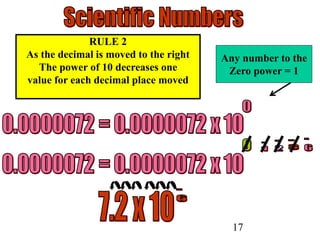
RULE 2
As the decimal is moved to the right
The power of 10 decreases one
value for each decimal place moved
Any number to the
Zero power = 1
18
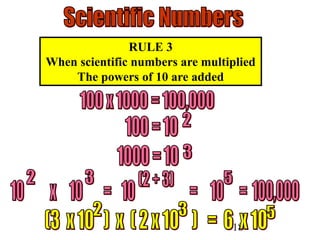
RULE 3
When scientific numbers are multiplied
The powers of 10 are added
19
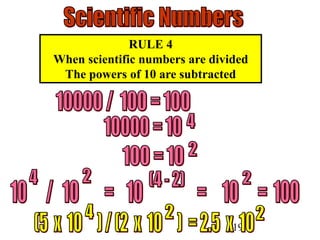
RULE 4
When scientific numbers are divided
The powers of 10 are subtracted
20
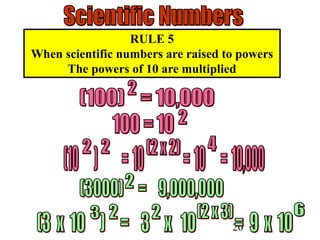
RULE 5
When scientific numbers are raised to powers
The powers of 10 are multiplied
21
Click Here

Measurement

  • 1.
  • 2.
    2 Measurement •All measurement iscomparison to a standard. Most often that standard is an excepted standard such as a foot of length, liter of volume or gram of mass. •Unusual standards may be used in obtaining measurements but this is rarely done since few people would be familiar with the standard used. For example, someone measuring a distance can pace off that distance but since the length of one’s step is variable and this would give a very unreliable measure. •We generally work with two systems of measurement, English and metric. The metric system is used more frequently in science although the English system can be used.
  • 3.
  • 4.
    4 Measurement •Basic metric unitsare systematically subdivided using a series of prefixes. Each prefix multiplies the basic unit by a specific value. For example the prefix “centi” multiplies by 0.01 (one hundredth – 100 cents in a dollar), “deci” multiplies by 0.10 (one tenth - 10 dimes in a dollar) and so on. •The prefix or multiplier may be applied to any basic measurement, grams, liters or meters and others yet to be discussed. The prefix may subdivide the unit or enlarge it. For example, “milli” divides the unit into a 1000 parts (0.001 or one thousandth) while “kilo” multiplies the unit by 1000 (a thousand times).
  • 5.
  • 6.
    6 UNIT CONVERSIONS •Quantities canbe converted from one type of unit to another. This conversion may occur within the same system (metric or English) or between systems (metric to English or English to metric). •Conversions cannot be made between measures of different properties, that is, mass units to length units for example. •A method of unit conversion commonly used is called Dimensional Analysis or Unit Analysis. In this procedure, units are used to decide when to multiply or divide in order to obtain the correct answer.
  • 7.
  • 8.
    8 1 cm 1 cm 1cm Volume = length x width x height 1 cm3 = 1 cm x 1 cm x 1 cm cc means cubic centimeter 1 milliliter 1.00 ml = 1.00 cc 1000 ml = 1000 cc = 1.0 liter
  • 9.
    9 Unit Analysis •Let’s applyUnit Analysis to a sample problem. In order to use this method we must have available a list of conversion factors from English to metric and vice versa. Some have been provided on the previous slides. •To begin we will examine a metric to metric conversion problem.
  • 10.
  • 11.
    11 FROM THE CONVERSIONTABLE PLACE THE NUMBERS IN THE SPOTS INDICATED BY THE UNIT LABELS CANCEL UNITS TO LEAVE UNITS OF THE ANSWER
  • 12.
    12 Unit Analysis –metric to metric •Problem: How many millimeters are contained in 5.35 kilometers. •Solution: First, we decide that units we are starting with (km) and the units we want to find (mm). Km.  mm. •Next, we will examine the metric relationships that are available to be used for the conversion. •Millimeter means 0.001 meters or 1000 mm = 1m •Kilometer means 1000 meter so 1000 m = 1km •Now, we will set up unit fractions so that all units will cancel out leaving only the unit for the answer (mm) •We are starting with km •Km x (m / km) x (mm / m) = mm (the units for our answer) •Km will cancel and m will cancel leaving just mm in our set up. •Now place the numbers in the positions indicated by the units •5.35 x (1000/1) x (1000/1) = 5.35 x 106 mm •Mental check: since mm are very small and km are large there should be a lot of mm in 5.35 km. 5.35 million is a lot!
  • 13.
    13 Unit Analysis –English  metric •Problem: How many milligrams are contained in 25 lbs? •Solution: We are starting with pounds and want to find milligrams. Lbs  mg •We need an English – metric weight (mass) conversion. We will use 454 grams = 1.0 lbs. We will also use 1000 mg = 1.0 grams •Set up the units: lbs x (g / lb) x (mg / g) = mg •25 x (454 / 1.0) x (1000 / 1.0) = 1.134 x 10⁷ mg •Check: there are lots of grams in a pound and lots to milligrams in a gram, therefore expect a large number and 11.34 million is a large number!
  • 14.
    14 In science, weoften encounter very large and very small numbers. Using scientific numbers makes working with these numbers easier
  • 15.
  • 16.
    16 RULE 1 As thedecimal is moved to the left The power of 10 increases one value for each decimal place moved Any number to the Zero power = 1
  • 17.
    17 RULE 2 As thedecimal is moved to the right The power of 10 decreases one value for each decimal place moved Any number to the Zero power = 1
  • 18.
    18 RULE 3 When scientificnumbers are multiplied The powers of 10 are added
  • 19.
    19 RULE 4 When scientificnumbers are divided The powers of 10 are subtracted
  • 20.
    20 RULE 5 When scientificnumbers are raised to powers The powers of 10 are multiplied
  • 21.