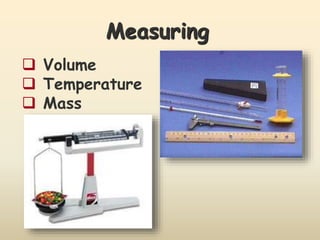
Measuring
 Volume
 Temperature
 Mass
Reading the Meniscus
Always read volume from
the bottom of the
meniscus. The meniscus
is the curved surface of
a liquid in a narrow
cylindrical container.
Try to avoid parallax errors.
Parallax errors arise when a meniscus or needle is
viewed from an angle rather than from straight-on
at eye level.
Correct: Viewing the
meniscus
at eye level
Incorrect: viewing the
meniscus
from an angle
Graduated Cylinders
The glass cylinder
has etched marks to
indicate volumes, a
pouring lip, and quite
often, a plastic
bumper to prevent
breakage.
Measuring Volume
 Determine the volume contained in a
graduated cylinder by reading the bottom
of the meniscus at eye level.
 Read the volume using all certain digits
and one uncertain digit.
 Certain digits are determined
from the calibration marks on
the cylinder.
The uncertain digit (the last digit
of the reading) is estimated.
Use the graduations to find all certain
digits
There are two
unlabeled graduations
below the meniscus,
and each graduation
represents 1 mL, so
the certain digits of
the reading are…
52 mL.
Estimate the uncertain digit and take
a reading
The meniscus is
about eight tenths
of the way to the
next graduation, so
the final digit in
the reading is
.
The volume in the graduated cylinder is
0.8 mL
52.8 mL.
10 mL Graduate
What is the volume of liquid in the graduate?
_ . _ _ mL6 26
25mL graduated cylinder
What is the volume of liquid in the graduate?
_ _ . _ mL1 1 5
100mL graduated cylinder
What is the volume of liquid in the graduate?
_ _ . _ mL5 2 7
Self Test
Examine the meniscus below and determine
the volume of liquid contained in the
graduated cylinder.
The cylinder contains:
_ _ . _ mL7 6 0
The Thermometer
o Determine the
temperature by reading
the scale on the
thermometer at eye
level.
o Read the temperature
by using all certain
digits and one uncertain
digit.
o Certain digits are determined from the calibration
marks on the thermometer.
o The uncertain digit (the last digit of the reading) is
estimated.
o On most thermometers encountered in a general
chemistry lab, the tenths place is the uncertain digit.
Do not allow the tip to touch the
walls or the bottom of the flask.
If the thermometer bulb
touches the flask, the
temperature of the glass
will be measured instead
of the temperature of
the solution. Readings
may be incorrect,
particularly if the flask
is on a hotplate or in an
ice bath.
Reading the Thermometer
Determine the readings as shown below on
Celsius thermometers:
_ _ . _ C _ _ . _ C8 7 4 3 5 0
Measuring Mass - The Beam Balance
Our balances have 4 beams – the uncertain digit is
the thousandths place ( _ _ _ . _ _ X)
Balance Rules
In order to protect the balances and ensure accurate
results, a number of rules should be followed:
 Always check that the balance is level and
zeroed before using it.
 Never weigh directly on the balance pan.
Always use a piece of weighing paper to protect
it.
 Do not weigh hot or cold objects.
 Clean up any spills around the balance
immediately.
Mass and Significant Figures
o Determine the mass by reading the riders
on the beams at eye level.
o Read the mass by using all certain digits
and one uncertain digit.
oThe uncertain digit (the last
digit of the reading) is
estimated.
o On our balances, the
thousandths place is
uncertain.
Determining Mass
1. Place object
on pan
2. Move riders
along beam,
starting with
the largest,
until the
pointer is at
the zero mark
Check to see that the balance
scale is at zero
Read Mass
_ _ _ . _ _ _1 1 4 ? ? ?
Read Mass More Closely
_ _ _ . _ _ _1 1 4 4 9 7

Measuring, physics for 9th grade 2014

  • 1.
  • 2.
    Reading the Meniscus Alwaysread volume from the bottom of the meniscus. The meniscus is the curved surface of a liquid in a narrow cylindrical container.
  • 3.
    Try to avoidparallax errors. Parallax errors arise when a meniscus or needle is viewed from an angle rather than from straight-on at eye level. Correct: Viewing the meniscus at eye level Incorrect: viewing the meniscus from an angle
  • 4.
    Graduated Cylinders The glasscylinder has etched marks to indicate volumes, a pouring lip, and quite often, a plastic bumper to prevent breakage.
  • 5.
    Measuring Volume  Determinethe volume contained in a graduated cylinder by reading the bottom of the meniscus at eye level.  Read the volume using all certain digits and one uncertain digit.  Certain digits are determined from the calibration marks on the cylinder. The uncertain digit (the last digit of the reading) is estimated.
  • 6.
    Use the graduationsto find all certain digits There are two unlabeled graduations below the meniscus, and each graduation represents 1 mL, so the certain digits of the reading are… 52 mL.
  • 7.
    Estimate the uncertaindigit and take a reading The meniscus is about eight tenths of the way to the next graduation, so the final digit in the reading is . The volume in the graduated cylinder is 0.8 mL 52.8 mL.
  • 8.
    10 mL Graduate Whatis the volume of liquid in the graduate? _ . _ _ mL6 26
  • 9.
    25mL graduated cylinder Whatis the volume of liquid in the graduate? _ _ . _ mL1 1 5
  • 10.
    100mL graduated cylinder Whatis the volume of liquid in the graduate? _ _ . _ mL5 2 7
  • 11.
    Self Test Examine themeniscus below and determine the volume of liquid contained in the graduated cylinder. The cylinder contains: _ _ . _ mL7 6 0
  • 12.
    The Thermometer o Determinethe temperature by reading the scale on the thermometer at eye level. o Read the temperature by using all certain digits and one uncertain digit. o Certain digits are determined from the calibration marks on the thermometer. o The uncertain digit (the last digit of the reading) is estimated. o On most thermometers encountered in a general chemistry lab, the tenths place is the uncertain digit.
  • 13.
    Do not allowthe tip to touch the walls or the bottom of the flask. If the thermometer bulb touches the flask, the temperature of the glass will be measured instead of the temperature of the solution. Readings may be incorrect, particularly if the flask is on a hotplate or in an ice bath.
  • 14.
    Reading the Thermometer Determinethe readings as shown below on Celsius thermometers: _ _ . _ C _ _ . _ C8 7 4 3 5 0
  • 15.
    Measuring Mass -The Beam Balance Our balances have 4 beams – the uncertain digit is the thousandths place ( _ _ _ . _ _ X)
  • 16.
    Balance Rules In orderto protect the balances and ensure accurate results, a number of rules should be followed:  Always check that the balance is level and zeroed before using it.  Never weigh directly on the balance pan. Always use a piece of weighing paper to protect it.  Do not weigh hot or cold objects.  Clean up any spills around the balance immediately.
  • 17.
    Mass and SignificantFigures o Determine the mass by reading the riders on the beams at eye level. o Read the mass by using all certain digits and one uncertain digit. oThe uncertain digit (the last digit of the reading) is estimated. o On our balances, the thousandths place is uncertain.
  • 18.
    Determining Mass 1. Placeobject on pan 2. Move riders along beam, starting with the largest, until the pointer is at the zero mark
  • 19.
    Check to seethat the balance scale is at zero
  • 20.
    Read Mass _ __ . _ _ _1 1 4 ? ? ?
  • 21.
    Read Mass MoreClosely _ _ _ . _ _ _1 1 4 4 9 7